Category Archives: Photography

The Altar of Zeus in the Pergamum Museum

The Pergamum Museum in Berlin gets its name from the reconstructed altar of Zeus from Pergamum (Bergama) in western Turkey. I noted earlier that this fabulous reconstruction is now closed for refurbishing. When we visited the Museum in mid-August, 2014, some scaffolding was already in place.

The Pergamum Altar in the Pergamum Museum. Photo by Ferrell Jenkins.

The Pergamum Altar in the Pergamum Museum. Photo by Ferrell Jenkins.

The altar of Zeus was built by Eumenes II (197–159 B.C.) to commemorate the victory of Attalus I over the invading Gauls. This is the most important and largest building from the Hellenistic age. The unique discovery of the Altar is told by Dr. Henry Koch:
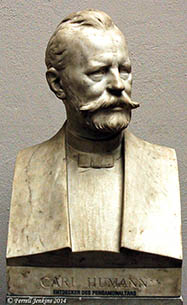
Carl Humaan

Carl Humaan

“A German engineer named Carl Humann had been authorized to build a road from Pergamon to the Aegean Sea. While he was supervising the work he noticed that marble statues and torsos were being carted from the ruins of the city and brought to the limekiln to be burnt into lime. It is to be feared that many a valuable statue was thus reduced to limestone. One day Humann also observed, how a peasant was hauling a marble slab adorned with statues and figures to the limekiln. He halted the peasant, asked him, how much he wanted for the slab, paid the price and immediately had the slab sent to the curators of the Berlin Museum in Germany. He offered the peasant more money, if he could procure additional slabs for him. The peasant gladly consented. For him it was lucrative business; for the curators it was a precious find.

Alexander Conze, a curator in Berlin, discerned the great value of the find. He recalled having read that a Roman writer named Ampelius living in the second century after Christ had written a Book of Wonders (Liber Memorialis). Among the wonders he also had mentioned the Altar of Zeus in Pergamum. This was a valuable clue for Conze. Humann was at once requested to obtain as many slabs a possible. Permission was also requested of the Turkish Government to have the slabs sent to Berlin and that excavations could be started at once. Permission was granted and the excavations were carried out from 1879-1885. Fortunately most of the ruins of the Temple had not as yet been found or touched. The curators in Berlin could piece them all together and thus the priceless Altar of Zeus could be assembled” (Koch, The Christian News, Nov. 22, 1976).

The Altar of Zeus was re-assembled in more than twenty years of museum work and is now housed in the special Pergamum Museum in Berlin. A trip to see this fabulous piece of architecture is recommended. The marble frieze depicts the mythological battle between gods and giants. The photo below shows a small portion of a scene.

A portion of the Zeus Altar marble frieze. Photo by Ferrell Jenkins.

A portion of the Zeus Altar marble frieze. Photo by Ferrell Jenkins.

Only the foundations of the altar can be seen at Pergamum. The Turkish government has requested the return of the Zeus Altar and has been putting pressure on Germany. See one report here.
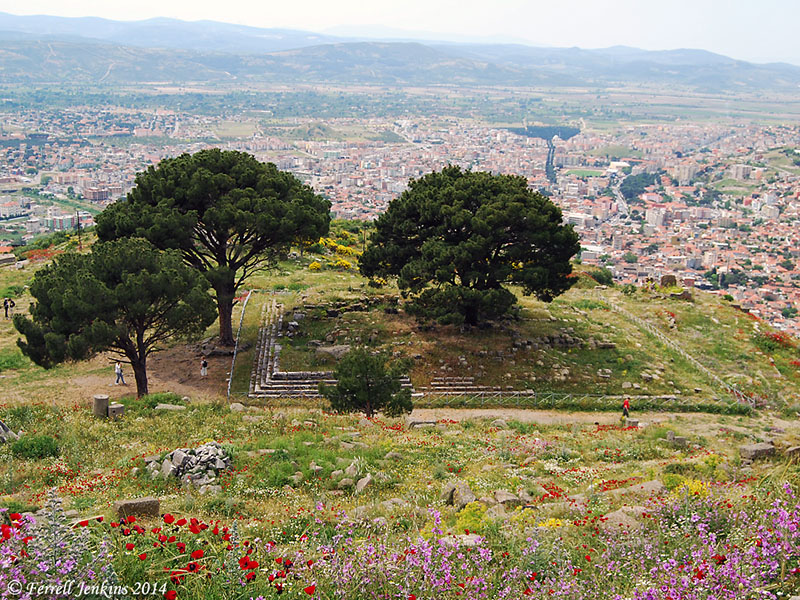
Site of the Zeus Altar at Pergamum. Photo by Ferrell Jenkins.

Site of the Zeus Altar at Pergamum. Photo by Ferrell Jenkins.

In the Lord’s letter to the church at Pergamum, He says,

I know where you dwell, where Satan’s throne is. Yet you hold fast my name, and you did not deny my faith even in the days of Antipas my faithful witness, who was killed among you, where Satan dwells. (Revelation 2:13 ESV)

Some scholars think the reference to Satan’s throne in this text is a reference to the Zeus altar at Pergamum, but there are other suggestions. Kistemaker summarizes some popular views suggested by Colin Hemer:

  • To a traveler coming from the east, the acropolis [of Pergamum] had the appearance of a throne.
  • The altar of Zeus Sōtēr seemed to be a throne.
  • Asclepius Sōtēr was identified with the serpent.
  • Pergamum was the center of emperor worship.

Or, it might be a combination of these elements.

You will probably need to wait two or more years before you can see the Zeus Altar in the Pergamum Museum.
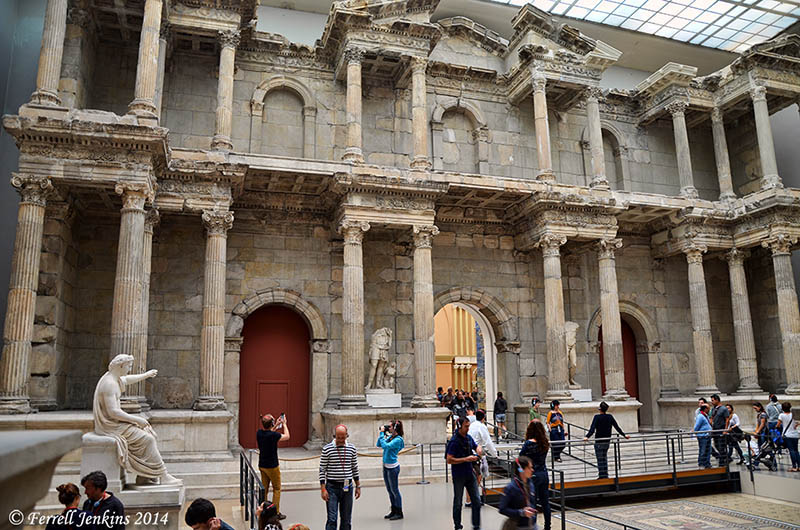
The Miletus Market Gate in the Pergamum Museum

The Pergamum Museum in Berlin is home to three outstanding architectural remains from the ancient world: the Zeus Altar from Pergamum, the Miletus Market Gate, and the Ishtar Gate from Babylon.

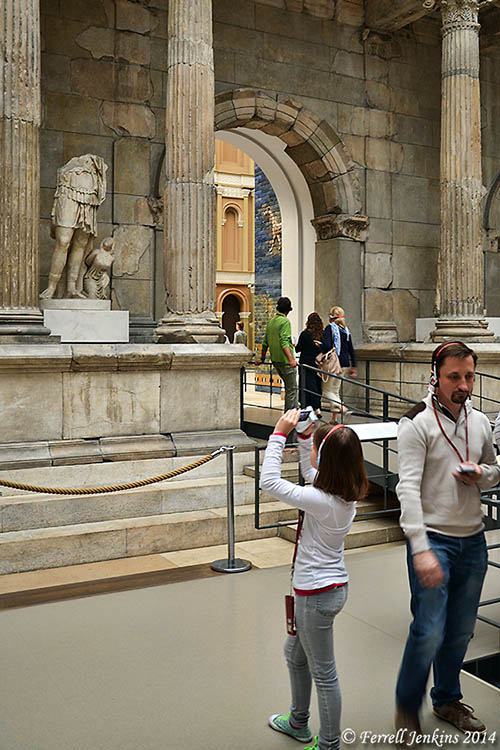
The Market Gate of Miletus, constructed about 120-130 A.D. during the reign of the Emperor Hadrian, has been reconstructed in the museum. Fant and Reddish say,

This two-story gateway is one of the finest examples of Roman façade architecture in existence” (Lost Treasures of the Bible, p. 349).

German archaeologists excavated the gate and sent it to Germany in the first decade of the 20th century. It was more than 20 years before a suitable room was available for the gate to be reconstructed.

Miletus was already a significant city with outstanding monuments when Paul stopped there on the return from his third journey, but this building would not be built for another 60 or 70 years.

The recently renovated Miletus Market Gate in the Pergamum Museum, Berlin. Photo by Ferrell Jenkins.

The recently renovated Miletus Market Gate in the Pergamum Museum, Berlin, Germany. Photo by Ferrell Jenkins.

A seated statue of the Emperor Trajan, seen on the left side of the above photo, comes from a different place. We know from the writings of Pliny that some Christians of Asia Minor were persecuted during the reign of Trajan. See here.

The Emperor Trajan (A.D. 98-117). Photo by Ferrell Jenkins.

The Emperor Trajan (A.D. 98-117). Photo by Ferrell Jenkins.

To illustrate the greatness of this museum, if we go through one exit from the room we see the Zeus Altar, but if we go through the gate we see the Ishtar Gate from Babylon. Notice the colored bricks of the Ishtar Gate in the photo below.

The Ishtar Gate can be seen through the Miletus Market Gate. Photo by Ferrell Jenkins.

The Ishtar Gate can be seen through the Miletus Market Gate. Photo by Ferrell Jenkins.

Miletus is mentioned only two places in the New Testament. The first is on Paul’s return from the third journey about A.D. 57 (Acts 20:15, 17). The other time is when Paul tells Timothy, in his last letter, that he had left Trophimus “sick at Miletus” (2 Timothy 4:20). This indicates that Paul may have stopped at Miletus on the voyage to Rome, but no activity is recorded.

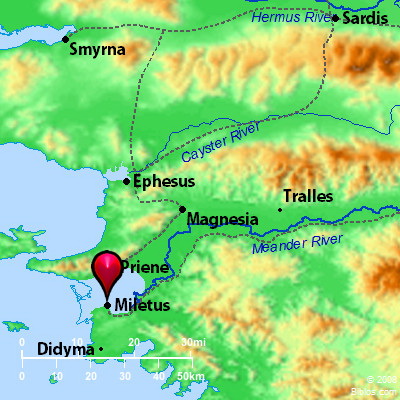
From Miletus, on the first visit, Paul sent for the elders of the church at Ephesus. In those days it would be a lengthy journey for a messenger to go from Miletus to Ephesus. The distance by land would have been about 63 miles. If the couriers went across the Gulf of Latmos (Latmus) the distance would be about 38 miles. The map below shows the location of Miletus on the south of the Gulf of Latmos. Over the centuries the harbor, fed by the Meander River, silted up. Today Miletus is landlocked about five miles away from the Aegean Sea.

Map showing Miletus and Ephesus. Map courtesy BibleAtlas.org.

Map showing Miletus and Ephesus. Map courtesy BibleAtlas.org.

Getting ready for the Cappadocian balloon flight

When you rise early to take a balloon flight you never know if the winds will permit flying (or floating). An extra layer of clothing is advised, and it is a good idea to get a sip of juice or coffee and a bit of something to eat before leaving the hotel for the takeoff point.

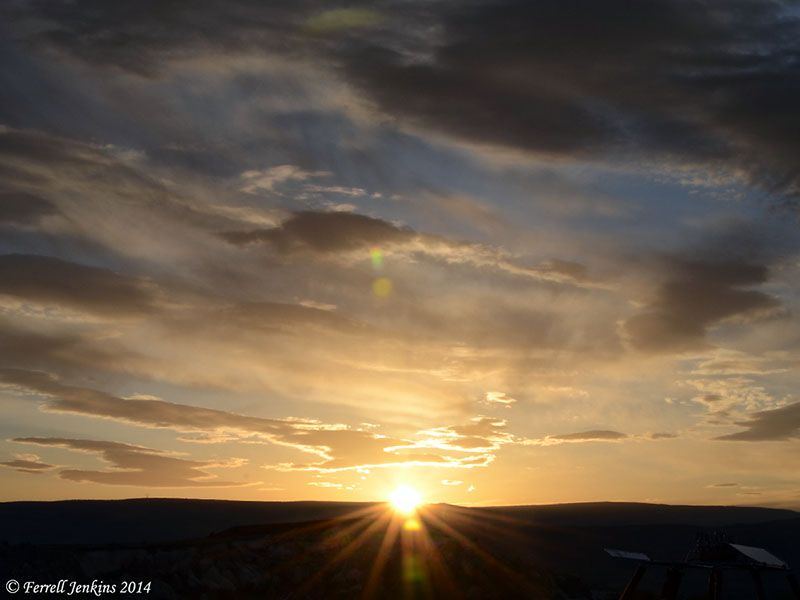
The sunrise was beautiful that morning back in May. Here is one of the shots I made as we waited for a favorable wind.

Cappadocian Sunrise May 10, 2014. Photo by Ferrell Jenkins.

Cappadocian Sunrise May 10, 2014. Photo by Ferrell Jenkins.

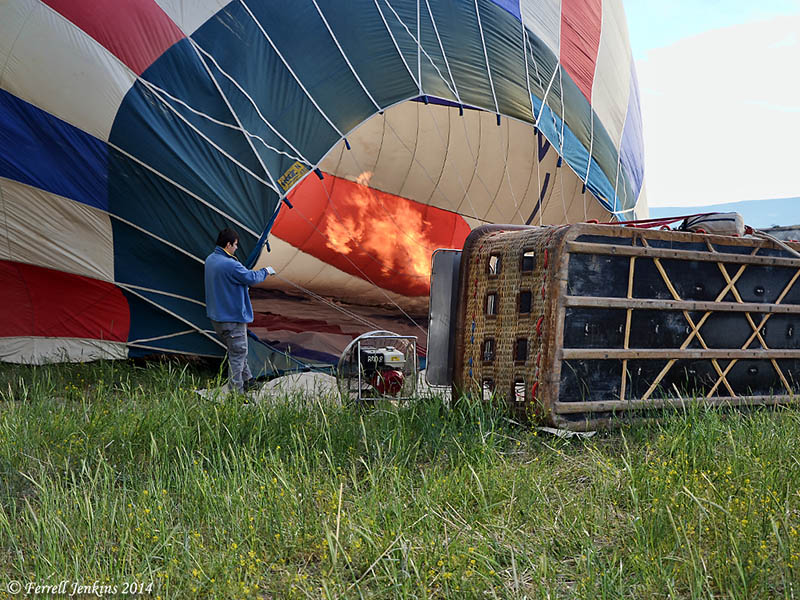
A group of retired balloon pilots monitor the weather and make the decision whether and when the balloons will be able to lift off. As we waited, I wondered if the weather would permit the flight. Finally the “all clear” signal came and the crews began to inflate the balloons for flight.

Inflating a Balloon for Flight. Photo by Ferrell Jenkins.

Inflating a Balloon for Flight. Photo by Ferrell Jenkins.

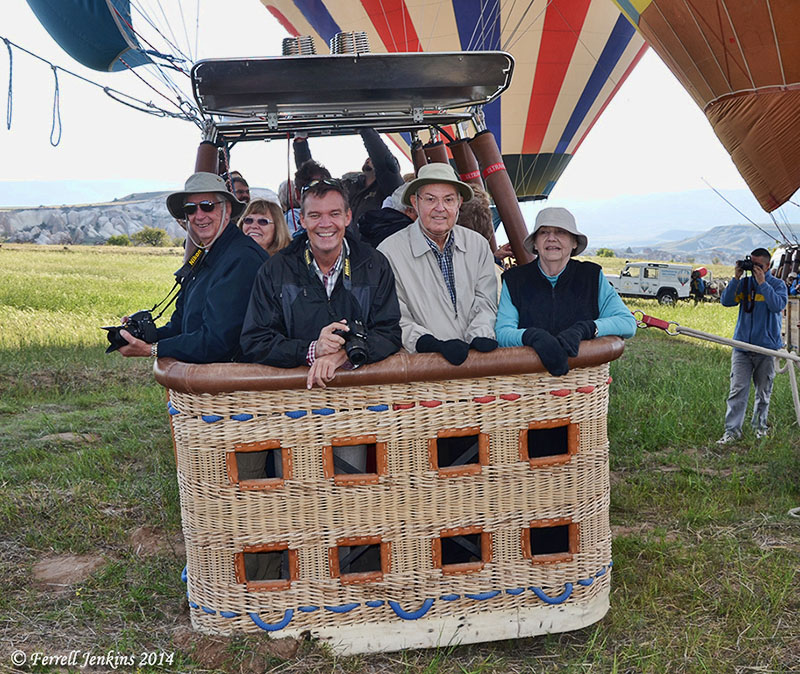
One of the crew offered to take our photo as the basket of about 20 persons began to lift off. If I look a little apprehensive it is not concern over the safety of the flight (we had made this flight on a previous tour), but because the crew member had my new camera. Elizabeth and I did not have any gloves so we wore socks to keep our hands warm.

Taking Off for a Balloon Flight Over Cappadocia.

Taking Off for a Balloon Flight Over Cappadocia.

After about an hour of floating over the lunar-like landscape, we approach a landing site (lower left corner of the photo). On the road you see some of the crews with trailers and buses as they make their way to pick up the passengers and to prepare the balloons for the flights the next morning.

Approaching the Landing Place. Photo by Ferrell Jenkins.

Approaching the Landing Place. Photo by Ferrell Jenkins.

Ballooning in Cappadocia

The photo below was made earlier this year over Cappadocia in Turkey.

Ballooning Over Cappadocia in Turkey. Photo by Ferrell Jenkins.

Ballooning Over Cappadocia in Turkey. Photo by Ferrell Jenkins.

The Bible tells us that Jews of Cappadocia were present in Jerusalem on the day of Pentecost (Acts 2:9). Peter wrote his epistles to saints scattered throughout Cappadocia and other places in Roman Asia Minor (modern Turkey).

Peter, an apostle of Jesus Christ, To those who are elect exiles of the dispersion in Pontus, Galatia, Cappadocia, Asia, and Bithynia,  2 according to the foreknowledge of God the Father, in the sanctification of the Spirit, for obedience to Jesus Christ and for sprinkling with his blood: May grace and peace be multiplied to you. (1 Peter 1:1-2)

Group claims world’s oldest pyramid “ruined” by restorers

According to a report in the International Business Times, activists in Egypt are angry with the Minister of Antiquities for re-hiring a company to restore the Step Pyramid of Zoser at Saqqara. The group says the firm “caused damage and major deterioration to the structure while trying to repair it.” The report may be read here.

Saqqara is significant because it is the location of the oldest freestanding stone building in the world. The architect of this structure was the vizier and physician Imhotep. Zoser reigned about 2600 B.C.

Hachette World Guide on Cairo, Alexandria and Environs, describes the pyramid in these terms:

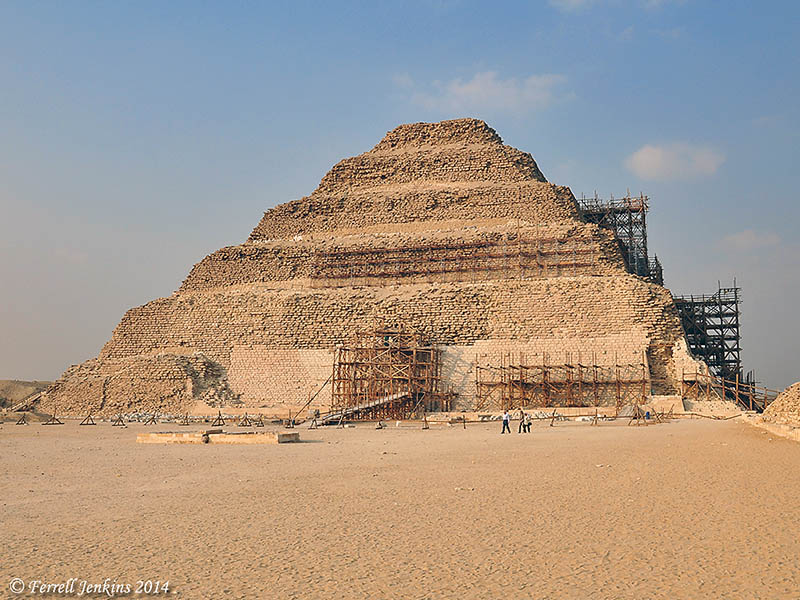
The Step Pyramid is formed of six unequal sections and is not, in the strict sense, a pyramid tat all. The plan is not square, but oblong in the S-W sense, and the summit is formed by a terrace (also oblong) and not by a Pyramidion. The dimensions of the base are approximately 397 feet by 357 feet. The present height of the Pyramid is 193 feet. It would originally have been some 196 feet. The verticle slope of the steps is on an average of some 16°, the horizontal [slope is] 22°.

On my last visit to Egypt in January, 2011, I noticed scaffolding on all sides of the step pyramid.

The Step Pyramid of Zoser at Saqqara. Photo by Ferrell Jenkins.

The Step Pyramid of Zoser at Saqqara. Photo by Ferrell Jenkins.

This pyramid, as well as the great pyramids of Giza, was built long before the time of the  biblical characters who visited Egypt — Abraham, Joseph, Jacob, et al.

HT: Jack Sasson

The Route of the Exodus and the Location of Mount Sinai

Over the past 48 years I have had the opportunity to visit almost all parts of the Bible World. I certainly have not solved all of the problems that are raised about locations of certain events, but I have tried to look at the major claims whether it is the location of Cana, the site for the baptism of Jesus, the place of the crucifixion and burial of Jesus, the location of Ararat, or the route of the exodus and the location of Mount Sinai, et al.

In this post I have pulled together a list of some things I have written about the route of the Exodus and the location of Mount Sinai. I hope you will find the posts helpful when you study this subject.

  • Pharaoh’s chariot wheels and other things that won’t float – Examining the claims of the late Ron Wyatt here.
  • Location of the Red Sea crossing and Mount Sinai here.
  • Location of Mount Sinai here.
  • Solomon’s Seaport at Ezion-geber here.
  • Sharks at Sharm el-Sheikh in the Sinai here. Sharm el-Sheikh is at the Straits of Tiran.
  • “Cracked Pot Archaeology” here.
  • Pseudo Archaeologists here.
  • Goshen and the Great Bitter Lake here.
  • Another day in Goshen here.

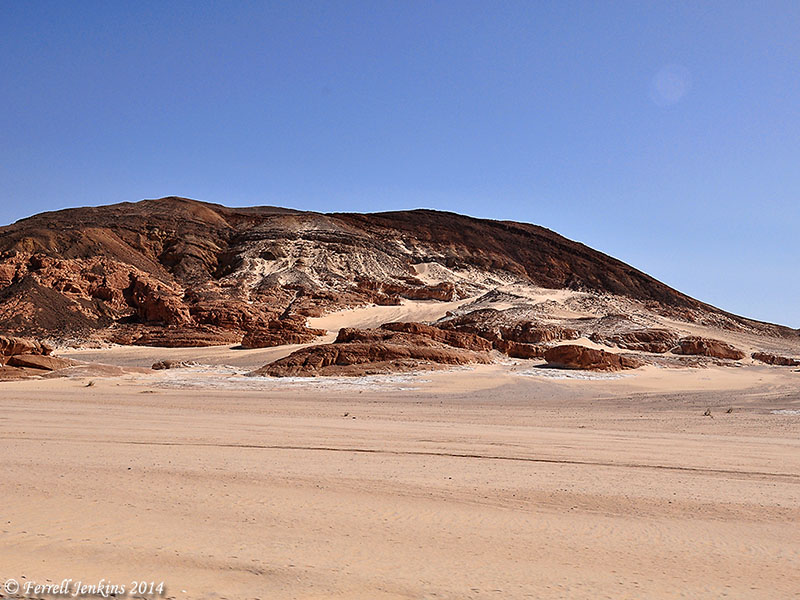
Below are a couple of photos that show the changing scenery that one sees in the Sinai Peninsula.

Sinai Peninsula near the Gulf of Eilat or Aqaba. Photo by Ferrell Jenkins.

Sinai Peninsula near the Gulf of Eilat or Aqaba. Photo by Ferrell Jenkins.

Read some scholarly presentations on the subject. Such as these recent Bible atlases.

  • Beitzel, Barry J. The New Moody Atlas of the Bible, 106-114.
  • Currid, John D. and David P. Barrett. Crossway ESV Bible Atlas, 77-91.
  • Rasmussen, Carl G. Zondervan Atlas of the Bible, 100-105.
Wadi Feiran in the Sinai Peninsula. Photo by Ferrell Jenkins.

Wadi Feiran in the Sinai Peninsula. Photo by Ferrell Jenkins.

Or books such as…

  • Hoffmeier, James K. Israel in Egypt: The Evidence for the Authenticity of the Exodus Tradition, chs. 8-9.

The Associates for Biblical Research includes several articles about the Exodus at their website here.

  • Is Mount Sinai in Saudi Arabia? here.
  • Mount Sinai is Not Jebel Al-Lawz in Saudi Arabia here.

I am hopeful you will browse through this material and remember to examine it more closely the next time you study Exodus.

London and the British Museum

We finally reached the third of the big three museums with Ancient Near Eastern collections that we had planned to visit. We spent large portions of two days in the museum. The museum is open every day of the week. Closing time is 5:30 p.m. every day except Friday when the time is 8:30 p.m. There is no required entry fee, but a request is made for a £5 (about $8.50) or more donation.

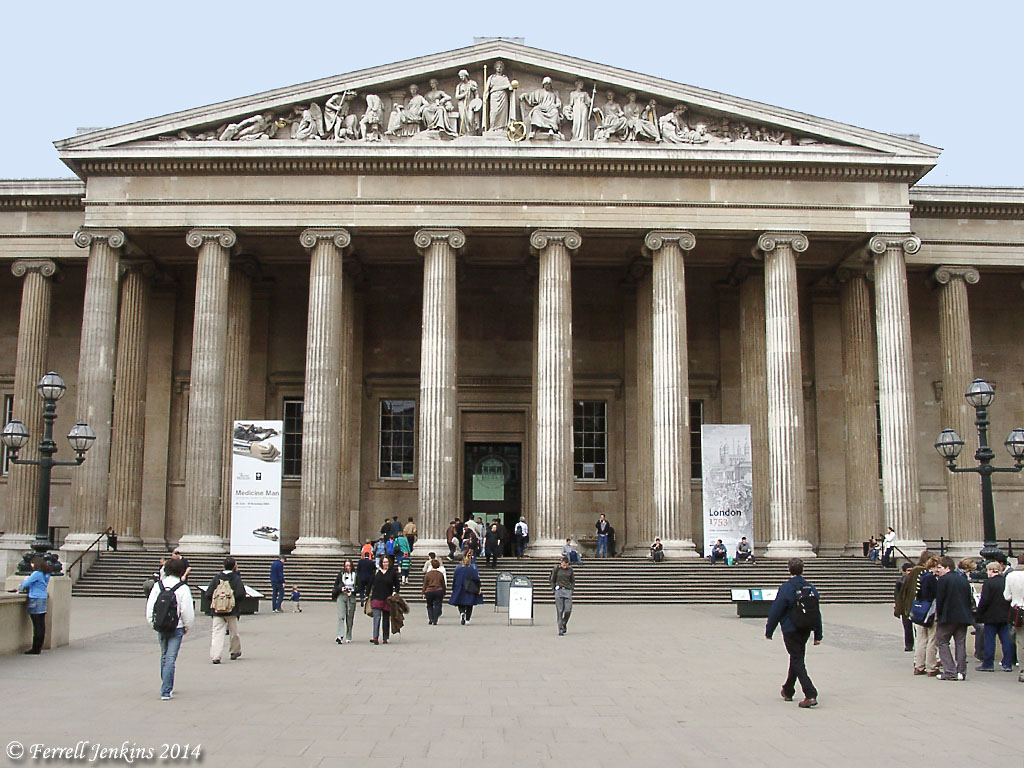
I have emphasized the crowds in the Pergamum Museum, and the Louvre. The same was true in the British Museum. The photo below was made a few years ago at the end of September. Once school is in session one should be able to find times without hugh crowds. Many galleries have natural light that comes in. Some photos are better with the natural light and others are better with the artificial light, depending on the glare on the case.

British Museum entrance on Great Russel Street, London. Photo by Ferrell Jenkins.

British Museum entrance on Great Russell Street, London. Photo by Ferrell Jenkins.

The British Museum was founded in 1753 to house the collection of Sir Hans Sloane which had been left to the nation. It is now among the greatest museums of the world.

Each of the big three museums has a specialty depending on the areas where the country has done archaeological work. The Pergamum museum is loaded with material from Mesopotamia and Turkey. The Louvre has a fabulous collection from the Levant, especially Syria, and Iran (Persia). The British Museum is big on the Levant, Egypt and Mesopotamia. All three have nice Roman and Greek galleries.

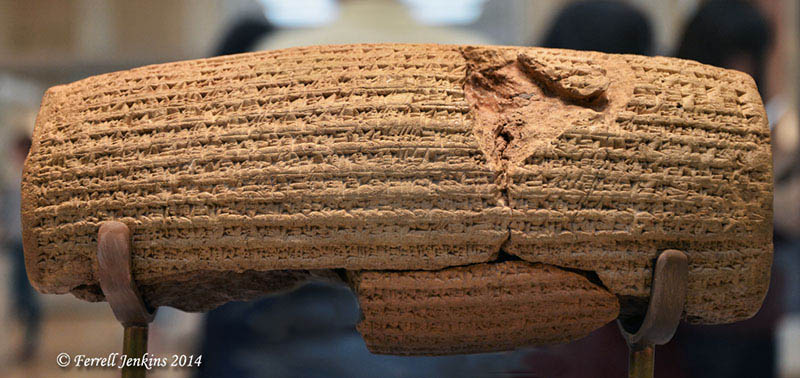
I knew that the Cyrus Cylinder had been part of a traveling exhibit for a few years. When we got near the Ancient Iran Room I told my wife that I would make a quick run to see what was there. I was delighted to see the Cyrus Cylinder prominently displayed.

Cyrus Cylinder in the British Museum. Photo by Ferrell Jenkins.

Cyrus Cylinder in the British Museum. Photo by Ferrell Jenkins.

The Cyrus Cylinder is important to Bible students because Cyrus is the Persian king who allowed the Judeans to return to Jerusalem and rebuild the temple.

Now in the first year of Cyrus king of Persia, that the word of the LORD by the mouth of Jeremiah might be fulfilled, the LORD stirred up the spirit of Cyrus king of Persia, so that he made a proclamation throughout all his kingdom and also put it in writing:  “Thus says Cyrus king of Persia, ‘The LORD, the God of heaven, has given me all the kingdoms of the earth, and he has charged me to build him a house at Jerusalem, which is in Judah. Whoever is among you of all his people, may the LORD his God be with him. Let him go up.’” (2 Chronicles 36:22-23 ESV; cf. Ezra 1:1-4).

Some artifacts that I had expected to see were not on display. Cases are changed and artifacts are moved around. Sometimes there will be a sign saying that the items is on loan, being photographed, or studied. In other instances there is no reference to the removed item. One significant item that I missed seeing in its usual place is the Babylonian Chronicle that gives the date of the Babylonian capture of Jerusalem in 597 B.C. Another missing item was the Standard of Ur.

A BBC report says that the 80,000 artifacts displayed in the British Museum amount to only 1% of the artifacts held by the Museum. On several occasions I have made inquiry about an artifact and been given a time when someone would be available to show it to me.

The British Museum web site provides information about planning a visit, and it also includes an online collection with photos.

Paris and the Louvre

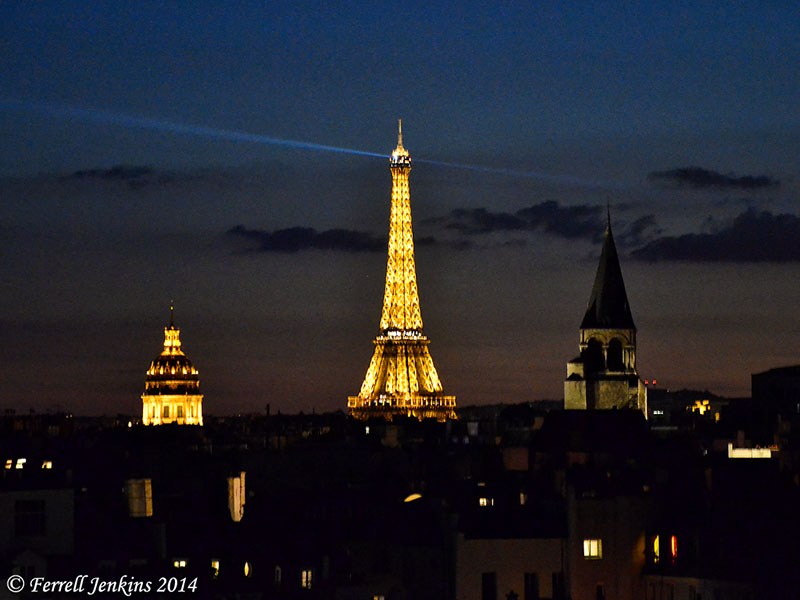
Paris is known as the City of Light. From the roof of our hotel in the St. Michel area we could see some of the significant monuments. This photo, made without tripod, shows the Eiffel Tower. I think the building to the left is the Hotel des Invalides which among other things is the burial site of Napoleon Bonaparte. The building to the right is St. Germain des Prés. In the opposite direction from the hotel we had a nice view of the Cathedral of Notre Dame.

Paris at Night. Photo by Ferrell Jenkins.

Paris at Night. Photo by Ferrell Jenkins.

We were able to spend two of our Paris days in the Louvre. This museum displays excellent collections of archaeological artifacts from Mesopotamia, Persia (Iran), the Levant (Syria, Jordan, some sites of the current West Bank), Greece, and Rome. There is an Egyptian collection, but I do not find it as satisfactory as the other collections.

The Louvre is always closed on Tuesday and certain rooms may be closed on other days, or a half day. Years ago I learned to have two or three days in Paris in order to be able to visit all of the galleries I wanted to see. Yes, we saw the Mona Lisa, too.

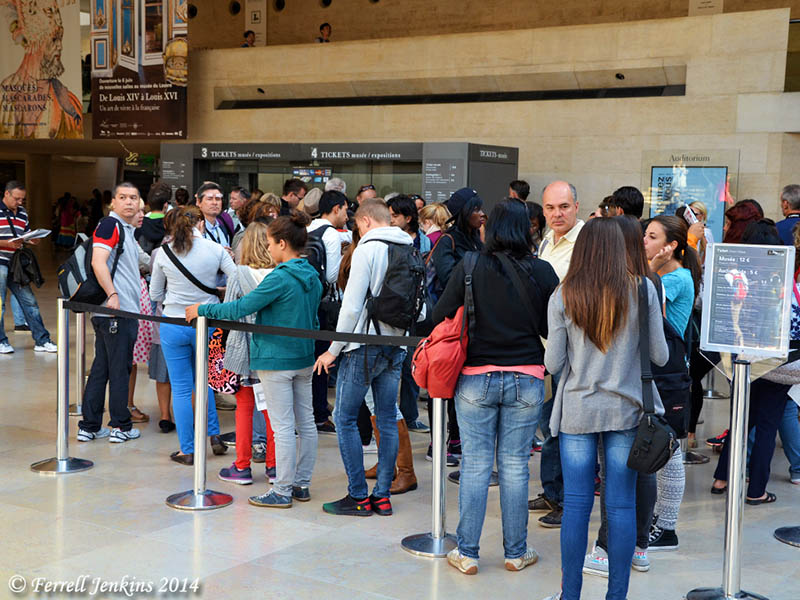
The lines to get tickets for the Louvre are long. The photo below shows two of the six or more places to buy tickets, in addition to automated machines, under the great pyramid. It is best to buy tickets online or from one of the shops such as the Tourism office near the Opera. Tickets are about $20.00 per person for each day of entry. Those with tickets are able to enter through a short line while long lines wait outside just to get into the building to wait in line to buy tickets. The Museum web site explains about advance tickets under “Plan Your Visit” here.

One of the ticket lines at the Louvre. Photo by Ferrell Jenkins.

One of the ticket lines inside the Louvre. Photo by Ferrell Jenkins.

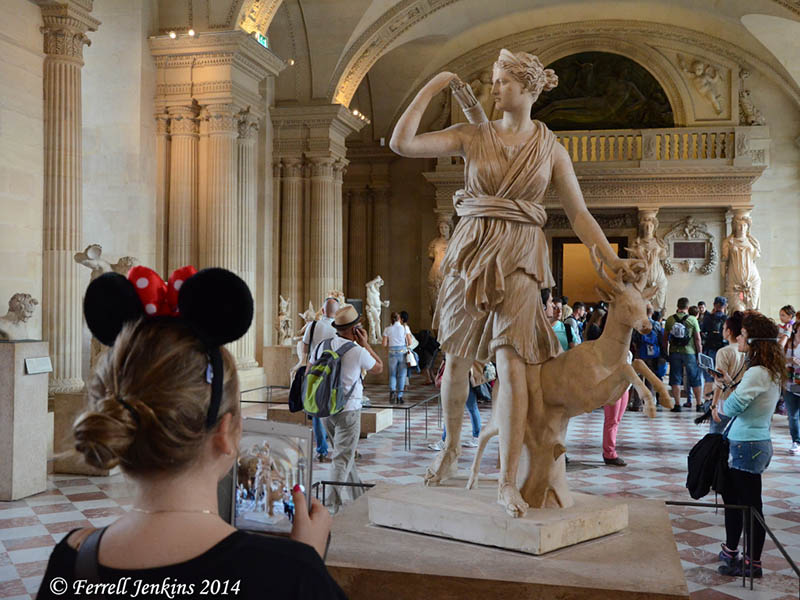
There were large crowds in the Louvre. Some galleries attract guides with tour groups. It’s fun to watch. The guide is nearly running with an umbrella or flag. The tourists are trying to keep up, but snapping their cameras or cell phones at busts they probably will not be able to identify once they are at home. I saw a young lady making a photo of the Roman Diana. I assume she had been at Disneyland Paris a day or two earlier. She did a nice job of composing her photo. When I saw her later and noted that she was a young teenager I was impressed that she wanted to visit the Louvre.

Euro Disney one day; the Louvre the next day. Photo by Ferrell Jenkins.

Euro Disney one day; the Louvre the next day. Photo by Ferrell Jenkins.

I have been to China, but I think most of the citizens have come to Berlin, Paris, and London to visit the museums.

Photography is permitted in the Louvre. I even made a few shots using flash when I thought it would not damage the artifact. None of the guards seemed to object. Items behind glass always create a problem for photographers. By visiting the museum two days I was able to check the first photos to be sure they were sharp. On the second day I was able to remake some of those that were not good.

Small awl may provide evidence of the earliest use of metal in Middle East

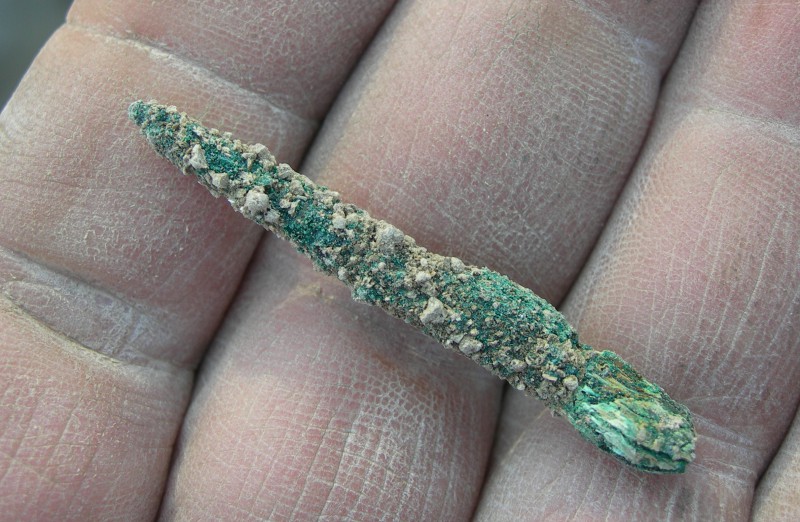
Copper awl.

The ancient awl. Estimated to be from the end of the sixth or the beginning of the fifth millennium BCE. Photo: Yosef Garfinkel.

The following report is a press notice released by Media Relations of Haifa University, Thursday, August 21, 2014.

An awl-inspiring find at Tel Tsaf: The oldest metal object found to date in the Middle East

According to Dr. Danny Rosenberg of the University of Haifa’s Zinman Institute of Archaeology, the copper awl is a unique and very rare artifact, whose discovery, along with other items during the excavations at Tel Tsaf in the Jordan Valley, indicates that the site was an ancient international commercial center.

A copper awl, the oldest metal object found to date in the Middle East, was discovered during the excavations at Tel Tsaf, according to a recent study published by researchers from the Zinman Institute of Archaeology and the Department of archaeology at the University of Haifa , in conjunction with researchers from the Hebrew University of Jerusalem and the German Archaeological Institute of Berlin. According to the study, which appeared in the prestigious journal PLOS One, the awl dates back to the late 6th millennium or the early 5th millennium BCE, moving back by several hundred years the date it was previously thought that the peoples of the region began to use metals.

Tel Tsaf, a Middle Chalcolithic village dated to about 5200-4600 BCE, is located near the Jordan River and the international border with Jordan. The site was first documented in the 1950s and excavations there began at the end of the 1970s. From the earliest digs nearly 40 years ago, this area, the most important archaeological site in the region dated to this period, has been supplying researchers with a great deal of valuable data, and continues to do so during this latest research project led by Dr. Danny Rosenberg of the University of Haifa in conjunction with Dr. Florian Klimscha of the Eurasia Department of the German Archaeological Institute in Berlin. For example, the researchers learned of the communites great wealth and the long-distance commercial ties it maintained from the large buildings made of mud-bricks and the large number of silos in which wheat and barley were stored on an unprecedented scale. There were many roasting ovens in the courtyards, all filled with burnt animal bones testifying to the holding of large events and many other findings, among them items made of obsidian (a volcanic glass with origins in Anatolia or Armenia), shells from the Nile River in Egypt and other areas around the Mediterranean, figurines of people and animals, and pottery unlike that found in almost any other location in the region.

But the most important finding to date is only 4 centimeters long. This unique item, a copper awl, which is 1 millimeter thick at the tip that was set in a wooden handle, was actually found during a previous excavation at the site by Prof. Yosef Garfinkel of the Hebrew University. The cone-shaped awl was found in a sealed grave of a woman about 40 years old that was dug inside a silo, and around her waist was a belt made of 1,668 ostrich-egg shell beads. The grave was covered with several large stones, and according to Dr. Rosenberg, its location within a silo testifies to both the importance of the deceased and the importance the community ascribed to the facility in which she was buried.

But while the grave, the woman’s skeleton, and the beaded belt were all previously reported in scientific journals, the little awl was only reported on recently, after its chemical components were analyzed by Prof. Sariel Shalev of the Department of Archaeology at the University of Haifa. As noted, the awl was found to made of copper, and according to Dr. Rosenberg, the fact that it was found just above the skeleton ad in a sealed grave, meant that it was buried with the woman, apparently as a burial offering, and may have belonged to her.

This artifact is important because until now, researchers believed that area residents began to use metals only in the Late Chalcolithic period (during the second half of the 5th millennium BCE, so that this finding moves back the appearance of metal in our region by several hundred years. This has significant impact on our understanding of the developing use of complex technologies and the related social contexts.

But this is not the only reason the awl is significant. The chemical examination of the metal shows it may have come from the Caucasus, some 1,000 kilometers from Tel Tsaf. According to Dr. Rosenberg, while the long-distance commercial ties maintained by village communities in our region were already known from even earlier periods, the import of a new technology combined with the processing of a new raw material coming from such a distant location is unique to Tel Tsaf and provides additional evidence of the importance of this site in the ancient world.

The researchers are still not sure what the awl was used for, but the early use of a metal object, as well as its distant source, also testify to the high social status of the woman and the importance of the building she was buried in.

The appearance of the item in a woman’s grave, which represents one of the most elaborate burials we’ve seen in our region from that era, testifies to both the importance of the awl and the importance of the woman, and its possible that we are seeing here the first indications of social hierarchy and complexity, said Dr. Rosenberg. However, in this area far more is unknown than is known, and although the discovery of the awl at Tel Tsaf constitutes evidence of a peak of technological development among the peoples of the region and is a discovery of global importance, there’s a lot of progress still to be made and many parts of the wider picture are still unknown to us”.

It seems that at least some of the questions raised by this unique item will be answered by an interdisciplinary research project we have been conducting at the site since last year, Dr. Rosenberg continued. This project integrates multi-national archaeologists and researchers from a variety of other scientific disciplines, who will address the even more complex questions that will undoubtedly arise.

HT: Joseph Lauer

Traveling in Europe

For the past week my wife and I have been traveling in Europe, revisiting some of the places we have enjoyed with groups over the years. Berlin is one of those places. We did some of the typical sightseeing, but the main visit was the museums with Ancient Near Eastern collections.

My first visit to the Pergamum Museum was about 1978. I returned several times when the Museum was behind the Berlin Wall, and have been there several times since the fall of the wall.

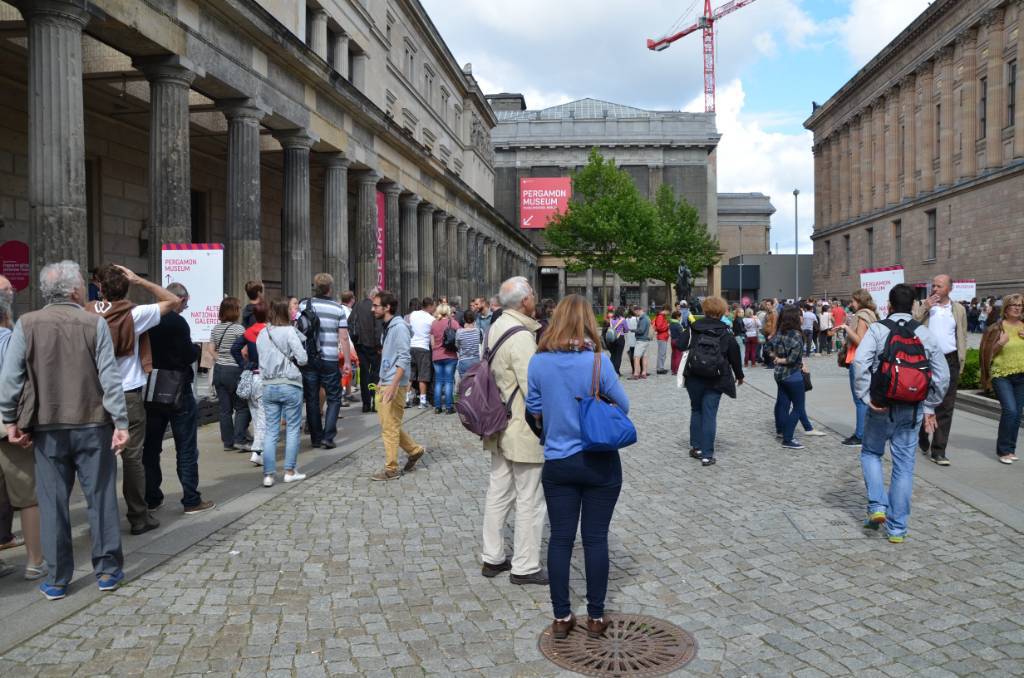
The Egyptian collection formerly was in the west, but now is housed in the Neues Museum in the building on the left of the photo below. Considerable construction is underway in the area. The former entry to the Pergamum Museum is closed. The red sign in the distance points to the temporary entry. Crowds are so large that people wait in line for four hours or more to buy at ticket and gain admission to the Museum. The only way to avoid this is to purchase a ticket online with a 30 minute time span for admission. I purchased a two day Museum pass after I arrived in Berlin and then made an appointment online for two different days. A single entry costs about 13 Euro (a little under $20 per entry).

berlin_pergamum-crowd-01fj_1

Crowds waiting in line to enter the Pergamum Museum. Photo by Ferrell Jenkins.
The Pergamum Altar already has some scaffolding in place. At the end of September the exhibition will close for __________ years (you know about government projects).

The visit was somewhat disappointing because of the appointment requirement, but mostly because portions of the Museum are closed. Whole galleries pertaining to the the Greco-Roman world are not open. The great Ishtar Gate from Babylon is open, and the Miletus Marketgate, which was covered with netting the last time I was in Berlin, is now one of the nicest exhibits. The halls dealing with Babylon, Assyria, and the Hittites were open.

Later I hope to share some representative photos with you, but I confess that I am traveling with a Samsung Tab 4 and have had difficulty getting the single photo above loaded into the blog. I refused to pay the $20+ a day to be online at the hotel. I only ate at one place that offered time online, and they could not locate the card with the passport. 😦

We are in Paris now and I have Wi-Fi at the hotel. The Louvre is closed on Tuesdays, so I went to the Tourism office and purchased tickets to the museum in order to avoid the long lines the next two days. The tickets here are under $20 per entry.

If any reader has experience in loading photos from an Android tablet into WordPress I would be glad to hear about it. Who knows, maybe I will be able to load a second photo.