Category Archives: Culture

Children in the Marketplaces

To those dissatisfied with both Jesus and John the Baptist, Jesus used a simple illustration that must have happened many times in each city of ancient Israel.

“But to what shall I compare this generation? It is like children sitting in the marketplaces and calling to their playmates, “‘We played the flute for you, and you did not dance; we sang a dirge, and you did not mourn.’ For John came neither eating nor drinking, and they say, ‘He has a demon.’ The Son of Man came eating and drinking, and they say, ‘Look at him! A glutton and a drunkard, a friend of tax collectors and sinners!’ Yet wisdom is justified by her deeds.” (Matthew 11:16-19 ESV; see also Luke 7:31-34) Some English versions use market places).

Keener, in The IVP Bible Background Commentary: New Testament, explains:

Spoiled children who pretend to have weddings and funerals (one later game was called “bury the grasshopper”) stand for Jesus’ and John’s dissatisfied opponents; dissatisfied with other children who will not play either game, they are sad no matter what. The term for “mourn” here is “beat the breast,” a standard mourning custom in Jewish Palestine. Custom mandated that bystanders join in any bridal or funeral processions.

This photograph made at Nazareth Village helps to illustrate the Biblical text.
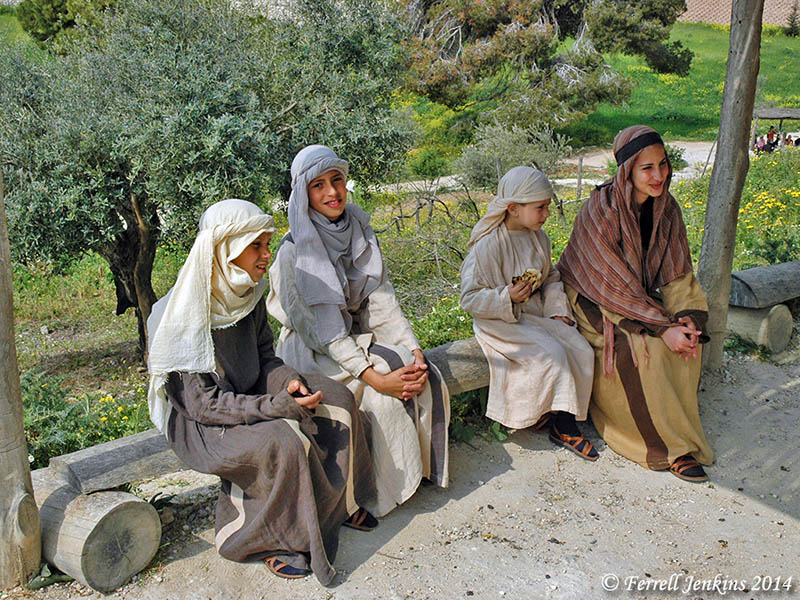
Children at Nazareth Village. Photo by Ferrell Jenkins.

Children at Nazareth Village. Photo by Ferrell Jenkins.

Hiking Abraham’s footsteps

The full title of this Haaretz article is “Hiking in Abraham’s footsteps, from Turkey to the Holy Land.” Sounds incredible at the moment. To hike this complete trail from Haran (Genesis 12:4) to Beersheba (Genesis 21:31) (not to mention the trip to Egypt) requires travel in Turkey, Syria, Jordan, Israel, and the Palestinian Authority (West Bank).

Among the leaders back of the concept is David Landis and his wife Anna Dintaman, developers of the Jesus Trail from Nazareth to the Sea of Galilee. Their book, Hiking the Jesus Trail and Other Biblical Walks in the Galilee, is worthwhile even for those who do not plan to walk the trail.
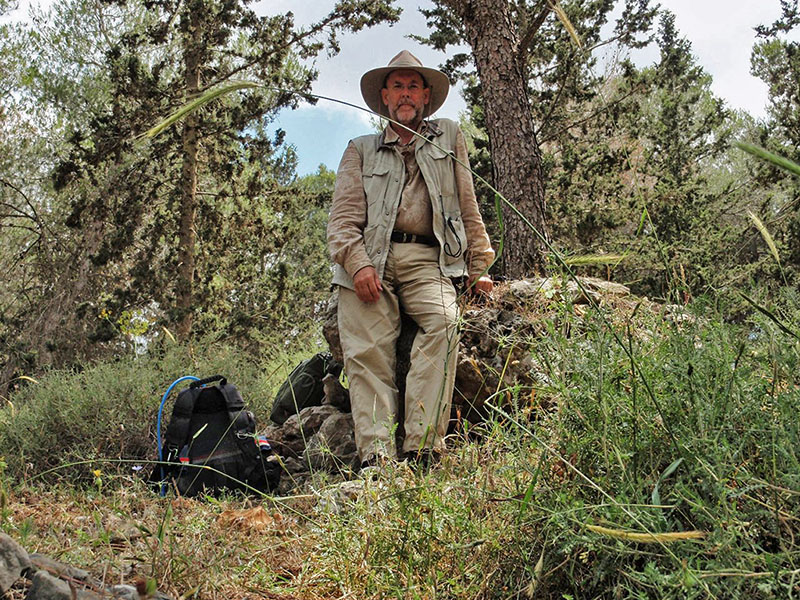
Larry Haverstock walked the Jesus Trail in 2011. I see that Larry’s posts about the experience is still available on his blog. See the 3rd Journey. You will find some fascinating stories along with beautiful photos you may never see from a bus or car.

Larry Haverstock in the Zippori Forest north of Nazareth.

Larry Haverstock in the Zippori Forest north of Nazareth.

The link to the Haaretz article may be accessed here. In order to read the full article you must register for free access to 10 articles a month.

Don’t expect to walk the Abraham Path from Haran (in Turkey) to Beersheva [Beersheba], but you might be able to walk small portions of the trail everywhere except the part going through Syria.

There are many hiking trails in Israel, but most of these avoid contact with the Palestinian Authority. The new plan seeks to involve the local people in the development of facilities useful to hikers.

If you like hiking, or if you appreciate the geography of the Bible lands you will probably enjoy the article. Abraham Path has a nice web site with maps and photos here.

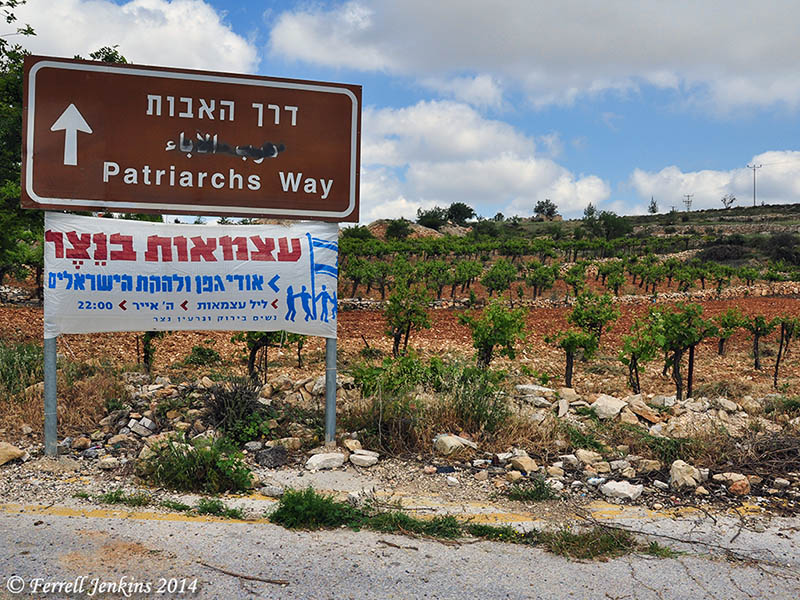
I don’t know what, if any, relationship there is between the Abraham  Path and the Patriarchs Way, a trail that is said to run from Beersheba to Nazareth. The defacing of the sign to eradicate the Arabic indicates one of the problems either trail might face. One often sees this sort of thing on signs pointing to Christian sites.

Sign pointing to Patriarchs Way off Hebron Road (Hwy. 60) south of Bethlehem . Photo by Ferrell Jenkins.

Sign pointing to Patriarchs Way off Hebron Road (Hwy. 60) south of Bethlehem . Photo by Ferrell Jenkins.

Walk the Land : A Journey on Foot through Israel, by Judith Galblum Pex, is a fascinating account of a couple who walked the Israel Trail from Eilat to Dan.
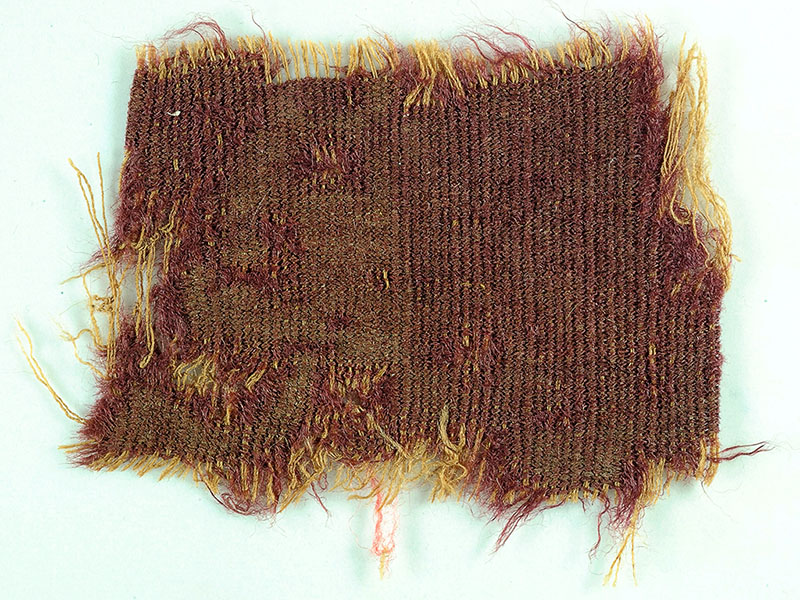
Purple fabric dyed from Murex found in Judean desert

The Israel Antiquities Authority announced last week the discovery of two pieces of fabrics found at Wadi Murabba’at on the western shore of the Dead Sea.

Thousands of fabrics dating to the Roman period have been discovered in the Judean Desert and regions of the Negev and the ‘Arava. So far only two were colored with dye extracted from the murex snail. Now, within the framework of a study conducted by Dr. Na‘ama Sukenik of the Israel Antiquities Authority, three other rare fabrics belonging to pieces of prestigious textiles were exposed that might have been used as clothing in the Roman period. …

These prestigious textiles, from the Wadi Murabba‘at caves located south of Qumran, were revealed in a study that analysis the dye of 180 textiles specimens from the Judean Desert caves. Among the many textiles, most of which were dyed using substances derived from plants, were two purple-bordeaux colored textiles – parts of tunics that were double dyed utilizing two of the most expensive materials in antiquity: Murex trunculus (Hexaplex trunculus) and American Cochineal insect.

Purple fabric discovered at Wadi Murabba'at at caves south of Qumran. Photograph: Clara Amit, courtesy of the Israel Antiquities Authority.

Purple fabric discovered at Wadi Murabba’at at caves south of Qumran. Photograph: Clara Amit, courtesy of the Israel Antiquities Authority.

The valuation of the Murex purple in the ancient world is explained.

Of all of the dyes that were in use, purple is considered the most prestigious color of the earlier periods; however it seems the public’s fondness for this reached its peak in the Hellenistic-Roman period. The purple dyed fabrics attested to the prestige of the garment and the social status of its owner. There were times when the masses were forbidden from dressing in purple clothing, which was reserved for only the emperor and his family. These measures only served to increase the popularity of that color, the price of which soared and was equal to that of gold.

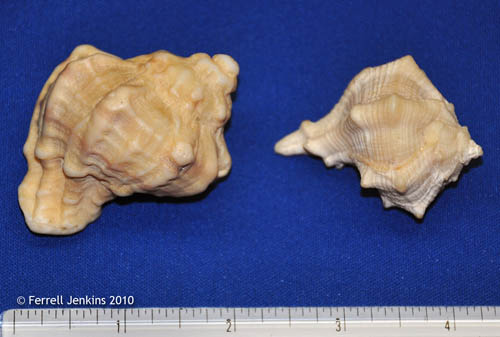
The photo below shows two Murex shells that I collected at the ruins of the ancient Phoenician site of Tyre.

Murex shells from Tyre. Photo by Ferrell Jenkins.

Murex shells from Tyre. Photo by Ferrell Jenkins.

Purple is mentioned in several New Testament texts. Notice these:

  • A rich man who habitually dressed in purple and fine linen (Luke 16:19).
  • Jesus was dressed in a purple garment to make him look like a king (Mark 15:17).
  • Purple was one of the products commonly traded and transported in the Roman Empire (Revelation 18:12).

If you are interested in more information about the Murex and the color Purple put the word Murex in the search box. You should locate six posts on this topic.

For the purple made from the madder root sold by Lydia (Acts 16:14), see here.

HT: Joseph Lauer

A snow house in Jerusalem

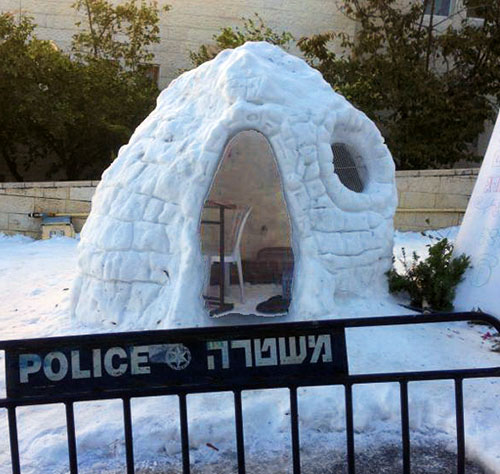
Elie sent me a photo he made this morning of a snow house in Jerusalem. If you know Jerusalem you know that the houses are built of stone (some of Jerusalem stone). The person building this snow house made it in imitation of the stone houses. It’s always good to have police protection!

Snon house in Jerusalem appears to be made of snow stone. Photo by EMB. Dec. 16, 2013.

Snow house in Jerusalem appears to be made of snow stone. Photo by EMB. 12/16/13.

Benaiah the son of Jehoiada, one of David’s mighty men “went down and struck down a lion in a pit on a day when snow had fallen” (1 Chronicles 11:22 ESV)

Scenes around Tell Ḥesbân (Heshbon)

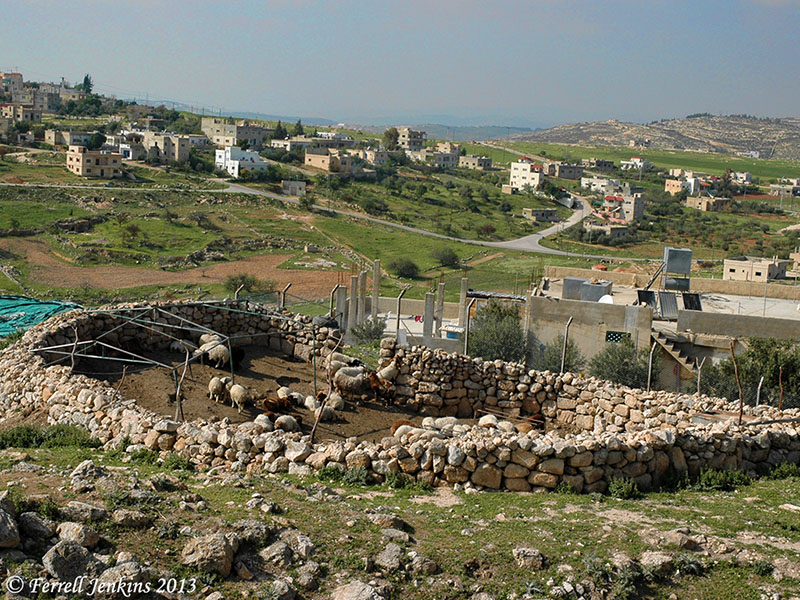
The photo below was made from the top of Tell Ḥesbân in Transjordan. It provides us a view of the general area of Moab during the period of the United Kingdom of Israel, and the Divided Kingdoms of Israel and Judah.

Sheepfold on the slope of Tell Ḥesbân. View of territory of Moab. Photo by Ferrell Jenkins.

Sheepfold on the slope of Tell Ḥesbân. View of territory of Moab. Photo by Ferrell Jenkins.

There are several biblical references to the sheepfold, or the fold of the sheep (Jeremiah 50:6; Micah 2:12; John 10:1, 16). Jesus used an illustration involving the sheepfold:

Truly, truly, I say to you, he who does not enter the sheepfold by the door but climbs in by another way, that man is a thief and a robber. But he who enters by the door is the shepherd of the sheep. (John 10:1-2 ESV)

We associate the land of Moab with Ruth the grandmother of King David.

So Naomi returned, and with her Ruth the Moabitess, her daughter-in-law, who returned from the land of Moab. And they came to Bethlehem at the beginning of barley harvest. (Ruth 1:22)

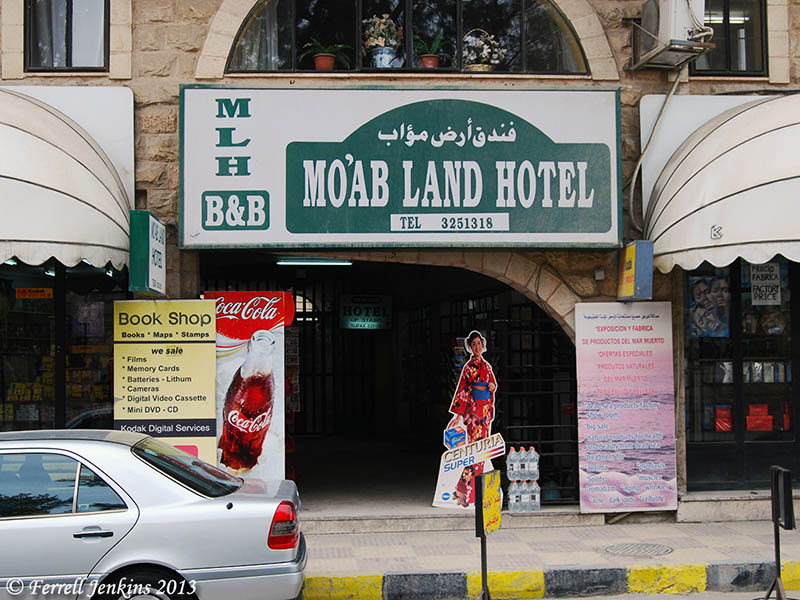
I find it fascinating that the modern locals pick up on the ancient names in order to attract the tourists who visit the area. At Madaba, about six miles south of Ḥesbân, there is a small hotel named Mo’ab Land Hotel. How appropriate.

The Moab Land Hotel in Madaba, Jordan. Photo by Ferrell Jenkins.

The Moab Land Hotel in Madaba, Jordan. Photo by Ferrell Jenkins.

Did you know C. S. Lewis died Nov. 22, 1963?

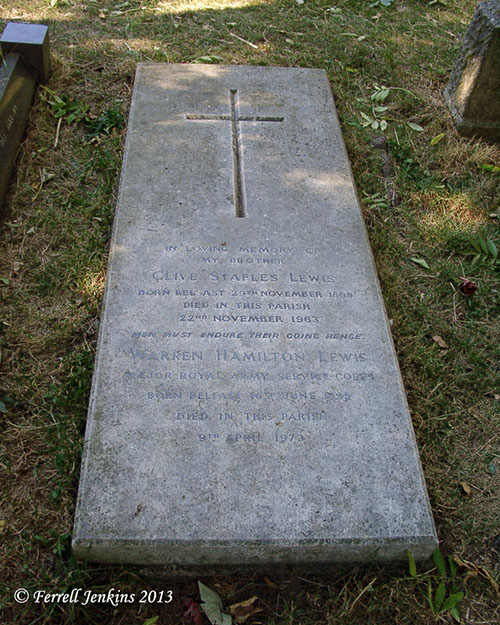
Recently I have been reading C. S. Lewis – A Life: Eccentric Genius, Reluctant Prophet by Alister McGrath. He says that Warnie found his brother dead at the foot of his bed at 5:30 p.m. [in Oxford], “Friday, 22 November 1963.” Then comes this paragraph:

At that same time, President John F. Kennedy’s motorcade left Dallas’s Love Field Airport, beginning its journey downtown. An hour later, Kennedy was fatally wounded by a sniper. He was pronounced dead at Parkland Memorial Hospital. Media reports of Lewis’s death were completely overshadowed by the substantially more significant tragedy that unfolded that day in Dallas.

C. S. Lewis was buried in the churchyard of Holy Trinity, Headington Quarry, Oxford after a private, and very small service. Warnie chose a phrase from a Shakespearean calendar that was in their home back in Belfast at the time of their mother’s death in August 1908: “Men must endure their going hence.” The quotation is from Shakespeare’s King Lear.

The grave of C. S. Lewis. Photo by Ferrell Jenkins.

The grave of C. S. Lewis. Photo by Ferrell Jenkins.

McAlister suggests that a better epitaph might be one from Lewis’s own words,

a seed patiently waiting in the earth: waiting to come up a flower in the Gardner’s good time, up into the real world, the real waking. I suppose that our whole present life, looked back on from there, will seem only a drowsy half-waking. We are here in the land of dreams. But cock-crow is coming.

C. S. Lewis is appreciated by many for the Chronicles of Narnia. Others have found his popular apologetic writings helpful. More information, including photos, about sites associated with Lewis is available here.

Where were you on November 22, 1963?

Most of us who were old enough to remember know exactly where were were and what we were doing the day President John F. Kennedy was assassinated.

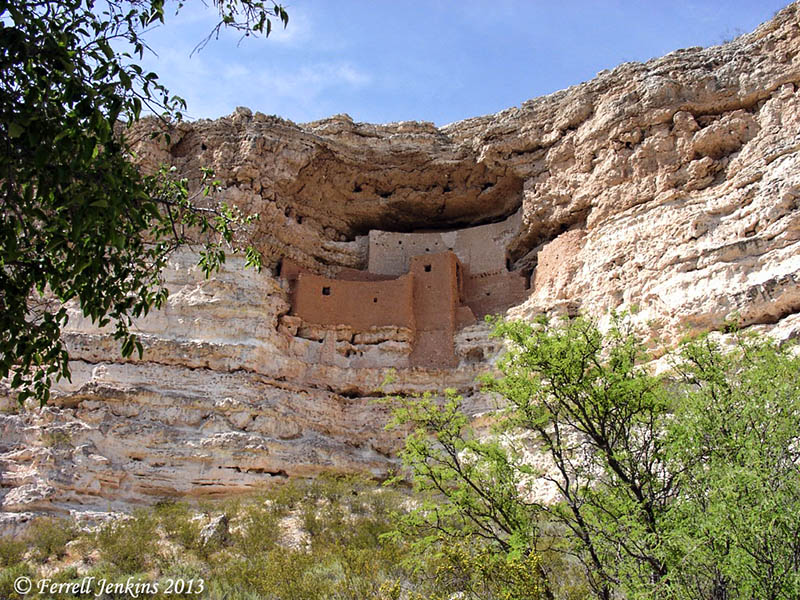
I was in a speaking engagement that week in Prescott, Arizona. David Curtis, a college friend, was the minister there at the time and he wanted to take me to see Montezuma Castle and Camp Verde, Arizona. This was an hour’s trip from Prescott. We could easily make the trip, have a little time to visit the sites, and be back in time for the evening service.

Montezuma Castle National Monument. Photo by Ferrell Jenkins, May, 2003.

Montezuma Castle National Monument. Photo by Ferrell Jenkins, May, 2003.

In Camp Verde we visited a small museum with artifacts illustration life about time shortly after the Civil War. We saw a framed newspaper front page on the wall with some wording like “President Dead.” It was about Abraham Lincoln. We stopped at a store in the center of the little town to get some refreshments. Someone came in and said, “Did you hear about the president?” Then another person said something similar. We went along by saying we had heard. We thought it was some of the local promotion.

After a few minutes someone mentioned specifically that Kennedy has been shot in Dallas. Well, you know that we had the car radio on all the way back to Prescott.

In 2003 my wife and I visited the same area. The old newspaper article was no longer displayed on the wall of the little museum. I asked the lady who showed us around about it. She confirmed that it had been there, but that she did not know where it was now (2003).

Where were you that fateful day?

The Meat Market at Corinth

Paul taught the saints at Corinth to,

Eat whatever is sold in the meat market without raising any question on the ground of conscience. (1 Corinthians 10:25 ESV)

The Greek word used here for “meat market” is makellon. Archaeological discoveries at Corinth include inscriptions mentioning the meat market and the fish market.

Henry J. Cadbury writes about visiting the Corinth excavations in July, 1933. He says he especially wanted to see “first hand the Erastus inscription….” Some of his comments in the article are still interesting today.

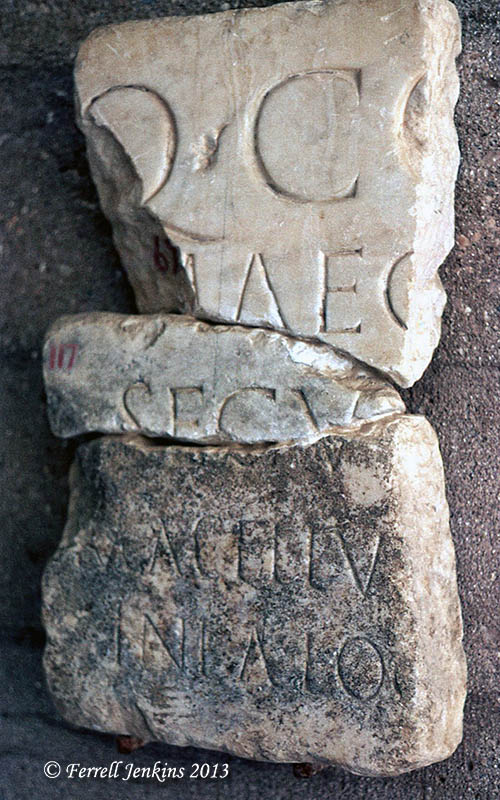
But what was particularly unexpected by me was to note among the inscribed fragments of marble in the new museum one containing quite clearly MACELLV.

As the piece has only seven other letters and these quite unintelligible the discovery of this single word is extremely tantalizing. But since the fragment in question was found in 1898, now thirty-five years ago, while so far as I know its one clear word has never been brought into connection with Paul’s reference to a Corinthian macellum, it is worth while now to do so. And the fragment does not stand quite alone; nine other fragments of the same inscription have been found, and furthermore another copy apparently of a similar inscription is represented by eleven fragments.

Citing A. B. West and L. R. Taylor, Cadbury says the various inscriptions mentioning the macellum at Corinth date to the “last years of Augustus or to the reign of Tiberias.”

In my earliest years of traveling to Corinth I saw this inscription each time I was there. Below is a digitized slide photo from 1971. This inscription was in an open hall surrounding the courtyard of what Cadbury called in 1934 “the new museum” at Corinth. At some point, perhaps in the 1990s the inscription was no longer on display. My guide at the time was well informed and had likewise seen the inscription. Inquiry in the office of the museum provided no information. Finally, a few years ago (probably 2008 or 2012) I found one of the workers preparing for the renovation of  a “newer” museum at Corinth. She informed me that the inscription was in their storeroom and that it would eventually be displayed again.

In the photo below you will see the Latin word MACELLV[M] in the fourth line from the top. Paul used the same Greek word in 1 Corinthians 10:25.

Makellum inscription at Corinth Museum in 1971. Photo by Ferrell Jenkins.

Makellum inscription at Corinth Museum in 1971. Photo by Ferrell Jenkins.

Cadbury refers to published inscriptions from Corinth. This is No. 124. It is thought to have consisted of three blocks. The beginning of the five lines in the first block of No. 124 reads as follows:

Q . C O
M A E C
S E C V
M A C E L L V
I N E A . L O C

New Testament Christians did not live in a vacuum, and the books of the New Testament were not written in a vacuum. Understanding the historical and social context of these writings helps us to better apply them to our own time.

Documentation: Henry J. Cadbury. “The Macellum of Corinth.” JBL 53:2 (1934): 134-141.

The theater at Corinth

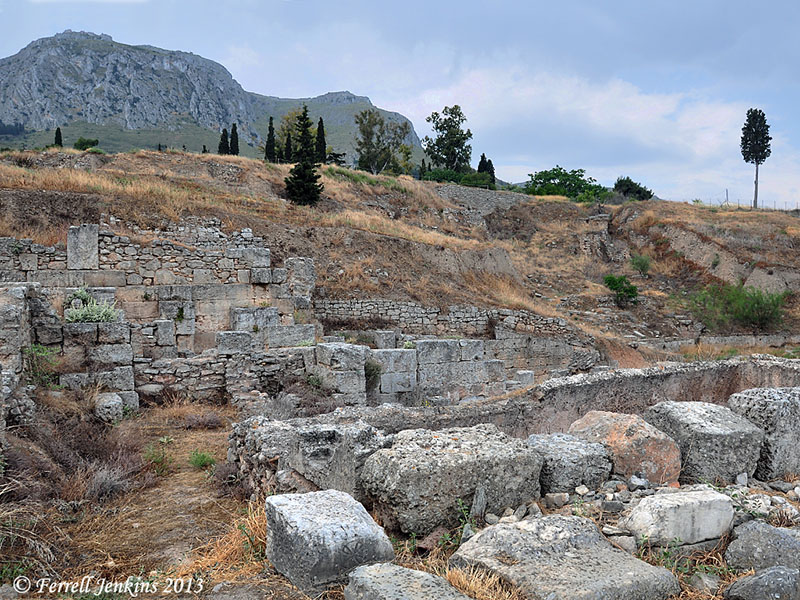
The theater at Corinth is a short distance from the agora and the Temple of Apollo. Reddish and Fant describe the theater:

The theater dates from the 5th century B.C.E. and later was rebuilt by the Romans, who added a multistory stage building . In Paul’s time it seated approximately 14,000 spectators. (A Guide to Biblical Sites in Greece and Turkey, p. 59)

According to the same source, both the theater and the odeion, “were later used for gladiatorial spectacles; the theater was even fitted for mock sea battles.”

Ruins of the theater at Corinth. Photo by Ferrell Jenkins.

Ruins of the theater at Corinth. Photo by Ferrell Jenkins.

The theater is not on the typical tourist route at Corinth, but it can be reached along a rugged path north of the major excavated area.

The Apostle Paul spent 18 months among the Corinthians.

And he stayed a year and six months, teaching the word of God among them. (Acts 18:11 ESV)

Vandalism in Protestant Cemetery on Mount Zion

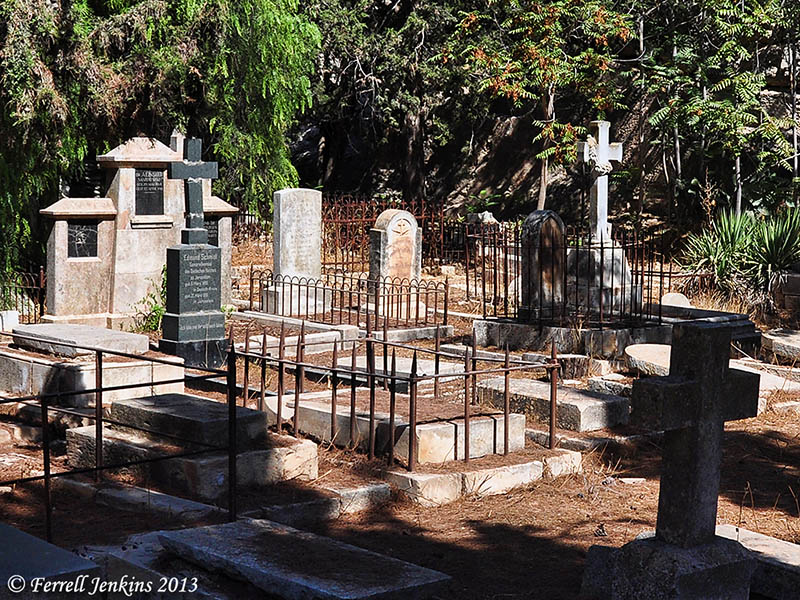
A little over a year ago I visited the Protestant Cemetery on Mount Zion in Jerusalem. Shortly thereafter a series of articles were posted about some of the persons buried there. See here for Spafford; here for Starkey; here for Schick; here for Fisher.

My friends Trent and Rebekah are currently students at the Jerusalem University College that adjoins the cemetery. In fact, one enters the locked cemetery gate through JUC property. Unfortunately, it would be possible for a person to enter the cemetery from the southwest corner where there is no fence.

Trent reports vandalism of some of the tombs with crosses last Sunday.

I’m sure you know of the “price tag” policy and campaign. [Yes, see here.]

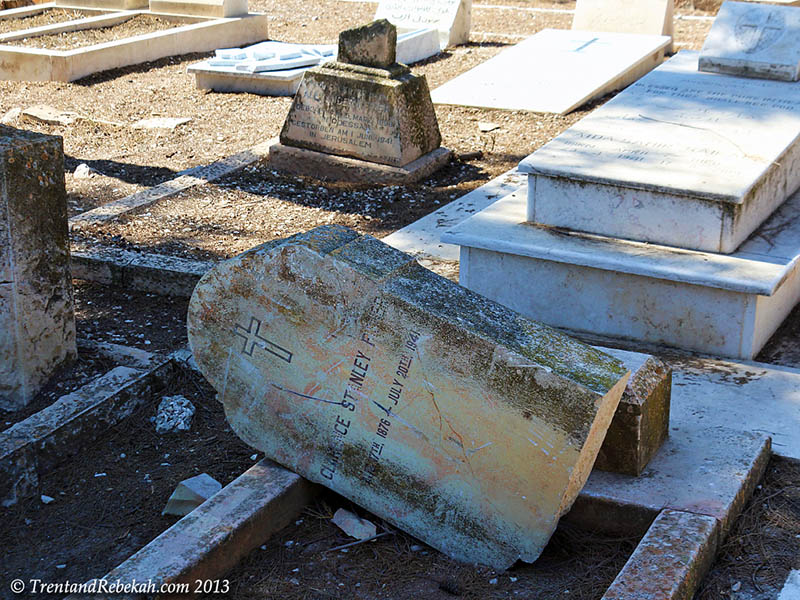
At some point on Sunday, not sure exactly when, vandals said to be associated with a Price Tag group entered the cemetery (not hard to do from the back/side) and smashed multiple tombstones which were bearing crosses. They also damaged at least one tombstone with Arabic writing.  I checked all the graves which you have written about on the blog (at least what I could find on the blog).  The only grave with damage seemed to be Clarence Fisher.  After talking with Dr. Wright, he says this tombstone was actually damaged in a similar attack about six months ago (photo attached).  The stone has been set back somewhat upright on the grave.

The incident on Sunday was incorrectly reported by some outlets as the nearby Catholic Cemetery.

Here is Trent’s photo of the broken headstone over Clarence Fisher’s grave.

Tomb of Clarence Fisher vandalized in Protestant Cemetery.

Tomb of Clarence Fisher vandalized in Protestant Cemetery.

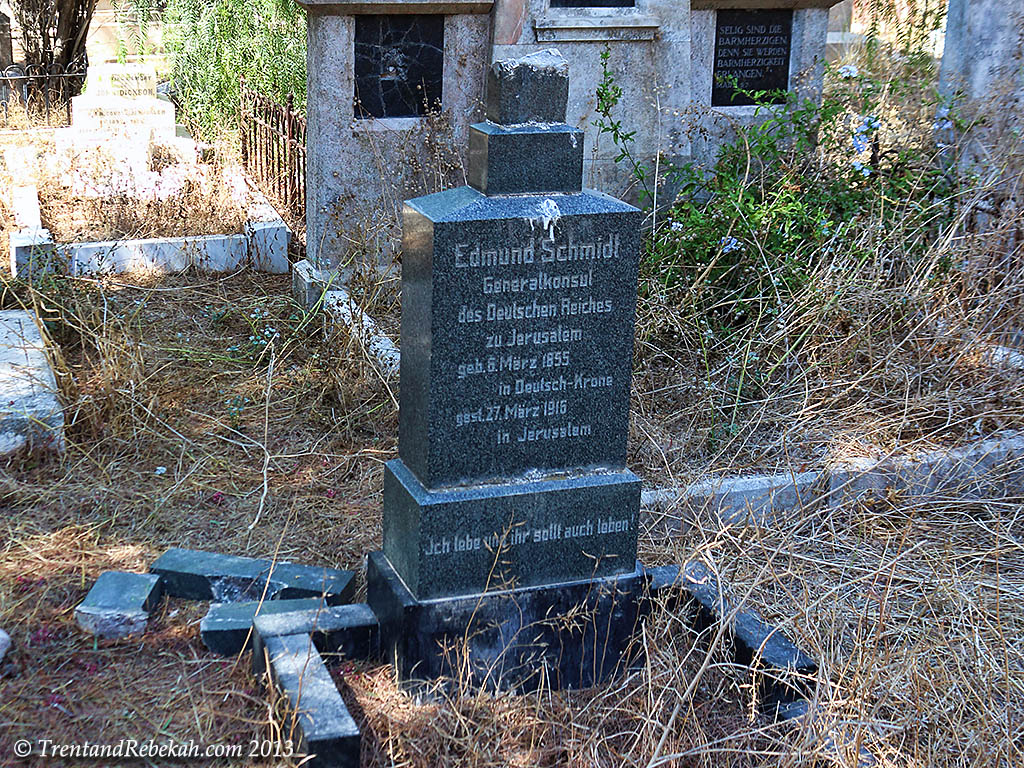
Another photo shows damage to the tomb of Edmund Schmidt, a German consul to Jerusalem.

Vandalized tomb of Edmund Schmidt.

Vandalized tomb of Edmund Schmidt.

In browsing my photos of September, 2012, I noticed that the cross on this tomb had already been broken and poorly repaired. In the photo above you will see the three pieces of the cross to the left of the headstone.

Tomb of Edmund Schmidt, September, 2012. Photo by Ferrell Jenkins.

Tomb of Edmund Schmidt, September, 2012. Photo by Ferrell Jenkins.

I also noticed that numerous crosses had been broken.

When we destroy that of which we are ignorant we reflect lack of appreciation of any history. It happens all over the world. If we destroy that with which we disagree, what will happen when someone disagrees with us?

The apostle Paul spoke of himself as one who previously destroyed what he presently was rebuilding.

For if I rebuild what I tore down, I prove myself to be a transgressor. (Gal 2:18 ESV)

Ynet reports here and here the arrest of four Jewish youths in this episode.