Monthly Archives: September 2009

On the road in Switzerland, Austria and Italy

This afternoon we are ticketed to leave Atlanta for an overnight flight to Zurich, Switzerland. After some brief sightseeing in Zurich we will head for Lucerne for overnight.

Most of our tours are in the Bible Lands (Israel, Jordan, Egypt, Turkey, Greece, et al.), but we have directed other tours since 1967. On this current tour in Switzerland, Austria, and Italy, in addition to the general learning that travel affords, we will give some emphasis to church history, and Paul’s time in Rome.

Ferrell and Elizabeth in Florence, Italy, 2001.

Ferrell and Elizabeth in Florence, Italy, 2001.

This time I am using a Nikon D90. It is amazing how much younger the camera makes us look. This will be a great selling point for many.

Piper: “I want all the words”

John Piper is doubtless one of today’s most respected evangelical leaders. He is a scholar and preaches like a scholar, but with a broad appeal. That is not an easy combination. To say Piper is a Calvinist is an understatement. I am not a Calvinist, but I often profit from the lessons of John Piper. One always comes away challenged.

In this video clip Piper takes on versions that do not allow the reader to know all the words of a text. Many read to get the idea and never learn the details. This can be misleading. I think preachers who never grapple with textual problems and leave their hearers in the dark do them a great disservice.

Piper is discussing John 4:44-45. Here is how it reads in the NASB:

44 For Jesus Himself testified that a prophet has no honor in his own country. 45 So when He came to Galilee, the Galileans received Him, having seen all the things that He did in Jerusalem at the feast; for they themselves also went to the feast.

Here is the NIV rendering of the same text:

44 (Now Jesus himself had pointed out that a prophet has no honor in his own country.) 45When he arrived in Galilee, the Galileans welcomed him. They had seen all that he had done in Jerusalem at the Passover Feast, for they also had been there.

Listen and think.

Cache of Bar-Kokhba coins found

Arutz Sheva, Israel National News, reports the discovery of a treasure chest of Bar-Kokhba period (132-35 AD) coins in the Judean Hills.

The largest-ever known number of coins from the time of Bar-Kokhba, the Jewish leader against Roman invaders, has been discovered in the Judean Hills by cave researchers from Hebrew and Bar-Ilan universities.

The research team found three batches of bronze, silver and gold coins in a deep cavern in a nature reserve. Pottery and weapons also were discovered during a research project by Prof. Amos Frumkin of Hebrew University and Prof. Hanan Eshel and Dr. Boaz Zissu of Bar-Ilan.

They found the approximately 120 coins in a “hidden wing” of the cave where the only opening is via a narrow and dangerous approach. Beyond the opening, a small chamber leads to a hall where Bar-Kokhba’s army apparently hid.

Most of the coins are in excellent condition, and Bar-Kokhba’s followers imprinted their own designs over the currency, which is of Roman origin.

Bar Kokhba coins. Photo: Jerusalem University & Israeli Government.

Bar Kokhba coins polished for presentation. Israeli news photo, Sasson Tiram.

The Arutz Sheva report is here. A G News report, with beautiful photos, is here.

HT: Joseph Lauer

Todd Bolen’s new collection of old photos

Todd Bolen has produced a new collection of photos. These are not his photos. They are the famous photos of The American Colony and Eric Matson Collection. This set of 8 volumes features 4,000 high-resolution photographs taken by resident photographers in the Holy Land from 1898 to the 1940s.

Every Bible student who has been using Bible study resources for several years has seen the photographs of The American Colony photographers and Eric Matson. When I edited the Truth in Life Bible class literature in the early 1970s we purchased and obtained permission to use several of the photographs in the literature.

The American Colony in Jerusalem was founded in 1881 by Horatio Spafford (author of the famous hymn, It is Well With My Soul). Eric Matson, one of the photographers inherited the collection, added his own work, and later donated his negatives to the Library of Congress. These photos have been available to the public for some time, but it has been difficult to locate a particular photo. And the quality of some of them, after so many years, is not good.

Bolen describes the collection:matson_dvd_front_200

This collection includes more than 4,000 selected photographs of sites and scenes from Palestine, Lebanon, Syria, Jordan, and Egypt. All of the images are included in pre-made PowerPoint® files for quick and easy use, as well as in high-resolution jpg format, suitable for projecting or printing. Quotations from 19th-century travelers give additional context to many of the photographs.

The Collection Includes:

  • Volume 1: Northern Palestine
  • Volume 2: Jerusalem
  • Volume 3: Southern Palestine
  • Volume 4: Lebanon, Syria, and Jordan
  • Volume 5: Egypt and Sinai
  • Volume 6: Traditional Life and Customs
  • Volume 7: Early 20th-Century History
  • Volume 8: People of Palestine

The first volume has been released on CD. Other volumes are being released one CD a month. The complete 8-volume set is available now on 2 DVDs.

In recent weeks Todd has written about Shechem, Samaria, and Beth Shean. Almost every tour group visits Beth Shean, but many are unable to go to the other sites. Take a look here at the way Beth Shean looks now and the way it looked in the 1920s.

Complete information on this set is available at Life in the Holy Land.

C. S. Lewis – Beyond Narnia

If you are interested in C. S. Lewis and his writings, you might enjoy a recent one hour documentary about him. The trailer may be seen here. The complete video is available here. A DVD is available for purchase.

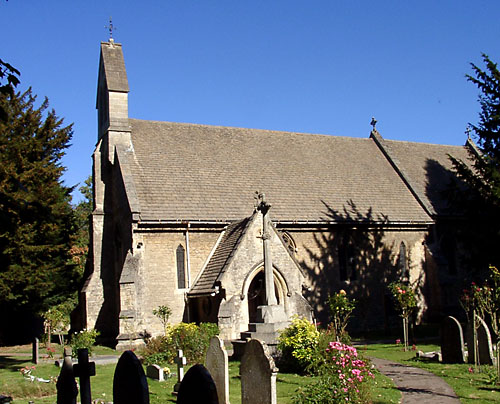
The photo below is of Holy Trinity Church, Headington Quarry, Oxford. This is the church Lewis and his brother Warnie attended. Both are buried in the church graveyard.

Holy Trinity Church, Headington Quarry. Photo by Ferrell Jenkins.

Holy Trinity Church, Headington Quarry. Photo by Ferrell Jenkins.

More information, including photos, about sites associated with Lewis is available here.

HT:  N.T. Resources Blog and Between Two World.

The Greek side of Istanbul

Today’s Zaman has an interesting article about Greeks in Istanbul. The article discusses mainly a few Greek remains to be seen in the city and some information about remaining Greek Orthodox churches.The article is interesting because of the historical developments and conflicts between Greek and Turks. The note about the Serpentine Column caught my attention.

Being approximately 2,500 years old, the Serpentine Column is said to be İstanbul’s oldest remaining Greek monument. Erected to honor the triumph of the Greeks over the Persians at Plataea, it originally stood at Delphi (both ancient cities on Greek ground) and was moved to İstanbul in 324 B.C. by Constantine the Great to mark the declaration of the new capital city of the then-founded Roman Empire under the name of Constantinople. The originally eight-meter-high piece was made up of three intertwined serpents which supported a golden bowl. The bowl is believed to have been lost or stolen when the city was sacked during the Fourth Crusade. Some say the heads were hit and cut off by a drunken nobleman in the 17th century but one of them can still be seen in the İstanbul Archaeology Museum. The rest of the column can be found today at the Hippodrome in the Sultanahmet quarter.

There is a serious mistake in the article. The Serpentine Column was originally erected at Delphi in 479 B.C., but it was placed in the hippodrome of Constantinople by Constantine in 324 A.D.

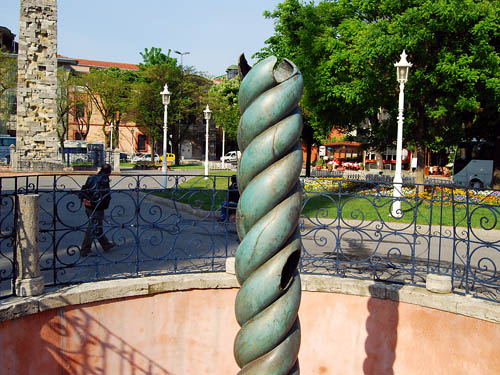
Here is a photo of the bronze Serpentine Column as it stands in the hippodrome.

Serpentine Column in Istanbul. Photo by Ferrell Jenkins.

Bronze Serpentine Column in Istanbul. Photo by Ferrell Jenkins.

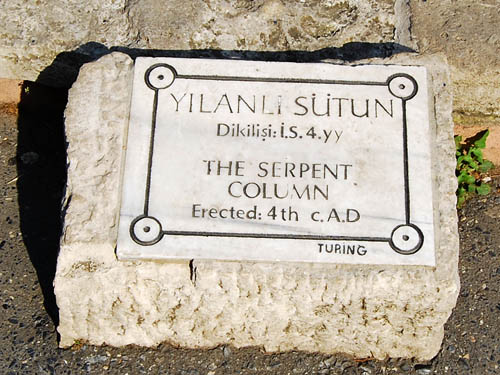
A sign marking the Serpentine Column indicates that the column was erected in the 4th century A.D. That is the date when Constantine had it erected in the hippodrome, but the column dates to the 5th century B.C.

Sign marking the Serpentine Column. Photo by Ferrell Jenkins.

Read the full  Today’s Zaman article here.

HT: Biblical Paths.

Canaanite fortification video on CNN

CNN posted a nice, short video on the Canaanite fortification we reported on yesterday. The link is here.

HT: Dan

Impressive Canaanite fortification in “City of David”

According to a press release from the Israel Antiquities Authority, “An Enormous 3,700 Year Old Fortification was Exposed in the City of David.”

The fortification rises to a height of c. 8 meters [about 26+ feet], and it seems that the Canaanites used it to defend the path that led to the spring.

The excavations are being conducted by the Israel Antiquities Authority in the “Walls Around Jerusalem National Park and are underwritten by the ‘Ir David Foundation.

A huge fortification more than 3,700 years old, which is ascribed to the Canaanites (Middle Bronze Age 2 [2000-1500 BC]), was uncovered in archaeological excavations the Israel Antiquities Authority is currently conducting in the “Walls Around Jerusalem National Park” in the City of David, with funding provided by the ‘Ir David Foundation.

According to the director of the excavation, Professor Ronny Reich of the University of Haifa, together with Eli Shukron on behalf of the Israel Antiquities Authority, “This is the most massive wall that has ever been uncovered in the City of David, and it rises to a height of 8 meters. We are dealing with a gigantic fortification, from the standpoint of the structure’s dimensions, the thickness of its walls and the size of the stones that were incorporated in its construction. The walls appear to be a protected, well-fortified passage that descends to the spring tower from some sort of fortress that stood at the top of the hill. The construction of a protected passage such as this is a plausible solution that explains the innate contradiction of the situation whereby the spring – which is a source of life from the standpoint of the fortress’ inhabitants in time of emergency – is located in the weakest and most vulnerable place in the area. The construction of a protected passage, even though it involves tremendous effort, is a solution for which there are several parallels in antiquity, albeit from periods that are later than the remains described here. A small section of the fortification was discovered in 1909, and it has been ascertained in the present excavations that it was part of an enormous wall. This is the first time that such massive construction that predates the Herodian period has been discovered in Jerusalem.”

During this period Jerusalem and the fields around it were an independent political entity with self-rule, similar to its neighbors Shechem to the north and Jericho to the east. Massive walls resembling the one that was just exposed in Jerusalem are known from Canaanite Hebron (Tel Rumeida), Shechem (Tell Balata) and Gezer.
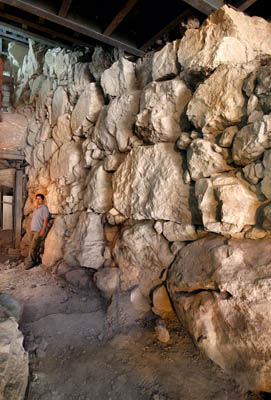
Middle Bronze II Fortification. Photo: Vladimir Naiahin, IAA.

Middle Bronze II Fortification. Photo: Vladimir Naiahin, IAA.

Professor Reich comments on the fortification:

“Even though it would seem we are dealing with impressive fortifications, the walls were after all primarily used to defend against marauding desert nomads who wanted to rob the city. These are the earliest fortifications in the region and they bear witness to the fact that from this point on the settlement had became an urban entity with a ruler who had the capability and resources to build such a structure. A small settlement would have been unsuccessful in organizing such construction”.

The known section of the fortification is 24 meters long; however, it is thought the fortification is much longer because it continues west beyond the part that was exposed, at the top of the hillside. Professor Reich adds, “The new discovery shows that the picture regarding Jerusalem’s eastern defenses and the ancient water system in the Middle Bronze Age 2 is still far from clear. Despite the fact that so many have excavated on this hill, there is a very good chance that extremely large and well-preserved architectural elements are still hidden in it and waiting to be uncovered”.
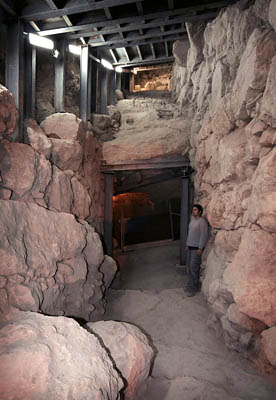
Middle Bronze II Fortification. Photo: Vladimir Naiahin, IAA.

Middle Bronze II Fortification. Photo: Vladimir Naiahin, IAA.

The public will be able to visit the fortification for the first time today, September 3. I would like to be there.

What does this mean for the Bible student? The Middle Bronze II period is the period of the Biblical Patriarchs. It was possibly during that period when Melchizedek, king of Salem and priest of God Most High, went out to bless Abraham after his return from rescuing Lot (Genesis 14:18). We have no way to know if this fortification was in existence at that time.

Assuming this fortification was still in use at the time when David captured the stronghold of Zion from the Jebusites, it helps explain the arrogance of the local residents (2 Samuel 5:6-7).

Take a look at the City of David website here.

HT: Joseph I. Lauer

Egyptian and Anatolian contacts with Galilee

Tel Aviv University reports on the discover of a rare Egyptian artifact dating to around 3000 BC from Tel Bet Yerah on the shore of the Sea of Galilee. The link to the report is here. The brief report from the Jerusalem Post is probably adequate here.

Although Egyptian-Israeli relations have been frosty in recent years, ties between the two lands were vibrant around 3,000 BCE during the Early Bronze Age – at least according to Tel Aviv University and University College London archeologists who discovered a rare, four-centimeter-long stone fragment at the point where the Jordan River exits Lake Kinneret.

The piece, part of a carved stone plaque bearing archaic Egyptian signs, was the highlight of the second season of excavations at Tel Bet Yerah (Khirbet el-Kerak). The site lies along an ancient highway that connected Egypt to the wider world of the ancient Near East.

Fragment of Egyptian plaque - c. 3000 BC - from Tel Bet Yerah.

Fragment of Egyptian plaque - c. 3000 BC - from Tel Bet Yerah.

. . . . . .

Earlier discoveries, both in Egypt and at Bet Yerah, have indicated that there was direct interaction between the site – then one of the largest in the Jordan Valley – and the Egyptian royal court. The new discovery suggests that these contacts were of far greater local significance than had been suspected.

The archeologists noted that the fragment – which depicts an arm and hand grasping a scepter and an early form of the ankh sign – was the first artifact of its type ever found in an archaeological site outside Egypt. It has been attributed to the period of Egypt’s First Dynasty, at around 3000 BCE.

. . . . . .

This year’s excavations also provided new insights into contacts between the early town and the distant north, when large quantities of “Khirbet Kerak Ware” (a distinctive kind of red/black burnished pottery first found at Tel Bet Yerah) were found in association with portable ceramic hearths, some of them bearing decorations in the form of human features.

One end of a decorated portable hearth - Khirbet Kerak Culture (c. 2700 BC)

One end of a decorated portable hearth - Khirbet Kerak Culture (c. 2700 BC)

“The hearths are very similar to objects found in Anatolia and the southern Caucasus,” noted Greenberg, “and most were found in open spaces where there was other evidence for fire-related activities.

“The people using this pottery appear to have been migrants or descendants of migrants, and its distribution on the site, as well as the study of other cultural aspects, such as what they ate and the way they organized their households, could tell us about their interaction with local people and their adaptation to new surroundings.”

. . . . . .

The tel was once described by influential American biblical archeologist William F. Albright as “perhaps the most remarkable Bronze Age site in all Palestine.” It presents the most complete sequence of the transition from village to city life in ancient Canaan.

Built on a raised peninsula near an important crossroads and a fertile valley, Tel Bet Yerah became a major regional center, and its fortification systems, city gate, streets and houses reveal elements of advanced urban planning.

Modern archeological research on the mound began in the early 1920s, when E.L. Sukenik (father of the late archeologist and politician Prof. Yigael Yadin) examined finds from the section of the old Samak (Tzemah)-Tiberias road that traversed the mound along its entire length.

At about the same time, Albright conducted his own investigation of the site; he was the first to identify and define the pottery known as Khirbet Kerak Ware.

The first archeological excavation was conducted in 1933, when the modern Tzemah -Tiberias highway was constructed. Over the next 70 years, about 20 excavation licenses were issued for Tel Bet Yerah and some 15,000 square meters were excavated, most of them in Early Bronze Age strata.

I think this type of information illustrates why the Lord placed His people on this land bridge between the great powers of the ancient world. It would continue to remain that way through the days of the Assyrians, Babylonians, Persians, Greeks, and Romans. And beyond.

HT: Joe Lauer

Tel Dor

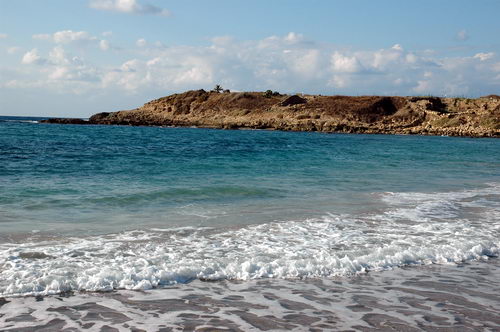
Tel Dor sits on a promontory on the Mediterranean coast between Caesarea Maritima and Mount Carmel.

View of Tel Dor from the south. Photo by Ferrell Jenkins.

View of Tel Dor from the south. Photo by Ferrell Jenkins.

The site of Dor seems to have been inhabited at least from the Late Bronze Age (1550-1200 B.C.). The Tel Dor Excavation site says,

The documented history of the site begins in the Late Bronze Age (though the town itself was founded in the Middle Bronze Age, c. 2000 BCE), and ends in the Crusader period.

Here is what we know about Dor from the biblical accounts:

  • The king of Dor joined the coalition of Jabin, king of Hazor, to fight unsuccessfully against Joshua and the Israelites (Joshua 11:1-2; 12:23).
  • Dor seems to have been allotted to the tribe of Manasseh within the territory of Asher (Joshua 17:11). It appears that Manasseh was unable to maintain control of the city (Judges 1:27).
  • Ben-abinadab, one of Solomon’s deputies, was responsible for the “height of Dor” when Solomon set up his administrative centers  (1 Kings 4:7-11).