Tag Archives: Apostle Paul

The Erastus inscription at Corinth

Even though the relationship between the Apostle Paul and the Corinthians was always a strained one, we know the names of numerous saints at Corinth who were helpful to Paul in his ministry.

Paul calls attention to a person named Erastus who was a “city treasurer.” He would be one of the few (“not many”) Christians who were among the socially elite at Corinth (1 Corinthians 1:26). A person named Erastus is mentioned three times in the New Testament. Whether these are two or three different persons, or all the same person, I do not know. Here are the biblical references:

  1. “And having sent into Macedonia two of his helpers, Timothy and Erastus, he himself stayed in Asia for a while.” (Acts 19:22 ESV)
  2. “Gaius, who is host to me and to the whole church, greets you. Erastus, the city treasurer, and our brother Quartus, greet you.” (Romans 16:23 ESV) [We understand that Romans was written from Corinth. The Greek term for “city treasurer” is oikonomos.]
  3. “Erastus remained at Corinth, and I left Trophimus, who was ill, at Miletus.” (2 Timothy 4:20 ESV)

It is of interest that during the 1929 archaeological excavation of the area near the theater (see here), a plaza was located that contained a stone inscription bearing the name of Erastus and indicating that he was a public official.
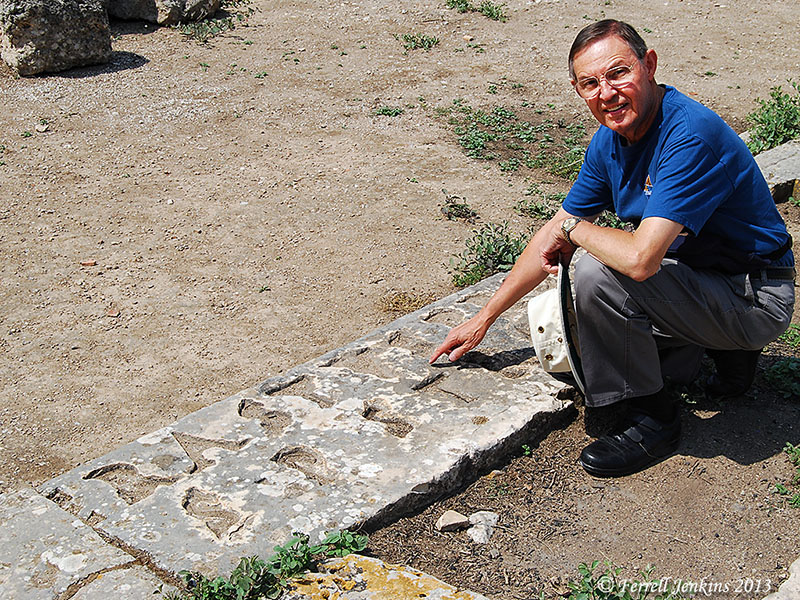
Ferrell Jenkins points to the Erastus Inscription at Corinth.

Ferrell Jenkins points to the Erastus Inscription at Corinth.

John McRay says the pavement in which this inscription was found dates to before A.D. 50. The letters are 7 inches high. The complete inscription reads:

ERASTVS-PRO-AEDILIT[at]E S-P-Stravit
In full: Erastus pro aedilitate sua pecunia stravit.

The English translation of the inscription is, “Erastus in return for his aedileship laid (the pavement) at his own expense.” (Archaeology and the New Testament, 331).

Originally the letters were filled with bronze, but most of that was removed long ago. The name ERASTVS is seen in the closeup below.

The name Erastus in the inscription near the theater. Photo by Ferrell Jenkins.

The name Erastus in the inscription near the Corinth theater. Photo by Ferrell Jenkins.

For those who have interest in a more technical discussion of this inscription may find it in David W.J. Gill, “Erastus The Aedile.” Tyndale Bulletin 40.2 (1989): 298. Gill asks,

Are we to identify the Erastus inscription with the Erastus of Romans? It needs to be pointed out that the evidence will not allow a certain identification or a certain rejection.

We are not able to answer the question with certainty, but the possibility that this man was among the disciples at Corinth, and a friend of Paul, is intriguing.
Paul stood before Galilo at Corinth

Luke records, in the book of Acts, an important historical event involving Paul during the 18 months he worked at Corinth

12 But when Gallio was proconsul of Achaia, the Jews made a united attack on Paul and brought him before the tribunal,
13 saying, “This man is persuading people to worship God contrary to the law.”
14 But when Paul was about to open his mouth, Gallio said to the Jews, “If it were a matter of wrongdoing or vicious crime, O Jews, I would have reason to accept your complaint.
15 But since it is a matter of questions about words and names and your own law, see to it yourselves. I refuse to be a judge of these things.”
16 And he drove them from the tribunal.
17 And they all seized Sosthenes, the ruler of the synagogue, and beat him in front of the tribunal. But Gallio paid no attention to any of this. (Acts 18:12-17 ESV)

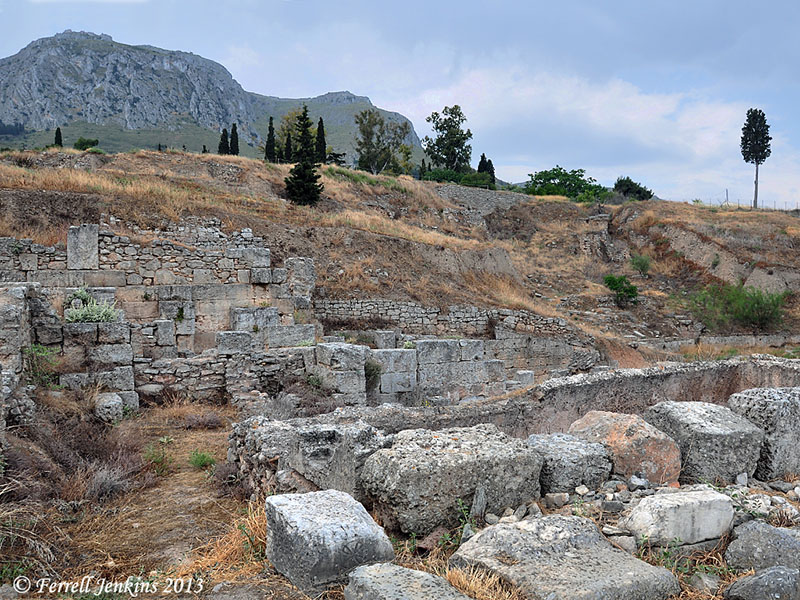
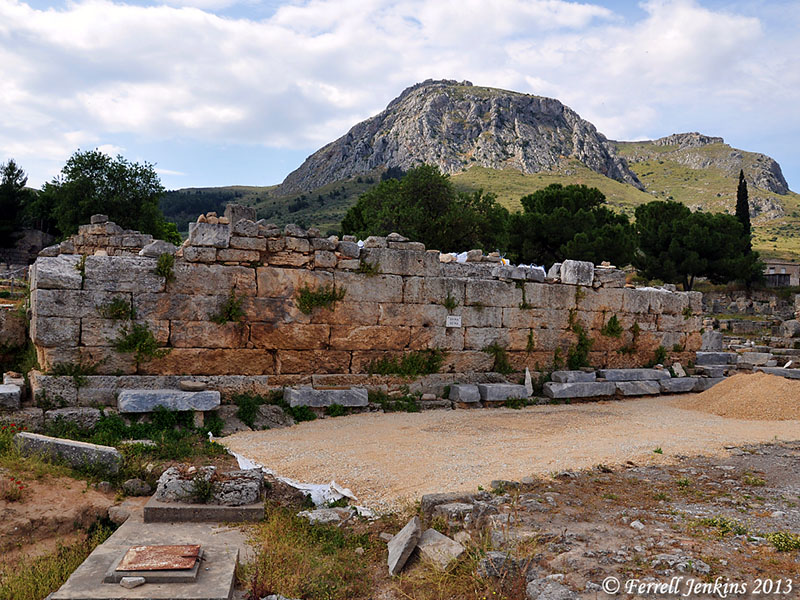
The photo below shows the actual platform or bema mentioned in Acts 18. Popular English versions use the terms tribunal, judgment seat, place of judgment, or judge’s bench.

The bema in the agora of Corinth. The Acrocorinth is in the distance. Photo by Ferrell Jenkins.

The bema in the agora of Corinth. Photo by Ferrell Jenkins.

The bema dates to A.D. 44, but could be as early as the time of Augustus (Murphy-O’Connor, St. Paul’s Corinth, 28).

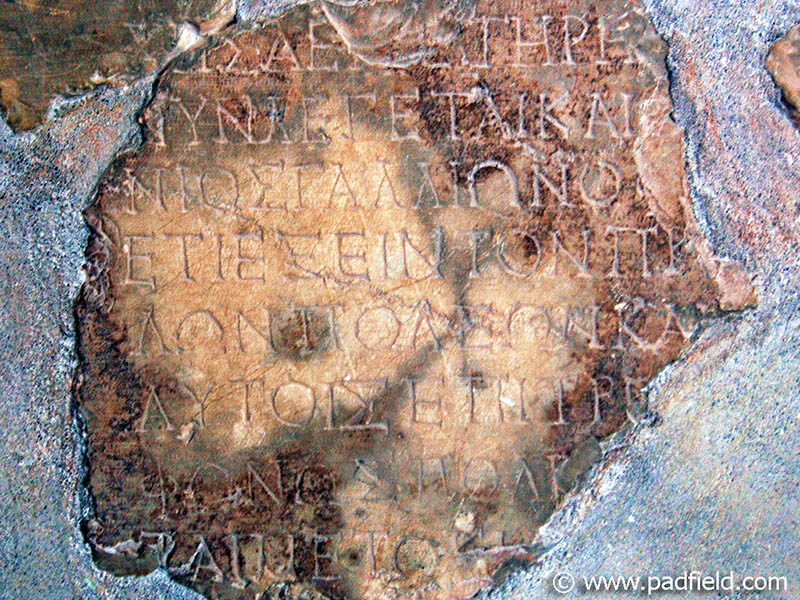
An inscription found at Delphi names Gallio the proconsul of Achaia. Gallio was the brother of the famous Roman Stoic philosopher Seneca. Gallio’s terms as proconsul of Achaia is usually dated to either A.D. 51/52 or 52/53. This is an important chronological help in our study of Paul’s journeys. In the largest fragment of the inscription, the name of ΓΑΛΛΙΩ (GALLIO)  may be seen in the center of the third line from the top.

The Delphi (Gallio) inscription. Photo by David Padfield.

The Delphi (Gallio) inscription. Photo by David Padfield.

I have been to Delphi at least two times, but the broken pieces of the Gallio Inscription were in a storage room. I did have written permission to see the fragment, but the slides I made were of poor quality. Thanks to David Padfield for permission to use the nice photo above which is now displayed in the museum at Delphi.

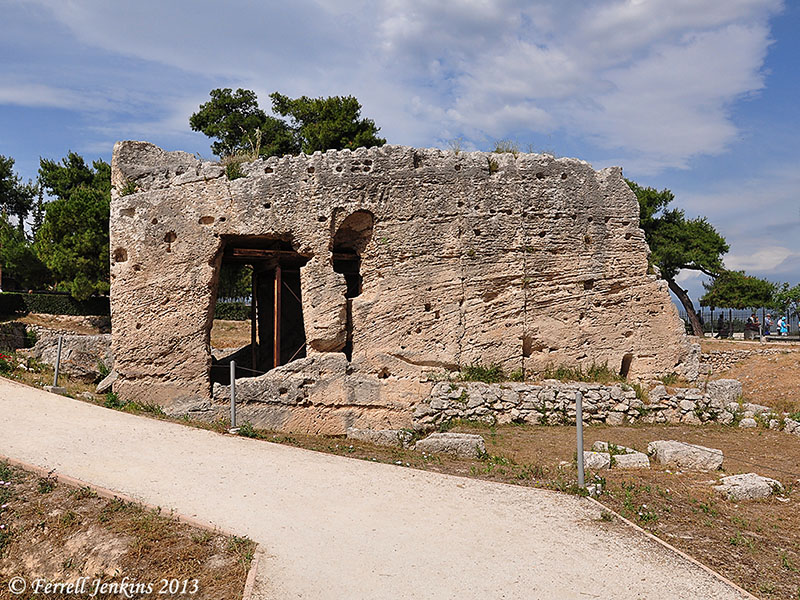
The theater at Corinth

The theater at Corinth is a short distance from the agora and the Temple of Apollo. Reddish and Fant describe the theater:

The theater dates from the 5th century B.C.E. and later was rebuilt by the Romans, who added a multistory stage building . In Paul’s time it seated approximately 14,000 spectators. (A Guide to Biblical Sites in Greece and Turkey, p. 59)

According to the same source, both the theater and the odeion, “were later used for gladiatorial spectacles; the theater was even fitted for mock sea battles.”

Ruins of the theater at Corinth. Photo by Ferrell Jenkins.

Ruins of the theater at Corinth. Photo by Ferrell Jenkins.

The theater is not on the typical tourist route at Corinth, but it can be reached along a rugged path north of the major excavated area.

The Apostle Paul spent 18 months among the Corinthians.

And he stayed a year and six months, teaching the word of God among them. (Acts 18:11 ESV)

The Fountain of Glauke at Corinth

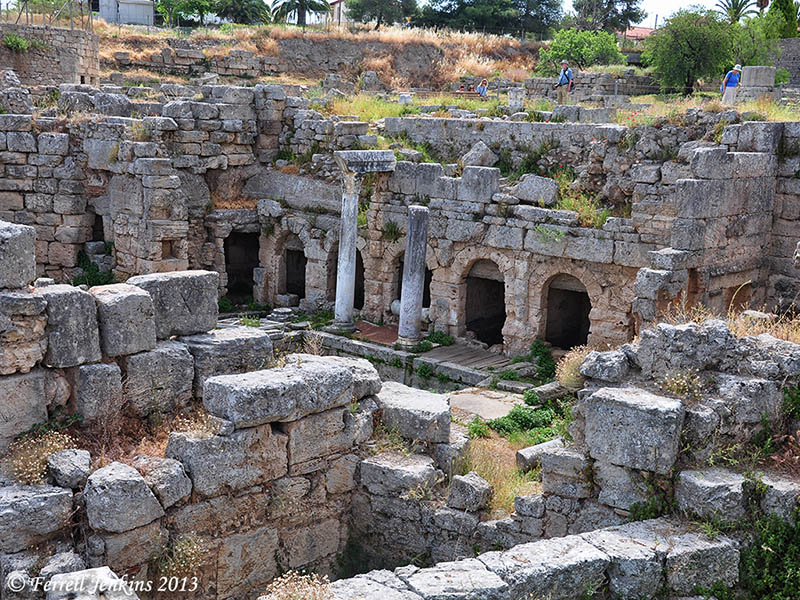
In addition to the Spring (or Fountain) of Peirene, Corinth had another significant water supply — the Fountain of Glauke. Reddish and Fant describe the fountain:

To the west of the temple [of Apollo] and on a lower level lies the Fountain of Glauke, supplied with water by a conduit from the Acrocorinth, virtually nothing of which remains except four reservoirs cut in the rock. It was named for the legendary daughter of a king of Corinth who threw herself into its waters to escape the flames of the magical robe sent her by Medea. Originally the fountain was covered by a building approximately 45 feet long and 40 feet wide. (A Guide to Biblical Sites in Greece and Turkey, 59).

The Fountain of Glauke at Corinth. Photo by Ferrell Jenkins.

The Fountain of Glauke at Corinth. Photo by Ferrell Jenkins.

Among the Christians at Corinth during the time of the Apostle Paul, we can certainly imagine that some of them visited these sites we have learned about as a result of the archaeological excavations over the past century. See Acts 18; 1 Corinthians; 2 Corinthians.

The Fountain of Peirene at Corinth

In the first century A.D. Corinth was the capital of the Roman province of Achaia and had direct communication with Rome. This was a wonderful place for Paul to teach the gospel of Christ (Acts 18).

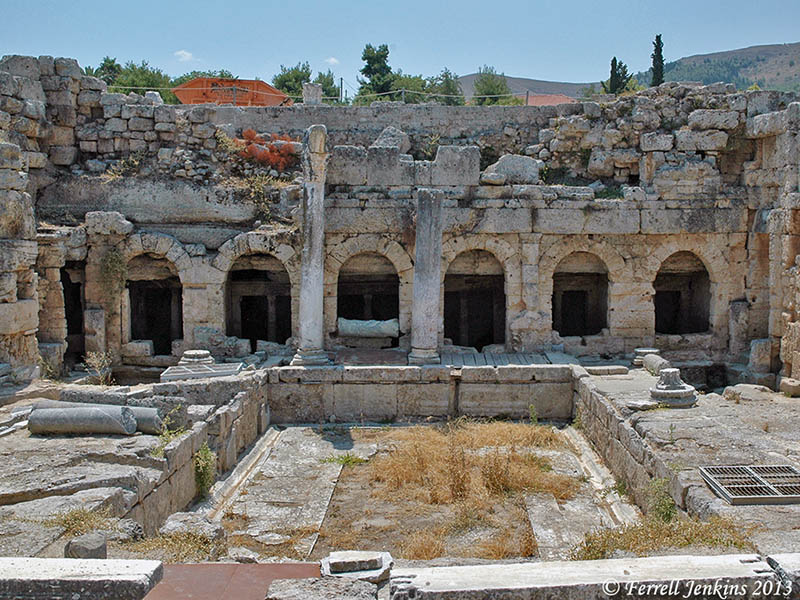
A large city such as Corinth needed a good water supply. Water from subterranean springs flowed underneath the city and was captured in a reservoir with a capacity of over 81,000 gallons. The Fountain of Peirene was the city’s most important water supply. Even now, if one stands anywhere near the openings in the once impressive structure he can hear the water flowing in the natural spring underneath the city.

The Fountain of Peirene at Corinth. Photo by Ferrell Jenkins.

The Fountain of Peirene at Corinth. Photo by Ferrell Jenkins.

An ornamental fountain once welcomed those who made the turn off the Lechaion Road to the Spring of Peirene.

An ornamental fountain in front of the spring. Photo by Ferrell Jenkins.

An ornamental fountain in front of the spring. Photo by Ferrell Jenkins.

The Lechaion Road at Corinth

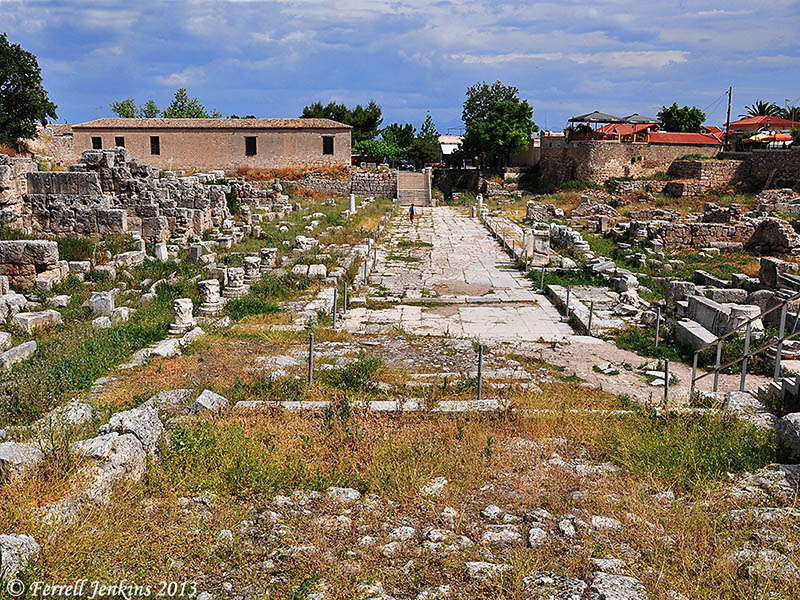
The Lechaion Road was the famous road that ran from the port of Corinth to the city. In Corinth the road was 20 to 25 feet wide, made of limestone, and flanked on either side by raised sidewalks and shops. The road ended at the agora which was directly to our back when we made the photo.

The Lechaion Road in Corinth. Photo by Ferrell Jenkins.

The Lechaion Road in Corinth. Photo by Ferrell Jenkins.

The Apostle Paul came to Corinth in the fall of A.D. 51 and remained until the spring of A.D. 53. During the eighteen months in the city he preached to both Jews and Greeks (Acts 18:1-4, 11).

A case can be made that there was a “lost letter” written by Paul to the Corinthians (1 Corinthians 5:9).

The document we call First Corinthians was written from Ephesus about A.D. 53/54.

Paul may have made a second visit to the city which ended in sorrow; some call this the “painful visit” of 2 Corinthians 2:1; 12:14; 13:1-4.

Paul proposed a third visit (2 Corinthians 12:14; 13:1-2), which probably took place during the three month stay in Greece (Acts 20:2-3). We believe that Paul wrote the letter to the Romans during this visit. Romans was delivered to the Romans by Phoebe, a servant of the church at Cenchreae (Romans 16:1).

Vandalism in Protestant Cemetery on Mount Zion

A little over a year ago I visited the Protestant Cemetery on Mount Zion in Jerusalem. Shortly thereafter a series of articles were posted about some of the persons buried there. See here for Spafford; here for Starkey; here for Schick; here for Fisher.

My friends Trent and Rebekah are currently students at the Jerusalem University College that adjoins the cemetery. In fact, one enters the locked cemetery gate through JUC property. Unfortunately, it would be possible for a person to enter the cemetery from the southwest corner where there is no fence.

Trent reports vandalism of some of the tombs with crosses last Sunday.

I’m sure you know of the “price tag” policy and campaign. [Yes, see here.]

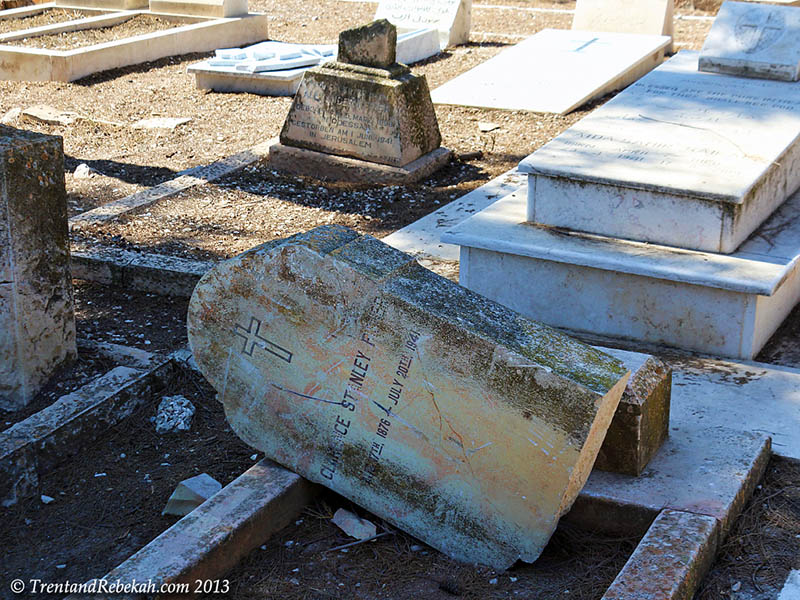
At some point on Sunday, not sure exactly when, vandals said to be associated with a Price Tag group entered the cemetery (not hard to do from the back/side) and smashed multiple tombstones which were bearing crosses. They also damaged at least one tombstone with Arabic writing.  I checked all the graves which you have written about on the blog (at least what I could find on the blog).  The only grave with damage seemed to be Clarence Fisher.  After talking with Dr. Wright, he says this tombstone was actually damaged in a similar attack about six months ago (photo attached).  The stone has been set back somewhat upright on the grave.

The incident on Sunday was incorrectly reported by some outlets as the nearby Catholic Cemetery.

Here is Trent’s photo of the broken headstone over Clarence Fisher’s grave.

Tomb of Clarence Fisher vandalized in Protestant Cemetery.

Tomb of Clarence Fisher vandalized in Protestant Cemetery.

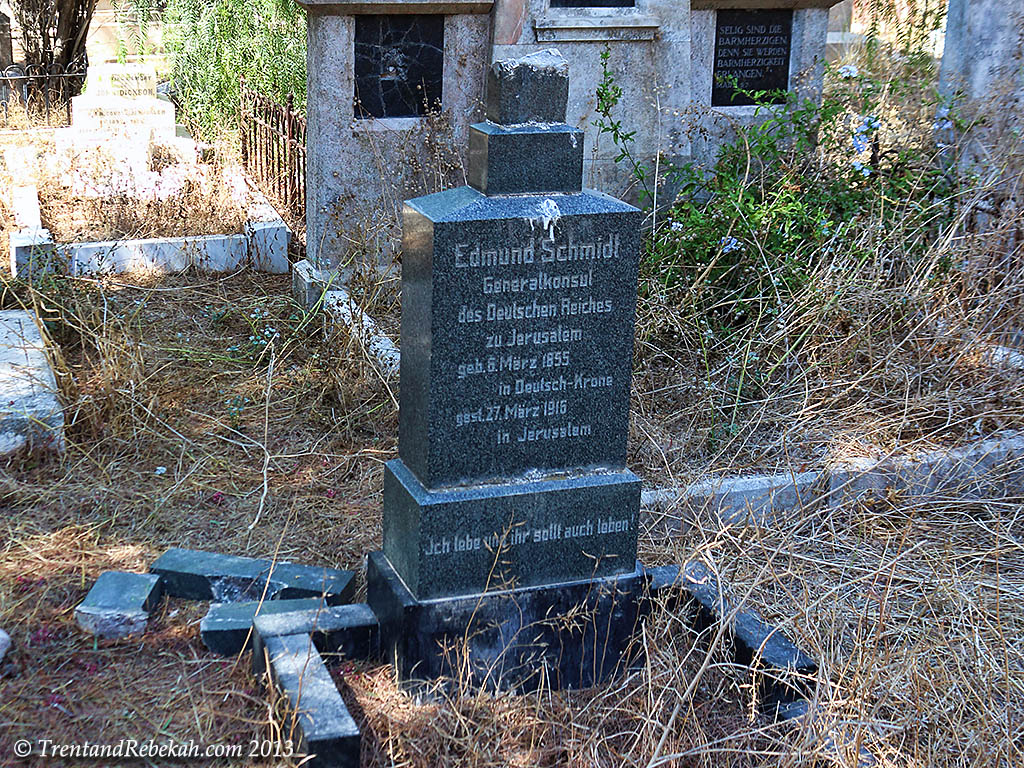
Another photo shows damage to the tomb of Edmund Schmidt, a German consul to Jerusalem.

Vandalized tomb of Edmund Schmidt.

Vandalized tomb of Edmund Schmidt.

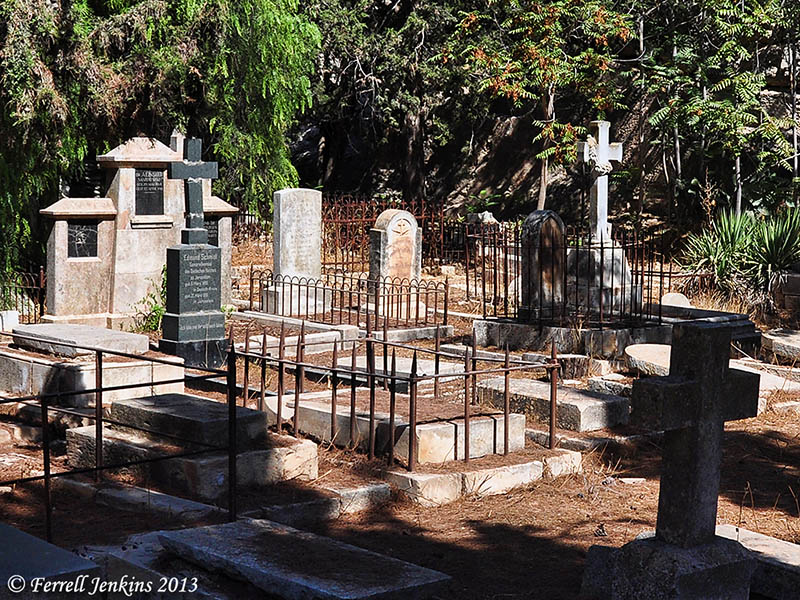
In browsing my photos of September, 2012, I noticed that the cross on this tomb had already been broken and poorly repaired. In the photo above you will see the three pieces of the cross to the left of the headstone.

Tomb of Edmund Schmidt, September, 2012. Photo by Ferrell Jenkins.

Tomb of Edmund Schmidt, September, 2012. Photo by Ferrell Jenkins.

I also noticed that numerous crosses had been broken.

When we destroy that of which we are ignorant we reflect lack of appreciation of any history. It happens all over the world. If we destroy that with which we disagree, what will happen when someone disagrees with us?

The apostle Paul spoke of himself as one who previously destroyed what he presently was rebuilding.

For if I rebuild what I tore down, I prove myself to be a transgressor. (Gal 2:18 ESV)

Ynet reports here and here the arrest of four Jewish youths in this episode.

Chester Beatty papyri digitized by CSNTM

The Center for the Study of New Testament Manuscripts (CSNTM) announces that they have filmed the Chester Beatty papyri. Here is the press release signed by Dr. Daniel B. Wallace, Executive Director of CSNTM:

The Chester Beatty papyri, published in the 1930s and 1950s, are some of the oldest and most important biblical manuscripts known to exist. Housed at the Chester Beatty Library (CBL) in Dublin, they have attracted countless visitors every year. It is safe to say that the only Greek biblical manuscripts that might receive more visitors are Codex Sinaiticus and Codex Alexandrinus, both on display at the British Library.

The Center for the Study of New Testament Manuscripts (CSNTM) is pleased to announce that a six-person team, in a four-week expedition during July–August 2013, digitized all the Greek biblical papyri at the Chester Beatty Library. The CBL has granted permission to CSNTM to post the images on their website (www.csntm.org), which will happen before the end of the year.

The New Testament papyri at the CBL include the oldest manuscript of Paul’s letters (dated c. AD 200), the oldest manuscript of Mark’s Gospel and portions of the other Gospels and Acts (third century), and the oldest manuscript of Revelation (third century). One or two of the Old Testament papyri are as old as the second century AD.

Using state-of-the-art digital equipment, CSNTM photographed each manuscript against white and black backgrounds. The result was stunning. Each image is over 120 megabytes. The photographs reveal some text that has not been seen before.

Besides the papyri, CSNTM also digitized all of the Greek New Testament manuscripts at the CBL as well as several others, including some early apocryphal texts. The total number of images came to more than 5100.

CSNTM is grateful to the CBL for the privilege of digitizing these priceless treasures. The staff were extremely competent and a joy to work with. Kudos to Dr. Fionnuala Croke, Director of CBL, for such a superb staff! This kind of collaboration is needed both for the preservation of biblical manuscripts and their accessibility by scholars.

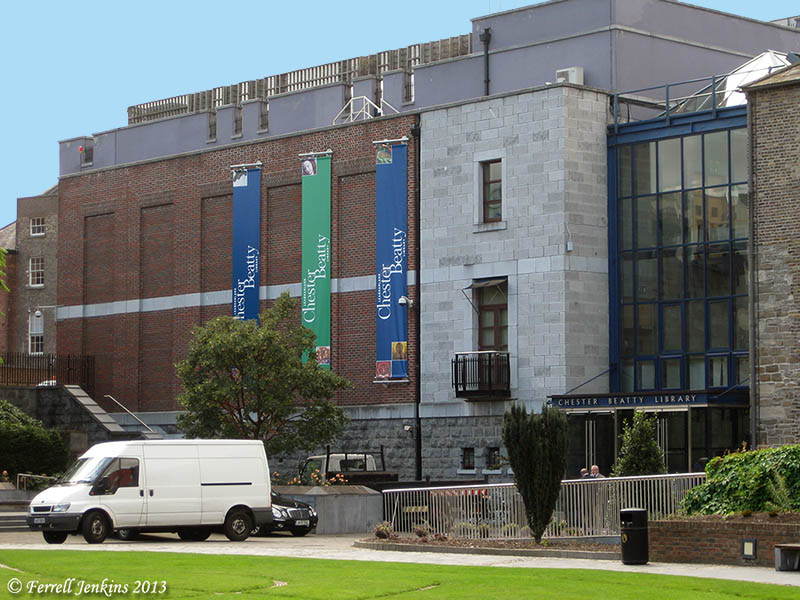
Chester Beatty Library in Dublin, Ireland. Photo by Ferrell Jenkins.

Chester Beatty Library in Dublin, Ireland. Photo by Ferrell Jenkins.

Larry Hurtado tells a little more about the background of this project here. If you wish to see the quality made possible by the CSNTM, see these pages from a 3rd century papyri at the University of Pennsylvania here.

On taking yourself too seriously

On the way from Luxor to the Valley of the Kings on the West Bank of the Nile one passes two huge statues known as the Colossi of Memnon. The statues are nearly 60 feet tall, and once stood at the entrance to the funerary temple of Amenhotep III (also known as Amenophis III). With their crowns, each statue would have been about 66 feet tall. Amenhotep III ruled Egypt during the 18th Dynasty (14th century B.C.).

During the time of the Roman Empire the statues were mistakenly associated with “Memnon, son of Eos and Tithonus, who was killed by Achilles during the Trojan War” (Baedeker’s Egypt).

The last time I was in the Valley of the Kings I noticed the head and chest of the statue had become a resting place for birds. Just an interesting picture, I thought.

Statue of Amenhotet III (or Amenophis III) on West Bank of Nile at Thebes (Luxor). Photo by Ferrell Jenkins.

Statue of Amenhotep III (or Amenophis III) on West Bank of Nile at Thebes (Luxor). Photo by Ferrell Jenkins.

Whether covered by sand or birds, this illustrates how the “mighty” are esteemed by many who follow. Don’t take yourself too seriously!

Paul: For by the grace given to me I say to everyone among you not to think of himself more highly than he ought to think, but to think with sober judgment, each according to the measure of faith that God has assigned. (Romans 12:3 ESV)

Huge columns said to be 1900-years-old found buried at Laodicea

Hurriyet Daily News reported today the discovery of a large number of “1,900-year-old huge columns” at Laodicea.

Excavations in the Aegean province of Denizli’s ancient city of Laodicea have revealed 1,900-year-old huge columns seven meters underground. The columns were found in the area known as the northern agora, one of the oldest faith centers in Anatolia.

The head of the excavations, Professor Celal Şimşek, said the northern agora had been discovered last year and they were continuing restoration and conservation work there. He said the area was one of the largest agoras in Anatolia. “The columned galleries here are in a rectangular shape on an area of 35,000 square meters. We previously revived the columned galleries that we call the eastern porch. This year we found the extension of these columns seven meters underground. They were in the same condition as when an earthquake ruined them. The columns date back to 1,900 years ago. Dust erosion and residue have filled the earth here and preserved the columns.”

Şimşek said their goal was to finish the excavations by the end of the year and to revive the columns in the beginning of the next year. He said the ancient city of Laodicea had served as a religious center.

“When the columned galleries are completely unearthed, there will be a very nice touring area. Tourists will have the chance to see traces from the past up close.”

A nice gallery of photos illustrate the article. One is a drawing showing how the area may have looked before being destroyed by earthquake. We are given no hint how the age of the columns was determined and whether the earthquake that felled them was also about 1,900 years old. Mark Wilson says,

Because of earthquakes the city was rebuilt numerous times during its history. A devastating earthquake during the reign of Focas (AD 602-10) finally caused the site to be abandoned. The residents founded a new city called Ladik, now the Kaleiçi district of Denizli. — Biblical Turkey, 247.

Laodicea is mentioned only in Paul’s epistle to the Colossians (2:1; 4:13-16) and in the Book of Revelation (1:11; 3:14). Paul says that Epaphras worked diligently for the saints in Colossae, Laodicea, and Hierapolis. These were cities of the Lycus River valley.

We have visited Laodicea several times over the years and been delighted with the archaeological reconstruction underway. The city should be on everyone’s list of “must see” sites of Turkey. Turkey has approximately 1100 historical sites, and the country has made considerable progress in preparing some of them for visitors. Use the search box on this blog to locate previous entries about Laodicea.

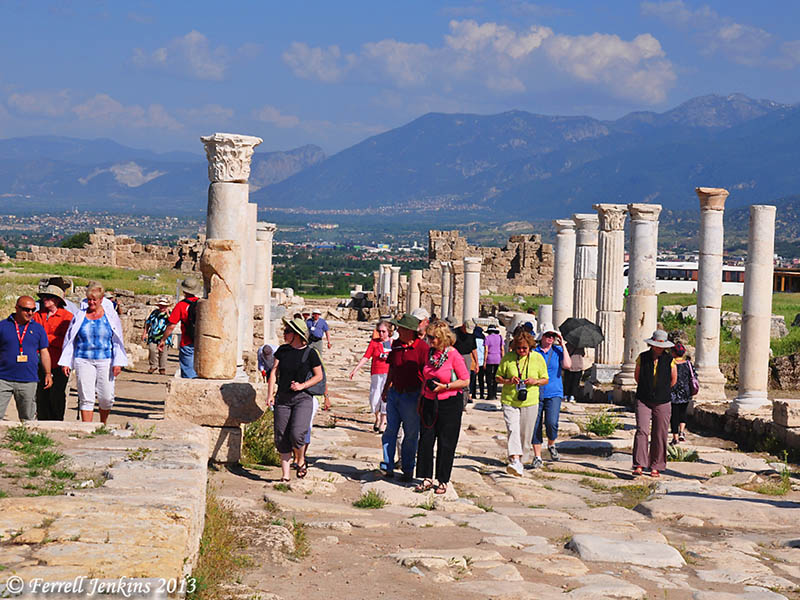
Tourists on the Syrian Street at Laodicea. Colossae is located at the foot of Mount Cadmus, seen in the distance to the east. Photo by Ferrell Jenkins.

Tourists on the Syrian Street at Laodicea. Colossae is located at the foot of Mount Cadmus, seen in the distance to the east. Hierapolis is to the north (our left as we view the photo). Photo by Ferrell Jenkins.

HT: Joseph I. Lauer