“Rejoice and be glad” you are not in Jerusalem

U.S. President Barack H. Obama plans a visit to Israel, the West Bank, Jordan, beginning Wednesday. Preparations are already under way. Arutz Sheva 7 reports here on the problems already evident.

In addition to the fact that Jerusalem is now one of the most difficult cities to navigate (my opinion based on 47 years of travel experience), the Passover is approaching. Jewish families must make many special preparations.

The President will be staying at the famous King David Hotel. If you planned to visit the Herodian Family Tomb behind the hotel, just forget it for a few days.

Over 5,000 police will be directly involved in providing security for Obama and his entourage, while hundreds of others will be helping out in indirect ways. For example, over 100 officers will be added to the police help line specifically to deal with issues called in by citizens relating to the Obama visit. Police will keep citizens updated on all aspects of the visit by phone and through social media.

Over 1,000 police alone will be deployed around the King David Hotel, where Obama will be staying, and will follow Obama around as he pays visits to people and institutions during his three day visit here.

Here is a photo of the King David Hotel from across the western part of the Hinnom Valley. It was taken either from the Protestant Cemetery, the Campus of Jerusalem University College, or a few meters to the north of that.
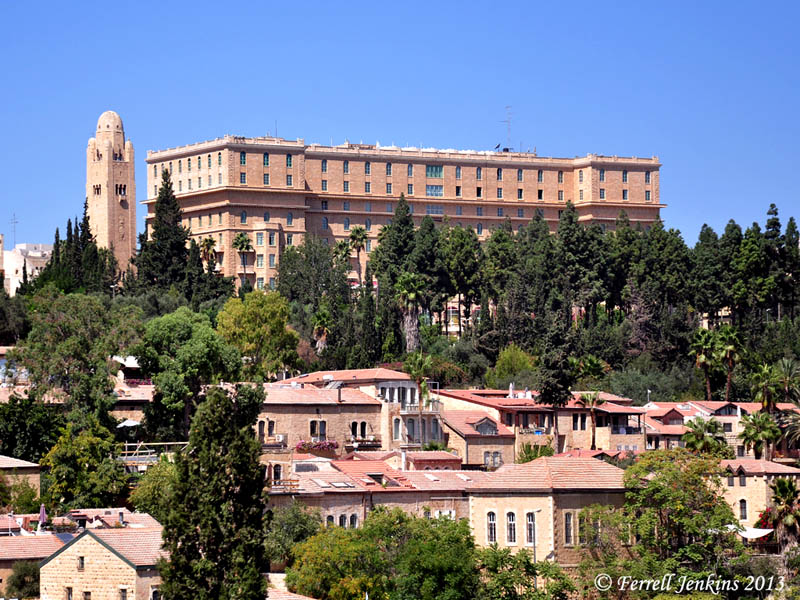
King David Hotel from the slope of Mount Zion. Photo by Ferrell Jenkins.

King David Hotel from the slope of Mount Zion. Photo by Ferrell Jenkins.

Take a look at some of the traffic problems.

Already on Sunday, long before Obama arrives, traffic in Jerusalem was extremely choked, as police began setting up barricades, and many Jerusalemites took to the road to finish their Passover shopping while the roads are still open.

Among the roads to be closed sporadically during Obama’s visit will be Road 1, between Ben Gurion Airport and the entrance to Jerusalem, as well as main Jerusalem thoroughfares such as Herzl Boulevard and Derech Hevron [Hebron Road]. Police said they will make every effort to ensure that roads are closed only of absolutely necessary.

Several years ago I was in Jerusalem when President Clinton came to visit. Our hotel was far from the Old City, but policemen were stationed about a block apart. Nations normally enjoy these high level visits, but I am not sure this current one means very much, but it keeps Air Force One running. (O.K., you have a right to your opinion.)

HT: Barry Britnell
Video about King Herod exhibit

CBN.tv has a nice brief video about the King Herod exhibit at the Israel Museum. This video features the exhibit as well as commentary by James Snyder, Israel Museum Director, and Dr. Sylvia Rozenberg, the Senior Curator. Here you will learn the rationale behind the million dollar exhibit that emphasizes Herod as a builder.

Click here for the short video.

For previous links to King Herod and this exhibit click here, or type the word Herod in the Search Box.

HT: the Book & the Spade.

Locusts still plague the Bible lands

References to locusts in the Bible are scattered from the time when the Israelites were in Egyptian bondage to the book of Revelation. Several Hebrew terms are used to describe locusts, perhaps of different species, or because of the various stages through which the locusts grow.

The prophet Joel uses the illustration of a locust invasion upon the land.

What the cutting locust left, the swarming locust has eaten. What the swarming locust left, the hopping locust has eaten, and what the hopping locust left, the destroying locust has eaten. (Joel 1:4 ESV)

Was he speaking of literal locusts, or of the invasion of a foreign enemy?

The prophet Amos speaks of the punishments brought by the LORD upon the northern kingdom of Israel prior to the Assyrian invasion.

“I struck you with blight and mildew; your many gardens and your vineyards, your fig trees and your olive trees the locust devoured; yet you did not return to me,” declares the LORD. (Amos 4:9 ESV)

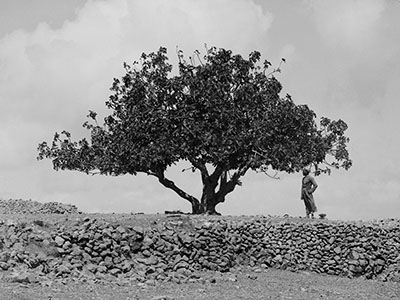
Notice that Amos makes specific reference to the fig trees and the olive trees. We have examples of this same thing happening during the 1915 locust plague. It was documented for National Geographic magazine by the photographs of Lewis Larson with a descriptive article by John D. Whiting. Here is a fig tree prior to the Locust plague.

Fig tree before the 1915 locust plague.

Fig tree before the 1915 locust plague.

And here is the way the same tree looked after the plague.

Fig tree after the 1915 locust plague.

Fig tree after the 1915 locust plague.

These two images are from the collection of 4,000 high-resolution photographs taken by resident photographers at the American Colony in Jerusalem from 1898 to the 1940s. The full set is available at Life in the Holy Land here. In addition to the photos in the collection, the photos are included in PowerPoint presentations. Descriptive information is included with many of them.

Several articles have appeared in the past week or so about a modern locust plague that affected Egypt and southern Israel. See here for Egypt. Some Jews, especially those from Yemen, gathered the photos [it was late; I meant locusts] for eating (see here). Some rabbis warned that the locusts may not be kosher (see here).

Just a reminder that some species of locusts were acceptable for the Israelites to eat.

Of them you may eat: the locust of any kind, the bald locust of any kind, the cricket of any kind, and the grasshopper of any kind. (Leviticus 11:22 ESV)

I know you can’t forget the diet of John the Baptist.

Now John wore a garment of camel’s hair and a leather belt around his waist, and his food was locusts and wild honey. (Matthew 3:4 ESV)

Seth Rodriquez provides more info about the 1915 plague here.

The theater at Beth-shean — a show of history

Beth-shean is mentioned only a few times in the Old Testament. The English Standard Version uses both Beth-shan and Beth-shean for this town. Other English versions use a variety of spellings including Bethshan.

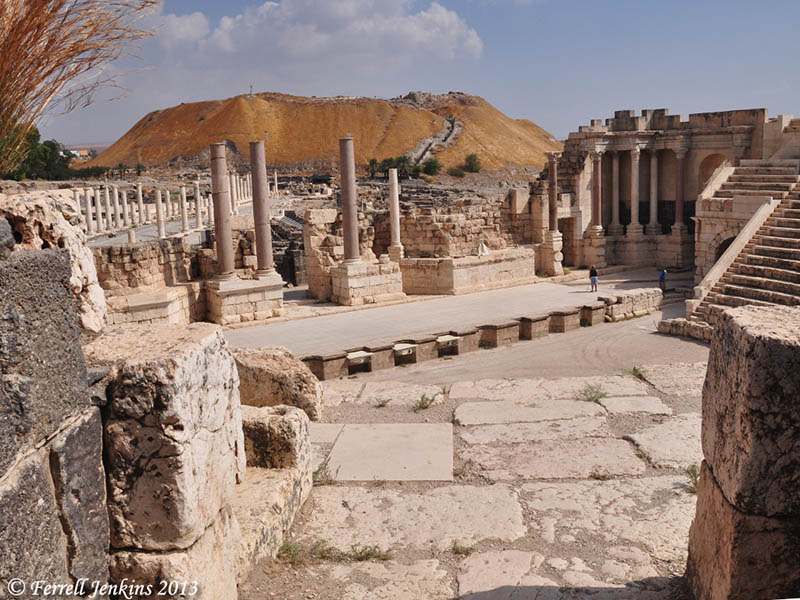
During one of my recent trips to Beth-shean I sat in the Roman theater and thought about the show of history that passed before my eyes. In the distance was the ancient tell, called Tell el-Husn or Tel Beth She’an, from which one has an impressive view of the area. Occupational levels date back at least to 3000 B.C. Artifacts from Canaan, Egypt, Anatolia, north Syria, and Mesopotamia have been uncovered from the mound.

For many Bible students the first event that comes to mind is the defeat of King Saul at the hands of the Philistines. After his death on nearby Mount Gilboa, Saul’s body was taken to Beth-shean and fastened to the wall of the city (1 Samuel 31).

View of Bethshan from the Roman theater. Photo by Ferrell Jenkins.

View of Tel Beth-Shean from the Roman theater. Photo by Ferrell Jenkins.

During the Greek period the city was named Scythopolis (city of the Scythians) and expanded to the foot of the tell.

In 63 B.C. the Romans, under the general Pompey, made the city part of the Decapolis (a league of ten cities; Matthew 4:25; Mark 5:20; 7:21). This was the only city of the Decapolis west of the Jordan River. The city was populated by gentiles, Jews and Samaritans.

The city grew to its largest size during the Byzantine period as a “Christian” city. It came under Muslim control in A.D. 636, and was destroyed by an earthquake in A.D. 749.

The destroyed Byzantine city lies between the theater and the mound. That’s a lot of history in one small place.

Jesus and the Sabbath

The Jews made charges that Jesus broke the Sabbath but they were not able to establish their charge. The basic charge was that Jesus was working in violation of the Mosaic law (Leviticus 23:3). Here is a list of the specific instances of events that took place on the Sabbath. Read the full accounts to see how Jesus responded.

  • Healed a man at the pool of Bethesda (John 5:1-9, 18; Jesus replied to accusations (John 7:21-24).
  • Healed the blind man (John 9:1-14).
  • Answered charges made against His disciples (Matthew 12:1-8; Mark 2:23-28; Luke 6:1-6).
  • Healed a man with a withered hand (Luke 6:6-11).
  • Healed the woman who was bent over (Luke 13:10-17).
  • He questioned the Pharisees regarding healing on the Sabbath and they could not answer Him. He healed the man with dropsy (Luke 14:1-5).
  • He taught in the synagogue in His “home town” on the Sabbath (Mark 6:1-6).

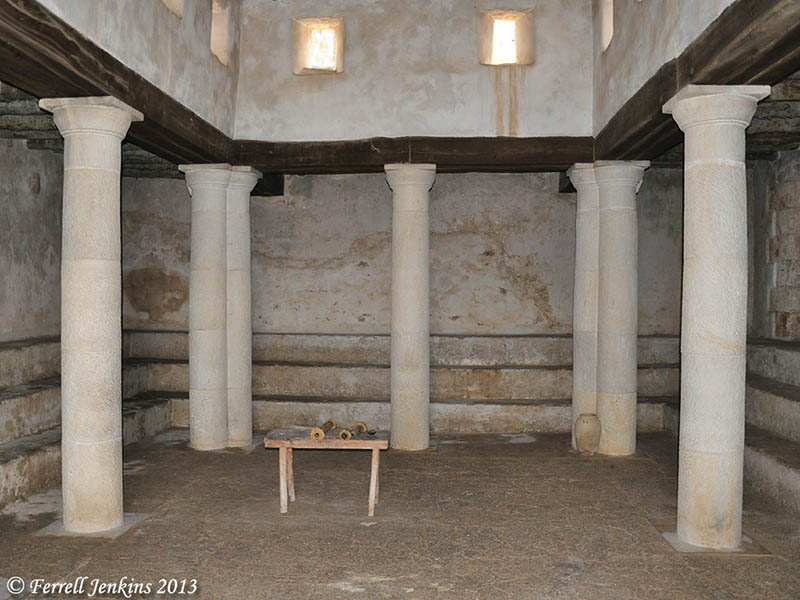
The photo below shows the interior of the model synagogue at the Nazareth Village.

Interior of the Nazareth Village Synagogue. Photo by Ferrell Jenkins.

Interior of the Nazareth Village Synagogue. Photo by Ferrell Jenkins.

The account of Jesus reading in the synagogue at Nazareth is recorded in Luke 4:16-21, with the reaction in the following verses.

And he came to Nazareth, where he had been brought up. And as was his custom, he went to the synagogue on the Sabbath day, and he stood up to read. And the scroll of the prophet Isaiah was given to him. He unrolled the scroll and found the place where it was written, “The Spirit of the Lord is upon me, because he has anointed me to proclaim good news to the poor. He has sent me to proclaim liberty to the captives and recovering of sight to the blind, to set at liberty those who are oppressed, to proclaim the year of the Lord’s favor.” And he rolled up the scroll and gave it back to the attendant and sat down. And the eyes of all in the synagogue were fixed on him. And he began to say to them, “Today this Scripture has been fulfilled in your hearing.” (Luke 4:16-21 ESV)

Horses in the Golan Heights

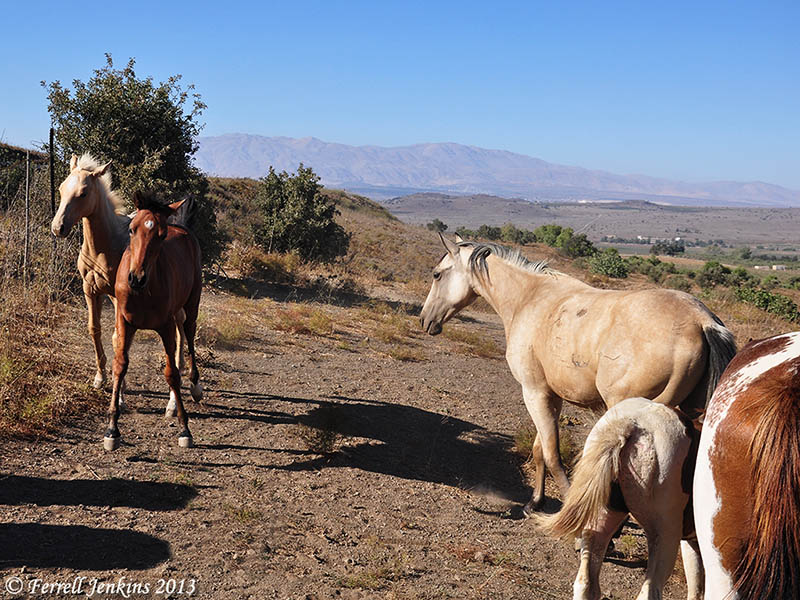
Last September we stopped in the Golan Heights at the overlook east to Kuneitra, Syria. A few horses were being pastured in the area. Mount Hermon is visible to the north.

Horses in the Golan Heights. Mount Hermon in the distance. Photo by Ferrell Jenkins.

Horses in the Golan Heights. Mount Hermon in the distance. Photo by Ferrell Jenkins.

This area is included in the description of the victories of the Israelites.

Now these are the kings of the land whom the people of Israel defeated and took possession of their land beyond the Jordan toward the sunrise, from the Valley of the Arnon to Mount Hermon, with all the Arabah eastward: (Joshua 12:1 ESV)

In search of Barnabas

A recent article (here) in the York [Pennsylvania] Daily Record features the research of Messiah College professor Dr. Michael Cosby. Cosby received a Fulbright Grant to do this research in Cyprus, a place associated with the life of Barnabas.

Barnabas is best known to most of us because of his association with the Apostle Paul on the first missionary journey. He is mentioned more than 20 times in the Book of Acts. Other than that, he is mentioned 3 times in Galatians 2, and once each in 1 Corinthians and Colossians.

We understand from Luke’s account that Barnabas, also known as Joseph, was a Levite of Cyprus (Acts 4:36). The first stop on the First Journey was at Salamis on the eastern end of the Mediterranean island of Cyprus (Acts 13:1-5). There the preachers spoke in the synagogue of the Jews, and later on the western end of the island at Paphos.

When Paul and Barnabas had a dispute prior to the Second Journey, Barnabas took his cousin Mark and went to Cyprus (Acts 15:36-41).

Nothing else is mentioned in the Bible about Barnabas and the island of Cyprus. But a great amount of tradition has grown up on the island. It is this tradition that Prof. Cosby studied, and he researched the association of the tradition to the modern Greek Orthodox Church of Cyprus, and the privileges granted to the Cypriot archbishops.

Having just visited Cyprus last year I find this a fascinating article. Perhaps you will enjoy it.

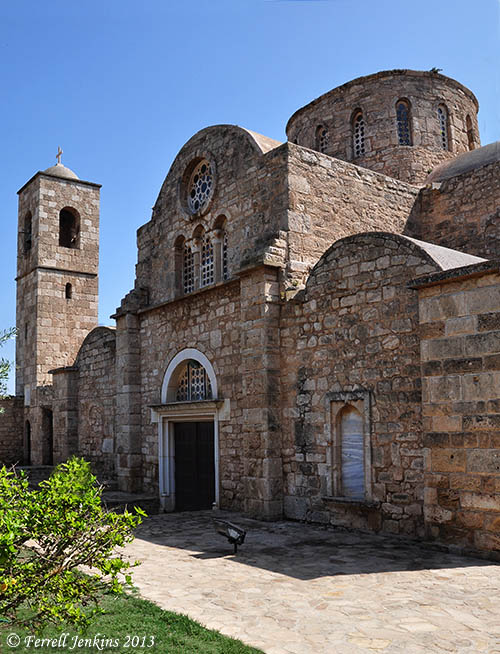
According to a tradition dating back to 488 A.D., the sepulcher of Barnabas was discovered by Anthemios, the Archbishop of Constantia and placed in a church he built near the tomb. The photo below shows the now-empty church near the ruins of Roman Salamis.

The Church of Barnabas at Salamis. Photo by Ferrell Jenkins.

The Church of Barnabas at Salamis. Photo by Ferrell Jenkins.

Salamis is now located in the the Turkish Republic of Northern Cyprus, or as the folks in the south of Cyprus say, “the occupied territory.”

Clarence Stanley Fisher — Armageddon

Clarence Stanley Fisher was trained as an architect at the University of Pennsylvania in his hometown of Philadelphia. He became involved in archaeology at Nippur, Iraq (the region of ancient Sumer). Later he worked with George Andrew Reisner at Giza, Egypt, and then at Samaria from 1908 to 1910. This expedition, sponsored by Harvard, was the first American excavation in Palestine. After a short time back at Giza, he excavated at Beth Shan (Beit She’an), a dig sponsored by the University of Pennsylvania.

Fisher received an invitation from the University of Chicago to work at Megiddo, a work funded by the Rockefeller family. This excavation continued from 1933 to 1939, but fisher stopped working at the site after two years because of bad health.

The Megiddo excavations were recounted by Fisher under the title The Excavation of Armageddon, a work published by the University of Chicago Press with a foreword written by James Henry Breasted. This work is available at Google Books.

From 1936 to the time of his unexpected death in 1941, Fisher served as Professor of Archaeology at the American Schools of Oriental Research in Jerusalem (now the Albright Institute).

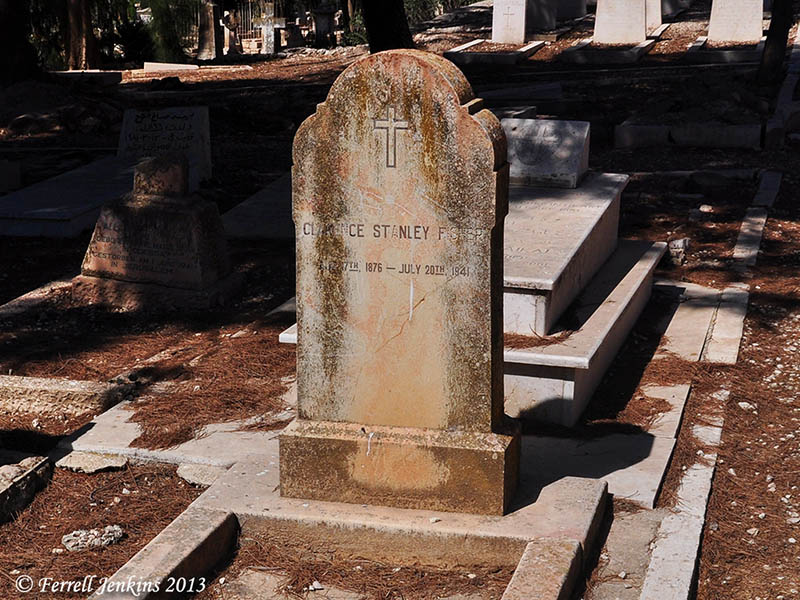
Fisher is buried at the Protestant Cemetery on Mount Zion in Jerusalem.

Grave marker for Clarence Stanley Fisher. Photo by Ferrell Jenkins.

Grave marker for Clarence Stanley Fisher. Photo by Ferrell Jenkins.

The brief information I have included here is summarized from a brief article by Milton C. Fisher in Bible and Spade 6:2 (Spring 1993). I get the impression that Milton is not related to Clarence. Milton Fisher cites two comments about C. S. Fisher that I wish to quote here.

W. F. Albright described Fisher as “an archaeological genius of no mean quality.”

Nelson Glueck wrote the following at the time of his death:

“The company of his friends misses him sorely. The host of those who loved him for his goodness of heart and humility of spirit will cherish the memory of this gentle man, whose last pilgrimage was to Nazareth, and whose final resting place is in Jerusalem.”

I find it fascinating to see so many well-known names associated with Fisher when Americans and American institutions were actively working in the Middle East.

Conrad Schick — architect, explorer, model builder

Conrad Schick was born in Switzerland and first came to Jerusalem with a group of men who planned to teach the local young people vocational trades. This group soon disintegrated, and Schick eventually married Friederike Dubler, a German missionary.

Schick became well known as an architect and city planner. He also became involved with some of the late 19th century explorers. He surveyed significant parts of the Old City, and built models of the temple mount and other structures in Jerusalem to use in teaching.

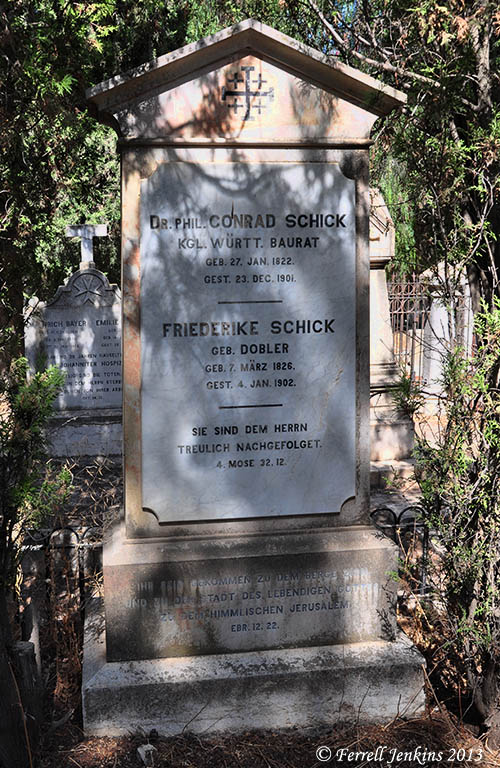
Schick and his wife are buried in the Protestant Cemetery on Mount Zion.

Grave marker for Conrad and Frederike Schick. Photo by Ferrell Jenkins.

Grave marker for Conrad and Frederike Schick. Photo by Ferrell Jenkins.

Epitaphs are often fascinating. This grave stone includes two Scriptures in German.

… for they have wholly followed the LORD (Numbers 32:12)

But you have come to Mount Zion and to the city of the living God, the heavenly Jerusalem … (Hebrews 12:22)

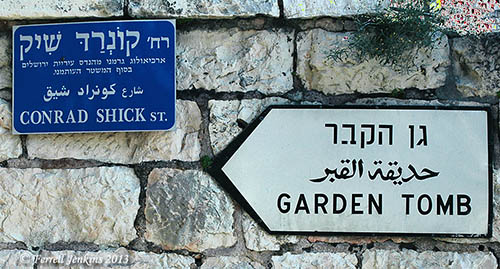
The short lane leading from Nablus Road to the Garden Tomb is named for Conrad Shick [Schick].

Conrad Schick Street leads to the Garden Tomb. Photo by Ferrell Jenkins.

Conrad Shick Street leads to the Garden Tomb. Photo by Ferrell Jenkins.

Tom Powers has prepared an article about Conrad Schick, and I have made use of it in this post. The entire paper is fascinating. See here.

There is also a page devoted to Schick here.

Special Note: If you have any interest in the American Colony, and other people buried in this cemetery, please take a look at the comments by Tom Powers (Outremer) following the two earlier posts about the Spaffords.

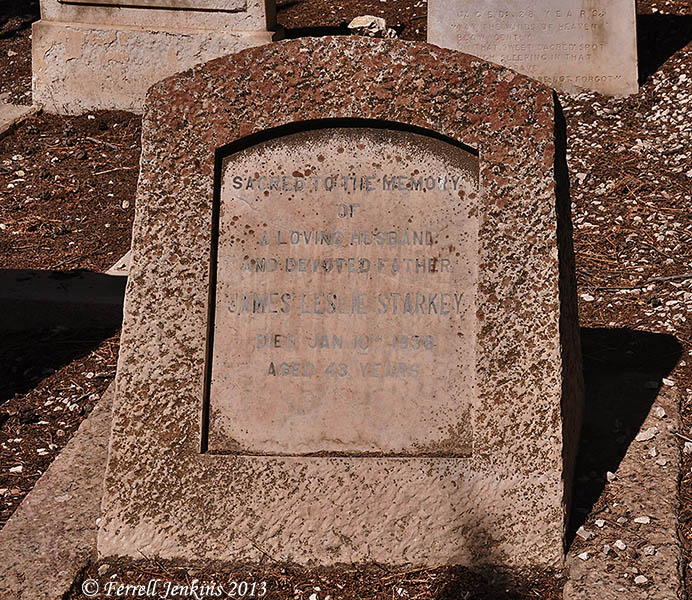
James Leslie Starkey, excavator of Lachish

James Leslie Starkey was born in London January 3, 1895. He became interested in ancient history by reading books such as Layard’s Nineveh and Its Remains. He took a course in Egyptology and came in contact with Flinders Petrie. Later he worked with Petrie in Egypt.

Starkey joined Petrie in the excavation at Tell Jemmeh, then at Tell el Far’ah (South) in southern Palestine, where he directed the dig during the final season.

In 1932 Starkey began his own dig at Tell ed-Duwer, identified as biblical Lachish. During his six years at the site, one of the more significant finds was the Lachish Letters which date to the period of the end of the Babylonian conquest of Judah, during the time of the prophet Jeremiah.

While on his way to Jerusalem in January 1938, for the opening of the new Palestine Archaeological (Rockefeller) Museum, Starkey was shot in an ambush.

Starkey was buried in the Protestant Cemetery on Mount Zion. Four years later the body of his former mentor, Flinders Petrie, was laid to rest a few yards away.

Tomb of James Leslie Starkey, excavator of Lachish. Photo by Ferrell Jenkins.

Tomb of James Leslie Starkey, excavator of Lachish. Photo by Ferrell Jenkins.

I found that information about Starkey is somewhat limited. Much of the info here has been gleaned from a page about Starkey on The Palestine Exploration Fund web site here. There you will see a photograph of Starkey with Petrie, and Olga Tufnell who spent twenty years to complete the four volumes of the Lachish Excavation Reports.