The Spafford grave in the Protestant Cemetery

How the Spaffords came to make Jerusalem their home is an interesting story, but I will leave it for you to read in Bertha Spafford Vester, Our Jerusalem: An American Family in the Holy City 1881–1949. It may be difficult to locate a copy of the book for a reasonable price, but it is available in Kindle format for $8.39. Click here: Our Jerusalem.

The members of the American Colony lived under a series of governments — the Turks, British, Jordanians, and Israelis. Horatio died in 1888 during the Turkish rule. The American Colony had secured a place for burials on the south eastern slope of the traditional Mount Zion overlooking the Hinnom Valley.

Before I can show you the grave marker of Horatio Spafford I should tell you about the desecration of his original grave. Toward the end of the 19th century, when the members of the American Colony needed a grave site, they learned that earlier burials had been removed and the remains placed “temporarily” in a large pit. After much effort, permission was granted by various ruling authorities for the bones to be gathered, and a small plot was granted for the burial of the American Colony members.

That small plot is pictured below. It is immediately inside the gate to the cemetery. The large marker identifies seven members of the American Colony whose remains were recovered: John C. Whiting; Horatio G. Spafford; William C. Sylvester; Herbert Drake; Margaret W. Lee; Geo. A. Fuller; John Miller. I have noticed at least four of these names in Vester’s Our Jerusalem. Whiting was also from Chicago. He and his family came to Jerusalem with the Spaffords, as did Margaret Lee.
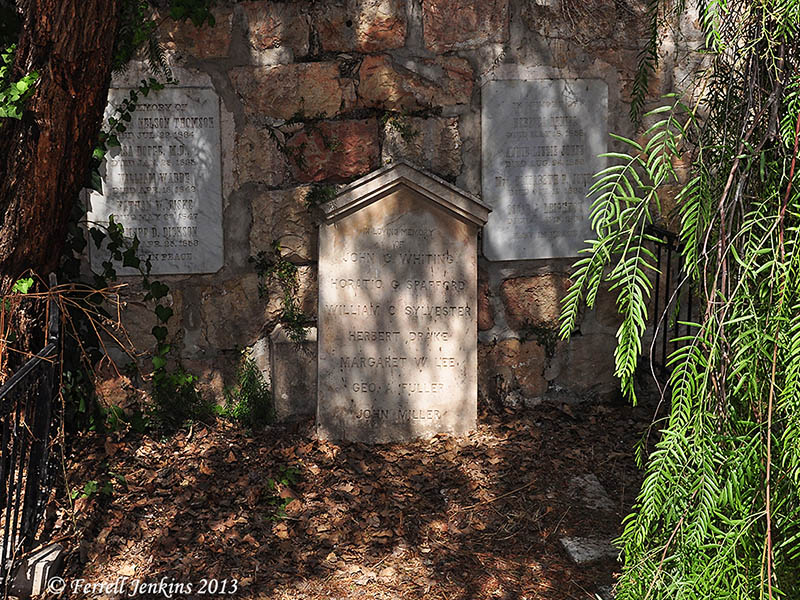
Grave stone for Spafford and other members of the American Colony in the Protestant Cemetery on Mount Zion. Photo by Ferrell Jenkins.

Grave stone for Spafford and other members of the American Colony in the Protestant Cemetery on Mount Zion. Photo by Ferrell Jenkins.

The two smaller markers in the wall identify others whose bones were recovered and buried in the common grave.

In 1896 a group of 37 Swedish farmers left Nås, Sweden, and made their way to Jerusalem. They took up residence at the American Colony. (Vester says there were 38, including 17 children, and a babe in arms. Perhaps the infant was born after leaving Sweden.) The Swedes mostly engaged in farming in the nearby Kidron Valley. I think you would enjoy reading the comment to the last post written by reader Erik Wold. You may see his photographs of Nås and read his Norwegian comments here (use Google Translate if you do not read Norwegian). The Swedish writer Selma Lagerlöf won a Nobel prize for her novel called Jerusalem, which was based on the American Colony. Bertha Vester says that her mother, Anna Spafford, “is the heroine in her book and is called Mrs. Gordon.”

Something else that has fascinated me is the fact that Eric Matson and the American Colony photographers worked from this location. About 40 years ago I edited a series of Bible Class literature called Truth in Life. We used some of Eric Matson’s wonderful Bible land photographs in the series. For more information about the work of Matson and the other photographers see Life in the Holy Land. I think Matson was the heir of one of the settlers from Sweden.

I do not know anything about the present ownership of the American Colony Hotel, but it is a prestigious 5-star luxury hotel.
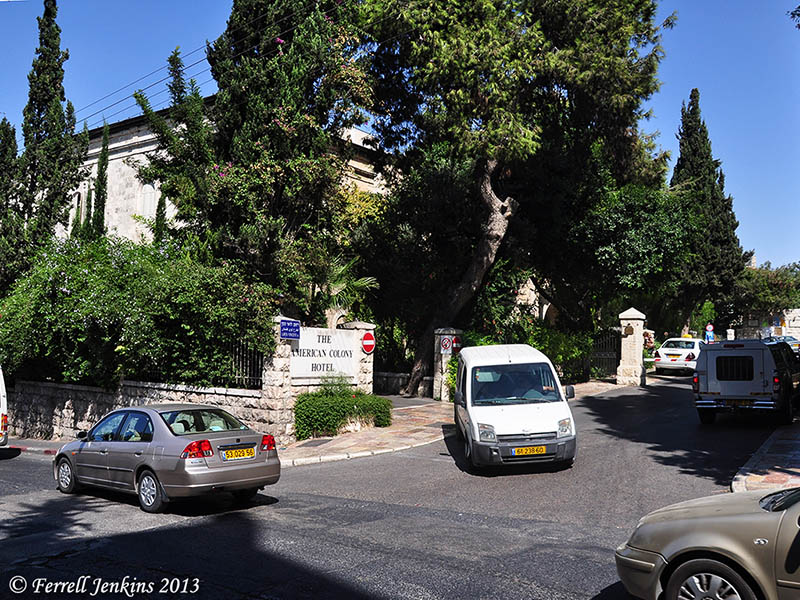
Entrance to the American Colony Hotel, Jerusalem. Photo by Ferrell Jenkins.

Entrance to the American Colony Hotel, Jerusalem. Photo by Ferrell Jenkins.

Would you like to see more photographs from the Protestant Cemetery?
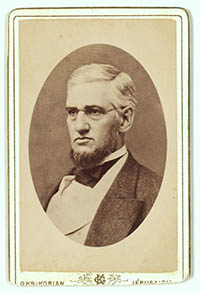
Horatio G. Spafford: “It Is Well With My Soul”

Last September I called attention here to the Protestant Cemetery on Mount Zion, Jerusalem. Several rather famous persons associated with archaeology and others who took up residence in Jerusalem have been buried there.

There seems to be a great amount of interest in the grave of Horatio Gates Spafford, the author of the well-known hymn, “It Is Well With My Soul.” Mr. Spafford was a well-known attorney in Chicago, but decided to give up his law practice and become involved in land sales. The great Chicago fire of October, 1871, brought many losses to Spafford.

Horatio G. Spafford

Horatio G. Spafford

At the advice of a physician, Spafford decided to take his wife, Anna, and their four little daughters to Europe. Reservations were made on the French ship S. S. Ville du Havre. While awaiting departure, Mr. Spafford received word that the man who was planning to buy a large parcel of land from him had died suddenly. Spafford could not tell his wife the bad news, but told her he needed to return to Chicago to take care of business. He would come as quickly as possible on a later crossing.

On the night of November 21, 1873, a British sailing ship rammed the Ville du Havre, resulting in the loss of many lives. The four little Spafford girls were lost at sea. When Anna Spafford reached land on another ship, she sent a cable to her husband with the words “Saved Alone.”

Horatio made plans to join his wife in England. As he made his way across the Atlantic, the captain called him and Mr. Goodwin into his private cabin.

“A careful reckoning has been made,” he told them, “and I believe we are now passing the place where the Ville du Havre was wrecked.”

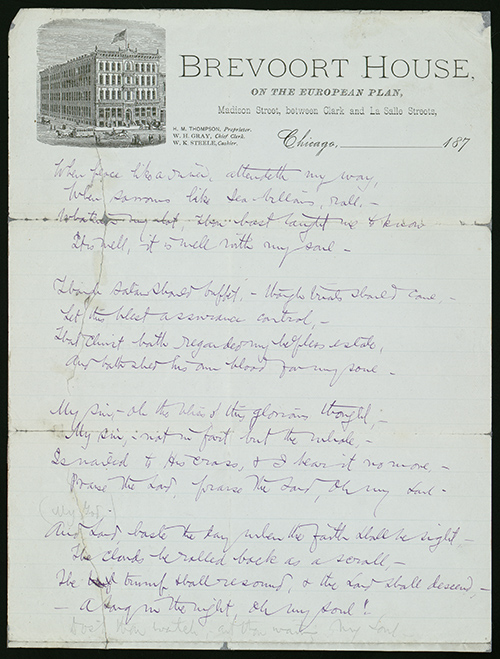
Spafford returned to his cabin and wrote the words to the hymn that has given comfort to many believers in Jesus.

Handwritten lyrics of "It Is Well With My Soul."

Handwritten lyrics of “It Is Well With My Soul.”

Here are the lyrics, later put to music by Phillip P. Bliss.

  1. When peace, like a river, attendeth my way,
    When sorrows like sea billows roll;
    Whatever my lot, Thou has taught me to say,
    It is well, it is well, with my soul.

    • Refrain:
      It is well, with my soul,
      It is well, it is well, with my soul.
  2. Though Satan should buffet, though trials should come,
    Let this blest assurance control,
    That Christ has regarded my helpless estate,
    And hath shed His own blood for my soul.
  3. My sin, oh, the bliss of this glorious thought!
    My sin, not in part but the whole,
    Is nailed to the cross, and I bear it no more,
    Praise the Lord, praise the Lord, O my soul!
  4. For me, be it Christ, be it Christ hence to live:
    If Jordan above me shall roll,
    No pang shall be mine, for in death as in life
    Thou wilt whisper Thy peace to my soul.
  5. But, Lord, ’tis for Thee, for Thy coming we wait,
    The sky, not the grave, is our goal;
    Oh, trump of the angel! Oh, voice of the Lord!
    Blessed hope, blessed rest of my soul!
  6. And Lord, haste the day when my faith shall be sight,
    The clouds be rolled back as a scroll;
    The trump shall resound, and the Lord shall descend,
    Even so, it is well with my soul.

The images I have used are from the Library of Congress exhibition about the American Colony, Jerusalem. See here.

The story I have recounted is that told by Bertha Spafford Vester, a daughter later born to the Spaffords, in her book, Our Jerusalem: An American Family in the Holy City 1881–1949.

In a post to follow I plan to show you the grave marker of Horatio Spafford and others associated with the work at the American Colony.

Herod the Great in the Israel Museum

Are you planning a visit to Jerusalem during the upcoming months? I suggest you visit the Israel Museum. There is much to see that is of importance to Bible students. We called attention to some of the archaeological artifacts several times.

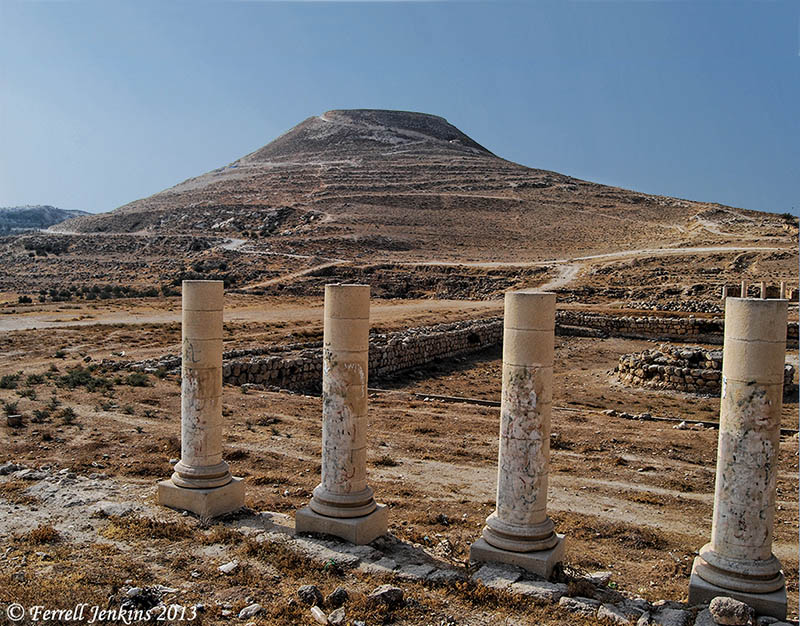
We have written about the Herodium here, here, here, here, and here (and perhaps a few other places) in this blog.

View of the Herodium toward the east. Photo by Ferrell Jenkins

View of the Herodium toward the east. Photo by Ferrell Jenkins

The Israel Museum recently opened a new exhibition called Herod the Great: The King’s Final Journey. The exhibition includes a reconstruction of the tomb and sarcophagus of the King from the Herodium. I suggest you begin by reading the article about the exhibition in The New York Times here.

Shmuel Browns, a tour guide in Israel, and a fellow-blogger, is quoted in the article. Please take a look at the beautiful photos and descriptions of the new exhibition by Browns.

Carl Rasmussen calls attention to the articles by Browns, and includes a nice photo of the large model of what Prof. Netzer thought the monumental tomb of Herod might have looked like here.

I’m looking forward to seeing this exhibition in a few weeks.

Green pastures

David, in describing the LORD as his shepherd, pictures himself as a sheep.

The LORD is my shepherd; I shall not want. He makes me lie down in green pastures. He leads me beside still waters. (Psalm 23:1-2 ESV)

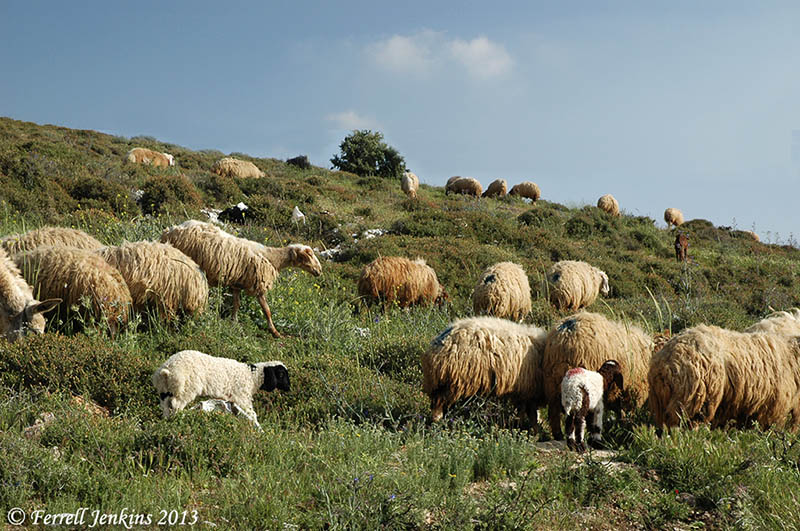
The picture below was made near Heshbon on the Transjordan plateau. It is rare in Israel or Jordan to see sheep in such an abundance of grass.

Sheep near Heshbon in Trans-Jordan. Photo by Ferrell Jenkins.

Sheep near Heshbon in Trans-Jordan. Photo by Ferrell Jenkins.

The Hebrew term mishor describes “level country, table-land, plain … specifically of the elevated plateau or table-land between the Arnon and Heshbon” (Brown, Driver, Briggs). Take a look at Joshua 13:17 in several English translations. Most of the popular English versions use the term plain. The NIV and the CSB use the term plateau.

We describe the area east of the Jordan Valley, now in the Hashemite Kingdom of Jordan, as Transjordan (the area across the Jordan). There are many hills, even mountains, in Transjordan, but the entire area is a plateau. In Israel there is a central mountain range between coastal plains and the Jordan Valley.

Like a cluster of henna…

Henna is mentioned only twice in the Bible, both in the Song of Solomon (or Canticles). The Shulammite girl describes her beloved.

My beloved is to me a cluster of henna blossoms in the vineyards of Engedi. (Song of Solomon [Canticles] 1:14 ESV; see also 4:13)

Scholars are divided about the meaning of the Hebrew term used here. Is this woman named Shulamith? Is she from the Jezreel Valley town of Shunem? Is she described as “the Perfect One” (NET Bible)? Or, is there some other plausible explanation?

Tristram mentions finding the “camphire of Engedi” at the site (cf. KJV transliteration of the Hebrew kopher).

The camphire of Engedi, mentioned in the Book of Canticles, we identified in a pretty shrub, with bunches of graceful pink-white blossoms, which was already in flower in some sheltered nooks, and called El-Henna by the Arabs, from which they procure the Henna dye—the Lawsonia alba of botanists. (The Land of Israel: A Journal of Travels in Palestine, Undertaken With Special Reference to Its Physical Character, 294-95).

Some small plants identified as henna can be seen at Neot Kedumim in the low hill country between Modi’in and Tel Aviv. Both they and the Fauna and Flora of the Bible identify it with the Lawsonia inermis. I don’t know how to sort out this name and the Lawsonia alba that Tristram mentions.

Henna growing at Neot Kedumim. Photo by Ferrell Jenkins.

Henna growing at Neot Kedumim. Photo by Ferrell Jenkins.

Henna is used by women of many societies on their hands, and other parts of the body. In several places I have seen local women painting designs on those who wished to try it.

One of the young ladies of my tour got henna tatoos from the Nubians in southern Egypt. Photo by Ferrell Jenkins.

Stacy got henna tattoos from a Nubian lady in southern Egypt near Aswan. She says it lasted about three weeks. Photo by Ferrell Jenkins.

Stacy tells me that the henna caused quite a stir when she returned to work. She says,

I talked with my hands. I gestured during a meeting and it stopped the meeting cold. Everyone stared. I said, “not to worry … it will disappear in 3 weeks” and continued on with the point I was making. 🙂

Life is fun.

Some suggested reading…

Wayne Stiles has a nice blog in which he connects the Bible and its Lands to life. He has suggested five other blogs for his readers here. I am honored to be included in his list. I appreciate these introductory words.

Where biblical events took place are more than throwaway mentions in the pages of Scripture. Often, they have significant bearing on God’s participation in the lives of His people.

Unfortunately, because we’re unfamiliar with geography we often miss these nuggets. I have found a lot of help in several Holy Land blogs that open up the Bible’s lands to my understanding.

Take a look at his list here. How many of them do you read?

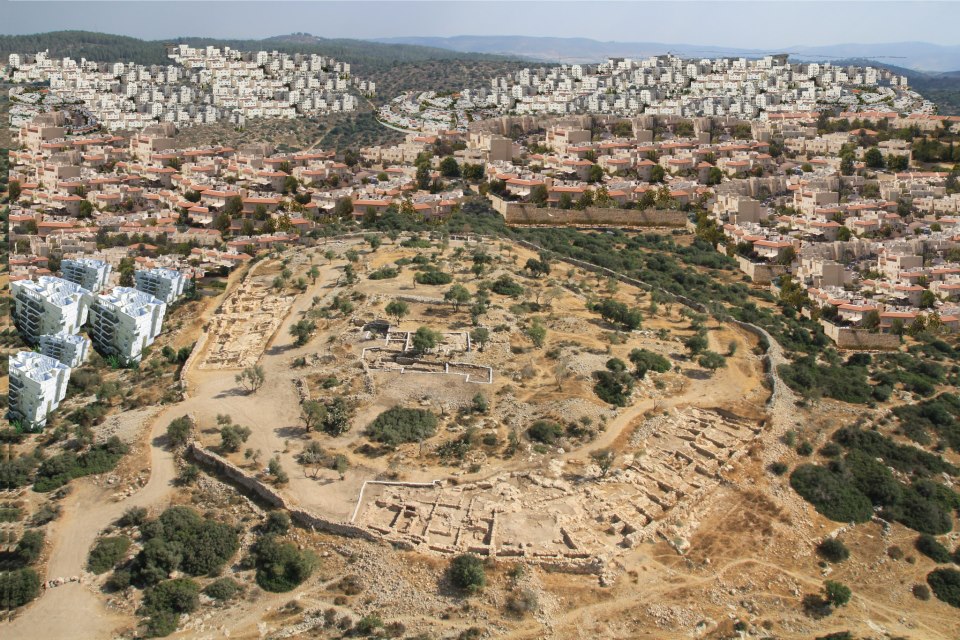
My friend and neighbor Luke Chandler has participated in the archaeological excavations at Khirbet Qeiyafa for at least three years. Qeiyafa is a city overlooking the Valley of Elah. Luke reported recently that a massive building program at the nearby town of Beit Shemesh would bring new residential buildings “no more than 20 meters from Qeiyafa’s western gate and wall.” At the present time the entire area from Qeiyafa eastward is without housing. The houses that have been drawn in show the proposed construction. Progress is sometimes good, but this is sad.

Proposed construction at Khirbet Qeiyafa.

The current plan for the expansion of Beit Shemesh. Some buildings are no more than 20 meters or so from the casemate wall and gate. The likelihood of damage to the site during and after construction would be significant. (Comment by Luke Chandler)

You can read Luke’s comments and see others photo here. Visit the Khirbet Qeiyafa: Save King David’s City Facebook page here. You will find more photos and diagrams.

The Great Pool at Gibeon

There are two references in the Bible to the pool of Gibeon. The first is in the account of a conflict between Abner and those aligned with King Saul, and Joab and the servants of David (2 Samuel).

Abner the son of Ner, and the servants of Ish-bosheth the son of Saul, went out from Mahanaim to Gibeon.  And Joab the son of Zeruiah and the servants of David went out and met them at the pool of Gibeon. And they sat down, the one on the one side of the pool, and the other on the other side of the pool.  (2 Samuel 2:12-13 ESV)

Arnold’s entry in The Anchor Yale Bible Dictionary says,

This “pool” undoubtedly refers to the impressive water system uncovered at el-Jib during recent archaeological excavations” [by Pritchard in the 1950s].

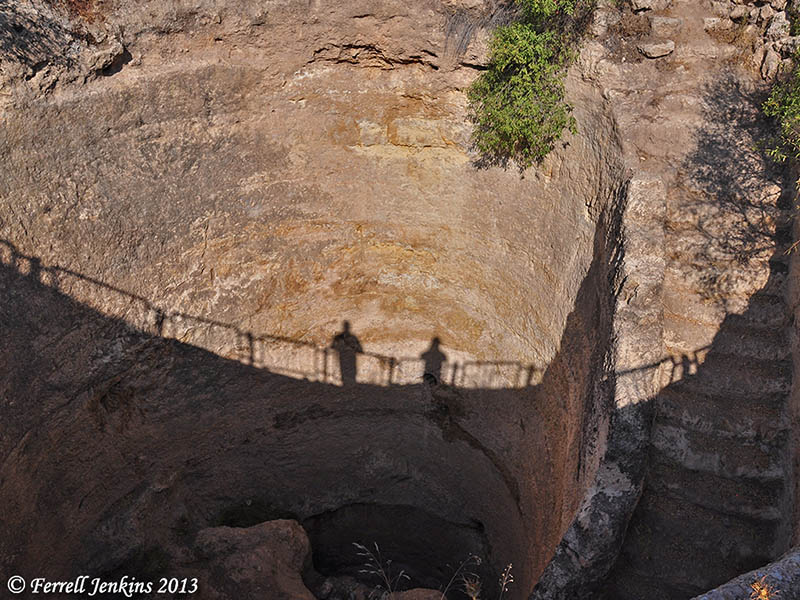
The pool had been constructed in the late 12th or early 13th century B.C. At first, it was thought to be a reservoir intended to hold water. Later it was learned that it served as a stairway leading to a source of water underneath the city.

After the destruction of Jerusalem by the Babylonians, the king of Babylon   made Gedaliah governor over the land. A rebellion led by a man named Ishmael killed Gedaliah at Mizpah (Jeremiah 41). The followers of Gedaliah and the men of Ishmael met at the great pool in Gibeon.

they took all their men and went to fight against Ishmael the son of Nethaniah. They came upon him at the great pool that is in Gibeon. (Jeremiah 41:12 ESV)

The great pool of Gibeon, cut from rock, measures 37 feet in diameter and 35 feet deep. Photo by Ferrell Jenkins.

The great pool of Gibeon, cut from rock, measures 37 feet in diameter and 35 feet deep. The steps led to the source of water located underneath. Photo by Ferrell Jenkins, whose shadow is visible, along with Leon Mauldin, standing at ground level.

For more information see James B. Pritchard’s Gibeon Where the Sun Stood Still (1962). For a ground level photo of the pool, see here.

Speaking at Florida College Annual Lectures

Tuesday morning at 10 a.m. I am scheduled to present an illustrated lecture on Biblical Coastal Towns of Turkey in Puckett Auditorium at the Florida College Annual Lectures. Normally in these sessions, in which I have participated in for many years, I present material on lesser-visited places that are important to Bible study.

There are several important coastal towns in Turkey that are mentioned in the Bible, mostly in connection with the journeys of Paul. These include Troas, Assos, Ephesus, Miletus, Patara, Myra, Attalia, Perga, and Seleucia. I have chosen to discuss two Black Sea cities (Sinope and Samsun) that are related to the discussion of the route of delivery of the Epistles of Peter, and to two cities on the Mediterranean Sea (Patara and Myra). I was able to visit all of these cities during the past year.

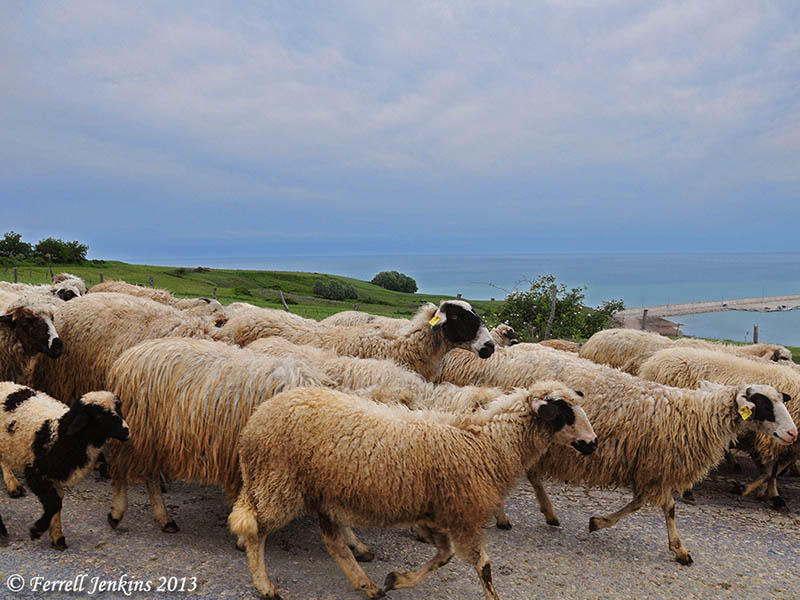
The photo below was made a few miles east of Sinope along the Black Sea (ancient Euxine). The territory is mountainous and the road is often far enough inland that the sea is not visible. Here the road runs along the sea, but still considerably above it. To the south, the mountains are much higher.

Sheep on the road east of Sinope, above the Black Sea. Photo by Ferrell Jenkins.

Sheep on the road east of Sinope, above the Black Sea. Photo by Ferrell Jenkins.

Nabatean town of Avdat restored

Avdat is located in the Wilderness of Zin, about 50 miles south of Beersheba. The beautiful ruins were vandalized about three years ago. Six different Israeli ministries invested nearly $2 million to repair the damage. The city has been designated by UNESCO as a world’s cultural heritage site.

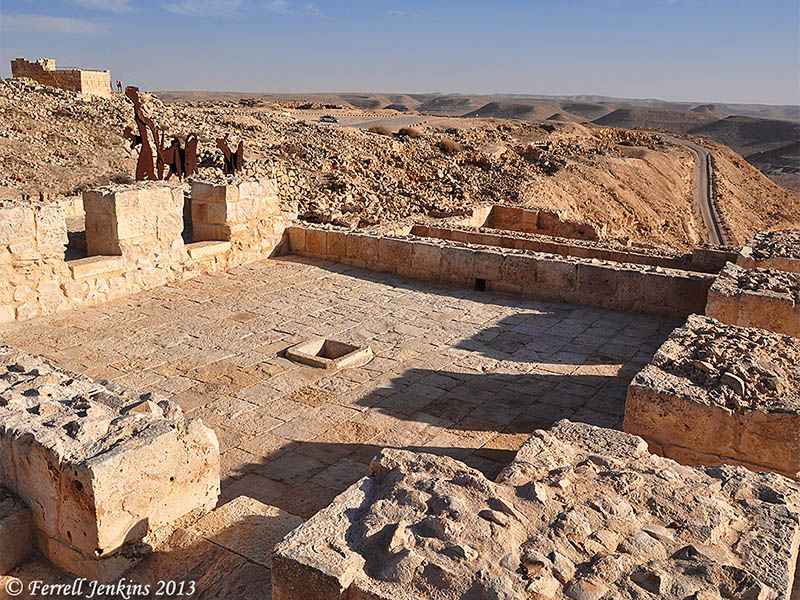
There are four wine presses at Avdat. The one I am showing below is a large Byzantine wine press.

Byzantine wine press at Avdat. Photo by Ferrell Jenkins.

Byzantine wine press at Avdat. Photo by Ferrell Jenkins.

Murphy-O’Connor describes the winepress.

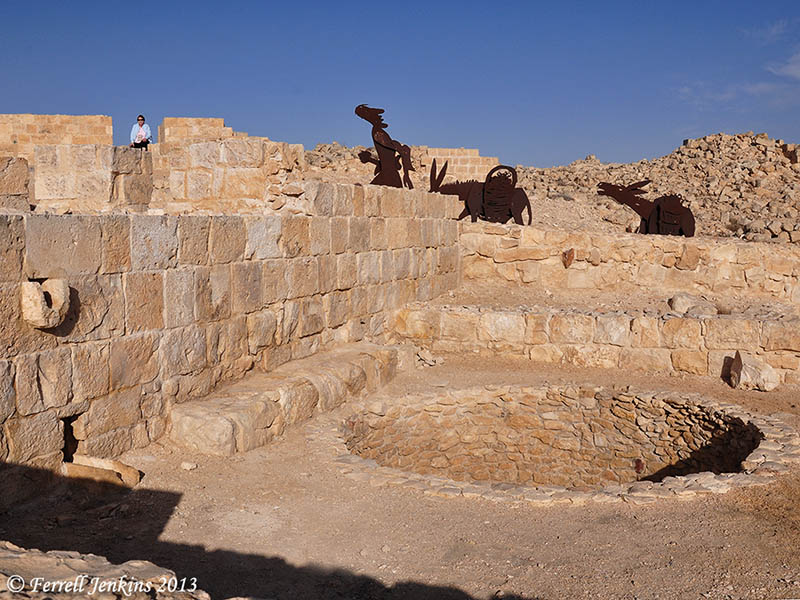
The winepress has a square treading area into which grapes were fed from small storage rooms on three sides. On the fourth side is a round pit into which the grape juice flowed via a channel under the treading floor from a central sump. – The Holy Land, 201.

The next photo shows the round pit.

The round pit into which the juice flowed. Photo by Ferrell Jenkins.

The round pit into which the juice flowed. Photo by Ferrell Jenkins.

I have never been able to take a group to Avdat, but I have made personal visits twice. See here and here.

For more information on the restoration see here.

Boxers in the Roman World

Our photo today is of a terracotta statuette of an African boxer. According to the sign accompanying the statuette, it is Roman, possible made in Italy.

The gloves are the Roman caestus, equipped with balls of lead to give a brutal blow.

Terracotta statuettes of African boxers. British Museum.

Terracotta statuette of an African boxer. British Museum. Photo by Ferrell Jenkins.

Paul used a boxing illustration to describe his own disciplined work in preaching.

So I do not run aimlessly; I do not box as one beating the air. But I discipline my body and keep it under control, lest after preaching to others I myself should be disqualified. (1 Corinthians 9:26-27 ESV)