Mysterious structure in the Sea of Galilee

Scientists report the discovery of a mysterious structure in the Sea of Galilee on the SW “corner” near the site of Bet Yerah.

According to Live Science here, this structure is made of large basalt blocks. These volcanic stones are common in the region.

A giant “monumental” stone structure discovered beneath the waters of the Sea of Galilee in Israel has archaeologists puzzled as to its purpose and even how long ago it was built.

The mysterious structure is cone shaped, made of “unhewn basalt cobbles and boulders,” and weighs an estimated 60,000 tons the researchers said. That makes it heavier than most modern-day warships.

Rising nearly 32 feet (10 meters) high, it has a diameter of about 230 feet (70 meters). To put that in perspective, the outer stone circle of Stonehenge has a diameter just half that with its tallest stones not reaching that height.

You will need to check the Live Science report, or the original scholarly article from International Journal of Nautical Archaeology (Vol. 42: Issue 1; March 2013) here or here (pdf). There you will find a map, photos and drawings of the structure.

I stopped very near the spot of the structure to make some photos of ripe date palms a few years ago.

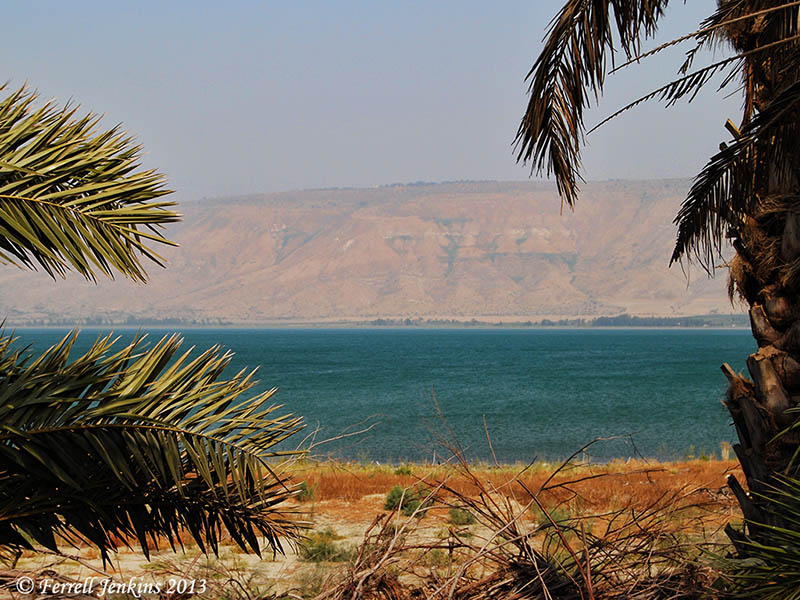
The Sea of Galilee near Bet Yerah. The view is to the east across this narrow southern end of the lake. Photo by Ferrell Jenkins.

The Sea of Galilee near Bet Yerah. The view is to the east across this narrow southern end of the lake. Photo by Ferrell Jenkins.

Whatever this structure and it purpose, it seems to have existed long before any of the biblical activity recorded in the region.

HT: Joseph I. Lauer

Syrian archaeological site endangered — a look at Ebla

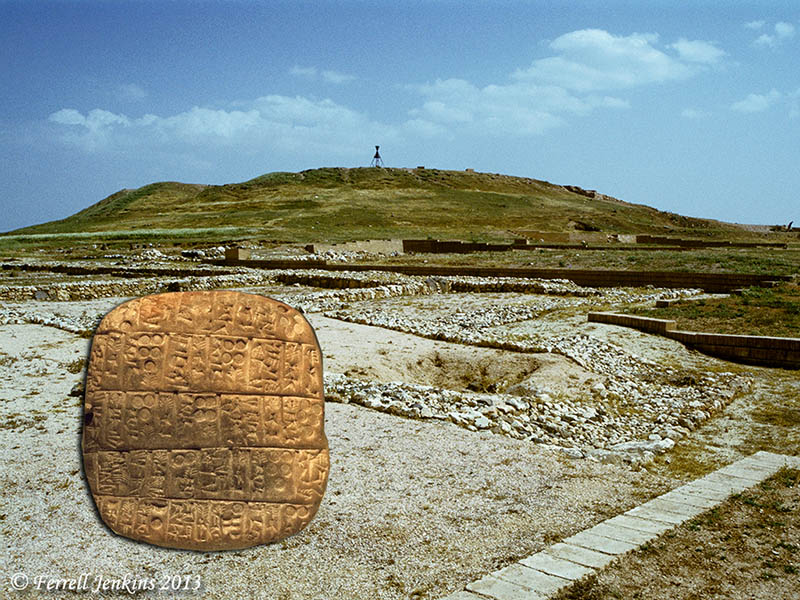
During the course of the bloody civil war in Syria we have heard of damage to various archaeological sites such as Aleppo and Palmyra. A recent article in The New York Times here includes a report specific to Tell Mardikh in northern Syria, about 30 miles SW of Aleppo.

The headline tells the story, “Grave Robbers and War Steal Syria’s History.” An excellent video illustrates what both of these factors (vandalism and war) are doing to destroy the ancient site.

Tell Mardikh, ancient Ebla, and one of the tablets discovered in 1975. Photo by Ferrell Jenkins.

Tell Mardikh, ancient Ebla, and one of the tablets discovered in 1975. Photo by Ferrell Jenkins.

We have previously written about Ebla, and the Ebla tablets, here, and here.

More than 17,000 cuneiform tablets were discovered in 1975. They date to the mid-third millennium B.C. when Ebla was the capital of a great Canaanite empire. Scholars state that there are important affinities between the Eblaite language and biblical Hebrew, both being members of the Northwest Semitic family.

The first golden age of Ebla is dated to 2400–2250 B.C. This is long before the time of Abraham who lived north of Ebla at Haran in Padan Aram for a time. Haran is about 150 miles north of Ebla.

So Abram went, as the LORD had told him, and Lot went with him. Abram was seventy-five years old when he departed from Haran.  (Genesis 12:4 ESV)

The death and destruction that has been going on in Syria is almost beyond comprehension. When we destroy our ancient history we become what Elton Trueblood called the Hippie generation, “a cut-flower generation.”

Ancient Sumerian site excavated

Mike Addelman, Press Officer of the Faculty of Humanities at the University of Manchester, has been kind enough to provide us with some photos of the recent excavation of Tell Kahiber.

Some of us might easily drive past the ancient mound without realizing that it was an ancient archaeological site. Prof. Stuart Campbell and Dr. Jane Moore, both of Manchester University, and independent archaeologist Robert Killick, first recognized important features of the tell on satellite images.

Early stages of excavation at ancient settlement mound of Tel Khaiber. Photo by Prof. Stuart Campbell, University of Manchester.

Early stages of excavation at ancient settlement mound of Tel Khaiber. Photo by Prof. Stuart Campbell, University of Manchester.

Tell Kahiber is located close to Tell Mugheir, thought by some scholars to be the biblical Ur of the Chaldeans, the home of Abraham (Genesis 11:28-31; 15:7). Historically we know this area to be Sumer. The following map from Bible Atlas shows the general area.

Area of ancient Sumer. BibleAtlas.org

Area of ancient Sumer. BibleAtlas.org

The New International Dictionary of Biblical Archaeology points out,

There are no direct references to Sumer in the Bible, although it corresponds to the “land of Shinar” mentioned eight times in the OT.

Amraphel is designated as the king of Shinar (Genesus 14:1). Notice a couple of other references.

The beginning of his [Nimrod] kingdom was Babel, Erech, Accad, and Calneh, in the land of Shinar. (Genesis 10:10 ESV)

And as people migrated from the east, they found a plain in the land of Shinar and settled there. (Genesis 11:2 ESV)

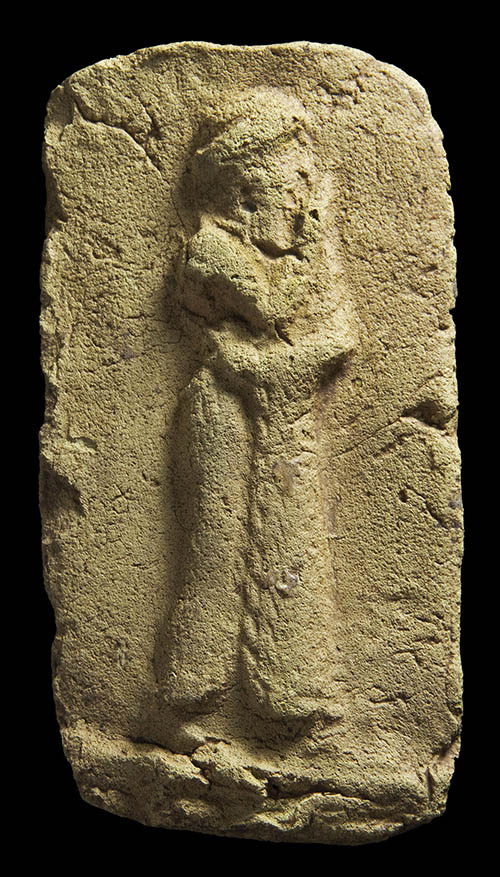
One of the most striking finds thus far is a plaque, about 3½ inches high, showing a worshiper approaching a sacred place. He is depicted as wearing a long robe with fringe down the front opening. Images such as this one help us to think of the clothing that may have been worn by Abraham and his family.

One of the most striking finds to date is a clay plaque, 9cm high, showing a worshiper approaching a sacred place. Photo by Prof. Stuart Campbell, University of Manchester.

One of the most striking finds to date is a clay plaque showing a worshiper approaching a sacred place. Photo by Prof. Stuart Campbell, University of Manchester.

This information is being broadcast via several news outlets. You may read the press release from Manchester University here.

Photos worth 1000 words (or more)

Locusts

Shmuel Browns, Israel guide and photographer, has posted the best photo of a locust that I have seen. And the photos of flowers in the Judean Desert are something most tourists never get to see. Look here.

From the top of the Great Pyramid

Carl Rasmussen, at his HolyLandPhoto’s blog, calls attention to some photos made by some Russians from the top of one of the Great Pyramid of Giza here. There you will find links to the Mail Online (British) and English Russia.

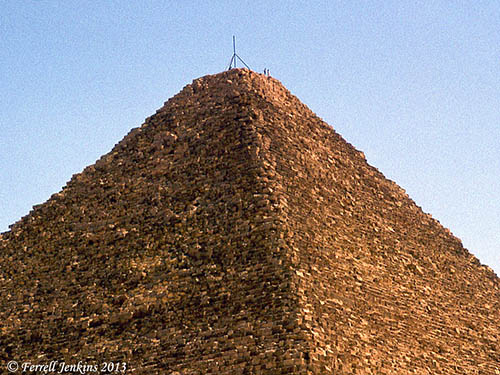
I suppose I never wished to climb the Great Pyramid, but I had two men with me in 1978 who wanted to do so. In the photo below you might be able to make out two men (Jim Puterbaugh and Bob Lyman) to the right of the marker showing the original height of the structure. Click on the photo for a larger image.

Two climbers on top of the Great Pyramid in 1978. Photo by Ferrell Jenkins.

Two climbers on top of the Great Pyramid in 1978. Photo by Ferrell Jenkins.

The Great Pyramid of Cheops (or Khufu) was constructed about 2500 B.C. No, not by the Israelites. That is even earlier than the biblical Patriarchs. It is said to contain more than 2,300,000 blocks of stone, each weighing an average of 2½ tons. The height was originally 479 feet, but now is 449½ feet.

It is April 1, but this is no joke.

Jerusalem Panorama

Look at this great high resolution panorama of Jerusalem from the Mount of Olives here. Spend some time with it. (HT: Bible Places Blog.)

Crucified skeleton found near Jerusalem

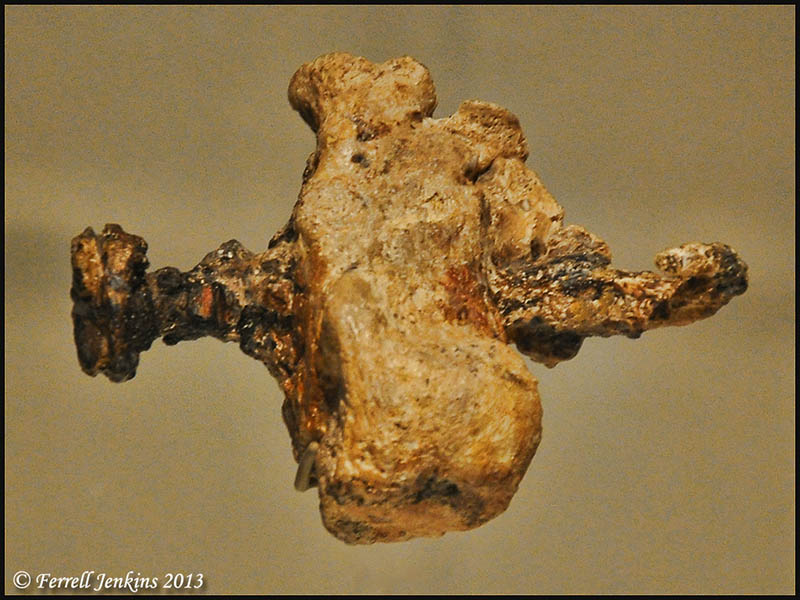
The Romans were adept at crucifixion, according to many historical sources. The first archaeological evidence of crucifixion was uncovered in 1978 [1968; see comments] when an ossuary (bone box, or receptacle) was found north of Jerusalem containing the bones of a man who had been crucified. His name was “Yehohanan, the son of Hagakol.” He is thought to have been between 24 and 28 years of age, and was about 5 feet 6 inches in height.

Both the ossuary and a replica of the heel bone are displayed in the Israel Museum. When Yehohanan was removed from the cross the nail pulled away from the wood.

Ankle bone of a man crucified outside Jerusalem in Roman times. Photo by Ferrell Jenkins.

Nail through the heel bone of a man crucified outside Jerusalem in Roman times. Display in Israel Museum. Photo by Ferrell Jenkins.

On Pentecost, Peter proclaimed the truth about Jesus. He said,

This man was handed over to you by God’s deliberate plan and foreknowledge; and you, with the help of wicked men, put him to death by nailing him to the cross. (Acts 2:23 NIV)

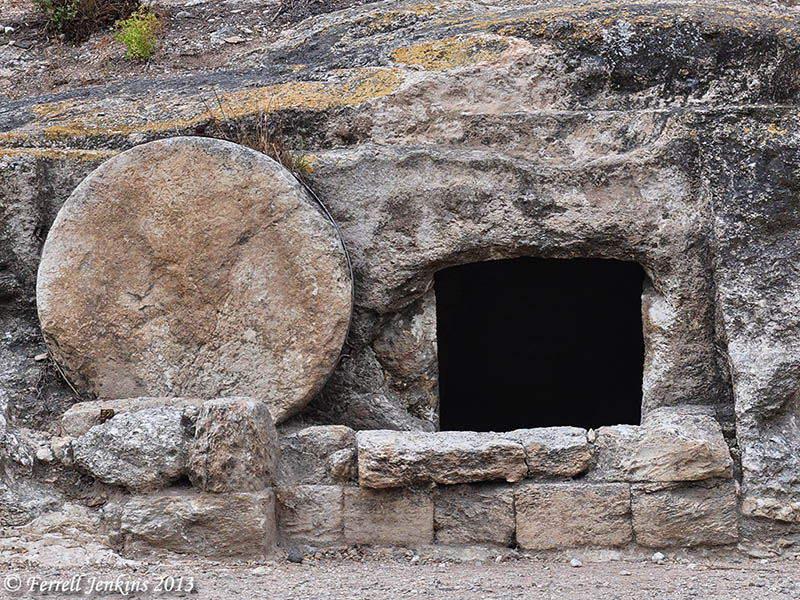
No ossuary, or bones belonging to Jesus, have ever been found. The angel at the empty tomb of Jesus announced to the women who had gone to complete the burial,

He is not here, for he has been raised, just as he said. Come and see the place where he was lying. (Matthew 28:6 NET)

Rock tomb with rolling stone near Jezreel Valley. Photo by Ferrell Jenkins.

Rock tomb with rolling stone near Jezreel Valley. Photo by Ferrell Jenkins.

SourceFlix has posted a nice brief video of Passion Week Archaeology here.

Florida College Lectures on Logos Pre-pub

Yesterday I explained a little about Logos Bible Software and their Community Pricing and Pre-publication Specials. Today I want to tell you about a set of Pre-pub books that are of special interest to me.

Florida College is an accredited (by the Southern Association) private liberal arts college that for decades has offered four years of Bible studies. The college does not accept funds from churches, but the board, administration and faculty are members of Churches of Christ that are often designated as non-instiutional.

Accreditation as a junior college was granted to Florida College in the mid-1950s, but the college continued to offer four years of Bible studies. Biblical Studies was the first accredited Bachelor’s degree to be offered in 1997.

Since its beginning in 1946, Florida College (earlier named Florida Christian College) conducted an annual Bible lecture program. Beginning in 1974 the main lessons in these lectureships were published in book form from the manuscripts of invited speakers. The speakers were teachers and ministers associated with Churches of Christ.

Melvin Curry followed Homer Hailey as chair of the Bible department after Hailey’s retirement in 1973. Nineteen of the volumes were edited by Curry. After that, it came my turn to edit ten volumes while I served as chair of Biblical Studies. Since my retirement in 2001, Daniel Petty has served as department chair and edited the annual lecture book.
FC Lectures 1996

There are a total of 38 volumes (1974–2011) in the series. Some of these volumes have been out of print for several years.

The Logos web site offers the following overview of the lecture books:

The Florida College Annual Lectures (1974–2011) brings you thirty-eight years of the college’s annual lectures series in complete written form. Prior to the first published lecture series in 1974, only content outlines were available.

Each volume includes fifteen or more lectures from contributors from various biblical fields, and focus on a specific theme. These themes deal with modern issues and are supported by recent scholarship. Learn what true worship entails. Discover how God can restore your life. Challenge yourself to share the gospel message. The Florida College Annual Lectures (1974–2011) (38 vols.) contains both informative and stimulating topics that allow you to apply the biblical principles found in its lectures to your daily walk with Christ.

With Logos, every word is essentially a link! Scripture references are linked directly to the Bibles in your library—both the original language texts and English translations. Logos Bible Software allows you to quickly move from the table of contents to your desired content and search entire volumes and collections by topic, title, or Scripture reference, making Logos the perfect software to expand your understanding of the Word.

How Pre-publication works. Books on Pre-pub will not be produced until Logos sees that there are enough orders to make the publication feasible. Interested customers lock in the pre-pub price. You must set up an account with Logos, but your card is not charged until the book or set is ready to deliver. You will be notified when the book is ready. At that time you have a choice to continue or cancel. You may have to wait 6 months or more until the work is ready.

The deal is great. This 38 volume set of Florida College Lectures is available on Pre-pub for $74.95. This set is scheduled to sell for $174 when it is published. Even that is a bargain.

In order for this great resource to become a reality, Logos need a few more people to agree to buy the completed work. Help yourself, and others, in this worthy effort.

Think about these 38 volumes for $75. There are more than 600 lectures. That’s about 12 cents per lecture. Even mine are worth that. The entire collection is searchable, along with all other works you have in your Logos collection. When a Scripture reference appears, simply mouse over it and the Scripture is visible in your preferred version of the Bible.

In a previous post here I have explained that you must have a Logos base package, or already have Logos on your computer.

Logos Bible Software is the premier digital publishing format for books dealing with Biblical Studies. If you are serious about Bible study, you need to investigate Logos.

Meanwhile. Go to the Logos web site and place your Pre-pub order NOW. The sooner Logos publishes, the sooner we can begin to utilize the search features in this entire set. You can always get to the information by going to Logos.com. Look under Products for the Pre-publication Specials. The direct link to info about the Florida College Annual Lectures, with a list of every lecture, is here.

Logos Community Pricing

Logos Bible Software has a feature called Community Pricing. It works like this. A book (or set) is chosen for publication. Interested persons are asked to place a bid on the completed digital publication. When there are enough bids to pay for publication the book is published. After the initial publication, the price goes up. I have purchased many Logos publications using Community Pricing and Pre-Publication Specials.

To use the Community Pricing or Pre-Pub specials you must already have Logos (or the older Libronix) on your computer. You may purchase a base package from Logos (here), or buy a relatively inexpensive set of books from someone like Rejoice Christian Software. I suggestion you buy something like the  Baker New Testament Commentary ($79.95 here), the Norman Geisler Apologetics CD-Rom Library ($29.95 here), or one of the other great specials they offer.

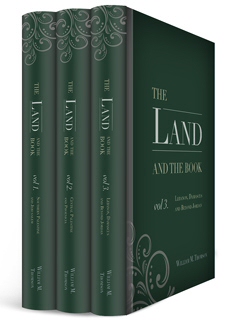
thompson_land-and-the-bookHere is a Community Pricing special too good to miss for anyone interested in the land of the Bible: The Land and the Book by William M. Thomson. This is an old work that is rich in information about the land and the culture of the Bible land.

Rich with scriptural landmarks and filled with hundreds of beautiful pen-and-ink illustrations, Thomson’s The Land and the Book has been a popular classic for over 100 years. Learn more about the people, places, and historical events behind the text you’re studying. Incorporate pictures, illustrations, and graphics into sermons, school papers, or Sunday school lesson plans. Whether you are a student, pastor, scholar, or layperson, the 3-volume Land and the Book is a must-have resource for Bible study or reading.

A work like this does not replace current studies, but it supplements them. Just go to Logos (here) and bid $18 on this work. If it sells for less you will pay less.
In the next post I will share another special pre-pub bargain.

Locusts video from Israel

Recently we mentioned the plague of locusts that devastated crops in Egypt. The southern portion of Israel might have been affected except for the effective use of pesticides.

When Joel Kramer, Executive Director of SourceFlix, learned that the locusts were in the southern part of Israel he drove from Jerusalem through the Negev and wilderness to photograph the locusts near the Egyptian border. He shares this with us in a high quality video here.

Joel includes wording from the book of Exodus 10 to remind us of the biblical plague of locusts in the time of Moses.

The writer of Proverbs describes the locusts this way:

 the locusts have no king, yet all of them march in rank; (Proverbs 30:27 ESV)

In studying the book of Revelation, I am impressed at the way in which locust plagues, which were (and still are) common in the Middle East, are used in the sounding of the fifth trumpet (Revelation 9:1-11). The comparison between the locusts and a literal army in their movement and damage is impressive.

 In appearance the locusts were like horses prepared for battle: on their heads were what looked like crowns of gold; their faces were like human faces,
8 their hair like women’s hair, and their teeth like lions’ teeth;
9 they had breastplates like breastplates of iron, and the noise of their wings was like the noise of many chariots with horses rushing into battle.
10 They have tails and stings like scorpions, and their power to hurt people for five months is in their tails. (Revelation 9:7-10 ESV)

HT: Bible Places Blog.

Hidden treasure

The discovery of hidden treasure is fairly common in and near ancient sites. Individuals may not have a bank account, but they keep the funds they have stored in what they consider a safe place.

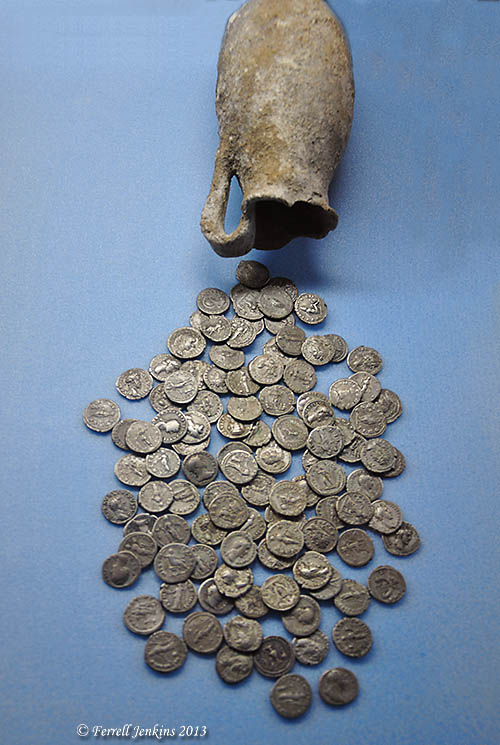
The photo below shows a clay jar with a hoard of silver coins displayed in the Samsun (Turkey) Archaeological Museum. These coins date from the Roman Imperial Period (69-79 A.D. and 238/244 A.D.). The earliest coins are not far removed from the time of the delivery of Peter’s Epistles to saints in Pontus and other Roman provinces (1 Peter 1:1). For more information about the delivery of Peter’s Epistles, see here.

For more information about the museum, check here and here.

Hoard of Roman coins displayed in Samsun Archaeological Museum. Photo by Ferrell Jenkins.

Roman coins displayed in Samsun Archaeological Museum. Photo by Ferrell Jenkins.

Photos such as this remind us of several Biblical passages. For today, consider Paul’s instruction to Timothy regarding what he was to teach those who set their hope on the uncertainty of riches.

 17 As for the rich in this present age, charge them not to be haughty, nor to set their hopes on the uncertainty of riches, but on God, who richly provides us with everything to enjoy.
18 They are to do good, to be rich in good works, to be generous and ready to share,
19 thus storing up treasure for themselves as a good foundation for the future, so that they may take hold of that which is truly life. (1 Timothy 6:17-19 ESV)

Restoration of historic sections of Izmir (biblical Smyrna)

Izmir is looking for local input on a restoration plan of the historic areas of Kadifekale and the agora.

On my last visit to Izmir I could see new work underway, especially in the area of the agora. The city now is developing a plan to restore an area of the city to make it more desirable for local citizens as well as tourists.

An article in Hurriyet Daily News (here) reports,

Municipal authorities in İzmir are calling for public participation amid an ambitious new project to redevelop some of the Aegean province’s most famous tourists sites in a bid to draw more visitors.

“We want to share ideas with scientists and the residents of İzmir. If we cannot get the support of citizens, it will not be possible to realize this project,” İzmir Metropolitan Mayor Aziz Kocaoğlu said.

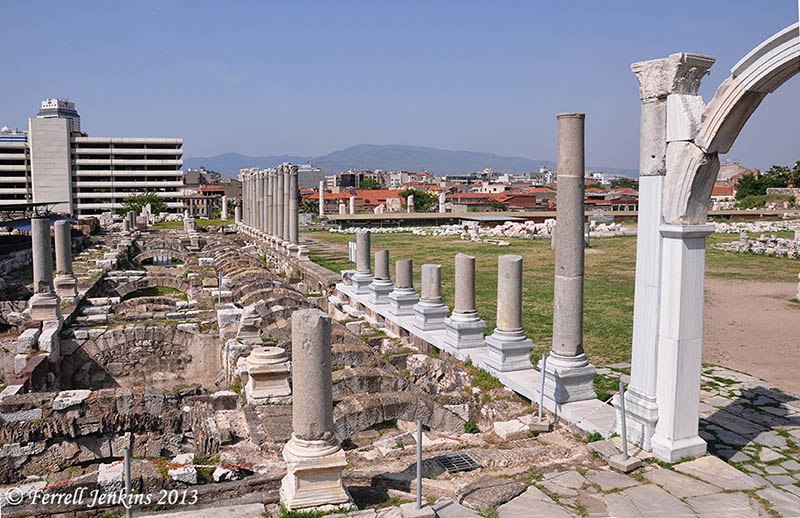
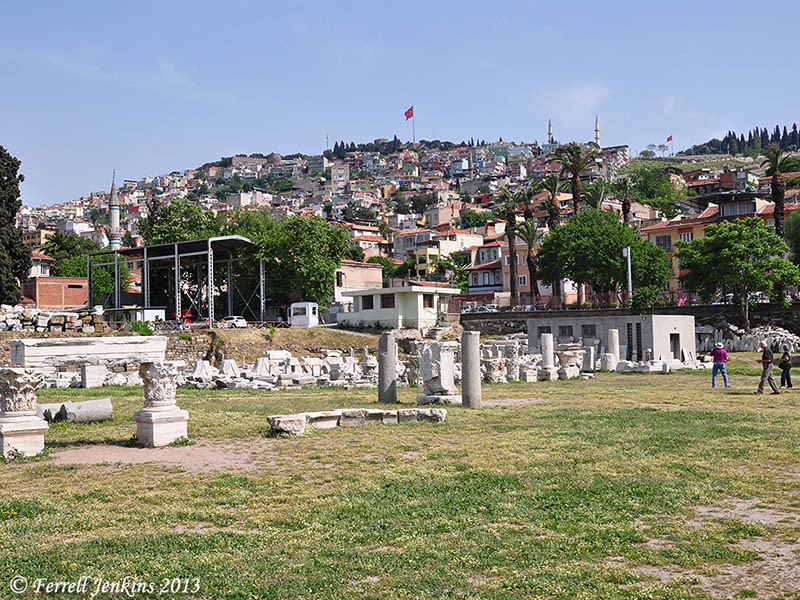
Our first photo shows a portion of the Roman agora. The arches which appear to be at ground level are actually the lower level of a two-story building.

The Roman agora of Izmir, biblical Smyrna. Photo by Ferrell Jenkins.

The Roman agora of Izmir, biblical Smyrna. Photo by Ferrell Jenkins.

The second photo was made from the agora, with a view of Kadifekale. The word Kadifekale means velvet castle. In ancient times this hill was called Mount Pagos. The article mentions plans to include a restored area on the mountain, including the theater which was built on the hillside. Mark Wilson says the ancient theater, now build over by houses, seated 16,000 persons (Biblical Turkey, 312).

A view of Kadifekale (Mount Pagos) from the agora. Photo by Ferrell Jenkins.

A view of Kadifekale (Mount Pagos) from the agora. Photo by Ferrell Jenkins.

Smyrna is mentioned in the Bible as the location of one of the Seven Churches addressed in the book of Revelation (the Apocalypse).

“And to the angel of the church in Smyrna write: ‘The words of the first and the last, who died and came to life. (Revelation 2:8 ESV; see also 1:11)

Here’s hoping for a speedy and accurate restoration of the ancient city.
HT: Jack Sasson