There was a time that John (the baptizer) was baptizing in the vicinity of Aenon near to Salem. I have not had the opportunity to visit the site of Aenon, but I have been to Salem several times. Sergio and Rhoda (locate on YouTube) visited the site with Danny the Digger, a guide who who has lived in the vicinity.
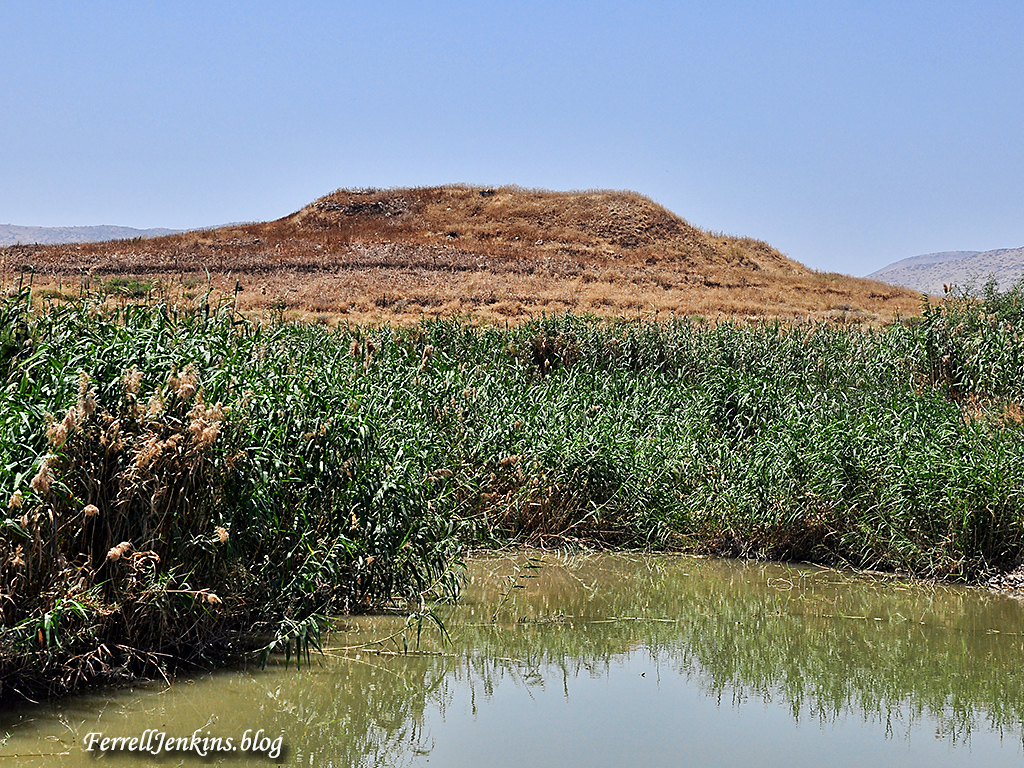
Salem is now identified with Tel Shalim. a site about eight miles south of Beth-shan (Beit She’an) on a dirt road between highway 90 and the Jordan River. In the vicinity there are many pools of water, many now used to raise the fish sold in the restaurants around the Sea of Galilee.
Tel Shalem in the northern Jordan Valley. Photo by Ferrell Jenkins.
John, the son of Zachariah and Elizabeth, was born in a village west of Jerusalem. The Lord gave him a special responsibility as the one preparing the way for Jesus the Messiah. The Gospels record some of his early work. John appeared, baptizing in the wilderness and proclaiming a baptism of repentance for the forgiveness of sins. And all the country of Judea and all Jerusalem were going out to him and were being baptized by him in the river Jordan, confessing their sins. (Mark 1:4-5 ESV)
John began to preach a baptism of repentance and many from Jerusalem and Judah came to him to be baptized.
Jesus came from Galilee to the Jordan River to be baptized by John (Matthew 3:13-17). His baptism was an exception to all the others John baptized. Jesus had no sin, but this was the occasion of the Father’s acknowledging him as his son.
A specific location is mentioned as “Bethany across the Jordan” (John 1:28). This location very near the traditional site that many have visited at Qasr el-Yahud near Jericho. Jordanian scholars claim that the baptism of Jesus took place on the eastern side of the Jordan River, a place they call Bethany beyond the Jordan. The photo below shows my long-time traveling friend, Leon Mauldin, very near this site.
Leon Mauldin on the banks of the River Jordan. Photo by Ferrell Jenkins.
When I was leading tours I often said to my group about some proposed site of a Biblical event, “If it was not here (pointing directly in front of me), it was here (spreading my arms wide). In Israel one is never far from a significant Biblical event.
The two main grain crops in Bible times were wheat and barley. Barley tended to be used mostly by the poor and for the feeding of the animals. It was planted and ripened about a month earlier than wheat.
Here is a list of the Biblical references to cutting the grain, binding it into sheaves so they could be brought into the barns.
The Psalmist said ” He who goes out weeping, bearing the seed for sowing, shall come home with shouts of joy, bringing his sheaves with him.” (Psalm126:6 ESV). And again, the Psalmist says, with which the reaper does not fill his hand nor the binder of sheaves his arms (Psalm 129:7 ESV)
Grain that has been cut and bound so that it can be brought into the barn.The ancient hill of Samaria can be seen in the distance.
One of the most familiar Biblical verses is certainly Psalm 23.
1The LORD is my shepherd; I shall not want. 2 He makes me lie down in green pastures. He leads me beside still waters. 3 He restores my soul. He leads me in paths of righteousness for his name’s sake. (Ps. 23:1-3 ESV)
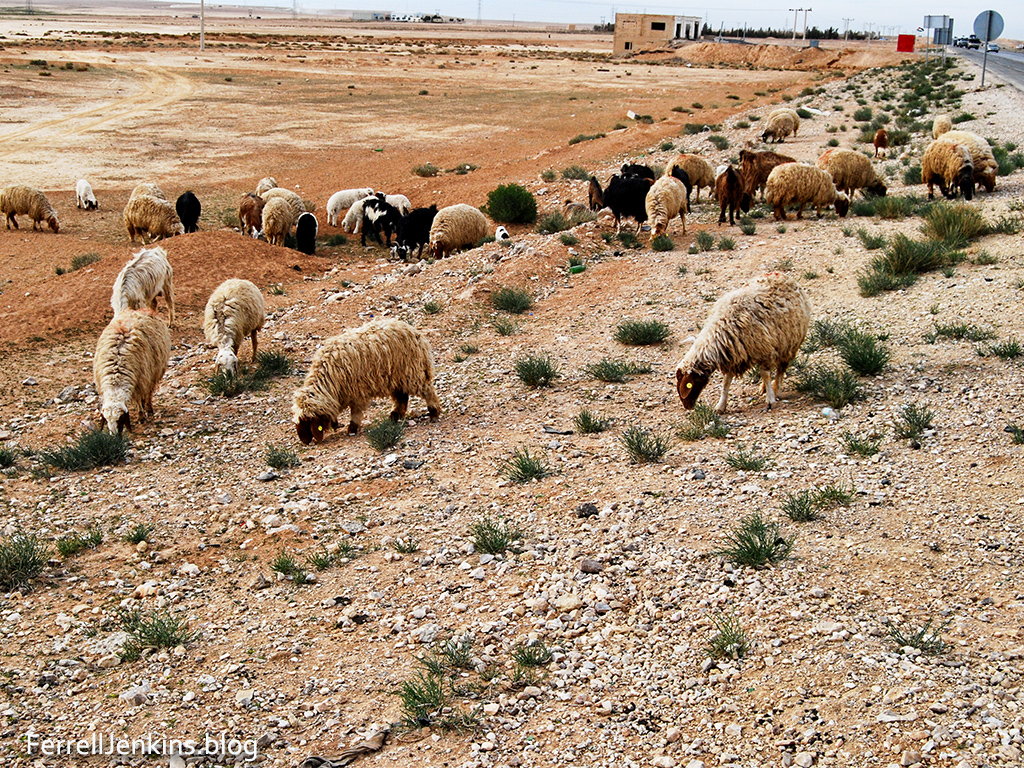
We often see shepherds and their sheep in beautiful green areas at many places in the Bible Lands, but in this case we see the shepherd with his sheep in the desert.
Our photo was made in Jordan along the desert road that leads from Amman to Aqaba.
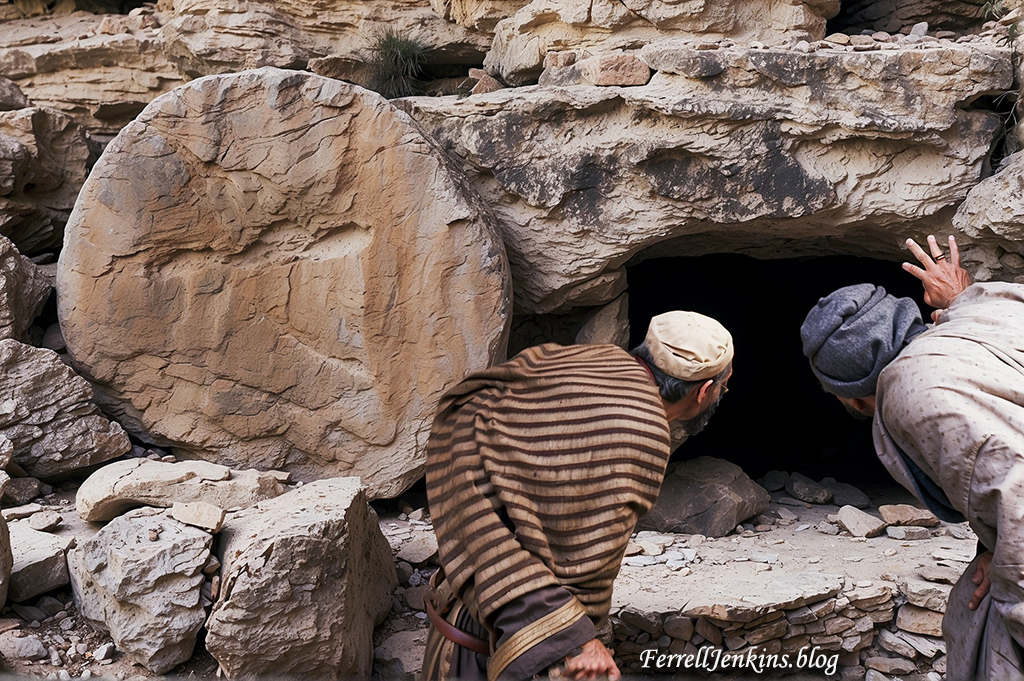
A Roman period tomb cut from stone, using a rolling stone to cover the opening.
The following text is taken from the Gospel of John, chapter 20.
Now on the first day of the week Mary Magdalene came to the tomb early, while it was still dark, and saw that the stone had been taken away from the tomb. So she ran and went to Simon Peter and the other disciple, the one whom Jesus loved, and said to them, “They have taken the Lord out of the tomb, and we do not know where they have laid him.” So Peter went out with the other disciple, and they were going toward the tomb. Both of them were running together, but the other disciple outran Peter and reached the tomb first. And stooping to look in, he saw the linen cloths lying there, but he did not go in. Then Simon Peter came, following him, and went into the tomb. He saw the linen cloths lying there and the face cloth, which had been on Jesus’ head, not lying with the linen cloths but folded up in a place by itself. Then the other disciple, who had reached the tomb first, also went in, and he saw and believed; for as ye they did not understand the Scripture, that he must rise from the dead. Then the disciples went back to their homes. (Jn. 20:1-10 ESV)
Imagine the emotions of the disciples of Jesus, both women and men, when they were told that the tomb that had been so carefully secured on Friday was found empty on the first day of the week, with only the grave clothes and the cloth that covered the head still in the tomb.
[The second photo showing the disciples of Jesus at the open tomb was made in Leonardo AI. David Padfield assisted me in this project.
Corinth is located about two miles south of the narrow isthmus which forms the land bridge, and controlled access, between the main land mass of Greece and the Peloponnesus. Corinth seemed to have flourished from the 8th to the 5th centuries B.C., and there are signs of habitation much earlier. In 146 B.C. the Greek history of Corinth was terminated when the Roman consul Mummius destroyed it. All that remains today of the old Greek city are the seven columns of the Temple of Apollo. Julius Caesar rebuilt Corinth in about 46 /4 4 B.C. as a Roman colony and settled many Roman soldiers there. Corinth became the capital of the Roman province of Achaia and had direct communications with Rome. There were enough Jews in the city to account for a synagogue (Acts 18). Perhaps the two most noticeable sites at Corinth today are the ruins of the temple of Apollo and the Acrocorinth (the mountain or high point of Corinth). The temple of Apollo was built in the 6th century B.C., but only seven of the original 38 Doric monolith columns are standing. There were numerous other pagan temples in the city including one dedicated to Asklepios, the god of healing.
The ruins of the Temple of Apollo at Corinth with the Acro Corinth in the background.
The judgment-seat (Greek, bema) was a speaker’s platform on which the judge sat or stood for the trial of one against whom an accusation had been made. In the excavations a t Corinth which have been conducted since 1896 the bema has been exposed in the agora. It is likely that Paul stood before Gallio at this place (Acts 1 8:12). The bema is dated to A.D. 44, but could be as early as the time of Augustus. The gospel was successful in this pagan city. Paul preached “Christ and Him crucified” (1 Cor. 2:2; 15:1-4). Paul was fearful but the Lord told him, “Do not be afraid any longer, but go on speaking and do not be silent; for I am with you, and no man will attack you in order to harm you, for I have many people in this ci ty” (Acts 18:9-10 ). Paul remained in Corinth for a year and six months.
A portion of the Erastus inscription at Corinth.
Inscribed in a limestone pavement near the theater at Corinth is a phrase which reads in Latin: ERASTVS PRO AEDILITATE S P STRAVIT. The translation goes something like this: Erastus , in return for the aedileship, laid the pavement at his own expense. It is possible, but not certain, that this Erastus was the friend of Paul (Rom. 16:2-3; 2 Tim 4:20). If so, then Erastus may have been one of the few (contrast, not many) of the socially elite at Corinth who accepted the gospel (1 Cor 1:26).
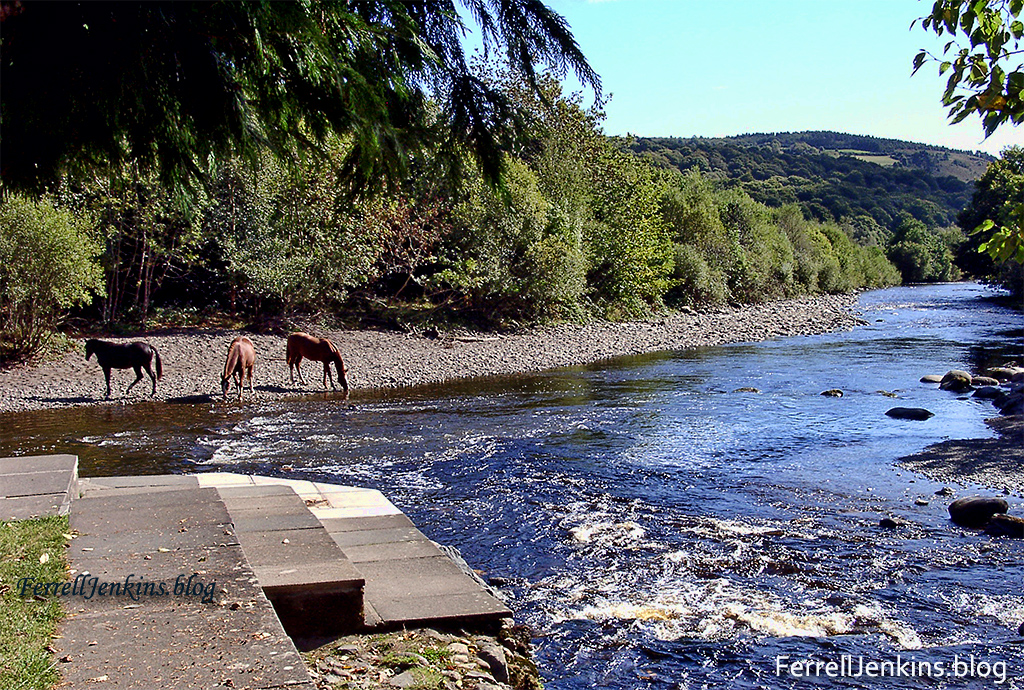
Thomas Moore (1779-1852) is known as one of Ireland’s best writers. A little south of Dublin, in Wicklow County, the Avonmore and Avonberg rivers meet. Moore made this spot famous in his poem The Meeting of the Waters.
The Meeting of the Waters
There is not in the wide world a valley so sweet As that vale in whose bosom the bright waters meet Oh the last rays of feeling and life must depart Ere the bloom of that valley shall fade from my heart Ere the bloom of that valley shall fade from my heart
Yet it was not that nature had shed o’er the scene Her purest of crystal and brightest of green ‘Twas not her soft magic of streamlet or hill Oh No ’twas something more exquisite still Oh No ’twas something more exquisite still
‘Twas that friends, the belov’d of my bosom were near Who made every scene of enchantment more dear And who felt how the best charms of nature improve When we see them reflected from looks that we love When we see them reflected from looks that we love
Sweet vale of Avoca! How calm could I rest In thy bosom of shade, with the friends I love best Where the storms that we feel in this cold world should cease And our hearts, like thy waters, be mingled in peace And our hearts, like thy waters, be mingled in peace
How fortunate is any person to have a special place to recall as a place of peace. I have enjoyed several of these places through the years. First, there is home. My study, when my desk is clean and it’s raining outside, is another. I think also of the Sea of Galilee at sunrise, or sunset. Spiritually we find peace in Christ.
Where the Sweet Waters Flow
Be anxious for nothing, but in everything by prayer and supplication with thanksgiving let your requests be made known to God. And the peace of God, which surpasses all comprehension, will guard your hearts and your minds in Christ Jesus. (Philippians 4:6-7 NAU)
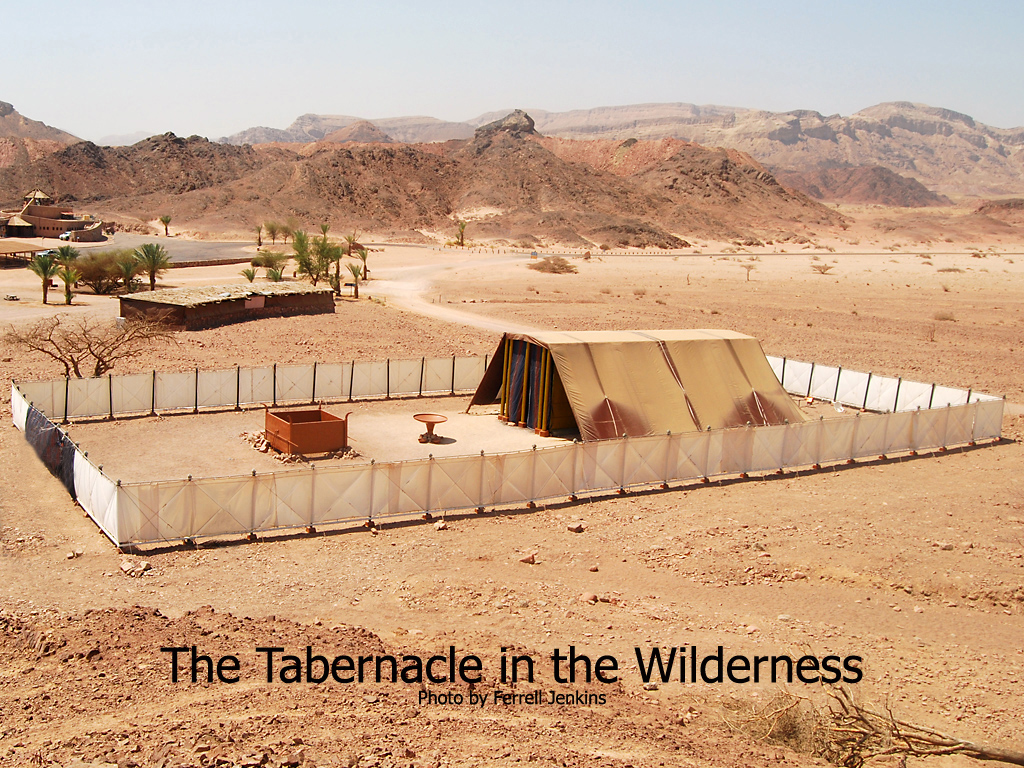
In the gospels one may find several references or allusions to events of the wilderness wandering. This indicates the significance of the event and suggests that it should be studied carefully by Christians as well as Jews.
“The Word became flesh and dwelt [tented, tabernacled] among us…” (Jn. 1:14). The Lord made His presence known to the Israelites in the “tent of meeting” (the tabernacle; Ex. 29:45-46).
The Law was given through Moses [in the wilderness] (Jn. 1:17).
The serpent in the wilderness (Jn. 3:14ff.; cf. 8:28; 12:32).
The manna (Jn. 6:31ff.; notice the “grumbling” over the bread, vs. 41).
The water (Jn. 7:37-38).
Jesus was tempted in the wilderness by the devil. (Mt. 4:1-11).
Jesus fasted for 40 days and 40 nights (cf. Israel’s 40 years).
Jesus was tempted but did not succumb.
In response to the temptations of the devil Jesus quoted from the book of Deuteronomy (Mt. 4:4;
Dt. 8:3; Mt. 4:7; Dt. 6:16; Mt. 4:10; Dt. 6:13).
Stephen made several references to the events of the wilderness in his sermon (Acts
7:30-44).
Paul calls attention to the exodus and events of the wilderness wandering (Acts 13:18; Gal. 4:21-31). Notice his use of the phrase, “Remove the wicked man from among yourselves” (1 Cor. 5:13; cf. Dt. 13:5, the false prophet; 17:7, the one who served other gods; 17:12, one who acts presumptuously; 21:21, the rebellious son; 22:21, a girl not found a virgin).
Israel was baptized, ate spiritual food and drank spiritual drink, but practiced idolatry and immorality and fell (1 Cor. 10:1-13). Compare the situation at Corinth: Christians who had been baptized, ate and drank the Lord’s supper, were tempted by the idolatry (meat sacrificed to idols) and immorality of their city.
The Writer of Hebrews speaks of events of the wilderness wandering.
The events at Mount Sinai (Heb. 12:18-29). The word spoken through angels (2:2; cf. Gal. 3:19).
The unfaithfulness of Israel in the wilderness (Heb. 3–4).
In the book of Revelation.
“See…that you make all things according to the pattern which was shown you on the mountain” (Heb. 8:5; Ex. 25:40, the building of the tabernacle).
The woman who gave birth to the man child fled into the wilderness where she was nourished (Rev. 12:6). This symbol makes the wilderness a place of protection and nourishing. The figure seems to be based on the experience of the nation of Israel and of Elijah (1 Kings 19:1-18) as they were cared for by the Lord.
Some of the trumpets of chapters 8-10 are drawn from the plagues of Egypt. The one like a son of man came on a white cloud (cf. Isa. 19:1, judgment of Egypt) and judged the enemy (Rev. 14:14-20). The saints sing the song of Moses and the Lamb beside the sea (Rev. 15; cf. Ex. 14:31; 15:1-19).
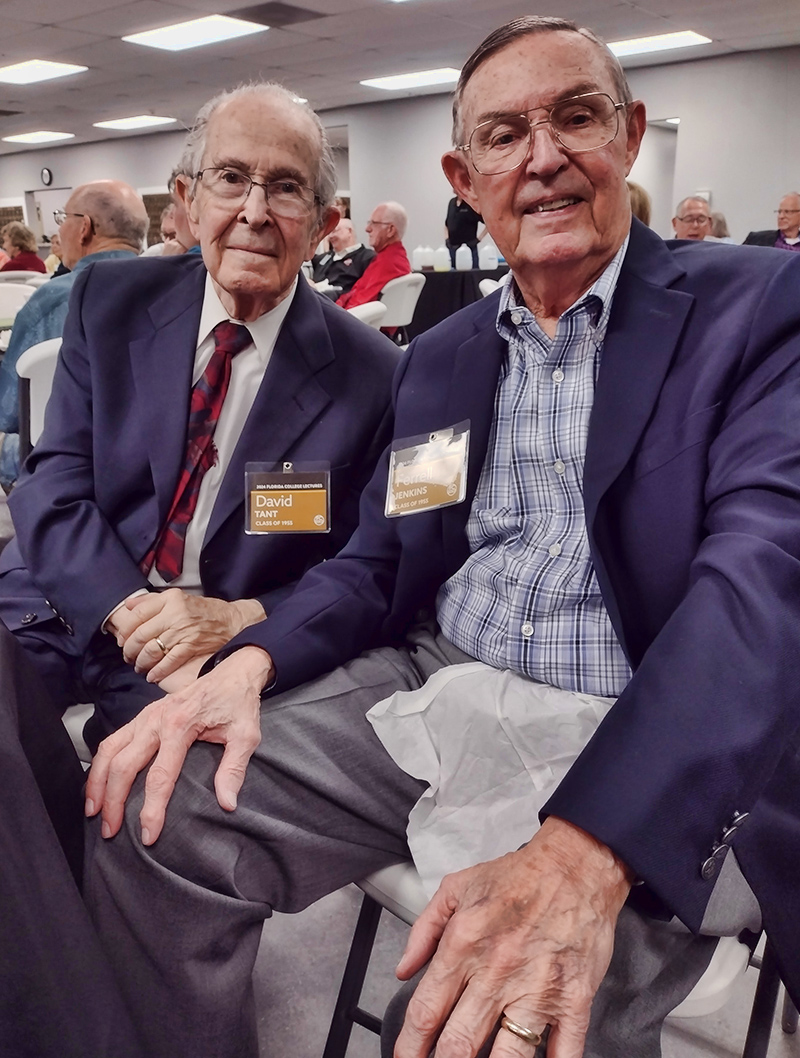
Last week during the Florida College annual lectureship there was a reunion lunch for “Old Timers.” Paulette and I were fortunate to sit at the table with David Tant. David and I were in the (junior college) class of 1955. I stayed around for two more years to study Bible. David went to Abilene.
Age-wise we are a year apart. You can guess which one is older. Most of the other attendees were probably my students in the day. It was fun to be together for a while.
Paulette made this picture of David and me. Flora was not able to attend this year, but I can tell you that she is younger than either of us.







 Ferrell's Travel Blog
You must be logged in to post a comment.