The value keeps going up, because so many of you find this blog of interest.


That is up from $564 last June.

The value keeps going up, because so many of you find this blog of interest.
That is up from $564 last June.
Biblical Archaeology Review announced today that the entire March/April edition is available online. Certainly this is to gain subscribers. Nonetheless it is a good opportunity for those who have not read the magazine to take a look.
Subjects include an article about a seal bearing the name Jezebel. Does it belong to the wicked Phoenician Queen, wife of Ahab?
Another article is about Emmaus, or Emmaus-Nicopolis, where Jesus met with some disciples after his resurrection (Luke 24:13ff.). Here is a photo I made of the fifth century baptistry at Emmaus in 2005.
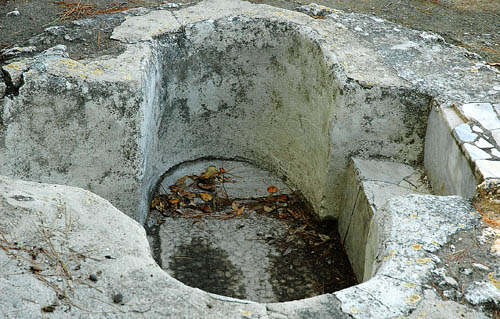
BAR has a photo of this baptistry, but calls it a “baptismal font.” The article says,
Two steps lead down into the basin where the penitent would stand when the priest poured water over him (the basin is not large enough for total immersion).
Of course, I must disagree with BAR. Many a preacher has baptized in a bathtub or some other small vessel when nothing else was available. In New Testament times baptism was immersion, as the word indicates, and as history records. The first known instance of the pouring of water as a substitute for immersion is the case of Novation in A.D. 251. It may well have been that pouring was practiced by the 5th century at Emmaus, but it is a departure from the New Testament (Romans 6:3-4). Baptism is commonly called a washing in the New Testament (Acts 22:16; 1 Corinthians 6:11; Ephesians 5:26; Titus 3:5; Hebrews 10:22).
Anyway, go online and read these and other articles from the current issue of BAR. Here is the link.
Posted in Archaeology, Bible Places, Bible Study, Israel, New Testament
Tagged baptism, BAR, Biblical Archaeology Review, Emmaus
The Jerusalem Post reports that an earthquake was felt in Israel last Friday, Feb. 15. Read the full story here.
The earth shook in many parts of Israel at 12:37 p.m. Friday. The quake was felt mainly in coastline cities, including Haifa, Tel Aviv and Nahariya.
The quake, Israel Radio reported, was also felt in Syria and Lebanon. A faded echo of the quake that hit the coast was also felt at the editorial offices of The Jerusalem Post in Jerusalem.
….The European-Mediterranean Seismological Center said on its Web site that the quake Friday was 5.3 on the Richter scale and that its epicenter was in Lebanon.
The region is long overdue for an earthquake of epic and potentially catastrophic proportions, scientists say.
The Great Rift runs all the way from northern Syria through Lebanon, Israel, the Arabah, and into eastern Africa. In Israel the area is called the Jordan Valley or the Dead Sea Rift, It is not surprising that earthquakes are mentioned frequently in the Bible. The prophet Amos dates his visions to “two years before the earthquake” (Amos 1:1). The earthquake he makes reference to must have been so memorable that everyone would know what he was talking about. Zechariah (14:5) also calls attention to this earthquake in the days of Uzziah king of Judah.
Jesus, in predicting the fall of Jerusalem to the Romans, said, “and in various places there will be famines and earthquakes” (Matthew 24:7; see Luke 21:11).
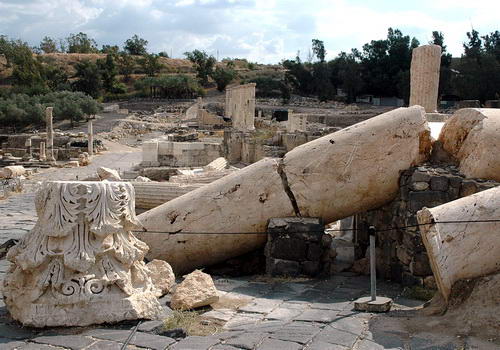
We have a wonderful example of the power of an earthquake in the Jordan Valley at the site of Bethshan [Bet-she’an, Beth-shean], about 25 miles south of the Sea of Galilee. The city was destroyed by an earthquake in A.D. 749. This photo shows the evidence brought to light during recently archaeological excavations in the city.
Posted in Archaeology, Bible Study, Israel, Old Testament
Tagged Bethshan, Earthquake, Israel
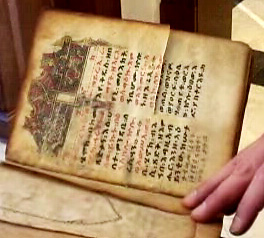
Enoch was originally written in Hebrew or Aramaic by Jews, and some ancient fragments of it have been found near the Dead Sea. But the oldest complete versions are in the ancient Ethiopian language of Ge’ez because Ethiopian Christians are the only enduring church group that revered the book as Scripture.
James C. VanderKam, a professor of Hebrew Scriptures at Notre Dame University and a leading expert on the Book of Enoch, has inspected the book on loan to the trust and estimates that it’s probably one of the five oldest manuscripts of the work.
“We don’t have very many that go back that far,” said VanderKam, who is co-author of an English translation of Enoch and is working on a commentary. VanderKam estimated that the text was about 500 years old because its script and contents are similar to a manuscript of that age in the British Museum. Specialists in Ethiopian script could make a more specific determination, he said.
Enoch is mentioned in Luke’s genealogy of Jesus (Luke 3:37). The writer of the epistles to the Hebrews says,
By faith Enoch was taken up so that he would not see death; AND HE WAS NOT FOUND BECAUSE GOD TOOK HIM UP; for he obtained the witness that before his being taken up he was pleasing to God (Hebrews 11:5 NASB).
The most interesting mention of Enoch in the New Testament is the quotation from the book in the little letter of Jude. In the midst of a litany of charges against “certain persons” who had crept in unnoticed among the Christians to whom he writes, he says,
It was also about these men that Enoch, in the seventh generation from Adam, prophesied, saying, “Behold, the Lord came with many thousands of His holy ones, to execute judgment upon all, and to convict all the ungodly of all their ungodly deeds which they have done in an ungodly way, and of all the harsh things which ungodly sinners have spoken against Him.” (Jude 1:14-15 NASB).
The book of Enoch was not considered one of the canonical books of the Hebrew Bible (Old Testament) by the Jews, but Jude seems to think it expressed the truth about what will happen to false teachers. In the same way, Paul quoted pagan poets whose work expressed the truth he was seeking to express (Acts 17:28).
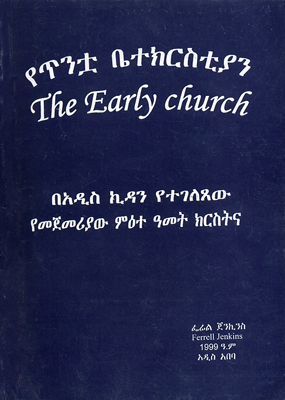
For several weeks I have been looking for an excuse to mention that my book, The Early Church, is now available in the Amharic language. All distribution is being done by Christians in Ethiopia, and I have no copies for distribution.
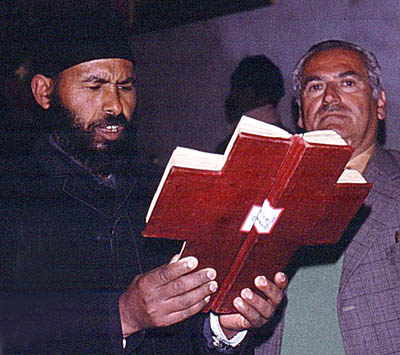
Ethiopians, sometimes called Abyssinians, have a small chapel adjoining the Church of the Holy Sepulcher in Jerusalem. There they sometimes show a portion of the Gospels prepared in the shape of a cross. One of my guides used to ask the Ethiopian to read to us from Amharic. This photo was made in 1977.
Posted in Bible Study, Church History, New Testament
Tagged Abyssinians, Amharic, Enoch, Ethiopians
Tourists often fail to see the waterfalls in Israel because they are hidden in the hills off the main roads and require a hike to get to them. Several years ago I was browsing the books at a profession meeting (SBL) I attended. One of the new publications was The Holman Bible Dictionary (1991). I noticed a photo of the waterfall at Engedi (En Gedi) on page 419. The caption for the photo reads:
The only natural waterfall in Israel is located at Engedi on the west side of the Dead Sea.
I spoke to one of the representatives of the publisher that I had come to know and told him this was a mistake that should be corrected. He thanked me and gave me a copy of the dictionary for having pointed out this error. I assume that future editions of the dictionary have a corrected caption.
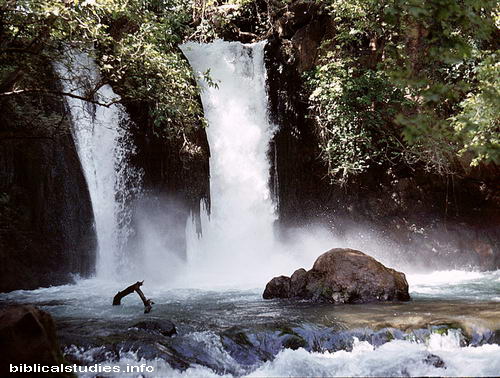
Here is a photo of the Jordan River Waterfall (sometimes called the Banias Falls) that I made in 1984. This waterfall is not far from the main road as you leave Banias (Caesarea Philippi) west toward Dan. A place like this would be most refreshing to a person like David as he was fleeing from Saul (1 Samuel 23:29-24:1). Of course, that was at Engedi, in the south.
What really got me to thinking about this today is Todd Bolen’s BiblePlaces Newsletter which came today. In addition to links to news mentioned on the Bible Places Blog, the main feature includes the Waterfalls of Israel. There are five high-resolution photos and a PowerPoint presentation available for download. Todd also mentions other waterfalls in Israel.
Several times before I have recommended the BiblePlaces Newsletter and the Pictorial Library of Bible Lands. Click here to subscribe to the Newsletter. Click here to go to BiblePlaces for information about the Pictorial Library.
The town of Magdala is not mentioned in the Bible, but Mary Magdalene is mentioned a total of 12 times in the four gospels. This place may have been her birthplace or her home. A few late manuscripts mention Magdala (Matthew 15:39 KJV), but earlier manuscripts read Magadan. Magdala is located about 4 miles north of Tiberias on the western shore of the Sea of Galilee.
The Hebrew word Magdala means tower. In New Testament times the city had become Hellenized and bore the Greek name Tarichea because of the importance of the salted-fish industry there. Mendel Nun located a harbor at the site. He says,
“In ancient times, pickled sardines were an important element of diet throughout the country–especially for those who lived near the lake” (BAR, Nov/Dec 1993).
Josephus had his headquarters at Magdala during the first Jewish Revolt against Rome (A.D. 66-70). He was able to get a group of at least 230 boats to go from Magdala to Tiberias (Jewish Wars 2.635-637). Vespasian attacked the town from the sea and destroyed it.
Archaeological excavations were conducted at Magdala in the early 1970s, on the plot owned by the Franciscan fathers, by Corbo and Loffreda. Biblical Archaeology Review announced (Sept/Oct 2007) that a new excavation will begin under the direction of Franciscan scholar Michele Piccirillo. In recent years entry to the site has been closed. The new excavations are welcomed.
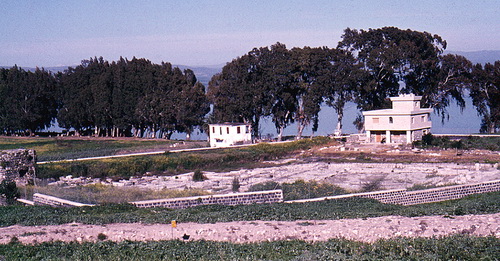
The photo below is one that I made in 1977 of the area overlooking the earlier excavations. A first century mosaic from Magdala showing a boat is on display at Capernaum. Moments after posting this blog I noticed that a report had been issued on new finds at Magdala. You may read the report and see new photos here. It will be exciting over the next few years to watch this ancient town give up its secrets.
A new 2-shekel coin entered circulation recently in Israel. This might be of interest to people who plan to travel to Israel. The Israeli New Shekel is worth about 27 cents in US money, so the 2-shekel (NIS 2) will be roughly equivalent to our half-dollar. Most American tourists who are in travel groups have prepaid their arrangements and have little need to exchange funds. Dollars are widely accepted in Israel.
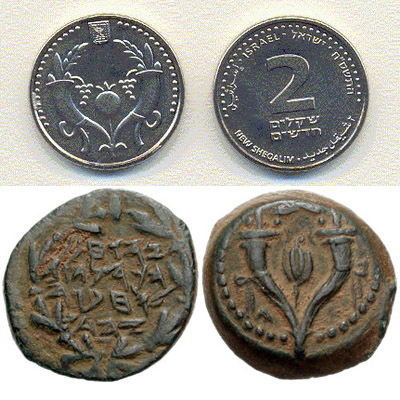
The new coin has an interesting historical association on the reverse side. It is a design of a cornucopia, a horn of plenty, and a pomegranate. This design is from an historical coin minted in the days of John Hyrcanus. Hyrcanus was one of the Maccabeans who successed Judas. He became high priest, and then ruler of the Hasmonean Dynasty from 135-104 B.C. During his reign we have the first reference to the Jewish parties, Pharisees and Sadducees, that are prominent in New Testament times.
John Hyrcanus extended the territory of the Maccabeans by seizing Idumaea (enter Herod!) and compelling the Idumaeans to be circumcised. He seized Samaritan territory and destroyed the temple of the Samaritans on Mount Gerizim. This is the temple alluded to by the woman of Samaria when she said to Jesus, “Our fathers worshiped in this mountain [Gerizim], and you people say that in Jerusalem is the place where men ought to worship” (John 4:20).
History is interesting, isn’t it? Here is a photo of the new 2-shekel and the bronze Prutah minted in the time of Hyrcanus. The photo is from Wikimedia Commons. Glancing through Hendin and Meshorer, I see that this design was fairly common during the period of the Maccabees.
The pomegranate can be eaten fresh, used for fresh juice, or processed into an alcoholic drink for future use. Writers say the pomegranate,
“is a beautiful, symmetrical fruit, scarlet in color. Filled with small seeds surrounded by juicy pulp, the fruit became an obvious symbol of fertility” (King and Stager, Life in Biblical Israel, 104).
Another source says,
“The pulp is divided into 9 or 10 partitions which hold the numerous seeds. The pulp is delicious and very refreshing to eat because of its copious juice. the seeds yield a syrup called grenadine. The flowers are used in the treatment of dysentery” (Fauna and Flora of the Bible, 169).
Saul stayed on the outskirts of Gibeah “under the pomegranate tree” (1 Samuel 14:2). The girl of the Song of Solomon is told twice that her “temples are like a slice of a pomegranate behind your veil” (Song 4:3; 6:7). She also says, “I would give you spiced wine to drink from the juice of my pomegranates” (Song 8:2). The fruit was used as the design for decoration on the hem of the garment of the high priest (Exodus 28:33).
This beautiful pomegranate was growing at the site of ancient Aphrodisias in Turkey. The photo is better than some I have from Israel. Enjoy.

Posted in Bible Lands, Bible Study, Israel, New Testament
Tagged Hyrcanus, pomegranate, shekel
When Aaron, Israel’s first High Priest, died his son Eleazar became the High Priest. The book of Numbers says that Aaron died on the mountain top of Mount Hor.
“Take Aaron and his son Eleazar and bring them up to Mount Hor; and strip Aaron of his garments and put them on his son Eleazar. So Aaron will be gathered to his people, and will die there.” So Moses did just as the LORD had commanded, and they went up to Mount Hor in the sight of all the congregation. After Moses had stripped Aaron of his garments and put them on his son Eleazar, Aaron died there on the mountain top. Then Moses and Eleazar came down from the mountain. When all the congregation saw that Aaron had died, all the house of Israel wept for Aaron thirty days.” (Numbers 20:25-29, NASB).
Deuteronomy records that Aaron died at Moserah (10:6), but it also records that he died on Mount Hor (32:50). We need not think of this as a discrepancy.
The best solution that can be posed to this problem so far is that Moserah is probably a larger area that included Mount Hor. Thus it would be quite correct to declare that Aaron’s death was either on Mount Hor (Num 20:22–29; 33:38–39; Deut 32:50) or Moserah (Deut 10:6). (Hard Sayings of the Bible, 166).
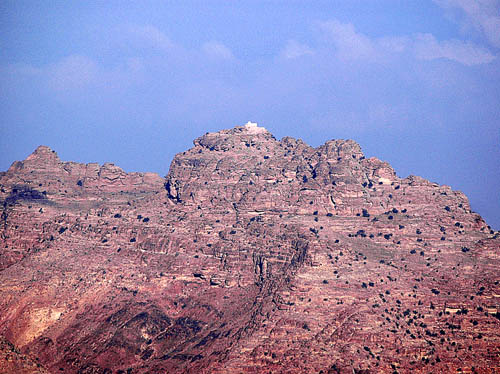
Mount Hor is identified traditionally with Jebel Nebi Harun in the territory of ancient Edom near Petra. From the area of the hotels above Petra one can see the white Moslem shrine marking the tomb of Aaron on the top of Mount Hor. This photo shows the monument in the distance. The mountains reflect the typical color of the area around Petra.
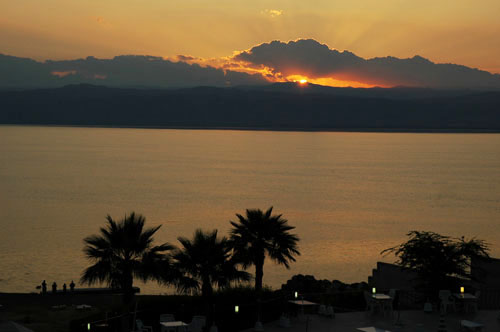
Here is a photo that I made at sunset on the shores of the Dead Sea in Jordan. The view looks west over the sea and the mountains of Judea between Bethlehem and Jerusalem. The Dead Sea is called the Salt Sea in the Bible (Genesis 14:3; Numbers 34:3, 12). The width of the sea at this point is about 11 miles. The level of the Dead Sea is now almost 1400 feet below [Mediterranean] sea level. This northern end of the Dead Sea is about 1300 feet deep.
We mentioned here that a seal found in the “City of David Excavation” in Jerusalem had been read by Prof. Eilat Mazar as Temech. In a comment on that page we noted that she had now changed her mind about the reading.
Today, the Jerusalem Post carried an article about this.
Mazar had originally read the name on the seal as “Temech,” and suggested that it belonged to the family of that name mentioned in the Book of Nehemiah.
But after the find was first reported in The Jerusalem Post, various epigraphers around the world said Mazar had erred by reading the inscription on the seal straight on (from right to left) rather than backwards (from left to right), as a result of the fact that a seal creates a mirror image when used to inscribe a piece of clay.
Several other scholars said the reading should be Shlomit.
Mazar said Monday that she accepted the reading of “Shlomit” on the ancient seal, and added that she appreciated the scholarly research on the issue.
“We are involved in research, not in proving our own opinions,” Mazar said.
Shlomit is the name of a woman mentioned in 1 Chronicles 3:19. Several English versions I checked use the spelling Shelomith. Whether the seal has anything to do with the persons named in the biblical text is unknown.
Posted in Archaeology, Bible Study, Old Testament
Tagged City of David, Jerusalem, Mazar
 Ferrell's Travel Blog
You must be logged in to post a comment.