“Biblioblogger Extraordinaire”?

Jim West laments that he has only recently become aware of this blog and my web pages. He writes here:

He runs an awesome blog and a couple of awesome resources pages which are worth your checking out.

His title, “Ferrell Jenkins: Biblioblogger Extraordinaire” is a little much, but appreciated.

Jim writes more than anyone I know. Reminds me of what some used to say about the late Dr. James D. Bales of Harding University: “He has written more than he has read.” Just joking. Thanks, Jim.

Dr. West had the unfortunate experience recently of someone gaining access to his password and deleting his blog. I am glad he is back. He writes on a variety of subjects and I check his blog regularly. Agree or not, he will cause you to think. Check it here.

I have had a link to Jim’s Biblical Studies Resources for a long time.

The Tell es-Safi/Gath Archaeological Project

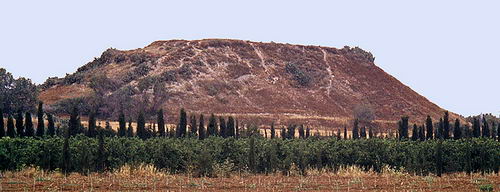
Prof. Aren Maeir, director of the Tell es-Safi/Gath Archaeological Project, asked permission to post my 1969 photo of the tell which we posted here. I was honored to do so. He has given us some directional info that I overlooked. He says that it is “of the northeastern portion” of the tell. He comments on the changes that have taken place since 1969.

Not only is the foto very nice, it is very interesting, since there are quite a few changes that can be seen on the tell since then. In particular, the intense 4X4 vehicle activity has taken a toll on the site, and a current view shows various parts that have been eroded away.

Maeir’s post includes a recent photo showing the northeastern part of the tell from another angle. Take a look here.

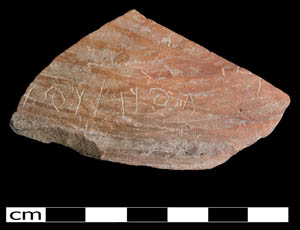
Back in 2005, I think, a pottery shard, inscribed with the Semitic letters AWLT and WLT, was found. Maeir says,

BOTH names that appear on the sherd (AWLT and WLT…) are etymologically very close to Goliath. All are quite similar to Indo-European, names such as Lydian Wylattes/Aylattes, which in the past have been etymologically compared to Goliath (way before this find).

I can’t resist posting a tiny photo here.

Goliath Inscription on Pottery from Tell es-Safi/Gath.

There is a wonderful high resolution photo of the shard online with other information. Read here.

The excavation at Tell es-Safi/Gath this year will be July 6-August 1. Click here for some information about the dig if you have interest. This site, near the valley of Elah, provides a wonderful background for the conflict between the Philistines and the Israelites, between David and Goliath.

Then a champion came out from the armies of the Philistines named Goliath, from Gath, whose height was six cubits and a span. (1 Samuel 17:4)

The Queen of Adiabene and a Rolling Stone

Queen Mother Helena of Adiabene came to Jerusalem with her son, King Izates, as a convert to Judaish in A.D. 46. Adiabene was located in northern Mesopotamia east of the Tigris River. During the famine in Judea, mentioned in Acts 11:28-30, the queen sent to Egypt for grain and to Cyprus for dried figs (Josephus, Ant. 20.51).

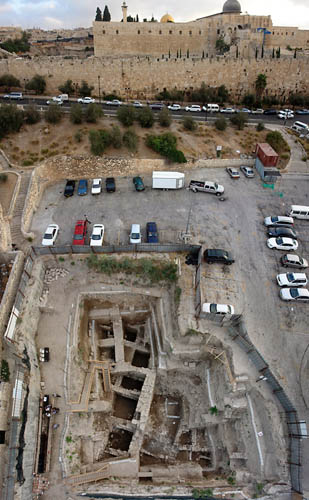
A recent excavation south of the Dung Gate, called the Givati garage area, has revealed a massive building which is being suggested as the palace of Queen Helena. So far there is no absolute proof that the Queen is to be identified with the structures, but it is a good suggestion. The reference in Josephus to the palace of the Queen in the lower city is helpful (Jewish Wars 6.355).

The press release of the Israel Antiquities Authority, December 3, 2007, says:

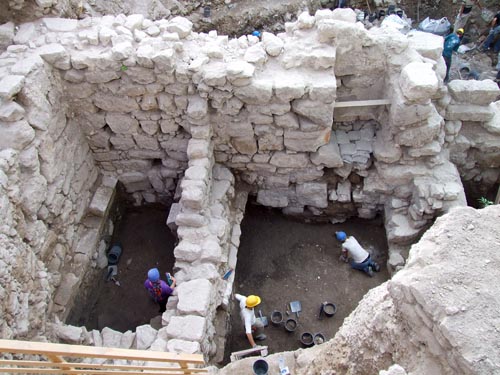
In the excavations the Israel Antiquities Authority is carrying out with the Nature and Parks Authority and the Ir David Foundation, an impressive architectural complex is being uncovered that includes massive foundations; walls, some of which are preserved to a height in excess of five meters and built of stones that weigh hundreds of kilograms; halls that are preserved to a height of at least two stories; a basement level that was covered with vaults; remains of polychrome frescoes; water installations and ritual baths (miqve’ot).

This photo shows the excavation at the bottom and the south wall of the old city of Jerusalem at the top. The City of David is directly to the right of the excavation.

Skyview of the excavation thought to be a palace belonging to Queen Adiabene. Photo supplied by the Israel Antiquities Authority.

The photo below shows details of one portion of the excavation.

Excavation thought to be palace of Queen Adiabene. Photo provided by Israel Antiquities Authority.

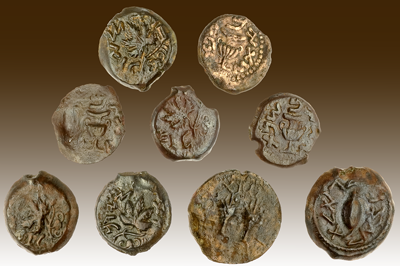
The excavation turned up stone vessels, pottery, and coins belonging to the end of the Herodian Temple [Israelis call this the Second Temple] period. This means prior to A.D. 70 when the Romans destroyed the temple. These coins bear images of, among other things, a vine leaf, a chalice, and an amphora with handles.

Coins found in the Givati excavation. Photo supplied by the Israel Antiquities Authority.

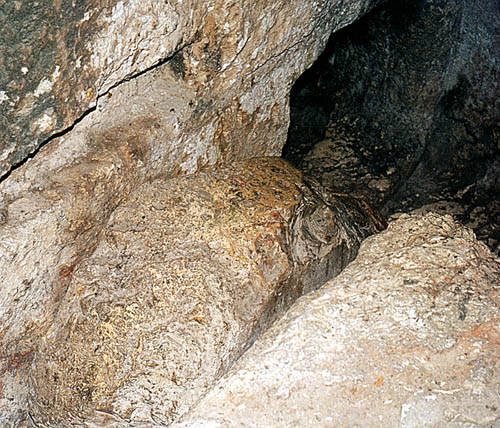
A large burial complex was dug north of the city for the burial of the Queen and her family. This is the tomb referred to in modern times as the Tomb of the Kings. It is a good place to see a rolling stone and a tomb hewn from solid rock. The property is under French control and the last three or more times I have been there it has been closed, and I was unable to rouse anyone by ringing the bell.

Tomb of the Kings, Jerusalem. The tomb of Queen Adiabene. Photo by Ferrell Jenkins.
This rolling stone is of the same type that covered the tomb of Jesus. When Joseph of Arimathea was granted permission from Pilate to bury Jesus, the historical record says,
And Joseph took the body and wrapped it in a clean linen cloth, and laid it in his own new tomb, which he had hewn out in the rock; and he rolled a large stone against the entrance of the tomb and went away. (Matthew 27:59-60)

Logos has ANET on pre-pub

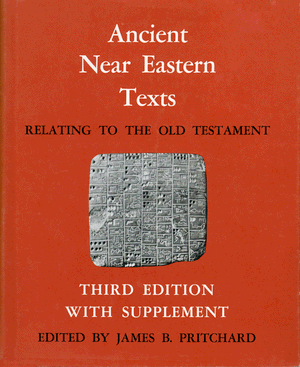
Logos is the premier source for good books available for use on the computer. Now they have Ancient Near Eastern Texts, edited by James Pritchard, on pre-pub. When Logos puts a book on the pre-pub list it means that they offer it for a lower price to those who will agree to buy it when it is ready for distribution. Over the years I have secured several good works this way.

Take a look at the pre-publication special information. The price will be $59.95. I have signed up, and I hope that you will do the same. Amazon offers the print version for $115.00.

Pritchard, Ancient Near Eastern Texts.

Everyone who studies the Bible and the historical association with countries like Egypt, Assyria, Babylon, and Persia, needs this work. The print edition costs about twice as much as the Logos digital version. The ability to search the Logos version will be a distinct advantage.

This edition of 735 pages was first published in 1969. Cyril J. Barber, The Minister’s Library, describes the original publication in these words:

Popularly referred to as ANET. An indispensable aid in understanding the background and culture of the peoples in the Ancient Near East.

HT: BiblePlaces Blog

More on the Rapaihu seal and Gath

Jim West has published a letter from Robert Deutsch and a page from a published book by Deutsch and Lemaire, Biblical Period Personal Seals in the Shlomo Moussaieff Collection, showing a seal that “probably belonged to the father of Rapayahu from Jerusalem.”

Read the entire letter and see the seal here.

Aren Maeir also notes a Tell es-Safi/Gath connection with the Rephaim here. He says,

Notice the name Rapaihu – basically it means the Rapa of Yahu. How does that connect to Gath and Safi?

Well, here it is: In the late 9th century BCE, Stratum A3, at Tell es-Safi/Gath (the level which we believe was destroyed by Hazael of Aram, a short 3-4 letter post-firing, incised inscription (as yet not fully published), was found on the body of storage jar, which has preliminarily been read as rpa’. This reading is reminiscent of the connection in the biblical narrative between the Rephaim and the Philistines in general, and the association of the enigmatic yldy hrph (roughly, “the offsprings of the rph) to several figures originating from the city of Gath (e.g., II Sam 21: 16-22).

Here is a photo I made of the tell of Gath in 1969 before the area was cluttered with power lines.

Tell Gath in 1969. Photo by Ferrell Jenkins.

The Philistine city of Gath provides us with the memorable statement of David when he mourned for Saul and Jonathan.

“Tell it not in Gath, Proclaim it not in the streets of Ashkelon, Or the daughters of the Philistines will rejoice, The daughters of the uncircumcised will exult” (2 Samuel 1:20 NASB).

Eighth Century B.C. Seal Found in the City of David

The Israel Antiquities Authority reports on the discovery of another seal from the area of the City of David. Read the full account here.

Finds recovered from the excavations in the City of David reveal an interesting development in the ancient world: whereas during the 9th century BCE letters and goods were dispatched on behalf of their senders without names, by the 8th century BCE the clerks and merchants had already begun to add their names to the seals.

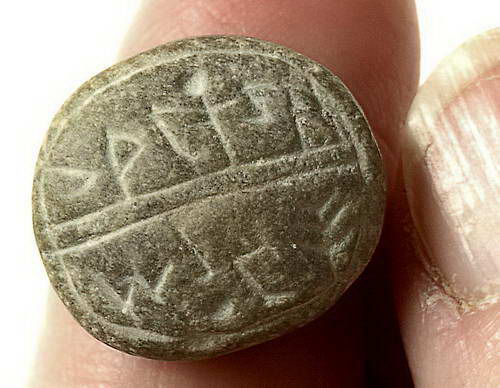
In an excavation the Israel Antiquities Authority is conducting together with the Nature and Parks Authority and the Elad Association, a complete seal bearing an ancient Hebrew inscription with the name of its owner – Raphaihu (ben) Shalem – as well as parts of other seals with writing on it were found.

Here is a nice photo of the seal, courtesy of IAA.

Rephaihu (ben) Shalem seal discovered in the City of David. Courtesy of IAA.

Seals were commonly used during Old Testament times. Jeremiah speaks of sealing and signing a deed (Jeremiah 32:10). Jezebel sealed letters with Ahab’s seal (1 Kings 21:8). Numerous seals bearing the names of biblical characters have been found over the years. It is suggested that this seal belonged to a clerk or merchant of some importance in the 8th century B.C.

Professor Ronny Reich and Eli Shukron are the excavators of the project where this find was made.

HT: BiblePlaces Blog; PaleoJudaica.

Writing in the Snow in Bowling Green

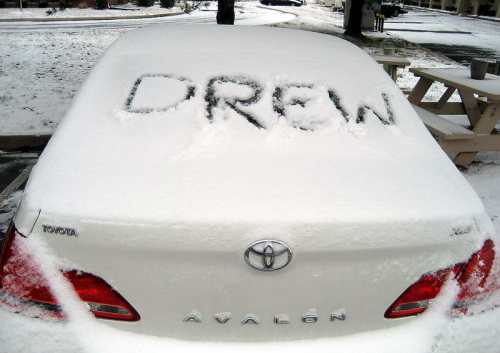
The temperature might reach 36 degrees today. There was enough snow overnight that the schools were closed today. I took advantage of the back window of my rental car to do a little writing.

“Drew” in Snow. Photo by Ferrell Jenkins.

Rivers in the Desert

Todd Bolen, over at BiblePlaces Blog, calls attention to an article in the Jerusalem Post about an American tourist who was killed in a Flash Flood at En Gedi. He calls attention, in one of the links, to some photos I made April 2, 2006 of a flash flood in the Wilderness of Judea. Afterwards I wrote an article about it for Biblical Insights. Read Todd’s blog and then read my article below. Todd also includes a beautiful photo of Nahal David at a more tranquil time.

————————————

Rivers in the Desert is the title of Nelson Glueck’s 1959 history of the Negev. These rivers also may be seen in the Judean wilderness and in the Sinai. Thomas Levy followed up on some of Glueck’s research in a Biblical Archaeology Review article in 1990.
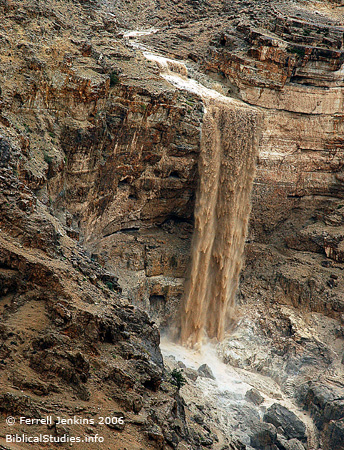
Wilderness of Judea Waterfall - April 2, 2006. Photo by Ferrell Jenkins.

If one travels in the desert during the summer months he will see a dry, desolate bad land with only an isolated tamarisk tree or shrub where the last water of the winter rain flowed. In the winter it can be different. Israel has two dominant seasons: winter and summer. The summer is dry and the winter is wet. The early rains begin about mid-October and continue till the late rains of early April. See Deuteronomy 11:14 and Joel 2:23.

he wilderness of Judea receives very little rain, but the area is affected by the rains that fall in the central mountain range (Jerusalem and the Mount of Olives; Bethlehem; Hebron). We sometimes describe the road that runs along that range as the water parting route. The rain that falls must seek its lowest level. From an elevation of about 2500 feet above sea level the water flows east through the wadis to an elevation of more than 1300 feet below sea level at the Dead Sea.

Levy reminds us that “Nahal, incidentally, is Hebrew for a dry river bed or valley that flows at most a few times a year. In Arabic, the word is wadi. The two words are used interchangeably in Israel today.” The wadi is similar to the arroyo of the American southwest.
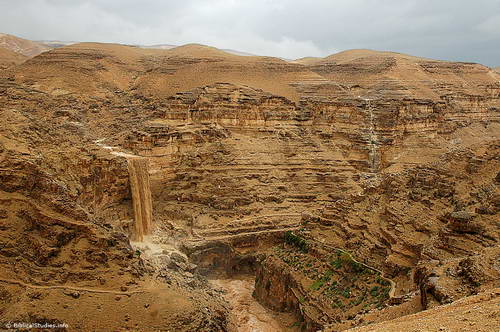
Wilderness of Judea Waterfall - April 2, 2006. Photo by Ferrell Jenkins.

Several members of my group told me of being awakened during the morning of April 2 by the severe storms in Jerusalem. At breakfast I explained to the group that this would be no problem for our planned sightseeing; we would just go to the Dead Sea and Masada. Eli, our guide, told the group that when we came out of the new tunnel that now cuts through the mountain between Mount Scopus and the Mount of Olives, it would probably be dry. In fact it was still raining on us almost all the way to the Jordan Valley.

Our driver decided to pull off the highway onto the old road that overlooks the Wadi Kelt (Qilt) on the way down to Jericho. On the south side of the wadi there is an overlook allowing a view of the Monastery of Saint George of Koziba. There we saw one of the most fascinating sights that can be imagined. It rained an astounding 4.41 inches in Jerusalem. This is about three times what the city normally gets for the entire month of April.

In this normal desert land there was a tremendous waterfall pouring down the side of the cliff into the wadi. Our guide said, and another experienced guide is reported to have told his group, that he had never seen it like this. That evening Todd Bolen and his wife were my guests for dinner at the hotel. Todd has lived and taught in Israel for the past ten years. He has provided us with excellent photos in his Pictorial Archive of Bible Lands (see bibleplaces.com). He was excited about the photos I had taken that day and included three of them on his blog. He was headed for Galilee the next day. He reported seeing hail at En Gev on the Sea of Galilee. The Jerusalem Post ran a photo of the flooded road at the Megiddo junction, and reported that five people had died as a result of the heavy rains.

Not only could we not get to Masada that day, but we could not go to Qumran on the shores of the Dead Sea. A couple of days later when we visited these sites we saw the damage to the road in multiple places where the wadis descended to the Dead Sea. Debris could be seen in the Dead Sea.
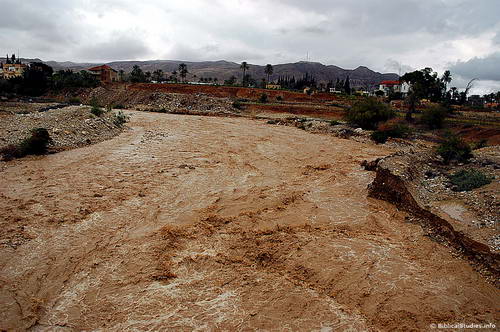
Wadi Qelt (Kelt) in the Wilderness of Judea. Photo by Ferrell Jenkins.

In forty years of travel in the Bible Lands, this was one of my most exciting days for photography. I am delighted to share it with you.

The photo below is of a typical dry wadi in the Wilderness of Judea.
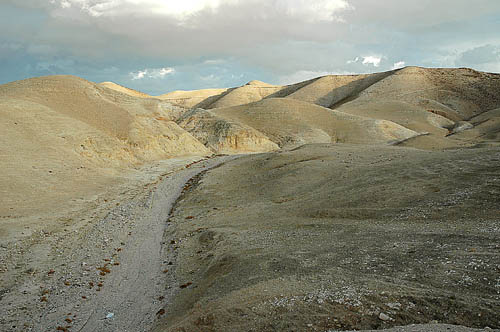
A dry wadi in the Wilderness of Judea. Photo by Ferrell Jenkins.
Understanding Postmodernism

What does this have to do with travel? Well, it is travel of the mind, and the road of history that has brought us to the place we are now in the early part of the 21st century.

I do try to stay on target with this blog, but I regularly check a blog called Parchment and Pen. There is a short video explaining, with a visual illustration, what Postmodernism is, and how we got to this place in modern thinking. I think you will profit by taking the time to listen to this discussion about Scripture, Tradition, Reason, and Postmodernism.

Here is the link to the video produced by Reclaiming the Mind Ministries. You may watch it online or download it to watch.

Hopefully this will help clear up some fuzzy thinking!

Photo for the 20,000 winner

And the winner is Jennifer!

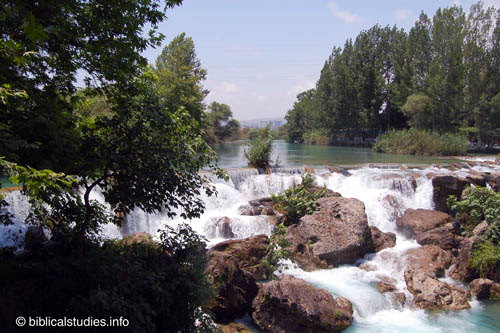
Back on January 30th we announced the winner of the digital photo for being the twenty thousandth visitor to the site. The winner has asked for a surprise photo from Turkey. So, I have decided to send her a photo of the waterfalls on the outskirts of Tarsus in Cilicia, the hometown of Saul (Paul, the Apostle). Here is a small copy of the image I am sending to the winner.

Waterfalls at Tarus in Cilicia, home of the apostle Paul. Photo by Ferrell Jenkins.

Tarsus was important historically. Because of its position on the River Cydnus near the Mediterranean about 30 miles below the Cilician Gates, Tarsus in Cilicia served as one of the great crossroads of history. Paul described his hometown as “no insignificant city” (Acts 21:39; 9:11; 22:3). It was a fortified city and trade center as early as 2000 B.C. It was captured by the Assyrian kings Shalmaneser III (833 B.C.) and Sennacherib (698 B.C.), and had seen the likes of Alexander the Great and Cleopatra.

Tarsus was commercially important. Ancient writers mention the linen woven here from flax which grew in the fertile plain. A material called cilicium was woven from goat’s hair and used to make coverings which would protect against cold and wet .

The city was culturally important. Strabo describes the people as being avid in the pursuit of culture. Tarsus was a university town, and was noted as the home of several well-known philosophers, especially of the Stoic school. Barclay says,

If a man was destined to be a missionary to the world at large, there was no better place in all the east for him to grow to manhood than in Tarsus” (The Mind of St. Paul, 25-26).

It is not difficult to imagine that famous leaders and armies stopped by this waterfall to be refreshed before (or after) making their way through the Cilician Gates. And it is easy to imagine that young Saul and his friends often visited the site.