Mount Nemrut in Commagene

Today I have posted an article on Mount Nemrut at biblicalstudies.info. I think you will find the article of interest.

The Kingdom of Commagene was important in the first century B.C., and has connections with Alexander the Great and Darius, and with one of the characters mentioned in the New Testament. I think you will enjoy it.

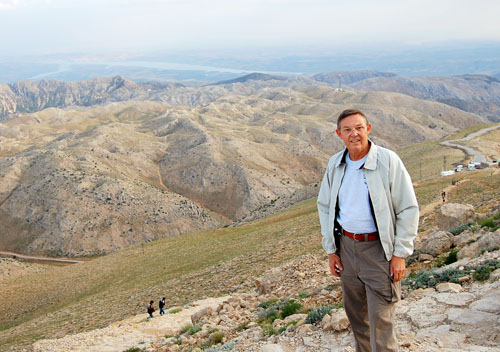
This photo shows the approach to the top of Mount Nemrut in Eastern Turkey. The Euphrates River valley is far below in the haze.

Approach the top of Mount Nemrut with the Euphrates Valley below.

“From Dan to Beersheba”

The tribe of Dan was assigned territory along the Mediterranean Sea where Joppa and the modern city of Tel Aviv now stand (Joshua 19:40-48). Because the Philistines lived in this territory the Danites found it necessary to move to a new location. A portion of the tribe moved north to the city of Laish at the foot of Mount Hermon and renamed it Dan (Judges 18). This northern city became the northern boundary of Israelite occupation and prompted the expression “from Dan to Beersheba” (Judges 20:1; 1 Kings 4:25).

An Aramaic inscription was found by Professor Avraham Biran at Dan July 21, 1993. The inscription mentions the king of Israel, the “the house of David,” and the Aramean (Syrian) god of storms and warfare, Hadad. The “house of David” is a reference to the southern kingdom of Judah. Two additional pieces of the inscription were found in June, 1994.

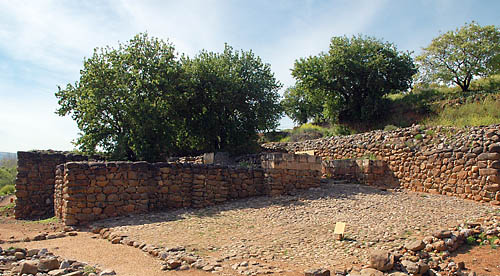
This photo show the partially reconstructed Iron Age (Israelite) gate at Dan.

The Iron Age City Gate at Dan. Photo by Ferrell Jenkins.

We have a winner!

As the sole judge of things like this, I declare chickenmomma the winner of a digital photo of choice as visitor number 20,000. Second is shirley (private Email, rather than comment). Third is priyank. I will be in touch with each of you privately to learn which picture you want.  Thanks to each.

Prize for visitor number 20,000

If you are visitor number 20,000, or the first one afterwards (see Blog Stats on the right) I will send you a high resolution digital photo of a biblical site of your choice. It will be suitable for use in PowerPoint presentations. This assumes that I have a photo of the place. Give me a list of three in your order of preference and I will do my best.

Leave a comment to let me know.

Approaching Y20K

When we began this little blog to post photos of our Ancient Crossroads Tour of Biblical and Historical Turkey, we never even thought about reaching 20,000 hits. But, it should happen today. Thanks for making this a site you visit regularly.

There are many things I would like to blog about if I could find the time, but I have basically tried to limit myself to things pertaining to travel in the Bible lands.

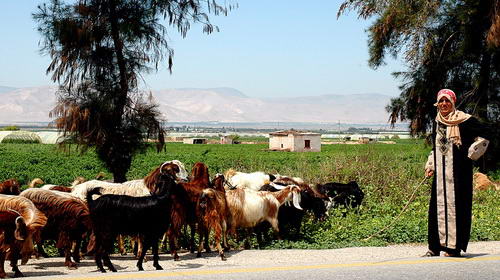
As our gift to you for traveling along with us, here is a picture of a woman caring for goats in the Jordan River valley on the east side. This photo was made in the Hashemite Kingdom of Jordan, looking across to Israel. In Roman times (the period of the New Testament) this area was known as Perea. The New Testament never uses the word Perea, but the Greek New Testament has the word peran (translated beyond), in the phrase “beyond the Jordan” (Matthew 19:1; John 1:28; 10:40). Jesus spent a considerable about of time in this region (John 10:40-42; Luke 13:22-35, et al.).

Caring for Goats in the Jordan Valley, the area of Perea in New Testament times. Photo by Ferrell Jenkins.
The desolate looking area across the valley is the northern end of the Wilderness of Judea. The Jordan River is rarely visible because it flows in a depression known as the Zor. The Zor is a depression cut into a wider depression called the Ghor. This valley is several hundred feet below sea level, making it ideal for truck farming today. If that expression (truck farming) is new to you, it means the growing of vegetables for use by people outside the area.
Thanks. Visit often.

Biblical Sites in Eastern Turkey

For the past two weeks I have been working on a presentation for a class at the Florida College Annual Lectures (February 5, 2008 at 9 a.m. in Puckett Auditorium). I plan to make a similar presentation at the Citrus Park Church of Christ, 5105 W. Ehrlich Road, Tampa, FL, Sunday evening January 27 at 5 p.m. If you live in the Tampa Bay area I would be pleased to have you present for this lesson.

I have visited biblical sites all over Turkey for many years. Two personal study trips have been made to the eastern part of the country, one in 1995, and another in June, 2007. Check the June archives for those blogs.

Our presentation will cover the land of Urartu (biblical Ararat), Mount Ararat, Mesopotamia, the Tigris and Euphrates Rivers, Harran, Carchemish, and a few other places. We will be looking at the biblical, historical, and geographical information that makes these places important in Bible history.

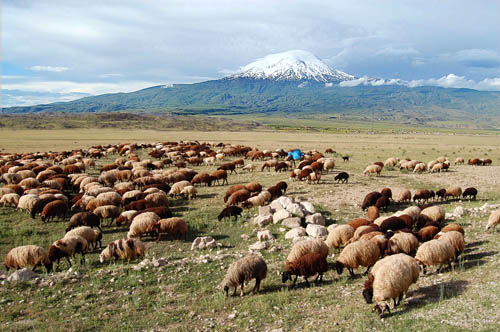
Here is a photo of Mount Ararat from June, 2007. The mountain is located near the Turkish border with Iran and Armenia, and many think it was the landing place of Noah’s ark (Genesis 6-9).

Mount Ararat in Eastern Turkey. Photo by Ferrell Jenkins

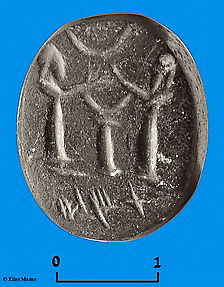
Does this seal bear the name of a Bible character?

We now have dozens of seals bearing the names of characters mentioned in the Bible, but every new one is interesting. The Jerusalem Post, January 16, 2008, reports the discovery of a seal that it says bears the name of a family of temple servants who were exiled to Babylon in 586 B.C., and then returned to Jerusalem after the exile. The discovery was made by Dr. Eilat Mazar at the City of David Excavation.

The Jerusalem Post:

The seal, which was bought in Babylon and dates to 538-445 BCE, portrays a common and popular cultic scene, Mazar said.
The 2.1 x 1.8-cm. elliptical seal is engraved with two bearded priests standing on either side of an incense altar with their hands raised forward in a position of worship.
A crescent moon, the symbol of the chief Babylonian god Sin, appears on the top of the altar.
Under this scene are three Hebrew letters spelling Temech, Mazar said.
The Bible refers to the Temech family: “These are the children of the province, that went up out of the captivity, of those that had been carried away, whom Nebuchadnezzar the king of Babylon had carried away, and came again to Jerusalem and to Judah, every one unto his city.” [Nehemiah 7:6]… “The Nethinim [7:46]”… The children of Temech.” [7:55].
. . .
“The seal of the Temech family gives us a direct connection between archeology and the biblical sources and serves as actual evidence of a family mentioned in the Bible,” she said. “One cannot help being astonished by the credibility of the biblical source as seen by the archaeological find.”

The full article is here.

Seal Discovered by Dr. Eilat Mazar in City of David Excavation.

According to the article, Dr. Mazar reads the inscription as Temech. In many English versions this name is translated as Temah. The Nethinim are mentioned in Nehemiah 7:24 rather than 7:46. See also Ezra 2:53. Other scholars were quick to point out that Mazar had read the inscription left to right, but that seals are normally in the reverse order so that when they are impressed in clay the name reads right to left. Thus the suggestion has been made that the name should be Shelomith. Others have pointed out that there was a Shelomith among the returnees from Babylon (Ezra 8:10).

A warning is in order. There is no way to connect a name on a seal, without additional information such as a title, to a specific person in the Bible. The best one can say is that the name was common to the time of a given event or book. And we are never quite sure if the reporter with a deadline to meet got the comment correct, or placed it in the correct context. In other words, we must await additional, more detailed information. A context for the dating of the seal to a particular year, or span of years, must be provided.

Be patient and wait at least another week (month, year, decade) before using this in your sermon!

Many scholars are critical of Dr. Eilat Mazar and her work in the City of David Excavation. They paint her as a person with an agenda to prove the Bible true, and that she stretches the evidence to fit the theory. If this is true, it is not good. On the other hand, I suspect it is the lack of belief in the veracity of the Bible that prompts some to criticize her every shovel of dirt.

In 2005 Mazar announced the discovery of a clay bulla (the impression of a seal) bearing the inscription, “Yehukal son of Shelemyahu son of Shobi.” The suggestion has been made, and seems legitimate, that this is the name of the “Jehucal the son of Shelemiah” mentioned in Jeremiah 37:3. This bulla is added to several others, published much earlier, of persons named in the book of Jeremiah.

Archaeology has been a wonderful tool for the Bible expositor, but we must be careful not to expect too much from it.

The aerial photo below, which I commissioned a fews years back, shows the area of the Temple Mount to the north (top of photo) and the City of David to the south (bottom of photo).
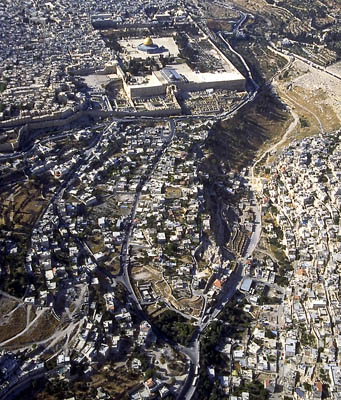
Aerial View of Jerusalem - Temple Mount and City of David. Photo belongs to Ferrell Jenkins.

HT: Paleojudaica; Todd Bolen; Chris Heard

Theology Matters . . . It Always Matters

Dr. Albert Mohler, president of Southern Baptist Seminary, writes some excellent material relating to Christianity and modern culture; that is, the Christian Worldview as it relates to other Worldviews.

In his most recent blog, Mohler reviews a book by George Weigel, a prominent Catholic intellectual and commentator. Weigel’s book, Faith, Reason, and the War Against Jihadism, shows the importance of taking theology seriously in dealing with the threat of jihadism. I recommend that you read Dr. Mohler’s comments here.

“An amazing experience”

An Associated Press report by Anne Gearan is headlined “Bush Visits Biblical Holy Sites.” You may read the entire article here. The article says,

Bush retraced the steps of Jesus and his disciples in the ancient town of Capernaum and gazed out on the nearby Sea of Galilee, where the Bible says Jesus walked on water and calmed a sudden storm by commanding the wind and waves to cease. The waters were crystal blue and calm when Bush visited, leaning in to listen as a brown-robed friar narrated his tour with New Testament passages.

“An amazing experience,” Bush happily said later.

It is an amazing experience for anyone with an interest in the Bible and Jesus. Bush is reported to have said, “I came as a pilgrim.” Many people make pilgrimages to worship at a particular holy site. There is, perhaps, a higher purpose for visiting these sites. On our tours we seek to demonstrate the accuracy of the Bible in describing the Bible land. This involves learning about the geography and topography of the land that help one to better understand the important events that transpired there.

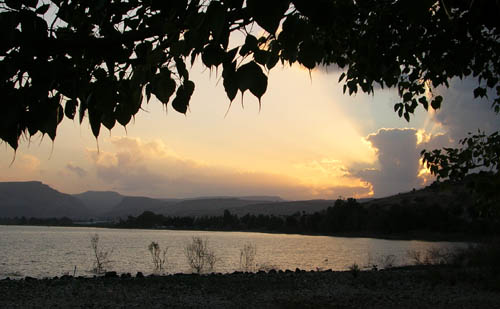
Sunset at Dalmanutha (Mark 8:10) at the northwest corner of the Sea of Galilee. Photo by Ferrell Jenkins.

Sunset at Dalmanutha

The photo above was made at sunset from the site known as Dalmanutha, near the Mount of Beatitudes. Dalmanutha is mentioned only once in the New Testament. After the feeding of the 4000, Mark records that Jesus immediately “entered the boat with His disciples and came to the district of Dalmanutha” (Mark 8:10). In the distance, on the left, you can see the silhouette of Mount Arbel. Then, just to the right of that is the Via Maris (the way to the Mediterranean Sea) from Galilee. The saddle-shaped hill is an extinct volcano known as the Horns of Hattin.

It is “an amazing experience” to visit this land and contemplate these great events.

Resources on the Book of Revelation

Yesterday I received an Email from Dr. Georg S. Adamsen in Denmark, asking that I change the link to his Revelation Resources page on my Biblical Studies Info Page. First, let me say I appreciate his notifying me of the change. Many individuals ask to include a link but never notify us when they close down the page.

Revelation Resources is now presented in blog format. Adamsen describes the blog this way:

Revelation Resources – about 250 hand-picked references on valuable resources for the study of the Book of Revelation. Many topics have separate introductions…

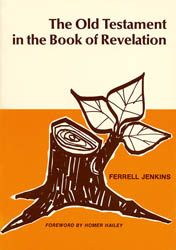
My Old Testament in the Book of Revelation has been included at Revelation Resources for several years. I was pleasantly surprised this evening when I was checking the URL to see that the book is featured on this page (January 7).

Because the current publisher of the book does not have a marketing strategy many people think the book is out of print. You may secure a copy from the Florida College Bookstore. I wasn’t able to locate the book on the website, but you can send an Email to bookstore@floridacollege.edu for information. I think the book now sells for $4.95. I saw a used copy on Amazon recently for $59.96!

Jenkins, The Old Testament in the Book of Revelation

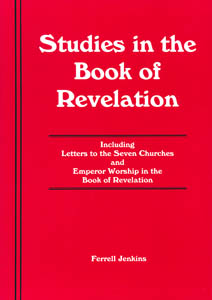
Florida College also recently reprinted my Studies in the Book of Revelation. It sells for $5.99. In my judgment this is an excellent source for a class study of the Revelation.

Jenkins, Studies in the Book of Revelation

Studies in the Book of Revelation (90 page paperback) is composed of these sections.

Introducing the Book at the End of the Bible
Worthy Is the Lamb
Saints Victorious
Does Revelation Teach Premillennialism?
Letters to the Seven Churches
Emperor Worship in the Book of Revelation

If you prefer to call Florida College Bookstore and speak to one of the friendly staff, use their toll free number (1-800-423-1648).

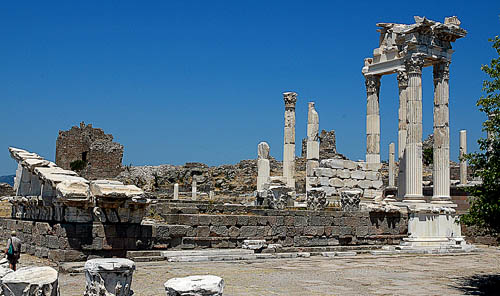
What does this have to do with travel, you wonder. The Revelation was written to the seven churches of Asia, the Roman province of Asia Minor, in the late first century A.D. The seven cities were Ephesus, Smyrna, Pergamum, Thyatira, Sardis, Philadelphia, and Laodicea. Several of them have significant ruins that can be visited. We have included them on several study tours we call Steps of Paul and John, including Turkey, Greece, and the Aegean Islands. During the course of this tour we spend some time lecturing on the setting of the Book of Revelation. We plan to do that in May when we again visit these and other cities associated with Paul and John.

Temple of Roman Emperor Trajan at Pergamum. Photo by Ferrell Jenkins.

This photo shows the reconstruction of the Temple of (Roman Emperor) Trajan ( A.D. 98-117). This was the second temple in Pergamum dedicated to the Emperor. The first temple in all of Asia was erected to Augustus in 29 B.C. Altogether Pergamum had three imperial temples.