Category Archives: Turkey

Aphek – where the Philistines were encamped

One of the significant battles between Israel and the Philistines took place during the time of Samuel when the ark of the covenant was located in the tent of meeting at Shiloh.

And the word of Samuel came to all Israel. Now Israel went out to battle against the Philistines. They encamped at Ebenezer, and the Philistines encamped at Aphek. (1 Samuel 4:1 ESV)

Israel encamped at Ebenezer, and the Philistines encamped at Aphek in the plain of Sharon. This indicates that the two places were fairly close to each other. Aphek is located about 21 miles west of Shiloh. Ebenezer is about 2 miles east of Aphek.

Herod the Great built a city at the site of Aphek and named it Antipatris in honor of his father.

Herod was also a lover of his father, if any other person ever was so; for he made a monument for his father, even that city which he built in the finest plain that was in his kingdom, and which had rivers and trees in abundance, and named it Antipatris. He also built a wall around a citadel that lay above Jericho, and was a very strong and very fine building, and dedicated it to his mother, and called it Cypros. (Jewish Wars 1:417)

Because Aphek/Antipatris sat on a major south-north and west-east routes, it was dominated by many nations. The dominant feature of the site today is the Turkish fort. Inside are the excavated ruins of buildings from Canaanite to Herodian/Roman times.

The apostle Paul stayed overnight at Antipatris on his journey from Jerusalem to Caesarea (Acts 23:31).

Aphek/Antipatris is known by the modern name Ras el-Ain because it is located at the headwaters of the Yarkon River which flows into the Mediterranean about 11 miles to the west.
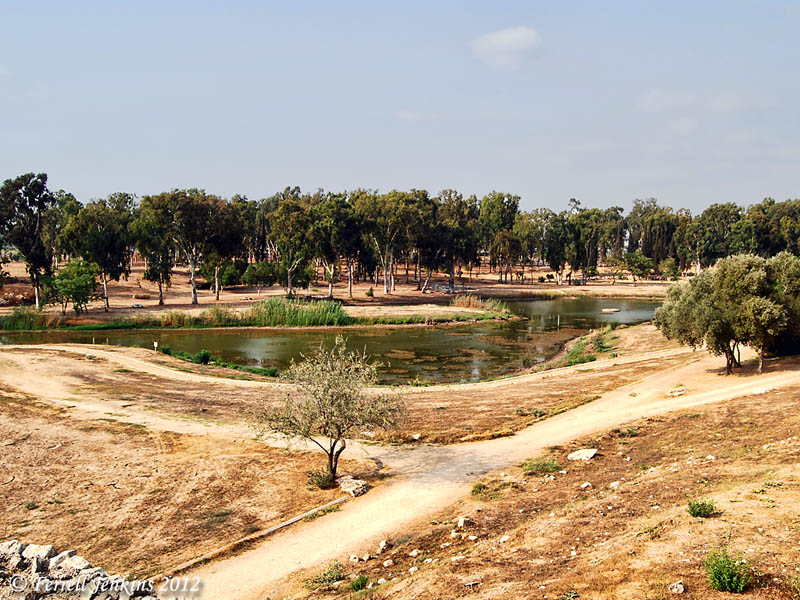
Source of the Yarkon River at Aphek/Antipatris. Photo by Ferrell Jenkins.

Source of the Yarkon River at Aphek/Antipatris. Photo by Ferrell Jenkins.

Aphex/Antipatris is now dominated by the ruins of an Ottoman fortress.
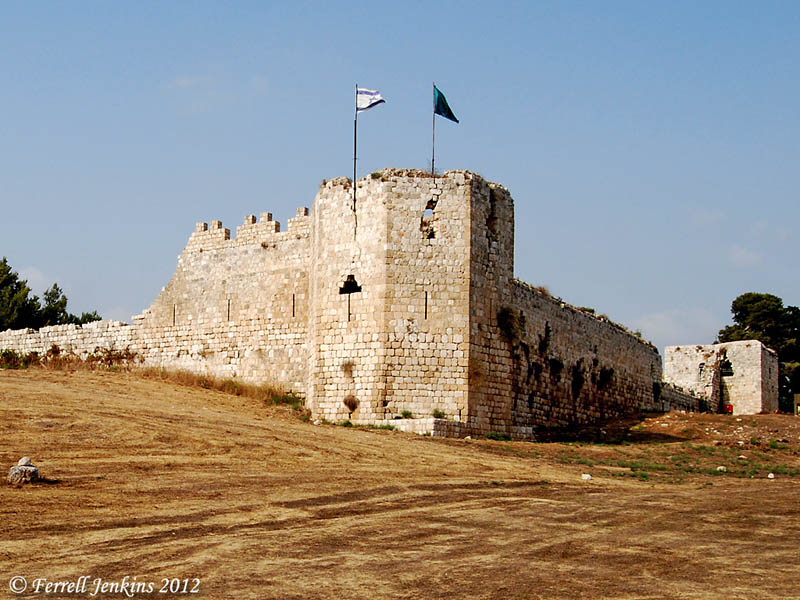
The Crusader castle of Mirabel, later used as a Turkish fortress. Photo by Ferrell Jenkins.

The Ottoman fortress at Aphek/Antipatris. Photo by Ferrell Jenkins.

Our final photo shows the fortress and the source of the Yarkon River from the air. Notice in the previous photos the grass is brown. Those photos were made in August. The next photo was made in December and the grass is green.
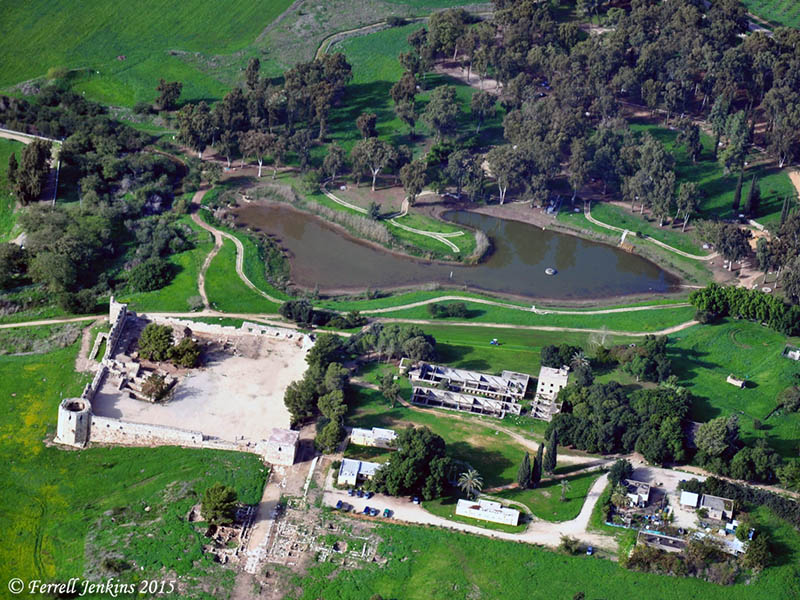
Aerial photograph of Aphek/Antipatris. Photo by Ferrell Jenkins.

Aerial photograph of Aphek/Antipatris. Photo by Ferrell Jenkins.

Leon Mauldin has written about Aphek here.

In the next post we plan to write about “The Other Aphek.”


“You shall not steal…You shall not covet”

“You shall not steal. “You shall not bear false witness against your neighbor. “You shall not covet your neighbor’s house; you shall not covet your neighbor’s wife, or his male servant, or his female servant, or his ox, or his donkey, or anything that is your neighbor’s.” (Exodus 20:15-17 ESV; cf. Romans 13:9)

The Ten Commandments, given to the nation of Israel, were clear about the attitude one should take toward the property belonging to others. Coveting causes one to desire the wife, or the property, of another man.

The reason the donkey and ox of another was not to be coveted or stolen was because these were the man’s means of income. How could he work without his donkey or ox?

A loaded donkey at Seleucia. Photo by Ferrell Jenkins.

A loaded donkey at Seleucia. Photo by Ferrell Jenkins.

It may be that none of my readers own a donkey or an ox, but the principle is clear. You shall not take that which belongs to another person. When I was teaching I had to deal with this issue a few times. I am confident that it happened other times, but I did not know about it at the time.

When a student turns in a report or paper that was written by another student he/she is stealing the work of another and pretending that it is his own. Occasionally a student will look over and take an answer that another person has given to a question. That is stealing.

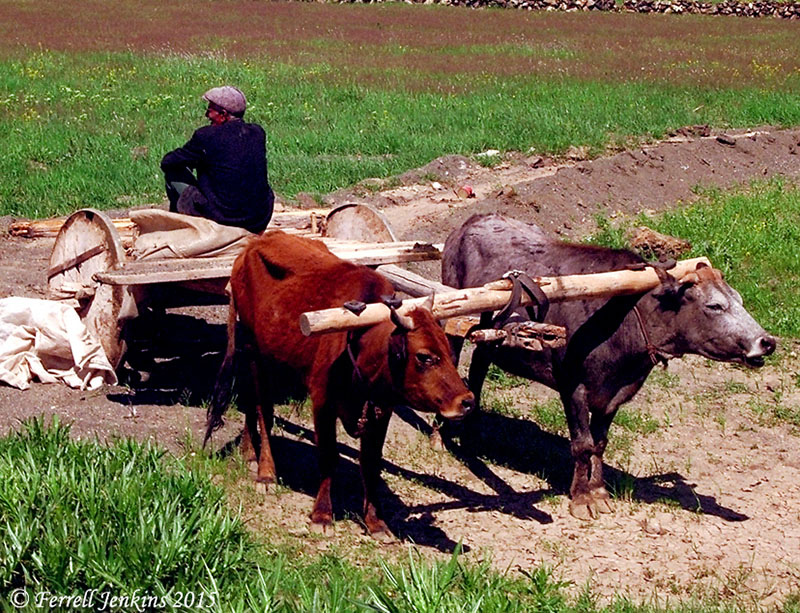
Oxen hitched to a small wagon near Mount Ararat in Turkey. Photo by Ferrell Jenkins.

Oxen hitched to a small wagon near Mount Ararat in Turkey. Photo by Ferrell Jenkins.

There is such a thing as intellectual property. The government of the United Kingdom describes intellectual property as “the words you’ve written.” It includes “things you write, make or produce.” Like photos, for example.

A student once told me that there was a student on campus who would make a CD of ten of your favorite songs for $1 for each song.  What if a person spends literally several thousand of dollars to purchase equipment, travel a long distance and make photos. Would it be o.k. to take that property and treat it as one’s own.

Several years ago I had a young person to copy some of my posts without permission and post them on his own web site. He cropped the photos to cut off the copyright notice. He said he didn’t know. His web site was closed down.

Recently someone living in a fashionable neighborhood in another country registered a internet site using my name. (I could post a photo of his house from Google earth!) He had this entire web site posted on his new domain, but he made it impossible for readers to reach me. All Email was directed to him (or her?).

There are strict laws governing this sort of thing. In the USA we have the DMCA (Digital Millennium Copyright Act). I have learned that some (perhaps most or all) of the hosting companies take this seriously. The DMCA “implements the 1996 treaties of the World Intellectual Property Organization (WIPO)” (Wikipedia, here), to which most of the nations in the United Nations subscribe. Once I got to the correct company, the offending web site was closed very quickly.

Even the Code of Hammurabi (ruled 1728-1686 B.C., according to Pritchard) contained numerous laws containing the penalties for stealing. Law 8 says,

If a seignior stole either an ox or a sheep or an ass or a pig or a boat, if it belonged to the church (or) if it belonged to the state, he shall make thirtyfold restitution; if it belonged to a private citizen, he shall make good tenfold. If the thief does not have sufficient to make restitution, he shall be put to death. (ANET).

I think that most of us are pleased when someone finds our material useful and even wants to share it with others. But stealing one’s property is another matter.

Our PHOTO PERMISSION page is liberal regarding private and classroom non-commercial use of our photos as long as credit is given.

Thanks for reading this blog. I hope you find it helpful in your own study and teaching.

Ancient underground city discovered in Cappadocia

Turkey’s Central Anatolian province of Nevşehir is known for the unusual rock formations. Now comes a new report that a previously unknown underground city has been found during destruction of some buildings in preparation for new buildings around the Nevşehir fortress.

The city was discovered by means of Turkey’s Housing Development Administration’s (TOKİ) urban transformation project. Some 1,500 buildings were destructed located in and around the Nevşehir fortress, and the underground city was discovered when the earthmoving to construct new buildings had started.

TOKİ Head Mehmet Ergün Turan said the area where the discovery was made was announced as an archeological area to be preserved.

“It is not a known underground city. Tunnel passages of seven kilometers are being discussed. We stopped the construction we were planning to do on these areas when an underground city was discovered,” said Turan.

The city is thought to date back 5,000 years and is located around the Nevşehir fortress. Escape galleries and hidden churches were discovered inside the underground city.

Stating that they were going to move the urban transformation project to the outskirts of the city, Turan said they had paid 90 million Turkish Liras for the project already, but did not see this as a loss, as this discovery may be the world’s largest underground city.

Hasan Ünver, mayor of Nevşehir, said other underground cities in Nevşehir’s various districts do not even amount to the “kitchen” of this new underground city.

“The underground city [was found] in the 45 hectares of the total 75 hectare area that is within the [urban] transformation project. We started working in 2012 with the project. We have taken 44 historical objects under preservation. The underground city was discovered when we began the destruction in line with the protocol. The first galleries were spotted in 2013. We applied to the [Cultural and Natural Heritage] Preservation Board and the area was officially registered,” said Ünver.

The newly discovered underground city will be the biggest among the other underground cities in Nevşehir that have been discovered so far.

The brief Hurriyet Daily News report is available here.

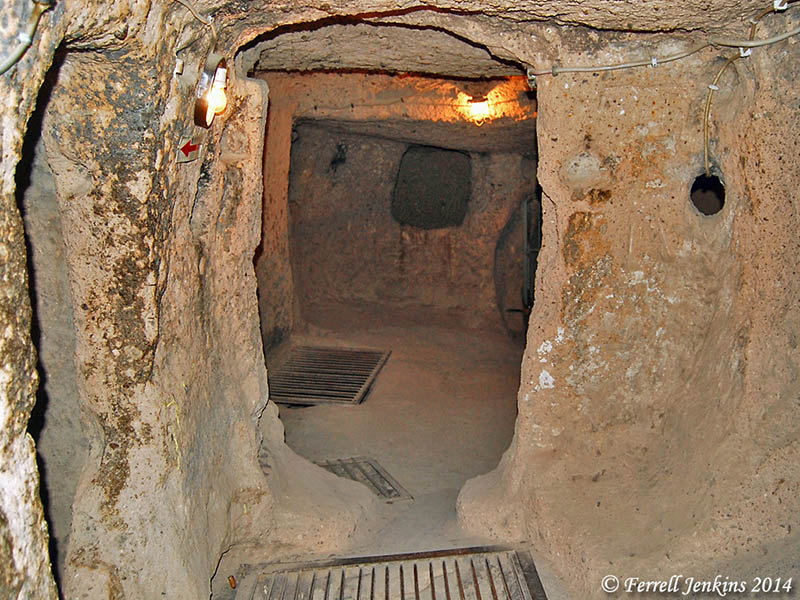
Several underground cities are open to the public. Our photo below was made at Kaymakli, a site registered on the World Heritage List in 1985.

Kaymakli Underground City in Cappadocia. Photo by Ferrell Jenkins.

A room in the Kaymakli Underground City in Cappadocia. Photo by Ferrell Jenkins.

The Bible tells us that Jews of Cappadocia were present in Jerusalem on the day of Pentecost (Acts 2:9). Peter wrote his epistles to saints scattered throughout Cappadocia and other places in Roman Asia Minor (modern Turkey; 1 Peter 1:1-2).

HT: Jimmy Dan Alexander


NASA photos of Israel and Middle East

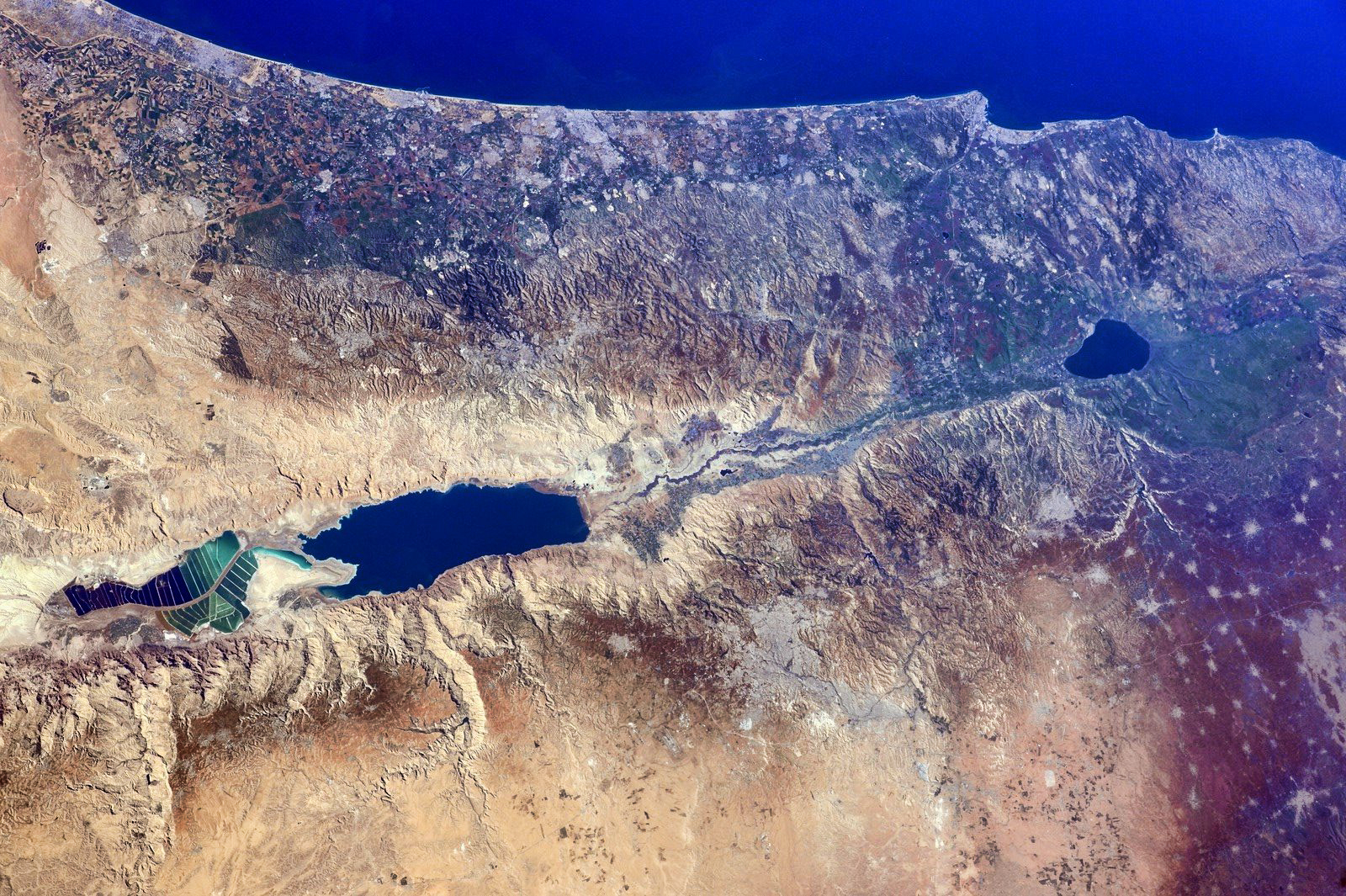
NASA has posted several excellent photos made by Barry Wilmore from the International Space Station on Facebook. The photos were made on Christmas day, 2014. See how many landmarks you can identify. Click on the photo for a larger image. Do you see Tyre?

Israel, the West Bank, and part of Jordan from the ISS. Photo: NASA/Barry Wilmore.

Israel, the West Bank, and part of Jordan from the ISS. Photo: NASA/Barry Wilmore.

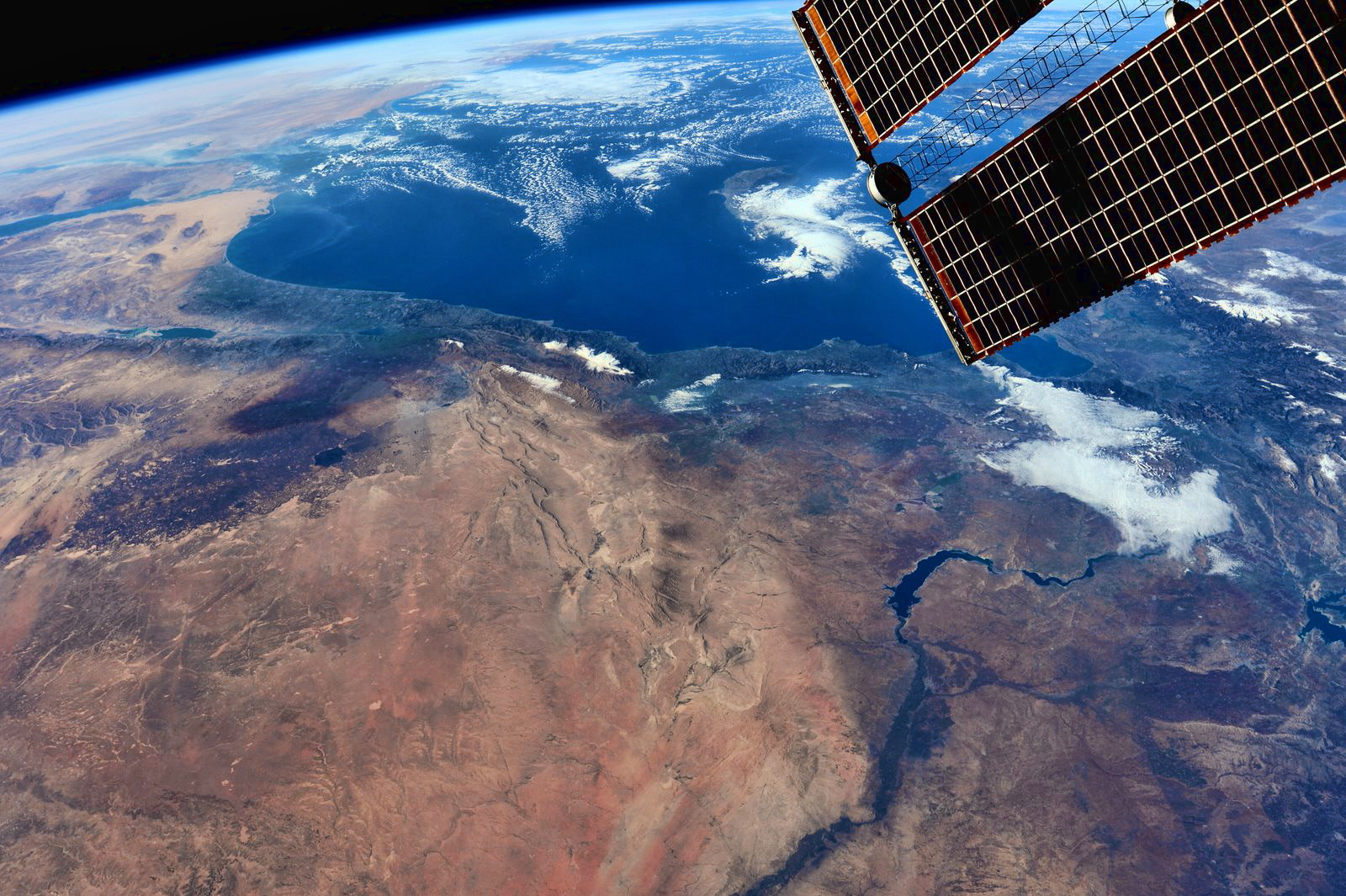
The photo below shows portions (or all) of (L to R) Egypt, Sinai Peninsula, Israel, Jordan, Lebanon, Syria, Turkey (including Euphrates River), and Iraq. Great photo.

The Middle East from the ISS. Photo: NASA/Barry Wilmore.

The Middle East from the ISS. Photo: NASA/Barry Wilmore.

Get out your Bible atlases and study these photos.

Our tax dollars put to good use, I would say.

Index of articles on Bethlehem and the Birth of Jesus

Bethlehem and the Birth of Jesus.  Our total number of posts has now grown to more than 1700 and this makes it difficult to locate a post you may need. This index is prepared to assist you in your study of the birth of Jesus in ancient Bethlehem. Most, if not all, of the posts include at least one photo illustrating the lesson.

Other places near Bethlehem. Most of the links below are related to Herod the Great and the fortress he built near Bethlehem. I see that I have normally used the spelling Herodium, but sometime Herodion.

Historical Connections to Modern Christmas Celebrations. These post are post-biblical, historical references to customs associated with Christmas.

When other posts on this subject are written I will try to remember to update the list.

Sunset from En Gev on the Sea of Galilee

Travelers to the Sea of Galilee are always delighted to get a sunrise photo from Tiberias. If you travel around the lake to the eastern shore in the late afternoon you might see two things. Because the winds from the Mediterranean come from the north east you might see the stormy waves on the sea. And you might see a beautiful sunset.

The photo below is made from Kibbutz En Gev. The small village, home to some of the fishing and touring boats that ply the Sea of Galilee, is located in the shadow of the impressive mound of Hippos (Susita).

Sunset from En Gev. Photo by Ferrell Jenkins.

Sunset from En Gev. Photo by Ferrell Jenkins.

The harbor of Hippos (Susita) is located immediately south of En Gev. It is one of 15 or more ancient harbors now known to have existed in the time of Jesus.

Babylon – index of articles

The Babylonian Empire was relatively short lived (626–539 B.C.), but it played a large role in biblical history. We have written about all of the Babylonian kings mentioned in the Bible. In this post I am pulling together an index collection of these articles to make it easy for one studying about the Babylonian captivity to locate all of them in one convenient place.

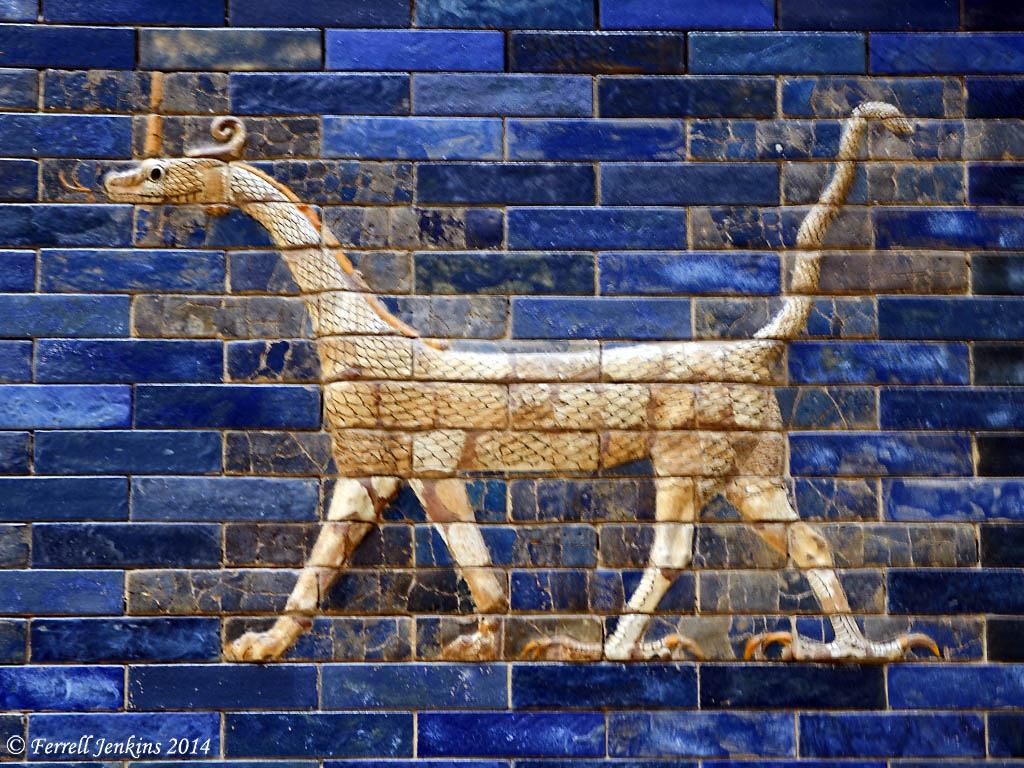
Dragon made of chrome brick on the Ishtar Gate. (Museum of the Ancient Near East, Berlin). The dragon is a composite creature with the head of a fire-spewing dragon, body and tail of a serpent, front feet of a feline, and back feet of a bird. This provides a good illustration of the apocalyptic language found in the Old Testament prophets. Photo by Ferrell Jenkins.

The dragon made of chrome brick on the Ishtar Gate from ancient Babylon was an emblem of Marduk (Museum of the Ancient Near East, Berlin). The dragon is a composite creature with the head of a fire-spewing dragon, body and tail of a serpent, front feet of a feline, and back feet of a bird. This provides a good illustration of the apocalyptic imagery found in the Old Testament prophets and the book of Revelation. Photo by Ferrell Jenkins.

The articles below, especially those with an * after the title, are considered minor references. They still might provide some helpful material and photos for the Bible student and teacher.

I trust this list will be helpful to students and teachers alike.

In the future, when I write something about Babylon I will try to remember to include a link in this index. I would appreciate learning if you find this index helpful.

1700 B.C. Hittite city wall unearthed

The Hurriyet Daily News reports the discovery of a 3,700-year-old city wall built to protect the ancient Hittite city of Hattuşa (now Bogazkale).

Archaeologists have unearthed part of the 3,700-year-old city wall of Hattuşa, capital city of the ancient Hittites, in the northern province of Çorum.

The Hittites had built the 4.5-kilometer city walls to protect their capital Hattuşa. “The city walls were first unearthed during the first year of excavations between 1906 and 1907. Some 700 meters of the 4.5-kilometer-long city walls have been unearthed. We worked for the restoration of 400-meter parts of the walls over the last three years. These walls were the first big project of the Hittites. The wall surrounds the whole city,” said Dr. Andreas Schachner, who is caryring out the excavations for the German Archaeological Institute, noting that their most recent archaeological work had focused on restoring the walls.

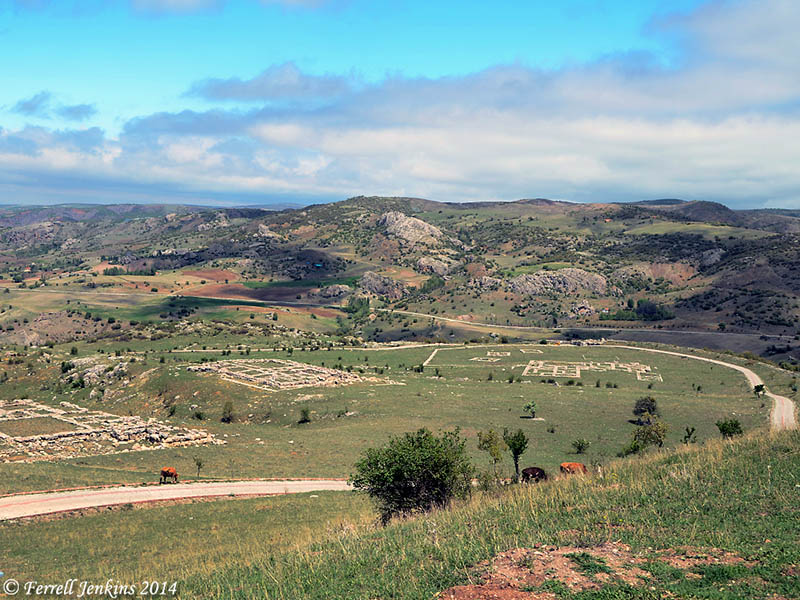
A view of Hattusas from the Upper City. Photo by Ferrell Jenkins.

A view of Hattusas from the Upper City. Photo by Ferrell Jenkins.

Schachner said they had also discovered 10 underground tunnels in some parts of the wall. “These tunnels were made for soldiers to leave the city in secret during an attack or occupation and fight. There is a tower in every 20-25 kilometer of the walls. The Hittites built the walls on an artificial hill to show the city’s power and magnificence,” he said.

He said the city walls were 10 meters high when they were built but later fell to five-six meters.

See this report and a photo here. For additional photos and information about this ancient Hittite city, use the Search box to look for Hittite or Hattusas.

HT: Jack Sasson

Book on the origin of Israel available

Daniel I. Block’s book, Israel: Ancient Kingdom or Late Invention?, is available in Kindle format today for $2.99. The retail price of the hardback is $28.

The publisher (B&H) of the 2008 book describes it as

a collection of essays responding to the radical claims that Israel and its history actually began following the Babylonian exile, and that the history of Israel we read about in the Bible is a fictionalized account.

Contributors are leading Bible and archaeology scholars who bring extra-biblical evidence to bear for the historicity of the Old Testament and provide case studies of new work being done in the field of archaeology.

The book includes the following essays dealing with some of the current discussions in Biblical studies.

  • Israel – Ancient Kingdom or Late Invention? – Daniel I. Block
  • The Value and Limitations of the Bible and Archaeology – Alan R. Millard
  • Contextual Criticism as a Framework for Biblical Interpretation – John M. Monson
  • North-West Semitic Inscriptions and Biblical Interpretation – Joel Drinkard
  • From Joseph to David: Mari and Israelite Pastoral Traditions – Daniel E. Fleming
  • Major Geographical Issues in the Accounts of the Exodus – James K. Hoffmeier
  • Slavery and Slave Laws in Ancient Hatti and Israel – Harry A. Hoffner Jr.
  • Were the Israelites Really Canaanites? – Alan R. Millard
  • Syria and the Bible: The Luwian Connection – Richard S. Hess
  • David and Solomon’s Jemsalem: Do the Bible and Archaeology Disagree? – Alan R. Millard
  • Who Were Israel’s Transjordanian Neighbors and How Did They Differ? – Gerald L. Mattingly
  • Shalmaneser III and Israel – K. Lawson Younger Jr.
  • Did the Israelites Really Learn Their Monotheism in Babylon? Simon J. Shenvin
  • Did Persian Zoroastrianism Influence Judaism? – Edwin M. Yamauchi
  • Interpreting the Bible as an Ancient Near Eastern Document – John H. Walton

The Altar of Zeus in the Pergamum Museum

The Pergamum Museum in Berlin gets its name from the reconstructed altar of Zeus from Pergamum (Bergama) in western Turkey. I noted earlier that this fabulous reconstruction is now closed for refurbishing. When we visited the Museum in mid-August, 2014, some scaffolding was already in place.

The Pergamum Altar in the Pergamum Museum. Photo by Ferrell Jenkins.

The Pergamum Altar in the Pergamum Museum. Photo by Ferrell Jenkins.

The altar of Zeus was built by Eumenes II (197–159 B.C.) to commemorate the victory of Attalus I over the invading Gauls. This is the most important and largest building from the Hellenistic age. The unique discovery of the Altar is told by Dr. Henry Koch:

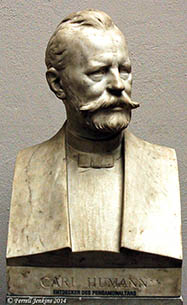
Carl Humaan

Carl Humaan

“A German engineer named Carl Humann had been authorized to build a road from Pergamon to the Aegean Sea. While he was supervising the work he noticed that marble statues and torsos were being carted from the ruins of the city and brought to the limekiln to be burnt into lime. It is to be feared that many a valuable statue was thus reduced to limestone. One day Humann also observed, how a peasant was hauling a marble slab adorned with statues and figures to the limekiln. He halted the peasant, asked him, how much he wanted for the slab, paid the price and immediately had the slab sent to the curators of the Berlin Museum in Germany. He offered the peasant more money, if he could procure additional slabs for him. The peasant gladly consented. For him it was lucrative business; for the curators it was a precious find.

Alexander Conze, a curator in Berlin, discerned the great value of the find. He recalled having read that a Roman writer named Ampelius living in the second century after Christ had written a Book of Wonders (Liber Memorialis). Among the wonders he also had mentioned the Altar of Zeus in Pergamum. This was a valuable clue for Conze. Humann was at once requested to obtain as many slabs a possible. Permission was also requested of the Turkish Government to have the slabs sent to Berlin and that excavations could be started at once. Permission was granted and the excavations were carried out from 1879-1885. Fortunately most of the ruins of the Temple had not as yet been found or touched. The curators in Berlin could piece them all together and thus the priceless Altar of Zeus could be assembled” (Koch, The Christian News, Nov. 22, 1976).

The Altar of Zeus was re-assembled in more than twenty years of museum work and is now housed in the special Pergamum Museum in Berlin. A trip to see this fabulous piece of architecture is recommended. The marble frieze depicts the mythological battle between gods and giants. The photo below shows a small portion of a scene.

A portion of the Zeus Altar marble frieze. Photo by Ferrell Jenkins.

A portion of the Zeus Altar marble frieze. Photo by Ferrell Jenkins.

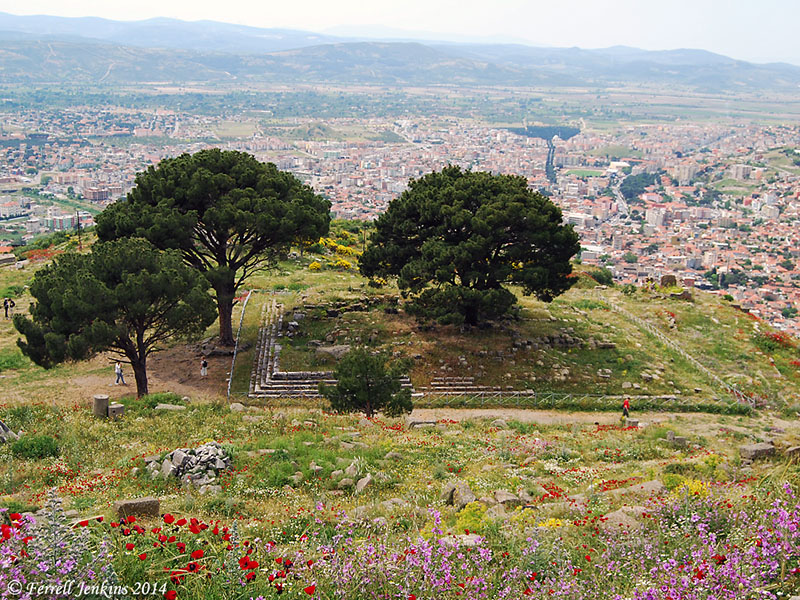
Only the foundations of the altar can be seen at Pergamum. The Turkish government has requested the return of the Zeus Altar and has been putting pressure on Germany. See one report here.

Site of the Zeus Altar at Pergamum. Photo by Ferrell Jenkins.

Site of the Zeus Altar at Pergamum. Photo by Ferrell Jenkins.

In the Lord’s letter to the church at Pergamum, He says,

I know where you dwell, where Satan’s throne is. Yet you hold fast my name, and you did not deny my faith even in the days of Antipas my faithful witness, who was killed among you, where Satan dwells. (Revelation 2:13 ESV)

Some scholars think the reference to Satan’s throne in this text is a reference to the Zeus altar at Pergamum, but there are other suggestions. Kistemaker summarizes some popular views suggested by Colin Hemer:

  • To a traveler coming from the east, the acropolis [of Pergamum] had the appearance of a throne.
  • The altar of Zeus Sōtēr seemed to be a throne.
  • Asclepius Sōtēr was identified with the serpent.
  • Pergamum was the center of emperor worship.

Or, it might be a combination of these elements.

You will probably need to wait two or more years before you can see the Zeus Altar in the Pergamum Museum.