Category Archives: Photography

A New Year’s poem by my favorite author

The New Leaf

He came to my desk with quivering lip —
The lesson was done.
“Dear Teacher. I want a new leaf he said,
“I have spoiled this one.”
I took the old leaf, stained and blotted
And gave him a new one, all unspotted,
And into his sad eyes smiled;
“Do better now, my child!”

I went to the Throne with a quivering soul —
The old year was gone.
“Dear Father, hast Thou a new leaf for me?”
“I have spoiled this one.”
He took the old leaf, stained and blotted
And into my sad heart smiled:
“Do better now, my child!”

This poem has been among my sermon notes for many years. It is one of those numerous good illustrations that have come down to us from Anonymous or Author Unknown.

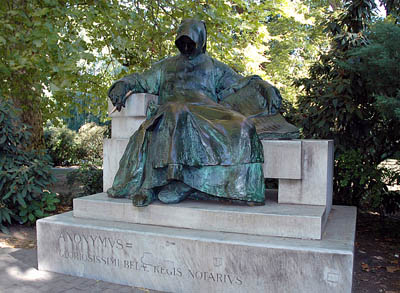
In Budapest, Hungary, near the entrance of Vajdahunyad Castle, there stands a statue of Anonymous by Miklos Legeti. The statue commemorates a 12th or 13th century unknown chronicler of one of the several rulers named King Bela.

Statue of Anonymous in Budapest. Photo by Ferrell Jenkins.

Statue of Anonymous in Budapest. Photo by Ferrell Jenkins.

The next time you quote him you will do so with knowledge of what he looked like.

BiblePlaces Newsletter

Todd Bolen’s BiblePlaces Newletter for December is now available. It includes a wonderful aerial photo of the Elah Valley. The main feature is a series of (Google) satellite photos of Jerusalem with the natural features (hills, valleys, springs, quarters of the city, etc.) identified. If you teach any lesson dealing with the city of Jerusalem you need these PowerPoint slides.

You should subscribe to the BiblePlaces Newsletter, but if you have not yet done so you may access the current issue here. The subscription link is at the bottom of the page.

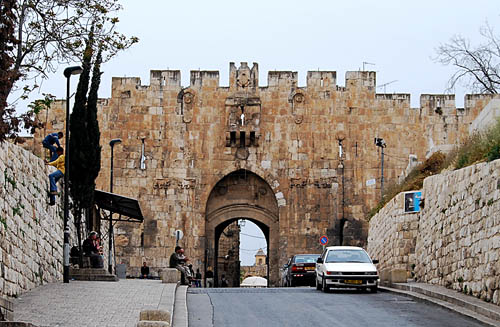
The photo below shows one of the modern gates of Jerusalem. It is labeled Stephen’s Gate on one of the slides mentioned above. Murphy-O’Connor says that Suliman called it the Bab el-Ghor (the Jordan Valley Gate). In Hebrew it is called the Lions’ Gate, but you may notice that the animals to the left of the gate are panthers. Murphy-O’Connor says this was “the heraldic emblem of the Mamluk sultan Baybar (1260-77). This is the only gate of the Old City on the east side that is currently open.

Lions Gate or St. Stephen Gate. Photo by Ferrell Jenkins.

Lions' Gate or St. Stephen's Gate. Photo by Ferrell Jenkins.

Travel is fun

One of the perils of travel is dealing with the hawkers. There is the guy who approaches a person with a Nikon Digital SLR trying to sell him postcards of the monument he just photographed. I remember a boy in Damascus in 1967 hawking those little inlaid boxes for “Just one lousy American dollar.” We were on a boat taking the canal tour in Bangkok when suddenly a boy comes up out of the dirty water into the moving boat.

Egypt is probably the worst place for hawkers. One thing is for sure. If you ever take an item in your hand it will be difficult to get rid of it. You may say, “I don’t need that.” He say, “Why you no need this?”

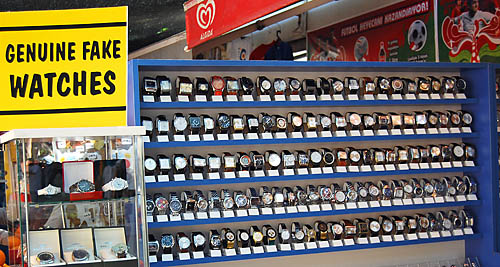
I like this refreshing sign in a shop at Ephesus. No doubt here!

Genuine fake watches in a shot at Ephesus. Photo by Ferrell Jenkins.

Genuine fake watches in a shop at Ephesus. Photo by Ferrell Jenkins.

Along the Lewis and Clark Historic Trail

Most of this week was spent in Columbia, Missouri, where I presented lessons on Christian apologetics under the title of Evidences for Faith at the Eastside Church of Christ. A good number of students from the University of Missouri are members of the church. It was a pleasure to be with them and the rest of the church, including some former students and long-time friends.

Highway 63, leading south from Columbia to Jefferson City, is part of the Lewis and Clark Historic Trail. The National Park Service web page gives this brief statement about the Trail.

Between May 1804 and September 1806, 31 men, one woman, and a baby traveled from the plains of the Midwest to the shores of the Pacific Ocean. They called themselves the Corps of Discovery. In their search for a water route to the Pacific Ocean, they opened a window onto the west for the young United States.

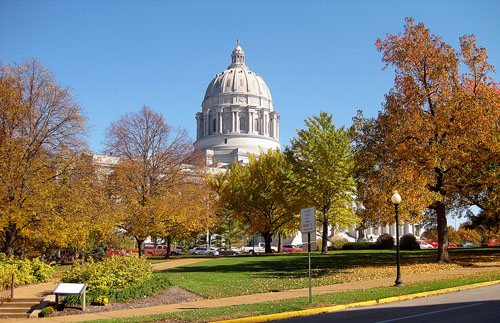
On election day, having already cast an absentee ballot in Florida, I drove to Jefferson City to make a few photos. Here is one I made of the state capitol building.

Missouri State Capitol, Jefferson City. Photo by Ferrell Jenkins.

Missouri State Capitol, Jefferson City. Photo by Ferrell Jenkins.

A beautiful photograph for election day

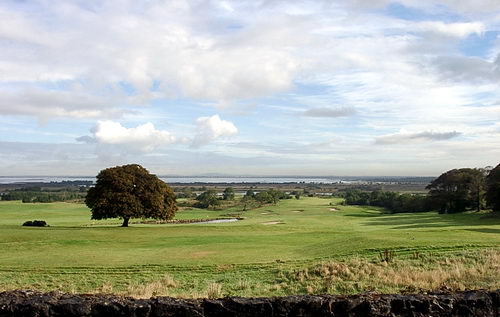
Here is a peaceful photo I made near Galway, Ireland.

A tranquil scene in the Emerald Isle. Photo by Ferrell Jenkins.

A tranquil scene in the Emerald Isle. Photo by Ferrell Jenkins.

The Bosporus

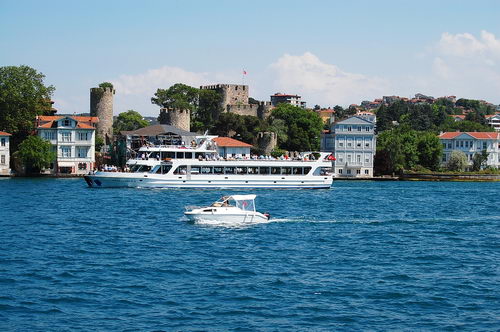
I think on all of my tours to Istanbul we have included and enjoyed a boat ride along the Bosporus (Bosphorus), vital waterway linking the Black Sea to the Mediterranean Sea. The Asian side was known as Bythinia in Roman times. Peter addressed his epistles to the saints in various parts of modern Turkey (1 Peter 1:1).

Today there is an interesting article in The New York Times about a boat ride on the Bosporus. I suggest you check this quickly if you are interested. I don’t know how long these links remain active. Click here.

Here is one of the many beautiful photos I have made during a boat ride on the Bosporus.

A view along the Bosphorus. Photo by Ferrell Jenkins.

A view along the Bosphorus. Photo by Ferrell Jenkins.

Baalbek – Roman Heliopolis

In the early days of my travel to the Middle East (1967-1975) our groups always visited Baalbek. From Beirut on the beautiful Mediterranean we drove  through the Lebanon Mountains.to the Beka Valley where Baalbek is located. This valley is more than 3800 feet above sea level. The headwaters of the Orentes and Libani rivers are in this valley.

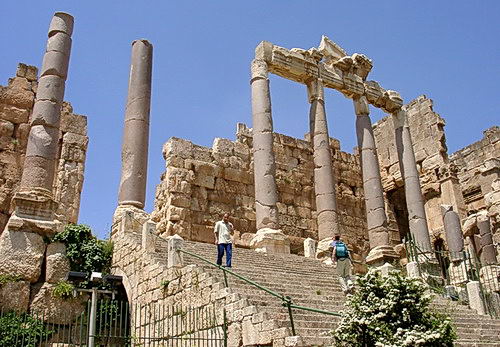
In Roman times Baalbek was called Heliopolis, the City of the Sun. The ruins at Baalbek are among the most impressive in the world. There are three temples: (1)  Jupiter; (2) Baachus; (3) Venus.

In the quarry near Baalbek there is a stone which is estimated to weigh 2,000 tons,. It often suggested that it is the largest hewn stone in the world. The stone is 70 1/2 feet long x 13 3/4 feet high x 15 3/4 feet wide.

My last visit to Baalbek was in 2002. The Beka Valley was a Hezbollah stronghold and was filled with soldiers and artillery, all pointed south.

I would like to see peace prevail in Lebanon for many reasons. The one I will mention here is that it would allow many people of the West the opportunity to see the wonderful sites of the country, including Baalbek.

This photo is of the reconstructed propylaea, the monumental gateway, leading to the temple platform.

The reconstructed propylaea of Roman Baalbek. Photo by Ferrell Jenkins.

The reconstructed propylaea of Roman Baalbek. Photo by Ferrell Jenkins.

A Bible Land tour for less than $20.00

Journey Through the Holy Lands is a DVD featuring Michael Hasel of Southern Adventist University. Dr. Hasel is Director of the Institute of Archaeology and teaches archaeology at SAU in Collegedale, Tennessee.

In 2007 Hasel was filmed at important biblical sites providing a commentary about the significance of the site. The following sites are visited:

Jerusalem
Garden Tomb; Church of the Holy Sepulcher; the Cardo; Western Wall; Temple Mount; Sheep Gate (often called St. Stephen’s or Lion’s Gate); Pool of Bethesda; Damascus Gate; the First Century House in the Jewish Quarter.

The Dead Sea Area
Qumran, Dead Sea, Masada, Wadi Qelt; Jericho

Egypt and the Sinai
The Giza Pyramids; Saqqara; St. Catherine’s Monastery; Mount Sinai

This DVD is not one of those slick TV presentations. It is the film of a competent scholar who is well acquainted with the history and archaeology of the area telling his tour group about it. I was impressed that Hasel spelled out the facts about such competing sites as the Holy Sepulcher and the Garden Tomb. At some places the commentary was very brief. At Jericho he mentioned the relevant research but did not show any of the evidence on the tell. There is no visit of sites in the Galilee.

At St. Catherine’s, Hasel tells about the discovery of the Sinaiticus Manuscript. Attractive maps and artwork has been added to the film. The background noise at the Giza Pyramids is noticeable and a distraction. The narration could have been added in a studio back home, but it would have changed the character of the film.

It was a pleasure to view the video. I would recommend it to those who have visited these areas and would like an on site review. It would be good for those who will never visit the sites, or those who are preparing for a trip.

Journey Through the Holy Lands is available for $15.00. Shipping and Handling for 1 or 2 copies is $2.50 each. For 3 or more copies it is $5.00.  Payment must be made by money order or check payable to Southern Adventist University. Send order to: Institute of Archaeology, Southern Adventist University, P.O. Box 370, Collegedale, TN 37315.

The Institute of Archaeology operates the Lynn H. Wood Museum which is the repository of the William G. Dever Near Eastern Collection. Check the web page here. I plan to visit the museum if I have an opportunity to travel in the area.

Review: Views That Have Vanished

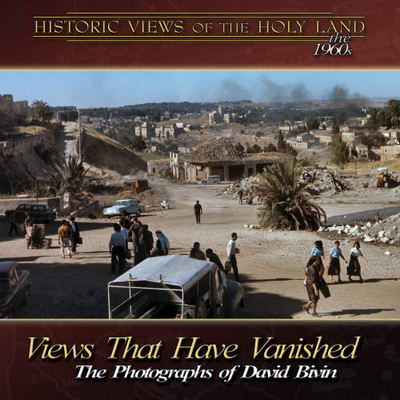
Todd Bolen, BiblePlaces.com, has released an extremely valuable CD that will be helpful to all students of the Bible lands. Views That Have Vanished is a collection of more than 700 high resolution photographs made by David Bivin beginning in 1963.

Views That Have Vanished - Photos of the 1960s.

Views That Have Vanished - Photos of the 1960s.

These photographs were made with one of the best cameras available at the time with the intent to be able to share them with family and friends who were unable to visit Israel, Jordan, Egypt and Greece. Bivin has now lived in Israel more than 30 years. Many of the places he visited in the 1960s have changed since then because of natural erosion. Some of the changes occurred because of archaeological activity, and the normal deterioration that takes place once a site is uncovered. Primarily the sites have changed because of the building activities of man.

My first visit to the Middle East was in 1967. Since then I have returned nearly 40 times and I have observed the tremendous changes made. Some sites, in preparation for visitors, are necessarily changed. Other sites are neglected and become dangerous for all but the most intrepid explorers to visit. Bivin had the wonderful opportunity live in Israel and record his experience in full color. I observe that many of the landscape photographs he made have a beautiful clear sky. Perhaps the sky was clearer 40 years ago. But, this is the advantage of living in the country and being able to go out when the weather is just right.

Everyone who has old photographs and slides knows that they begin to deteriorate after a few years. This happened to some of Bivin’s photographs. Todd Bolen has scanned these old negatives with high quality equipment. In many instances the color has been restored.

The photographs are available in high-resolution (1600 x 1200 or higher) in jpg format and also in PowerPoint with explanatory notes. I was especially impressed with the large number of photographs of some of the well known archaeologists of the past (Glueck, Yadin, et al.) and some historic views such as people in Jerusalem mourning the death of Anwar Sadat, president of Egypt.

Views That Have Vanished is a great addition to the already long list of photographic materials published by BiblePlaces. The CD belongs in the library of every church and every person who teaches Bible classes with an emphasis on the land in which these historical events took place. Frequently I say to my groups, “I wish you could have seen this before….” Now, you can see it through these photographs.

The CD is available for only $20 during October. Take a look here. If you would like to see some examples of Views then and now, take a look here.

Cappadocian sunrise

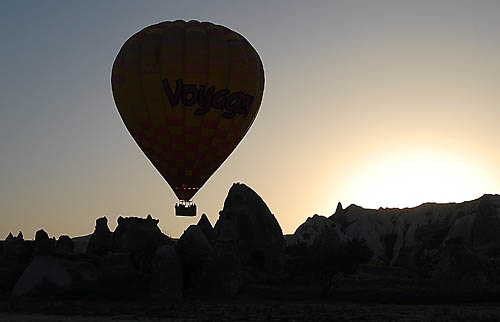
He is a photograph I made at sunrise in the Cappadocian region of Turkey.

Cappadocian sunrise. Photo by Ferrell Jenkins.

Cappadocian sunrise. Photo by Ferrell Jenkins.

The Bible tells us that Jews of Cappadocia were present in Jerusalem on the day of Pentecost (Acts 2:9). Peter wrote his epistles to saints scattered throughout Cappadocia and other places in Roman Asia Minor (modern Turkey).

Peter, an apostle of Jesus Christ, To those who are elect exiles of the dispersion in Pontus, Galatia, Cappadocia, Asia, and Bithynia,  2 according to the foreknowledge of God the Father, in the sanctification of the Spirit, for obedience to Jesus Christ and for sprinkling with his blood: May grace and peace be multiplied to you. (1 Peter 1:1-2)