Category Archives: Photography

The tabernacle in the wilderness

A full size model of the Israelite tabernacle has been constructed in Timna Park, 17 miles north of Eilat. This was one of the big reasons I wanted to visit Eilat on this trip. The tabernacle was built while the Israelites were at Mount Sinai (Exodus 25-40). The tabernacle was a movable tent of worship which was taken each place Israel wandered during the forty years in the wilderness. Stephen spoke of the tabernacle this way:

“Our fathers had the tabernacle of testimony in the wilderness, just as He who spoke to Moses directed him to make it according to the pattern which he had seen. (Acts 7:44)

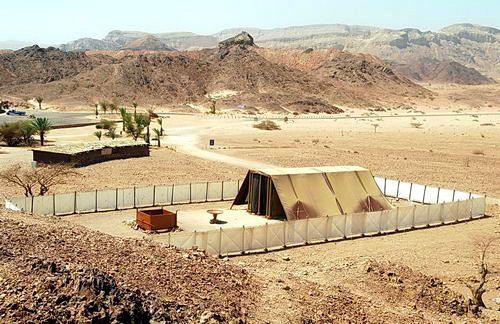
I walked up hill above the tabernacle model and took this view of the tabernacle with the laver and the altar of burnt offering in the courtyard.

The tabernacle in the wilderness. Photo by Ferrell Jenkins.

The tabernacle in the wilderness. Photo by Ferrell Jenkins.

If you are ever near Eilat, drop by and see this wonderful model.

The Persian background of Iran

The August, 2008, issue of National Geographic has a good article on the Ancient Soul of Iran. The emphasis is on the rich Persian history of the area. The article is online at ngm.com. The article includes many of those fabulous NG photographs. Most of them were shot in low light to evoke the past glory of Iran. There are more photos at the website than in the magazine. You might be able to buy a copy of the magazine at your local bookseller.

Iran is the only major area of the Bible world that I have been unable to visit. Maybe that will change within the next few years. Marguerite Del Giudice says,

In fact, the first thing people said when I asked what they wanted the world to know about them was, “We are not Arabs!” (followed closely by, “We are not terrorists!”

The article features the people of Iran, and not the government. There are some interesting comments on the influence of Zoroastrianism’s teaching.

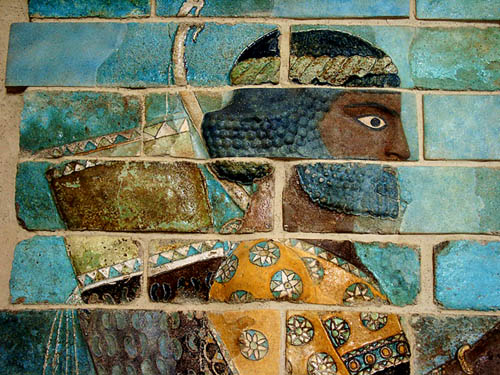
Many of the great museums of the world have ancient Persian artifacts. This is especially true of the Louvre, the British Museum, and the Oriental Institute of the University of Chicago. Here is a photo from the Louvre of one of the Persian archers.

Archer from the Palace of Darius in the Louvre. Photo by Ferrell Jenkins.

Archer from the Palace of Darius in the Louvre. Photo by Ferrell Jenkins.

The Persians played a significant role in the Restoration of the Judeans to their land after the Babylonian Exile. Here are a few highlights.

  • Cyrus, who conquered Babylon, allowed the Jews to return to their land in 536 B.C. See 2 Chronicles 36, and compare the Cyrus Cylinder (in the British Museum).
  • Darius I allowed the Jews to rebuild the temple in Jerusalem (520-516 B.C.; Ezra 6:1-5).
  • Xerxes is the Ahasuerus of the book of Esther.
  • During the reign of Artaxerxes I, the second group of Jews return under the leadership of Ezra (458 B.C.). Nehemiah returned to rebuild the walls of Jerusalem (444 B.C.).

Tutankhamum and the World of the Pharaohs

The premier exhibition of Tutankhamum and the World of the Pharaohs is current open in Vienna. Maybe you will not be able to get to Vienna, but there are some wonderful photos on line. The exhibit web page is here.

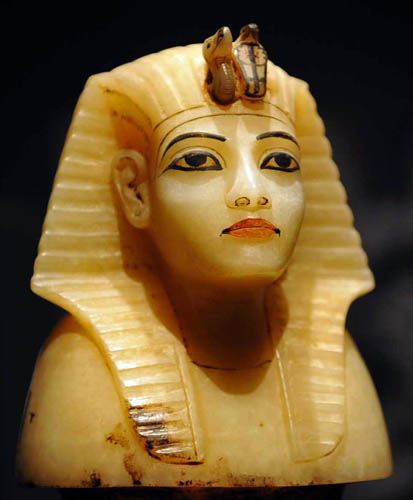
To get to the photos click on the English (UK) flag at the top of the page. (Pay attention. This will not work on the German page.) Then click on Press and Media. The photo here shows the top of one of the canopic jars in the the King Tut tomb. This jar, made of alabaster, was used to store one of the major organs of the body. Click on the photo for a larger image.

The top of a canopic jar from the tomb of Tutanhkamum. Photo by Sandro Vannini.

The top of a canopic jar from the tomb of Tutanhkamum. Photo by Sandro Vannini.

Howard Carter discovered the intact tomb of King Tut in 1922. Tut lived between 1341 and 1323 B.C. This is about a century after Moses was in Egypt if we depend on the dates given in certain Old Testament references like 1 Kings 6:1.

Now it came about in the four hundred and eightieth year after the sons of Israel came out of the land of Egypt, in the fourth year of Solomon’s reign over Israel, in the month of Ziv which is the second month, that he began to build the house of the LORD.

The fourth year of Solomon’s reign would have been about 966 B.C.

When one sees the wealth represented in the tomb of King Tut he must be impressed with the statement made by the writer of Hebrews regarding the treasures of Egypt.

By faith Moses, when he had grown up, refused to be called the son of Pharaoh’s daughter, choosing rather to endure ill-treatment with the people of God than to enjoy the passing pleasures of sin, considering the reproach of Christ greater riches than the treasures of Egypt; for he was looking to the reward. (Hebrews 11:24-26 NASB)

A river in Pamphylia

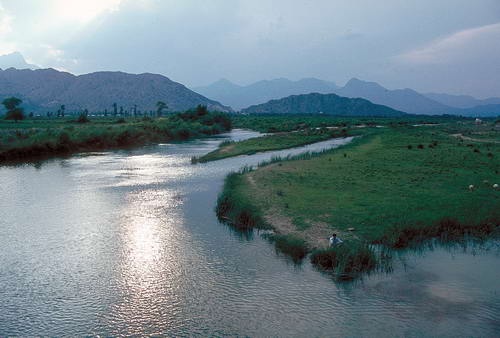
This week I am busy with a number of projects, but I wanted to share a beautiful photo that I made early one morning in the mid-80s. This is a river that flows from the Tarus Mountains into the Mediterranean at Antalya, Turkey. Antalya is know in the Bible as Attalia. Paul and Barnabas sailed from Attalia at the conclusion of the first preaching journey.

When they had spoken the word in Perga, they went down to Attalia. From there they sailed to Antioch, from which they had been commended to the grace of God for the work that they had accomplished. (Acts 14:25-26)

Attalia was in the Roman province of Pamphylia in the days of Paul.

A river in Pamphylia with the Tarus Mountains in the background.

Good illustrations for teaching

Every teacher of the Bible should be looking for good illustrations to help convey biblical truths. Ezekiel used a brick with a sketch of Jerusalem on it to teach about the destruction of the city (Ezekiel 4:1). Jeremiah broke a clay vessel to teach the same lesson (Jeremiah 19).

Jesus used sowers, birds, and flowers of the field to teach important lessons (Mt. 13:18; 6:26; 6:28).

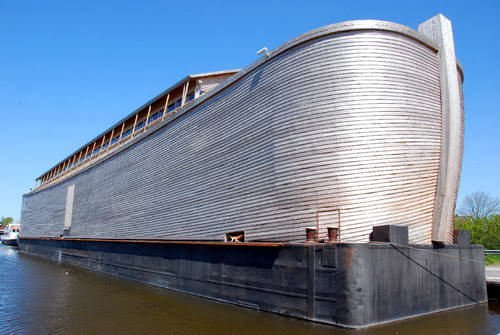
About a year ago we learned that a contractor in the Netherlands has built a replica of Noah’s ark. W. Frank Walton has called my attention to a series of photos by “Paul the Dane” showing both replica from both the outside and the inside. These photographer holds copyright to the photos, but his page says “permission from author required for commercial use.” I take this to mean that non-commercial use, such as Bible classes, is allowed. For information about Noah’s ark read Genesis 6-9.

Paul the Dane has these photos posted at Pbase. Click here for his page. He also has some nice photos of Damascus. He says this of the ark photos:

It was built approximately to scale, however is 1/2 the length and 1/3 the width of the Biblical dimensions. It was built to show the world how massive the Ark was and how so many animals could have been housed for a long time.

Here is one of the nice exterior views.
Frequently I go to Pbase to search for photos I might need of some historical site that I have not visited. Be sure you ask for permission if the photographer does not grant such.

A few years ago I wrote an article, “Using Photographs to Ilustrate Lessons” for Biblical Insights. Read it here. At the Biblical Studies Info page I have links to numerous sources of good photos of the Bible lands. Look here, then under Photos.

Update: J. P. van de Giessen has pointed me to his post about the ark here. He has some photos of the ark while under construction. Nothing quite like having a “reporter” on the spot! The official web page is here. It also includes photos of the construction.

Sunset over Edom

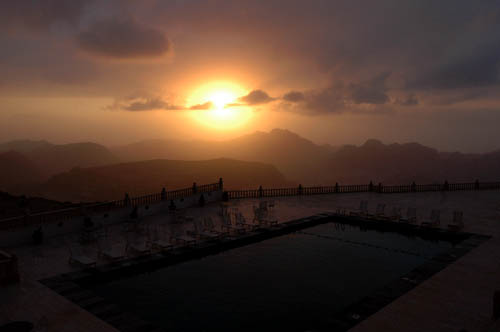
I ran across this beautiful sunset photo that I made from a hotel above Petra, Jordan, in 2006.

The oracle concerning Edom. One keeps calling to me from Seir, “Watchman, how far gone is the night? Watchman, how far gone is the night?” The watchman says, “Morning comes but also night. If you would inquire, inquire; Come back again.” (Isaiah 21:11-12)

There are some text critical issues with the term Edom in this verse, but I will leave that for you to work on. Keil and Delitzsch call attention to a comment by Luther that illustrates the certain judgment that would come upon ancient Edom, the descendants of Esau.

But what is the meaning? Luther seems to me to have hit upon it: “When the morning comes, it will still be night.”

The decline and fall of any nation ought to cause one to take a pause and think about it.

A pretty picture

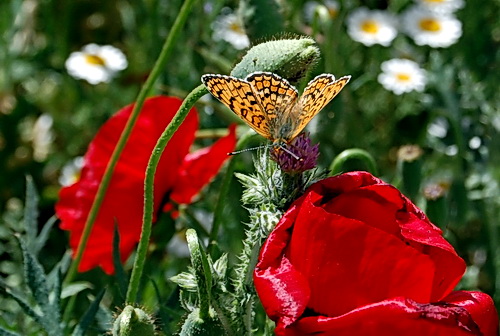
While looking for a photo for use in a lesson for Sunday I noticed this photo that I made near Konya, Turkey. This is the site of biblical Iconium (Acts 13:51-14:5). I was lucky to catch the butterfly on a poppy (anemone). Enjoy.

Disaster strikes! Or was it good fortune?

My last photo with my Nikon D40X was made in the Roman agora at Thessalonica. When we arrived at the Athens airport we saw something that we thought our grandson would enjoy. I took out the trusty D40X, but it would not shoot. We made the photo with the standby Canon Power Shot SD630. At the hotel I discovered that all functions of the camera worked except the lense. I have a 55-200mm lense with me. When I put it on the camera everything worked perfectly.

When I get back home I will head down to the Best Buy with my little warranty in hand to get this taken care of before another major trip.

The lense I normally use is the 18-55mm. Most folks I talk with about cameras say they want to get a zoom, long-distance lense. Most of my photos are shot using the wide-angle feature.

What a wonderful time for the camera to go out. Last shot on the last day of touring. I had noticed the camera seeming to have some difficult in firing for the past few days. Finally, it died. The camera is only about six months old, but it has been used for about 7000 shots.

The Canon is a wonderful camera, but it has no viewfinder. This is all right for indoor shots, but it is very difficult to see the digital display in bright sunlight. I strongly advise that travelers get a digital camera with a view finder.

Agora. We have mentioned the agora many times in these blogs. The agora (forum) was the marketplace of the Roman city. This morning we walked over to a gas station to get some water. I noticed the sign over the store read Mikre Agora. We would call it a Mini Market.

Paul showed me Fair Havens in Crete

Thursday our ship docked at Heraklion, Crete. Crete is associated with Paul’s voyage to Rome. The biblical account is found in Acts 27:7-15. Note verses 7 and 8.

When we had sailed slowly for a good many days, and with difficulty had arrived off Cnidus, since the wind did not permit us to go farther, we sailed under the shelter of Crete, off Salmone; and with difficulty sailing past it we came to a place called Fair Havens, near which was the city of Lasea.

The ship sailed under the shelter of Crete and came to Kali Limenes (Fair Havens) near the city of Lasea. Because Fair Havens was not a suitable harbor for wintering, the pilot and captain of the ship decided to sail on in hopes of reaching “Phoenix, a harbor of Crete, facing southwest and northwest,” and spend the winter there. Because of a severe wind, called Euraquilo, which came down from the land, they were driven by the wind and eventually wrecked on the island of Malta.

Fair Havens was not a stop on our tour because the ship was docked at Heraklion for only five hours. The distance would make it impossible to take a group on a coach (bus) to Fair Havens. I have wanted to return since my first visit in 1984, and determined that I would try it this time even if it meant taking some other transportation to catch the ship. But, I figured that we could do it in four hours by taxi. One gospel preacher and his wife asked me earlier if it could be arranged. I also invited the other three preachers on the tour to join us. We took two taxis and made our way across the mountains to the south side of Crete. The drive itself was rewarding. There were some small patches of snow still on the highest mountain of the country. The beautiful mountain sides and valleys were filled with vineyards, and olive and fruit groves.

Paul showed you Fair Havens?, you are asking. Yes, my taxi driver was named Paul!

Here is one of the photos I made of the harbor at Fair Havens.

In the air and on the road again

We are off to Israel and Jordan.

Soon we will be leaving our hotel and heading for Lufthansa at the JKF International Airport to meet our group. There were at least eight of us at this hotel last night. We have an intermediate stop at Frankfurt, and then on to Tel Aviv. If we arrive on time we will be able to visit Joppa before sunset. Our overnight stay will be at Netanya, along the beautiful Mediterranean.

If possible we will connect to the Internet at Frankfurt. Otherwise, expect our first post from Netanya. We hope to give you a brief behind the lense look at the places we visit in Israel and Jordan. Our time in Israel and Jordan will be seven hours ahead of EDT.

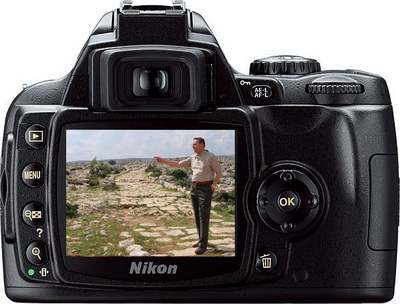
Nikon D40X and Ferrell Jenkins on Roman Road near Tarsus.