Category Archives: New Testament

Problems Faced by the Seven Churches # 1

As Gentiles heard the Gospel and obeyed it, the new Christians faced problems that had not been faced by the Jewish converts. At Lystra a man lame from birth was healed by Paul. So effective was this miracle that the crowd began saying in their own Lycaonian language,

“The gods have come down to us in the likeness of men!”  Barnabas they called Zeus, and Paul, Hermes, because he was the chief speaker” (Acts 14:11-12 ESV).

Zeus was considered by the Greeks to be the chief god of the pantheon of gods. Among the Romans he was known as Jupiter. Sometimes he was known as Olympian Zeus because he is said to have resided in Mount Olympus.

/classic
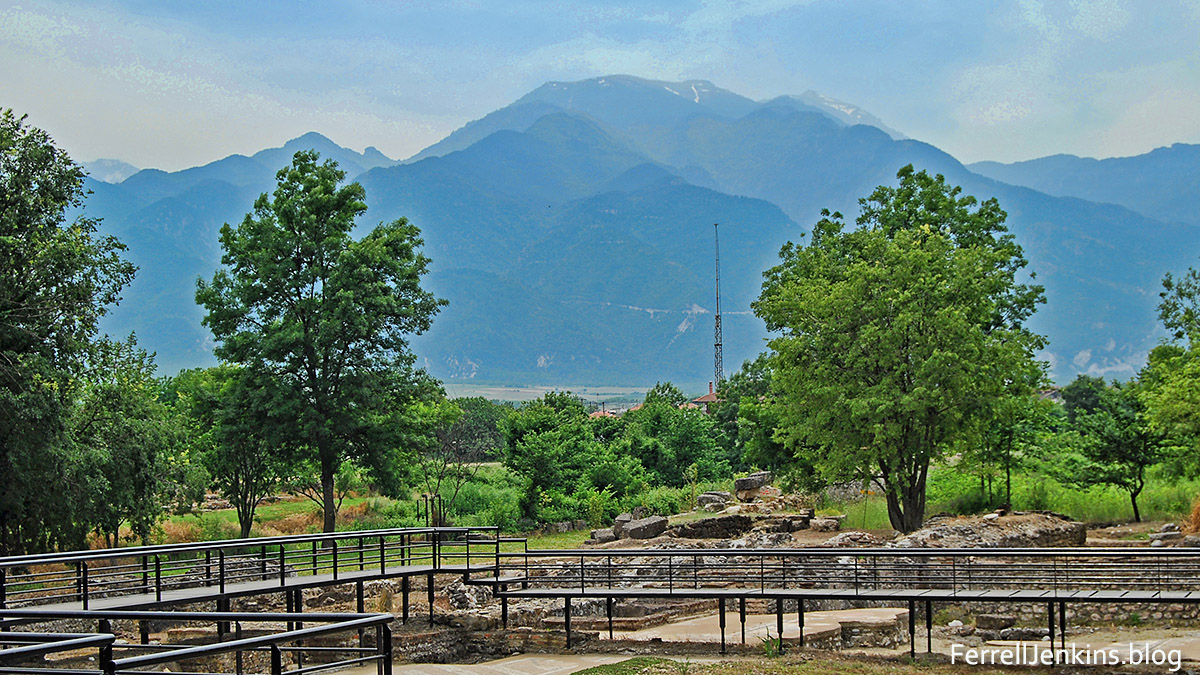
View of Mount Olympus from Dion, Greece. Photo by Ferrell Jenkins.

There may have been several temples dedicated to Zeus in Asia Minor. One outstanding one was the temple at Pergamum. But more about that one later.

This bust of Zeus is displayed in the museum at Ephesus
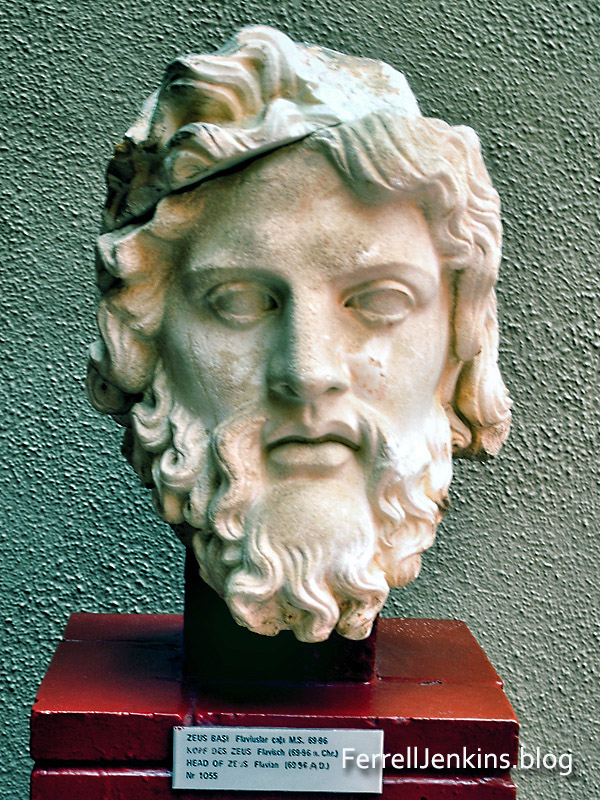
A bust of Zeus, the chief of the pagan gods, displayed in the museum at Ephesus. Photo by Ferrell Jenkins.

In the letter to the church at Pergamum it is said that they had some who hold the teaching of Balaam, “who taught Balak to put a stumbling block before the sons of Israel, so that they might eat food sacrificed to idols and practice sexual immorality” (Rev. 2:14; see also 2:20; 9:20; 21:8; 22:15 ESV).

For many workers in the ancient world participation in banquets where food was sacrificed to idols was expected and the practice of sexual immorality apparently was common.

At Ephesus the most popular god was Artemis or Diana as she was known to the Romans. There were temples dedicated to her in other cities of Asia Minor. Sardis, for example. Paul’s preaching the gospel of Christ ruined the business of the silversmiths who made small images of Artemis at Ephesus. The outrage brought about the massive gathering in the theater at Ephesus (Acts 19).

We have only a few remains of the Artemis temple at Ephesus, but enough remains to determine the size of the temple where the statue of Artemis was displayed. Pausanias said the temple of Artemis surpassed every structure raised by human hands. One of the best displays of artifacts relating to the temple is in the British Museum.
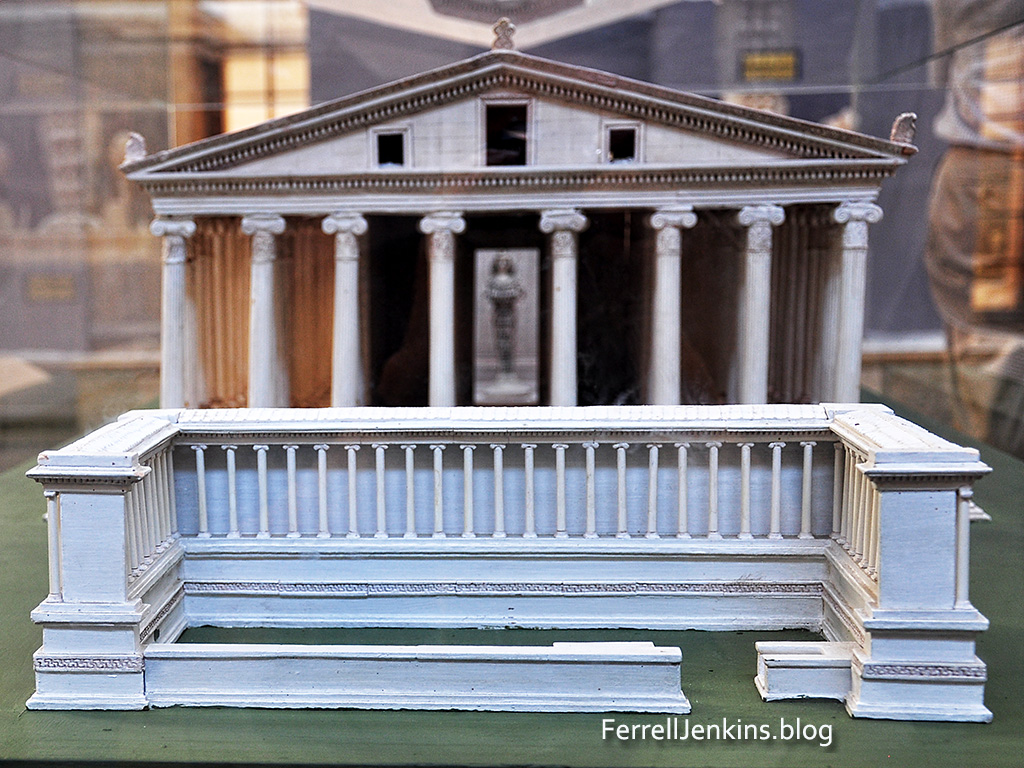
Model of the Temple of Artemis/Diana. Located in the Ephesus Museum. Photo by Ferrell Jenkins.

Artemis is said to have been worshiped “in all of Asia and the world.” She is described as magnificent and great (Acts 19:27-28). Artemis probably would not have fared well in a modern beauty contest. She was not a lovely figure, but originally she was a “black, squat, repulsive figure” covered with many breasts. It is thought that originally she might have been carved from a meteorite. The final form of Artemis is seen in our photo below. Suggestions regarding her appearance include multiple breasts, ostrich eggs, bunches of dates, ova of bees, testicles of bulls, (bunches of grapes). It is agreed that Diana was the mother of fertility.
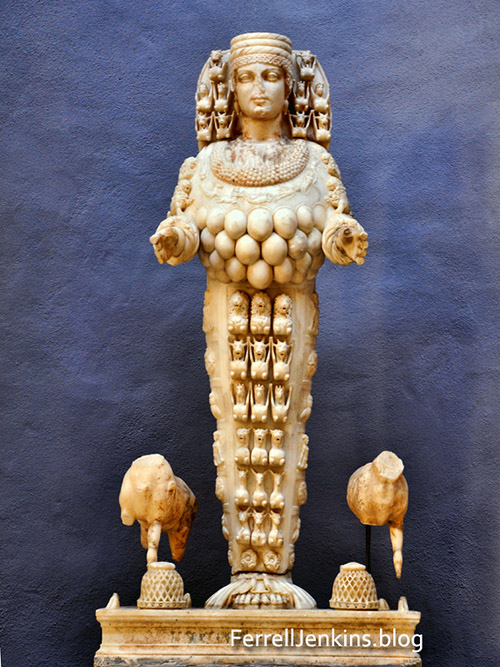
Artemis/Diana of the Ephesians. Photo: ferrelljenkins.blog.

Artemis statue from Ephesus. Photo by Ferrell Jenkins.

If everyone in town adored Artemis it would be more of a temptation for the new Christians to leave their love for Christ and return to the former practice. The Lord told the Ephesians, “But I have this against you, that you have abandoned the love you had at first” (Rev. 2:4 ESV).

Locating the Seven Cities of Revelation 1-3

The Address Tells Us a Lot

“The book of Revelation is addressed to the seven churches that are in Asia. In the Roman Empire the province of Asia comprised the territory in Asia Minor south of Bithynia, north of Lycia, west of Galatia, and east of the Aegean” (Pfeiffer 287). Separate letters are addressed to the seven churches of Asia: Ephesus, Smyrna, Pergamum, Thyatira, Sardis, Philadelphia, Laodicea. The “letters” actually take the form of Imperial edicts, opening “with the characteristic verb of declaration, legei [says]” (Horsley I:40; cf. Deissmann 375). These churches must be representative, for there were other churches in Asia: Troas (Acts 20:7); Colossae (Col. 1:2); Hierapolis (Col. 4:13). Beginning at Ephesus, the cities named formed a type of circuit or loop. If one begins at Ephesus and follows the route suggested in Revelation, the distance from Ephesus to Laodicea is about 256 miles. From Laodicea to Ephesus is almost 100 miles.” See source below.

The map showing Patmos and the area of Asia Minor where the Seven Churches of Revelation 1-3 were located in Asia Minor (Revelation 1:4, 11). Take a look at the map. Begin with Ephesus, then move north to Smyrna, on to Pergamum. Then take the road southeast to Thyatira. Continue southeast to Sardis. From there continue east to Philadelphia, then southeast to Laodicea. If you wanted to complete the circuit you could travel west back to Ephesus. You could trace these same places on a modern map of Turkey, but the modern names of the cities must be followed: Selcuk, Izmir, Bergama, Akhisar, Sardes, Alasehir. Laodicea is located between Pamukale and Denizli. Most tours use the hotels at Kusadasi (near Ephesus) or Izmir, and Pamukale, working in and out from these cities.

This map showing the location of Patmos and the Seven Churches of Revelation was made in BibleMapper by Mark Hoffman.

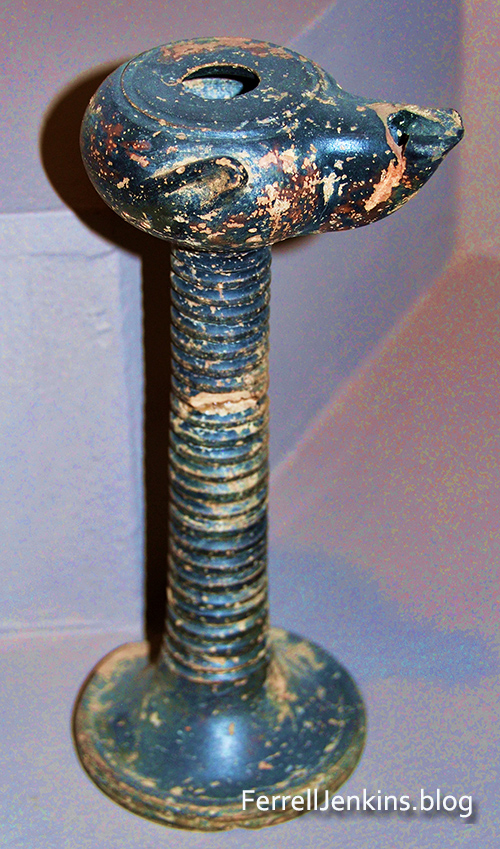
The seven churches are said by the Lord to be “seven golden lampstands” (Rev. 1:20). We should not think of the Menorah, a seven-branched lamp. Instead we think of seven individual stands, each with a lamp on top. The church is to hold up or display the light. The example from Ephesus pictured below may give us insight into the imagery being used here.

Lamp on Stand, Ephesus Museum. Photo by Ferrell Jenkins.

When we read about the church in Jerusalem, Samaria, and other cities of the Levant we see a special set of problems related to the relationship between the new Christian movement and Judaism. When we move into the territory of Syria, Cilicia, Galatia, Asia Minor, Greece and Rome we see different problems and circumstances.

One reads Exodus in the light of the circumstances faced by the Israelites in Egypt. One reads Leviticus and Numbers in the light of the wilderness travel of the Israelites. The gospels are read with an understanding of the background of Judea, Samaria, and Galilee. In Asia Minor, Greece, and Rome we read the Epistles and Revelation with an understanding of that background.

Source: The first paragraph is from: Jenkins, Ferrell. “Introduction to the Book of Revelation.” Overcoming with the Lamb: Lessons from the Book of Revelation. Ed. Ferrell Jenkins. Temple Terrace, FL: Florida College Bookstore, 1994. 19. Print. Florida College Annual Lectures.) This book is available from Logos in digital format.

Colossae – known only from Colossians

The word Colossae appears only once in the New Testament.

Paul, an apostle of Christ Jesus by the will of God, and Timothy our brother, 2 To the saints and faithful brothers in Christ at Colossae: Grace to you and peace from God our Father. (Colossians 1:1-2 ESV).

Colossae was one of the tri-cities of the Lycus River valley. Paul’s letter to the saints at Colossae mentions two other cities, Laodicea and Hierapolis (Colossians 4:13-16).

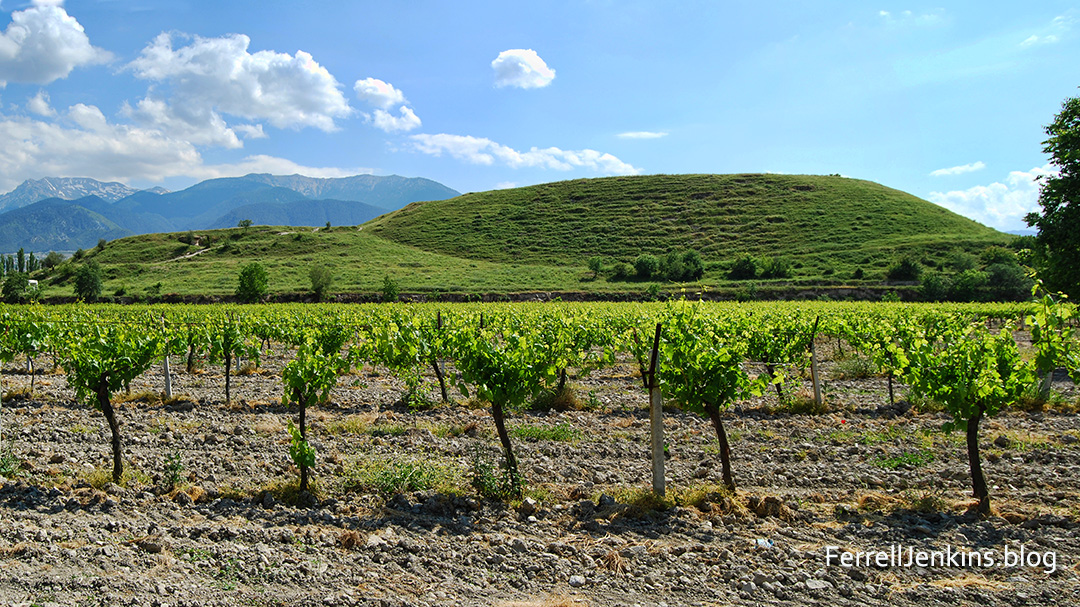
Colossae is located on the south bank of the small Lycus River which continues to flow westward to join the Meander River. In the photo below you will see the ancient mound central in this image. In the backgound (south) to the left you will see Mount Cadmus. The city of Honaz is located at the base of the mountain.

Between the vineyard in the foreground and the mound there is a a little black line. Hidden there is the small Lycus River flowing west (to the right).

Colossae, Mount Cadmus. Photo: ferrelljenkins.blog.

The mound or tel ( Huyuk in Turkey) of Colossae is located on the north side of Mount Cadmus. Photo by Ferrell Jenkins.

The site of Colossae was discovered by William J. Hamilton in 1835. The tell (Turkish, huyuk) is located on the south bank of the Lycus River about three miles northwest of Honaz. Colossae was deserted by A.D. 800 when the city moved to the new town of Khonai (modern Honaz). There is little to be seen today. Several organizations have shown interest in excavating Colossae but so far there has been no major expedition. See article by Dr. Harold Mare, NEAS Bulletin, New Series No. 7, 1976. A group from Flinders University, Adelaide, Australia, has conducted some research in the area.

The Arch of Domitian at Hierapolis

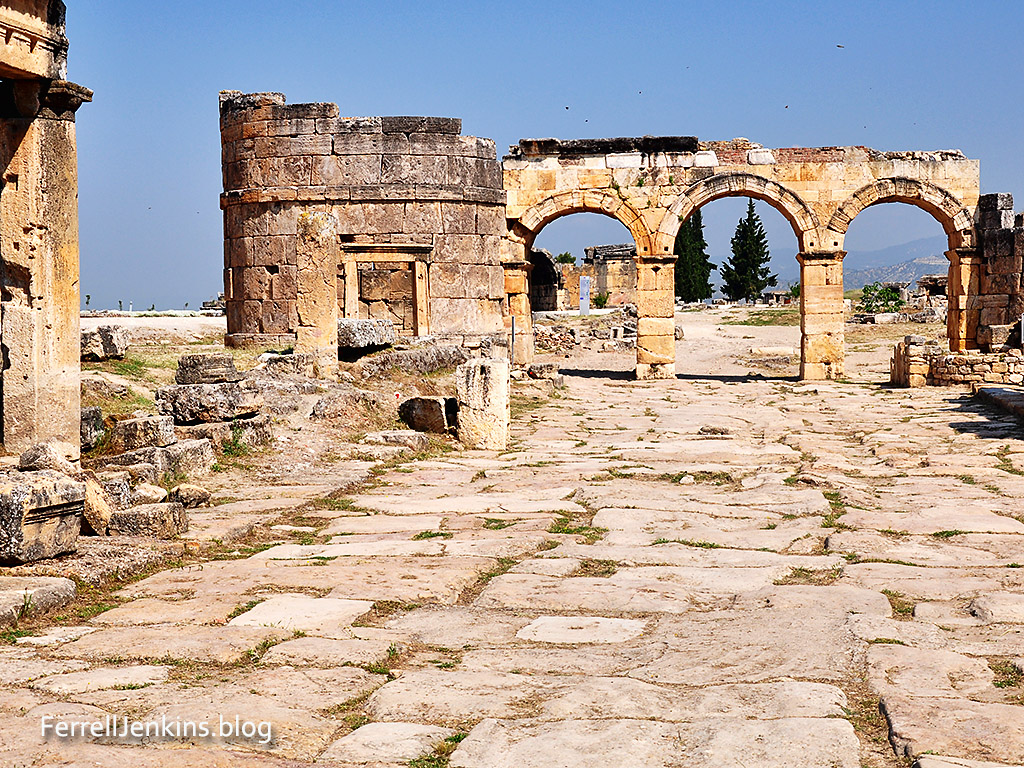
Hierapolis is a city famous for its hot mineral springs and terraced travertine formations. Tradition associates this city with Philip. It is not clear whether Philip the apostle, or Philip the evangelist is intended. See here for more information and photos. A colonnaded street and the Arch of Domitian (emperor A.D. 81-96) was erected by Julius Frontinus, proconsul of Asia about A.D. 82-83. The book of Revelation was written about the time of Domitian’s death.

Arch of Domitian at Hierapolis. Photo: ferrelljenkins.blog.

The colonnaded street and Arch of Domitian, Roman Emperor (A.D. 81-96), erected by Julius Frontinus, proconsul of Asia about A.D. 82-83. Photo by Ferrell Jenkins.

Papias (about A.D. 60 to A.D. 130) was a disciple of the apostle John and a companion of Polycarp. Fragments of his writings about the apostles survive in Irenaeus and Eusebius. He is said to have been Bishop of Hierapolis. Eusebius (active about A.D. 185), tells us that Papias wrote as follows:

Matthew also issued a written Gospel among the Hebrews in their own dialect, while Peter and Paul were preaching at Rome, and laying the foundations of the Church. After their departure, Mark, the disciple and interpreter of Peter, did also hand down to us in writing what had been preached by Peter. Luke also, the companion of Paul, recorded in a book the Gospel preached by him.

Afterwards, John, the disciple of the Lord, who also had leaned upon His breast, did himself publish a Gospel during his residence at Ephesus in Asia. (Euseius, Against Heresies III.1.1)

Paul commended Epaphras for his labor on behalf of all of the churches of the Lycus River valley.

For I testify for him that he has a deep concern for you and for those who are in Laodicea and Hierapolis. (Colossians 4:13).

The photo is suitable for use in presentations for teaching.

The day after Tisha B’av

The phrase Tisa B’av may be strange to Christians, but it means the Fast of the Ninth. The observance “is a day of mourning to commemorate the many tragedies that have befallen the Jewish people” (Judaism 101). According to this source, five terrible events took place on or near the ninth day of the month Av, the fifth month of the Jewish calendar.

The most significant of these events are the destruction of the Temple by the Babylonians in 586 B.C. (2 Kings 25:8-9; Jeremiah 52:12-13), and the destruction by the Romans in A.D. 70.

In the past half century a considerable amount of evidence has come to light concerning the destruction of Jerusalem by the Babylonians. The temple destroyed in 586 B.C. had been constructed by King Solomon in about 966 B.C. It was rebuilt by those who returned from the Babylonian Exile (530-516 B.C.).

Herod the Great began about 19/20 B.C. to rebuild the temple. This work was still in progress during the ministry of Jesus.

The Jews then said, “It has taken forty-six years to build this temple, and will you raise it up in three days?” (John 2:20 ESV)

Christians take seriously the prophecy of Jesus preserved by the Jewish writer Matthew.

Jesus left the temple and was going away, when his disciples came to point out to him the buildings of the temple. But he answered them, “You see all these, do you not? Truly, I say to you, there will not be left here one stone upon another that will not be thrown down.” (Matthew 24:1-2 ESV)

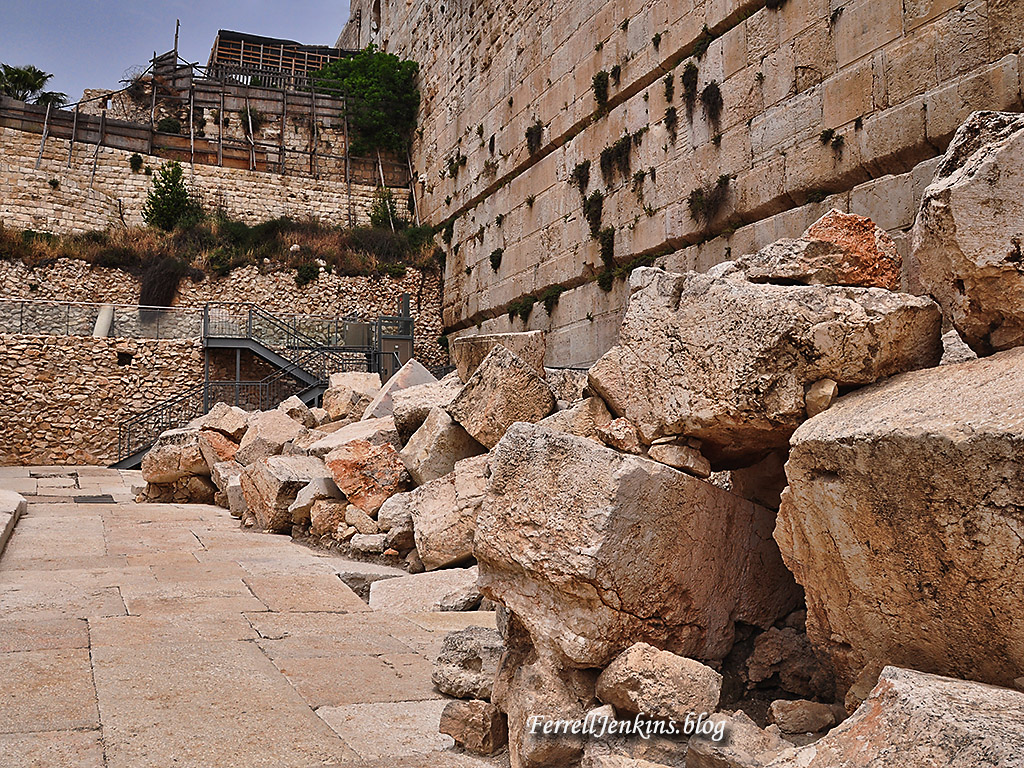
Vivid evidence of the Roman destruction of Jerusalem was discovered at the SW corner of the temple area in the Tyropean Valley. Some of the rubble can still be seen on the street which was probably built by Agrippa II in the 60s of the first century.

Evidence of Roman destruction of the Temple precinct in A.D. 70. Photo: ferrelljenkins.blog.

Stones that fell, or were pushed, from the Temple Mount platform to the street below in A.D. 70 at the time of the destruction by the Romans. Photo by Ferrell Jenkins.

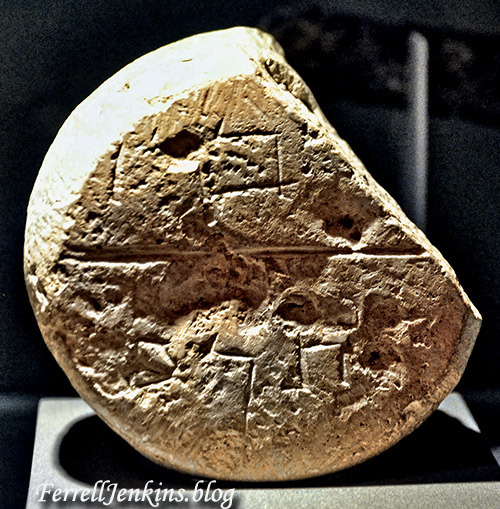
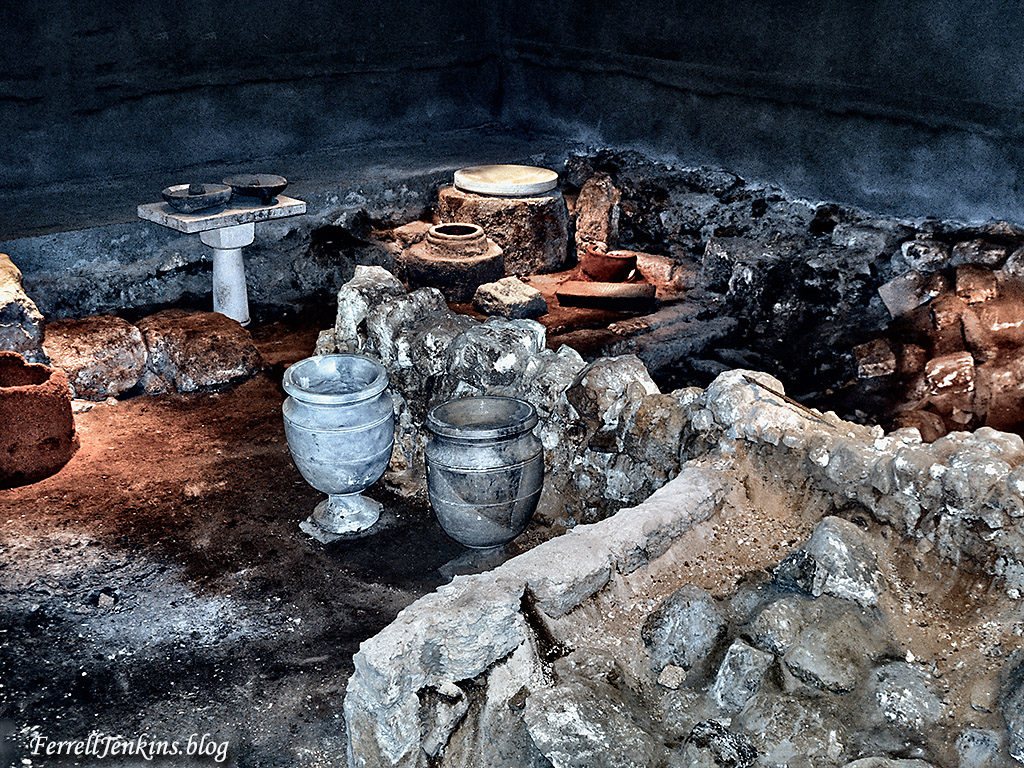
As a result of archaeological excavations in Jerusalem since 1967 we have other vivid examples of the destruction of Jerusalem in A.D. 70. Take a look at the ruins of the Burnt House in the Jewish Quarter. These ruins were discovered at a depth of about 20 feet below street level. It is near the Western Wall of the temple and is what is left of a luxurious house belonging to the Kathros family, a family known for the making of incense. A stone weight bearing the phrase “of Bar Kathros” was found in the excavations (Avigad, Discovering Jerusalem, p. 130. The wealth of the family living here is evidenced by the stone table and the stone jars found in the rubble.

Bar Kathros weight in the Burnt House, Jerusalem. Photo: ferrelljenkins.blog.

A stone weight with the inscription “of Bar Kathros.” Photo by Ferrell Jenkins.

The stone weight was found among the rubble of the basement work room of the Kathros family.

The burnt house after the Roman destruction of Jerusalem. Photo: ferrelljenkins.blog.

The house of the family Kathros, makers of incense for use in the temple, after the destruction by the Romans in A.D. 70. I have used a filter to highlight the result of the burning. Notice the ashes in the lower left corner. Some of the jars have taken on a silver look but they are stone jars. Do you see the arrow? Click on the photo for a larger image. Photo by Ferrell Jenkins.

It happened just as Jesus said it would.

The Pool of Bethesda

The Pool of Bethesda is mentioned only once in the New Testament. At this pool Jesus healed a man who had been an invalid for 38 years.

Now there is in Jerusalem by the Sheep Gate a pool, in Aramaic called Bethesda, which has five roofed colonnades. (John 5:2 ESV)

The pool consisted of two pool near what we know today as the Lion’s Gate or Saint Stephen’s Gate to the Old City of Jerusalem. The church of Saint Anne faces the east side of the southern pool. The two pools were divided by a barrier wall between them. Citing the 1938 French publication by N. Van Der Vliet , Shimon Gibson says,

The Bethesda Pool was divided into two parts: the “Northern Pool” (53 x 40 m) which served as a reservoir for collected rainwater (with a capacity of some 21,200 cubic metres of water), and the “Southern Pool” (47 x 52 m) which was used for bathing (see below). The two pools would have been surrounded by porticoes (stoai) on four of its sides (with flat, not tiled, roofs), and with an additional portico (open on both sides) ex- tending across the barrier wall separating the two pools. The pools were not symmetrically rectangular, but were trapezoidal in form, (“The Excavations at the Bethesda Pool in Jerusalem: Preliminary Report on a Project of Stratigraphic and Structural Analysis”, pp. 17-44 in F. Bouwen (ed.), Sainte-Anne de Jérusalem. La Piscine Probatiquen de Jésus À Saladin. Proche-Orient Chrétien Numéro Spécial. 2011, Saint Anne: Jerusalem, p. 23).

Photo of the Pool of Bethesda from the Second Temple Model, Israel Museum, Jerusalem. In this model you see the two pools with the five colonnades or porticoes, the Herodian temple, and the Antonia (the building with the four towers build to protect the temple precinct. Notice that the model shows tiled roofs which Gibson says was not the case. Photo by Ferrell Jenkins

Gibson says that the archaeological excavations have revealed that Early Roman, Late Roman, two phases of Byzantine, and the Crusader period are known here. That area now looks like this.

The Pool of Bethesda excavations. Photo: ferrelljenkins.blog.

The excavated area of the Pool of Bethesda showing the Crusader and Byzantine ruins. Photo by Ferrell Jenkins.

This nice map from the Bible Mapper Blog shows the relationship of the Pools of Bethesda to the Temple Mount. Those who have visited the Temple Mount in recent years may have exited on the northern side and visited the Pool (or Pools) of Bethesda. As you exit there is a noticeable depression. This is where the Pool of Israel or the Sheep Pool was located.

This map shows the Pools of Bethesda near the top. It comes from the Bible Mapper Blog.

The foreground of the next photo shows ruins of various pools from the Roman period that are known to have been considered a place of healing. Votive offering to Serapis and Asklepius, pagan healing gods, were found in the excavations.

In the foreground, to the east of the church ruins, we have ruins from the Roman period showing a sacred area known to have been considered a place of healing. Photo by Ferrell Jenkins.

Even though the invalid of John 5 had been brought there by friends or neighbors (he could not have come by himself) he remained an invalid. André Parrot says Jesus,

… achieved a victory over the gods of classical paganism which had been introduced into the very heart of Jerusalem, the city of Yahweh (Land of Christ, p. 100).

The Wilderness of Judea – a Hard Way to Go

A portion of the Judean Wilderness is displayed in Green on this map, but it is a very dry area of the country. The walking trip from Jericho to Jerusalem takes at least 7 hours and 30 minutes. Made with BibleMapper.

John the Baptist preached in the wilderness of Judea (Matthew 3:3), and Jesus was tempted in the wilderness (Matthew 4:1). Jesus spoke to the crowds about John this way:

What did you go out into the wilderness to see? A reed shaken by the wind? (Luke 7:24 ESV)

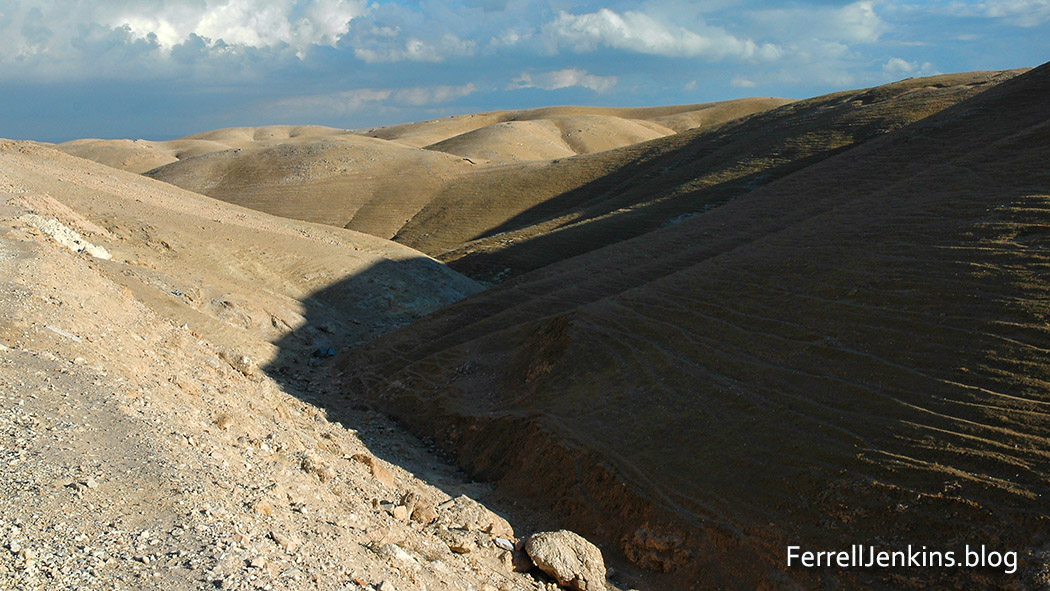
This is a fairly typical view of the Wilderness of Judea at sea level. Photo by Ferrell Jenkins.

The wilderness (Greek eremos) of Judea is described this way in Bauer (BDAG):

Of the Judean wilderness, the stony, barren eastern declivity of the Judean mountains toward the Dead Sea and lower Jordan Valley.

Wilderness of Judea. Photo: ferrelljenkins.blog.

The wilderness of Judea a short distance west of Jericho. The shadows constantly change the appearance of the wilderness. Photo by Ferrell Jenkins.

The Hebrew word for this wilderness is midbar. Charles F. Pfeiffer said the wilderness of Judea,

is the region of rugged gorges and bad lands in the eastern part of Judah where the land slopes off toward the Jordan Valley. In ancient times this area was infested with wild animals. Except for a brief time during the spring rains the wilderness is arid. (Baker’s Bible Atlas, 201)

The Saint George monastery hangs along a cleft in the wilderness of Judea where the Wadi Kelt runs from near Jerusalem past Jericho. Notice the beautiful color shades here. Photo by Ferrell Jenkins.

Many people who read the Bible in English, without checking into the matter, think of the wilderness as being a place filled with wild growth and underbrush. Jesus’ question to the crowds indicates that no reeds are to be found in the wilderness. In this case a picture really is worth a thousand words. This shows one of the many changing views one might see in the wilderness. This one was made in the month of November and shows a view west toward Jerusalem.

The wilderness of Judea stretches from the eastern slope of the central mountain range to the Jordan River. Of course, it extends much farther south along the Dead Sea.

Jerash (Gerasa) in Jordan

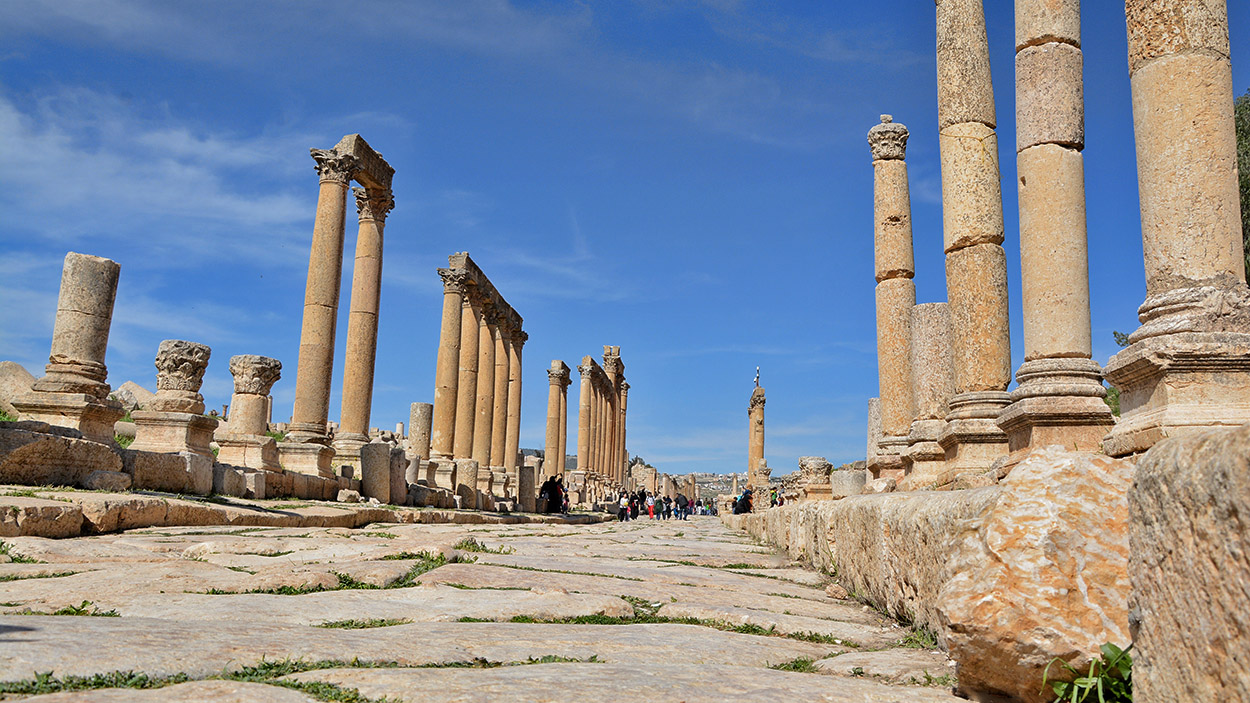
Jerash is also called Gerasa and Jarash. It was founded by Alexander the Great about 332 B.C., but declined as an important city about 300 B.C. The ruins are seen today are principally from the second century A.D. Roman city. We can imagine what the city of the time of Jesus looked like.

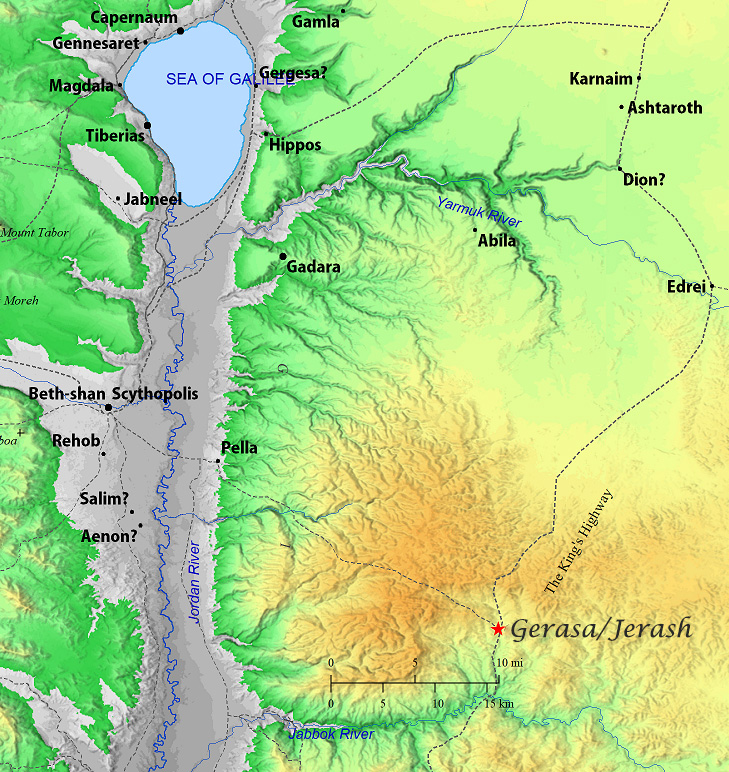
Gerasa/Jerash

This map shows the relationship of Gerasa/Jerash to Galilee, the principal area of Jesus’ ministry. Photo prepared with BibleMapper v.5. ferrelljenkins.blog.

Jerash is located in a well-watered valley in the mountains of Gilead. The modern village is inhabited mostly by Circassians, who were brought there by the Turks in the last part of the 19th century.

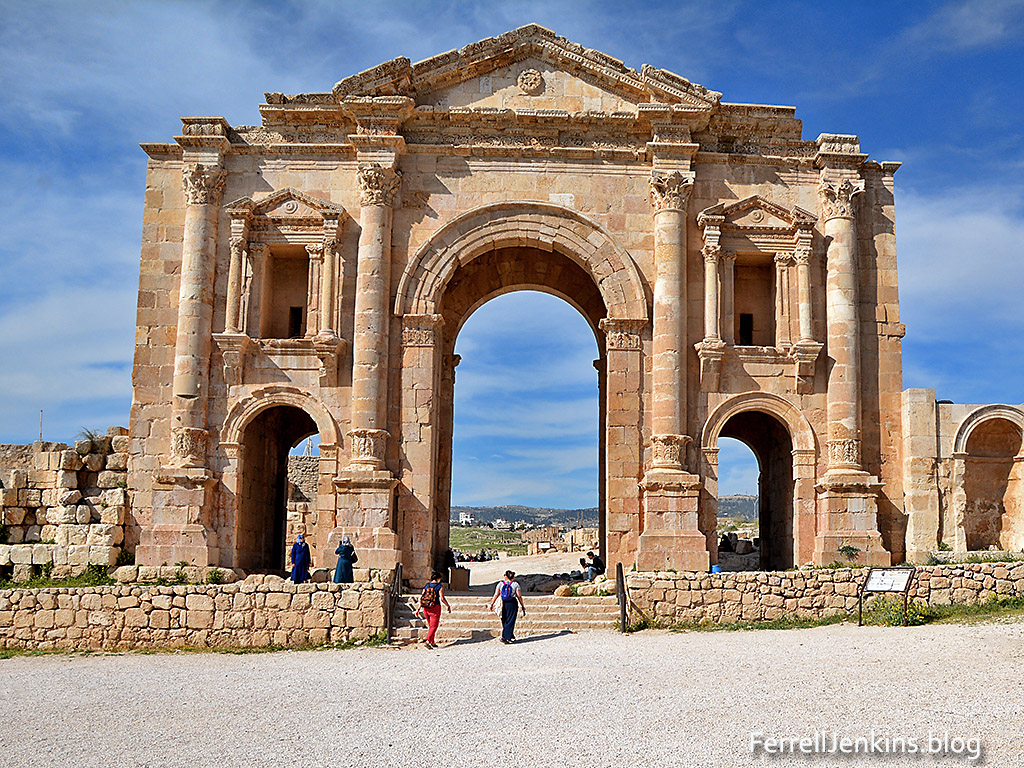
Hadrian's Arch, Jerash, Jordan. Photo: ferrelljenkins.blog.

The Triumphal Arch was constructed at the time of the visit of the Emperor Hadrian in A.D. 129. Photo by Ferrell Jenkins.

A German traveler named Seetzen rediscovered Gerash for the Western world in 1806. Excavations were begun in the 1920s. The main points of interest include the following: Triumphal Arch (built in 129 A.D. to celebrate Hadrian’s visit; Oval-shaped Forum (only one of its kind from the Roman period, from 1st century); Temple of Artemis (columns are 45 feet high with Corinthian capitals); Cathedral Church (ca. A.D. 350-375). Thirteen Byzantine churches have been excavated at Jerash.

Cardo from Roman city Jerash, Jordan. Photo: ferrelljenkins.blog.

A view of the cardo of Jerash in Jordan. Jerash was one of the cities of the Decapolis. Photo by Ferrell Jenkins.

People from the Decapolis followed Jesus during His ministry in Galilee. Jerash was the second largest city of the Decapolis, after Damascus (Matthew 4:23-25). When Jesus traveled through the Decapolis he possibly visited the area around Jerash (Mark 7:31).

Ferrell’s Favorite Foto #38 – a thistle

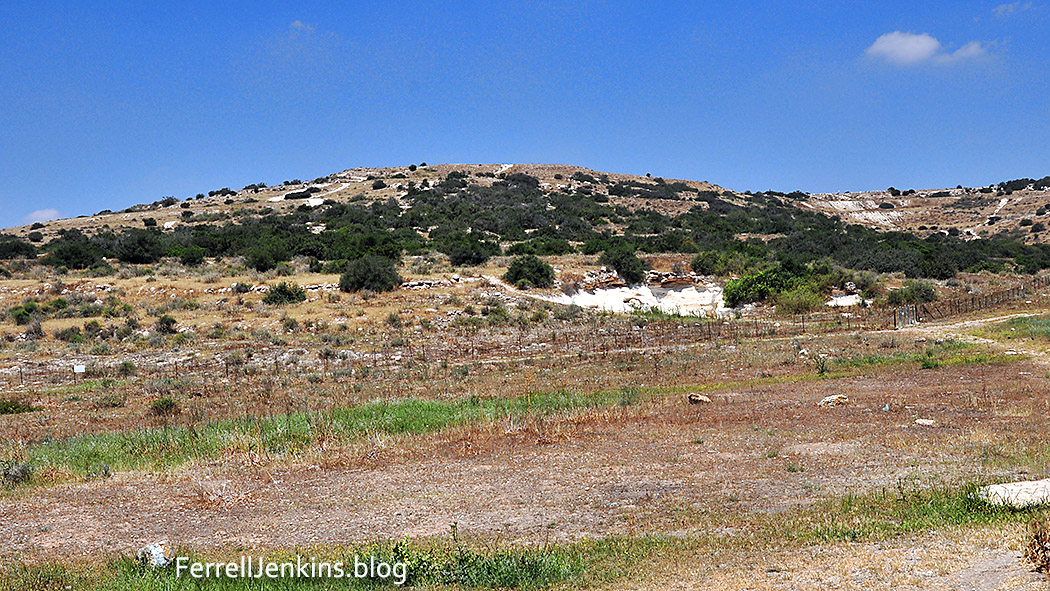
Our favorite foto today was made near Tel Goded, also known as Tell el-Judeideh. This mound has been suggested as the site of Moresheth-gath, the home of the prophet Micah (1:14; see The Sacred Bridge, 170). This site is located on the Israel National Trail.

Tel Goded, also known as Tell el-Judeideh, may be the location of Moresheth-gath, the home of the prophet Micah. Photo by Ferrell Jenkins.

Our photo was made near an underground spring, or possibly a cistern, just outside the lower right corner of the photo.

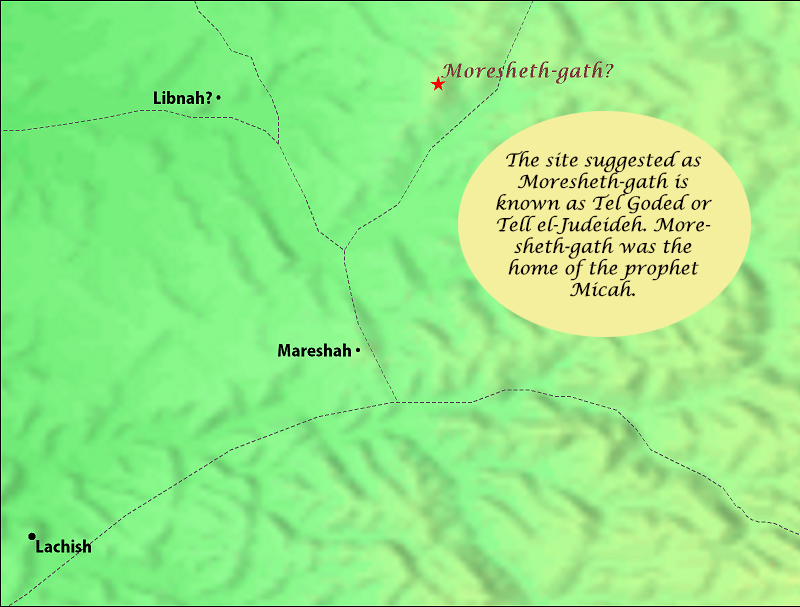
This map was created using BibleMapper 5. Moresheth-gath is located 5.9 miles from Lachish. The suggest site for Libnah is known today as Tel Burna.

Thorns and thistles are mentioned as a plant more or less worthless. As a result of man’s sin, the earth was to bring forth thorns and thistles (Genesis 3:18-19). Jesus said that false prophets could be recognized by their fruits. He said, “Are grapes gathered from thornbushes, or figs from thistles? (Matthew 7:15-16, ESV).

A large variety of thorns and thistles grow throughout the bible lands. During the rainy season many of them produce beautiful flowers, but later on they become a real problems to those who wish to walk through the fields. Peter may be drawing on this figure when he says, “Therefore, gird your minds for action”  (1 Peter 1:13 NAS). Just as a person of that time would gird up their flowing garment to keep it from hanging on the encroaching thistles along the path they were walking. We miss the imagery with our newer versions that say something like, “preparing your minds for action” (ESV).

William Barclay says,

He tells them to gird up the loins of their mind. This is a deliberately vivid phrase. In the east men wore long flowing robes which hindered fast progress or strenuous action. Round the waist they wore a broad belt or girdle; and when strenuous action was necessary they shortened the long robe by pulling it up within the belt in order to give them freedom of movement. The English equivalent of the phrase would be to roll up one’s sleeves or to take off one’s jacket. Peter is telling his people that they must be ready for the most strenuous mental endeavour. They must never be content with a flabby and unexamined faith; they must set to and think things out and think them through. It may be that they will have to discard some things. It may be that they will make mistakes. But what they are left with will be theirs in such a way that nothing and nobody can ever take it away from them. (Barclay, William, ed. The Letters of James and Peter. Philadelphia: Westminster John Knox Press, 1976. Print. The Daily Study Bible Series.)

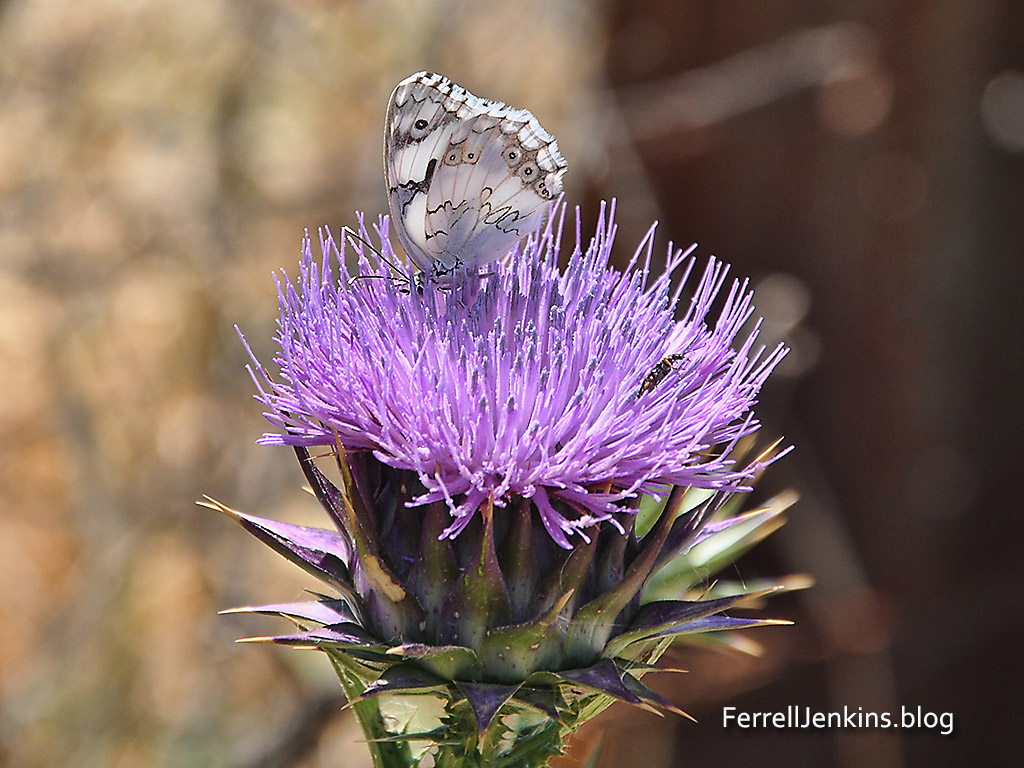
I looked through several books showing the plants of the bible lands as well as the Thorns and Thistles photos in the Pictorial Library of Bible Lands. I think this is the Holy Milk Thistle, sometimes called Mary’s thistle.

Butterfly, thistle, insect near Tel Goded. Photo: ferrelljenkins.blog.

A beautiful butterfly on a thistle near Tel Goded (T. Photo by Ferrell Jenkins.

What makes this photo a favorite is not only that it is a thistle but that it also has a beautiful butterfly on it. If you look closely you may also see an insect, but you can’t miss the sharp thorns.

The comment by G. E. Post in the old Hastings, A Dictionary of the Bible, is interesting – even colorful.

There is probably no country on earth of the same extent which has so many plants with prickles and thorns as the Holy Land. One would be tempted to believe that this is a providential provision to protect them from the ravages of goats, asses, and camels, were it not that the mouths of these creatures are provided with a mucous membrane so tough that it seems impervious to thorns.

Beautiful mound covers the site of ancient Lystra

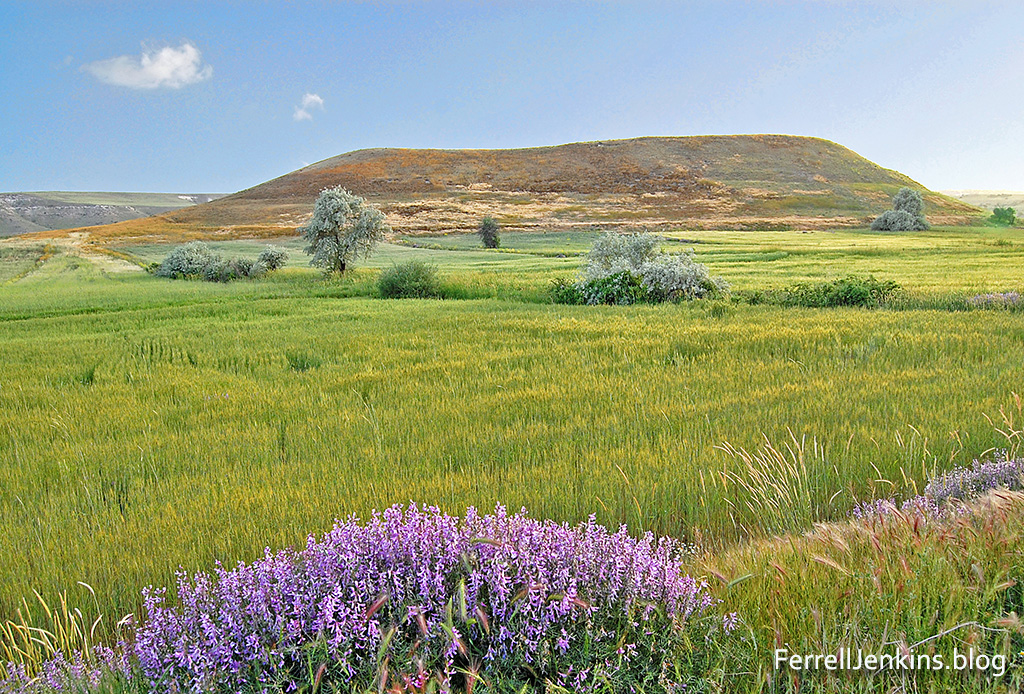
The mound of Lystra, now called Zordula, is located about 18 miles south of Konya (biblical Iconium), Turkey, near the village of Hatunsaray.

Lystra was visited by Paul and Barnabas on the First Missionary or Preaching Journey (Acts 14). Lystra and Derbe were towns of Lycaonia (Acts 14:6). The locals spoke the Lycaonian language. They called Barnabas, Zeus, and Paul, Hermes (14:12). Inscriptions have been found that identify these particular gods with Lycaonia.

This was the home of young Timothy, “the son of a Jewish woman who was a believer, but his father was a Greek” (Acts 16:1). Timothy accepted the invitation of Paul to join him on the second journey. Two of Paul’s epistles were written to Timothy.

The mound of Lystra, 18 miles south of modern Konya. View to the south. Photo by Ferrell Jenkins.