Category Archives: New Testament

Looting and vandalism in Petra

Looting and vandalism of historic or archaeological sites is nothing new. We have reported on vandalism in Israel, but especially in the war-torn countries of Syria and Iraq.

Heritage Daily has an article here on looting and vandalism at Petra. Petra was designated a UNESCO World Heritage Site in 1985. Archaeologists from Brown University have been working in Petra since 2009. They have been able to photograph excavated area each year. Now they report on signs of recent vandalism. The article says,

The damage caused by looting is nothing new and some of the more iconic buildings at Petra bear witness to this. A giant urn carved above the entrance to the Monastery bears the marks of hundreds of gunshots. The local Bedouin tribesmen living in and among the ancient ruins say the damage was caused when local men would open fire with rifles, seeking the loot thought to be inside the urn which is actually made of solid stone.

Heritage Daily has established from sources at Brown University that they are lobbing for additional security at the site and robust investigation to target the individuals concerned. However lack of funds for the Petra Archaeological Park and the isolated rugged area is hindering this work.

There is a considerable amount of natural wear over the centuries. In some cases we must imagine how the stones looked when they were carved by the Nabateans who lived in the area.
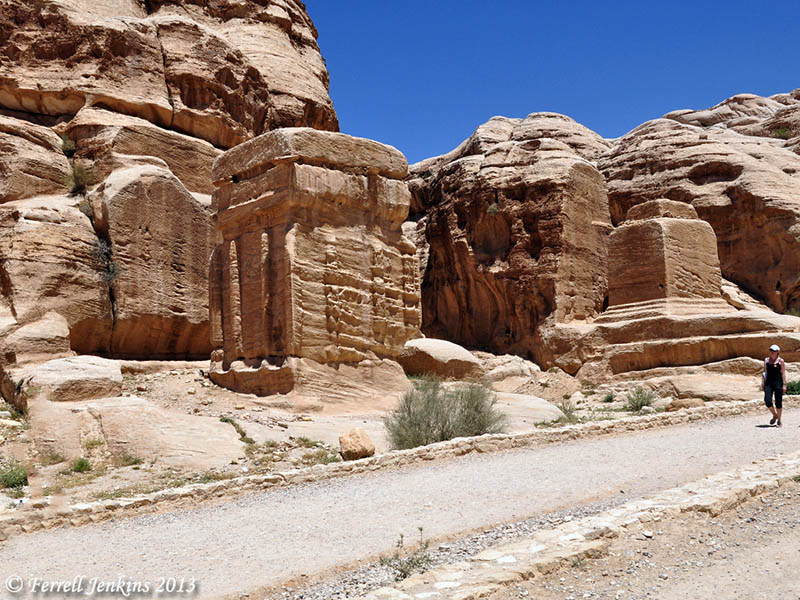
Nabatean Djinn blocks at Petra. Photo by Ferrell Jenkins.

Nabatean Djinn blocks at Petra. Some sources refer to these as god-blocks.Photo by Ferrell Jenkins.

I have noticed erosion in the structures cut from the beautiful sandstone at Petra since my first visit in 1967. Some of this may have been caused by those who fill little bottles with the various colors of sand to sell to the tourists.
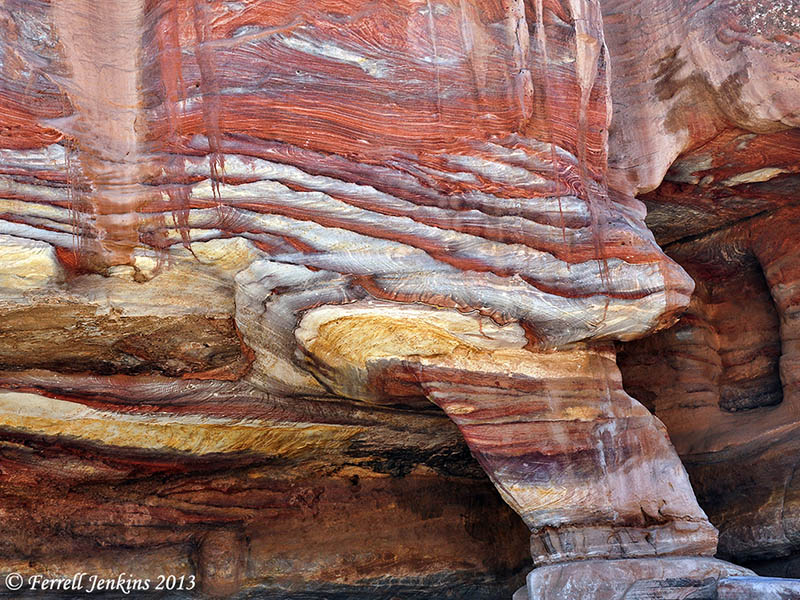
Natural erosion is evidence in these structures cut from the beautiful sandstone structures of Petra. Photo by Ferrell Jenkins.

Natural erosion is evidenced in these structures cut from the beautiful sandstone structures of Petra. Photo by Ferrell Jenkins.

This territory was once inhabited by the Biblical Edomites, but the structures we see today were carved from stone by the Nabateans who inhabited the area from about the fourth century B.C. to the early second century A.D.

One of the most famous Nabatean rulers was Aretas IV (about 9 B.C. to A.D. 40). It was during his reign, which extended at far north as Damascus, when Paul escaped Damascus (2 Corinthians 11:32-33). See here.

HT: Jack Sasson
Chester Beatty papyri digitized by CSNTM

The Center for the Study of New Testament Manuscripts (CSNTM) announces that they have filmed the Chester Beatty papyri. Here is the press release signed by Dr. Daniel B. Wallace, Executive Director of CSNTM:

The Chester Beatty papyri, published in the 1930s and 1950s, are some of the oldest and most important biblical manuscripts known to exist. Housed at the Chester Beatty Library (CBL) in Dublin, they have attracted countless visitors every year. It is safe to say that the only Greek biblical manuscripts that might receive more visitors are Codex Sinaiticus and Codex Alexandrinus, both on display at the British Library.

The Center for the Study of New Testament Manuscripts (CSNTM) is pleased to announce that a six-person team, in a four-week expedition during July–August 2013, digitized all the Greek biblical papyri at the Chester Beatty Library. The CBL has granted permission to CSNTM to post the images on their website (www.csntm.org), which will happen before the end of the year.

The New Testament papyri at the CBL include the oldest manuscript of Paul’s letters (dated c. AD 200), the oldest manuscript of Mark’s Gospel and portions of the other Gospels and Acts (third century), and the oldest manuscript of Revelation (third century). One or two of the Old Testament papyri are as old as the second century AD.

Using state-of-the-art digital equipment, CSNTM photographed each manuscript against white and black backgrounds. The result was stunning. Each image is over 120 megabytes. The photographs reveal some text that has not been seen before.

Besides the papyri, CSNTM also digitized all of the Greek New Testament manuscripts at the CBL as well as several others, including some early apocryphal texts. The total number of images came to more than 5100.

CSNTM is grateful to the CBL for the privilege of digitizing these priceless treasures. The staff were extremely competent and a joy to work with. Kudos to Dr. Fionnuala Croke, Director of CBL, for such a superb staff! This kind of collaboration is needed both for the preservation of biblical manuscripts and their accessibility by scholars.

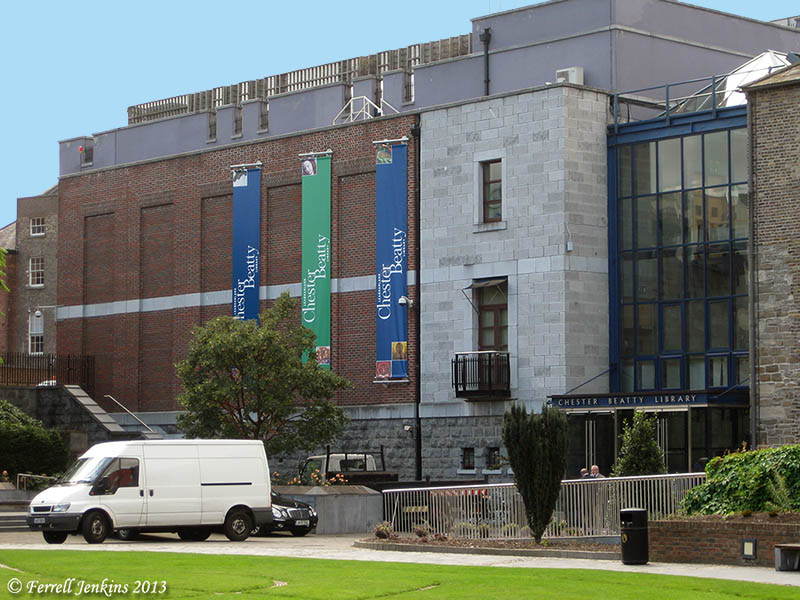
Chester Beatty Library in Dublin, Ireland. Photo by Ferrell Jenkins.

Chester Beatty Library in Dublin, Ireland. Photo by Ferrell Jenkins.

Larry Hurtado tells a little more about the background of this project here. If you wish to see the quality made possible by the CSNTM, see these pages from a 3rd century papyri at the University of Pennsylvania here.

Catching up on the news

For the past few weeks I have been marking items to mention on this blog, but I have gotten behind due to a speaking engagement all last week and some other things. Take a look at those that interest you.

Excavation Reports

James Tabor reports on the 2013 Mt. Zion dig season. The team thinks they may have uncovered a Second Temple period priestly mansion. They found a bathroom with a tub adjecent to a “large below-ground ritual cleansing pool (mikveh) — only the fourth bathroom to be found in Israel from the Second Temple period, with two of the others found in palaces of Herod the Great at Jericho and Masada.” To read more click here.

DK sent me a link to an article in The Huffington Post here. The headline is typical media: “Bathtub Unearthed In Jerusalem May Have Belonged To One Of Jesus’ Enemies.” (Or not!) The first line of the story asks, “Have researchers uncovered the bathtub of one of Jesus’ persecutors?” At least wait until they build a structure over the excavation and begin charging admission. There are several nice photos at the bottom of the article.

Abel Beth Maacah (Abel-Beth-Maacah) is in the north of Israel nearly to the border with Lebanon. Excavations under the direction of Robert Mullins and Nava Panitz-Cohen. The team is looking for Abel’s Aramean (Syrian) connection, and to Phoenician connections. The report reminiscences,

A modern illustration of the proximity of Tel Abel Beth Maacah to the Phoenician coast can be found in an exhibit in the local museum at nearby Metulla. An advertisement from the 1930’s invites one to spend their summer vacation in lovely, cool Metulla. According to the ad, the easiest way to get there from Tel Aviv is to take a boat to Tyre and then a carriage from there to Metulla, 35 kilometers away! We dream of the day when we too can take such a ride.

For our previous posts on Abel Beth Maacah, along with Biblical references, see here, here, and here. The brief excavation report, with numerous photos, is in the The Ancient Near East Today here.

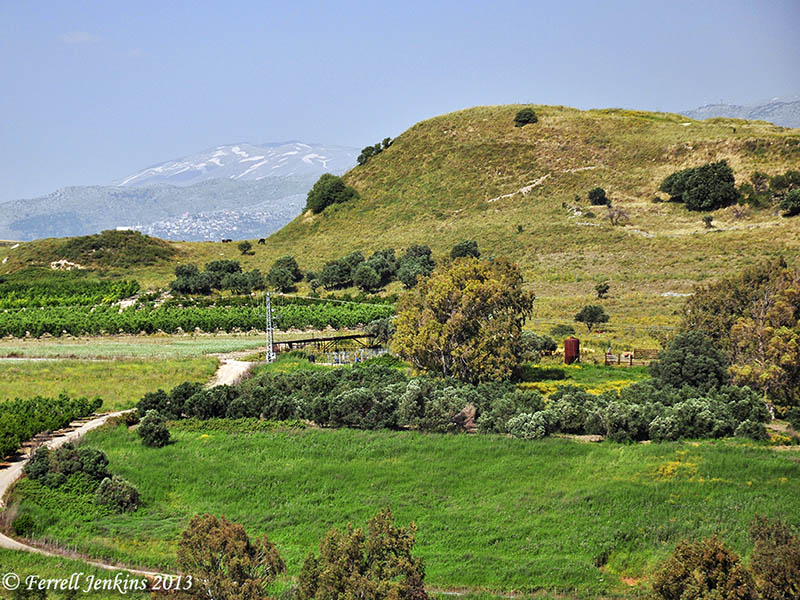
North end of Tell Abel-Beth-Maacah with Mount Hermon to the east. Photo by Ferrell Jenkins.

North end of Tell Abel-Beth-Maacah with Mount Hermon in the background to the east across the Beqa Valley. Photo by Ferrell Jenkins.

The first excavations ever have begun at the ancient city of Derbe. Derbe was visited by Paul and Barnabas on the first preaching journey (Acts 14:20-21). Paul returned with Silas on the second journey (Acts 16:1). We look forward to future reports from Derbe.

See the announcement in Hurriyet Daily News here. HT: HolyLandPhotos Blog.

And More…

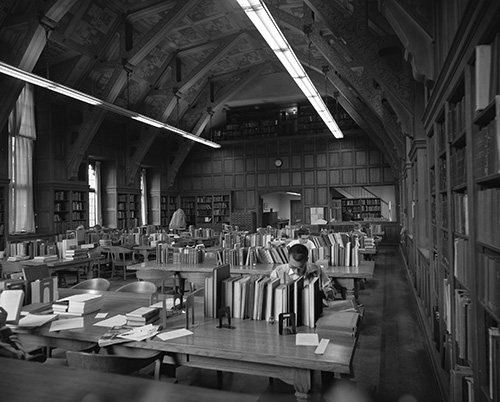
The American School of Oriental Research (ASOR Blog) publishes a monthly publication called The Ancient Near East Today. You may sign up for this (currently) free newsletter. In addition to the report on Abel Beth Maacah, I found the illustrated article about “Digging through Data at the Oriental Institute” extremely fascinating. Take a look at the photo of Dr. James H. Breasted breaking ground for the Oriental Institue, and the iconic photo from about 1975 of the famous card catalog and research area. My late friend Dr. James Hodges worked here for several years while completing his doctorate. The article goes on to show the changes wrought by the digital age.

Oriental Institute Research Area about 1975.

Oriental Institute Research Area about 1975.

Leon Mauldin has a good article on “Physical Features of the Land of Israel” here. A helpful map is included with the article. After discussing the geographical features of the land, Leon reminds us,

These factors helped determine where people lived, what crops could be grown where, and what land was good for cattle, etc. No place on earth has as much variety as the Bible land.

On taking yourself too seriously

On the way from Luxor to the Valley of the Kings on the West Bank of the Nile one passes two huge statues known as the Colossi of Memnon. The statues are nearly 60 feet tall, and once stood at the entrance to the funerary temple of Amenhotep III (also known as Amenophis III). With their crowns, each statue would have been about 66 feet tall. Amenhotep III ruled Egypt during the 18th Dynasty (14th century B.C.).

During the time of the Roman Empire the statues were mistakenly associated with “Memnon, son of Eos and Tithonus, who was killed by Achilles during the Trojan War” (Baedeker’s Egypt).

The last time I was in the Valley of the Kings I noticed the head and chest of the statue had become a resting place for birds. Just an interesting picture, I thought.

Statue of Amenhotet III (or Amenophis III) on West Bank of Nile at Thebes (Luxor). Photo by Ferrell Jenkins.

Statue of Amenhotep III (or Amenophis III) on West Bank of Nile at Thebes (Luxor). Photo by Ferrell Jenkins.

Whether covered by sand or birds, this illustrates how the “mighty” are esteemed by many who follow. Don’t take yourself too seriously!

Paul: For by the grace given to me I say to everyone among you not to think of himself more highly than he ought to think, but to think with sober judgment, each according to the measure of faith that God has assigned. (Romans 12:3 ESV)

Roman period wine presses at Eretz Israel Museum

The Eretz Israel Museum, located on the campus of Tel Aviv University in Tel Aviv, is a wonderful, educational museum to visit. Many of the exhibits are outside, including an archaeological tel (Tel Qasile), and others are in several different small buildings.

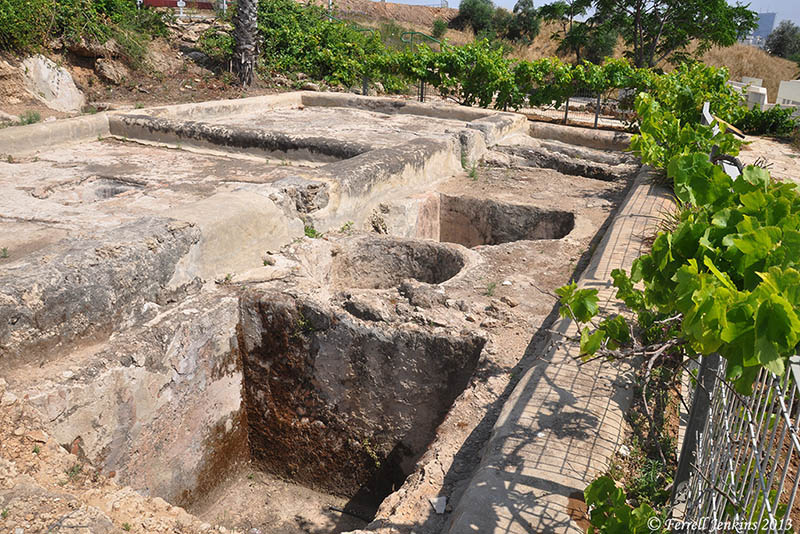
In the photo below we see two Roman period wine presses. (Common English versions use the spelling winepress.) The treading floors are on the left and the collecting vats are on the right.

Roman winepresses at Eretz Israel Museum, Tel Aviv. Photo by Ferrell Jenkins.

Roman wine presses at Eretz Israel Museum, Tel Aviv. Photo by Ferrell Jenkins.

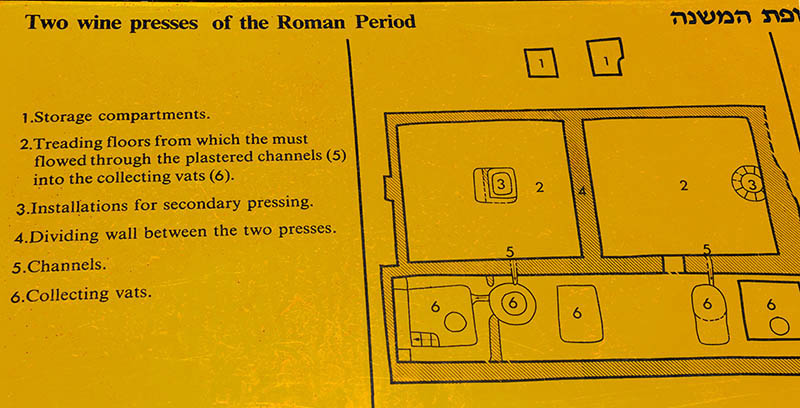
The sign below provides needed explanation for those who have not seen a wine press from the Roman period.

Explanation of Roman winepresses at Eretz Israel Museum, Tel Aviv. Photo by Ferrell Jenkins.

Explanation of the Roman wine presses at Eretz Israel Museum. Photo: Ferrell Jenkins.

One of the parables of Jesus illustrates how common such wine presses were in Biblical times.

“Hear another parable. There was a master of a house who planted a vineyard and put a fence around it and dug a winepress in it and built a tower and leased it to tenants, and went into another country. (Matthew 21:33 ESV)

See a photo of the Byzantine wine press at Avdat here. The Museum website may be visited here.

Beit Jamal may be En-Gannim

Beit Jamal (or Beit Jemâl) is sometimes identified with the En-Gannim of Joshua 15:34. Note the association with other towns belonging to the tribe of Judah in the general vicinity:

33 And in the lowland, Eshtaol, Zorah, Ashnah,
34 Zanoah, En-gannim, Tappuah, Enam,
35 Jarmuth, Adullam, Socoh, Azekah,
36 Shaaraim, Adithaim, Gederah, Gederothaim: fourteen cities with their villages. (Joshus 15:33-36 ESV)

The International Standard Bible Encyclopedia (Rev.) describes En-Gannim as,

A town in the “valley” or Shephelah territory of Judah, named with Zanoah and Eshtaol (Josh. 15:34). Two places have been suggested as locations: one is Khirbet Umm Jina, very close to Beth-shemesh; the other is at Beit Jemâl about 3 km (2 mi) to the south.

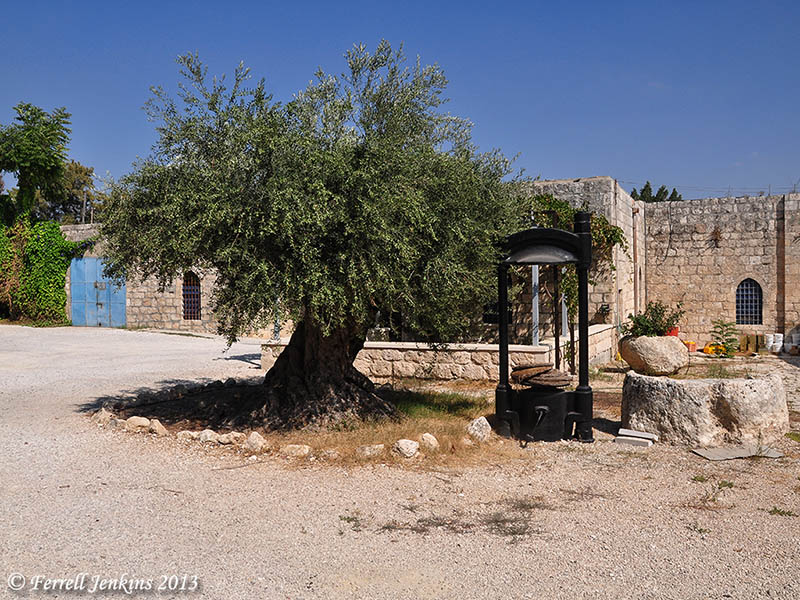
Beit Jamal is today the site of a small monastery nestled in an area of Olive groves. I came across it while looking for the road to Jarmuth (Hebrew, Yarmuth) (Joshua 10:3, 5, 23; 12:11; 15:35; Nehemiah 11:29).

A large olive tree with two old olive presses at Beit Jamal. Photo by Ferrell Jenkins.

A large olive tree with two old olive presses at Beit Jamal. Photo by Ferrell Jenkins.

This little monastery caught my attention a few days ago when Haaretz reported a “price tag” attack on the community. The article explains that “price tag” is “Israeli shorthand for anti-Arab hate crimes.” The article says,

Jewish extremists originally used the term “price tag” to describe vandalism and violence that targeted Israelis as well as Palestinians and was aimed at preventing or avenging evacuations of West Bank settlers.

Here are some appropriate parting words for all of us.

The LORD lift up His countenance on you, And give you peace. (Numbers 6:26 NAU)

May mercy and peace and love be multiplied to you. (Jude 1:2 NAU)

Herod the Great: The King’s Final Journey

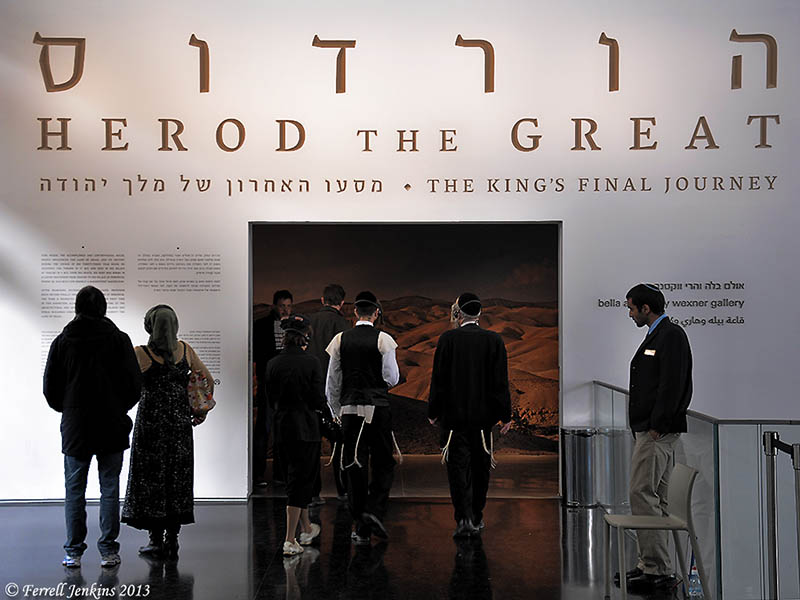
The Israel Museum exhibition of Herod the Great: The King’s Final Journey is scheduled to continue through January 4, 2014. This is a wonderful exhibit. If you can’t make it by the deadline, you may take a gallery tour here. This includes photos, drawings, explanations, and videos that walk you through the exhibit.

Entrance to the Herod the Great exhibit in the Israel Museum. Photo by Ferrell Jenkins.

Entrance to the Herod the Great exhibit in the Israel Museum.

For additional information about Herod and some of his building projects, see here, herehere, and other places.

Leen Ritmeyer was with a group allowed to make some photos within the exhibit. Read about it here.

Evidence of Cinnamon in use 3000 years ago

Live Science reports (here) on the investigation of 27 flasks from five archaeological sites in Israel showing that cinnamon was stored in them. The flasks date back to about 1000 years B.C. Ten of the 27 flasks contain “cinnamaldehyde, the compound that gives cinnamon its flavor, indicating that the spice was stored in these flasks.” Tel Dor is the only site named in the report.

At this time cinnamon was found in the Far East with the closest places to Israel being southern India and Sri Lanka located at least 3,000 miles (nearly 5,000 kilometers) away. A form of it was also found in the interior of Africa, but does not match the material found in these flasks.

This discovery “raises the intriguing possibility that long-range spice trade from the Far East westward may have taken place some 3,000 years ago,” researchers write in a paper to be published in the journal Mediterranean Archaeology and Archaeometry. Although cinnamon can be purchased today at any grocery or bulk food store, 3,000 years ago, people in the Levant would have needed to take part in trade that extended beyond the edge of the known world in order to acquire it, something this discovery suggests they were willing to do.

This trade may go back ever further into antiquity and involve other goods and parts of the Middle East. The researchers note, for example, that black pepper from India has been found in the mummy of Ramesses II, a pharaoh of Egypt who lived more than 3,200 years ago.

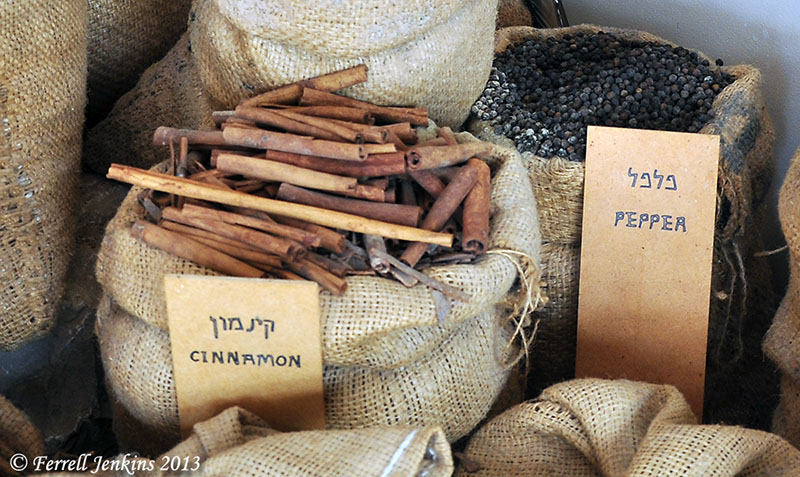
Cinnamon displayed on the Spice Route at Avedat. Photo by Ferrell Jenkins.

Cinnamon and pepper displayed on the ancient Spice Route at Avedat.

Cinnamon is mentioned only four times in the Bible.

  • Cinnamon was used in the anointing oil for the tabernacle (Exodus 30:23).
  • The adulterous woman tells the young man that she has perfumed her bed with cinnamon and other spices (Proverbs 7:17).
  • Cinnamon is used in the sexual/sensuous context of Song of Solomon 4:14.
  • Cinnamon is one of the spices imported by Babylon (the ancient Roman Empire) in Revelation 18:13.

Much archaeological work goes on in the library and in the lab.

HT: Joseph I. Lauer

The Philistine city of Ashdod in the Bible

Ashdod is mentioned in the Bible as one of five cities of the Philistine Pentapolis (1 Samuel 6:17). The city is mentioned earlier among the Canaanite cities in the Ebla tablets. Here is a brief survey of the events recorded in the Bible.

  • Some of the Anakim were left in Gaza, Gath, and Ashdod after Israel entered the land (Joshua 11:22).
  • Ashdod was among some cities that remained under Philistine control even though it had been assigned to the tribe of Judah (Joshua 13:2-3; 15:46-47).
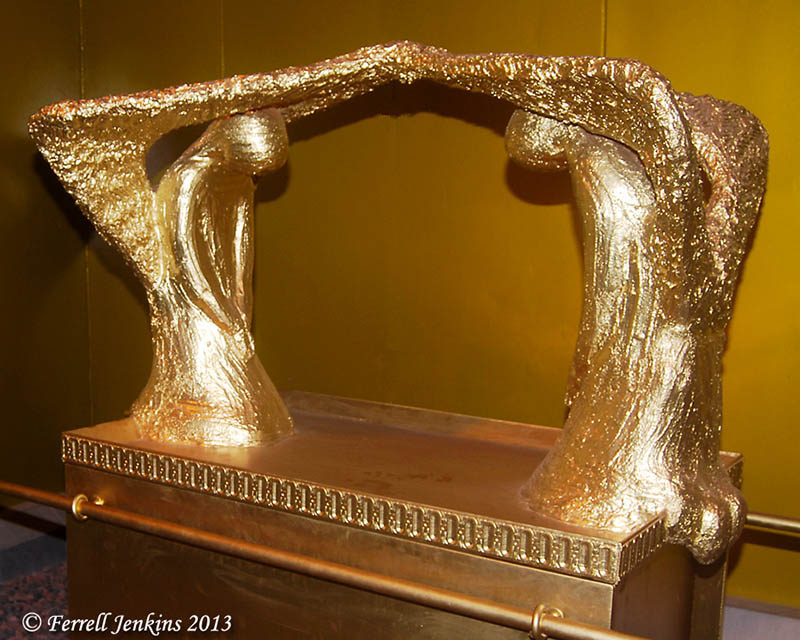
  • When Israel lost the Ark of the Covenant at Ebenezer, the Philistines brought it to Ashdod and placed it in the temple of Dagon (1 Samuel 5:1-8).
Representation of the Ark of the Covenant in the Tabernacle in the Wilderness at Timna. Photo by Ferrell Jenkins.

Representation of the Ark of the Covenant in the Tabernacle in the Wilderness at Timna.

  • Uzziah, king of Judah (767-740/39 B.C.), made war against Ashdod. He broke down the wall of Ashdod and built cities in the area (2 Chronicles 26:6).
  • King Sargon II of Assyria captured Ashdod in 712/711 B.C. (Isaiah 20:1).
  • After the return from Babylon, Nehemiah faced problems because some of the Judeans had married women of Ashdod. Their children spoke the language of Ashdod, and could not speak the language of Judah (Nehemiah 13:23-24).
  • The prophets Jeremiah, Amos, Zephaniah, and Zechariah spoke against Ashdod (Jeremiah 25:20; Amos 1:8; 3:9; Zephaniah 2:4; Zechariah 9:6).
  • Ashdod was known as Azotus in New Testament times (Acts 8:40).

In the next post we hope to discuss Isaiah 20:1 and the archaeological discovery that complements this text.

Visiting Ashdod-Yam — New Testament Azotus

Back in May, my friend Dan and I visited the site of Ashdod-Yam. The site is located a little over 3 miles NW of Tel Ashdod. Tel Ashdod, the city mentioned in the Old Testament, is difficult to visit. My young friends, Trent and Rebekah, mentioned visiting Ashdod a few weeks ago. The site, “now a cow pasture,”  is enclosed by a highway and railroad track on one side and an industrial park on the other. Finding the right hole in the fence is not easy.

You can see a small photo of the excavated area at Tel Ashdod in Journal 118 of Hadashot Arkheologiyot here. Biblical Archaeological Review has a full page photo of the Assyrian palace excavated at Tel Ashdod. (See “Assyrian Palace Discovered in Ashdod.” BAR, Jan/Feb 2007.)

Sargon II took the city of Ashdod in 712/711 B.C., an event mentioned in Isaiah 20:1. By Roman times Ashdod consisted of two cities, the coastal town of Azotus Paralios and the inland town of Azotus Mesogeius. (There is too much history for inclusion here.)

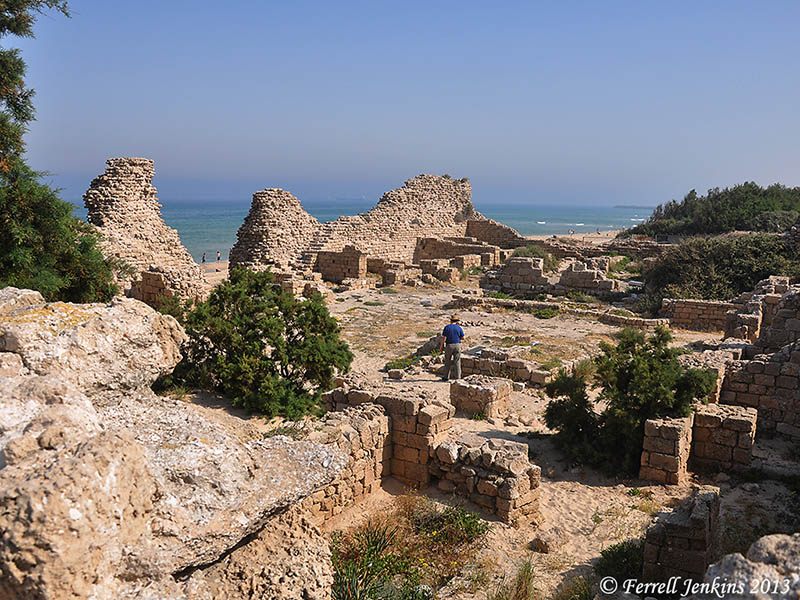
The citadel at Ashdod-Yam with a view north toward the modern city of Ashdod. Photo by Ferrell Jenkins.

The citadel, an early Islamic and Crusader fortress, at Ashdod-Yam with a view north. Photo by Ferrell Jenkins.

Azotus is mentioned only once in the Bible. After the baptism of the man of Ethiopia, the evangelist Philip “found himself at Azotus.”

But Philip found himself at Azotus, and as he passed through he preached the gospel to all the towns until he came to Caesarea. (Acts 8:40 ESV)

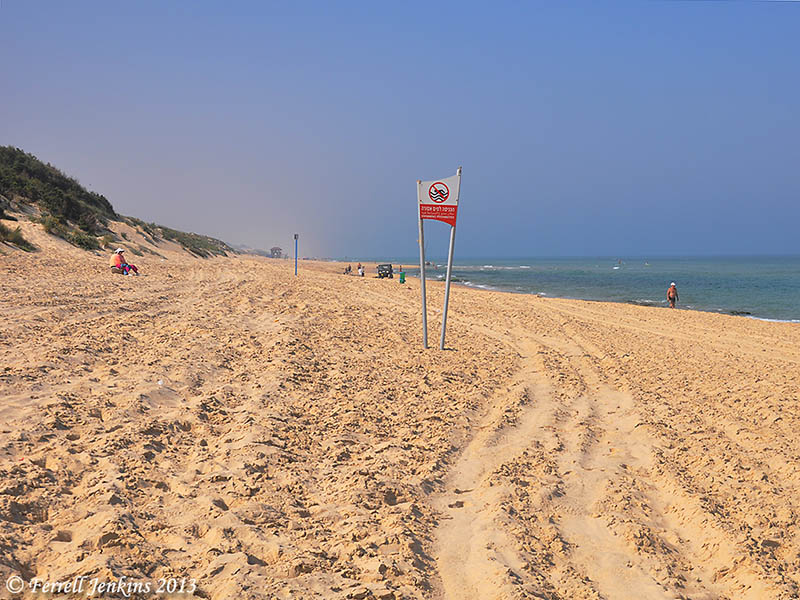
Except for the fortress, the large site of Ashdod-Yam resembles sand dunes. A joint excavation conducted by the Institute of Archaeology of Tel Aviv University and the Institut für Alttestamentliche Wissenschaft of the Leipzig University has just completed the current season. The excavation web site may may be accessed here.

Ashdod Yam. A view south toward Ashkelon. The large tel can be seen sloping down on the left of the photo. Photo by Ferrell Jenkins.

Ashdod-Yam. A view south toward Ashkelon. The large tel can be seen sloping down on the left of the photo. Photo by Ferrell Jenkins.

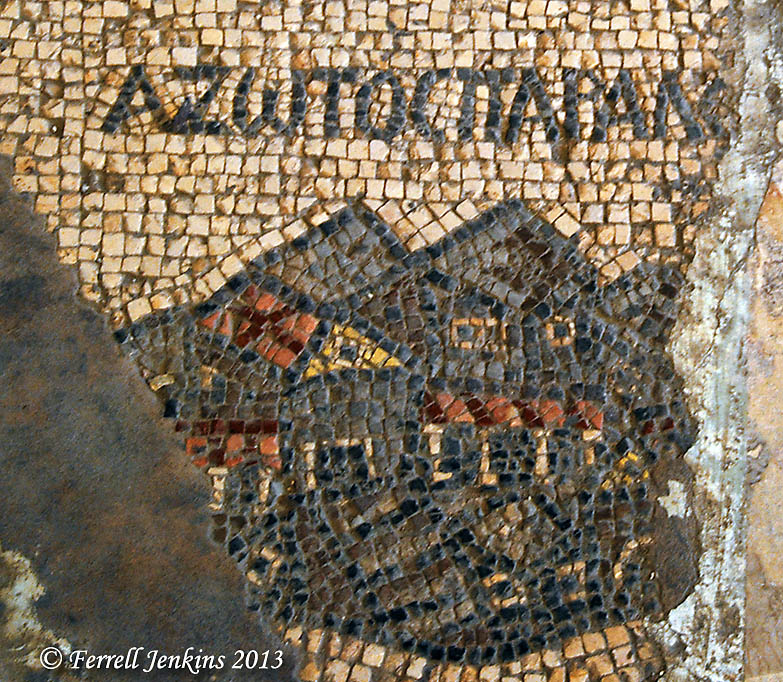
Below is a photo of the name of Azotos Paralios in the 6th century Madaba mosaic map.

Azotus Paralios is portrayed on the 6th century A.D. Madaba mosaic map. Photo by Ferrell Jenkins.

Azotos Paralios is portrayed on the Madaba mosaic map. Photo by Ferrell Jenkins.