Category Archives: Jordan

James B. Pritchard on film in 1967

Last evening I watched The Book and the Spade, a documentary film produced in 1967 by the University Museum of the University of Pennsylvania. The film is about the archaeological work in Jordan. At the time that included Jerusalem, Gibeon, Shechem, Samaria, Bethlehem, Qumran, Amman, Jerash, and Tell es Sadiyeh in the Jordan Valley. Pritchard is seen on the film at Tell es Saidiyeh, east of the Jordan River, giving an account of the discoveries there. He believed the site to be Zarethan. The Bible says that the bronze utensils which Hiram made for King Solomon were made,

In the plain of the Jordan the king cast them, in the clay ground between Succoth and Zarethan. (1 Kings 7:46)

This film is of great historical significance because it features Pritchard and because it shows places that no longer look the way they did in 1967. I suggest you take the time to watch it. Here is the link to The Book and the Spade. The film is about 28 minutes long.

Excavations were resumed in 1985 by Jonathan N. Tubb of the British Museum.

Some scholars have suggested that Zarethan should be located on the west side of the Jordan Valley.

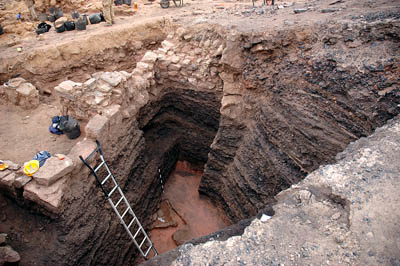
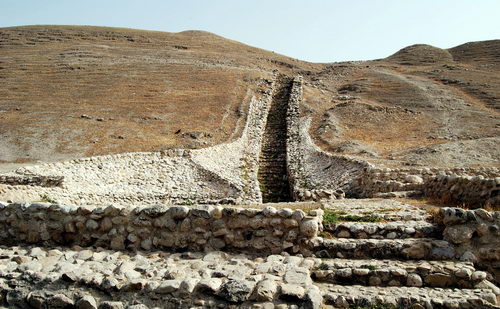
This photo shows the north side of Tell es Saidiyeh with the steps leading to the spring that Pritchard mentions in the film.

Tell es Sadiyeh, excavated by James B. Pritchard. Photo by Ferrell Jenkins.

Tell es Saidiyeh, excavated by James B. Pritchard. Photo by Ferrell Jenkins.

HT: The Book and the Spade blog by Gordon Govier.

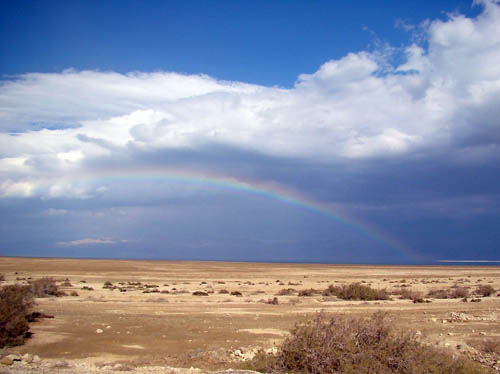
Rainbow over the Dead Sea

My friend Leon Mauldin is in Israel. He sent me a nice photo in which he captured a rainbow over the Dead Sea. I publish it here with his permission. This view looks east toward the Transjordan tableland. You can’t see the mountains because of the heavy clouds. To the far right of the photo you will see a glimmer of light on the surface of the Dead Sea.

Rainbow over the Dead Sea. Photo by Leon Mauldin.

Rainbow over the Dead Sea. Photo by Leon Mauldin.

The land in the foreground of the photo was covered by the water of the Dead Sea just forty years ago. With less water flowing into the Dead Sea the level has been declining over the past few decades.

The name Dead Sea is not used in the Bible. Rather, this body of water is called the Sea of the Arabah, the Salt Sea, or the Eastern Sea. The Bible describes the territory of the Transjordan tribes, Reuben and Gad, this way:

The Arabah and the Jordan River were also a border, from the sea of Chinnereth to the sea of the Arabah (that is, the Salt Sea), beneath the watershed of Pisgah to the east. (Deuteronomy 3:17).

Josepus called this body of water Lake Asphaltitis.

Thanks for following our tours

Thanks to your interest we noticed an increase in readers during our trip to Egypt. We appreciate your interest in the subjects we write about.

A blog is different from a web page. On a web page, such as the Biblical Studies Info Page, there are many categories and pages available. When you check the blog you see the last entry at the top of the page. You must click on the Archives listing, or use the Search Box to locate earlier posts.

A list of some other trips we have covered on this blog might be helpful to you (from the most recent to the earliest).

  • Egyptian Adventure (begin January 16, 2009).
  • Israel (personal study) trip (begin August 20, 2008).
  • Steps of Paul and John (Greece and Turkey) (May, 2008).
  • Bible Land Tour of Israel and Jordan (April, 2008).
  • Scotland Highlights (September 2007).
  • Biblical & Historical Sites in Turkey (May and June, 2007).

The purpose of these trips is educational. We seek to relate the history and the land to the biblical account.

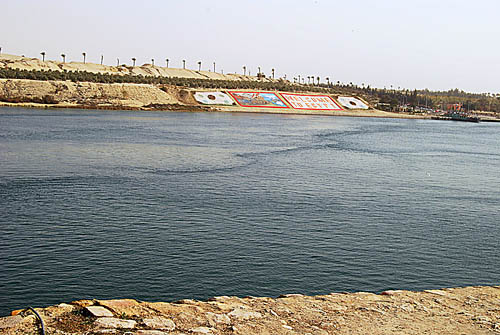
Suez Canal near Ismailia. Photo by Ferrell Jenkins.

Suez Canal near Ismailia. Photo by Ferrell Jenkins.

This view of the Suez Canal at Ismailia looks from the east to the west. The ancient Egyptians dug numerous canals in the general area. This modern canal was officially opened November 17, 1869.

We would like for you to continue to check the blog several times a week as we write about other matters of interest to Bible students.

McGarvey’s Land of the Bible

J. W. McGarvey was one of the best scholars of the 19th century Restoration Movement. He was president of the College of the Bible in Lexington, KY. One of my first books was his practical New Commentary on Acts of Apostles (1892). He had earlier (1868) written A Commentary on Acts of Apostles dealing with some of the critical issues of the book. McGarvey addressed some of the critical questions of the day in The Authorship of Deuteronomy, Jesus and Jonah, and Biblical Criticism.

McGarvey visited Palestine in 1879. His former students paid for the trip [I like that!], with the understanding that he would write a book. They would get their money back from the sale of the book. His book, Lands of the Bible, was published by J. B. Lippincott & Co., London and Philadelphia, in 1881. The title page indicates that 15,000 copies were printed. Impressive for a book on that subject.

J. W. McGarvey’s Lands of the Bible is available at the Restoration Movement pages here. For other works by McGarvey and other Restoration leaders begin with the home page here.

When I led my first group to the Bible Lands in 1967, one friend in the group had studied McGarvey’s book carefully. He took a tape measure with him. When we came to certain sites he took out the tape to take measurements. He wanted to be sure he was at the same place McGarvey visited.

Chapter IX in McGarvey’s book is titled “Argument from the Agreement of the Land and Book.” I have an outline of this material in my Introduction to Christian Evidences [OP], and use some of this material in my Daily Life in Bible Times series. One would be mistaken not to move beyond McGarvey, Thompson, Robertson, and the other early explorers. On the other hand, it would be amiss to dismiss what these scholars wrote.

What prompted all of this? Todd Bolen recently wrote a post on The Acoustics of Mounts Gerizim and Ebal in which he quotes from one of McGarvey’s letters here. I urge you read his post now. Also follow the link to the Biblical Studies and Technology Tools post showing the valley between Ebal and Gerizim using digital mapping tools.

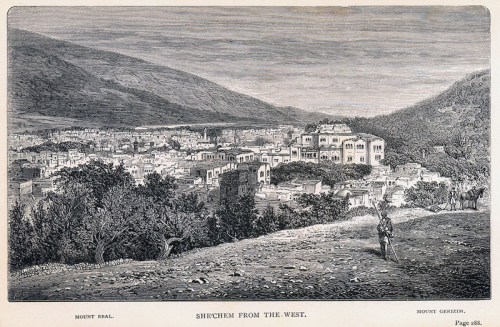
I wanted to contribute something to this study by including here a scan of the plate from my original edition of Lands of the Bible (opposite page 288).

Shechem from the West. McGarvey, Land of the Bible.

Shechem from the West. McGarvey, Land of the Bible.

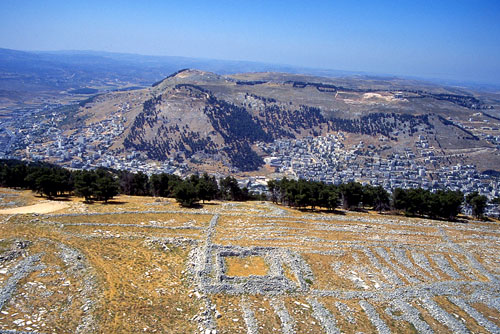
Todd Bolen has a great photo of Mount Ebal from Mount Gerizim. I would like to add the other side of the valley. Here is a photo showing Mount Gerizim from above Mount Ebal. It is an aerial shot made for me by the well known photographer Zev Radovan.

View of Mount Gerizim from above Mount Ebal.

View of Mount Gerizim from above Mount Ebal.

Maybe later we will discuss some of the important biblical events that took place in this area. For not let us note that this is where the blessings and curses of the law were read after the children of Israel entered the promised land (Deuteronomy 11:19). Here is the account of that event:

All Israel with their elders and officers and their judges were standing on both sides of the ark before the Levitical priests who carried the ark of the covenant of the LORD, the stranger as well as the native. Half of them stood in front of Mount Gerizim and half of them in front of Mount Ebal, just as Moses the servant of the LORD had given command at first to bless the people of Israel. Then afterward he read all the words of the law, the blessing and the curse, according to all that is written in the book of the law.  There was not a word of all that Moses had commanded which Joshua did not read before all the assembly of Israel with the women and the little ones and the strangers who were living among them. (Joshua 8:33-35 NASB)

Final SBL report

Sunday afternoon I attended a session on Rome and Religion: A Cross-Disciplinary Dialogue. The featured speaker was Karl Galinsky, a distinguished professor of classics from the University of Texas. His topic was The Cult of the Roman Emperor: Uniter or Divider. Galinsky began by saying that he was pleased to see that New Testament scholars had finally discovered the “historic context of the New Testament.”

Galinsky emphasized that the Emperor cult existed. He said that we must not think of it as the prominent cult, but as being intertwined with the other cults known throughout the Roman Empire. Another speaker, Barbette Stanley Spaeth, cited evidence of the emperor cult in Corinth. I found the information significant in the study of the book of Revelation as well as the epistles of Paul.

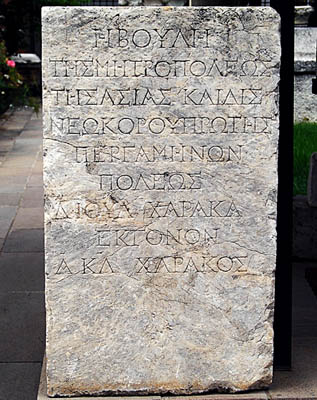
A Travel Note: The photo below shows an inscription which is now displayed in the garden of the archaeology museum in Bergama, Turkey (ancient Pergamum; Revelation 3:12-17). The inscription states that Pergamum was metropolis of Asia and twice NEOKOROS. This last word was the one commonly used when a city of Asia Minor was awarded the right to build a temple to the Emperor. This type of information must be taken into account when we consider the setting of the Book of Revelation.

Inscription at Pergamum claiming that the city was twice NEOKOROS. Photo by Ferrell Jenkins.

Inscription at Pergamum claiming that the city was twice NEOKOROS. Photo by Ferrell Jenkins.

Monday morning I attended another session on Biblical Lands and Peoples in Archaeology and Text. This one dealt with Samaria and the Samaritans. There were seven presenters. I especially enjoyed hearing Robert J. Bull of Drew University. Bull excavated a site called Tell er Ras on Mount Gerizim between 1964 and 1968 when it was under the control of the Hashemite Kingdom of Jordan. I enjoyed seeing his photos, drawings, and explanations. His work uncovered evidence of Hadrian’s temple in the early second century A.D. In more recent excavations Y. Magen claims to have discovered the Samaritan temple destroyed by John Hyrcanus. Magen was not present. Some of the speakers indicated that a final report has not been made by Magen and they did not comment on the matter.

This whole area is of great significance to students of the New Testament. The conversation between Jesus and the woman of Samarian dealt with this issue.

“Our fathers worshiped in this mountain, and you people say that in Jerusalem is the place where men ought to worship.” (John 4:20).

Society of Biblical Literature in Boston

The annual meeting of the Society of Biblical Literature is being held in Boston this year. I have been attending these meetings for many years. I come in order to hear a few of the many valuable, and some not so valuable, presentations by scholars who are presenting their latest research on some particular topic.  When I was still actively teaching I often attended sessions that were related to the courses I was teaching. Now I tend to go to what is of interest.

These meetings attract more than 5000 members, most of whom are teachers in some field relating to biblical studies.

One of my favorite topics is archaeology and how it relates to biblical history. Many of the leading archaeologists make presentations or read papers telling about the most recent excavations. This, of course, puts me far ahead of the curve if one is waiting to read the information in a magazine or a book. In fact, I observe that many presentations given at SBL will eventually be a chapter in a volume published by the author some years later.

Saturday I heard Thomas Levy and other colleagues from the University of California San Diego tell about the recent work in southern Jordan dealing with the ancient Edomites and copper mining in the area. Levy has discovered that copper mining was common in the area from the 10th century B.C. I have already reported on this discovery, with photos, here, with a related post about mining at Timna here. I hope you will take time to read those reports.

In the afternoon I attended a session on the Wall of Jerusalem in the Persian Period. I suspect that the person making room assignments has no idea about some of the presenters. The most controversial of the speakers here was Israel Finkelstein of Tel Aviv University. He has been dubbed the father of minimalism. Actually he is currently the most prominent in a long line of those who devalue the biblical record. The room was full and overflowing. I sat on the floor in order to be able to see the screen and hear the speaker. The presentations by Ronny Reich, Alon de Groot,  and Wolfgang Zwickel were also informative. Evidence from the Persian period is limited, possibly because it was a significant but short period of biblical history. Here are some of the major events:

  • The Jews were allowed to return from Babylonian Exile in 536 B.C. because of the decree of Cyrus. Remember that only a remnant returned.
  • The temple was rebuilt in 520-516 B.C.
  • Ezra returned with a second group in 458 B.C.
  • Nehemiah returned to help rebuild the wall in 444 B.C.

The evidence presented regarding the number of inscriptions, pottery, jewelry, etc. from the Persian period indicated a small number of items in comparison to the much larger number from the Iron Age and the Hellenistic Age. This is really not surprising when we consider the the circumstances of the period, the possible reuse of materials by later builders, etc.

Everywhere one puts down a pick in Jerusalem there is evidence of earlier civilizations. Keep digging!

Before closing, let me add a little something Persian to this post. Here is a photo of the Cyrus Cylinder, now in the British Museum.
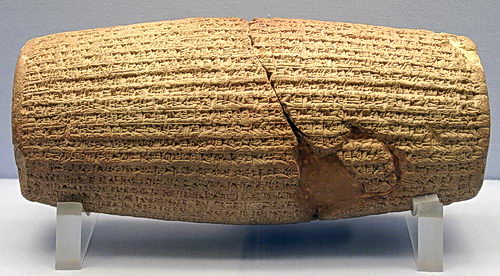
The Cyrus Cylinder. British Museum. Photo by Ferrell Jenkins.

The Cyrus Cylinder. British Museum. Photo by Ferrell Jenkins.

This document records that Cyrus allowed captive peoples to return to their homelands, build their temples and worship their gods. This is similar to the account given in 2 Chronicles 36 and Ezra 1 regarding the Judeans.

Now in the first year of Cyrus king of Persia– in order to fulfill the word of the LORD by the mouth of Jeremiah– the LORD stirred up the spirit of Cyrus king of Persia, so that he sent a proclamation throughout his kingdom, and also put it in writing, saying,  23 “Thus says Cyrus king of Persia, ‘The LORD, the God of heaven, has given me all the kingdoms of the earth, and He has appointed me to build Him a house in Jerusalem, which is in Judah. Whoever there is among you of all His people, may the LORD his God be with him, and let him go up!'” (2 Chronicles 36:22-23)

Copper smelting in 10th century B.C. Edom

Several sources are reporting the discovery of copper smelting operations in Jordan dating to the 10th century B.C. This is the time of Solomon. The discovery was made at a site called Khirbat en-Nahas about 30 mile south of the Dead Sea on the eastern side of the Arabah. The photo below is by Thomas Levy, UC San Diego.

Industrial copper slag mound at Khirbat en-Nahas. Photo Thomas Levy.

Industrial copper slag mound at Khirbat en-Nahas. Photo Thomas Levy.

This is the ancient territory of Edom. Scholars have known for 30 or more years that there was metalworking there in the 7th century B.C. Researchers, led by Professor Thomas E. Levy of the Department of Anthropology at UC San Diego, and Mohammad Najjar of Jordan’s Friends of Archaeology, dug deeper into the site to find evidence of smelting from the 9th and 10th century.

Naysayers who seem frightened that some modern archaeological discovery might “confirm” the biblical record are already at work. Israel Finkelstein of Tel Aviv University is quoted as saying that the stories of the Old Testament “depict the concerns, theology and background of the time of the writers” which he says belong to the 5th century B.C. They cannot be accepted as factual according to Finkelstein.

From his study in Florida, Ferrell Jenkins said,

Instead of immediately linking a discovery such as this to a biblical character or event, would it not be better to think of the discovery in the terms of shedding light on the biblical record?

An Egyptian scarab from Tanis or the eastern delta and an amulet of the Egyptian goddess Mut caused Levy to suggest that these artifacts might be associated with the Egyptian pharaoh Sheshonq I. Pharaoh Sheshonq I is known as Shishak in the Bible. Here is a summary of the biblical references to Shishak.

  • Provided refuge to Jeroboam for a few years prior to the death of Solomon (1 Kings 11:40).
  • Invaded Israel (Canaan) in the fifth year of King Rehoboam (926 B.C.) and took away treasures from the temple in Jerusalem (1 Kings 14:25-26; 2 Chronicles 12:2-9).

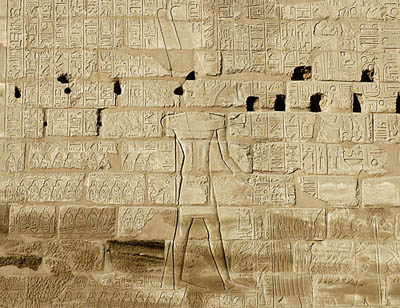
Shishak left a record of his invasion of Canaan on the walls of the temple of Amum at Karnak (modern Luxor, Egypt). Here is a photo of the relief at Karnak showing Shishak holding lines to the 156 Canaanite cities he claims to have captured.

Pharaoh Shishak I of Egypt. Photo by Ferrell Jenkins.

Pharaoh Shishak I of Egypt. Photo by Ferrell Jenkins.

The Bible says that Israel would be able to dig copper from the hills of the country to which they were going (Deuteronomy 8:9). See also Job 28:1-2.

We have known for some time that copper was smelted by the Egyptians at Timna, about 25 miles north of Eilat. Here is a photo showing a reconstruction of the process for copper smelting there in the 13-12th century B.C.

Model of copper smelting installation at Timna. Photo by Ferrell Jenkins.

Model of copper smelting installation at Timna. Photo by Ferrell Jenkins.

More details about this discovery may be found at the following sites: UC San Diego News Center. At the Los Angeles Times there is a nice 12 minute video about the discovery narrated by Thomas Levy.

HT: Joseph I. Lauer

Update [later in the day]: Todd Bolen has added three great photos taken at Khirbat en-Nahas at his Bible Places Blog.

A look at two prodigal sons

Every Bible reader knows the story of the prodigal son. He became dissatisfied with things at home, asked his father for his part of the inheritance, and took off for a distant country. There he wasted his estate on wild living. See Luke 15 for details of the story.

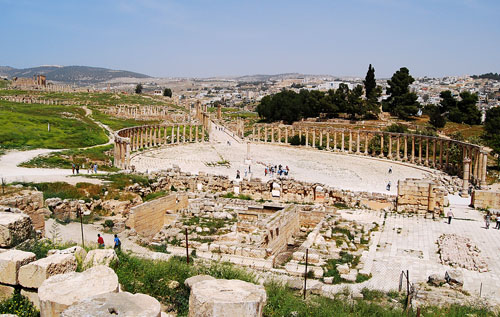
I have often wondered if the young prodigal went away to the region of Decapolis. A city like Jerash doesn’t seem that far today, but we must remember that most people likely walked or used donkey transportation in those days. Jerash would provide a wonderful opportunity for a boy away from home for the first time to become involved in loose living. Most of the ruins at Jerash belong to the second century, but it is not difficult to imagine an impressive city there in the first century.

The forum at Jerash. Photo by Ferrell Jenkins.

The forum at Jerash. Photo by Ferrell Jenkins.

Another story worth considering has come to my attention. About 100 years ago Adolf Deissmann wrote Light From the Ancient East. He demonstrated how the Egyptian papyri illustrates New Testament teaching. In fact, he showed that the language of the New Testament was generally the koine (common) Greek of the day.

The papyrus about which Deissmann writes comes from the second century A.D. It tells of a young man named Antonius Longue from the village of Caranis in the Fayum of Egypt. He quarreled with his mother, left home, engaged in loose living, and running up debts.

Eventually Antonius learns that his mother has come to town to search for him. He writes her to plead for reconciliation. One must still question his character, for he hints that his mother might pay his debts. In his letter written to his mother he says,

I beseech thee, mother, be reconciled to me! I know that I have sinned.

Deissmann comments on the value of an account like this in the study of the New Testament.

There can be no doubt that this letter is one of the most interesting human documents that have come to light among the papyri. This priceless fragment, rent like the soul of its writer, comes to us as a remarkably good illustration of the parable of the Prodigal Son (Luke 15:11 ff.).

He also points out that the term reconciled is the same one used in the New Testament in texts like Matthew 5:23-24.

If therefore you are presenting your offering at the altar, and there remember that your brother has something against you, leave your offering there before the altar, and go your way; first be reconciled to your brother, and then come and present your offering. (NASB)

The church as a solid bulwark

The apostle Paul wrote these words to the saints at Colossae:

For though I am absent in body, yet I am with you in spirit, rejoicing to see your good order and the firmness of your faith in Christ. (Colossians 2:5 ESV)

J. B. Lightfoot suggested that the term stereoma [firmness] was a military metaphor. He says that Paul’s companionship with soldiers of the praetorian guard (Philippians 1:13) might have suggested the image.

I always enjoy William Barclay’s comments on words. He makes the following comments on order and firmness.

These two words present a vivid picture, for they are both military words. The word translated order is taxis, which means a rank or an ordered arrangement. The Church should be like an ordered army, with every man in his appointed place, ready and willing to obey the word of command. The word translated firmness is stereoma, which means a solid bulwark, an immovable phalanx. It describes an army set out in an unbreakable square, solidly immovable against the shock of the enemy’s charge. Within the Church there should be disciplined order and strong steadiness, like the order and steadiness of a trained and disciplined body of troops.

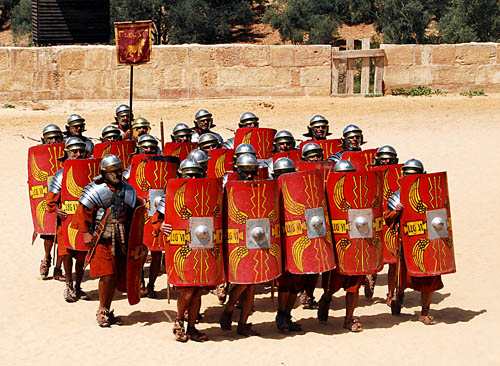
These soldiers from the Roman Army and Chariot Experience at Jerash, Jordan, demonstrate what is meant by the term firmness (stereoma).

Soldiers in formation as a solid bulwark. Photo by Ferrell Jenkins.

Soldiers in formation as a solid bulwark. Photo by Ferrell Jenkins.

A Bible Land tour for less than $20.00

Journey Through the Holy Lands is a DVD featuring Michael Hasel of Southern Adventist University. Dr. Hasel is Director of the Institute of Archaeology and teaches archaeology at SAU in Collegedale, Tennessee.

In 2007 Hasel was filmed at important biblical sites providing a commentary about the significance of the site. The following sites are visited:

Jerusalem
Garden Tomb; Church of the Holy Sepulcher; the Cardo; Western Wall; Temple Mount; Sheep Gate (often called St. Stephen’s or Lion’s Gate); Pool of Bethesda; Damascus Gate; the First Century House in the Jewish Quarter.

The Dead Sea Area
Qumran, Dead Sea, Masada, Wadi Qelt; Jericho

Egypt and the Sinai
The Giza Pyramids; Saqqara; St. Catherine’s Monastery; Mount Sinai

This DVD is not one of those slick TV presentations. It is the film of a competent scholar who is well acquainted with the history and archaeology of the area telling his tour group about it. I was impressed that Hasel spelled out the facts about such competing sites as the Holy Sepulcher and the Garden Tomb. At some places the commentary was very brief. At Jericho he mentioned the relevant research but did not show any of the evidence on the tell. There is no visit of sites in the Galilee.

At St. Catherine’s, Hasel tells about the discovery of the Sinaiticus Manuscript. Attractive maps and artwork has been added to the film. The background noise at the Giza Pyramids is noticeable and a distraction. The narration could have been added in a studio back home, but it would have changed the character of the film.

It was a pleasure to view the video. I would recommend it to those who have visited these areas and would like an on site review. It would be good for those who will never visit the sites, or those who are preparing for a trip.

Journey Through the Holy Lands is available for $15.00. Shipping and Handling for 1 or 2 copies is $2.50 each. For 3 or more copies it is $5.00.  Payment must be made by money order or check payable to Southern Adventist University. Send order to: Institute of Archaeology, Southern Adventist University, P.O. Box 370, Collegedale, TN 37315.

The Institute of Archaeology operates the Lynn H. Wood Museum which is the repository of the William G. Dever Near Eastern Collection. Check the web page here. I plan to visit the museum if I have an opportunity to travel in the area.