Category Archives: Bible Lands

A Cedar of Lebanon Grows in Israel

My first visit to Neot Kedumim was with Leon Mauldin about 14 years ago. Neot Kedumim is a Biblical Landscape Reserve in Israel, located halfway between Jerusalem and Tel Aviv in the vicinity of Modin. One can spend several hours following one of the several trails on this 625 acres of hills and valleys. For more details visit the website here.

A few years ago I was doing some reading about the animals in the Haibar Reserve north of Eilat in the Arabah when I ran across a reference a cedar of Lebanon growing in Neot Kedumim. The article written by Helen Frenkley provides the explanation:

One of the most striking garden areas at Neot Kedumim is the Garden of Wisdom Literature, where cedars of Lebanon grow alongside clumps of hyssop bushes. Transplanting fifteen 40-year-old cedars of Lebanon to Neot Kedumim was quite an undertaking. In 1976, the trees were purchased from the Hebrew University of Jerusalem’s botanical garden on Mt. Scopus. Those cedars of Lebanon had been brought as cones from Lebanon in 1936 by Dr. Ephraim and Mrs. Hannah Hareuveni and their 12-year-old son, Nogah, after an extended botanical field trip to that country. The seeds that germinated were planted on Mt. Scopus not far from the Museum of Biblical and Talmudic Botany established by the Hareuvenis at the university in 1925. Carefully tended, these trees thrived and new seedlings were added as the years went by.

Ephraim and Hannah Hareuveni died in the 1950s without seeing the Biblical Landscape Reserve they had dreamed of creating. Mt. Scopus was cut off from western Jerusalem by Jordanian forces during the 1948 War of Independence and was inaccessible to Israelis, except for a small caretaker police force, between 1948 and 1967. In the Six Day War of 1967, Mt. Scopus became part of Israel. Nogah Hareuveni was one of the first people who returned to see how the cedars of Lebanon had weathered the near siege conditions of those 19 years. Because of the lack of drinking water on Mt. Scopus, it had been impossible to irrigate the cedars, which consequently suffered greatly.

Nine years later, however, 15 of those cedar trees were boxed. When, after eight more months, the side roots grew, confined within the four-sided slats, the tap roots were cut and the trees trucked down to Neot Kedumim. Pits with rich soil had been prepared and a water tanker stood by for immediate irrigation. Neot Kedumim is 2,000 feet lower in elevation than Mt. Scopus, but much to everyone’s surprise and delight, the diligent care paid off. The cedars survived and flourished. Several scores of saplings of various ages have now been added, so that a grove of some 50 cedars of different sizes thrives in the Garden of Wisdom Literature at Neot Kedumim.

You can find the complete article in Frenkley, Helen. “The Search for Roots—Israel’s Biblical Landscape Reserve.” Biblical Archaeology Review. Sept/Oct. 1986.

When I purchased my ticket to visit Neot Kedumim in early April I asked about the cedars. The person on duty called the office to inquire. A very nice lady came  to provide the answers I needed. This time I took a trail different from the one Leon and I had taken in ’05.

It took a while, and I began to wonder if I would ever see a cedar. Eventually I came to an area where several small trees were visible.
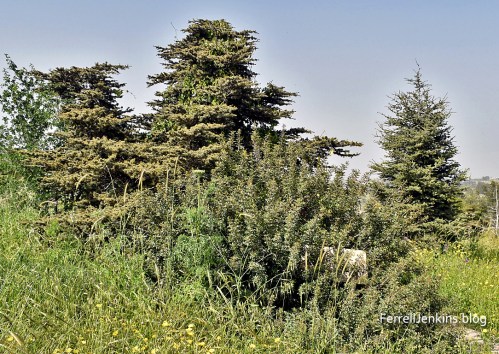
Cedars of Lebanon in Israel. FerrellJenkins.blog.

Small Cedars of Lebanon growing at Neo Kedumim in the lowlands of Israel. Photo by Ferrell Jenkins.

After a while I came to what I think is the oldest of the Cedars. This plant is identified as a Cedrus Libani (cedar of Lebanon).
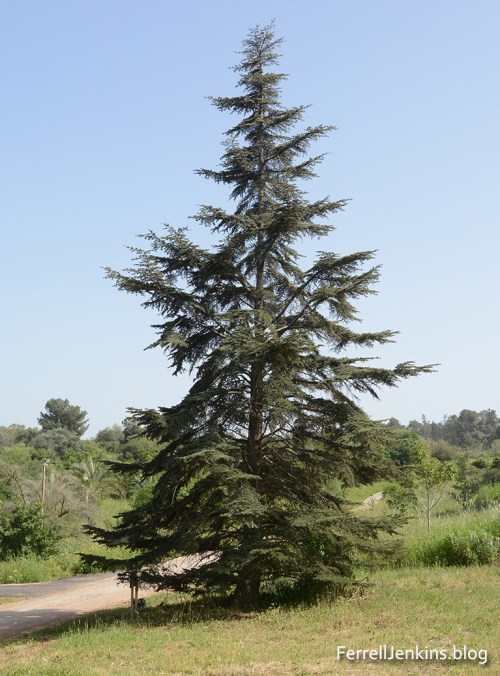
Cedar of Lebanon growing in Neot Kedumim. ferrelljenkinsl.blog.

Likely the largest Cedar of Lebanon (Cedrus Libani) growing in Neot Kedumim. Photo by Ferrell Jenkins.

Not very long back we presented several articles on the Cedar of Lebanon. Begin here. If you do not easily locate others in the series, just use the Search Box and insert cedars.

I can highly recommend visits to Neot Kedumim) for travelers who have the time to visit. This year Luke Chandler traveled with me, but he had to return home a few days early. When he reads this he will be sorry!
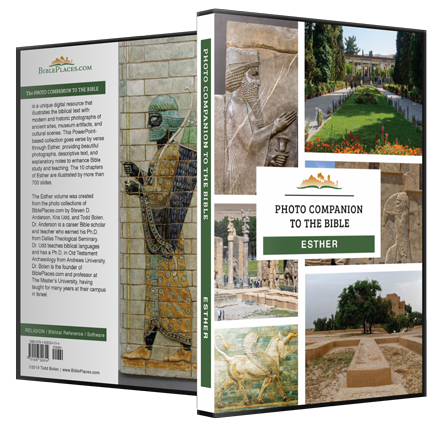
Need Illustrations for teaching Daniel and Esther?

BiblePlaces.com has just published their 9th and 10th volumes in the new Photo Companion to the Bible. I have recommended the earlier volumes, but in some ways the two current volumes on Daniel and Esther may be the best. Each of the books lend themselves to the use of historical and cultural illustrations. Each of the books have a historical setting relating to Persia. The new photos made by Todd Bolen in modern Iran (ancient Persia) within the past year enhance these volumes. And there are numerous illustrations relating to the Babylonian, Greecian, and Roman empires too.

If you have followed this blog very long you already know that I highly recommend the material published by BiblePlaces.com. I suggest you go here for detailed info on the Daniel volume. That volume of more than 1,000 images is PowerPoint ready and is on sale today for $39, a saving of $30. Scroll to the bottom of the page and take a look at sample photos from several volumes.

Photo Companion to the Bible: Esther

Now to the volume on Esther. In teaching this book you will now have excellent photos made in Persia within the year. This volume of more than 700 images is also on sale today for $39. To see more information and see sample photos, along with ordering info, go here.

Each volume in the Photo Companion to the Bible includes a DVD with all of the images and the PowerPoint presentations. This makes it easy to select the illustrations you wish to use in your own presentation. You are also allowed to download the images to your personal computer.

All of the materials published by BiblePlaces.com may be purchased with secure checkout. Get these volumes before the price goes up. Satisfaction is guaranteed.

In the title I ask, do you “Need Illustrations for teaching Daniel and Esther?” If you answered “no” you probably should not be teaching! I hear many lessons that could be improved through the use of appropriate illustrations from the Bible lands. Sometimes I have wondered if the reason some do not use appropriate historical or cultural illustrations is because to do so require much study to use them well. Do the study, use the images, and more folks will be letting you know they enjoyed and appreciated the lesson. End of sermon.

Ferrell’s Favorite Foto #20

Today’s foto has not been a favorite very long. Just this afternoon at the close of a wonderful day along the Dead Sea and the Jordan River. The story below.

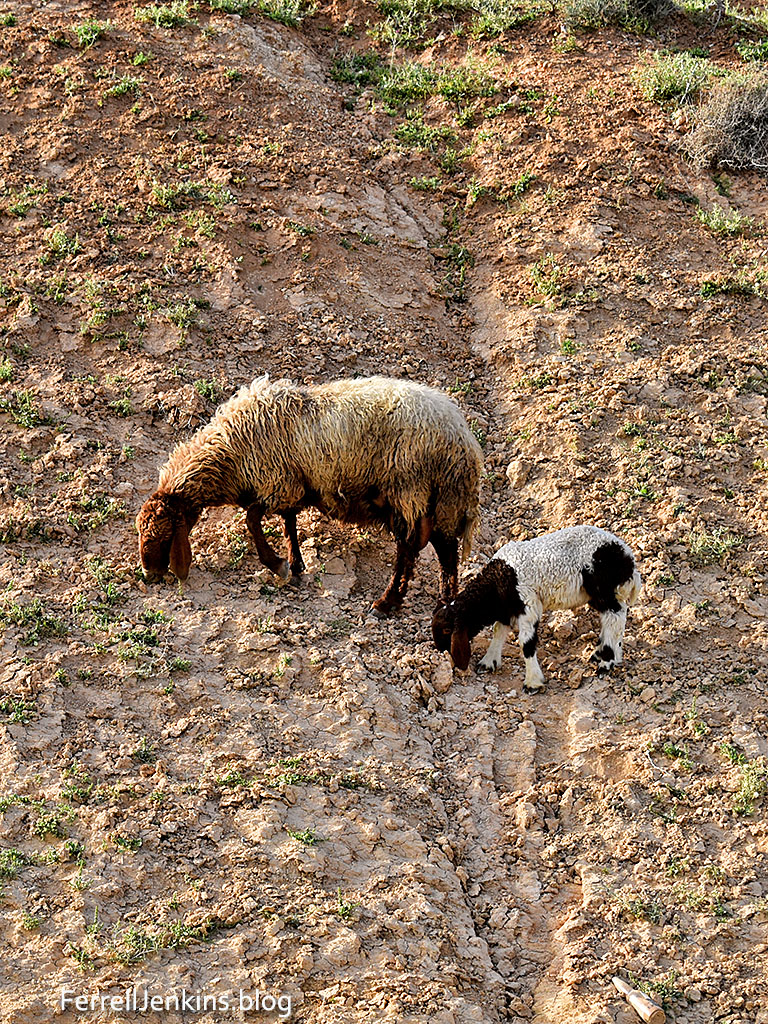
Ewe and lamp grazing on the side of a cliff on Highway 1. Photo: ferrelljenkins.blog.

Ewe and lamb grazing along the side of Route 1 from the Dead Sea to Jerusalem and Tel Aviv. This area is just a few miles east of Jerusalem. Photo by Ferrell Jenkins.

I have been traveling privately on what I call a personal study tour. I have invited numerous people to join me from time to time. They are always knowledgeable, having traveled at least a few times before. This year I invited Luke Chandler to join me. Luke made his first trip to Israel on one of my tours. He is now an accomplished leader, and he has brought people to participate in excavations at various sites. We are neighbors. We both have a genuine interest in Israel as it pertains to the Bible. Luke left for home last Friday and I plan to leave Wednesday.

Now here is the story behind today’s photograph.

I spent much of the day traveling and stopping for fotos along the Dead Sea today. I visited the ancient synagogue at En Gedi, and then went to Kasser Al-Yahud, the traditional place where John baptized Jesus (Matthew 3). If we were  in Jordan, and we were only yards away, we would call it Bethany Beyond the Jordan (John 1:28).

On my way back to Jerusalem I noticed sheep along the STEEP hillside on the north side of Highway 1 that runs from the Dead Sea to Jerusalem and Tel Aviv. I was surprised to see a wide lane along the highway for cars with problems to park. There were long periods between groups of cars. I pulled over and made this photo from the car. Then I got out and made more of the flock.

So this foto is a favorite because of the subject and because of the unusual situation. Yes, the side of the road is close to a 90 degree angle.

I thought about parents and children. The lamb seems to have no fear of being on the hillside. The lesson we can learn is that children often learn fear or calmness from what they see in their parents.

Ferrell’s Favorite Fotos #19

Riblah served as a base of operation for the Egyptian Pharaoh Necho and the Babylonian King Nebuchadnezzar. The city is located on a broad plain about 50 miles south of Hamath (modern Hama in Syria), on the main road between Egypt and Mesopotamia. The Orontes River flows past the site on the west side. On a modern map you will locate Riblah in Syria immediately north of the border with Lebanon.

There is little more than a “country store” at the village today, but the name Riblah is preserved as Ribleh, Syria.

  • Pharaoh Necho imprisoned Jehoahaz, king of Judah, at Riblah. He later took him to Egypt where he died. The date was about 609 B.C. (2 Kings 23:31-34).
  • Zedekiah, puppet king of Judah, tried to escape capture by the Babylonians. He fled Jerusalem but was captured on the plains of Jericho and brought to Riblah. There Nebuchadnezzar passed sentence on him. His sons were slaughtered in his sight and he was bound with brass fetters and taken to Babylon. The date was 586 B.C. (2 Kings 25:5-7; see also Jeremiah 39:5-6; 52:9-10).
  • The officials of Zedekiah were taken to Riblah where they were put to death (2 Kings 25:19-21; see also Jeremiah 52:26-27).

In 2002 David McClister, a colleague at Florida College, and I spent several days visiting sites in Syria. Riblah was the most difficult to locate. Most folks, after seeing the site, would probably say, “What’s the big deal?”  Even though Riblah is mentioned only these few times in the Old Testament, it’s location makes it important in all movement between the south (Egypt and Israel) and Mesopotamia.

The ancient mount of Riblah, once headquarters of Babyonian king Nebuchadnezzar. FerrellJenkins.blog.

The ancient mount of Riblah, once headquarters of Babyonian king Nebuchadnezzar. Slide scan. Photo by Ferrell Jenkins in 2002.

This post is a repeat, but I thought the favorite photo needed more explanation than most of the images I am using.

Ferrell’s Favorite Foto # 18

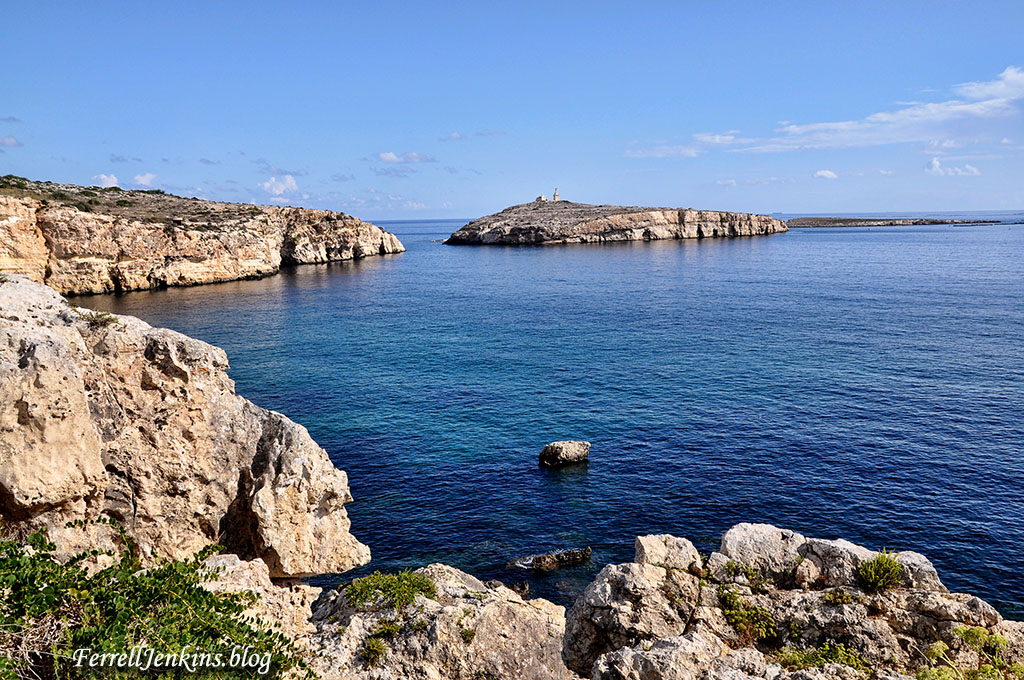
The island of Malta is mentioned in the book of Acts as the place where Paul was shipwrecked during the voyage to Rome.

After we were brought safely through, we then learned that the island was called Malta. (Acts 28:1 ESV)

Saint Paul's Bay and Island in Malta. Photo: FerrellJenkins.blog.

Saint Paul’s Bay and Island in Malta. Photo by Ferrell Jenkins.

There are several natural bays and harbors at Malta that have been suggested as the place of the shipwreck described in Acts 27-28. Saint Paul’s Bay is thought by some scholars to be the place where two sea met (Acts 27:41). Several English versions follow this reading (for example: NAS, NAU, NKJ, KJV)

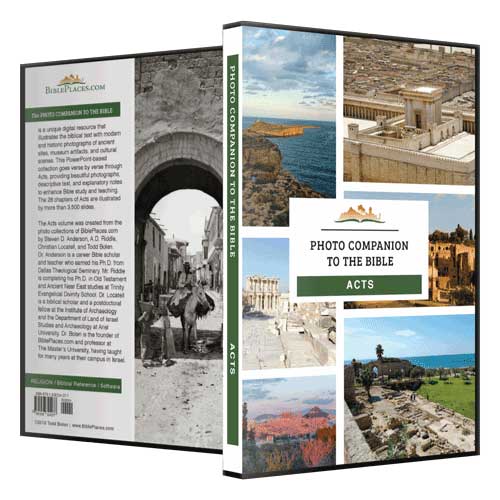
The new Photo Companion to theBible: Acts contains photos of all of the places where the shipwreck could have occurred.

Ferrell’s Favorite Foto # 16

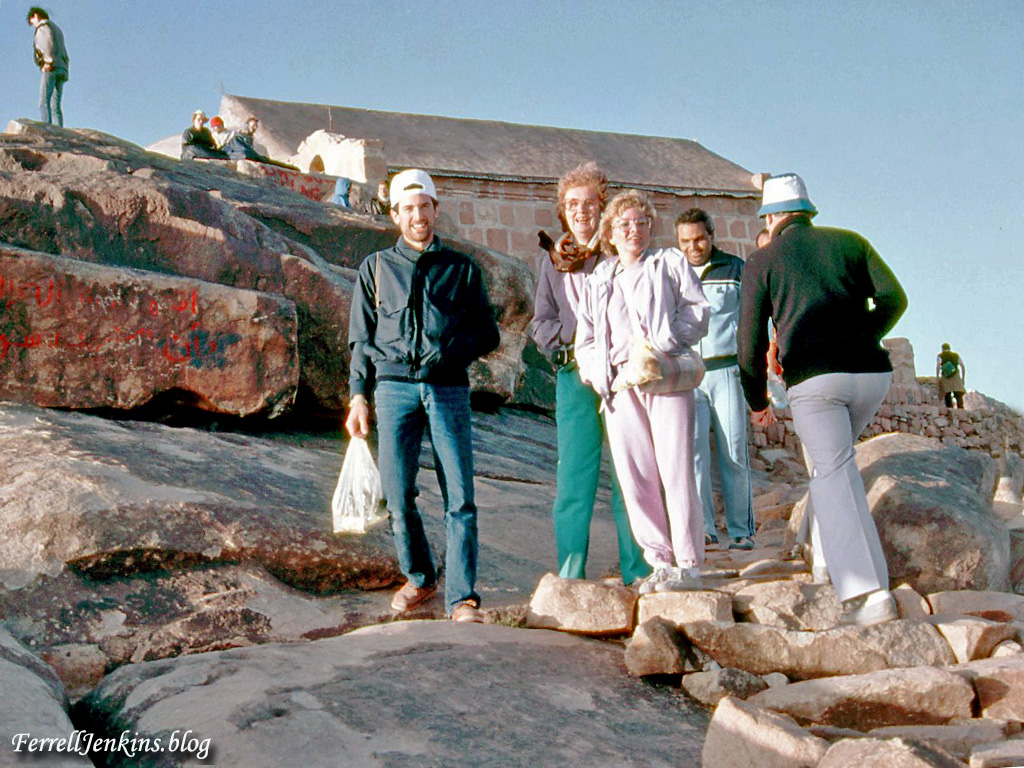
In April, 1986, arrangements were made for my travel group to leave Israel from Eilat and travel to Mount Sinai for an overnight stay. Opportunity was given for those who wished to climb the traditional mountain where Moses was given the Law (Exodus 20-24). Only four of the group chose to do so.

The peak known as Jebel Musa (Mount Moses) is thought by many to be the Mount Sinai of the Bible. Beginning at Saint Catherine’s monastery it takes about two hours and thirty minutes to climb to the top where the elevation is more than 7,500 feet. We began at 3:05 a.m. and made it to the top in time to see the sunrise. After thirty minutes of rest and meditation we made it back to the monastery in about two hours.

Tourmembers who climbed Mount Sinai with me in 1986. FerrellJenkins.blog.

Three tour members who climbed the traditional Mount Sinai with me April 10, 1986. Tour members left to right: Mark Dunagan (Oregon), Lillian Price (Indiana), Gloria Spurgeon [Land] (Texas). Samir Kamel (in gray behind Gloria) is the Egyptian escort for the Nawas Travel Company who came from Cairo to meet us, climbed the mountain with us.He was later appointed the general manager of the Cairo office. Slide photo by Ferrell Jenkins.

The chapel in the background is identified here.

On the summit is an Orthodox Chapel of the Holy Trinity, built in 1934 on ruins of a 4th-century Byzantine church. It is said to have been built over the rock from which God took the tablets of stone and its interior is decorated with frescoes of the life of Moses.

For more information about Mount Sinai see our Index: Route of the Exodus and the Location of Mount Sinai here.

Great Resource for Teaching Acts

The new Photo Companion to the Bible, produced by Todd Bolen and BiblePlaces.com, is a wonderful resource for those who teach the Bible. The first set in this series of material was on the book of Ruth. Next came the Gospels. And now we have the book of Acts.

There are more than 4000 images in this set on Acts. The images for each of the 28 chapters are included in a PowerPoint presentation with annotations explaining the image selection and background.

I could say much more about the value of this collection of material, but I suggest you go immediately to the detailed information here. You will see samples of the work and ordering information. For a limited time you can get this material at a special sale price.

Videos, Surveys, and Favorite Fotos

Some of my friends are producing exciting videos to help Christians and other students of the Bible World to a fuller and more rewarding understanding of the region.

Appian Media

Barry Britnell and Jeremy Dehut, along with the crew at Appian Media are producing some nice videos in Israel. These videos can be helpful to the person preparing for a trip, or for those who will never be able to go but want a deeper understanding of the Bible.

Their first series was Following the Messiah, and now they are releasing Searching for a King (the period of the United Kingdom). I suggest you take a look at the new release here.

Wayne Stiles’ Survey

If you have traveled with me over the past 50+ years (I am not the only one still alive from the first tour!), you might like to help Wayne Stiles with his survey on how best to prepare and make the most of your tour.

My friend, Wayne Stiles, has been helping people learn about the Bible World for a long time. He has a helpful blog – Wayne Stiles: Connecting the Bible and its Lands to Life. Several years back Wayne wrote a doctoral dissertation on the benefits of understanding and experiencing the historical geography of Israel. I found it most helpful in my own travels and the preparation of my travelers. He has also written some helpful books. On several occasions he has helped me with information I needed. Wayne is now making personal trips to Israel and producing videos year round. You can learn about his material at Walking the Bible Lands.

Wayne is putting together a video series to help pilgrims better prepare for a Holy Land tour. If you have been to Israel before, will you give your advice by answering a few quick questions? Thanks in advance for your help! Click here: http://bit.ly/israel-tour-questions.

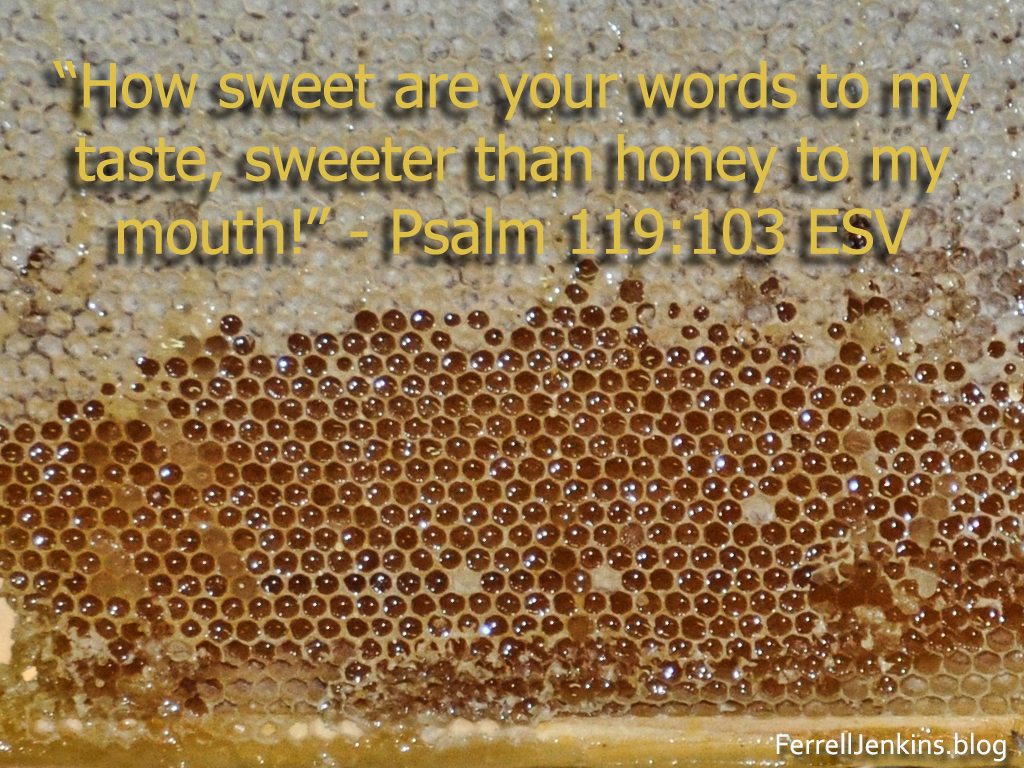
And, if you promise to look at both of these sites (Appian Media and Walking the Bible Lands) I will give you one of my favorite photographs.

A breakfast honey comb at the Ron Beach Hotel on the shore of the Sea of Galilee, Tiberias, Israel. FerrellJenkins.blog..

A breakfast honey comb at the Ron Beach Hotel on the west shore of the Sea of Galilee, Tiberias, Israel. Photo by Ferrell Jenkins.

Ferrell’s Favorite Fotos # 8

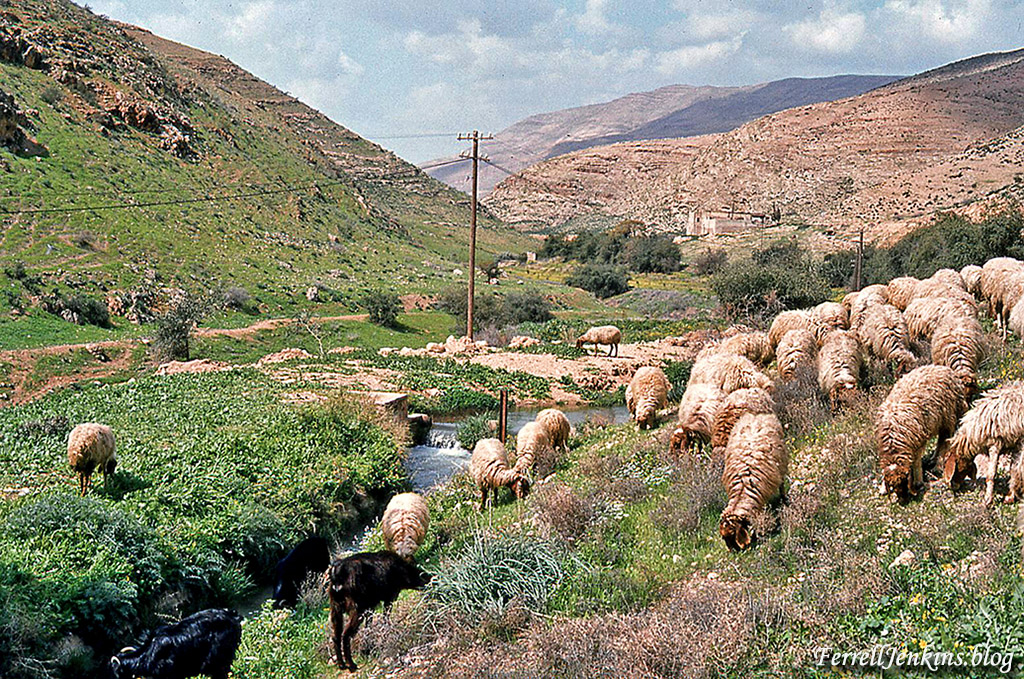
Traveling in the Wadi Farah (or Faria) in 1982 with the late Jimmy Cravens of Tampa, Florida, we came upon a shepherd moving his sheep from one side of the road to the other. This scene calls to mind Psalm 23.

The LORD is my shepherd; I shall not want. He makes me lie down in green pastures. He leads me beside still waters. (23:1-2 ESV)

Sheep beside still water in Wadi Farah. FerrellJenkins.blog.

Sheep in green pastures, beside still water, in Wadi Farah. Scanned from slide made by Ferrell Jenkins in March, 1982.

This scene is located in a region often called the West Bank, part of the Palestinian Authority. The Wadi Farah leads from near Tirzah to the Jordan Valley.

Biblical characters such as Abraham and Jacob likely used this route to travel from the Jordan Valley to Shechem.

Ferrell’s Favorite Fotos #5

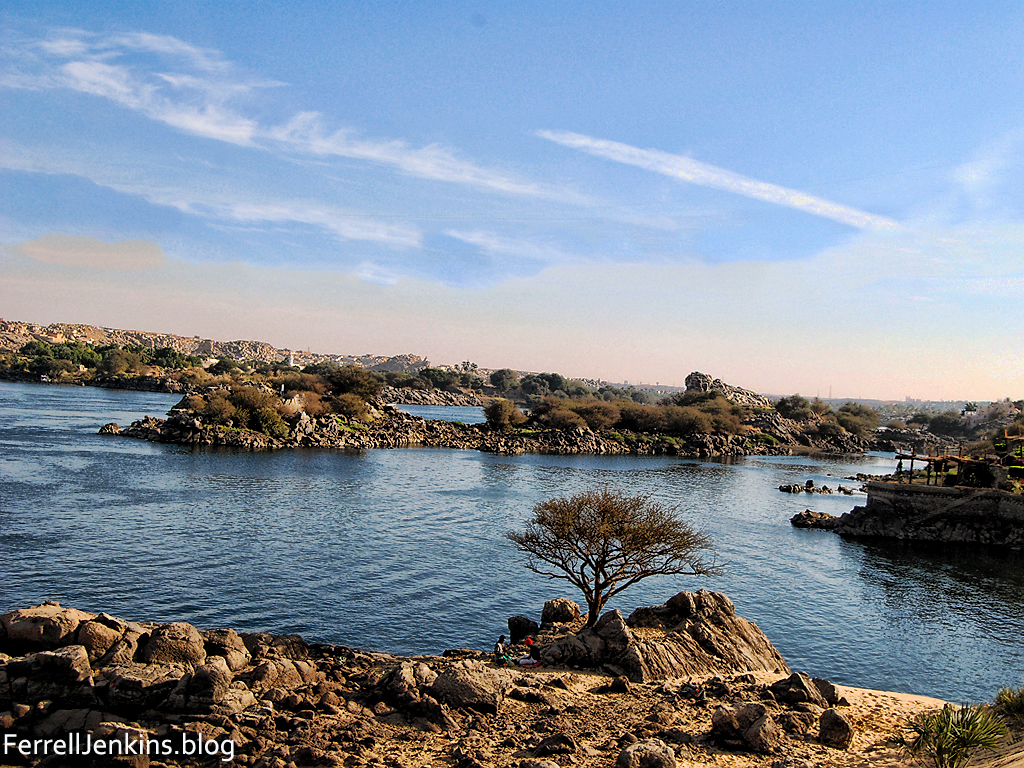
The first cataract of the Nile River is at Aswan, Egypt. Aswan is identified with Syene in Ezekiel 29:10, and with the Sinim of Isaiah 49:12. This cataract provided a natural boundary between Egypt to the north and Cush to the south. It was impossible for large boats to traverse this region of the Nile.

Nile River at Aswan, Egypt. Photo by Ferrell Jenkins.

The first cataract of the Nile River at Aswan, Egypt. Photo by Ferrell Jenkins.

For more information read here.