Category Archives: Archaeology

Researchers claim to have found Biblical Ziklag

It’s that time of the year. Archaeological digs are closing down for the season and the directors of the digs want you to know what they have uncovered. You probably have not heard of Khirbet a-Ra‘i or Tel a-Ra‘i but you know that the Bible reports that David was given the site of Ziklag by Achish, King of Gath.

So that day Achish gave him Ziklag. Therefore Ziklag has belonged to the kings of Judah to this day. And the number of the days that David lived in the country of the Philistines was a year and four months. (1 Samuel 27:6-7 ESV)

Here is the complete Israel Antiquities Authority news release from earlier today with a few of the nice photos provided by the IAA.

—  “ —

Researchers from the Hebrew University, the Israel Antiquities Authority and Macquarie University in Sydney: “We Have Found Biblical Ziklag”

Aerial photo of Tel Arai. Photo by Emil Aljem, Israel Antiquities Authority.

The site, from the time of King David, was discovered near Kiryat Gat *
According to the Biblical narrative, David found refuge in Ziklag while fleeing
from King Saul. From there he went to Hebron to be anointed as King *
Dozens of complete pottery vessels were found at the site, 3,000 years old
How was Biblical Ziklag found? Researchers from the Hebrew University in Jerusalem, the Israel Antiquities Authority and Macquarie University in Sydney, Australia, believe they have discovered the Philistine town near Kiryat Gat, immortalized in the Biblical narrative. Ziklag is mentioned multiple times in the Bible in relation to David (in 1 Samuel and 2 Samuel). According to the Biblical narrative, Achish, King of Gat, allowed David to find refuge in Ziklag while fleeing King Saul and from there David also departed to be anointed King in Hebron. According to scripture, Ziklag was also the scene of a dramatic event, in which the Amalekites, desert nomads, raided and burned the town taking women and children captive.

The excavation, which began in 2015 at the site of Khirbet a-Ra‘i in the Judaean foothills – between Kiryat Gat and Lachish, has proceeded in cooperation with Prof. Yosef Garfinkel, Head of the Institute of Archaeology at the Hebrew University in Jerusalem, Saar Ganor of the Israel Antiquities Authority and Dr. Kyle Keimer and Dr. Gil Davis of Macquarie University in Sydney, Australia. The excavation was funded by Joey Silver of Jerusalem, Aron Levy of New Jersey, and the Roth Family and Isaac Wakil both of Sydney. The excavation has been ongoing for seven seasons with large areas being exposed – approximately 1,000 sq.m., leading to this new identification for Ziklag.

Walls from Tel a-Rai. Photo Israel Antiquities Authority.

Massive walls from Tel a-Rai. Photo: Israel Antiquities Authority.

The name Ziklag is unusual in the lexicon of names in the Land of Israel, since it is not local Canaanite-Semitic. It is a Philistine name, given to the town by an alien population of immigrants from the Aegean. Twelve different suggestions to identify Ziklag have been put forward, such as Tel Halif near Kibbutz Lahav, Tel Sera in the Western Negev, Tel Sheva, and others. However, according to the researchers, none of these sites produced continuous settlement which included both a Philistine settlement and a settlement from the era of King David. At Khirbet a-Ra‘i, however, features from both these populations have been found.

Evidence of a settlement from the Philistine era has been found there, from the 12-11th centuries BC. Spacious, massive stone structures have been uncovered
containing finds typical of the Philistine civilization. Additional finds are foundation deposits, including bowls and an oil lamp – offerings laid beneath the
floors of the buildings out of a belief that these would bring good fortune in the
construction. Stone and metal tools were also found. Similar finds from this era were discovered in the past in excavations in Ashdod, Ashkelon, Ekron and Gath–the cities of the Lords of the Philistines.

Showing Tel a-Rai excavation in Israel.

A young lady cleans around one of the jars found in the excavation at Tel a-Rai this year. Photo courtesy of Israel Antiquities Authority.

Above the remains of the Philistine settlement was a rural settlement from the time of King David, from the early 10th century BC. This settlement came to an end in an intense fire that destroyed the buildings. Nearly one hundred complete pottery vessels were found in the various rooms. These vessels are identical to those found in the contemporary fortified Judaean city of Khirbet Qeiyafa—identified as biblical Sha‘arayim—in the Judaean foothills. Carbon 14 tests date the site at Khirbet a-Ra‘i to the time of King David.

The great range of complete vessels is testimony to the interesting everyday life during the reign of King David. Large quantities of storage jars were found during the excavation- medium and large-which were used for storing oil and wine. Jugs and bowls were also found decorated in the style known as “red slipped and hand burnished,” typical to the period of King David.

Following a regional archaeological study in the Judaean foothills managed by Professors Garfinkel and Ganor, a picture of the region’s settlement in the early Monarchic era is emerging: the two sites – Ziklag and Sha‘arayim-are situated on the western frontier of the kingdom. They are both perched atop prominent hills, overlooking main routes passing between the Land of the Philistines and Judea: Khirbet Qeiyafa in the Elah Valley sits opposite Philistine Gath, and Khirbet a-Ra‘i, sits opposite Ashkelon. This geographic description is echoed in King David’s Lament, in which he mourns the death of King Saul and Jonathan in their battle against the Philistines: “Tell it not in Gath, publish it not in the streets of Ashkelon.”

—  ” —

Various newspapers, especially those in Israel, have covered this notice today. Certainly there will be much discussion among scholars, some of whom will suggest other possible locations, but all within a reasonable distance, for Ziklag. Perhaps I will be able to add some additional information in the next few days.

Luke Chandler and other friends participated in the dig at Tel a-Rai during the past few weeks.

HT: Joseph Lauer and others.

Sealing a document in Bible times

This text in the book of the prophet Jeremiah describes the importance of documents and seals in Judah in the sixth century B.C.

Jeremiah said, “The word of the LORD came to me:  Behold, Hanamel the son of Shallum your uncle will come to you and say, ‘Buy my field that is at Anathoth, for the right of redemption by purchase is yours.’ Then Hanamel my cousin came to me in the court of the guard, in accordance with the word of the LORD, and said to me, ‘Buy my field that is at Anathoth in the land of Benjamin, for the right of possession and redemption is yours; buy it for yourself.’ Then I knew that this was the word of the LORD. “And I bought the field at Anathoth from Hanamel my cousin, and weighed out the money to him, seventeen shekels of silver. I signed the deed, sealed it, got witnesses, and weighed the money on scales. Then I took the sealed deed of purchase, containing the terms and conditions and the open copy. ( Jeremiah 32:6-11 ESV. Continue reading in Jeremiah for the full story.)

Important documents were rolled and then tied with string. A small amount of damp clay was placed on the string and the person would impress his seal into the clay. When the impression dried it made a permanent copy of the seal. This was called a bulla (plural is bullae). Both seals and bulla of various biblical characters have been discovered in Israel.

The photo below  is of a display at the Hecht Museum at the University of Haifa.

Sealed document at Hecht Museum. ferrelljenkins.blog.

Seal document and ancient bullae display at Hecht Museum, University of Haifa. Photo by Ferrell Jenkins.

You can find more information about seals and sealing by putting the word seal in the Search Box. Click on the photo for a larger image suitable for use in teaching.

Olive installation at Neot Kedumim

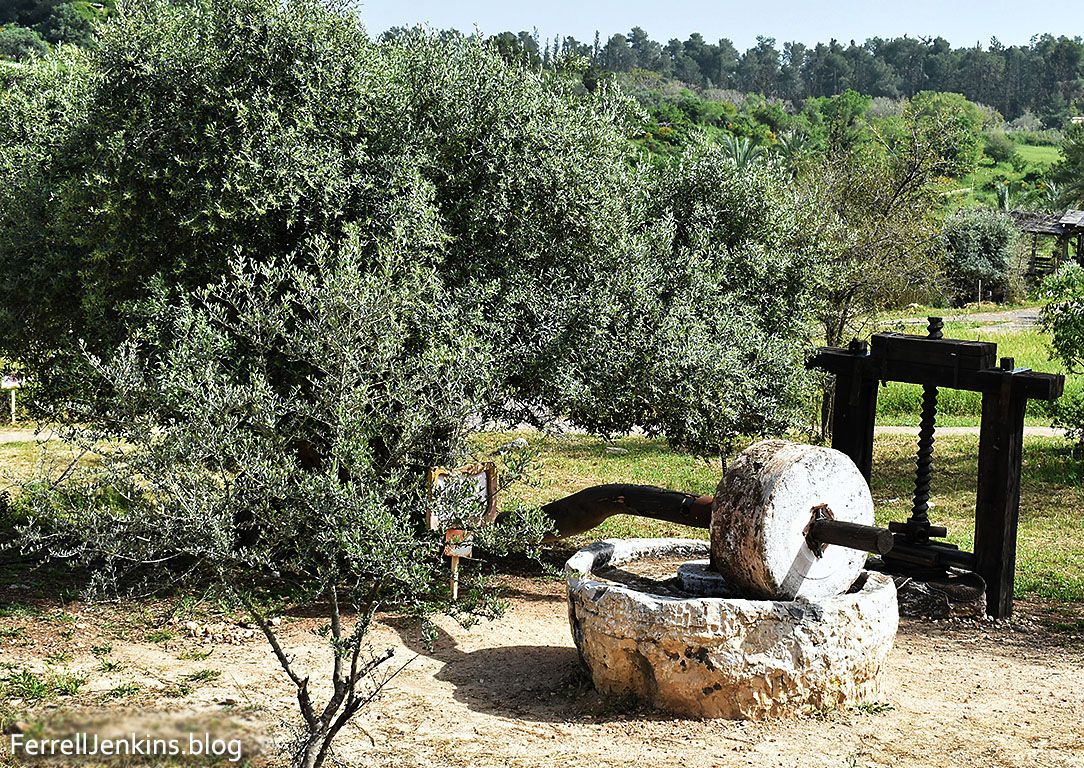
For millennia olives have been so important in Israel and the West Bank that we see ancient crushing installations at various places we visit. Some of the presses are in small museums. I was impressed with the installation in the park at Neot Kedumim. At a distance it had an idyllic look.

Olive tree, crushing stone, and press at Neot Kedumim. Photo: ferrellJenkins.blog.

Olive tree, crushing stone, and press at Neot Kedumim. Photo by Ferrell Jenkins.

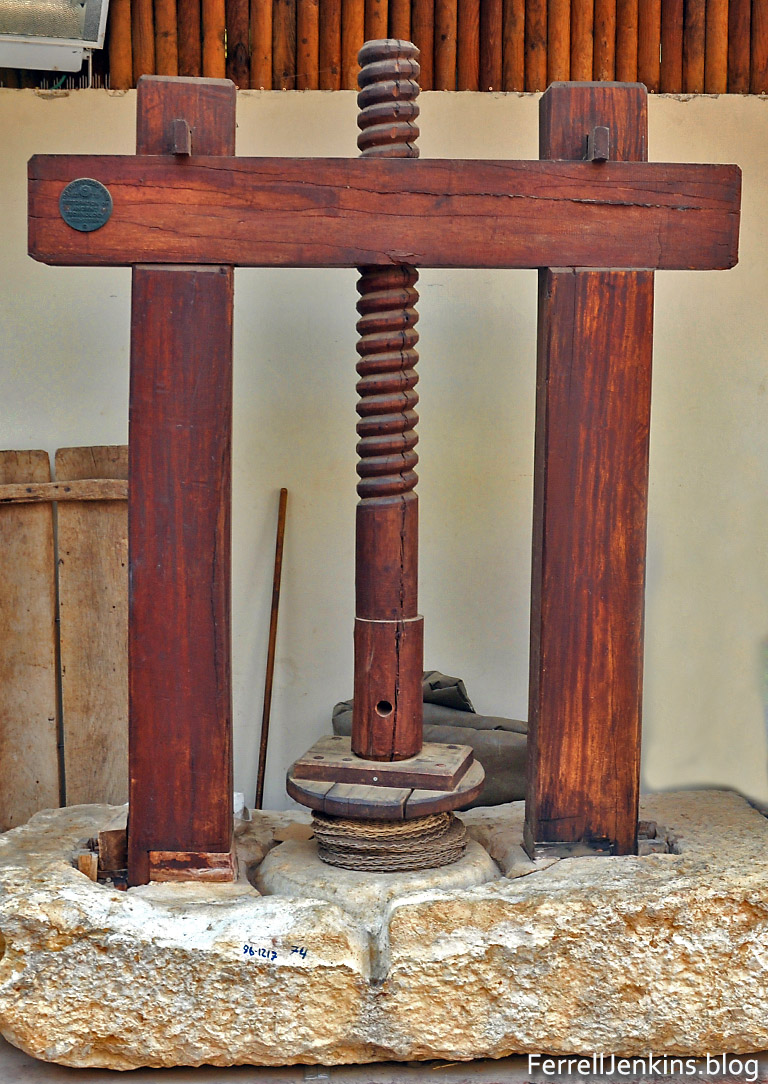
It is possible that some families had their own setup for producing olive oil. First, there was an olive tree, certainly large enough to produce a lot of olives, then a crushing stone that could be rolled over the olives by a person or pulled by an animal. It was also essential that they have a press. In this case the press was of the screw type. The crushed olives were placed in bags and then pressed.

Lucas P. Grimsley explains the importance of various agricultural products, including olive oil, produced in Palestine.

By NT times, Palestine was a part of the Greco-Roman world, and it played an important role in Rome’s trade network in the east. Ancient records indicate that Palestine primarily imported luxury goods (wine from Italy, beer from Media, baskets from Egypt, sandals from Laodicea), in addition to natural resources such as wood and metal. Exports continued to be primarily agricultural (olive oil, wheat, honey, figs). Despite the difference in goods, the trade balance was generally in favor of Palestine.
Specific references to trade are limited in the NT, but they attest to the fact that trade was a part of  everyday life. (Dictionary of Daily Life in Biblical and Post-Biblical Antiquity, Vol. IV: 299-300).

Below is a photo of the same type olive press. It is one of several types of presses displayed at the Ein Dor Museum of Archaeology.

Olive Press at Ein Dor Archaeological Museum. Photo: ferrelljenkins.blog.

An olive press displayed at Ein Dor Museum of Archaeology. Photo by Ferrell Jenkins.

While browsing the recent Dictionary of Daily Life in Biblical and Post-Biblical Antiquity I came across this survey of the olive and its importance in Bible times.

The olive is one of the first trees mentioned in the Bible ( Gen 8: 1 1 ), in the passage in which the dove returns to Noah with an olive branch. The olive (Heb. zayit; Olea europaea) is the best-known and one of the most important trees of the Mediterranean Basin and Middle East. Olives were highly valued, and the harvesting and pressing out of olives was a significant part of the life of rural families. The pulp contains about 40 percent oil, which was used for lamps, cooking, and medicinal purposes, as well as
anointing in religious ceremonies. The psalmist proclaims that he is like an olive tree because he trusts in God’s unfailing love (Ps 52:8). (GCT, Dictionary of Daily Life in Biblical and Post-Biblical Antiquity, Vol. 4, p. 309.)

Over the years we have posted several times about olives and the olive trees. Check our index page on the subject here.

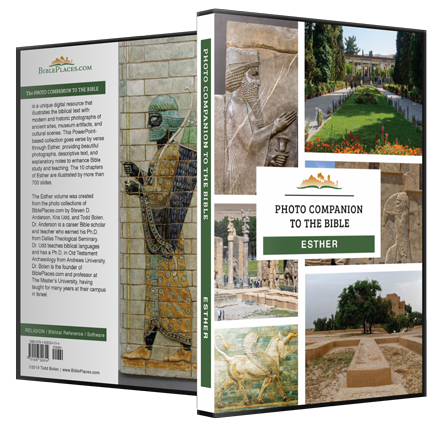
Need Illustrations for teaching Daniel and Esther?

BiblePlaces.com has just published their 9th and 10th volumes in the new Photo Companion to the Bible. I have recommended the earlier volumes, but in some ways the two current volumes on Daniel and Esther may be the best. Each of the books lend themselves to the use of historical and cultural illustrations. Each of the books have a historical setting relating to Persia. The new photos made by Todd Bolen in modern Iran (ancient Persia) within the past year enhance these volumes. And there are numerous illustrations relating to the Babylonian, Greecian, and Roman empires too.

If you have followed this blog very long you already know that I highly recommend the material published by BiblePlaces.com. I suggest you go here for detailed info on the Daniel volume. That volume of more than 1,000 images is PowerPoint ready and is on sale today for $39, a saving of $30. Scroll to the bottom of the page and take a look at sample photos from several volumes.

Photo Companion to the Bible: Esther

Now to the volume on Esther. In teaching this book you will now have excellent photos made in Persia within the year. This volume of more than 700 images is also on sale today for $39. To see more information and see sample photos, along with ordering info, go here.

Each volume in the Photo Companion to the Bible includes a DVD with all of the images and the PowerPoint presentations. This makes it easy to select the illustrations you wish to use in your own presentation. You are also allowed to download the images to your personal computer.

All of the materials published by BiblePlaces.com may be purchased with secure checkout. Get these volumes before the price goes up. Satisfaction is guaranteed.

In the title I ask, do you “Need Illustrations for teaching Daniel and Esther?” If you answered “no” you probably should not be teaching! I hear many lessons that could be improved through the use of appropriate illustrations from the Bible lands. Sometimes I have wondered if the reason some do not use appropriate historical or cultural illustrations is because to do so require much study to use them well. Do the study, use the images, and more folks will be letting you know they enjoyed and appreciated the lesson. End of sermon.

Ferrell’s Favorite Fotos #19

Riblah served as a base of operation for the Egyptian Pharaoh Necho and the Babylonian King Nebuchadnezzar. The city is located on a broad plain about 50 miles south of Hamath (modern Hama in Syria), on the main road between Egypt and Mesopotamia. The Orontes River flows past the site on the west side. On a modern map you will locate Riblah in Syria immediately north of the border with Lebanon.

There is little more than a “country store” at the village today, but the name Riblah is preserved as Ribleh, Syria.

  • Pharaoh Necho imprisoned Jehoahaz, king of Judah, at Riblah. He later took him to Egypt where he died. The date was about 609 B.C. (2 Kings 23:31-34).
  • Zedekiah, puppet king of Judah, tried to escape capture by the Babylonians. He fled Jerusalem but was captured on the plains of Jericho and brought to Riblah. There Nebuchadnezzar passed sentence on him. His sons were slaughtered in his sight and he was bound with brass fetters and taken to Babylon. The date was 586 B.C. (2 Kings 25:5-7; see also Jeremiah 39:5-6; 52:9-10).
  • The officials of Zedekiah were taken to Riblah where they were put to death (2 Kings 25:19-21; see also Jeremiah 52:26-27).

In 2002 David McClister, a colleague at Florida College, and I spent several days visiting sites in Syria. Riblah was the most difficult to locate. Most folks, after seeing the site, would probably say, “What’s the big deal?”  Even though Riblah is mentioned only these few times in the Old Testament, it’s location makes it important in all movement between the south (Egypt and Israel) and Mesopotamia.

The ancient mount of Riblah, once headquarters of Babyonian king Nebuchadnezzar. FerrellJenkins.blog.

The ancient mount of Riblah, once headquarters of Babyonian king Nebuchadnezzar. Slide scan. Photo by Ferrell Jenkins in 2002.

This post is a repeat, but I thought the favorite photo needed more explanation than most of the images I am using.

Ferrell’s Favorite Foto # 15

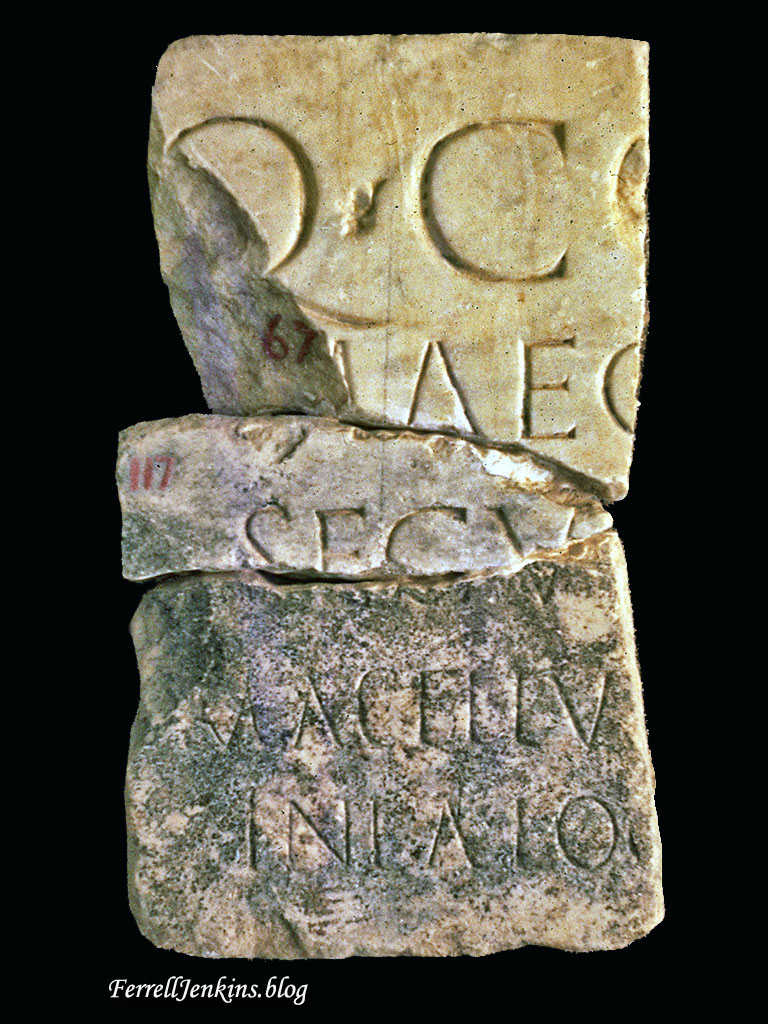
This may be the least attractive photo I have published in this series. Why post it, you may think? It is a picture of Inscription No. 124 found at Corinth in 1898. Lacking one letter we have a reference to a MACELLV [macellum]. I knew of this inscription from my earliest tours and always showed it to my group when we visited the museum at ancient Corinth. But one year I went to the place where the inscription had been displayed and it was not there. The metal hooks which held it to the wall were still there, but not the inscription. Afterwards for several tours I asked my guide to inquire of the inscription which she also recalled seeing. At first we were told they did not know where the artifact was. On my visit in 2012 I was told that the inscription was in storage and they could not show it to me. That is the last I have heard of it. Perhaps by now it is again on display.

Macellum Inscription - Corinth, No. 124. Photo: FerrellJenkins.blog..

Macellum Inscription – Corinth, No. 124. Photo by Ferrell Jenkins in 1971.

Perhaps you wonder if I am losing my mind. In fact, Henry J. Cadbury wrote about “The Macellum of Corinth” in the Journal of Biblical Literature in 1934. Putting aside 2 Timothy 4:13, which uses the word membranas (parchment), as a genuine Pauline reference, Cadbury says there are only two Latin words in Paul: praetorium (Philippians 1:18) and macellum (1 Corinthians 10:25).

Eat whatever is sold in the meat market without raising any question on the ground of conscience. (1 Cor. 10:25 ESV).

We also have an inscription from Corinth mentioning the meat market built by the family of the Cornelli and another mentioning Lucius butcher. All of these inscriptions date to the Roman period. Paul was describing things that really existed during his stay at Corinth.

Not the most beautiful photo, but I am fond of it because I happened to be at Corinth at an opportune time to capture this inscription on film.

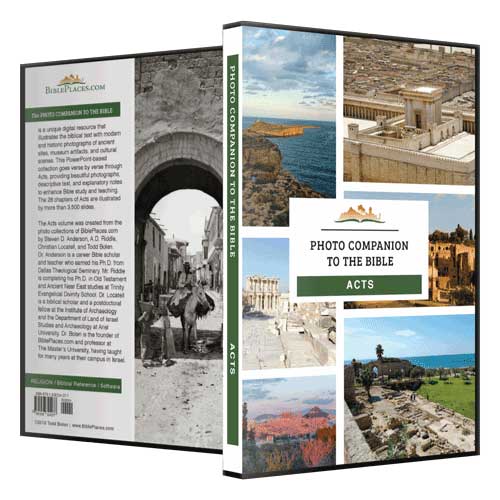
Great Resource for Teaching Acts

The new Photo Companion to the Bible, produced by Todd Bolen and BiblePlaces.com, is a wonderful resource for those who teach the Bible. The first set in this series of material was on the book of Ruth. Next came the Gospels. And now we have the book of Acts.

There are more than 4000 images in this set on Acts. The images for each of the 28 chapters are included in a PowerPoint presentation with annotations explaining the image selection and background.

I could say much more about the value of this collection of material, but I suggest you go immediately to the detailed information here. You will see samples of the work and ordering information. For a limited time you can get this material at a special sale price.

Videos, Surveys, and Favorite Fotos

Some of my friends are producing exciting videos to help Christians and other students of the Bible World to a fuller and more rewarding understanding of the region.

Appian Media

Barry Britnell and Jeremy Dehut, along with the crew at Appian Media are producing some nice videos in Israel. These videos can be helpful to the person preparing for a trip, or for those who will never be able to go but want a deeper understanding of the Bible.

Their first series was Following the Messiah, and now they are releasing Searching for a King (the period of the United Kingdom). I suggest you take a look at the new release here.

Wayne Stiles’ Survey

If you have traveled with me over the past 50+ years (I am not the only one still alive from the first tour!), you might like to help Wayne Stiles with his survey on how best to prepare and make the most of your tour.

My friend, Wayne Stiles, has been helping people learn about the Bible World for a long time. He has a helpful blog – Wayne Stiles: Connecting the Bible and its Lands to Life. Several years back Wayne wrote a doctoral dissertation on the benefits of understanding and experiencing the historical geography of Israel. I found it most helpful in my own travels and the preparation of my travelers. He has also written some helpful books. On several occasions he has helped me with information I needed. Wayne is now making personal trips to Israel and producing videos year round. You can learn about his material at Walking the Bible Lands.

Wayne is putting together a video series to help pilgrims better prepare for a Holy Land tour. If you have been to Israel before, will you give your advice by answering a few quick questions? Thanks in advance for your help! Click here: http://bit.ly/israel-tour-questions.

And, if you promise to look at both of these sites (Appian Media and Walking the Bible Lands) I will give you one of my favorite photographs.

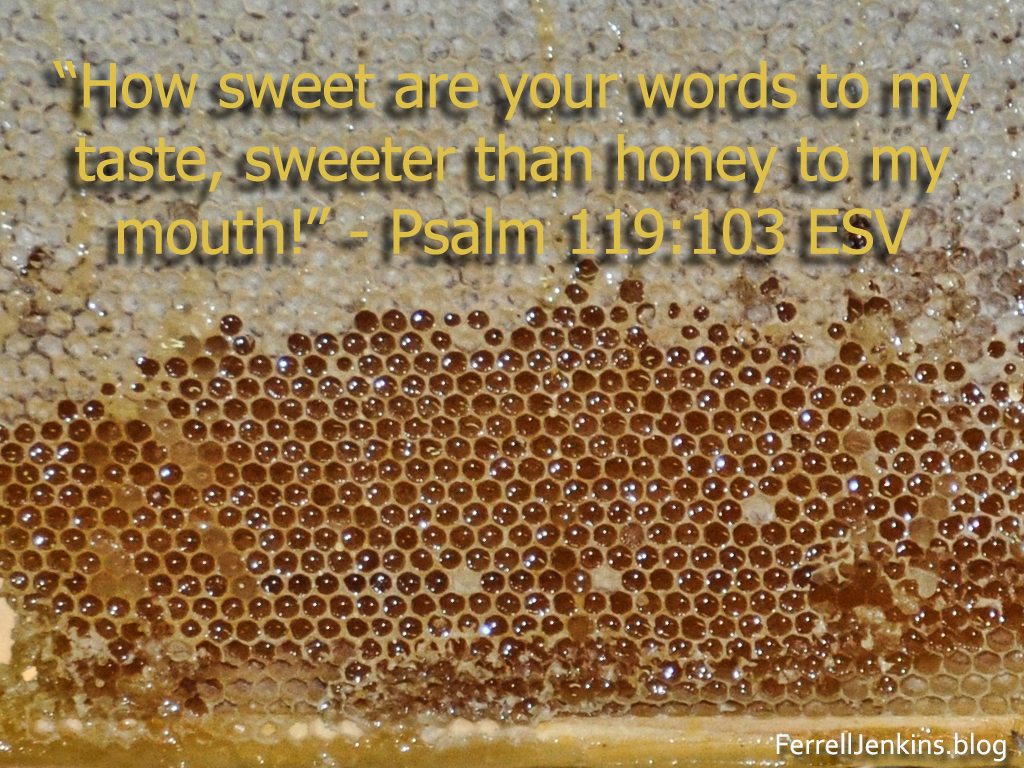
A breakfast honey comb at the Ron Beach Hotel on the shore of the Sea of Galilee, Tiberias, Israel. FerrellJenkins.blog..

A breakfast honey comb at the Ron Beach Hotel on the west shore of the Sea of Galilee, Tiberias, Israel. Photo by Ferrell Jenkins.

Ferrell’s Favorite Fotos # 9

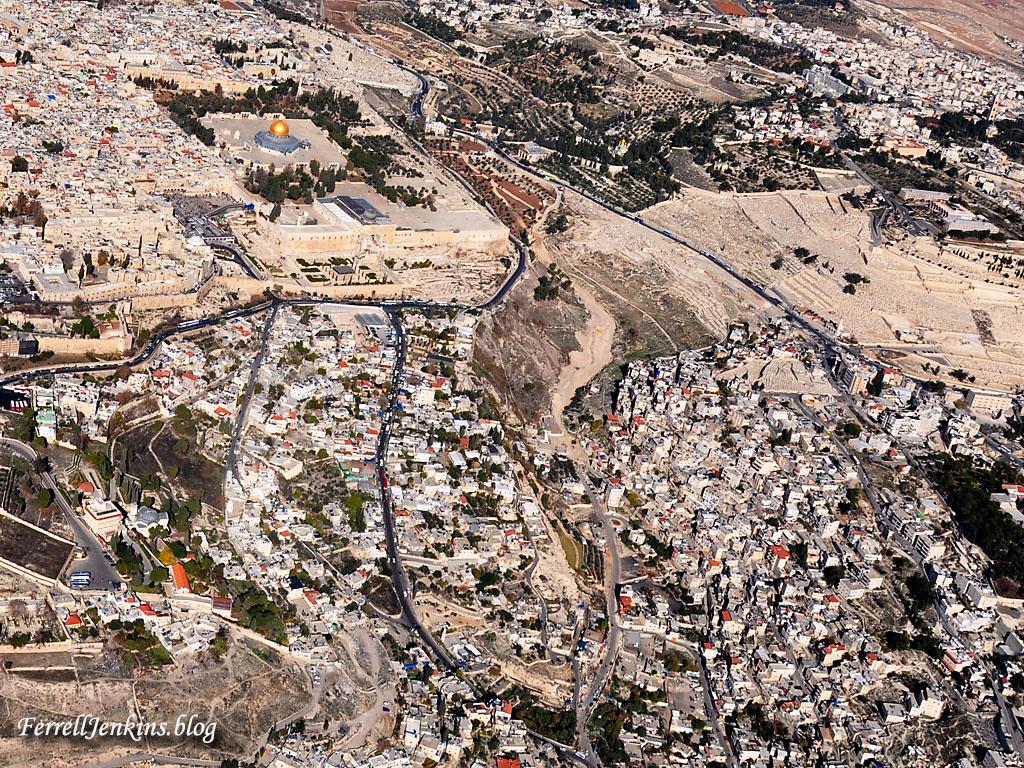
In December 2009 I took my first photographic flight over Jerusalem. With the photos I made I can find almost any of the significant historical buildings. I really liked the view I am showing today. In it you can see the Temple Mount, the site believed to be the Mount Moriah of the Bible, the location of the Temple of Solomon and the location of the Temple built by Herod the Great. The area underwent a number of changes after the destruction of the temple by the Romans in A.D. 70

Since the late 7th century A.D. the site has been occupied by Moslem shrines, the Dome of the Rock and the Al Aksa Mosque.

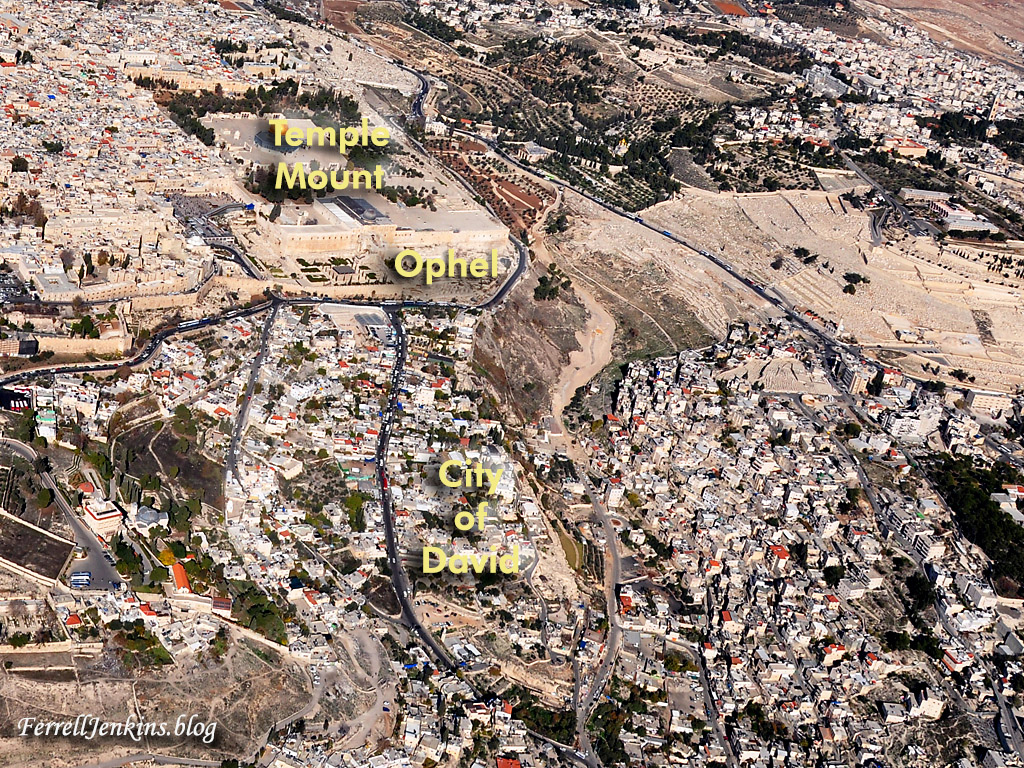
But this photo has more. Just above the middle of the photo is the Ophel which was originally built by King Jotham (2 Chronicles 27:3).  In the bottom half of the picture is the City of David. It is bounded on the right (East) by the Kidron Valley, and on the left (West) by a road. It is shaped somewhat like a vase or bottle.

Aerial view of the Temple Mount, the Ophel, and the City of David. Photo: FerrellJenkins.blog.

Aerial view of the Temple Mount, the Ophel, and the City of David. Photo by Ferrell Jenkins.

To make this clear I am including the same photo with the areas I mentioned identified. The Mount of Olives is in the upper right hand corner of the photo.

Aerial photo of the Temple Mount, the Ophel, and the City of David with identification. Photo: FerrellJenkins.blog.

Aerial photo of the Temple Mount, the Ophel, and the City of David with identification. Photo by Ferrell Jenkins.

It was an exciting day when I captured all of that in the same photo. You may be able to use it in your study and teaching. For more info see here.

New Resource on Persia from BiblePlaces.com

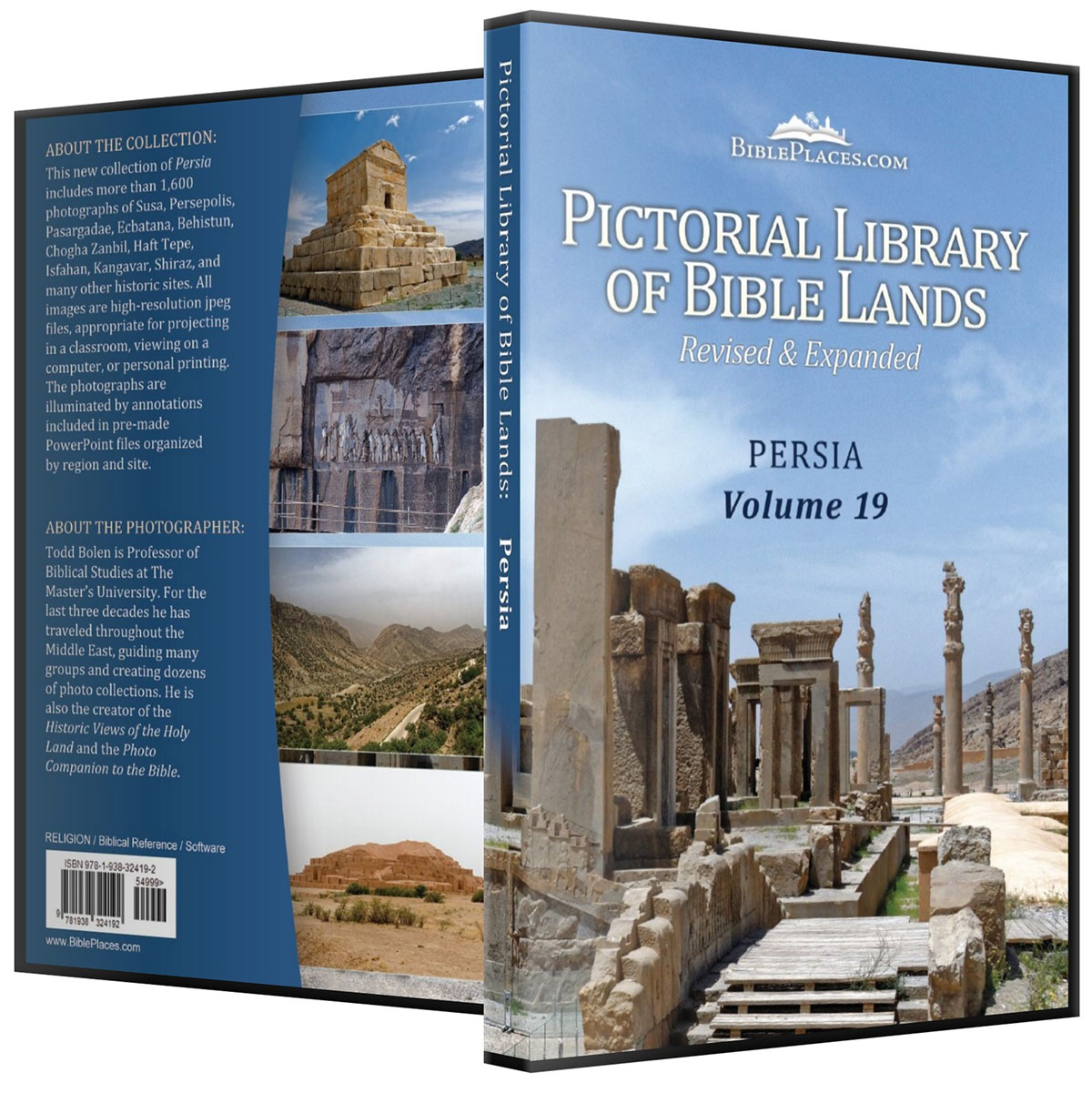
Persia is the only major country in the Bible Lands that I have not been able to visit. I was delighted when I learned that Todd Bolen, of BiblePlaces.com, had made such a trip.

In his usual thorough way, Bolen has included all the sites one might need in teaching about Esther, Daniel, Ezra, Nehemiah, Cyrus, Darius, Xerxes, Artaxerxes, the return from Exile, and more!

There are 1600 high-resolution images of historical sites and scenery in modern Iran.

BiblePlaces.com

Persia – Volume 19 – in the Pictorial Library of Bible Lands.

BiblePlaces.com is offering this Volume 19 of the Pictorial Library of Bible Lands for the introductory price of $25.00. You will have immediate download and also receive the DVD. In addition to ordering a copy for yourself, this is a wonderful gift to consider for some minister or Bible teacher. Even if they already have the Pictorial Library of Bible Lands, this is a new volume.

Time is running out on this introductory price of $25.00. Go here for secure ordering info.

I suggest you subscribe to the BiblePlaces Newsletter. Here is a link to the most recent issue which also includes more of the Persia photos. At the bottom of the page you will learn how to subscribe.