Category Archives: Archaeology

The Antikythera Shipwreck and “Danger at sea”

The Antikythera Shipwreck is a special exhibition at the Athens (Greece) National Museum which is scheduled to run from April 2012 to April 2013.

The shipwreck off the eastern coast of Antikythera is dated to 60-50 BC, a period during which maritime trade and transportation of works of Greek art from the Eastern Mediterranean to Italy flourished. Its cargo dates from the 4th to the 1st century BC. The ship was a freighter of about 300 tons capacity and was sailings towards Italy.

We had visited Thera (aka Santorini) during our Aegean cruise. Antikythera (“opposite Kythera”) is a Greek island between Crete and the Peloponnese (where Corinth is located).

The statue below is made of Parian marble. Scholars in the field suggest that this is possibly Achilles. Being on the bottom of the Aegean Sea for centuries shows its effects on the statue.

Possibly Achilles. The Antikythera Shipwreck. Athens National Museum. Photo by Ferrell Jenkins.

Possibly Achilles in Parian Marble. The Antikythera Shipwreck. Athens National Museum. Photo by Ferrell Jenkins.

Numerous bronze pieces are displayed. The bust below is part of a portrait statue known as “The Antikythera Philosopher.” The head, hands, feet, and pieces of the himation were recovered and are displayed. This piece of art is said to date to about 230 B.C.

The Antikythera Philosopher. Athens National Museum. Photo by Ferrell Jenkins.

The Antikythera Philosopher. Athens National Museum. Photo by Ferrell Jenkins.

We typically think of ships from the Roman period, and earlier, staying near the shore. This was certainly true of many of the sea journeys of the Apostle Paul (Acts 20:5, 13-16 27:5-7).

Greek archaeologists announce here the discovery of two Roman-era shipwrecks in water nearly a mile deep. Sailing to Italy required leaving the safety of the nearby shore for deep waters. Such was true of Paul’s journey to Rome after leaving Crete (Acts 27).

Paul spoke of the dangers at sea in his second letter to the Corinthians (11:24-29) about A.D. 55.

  • Three times I was shipwrecked.
  • A night and a day I was adrift at sea.
  • He mentioned “Danger at sea.”

The Malta shipwreck is the only one recorded in Acts, and it occurred after the writing of 2 Corinthians. Hughes mentions at least nine voyages between Acts 9 and 18. Paul says three of these ended in shipwreck. Hughes says there were at least another nine voyages between the writing of 2 Corinthians and the Malta shipwreck (The Second Epistle to the Corinthians, NICNT, 410-411).

At least some of the ships used by Paul seem to have been grain ships (Acts 27:38), but there may have been other cargo on some of them.

If you visit Athens between now and April 2013, be sure to take some time for The Antikythera Shipwreck.
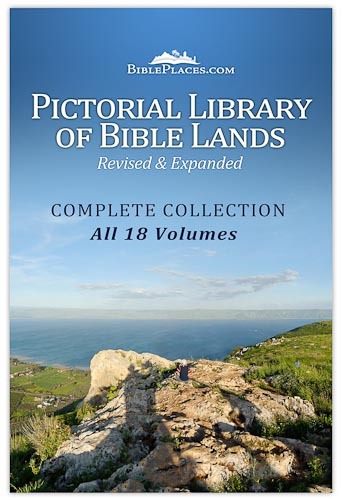
Major revision of the Pictorial Library of the Bible Lands

Todd Bolen announces the release of a total revision of the Pictorial Library of Bible Lands. This revised and expanded edition is the culmination of 9 years of work. The previous version contained 6000 photographs in 10 volumes. According to the announcement,

This new edition consists of 18 volumes with nearly 18,000 photographs, adding hundreds of new sites and re-visiting the old favorites.

Here are just a few features of the new edition of the Pictorial Library of Bible Lands.

  • Eight new volumes: (Lebanon, Eastern and Central Turkey, The Greek Islands, and more. New subjects include Cultural Images, Signs, and Trees, Plants, and Flowers.
  • New Photos: For example, more than 1000 new photos have been added to the Jerusalem volume.
  • New Photographers. In addition to the photos by Todd Bolen, the work of more than 40 photographers are included in this new set.
  • New Maps. New, original maps have been created to identify the sites.
  • New Indexes. Every photograph is indexed in a list of more than 400 pages.
  • You get the hi-res photos and the photos already in PowerPoint. You can use the presentation as it is or include individual slides in your own lesson.
  • And more…
Pictorial Library Complete Collection. BiblePlaces.Com.

Front cover of the new Pictorial Library Complete Collection.

For those who already own the previous collection, Bible Places is offering the new 18-volume set for the upgrade price of $179. The entire set for new purchasers is $389.

Would you prefer to make your own photos? Try buying a good digital SLR camera starting at about $1500, flying to Israel (not to mention Lebanon, Egypt, Turkey, Greece, the Greek Islands, Italy, et al.), renting a car for a few weeks, buying the gas. Oh, and don’t forget to hire a private plane for a few hours so you can get some good aerial photos. That might cost at least $389. πŸ™‚ And what if the lighting conditions were not right for a good photos the day you were at a site? What if you don’t have time to get your photos organized and write a description of each one? Need I go on to make a point? Did I mention that living and teaching in Israel for a decade helps?

Every church should have a set of this material for the teachers to use in their teaching. Over the years I have found that some short-sighted groups (churches) will not make such an expenditure. The other choice is to buy the set for yourself.

I hear several lessons a week, and every one of them could be improved by the use of photos from this wonderful collection.

Learn more about the new Pictorial Library of Bible Lands in the following places:

Charles Savelle has a good interview with Todd Bolen at the BibleX blog here.

I have profited much from the work of Todd Bolen and am delighted to count him as a friend and to recommend this collection of photographs to every teacher of the Bible.

Follow the BiblePlaces.com Blog here.

The looting of Sardis

Finally, Greece and Turkey can agree on something. They wish they had back the archaeological treasures that have been taken to other countries in the past. Greece wants back the Elgin marbles taken from Athens to the British Museum. Turkey wants back the treasures taken from Sardis in September 1922, the days of unrest during the fall of the Ottoman Empire. According to the article by John Leonard in Athens News, the port city of Smyrna (modern Izmir) was burning when John Horton sent crates of antiquities to the United States.

Numerous Turkish artifacts, including some real big ones (in size and importance), are displayed in the British Museum, and in the Pergamum Museum in Berlin.

It is a fascinating story with two sides. Read Leonard’s article here.

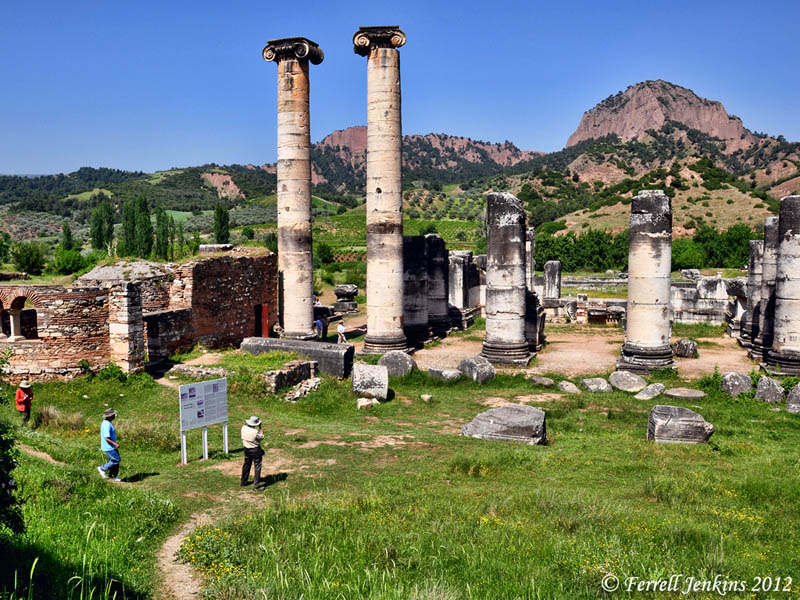
The photo below is one I made at Sardis earlier this month. The view is West over the ruins of the Temple of Artemis. One of the Ionic capitals is in the Metropolitan Museum in New York. The temple dates back to at least the 6th century B.C., but was destroyed in 499 B.C., and then underwent three rebuilding phases. The columns seen here date to the third rebuilding phase (ca. A.D. 150). Ruins of a restored Byzantine church from the fourth century A.D. may be seen in the left corner of the photo.

Sardis. Temple of Artemis. View West. Photo by Ferrell Jenkins.

Sardis. View west over the Temple of Artemis. Photo by Ferrell Jenkins.

Sardis is mentioned in the Bible only in Revelation (Apocalypse) 1:11 and 3:1-6.

saying, “Write what you see in a book and send it to the seven churches, to Ephesus and to Smyrna and to Pergamum and to Thyatira and to Sardis and to Philadelphia and to Laodicea.”Β  (Revelation 1:11 ESV)

Another post about efforts to retrieve artifacts from foreign museums may be read here.

HT: Jack Sasson

Additional Gezer boundary stone discovered

Eric Mitchell and Jason Zan report the discovery of a “previously undiscovered bilingual inscription” at Gezer, and the rediscovery ofΒ  an inscription lost for more than a century.

An archaeological survey led by Southwestern Baptist Theological Seminary of Fort Worth, Texas, discovered aΒ previously undiscovered bilingual inscription this week at the ancient site of Tel Gezer, Israel. Gezer, a biblical city, was situated on the border between the Philistine and Israelite territories guarding the route to Jerusalem. The city was given as a dowry to the daughter of Pharaoh, who married king Solomon. Gezer is well known in the later Maccabean period for its boundary stones with inscriptions in both Hebrew and Greek. In addition to the new inscription, the Southwestern Seminary survey team rediscovered a previously known inscription that had been lost to the archaeological community for more than a century.

The boundary inscriptions demonstrate the period of conflict between the Seleucids and Maccabees. They show that the city had agricultural land around it and that the Jewish occupants were concerned over keeping their fields according to Jewish law. These discoveries are significant since the boundary stones have been frequently sought, but with long time frames between new discoveries. According to the scholarship of Ronnie Reich, of the University of Haifa, there are 12 known and published Gezer boundary stones dating to the Maccabean period. These bilingual inscriptions in outcrops of limestone bedrock ring the ancient city of Gezer on the South, East and Northeast. Many of these are two line inscriptions reading β€œRegion of Gezer” on one line in Hebrew and β€œBelonging to Alkios” on the second line in Greek.

The article may be read in its entirety here.

According to the article, there are now 13 known boundary inscriptions from Gezer.

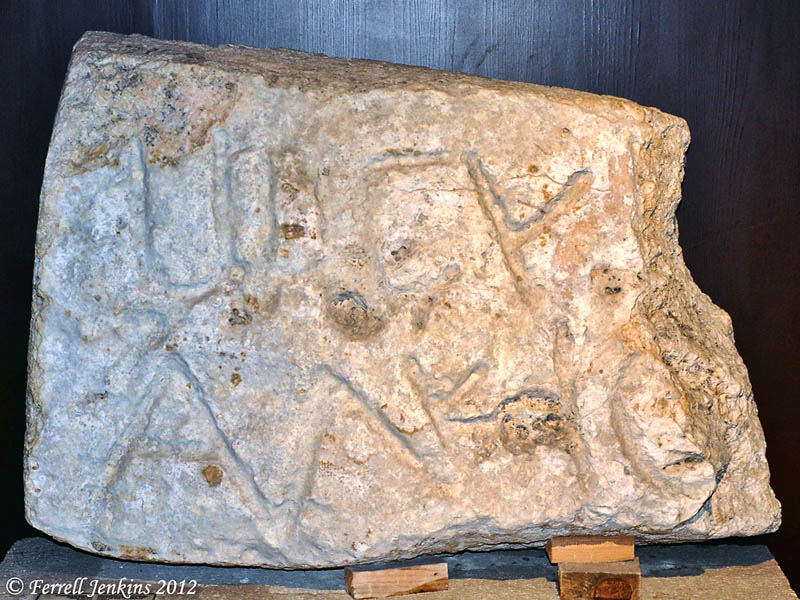
On my recent tour in the Steps of Paul and John, we visited the Istanbul Archaeological Museum where one of these boundary stones is displayed. It is turned so that the Greek letters “Alkio” are visible on the bottom. We would expect the missing letter to be the “s” or “u“. The line at the top, but upside down, is the Aramaic word for boundary or region, and the first letter of Gezer (GZR). Todd Bolen includes a photo here of one of the inscriptions still in place at Gezer.

Gezer Boundary Stone. Istanbul Archaeology Museum. Photo by Ferrell Jenkins.

Gezer Boundary Stone. Istanbul Archaeology Museum. Photo by Ferrell Jenkins.

Biblical references to Gezer include the following:

  • The king of Gezer fought against Joshua and the Israelites during the conquest (Joshua 10:33; 12:12).
  • Gezer was allotted to Ephraim (Joshua 16:3).
  • Gezer became a city of the Levites (Joshua 21:21). It was designated as a city of refuge (1 Chronicles 6:67).
  • Israel failed to drive out the Canaanites who lived in Gezer (Joshua 16:10; Judges 1:29).
  • By the time of David the Philistine seem to be living at Gezer (2 Samuel 5:25; 1 Chronicles 14:16; 20:4).
  • Pharaoh, king of Egypt, captured Gezer, burned it, and gave it as a dowry to his daughter, Solomon’s wife (1 Kings 9:16).
  • Solomon (re)built the cities of Hazor, Megiddo, and Gezer (1 Kings 9:15-17).

The following aerial photograph of Gezer was made in December, 2009.

Gezer Aerial View. Photo by Ferrell Jenkins.

HT: Bible Places Blog.

Eisenbrauns 2012 Mug announced

Scholarly book publisher Eisenbrauns announces the Eisenbrauns 2012 Mug.

Eisenbrauns 2012 Mug

Eisenbrauns 2012 Mug
A Hittite Proverb

Eisenbrauns, Forthcoming June 2012
14 ounces, Hittite and English
Ceramic
Your Price: $7.50
www.eisenbrauns.com/item/EISMUG2012

If you want to know what the Hittite proverb says, click on the link to Eisenbrauns.

Just something on the lighter side for you to enjoy while I make my way across the Atlantic.

From Cyprus to Pamphylia

Today we took a flight from Ercan Airport in the Turkish Republic of Cyprus to Turkey. Flying from Greece to Cyprus it was necessary to fly to Larnaca on the southern coast. Flights from Larnaca do not go to Turkey, and flights from Ercan do not go to Greece. Let’s put that aside for now.

The flight from Cyprus to Antalya (biblical Attalia) took about 45 minutes. I thought some about how Paul, Barnabas, and John Mark made their way from Paphos on Cyprus to Perga in Pamphylia (a few miles from the Antalya airport). The distance in a straight line is 185 miles. Here is Luke’s account of the journey.

Now Paul and his companions set sail from Paphos and came to Perga in Pamphylia. And John left them and returned to Jerusalem,Β  but they went on from Perga and came to Antioch in Pisidia.Β  (Act 13:13-14a ESV)

There are impressive Hellenistic and Roman ruins at Perga. Most of the Roman structures date to the second century A.D. This is where John Mark turned back from the work (Acts 13:13-14; 15:37-39). The text indicates that Perga was only a beginning point for work further north. On his return from the first journey, Paul spent some time preaching here (Acts 14:25).

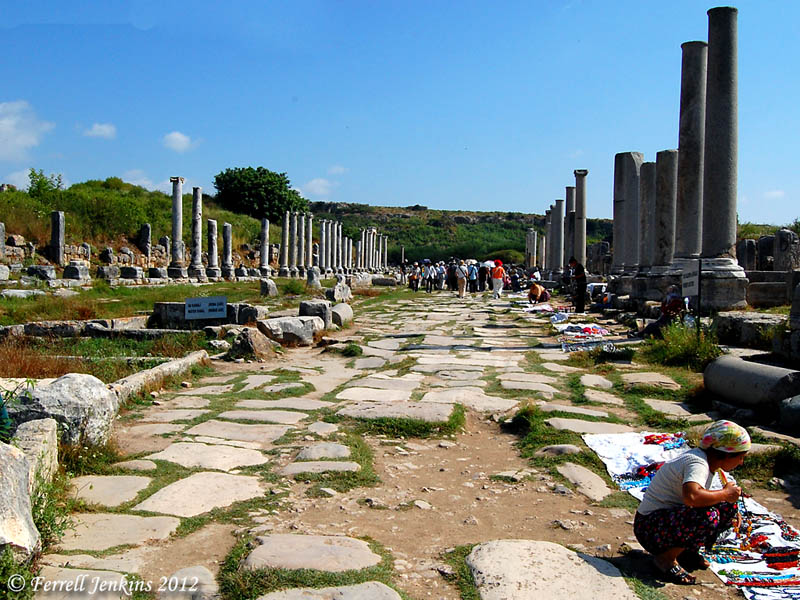
Our plans do not include revisiting sites that we have recently visited, but here is a photo of the North-South street in the Agora of Perga. The view is toward the fountain at the head of the street. A local vendor spreads out her jewelry on the ancient street.

Perga in Pamphylia. N-S street in the Agora with a view toward the fountain. Photo by Ferrell Jenkins.

N-S street in the Perga agora with view toward the fountain. Photo by Ferrell Jenkins.

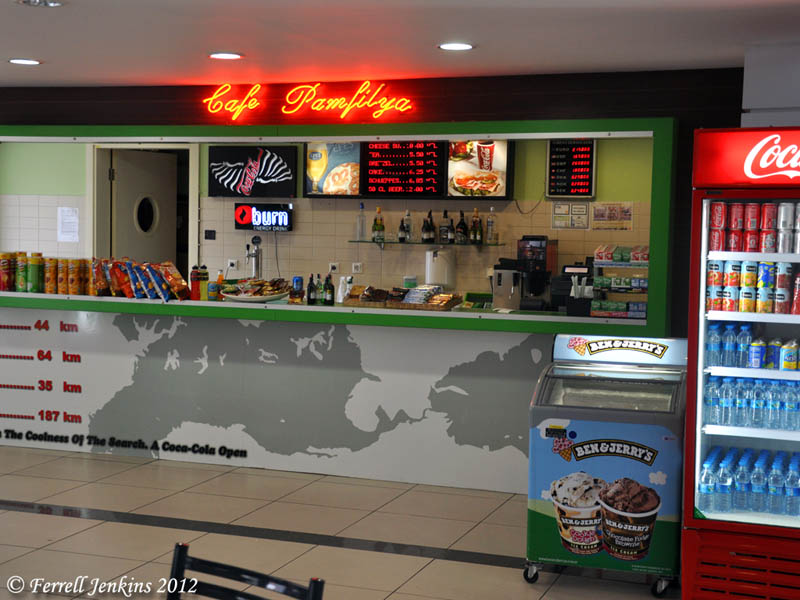
When we arrived at the Antalya International Airport I soon realized that we had come to the right place. The snack stand was named Cafe Pampilya. How appropriate.

Cafe Pamfilya in the Antalya International Airport. Photo by Ferrell Jenkins.

Cafe Pamfilya in the Antalya International Airport. Photo by Ferrell Jenkins.

Tonight we are staying on the Mediterranean Sea on the west side of Antalya (Acts 14:25). Antalya is the modern name for Attalia which served as the port of entry from Egypt and Syria to the interior of Asia. From here Paul sailed back to Antioch (Acts 14:25).

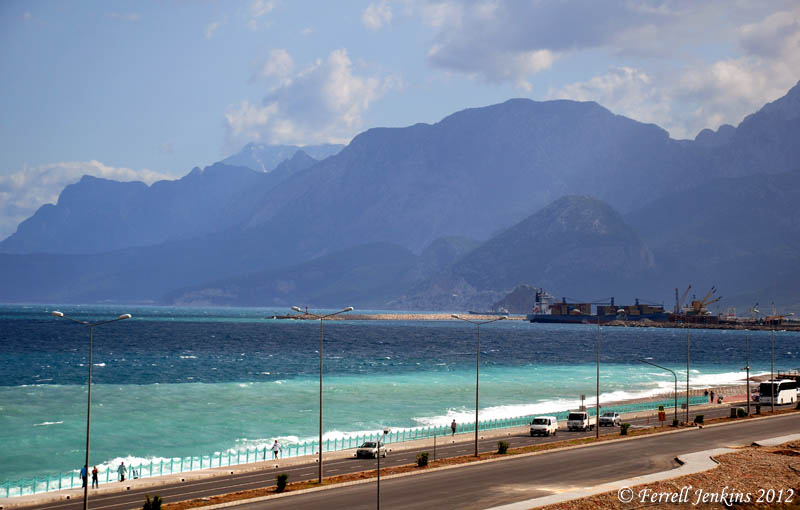
We have a nice view of the Lycian Mountains from our hotel balcony. Tomorrow we plan to drive along the coast to Myra (Acts 27:5) and other points west.

Lycian Mountains west of Antalya, Turkey. Photo by Ferrell Jenkins.

Lycian Mountains west of Antalya, Turkey. Photo by Ferrell Jenkins.

Two week ago when I was in Turkey with the group, it was about 5-7 degrees warmer than usual. Today it has rained and the wind is cool.

A post I wrote about Perga and Attalia in 2007, in the early days of this blog, may be read here.

1400 year old olive press excavated

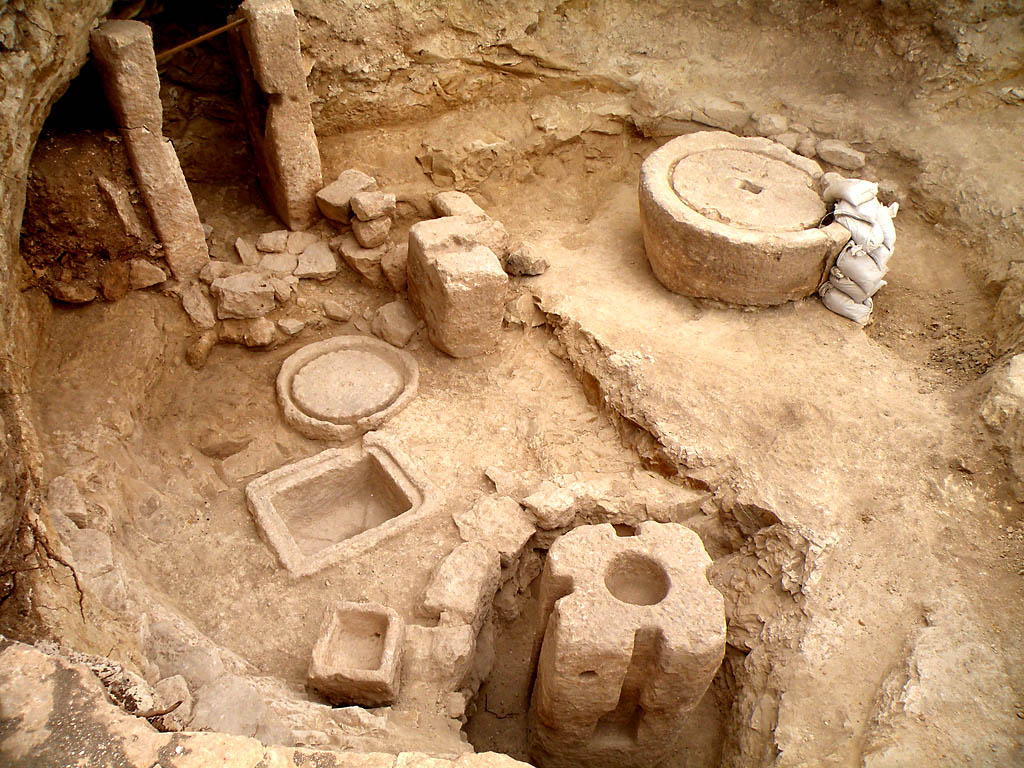
The Israel Antiquities Authority announces the discovery of a 1400 year old olive press at Modi’in. According to a brief article in Arutz Sheva,

A statement by the IAA called the press the grandest and most complete one found so far.

Archaeologist Hagit TorgΓ«, who is directing the dig, said the press, which was used to produce industrial quantities of oil for food and light, about 1,400 years ago, “was preserved surprisingly intact with all its components.”

1400 year old olive press at Modi'in. Credit: Hagit TorgΓ«, Israel Antiquities Authority.

Olive press at Modi’in. Credit: Hagit TorgΓ«, Israel Antiquities Authority.

Click on the photo for a hi-res image.

Olives are mentioned in the Bible from Genesis (8:11) to Revelation (18:13), and are still important in many parts of the world.

HT: Joseph Lauer

Paul worked 18 months at Corinth

Paul first visited Corinth during his second preaching journey (A.D. 50-53; Acts 15:36-18:22). After facing opposition of his fellow Jews in Thessalonica and Berea, the brethren at Berea conducted him to the sea and to Athens, the intellectual capital of the Greco-Roman world.

Paul was alone in Athens, but he had sent for Timothy and Silas to come to him immediately from Berea. After what might be considered limited success at Athens, Paul continued to Corinth in the Peloponnesus. Paul stayed at Corinth for 18 months according to Luke’s account in Acts 18.

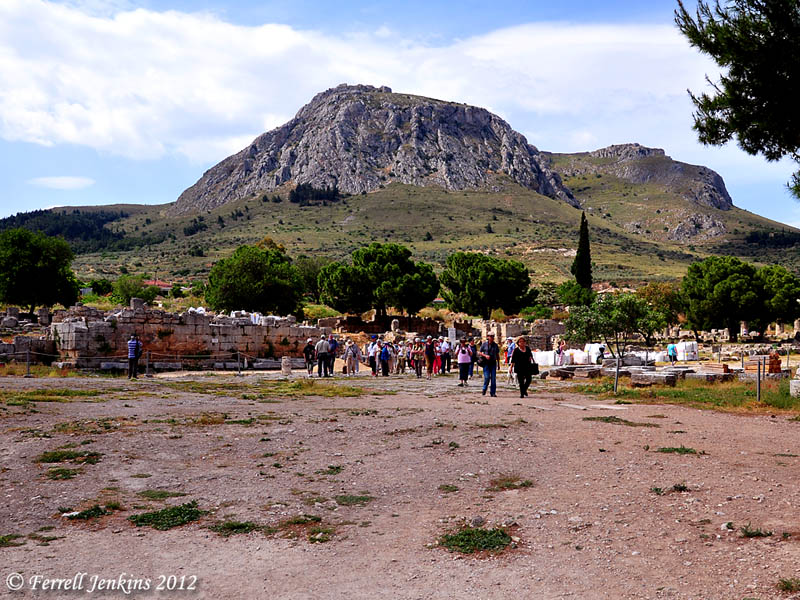
During that time he was brought before Gallio. The site of this encounter was likely before the bema, the judgement-seat, in the agora. The photo reflects one of the important things we saw today at Corinth. The foundation of the bema is seen in the left of the photo. The Acrocorinth, the high point of the city, is in the distance.

Corinth. The Bema in the Agora. Acrocorinth in distance. Photo by Ferrell Jenkins.

The Bema in the Agora of Corinth. Photo by Ferrell Jenkins.

Numerous changes are taking place all over Europe at popular tourist destinations. I first noticed it a few years ago when the bus driver had to park a distance from the center of activity in Salzburg, Austria. Everyone had to walk a considerable distance to reach the place where the walking normally began. Then I saw it in Florence and Rome. Now it is true in Athens and Corinth. Buses are required to drive a long distance out of the way to reach the parking at Corinth.

At the site we now see rope barriers preventing one from walking close to the columns of the Temple of Apollo, or approaching the Fountain of Peirene, or the Bema. I understand that these restricting are imposed by the European Union on their member states.

Visiting anywhere in the world takes longer than it did a few decades ago due to the tremendous increase in traffic.

More about Hierapolis

After a period of worship this morning we began our touring day in Pamukkale (ancient Hierapolis). From there we continued to Aphrodisias, a Roman city that gives an impression of the reality of life in the period when Christianity was first being spread across the Empire. From there we continued to our hotel on the Aegean Sea.

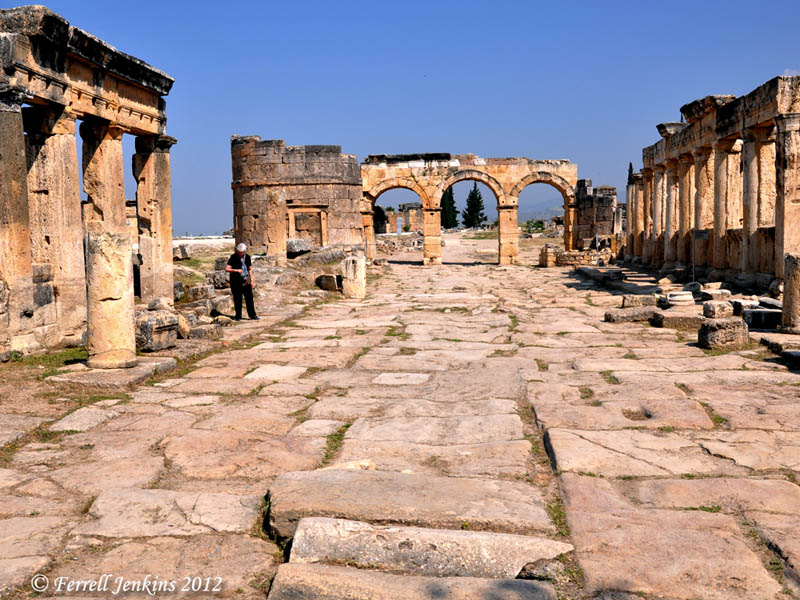
The photo below was made at Pamukkale, Turkey (ancient Hierapolis). We are standing on the colonnaded Roman road, and the monumental gateway behind us is the Arch of the Emperor Domitian (A.D. 81-96). It was constructed in A.D. 82-83.

It was during the reign of Domitian, or shortly thereafter, that the book of Revelation was written by the Apostle John.

Arch of Domitian at Pamukkale (ancient Hierapolis). Photo by Ferrell Jenkins.

Arch of Domitian at Pamukkale (ancient Hierapolis). Photo by Ferrell Jenkins.

Hierapolis was the home of Papias (c. A.D. 60 to c. A.D. 130). He was a disciple of the apostle John and a companion of Polycarp. There are some traditions associating Philip (apostle?, evangelist?) with the city.

The city of Hierapolis is one of the three cities of the Lycus River valley named in the New Testament.

For I testify for him that he has a deep concern for you and for those who are in Laodicea and Hierapolis. (Colossians 4:13).

Tomorrow we hope to visit Ephesus and Miletus.

Sardis, Philadelphia, Laodicea, Colossae, and Hierapolis

There were many sites to see today. We left Izmir (Smyrna) in the morning and drove east to the site of ancient Sardis (Revelation 3:1-6). From there we continued to in a southeast direction to Philadelphia (Revelation 3:7-13). Then we made our way to the Lycus River valley. The first stop was at Colossae (Paul’s epistle to the Colossians). After viewing the ancient mound which still awaits excavation, we went to Laodicea (Revelation 3:14-22). On the way to the hotel we stopped for a photo of the cliffs at Pamukkale (ancient Hierapolis, ColossiansΒ  4:13). The name Pamukkale meansΒ  “cotton castle” or “cotton fortress.”

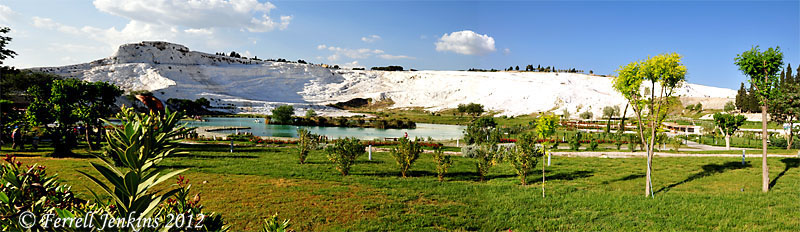
Mellink describes the formation here. He says the city,

… is famous for its continuing geological transformation. Hot mineral springs issue from the rock in the city, and the waters streaming down the cliffs have deposited limestone in large formations, the surface of which is made a gleaming white ‘frozen cascades’ (IDB II:601).

'Pamukkale 'frozen cascades'. Photomerge by Ferrell Jenkins.

‘Pamukkale ‘frozen cascades’. Photomerge by Ferrell Jenkins.

We could see the white hillside clearly from Laodicea about six miles to the south. The photo above was made just below the cliffs. Hierapolis sits on the plateau. Click on the photo for a larger image.

Nothing has changed in the past few years at Sardis, Philadelphia, and Colossae. A tremendous change is taking place at Laodicea. Portions of the city that had remained buried until the past decade are now coming to light. I was surprised at the changes just in the past four years since I was here. Later on we will try to show you some of these new things.

Tomorrow we plan to visit Hierapolis and Aphrodisias before arriving at Kusadasi on the Aegean Sea near Ephesus.

Everyone in our group remains well and seems to be enjoying the visits and the study time together.