Category Archives: Archaeology

Photography in the Israel Museum. Can it be?

Carl Rasmussen, author of the Zondervan Atlas of the Bible, reports here on his HolyLandPhotos’ Blog that he took a group to the Israel Museum today and that photography (without flash) was allowed in the archaeology section. Prof. Rasmussen concludes, “A new era has begun!!”

Several times I have criticized museums that do not allow photography of archaeological artifacts.

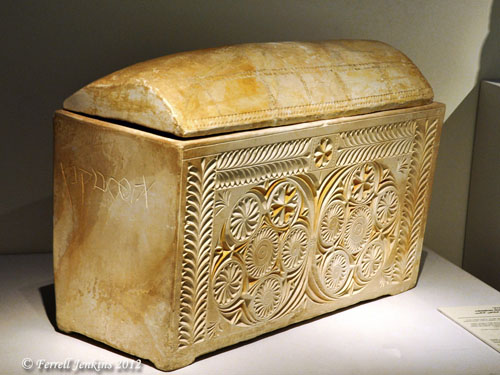
A photo such as the one below can be helpful to teachers who prefer to have their own photos for use in teaching. The highly decorated Caiaphas Ossuary was discovered during the construction of a water park in Jerusalem’s Peace Forest. The remains of six individuals were found inside the ossuary including that of a man about 60 years of age. The name of Caiaphas is inscribed on both ends of the “bone box.” The single line visible in this photo is translated “Joseph son of Caiaphas.” Many scholars believe that this is likely the high priest Caiaphas before whom Jesus stood prior to His crucifixion.

So Annas sent Him bound to Caiaphas the high priest. (John 18:24 NAU)

The Caisaphas Ossuary in the Israel Museum, Jerusalem.

The Caiaphas Ossuary in the Israel Museum, Jerusalem. Photo by Ferrell Jenkins.

HT: Barry Britnell

Another Giveaway by Bible Places Blog

Bible Places Blog is giving away a 6-DVD set featuring 36 half-hour lectures by Dr. Jodi Magness on The Holy Land Revealed. You have two (maybe three) chances to win. Be warned. I have entered this time!

Click here for details.

Mosaic of Samson and the foxes discovered in Galilee synagogue

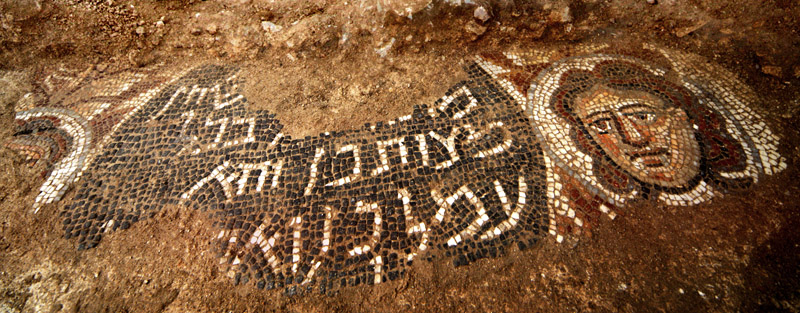
Excavations at Huqoq in Galilee have uncovered a mosaic floor depicting exploits of Samson. The photo below shows a female face and a partial Hebrew inscription referring to “rewards for those who perform good deeds .” No photo of the Samson portion of the mosaic has been provided.

Huqoq Galilee Synagogue Mosaic showing Samson. Photo by Jim Haberman.

Huquq Synagogue Mosaic with female face and inscription. Photo by Jim Haberman.

At the moment the most best information I have is from the Israel Antiquities Authority. Everything set off below, and the photo above, is from that source.

—•—

A monumental synagogue building dating to the Late Roman period (ca. 4th-5th centuries C.E.) has been discovered in archaeological excavations at Huqoq in Israel’s Galilee.

The excavations are being conducted by Jodi Magness of the University of North Carolina at Chapel Hill and David Amit and Shua Kisilevitz of the Israel Antiquities Authority, under the sponsorship of UNC, Brigham Young University in Utah, Trinity University in Texas, the University of Oklahoma and the University of Toronto in Canada. Students and staff from UNC and the consortium schools are participating in the dig

Huqoq is an ancient Jewish village located approximately two to three miles west of Capernaum and Migdal (Magdala). This second season of excavations has revealed portions of a stunning mosaic floor decorating the interior of the synagogue building. The mosaic, which is made of tiny colored stone cubes of the highest quality, includes a scene depicting Samson placing torches between the tails of foxes (as related in the book of Judges 15). In another part of the mosaic, two human (apparently female) faces flank a circular medallion with a Hebrew inscription that refers to rewards for those who perform good deeds.

“This discovery is significant because only a small number of ancient (Late Roman) synagogue buildings are decorated with mosaics showing biblical scenes, and only two others have scenes with Samson (one is at another site just a couple of miles from Huqoq),” said Magness, the Kenan Distinguished Professor in the department of religious studies in UNC’s College of Arts and Sciences. “Our mosaics are also important because of their high artistic quality and the tiny size of the mosaic cubes. This, together with the monumental size of the stones used to construct the synagogue’s walls, suggest a high level of prosperity in this village, as the building clearly was very costly.”

—•—

The web site of Dr. Magness may be accessed here.

Several centuries before the synagogue at Huqoq was built, Jesus visited synagogues in Galilee.

Jesus went throughout all of Galilee, teaching in their synagogues, preaching the gospel of the kingdom, and healing all kinds of disease and sickness among the people. (Matthew 4:23 NET)

HT: Joseph Lauer

Leeches in Sea of Galilee; Palestinian Village; Jericho

Sea of Galilee invaded by leeches. For the second time in 7 years the lake has an explosion of leeches. The article in Haaretz says,

Standing in the water for as little as two minutes will cause your legs to be covered in hundreds of leeches. These particular types are not blood-suckers, making them relatively easy to remove once one is out of the water

Causes for the large number of leeches include “human activity, including pollution, poisoning and overpumping.”

Read the full article here.

The Sea of Galilee was central to much of the ministry of Jesus.

While walking by the Sea of Galilee, he saw two brothers, Simon (who is called Peter) and Andrew his brother, casting a net into the sea, for they were fishermen. (Matthew 4:18 ESV)

Palestinian Village uses Roman irrigation system to continue terraced farming near Bethlehem. Read the story, with beautiful photo, in The New York Times here.

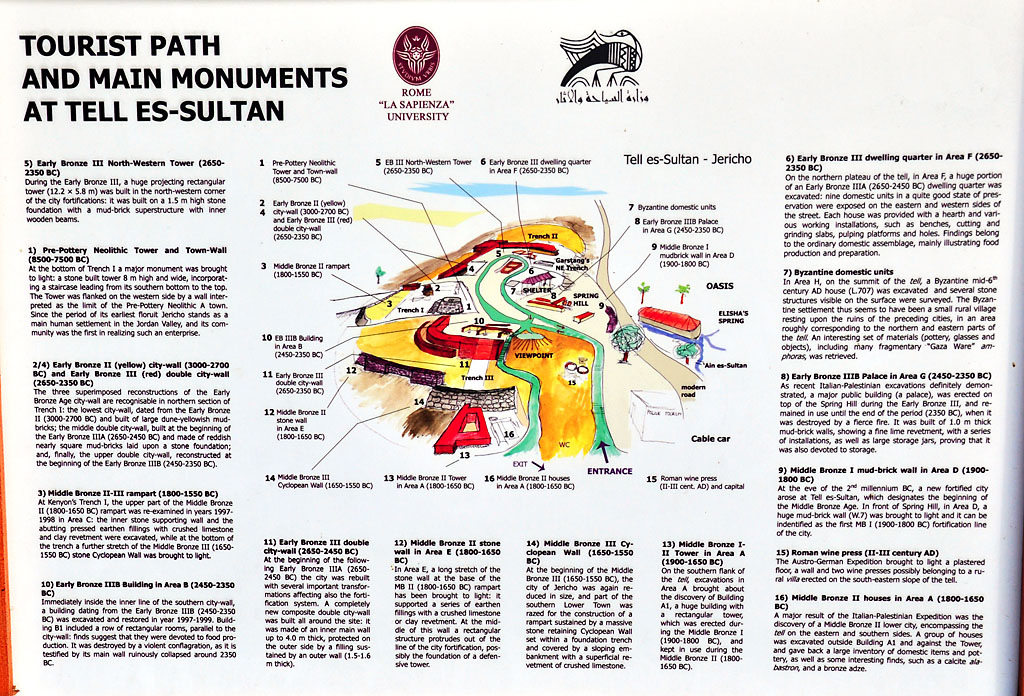
Tell es-Sultan/Jericho. Sepienza University in Rome, in cooperation with the Palestinian General Directorate of Antiquities, has published a Palestine Archaeological Databank and Information System. Check here for maps and other information. Our readers will likely be interested in the excavation reports on Tell es-Sultan/Jericho here. Click on the Results 2012 photo for the most recent work by the Italian-Palestinian Expedition at Jericho. Every visitor to the site will welcome is the new paths, identifying signs, and general clean-up of the site.

I was especially pleased to see the Digital Visit plan of the site. Click on it was a colorful, readable plan of the site like the central portion of the one shown below. Prof. Lorenzo Nigro is the director of the excavation.

Tourist Path and Main Monuments at Tell es-Sultan/Jericho. Photo by Ferrell Jenkins.

Tourist Path and Main Monuments at Tell es-Sultan/Jericho. Photo by Ferrell Jenkins.

Jericho is important in Old Testament history (Joshua 6).

HT: Bible Places Blog; Jack Sasson; Barry Britnell; “La Sapienza” Expedition to Palestine.

Roman artifacts in the Samsun Archaeology Museum

Our main interest in visiting the Black Sea coastal cities of Samsun and Sinop is because they are part of the ancient Roman province of Pontus. Somewhere in Pontus, probably Amisos (now Samsun), was the beginning point for the messenger who carried Peter’s first epistle to the elect of the diaspora residing in Pontus, Galatia, Cappadocia, Asia, and Bithynia (1 Peter 1:1).

The Archaeology Museum in Samsun has only a few items from the first century Roman period on display, but they are significant.

A marble head of Augustus is displayed prominently. Augustus was the Roman Emperor from 30 B.C. to A.D. 14. He is mentioned only once in the New Testament, but his influence in the eastern part of the Empire is evident in many way. The apostles traveled along roads built in the days of Augustus.

Luke records that the decree for a census to be taken of all the inhabited earth went out from Augustus.

Now in those days a decree went out from Caesar Augustus, that a census be taken of all the inhabited earth. (Luke 2:1 NAU)

This accounts for Mary and Joseph traveling from Nazareth to Bethlehem at the time of the birth of Jesus.

Roman Emperor Augustus. Displayed in Samsun Archaeology Museum. Photo by Ferrell Jenkins.

Augustus. Displayed in Samsun Archaeology Museum. Photo by Ferrell Jenkins.

I was surprised at the many references to Augustus on this blog. Just put the word Augustus in the search box to locate posts that mention him.

There is a first century image is that of a young athlete in the museum. He is full height, with arms missing.

Young Roman athlete in Samsun Archaeology Museum. Photo by Ferrell Jenkins.

Young Roman athlete in Samsun Archaeology Museum. Photo by Ferrell Jenkins.

The Apostle Paul used several illustrations from athletics. He told the young preacher Timothy that discipline and self control were necessary in his work as a preacher.

Every athlete exercises self-control in all things. They do it to receive a perishable wreath, but we an imperishable. So I do not run aimlessly; I do not box as one beating the air.  But I discipline my body and keep it under control, lest after preaching to others I myself should be disqualified. (1 Corinthians 9:25-27 ESV)

The Samsun Archaeological Museum

Hidden in Plain Sight. While driving around Samsun we saw a brown sign pointing to the Archaeology Museum, but we were not able to locate the building. We knew it was there because Mark Wilson mentions it in Biblical Turkey (340), as do some other guide books. I mentioned earlier that very few people in this region speak English. There was one girl at the hotel who could speak English. We met one young man in a local store who had been living in New York who spoke English, and a lady from the Netherlands. We always get by, and the locals are almost always helpful.

When we inquired about the Archaeology Museum we were always directed to the Gazi Museum. That is a museum devoted to the early history of Mustafa Kemal Atatürk, the founder of the Republic of Turkey. We enjoyed visiting that museum, but it still was not what we were looking for. After much effort, we finally found a policeman who pointed us in the right direction. Then, while we were standing on the street corner with an inquiring look, a Moslem lady asked if she could help us. She was from the Netherlands. She went in a store to inquire. They pointed us back to the Gazi Museum. When we indicated that was not the museum, we were finally pointed directly across the main street, beyond a little park, to the Archaeology Museum. By this time one of the local men indicated we should follow him. Success, at last.

The museum is small, but contains artifacts ranging from the Chalcolithic Period (as early as 4300 B.C.) to the Roman Period.

Excavation at Ikiztepe. Ikiztepe is a site located about 4 miles northwest of Bafra (see our discussion of the Halys River in yesterday’s post). In recent excavations, evidence of “cultures of the Chalcolithic Age, the Bronze Age and the Transition Age (Before Hittites) have been determined” (Museum brochure).

An article in Hurriyet Daily News says that discoveries at Ikiztepe range from the Chalcolithic Age to the Hellenistic period.

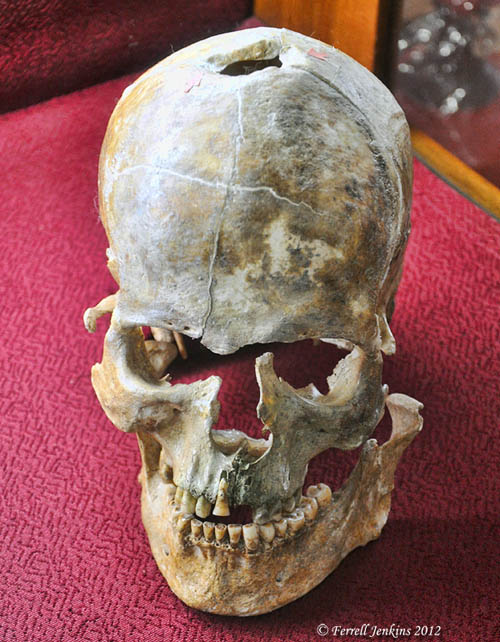
The most interesting findings unearthed during the excavations are skulls, which underwent surgical operation. In the graveyard on the highest hill in the ancient site, dating back to 2300-2100 BC, eight out of the 690 skeletons had skulls with traces of surgical operation. These skulls have archaeological importance since they are the only ones unearthed in Anatolia. They also show that people who lived there did not have the characteristics of Mediterranean people but of southern Russians and Bulgarians.

Read the full article here.

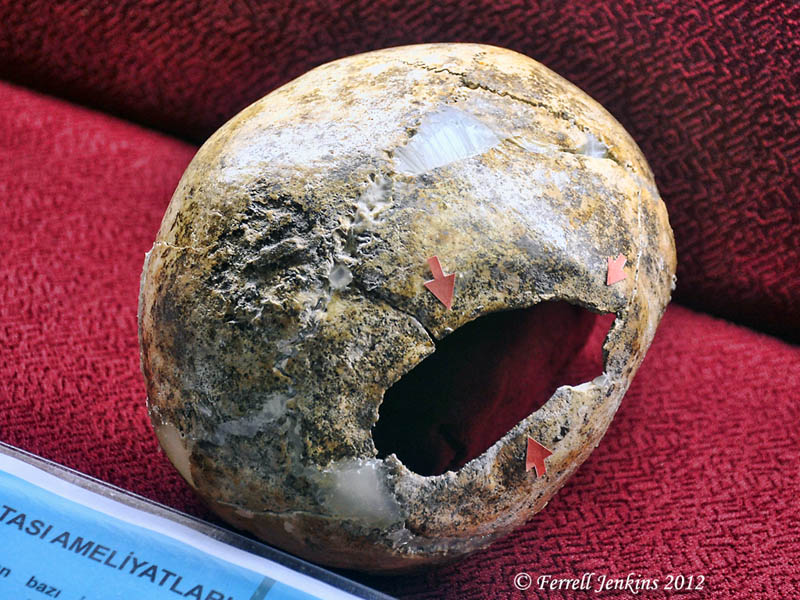
Ancient brain surgery that cut a hole in the skull to relieve pressure is referred to as trepanation. A few of the skulls found at Ikiztepe are displayed in the museum. They are said to belong to Bronze Age III. I think that would be in the neighborhood of 1600 B.C. Here are two of the photos I made that show the hole drilled in the skull.

Example of Trepanation, Bronze Age III, Ikiztepe. Samsun Archaeological Museum. Photo by Ferrell Jenkins.

Example of Trepanation, Bronze Age III, Ikiztepe. Samsun Archaeological Museum. Photo by Ferrell Jenkins.

The surgery in the case below required a much larger hole.
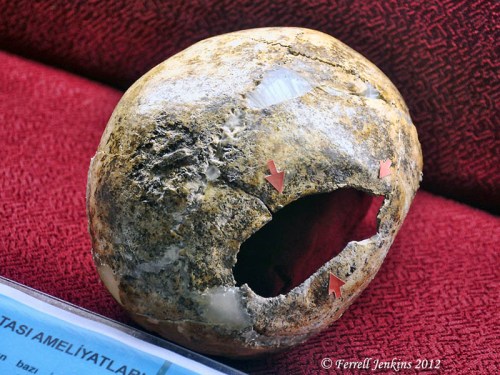
Example of Trepanation, Bronze Age III, Ikiztepe. Samsun Archaeological Museum. Photo by Ferrell Jenkins.

Example of Trepanation, Bronze Age III, Ikiztepe. Samsun Archaeological Museum. Photo by Ferrell Jenkins.

There is no indication whether the surgery was successful, or what happened to the surgeon if it failed.

Joe Zias, in an article in Mikhmanim (Spring 1999), says there have been 29 skulls showing trepanation (trephination) discovered in Israel. He says the survival rate based on “inflammatory or bone remodeling” indicate a 77 percent survival rate in these cases. You may read his entire article about this and other medical issues in ancient Israel here.

In a future post I plan to show you a few of the Roman period ruins, the time of Peter’s epistles (1 Peter 1:1).

BiblePlaces giveaway of the PLBL Israel Collection

Between now and Friday at 10 am Pacific time you have an opportunity to enter a significant giveaway worth $149. Todd Bolen announces how you can win one of two copies of the 5 volumes of Israel photos in the Pictorial Library of Bible Lands.

For full details click here. If you don’t win one of the sets you can always purchase it.

For my opinion about the full 18 volume Pictorial Library of Bible Lands see the review here.

— • —

Peter’s Epistles and Pontus. I have been busy with other matters and unable to write more about the Black Sea coast. Hopefully tomorrow.

Two arrested in Greece for antiquities theft

Numerous news sources are reporting the arrest of two men east of Thessaloniki (Thessalonica), Greece, with a 4th century B.C. gold wreath and armband. The arrest was near the Biblical sites of Amphipolis and Apollonia. We recognize those as places passed by Paul and his companions as they traveled the Via Egnatia between Philippi and Thessalonica.

Now when they had passed through Amphipolis and Apollonia, they came to Thessalonica, where there was a synagogue of the Jews. (Acts 17:1 ESV)

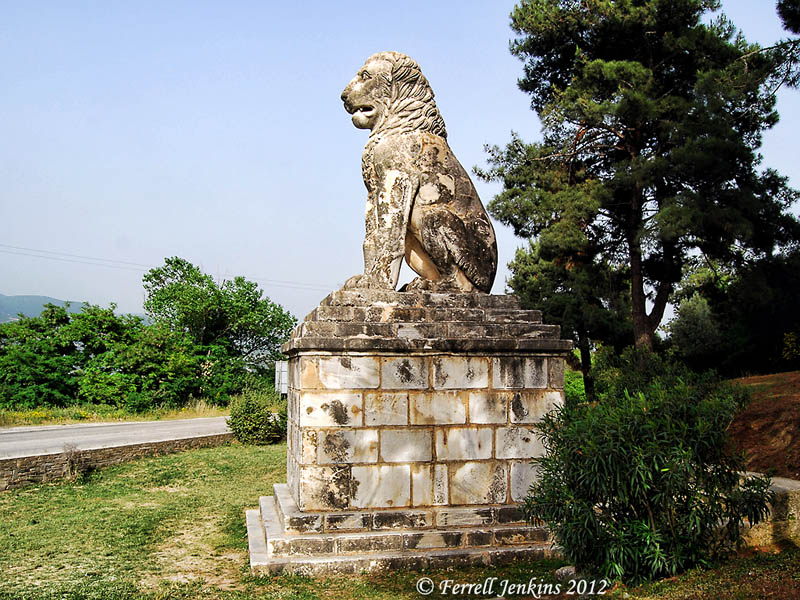
Very little archaeological work has been done in Amphipolis and Apollonia. One interesting artifact on the Strymon River at Amphipolis is this lion from the 4th century B.C.

The Lion of Amphipolis, Greece. Photo by Ferrell Jenkins.

The Lion of Amphipolis, Greece. Photo by Ferrell Jenkins.

The news report in The Republic, Columbus, Indiana, here  includes two nice photos of the wreath.

The photo of the gold wreath below comes from 4th century B.C. Greece. It is now displayed in the Metropolitan Museum, New York City.

Gold crown from Greece. Metropolitan Museum, NY. Photo by Ferrell Jenkins.

Gold crown from Greece. Metropolitan Museum, NY. Photo by Ferrell Jenkins.

Paul spoke of his beloved brothers at Philippi as his joy and crown.

Therefore, my brothers, whom I love and long for, my joy and crown, stand firm thus in the Lord, my beloved. (Philippians 4:1 ESV)

HT: Jack Sasson

The Mausoleum at Halicarnassus

Why would we want to visit Bodrum on the Aegean coast of Turkey? It is located in the area of the Roman province of Caria, and is built over the site of ancient Halicarnassus. It is where Mausolus built a tomb for himself. From this structure we get our word mausoleum.

Only a small city block preserves the remains of the famous Mausoleum. Parking nearby is almost an impossibility, but one of the shopkeepers allowed us to block the entry to his shop for a few minutes.

Halicarnassus. Site of the tomb of King Mausolos. Photo by Ferrell Jenkins.

Halicarnassus. Site of the tomb of King Mausolos. Photo by Ferrell Jenkins.

The small brochure available at the site gives this information about the Mausoleum.

It is one of the Seven Wonders of the Ancient World. Its construction was initiated by Mausolus, a member of the Hekatomnid dynasty appointed by Persians as the Satrap of Caria, before his death, and continued by his wife and sister Artemisia after his death. Mausolus, the then most important administrator, probably decided to build such an important structure to symbolize his eternity and greatness. Its construction was started just before Mausolus’ death, i.e. just before 353 B.C.

Along with a few architectural fragments at the site, there is a nice model suggesting how the Mausoleum looked. According to the brochure, the tomb may have been as high as a 20-story apartment building.

Model of the Tomb of Mausolos at Halicarnassus. Photo by Ferrell Jenkins.

Model of the Tomb of Mausolos at Halicarnassus. Photo by Ferrell Jenkins.

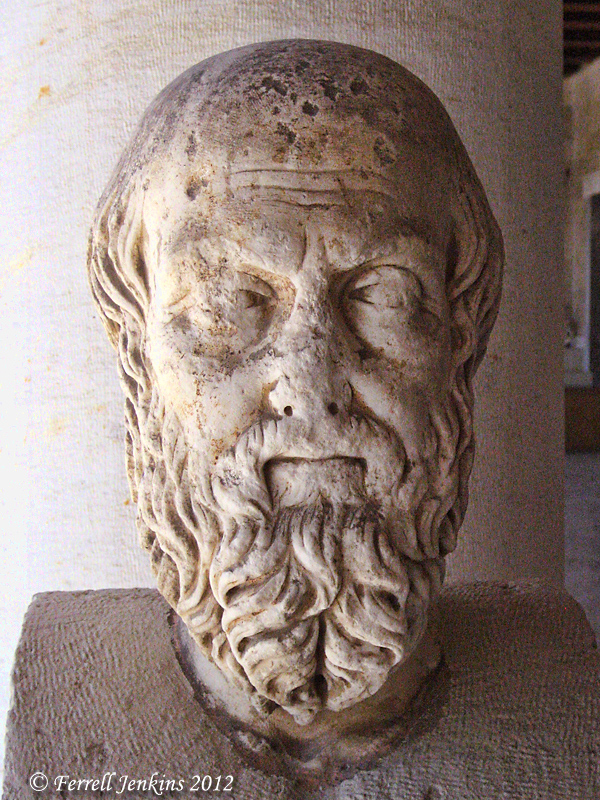
Herodotus Bust displayed in the Stoa of Attalus, Athens Agora

Herodotus Bust displayed in the Stoa of Attalus, Athens Agora. Photo: F. Jenkins.

Is it possible that Paul may have seen this structure when he sailed past Cos (Acts 21:1)? Ferries run between Bodrum (Turkey) and Cos (Greece) today.

Halicarnassus is listed among the towns that were informed by the Romans of their support of the Jews (1 Maccabees 15:23).

The Greek historian Herodotus claimed Halicarnassus as his home.

At least one lesson we learn at Halicarnassus is that monuments built to oneself do not endure for long. Think of Absalom.

Now Absalom in his lifetime had taken and set up for himself the pillar that is in the King’s Valley, for he said, “I have no son to keep my name in remembrance.” He called the pillar after his own name, and it is called Absalom’s monument to this day. (2 Samuel 18:18 ESV)

Another Milestone — One Million Hits

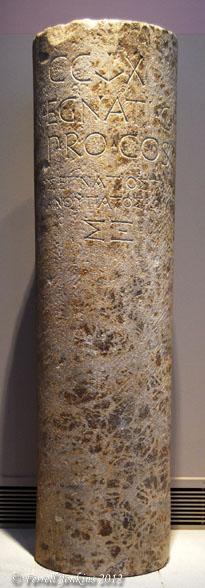
Milestone from the Via Egnatian. Thessalonica Museum. Photo by Ferrell Jenkins.

Milestone from the Via Egnatian displayed in the Thessaloniki Museum. Photo by Ferrell Jenkins.

A few minutes ago the counter on this blog indicated that we have reached one million hits since beginning the blog about five years ago.

This is not much compared to many secular web sites, or even some biblioblogs, but I am pleased with the results over these years.

Ferrell’s Travel Blog was begun to keep friends and family of our tour members informed about the progress of a tour in 2007. Had I realized it was to become a regular part of my life, averaging more than 1100 hits a day, I would have named it differently. But I didn’t, and here we are.

Thanks for following the blog. I am especially pleased when Bible class teachers write to tell me they are using the material in their Bible classes.

I have enjoyed the contact with some well-informed people who have taken time to communicate with me regarding the subjects I write about. Thanks to all who have taken the time to leave a comment on the blog, in person, by Facebook, or by Email.

We celebrated becoming half a millionaire November 21, 2010, here.

Some days I think of discontinuing the blog; other days I don’t.

The photo of the milestone from the Via Egnatian, a Roman road used by the Apostle Paul, seems appropriate today.