Category Archives: Archaeology

Visiting Pergamum and Thyatira

Today we went north from Izmir (Smyrna) to Pergamum (Revelation 2:12-17) where we visited the citadel, the Ascleipion, and the local museum. From there we continued in a southeastly direction to Thyatira before returning to Izmir.

This first photo was made on the acropolis of Pergamum sitting atop a high hill overlooking the territory around it. Sharon, from a previous tour, tries to get a good view of the landscape below.
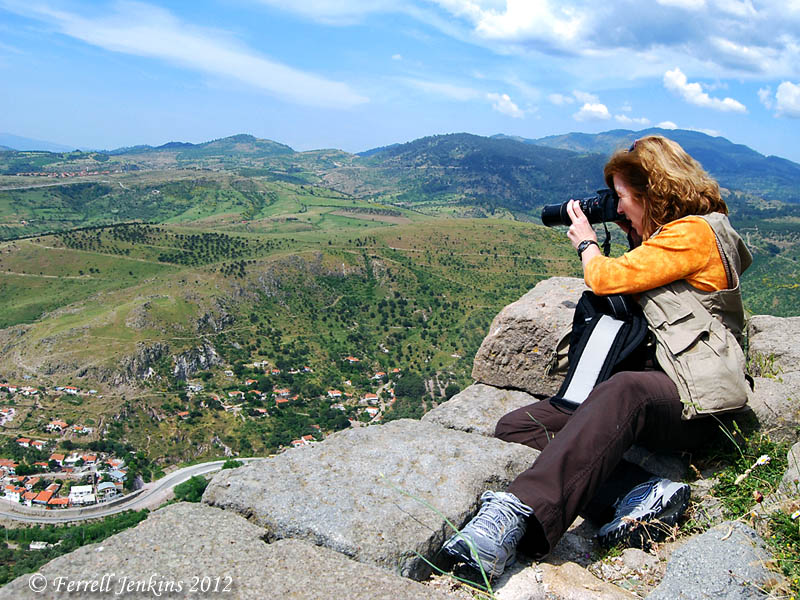
View from the Acropolis of Thyatira. Photo by Ferrell Jenkins.

View from the Acropolis of Pergamum. Photo by Ferrell Jenkins.

At Pergamum we saw the partially reconstructed Temple of the Emperor Trajan (A.D. 98-117), the area where the famous library of the ancient world stood, the foundation of the temple of Athena, the theater, and the site of the Zeus Altar. The altar has now been reconstructed in the Pergamum Museum in Berlin.
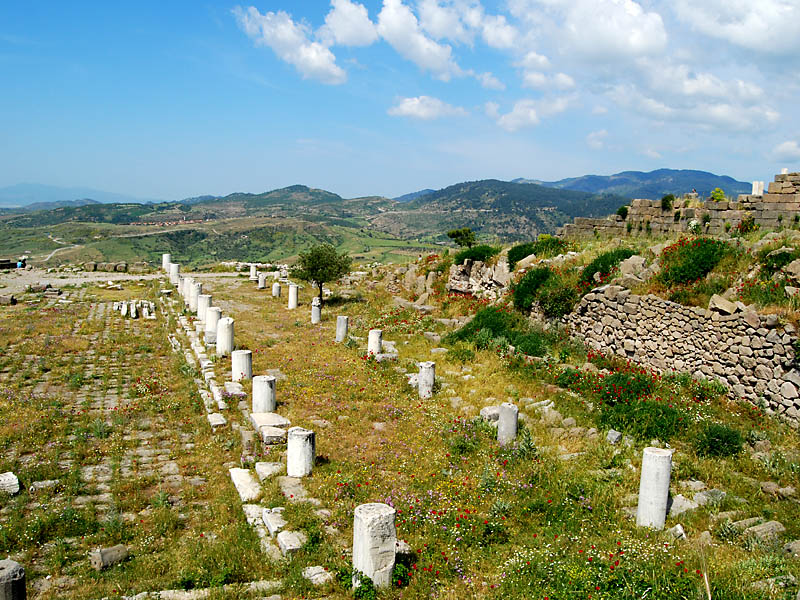
The area of the famous Pergamum library. Photo by Ferrell Jenkins.

The area of the famous Pergamum library. Photo by Ferrell Jenkins.

When Pergamum could no longer get papyrus sheets from Egypt they developed the writing material called parchment. There are a few shops in the city today (modern Bergama) selling parchment made from goat skin.
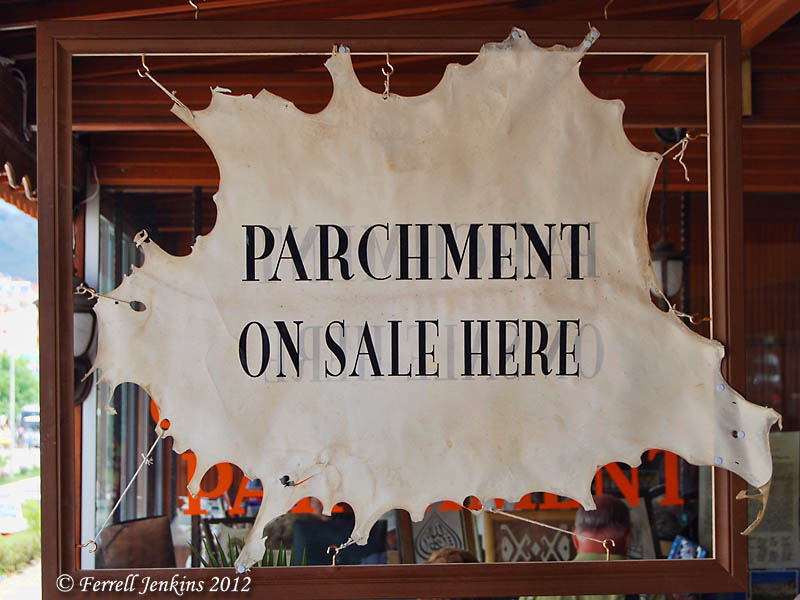
Parchment for sale at Bergama. Photo by Ferrell Jenkins.

Parchment for sale at Bergama. Photo by Ferrell Jenkins.

One interesting difference between our visit to Pergamum today and the last time we visited the site is the addition of a cable car. Buses are no longer allowed to drive to the top of the Acropolis. Visitors take the cable cars to the entrance of the archaeological site.
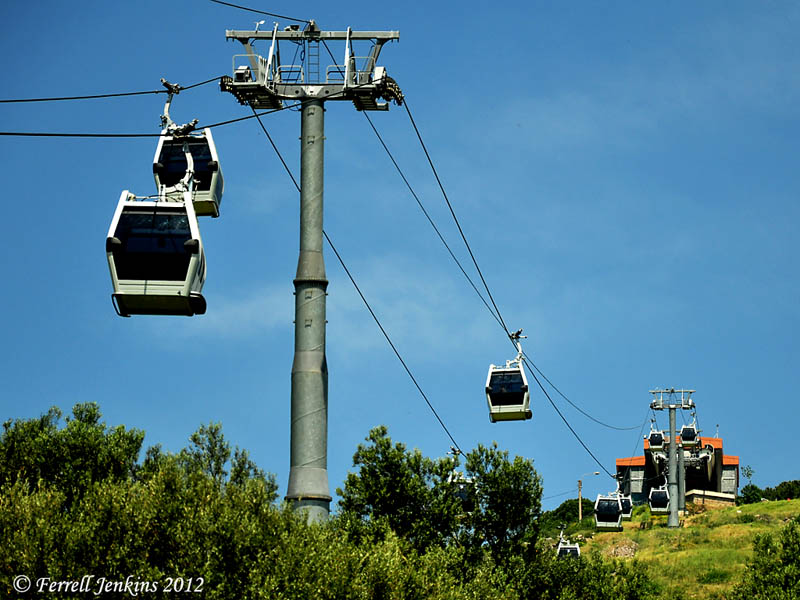
Cable cars to reach the Acropolis at Pergamum. Photo by Ferrell Jenkins.

Cable cars to reach the Acropolis at Pergamum. Photo by Ferrell Jenkins.

There is still little to see at Thyatira. A few scattered ruins can be seen in one square block in the center of the little town of Akhisar. In New Testament times this was the home of Lydia, the seller of purple (Acts 16:14). One of the letters in the Book of Revelation was addressed to the church in the city (Revelation 2:18-29).

I was pleased to see Mark Wilson’s Biblical Turkey: A Guide to Jewish and Christian Sites of Asia Minor, available in a bookshop at Pergamum. Several members of our group who had failed to buy a copy in advance did so today.
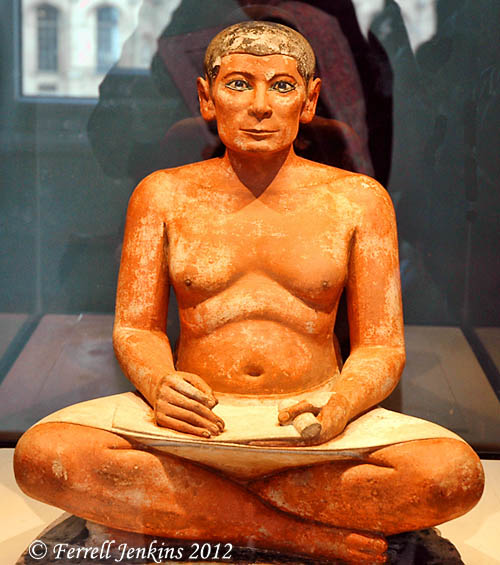
Scribes kept important records

The picture below shows a scribe from ancient Egypt. The statue from Saqqara dates to the 4th or 5th dynasty — about 2600 to 2350 B.C. The limestone statue is painted with encrusted eyes of rock crystal. The statue is on display in the Louvre.

Scribe from Saqqara displayed in the Louvre. Photo by Ferrell Jenkins.

Scribe from Saqqara displayed in the Louvre. Photo by Ferrell Jenkins.

We do not have a great number of examples of writing from ancient Israel, but the Bible is abundant with references to writing and record keeping. The entry on the Hebrew word katab in the Theological Wordbook of the Old Testament says,

katab is the only general word for “write” and it is widely used. Curiously, it is not used in Genesis. Moses wrote on a scroll God’s curse on the Amalekites (Exo 17:14 ). God himself wrote the Ten Commandments (Exo 31:18). Moses also is specifically said to have written the Book of the Covenant (Exo 24:4), the Sinai legislation (Exo 34:27), the names of the leaders of the tribes (Num 17:2-3), the wilderness itinerary (Num 33:2), the law “from beginning to end” (Deut 31:9, 24) and Moses’ final song (Deut 31:22, 24). It is quite possible that the general references of Deut 31:9  and Deut 24 refer to the whole of the Pentateuch (cf. Deut 28:58-61; Deut 29:20-21) although critical scholars refer it only to Deut and question even that.

I think the reference to Moses writing the wilderness itinerary of the Israelites is interesting.

Moses wrote down their starting places, stage by stage, by command of the LORD, and these are their stages according to their starting places. (Numbers 33:2 ESV)

Preliminary report on Khirbet Qeiyafa for 2010-2011

A preliminary report for the 2010-2011 archaeological seasons has been published by the Israel Antiquities Authority in Hadashot Arkheologiyot: Excavations and Surveys in Israel. The report is written by  Yossi Garfinkel, Sa‘ar  Ganor  and Michael Hasel.

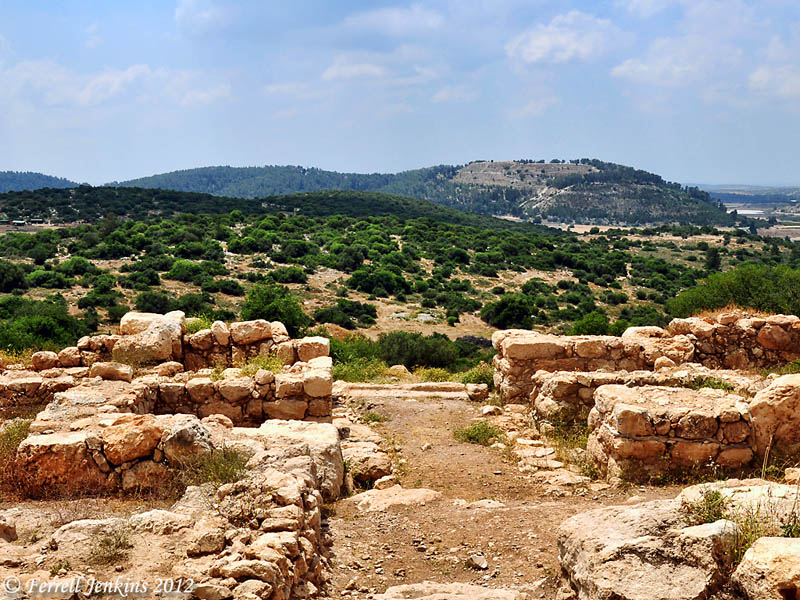
My photo shows the Iron Age, four-chamber, gate with a view toward Tel Azekah.

Iron Age Gate view a view toward Azekah. Photo by Ferrell Jenkins. May, 2011.

Iron Age Gate with a view toward Azekah. Photo by Ferrell Jenkins. May, 2011.

The full report with 11 photographs (or plans) is available here. The report concludes,

The excavations at Khirbat Qeiyafa clearly reveal an urban society that existed in Judah already in the late eleventh century BCE. It can no longer be argued that the Kingdom of Judah developed only in the late eighth century BCE or at some other later date.

The current issue of Biblical Archaeology Review (May/June 2012) carries two article relating to the Qeiyafa ostracon. One is by Christopher A. Rollston who asks the question, “What’s the Oldest Hebrew Inscripton?” He responds that each of four inscriptions he considers (Qeiyafa, Gezer calendar, Tel Zayit, and Izbet Shartah) predate Old Hebrew.

The other article is by Gerard Leval. In “Ancient Inscription Refers to Birth of Israelite Monarchy” he summaries the French-language article by “Emile Puech, the senior epigrapher of the prestigious École Biblique et Archaéologique Française in Jerusalem.” Puech draws the following conclusion:

Moreover, the inscription seems to memorialize (or, in Puech’s words, is “a witness to”18) the transition not from one king to another (from Saul to David), but rather from the period of the judges to the monarchy—thus from Samuel and his sons to Saul.19

If Puech is correct, the Qeiyafa Ostracon is the only archaeological artifact referring to Israel’s first king. And it is the earliest non-Biblical confirmation of the establishment of the Israelite monarchy.

Leval’s article is available online at BAR here.

This information is sure to create a lot of discussion.

HT: Joseph I. Lauer; Bible Places Blog.

Millstones work better than concrete shoes

Jesus used the common millstone in one of his teaching illustrations.

And he said to his disciples, “Temptations to sin are sure to come, but woe to the one through whom they come!  It would be better for him if a millstone were hung around his neck and he were cast into the sea than that he should cause one of these little ones to sin. (Luke 17:1-2; cf. Matthew 18:6; Mark 9:42 ESV)

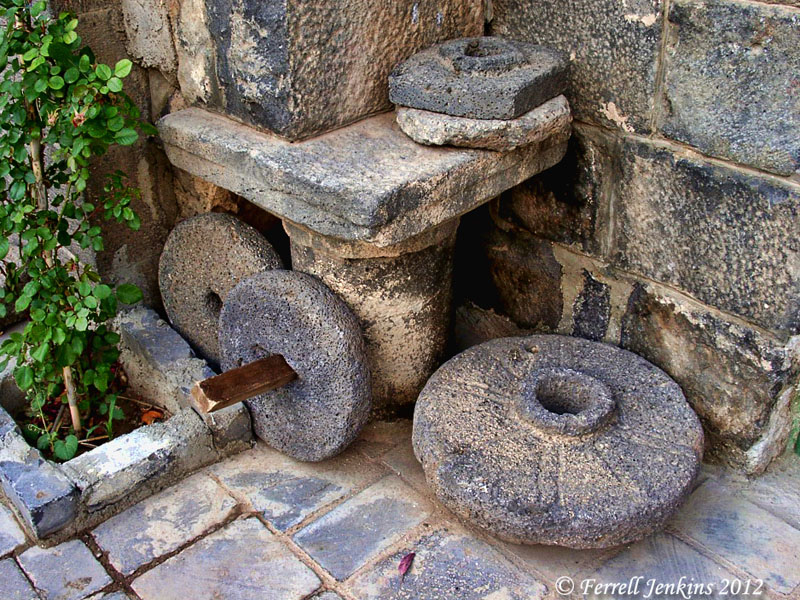
The photo below shows a collection of millstones at the Roman ruins of Bosra in southern Syria, a few miles north of the border with Jordan, in a region known as Hauran. The area has seen much volcanic action in the past. These dark millstones are made of basalt. The region is described by Ulrich Hübner this way.

Bozrah lies on one of the fruitful and water-rich plains of S Haurān at the important intersection of the N–S route, which leads from Damascus through the Transjordan to the Hejaz, with the E–W route, on which one could travel from the Mediterranean to Mesopotamia. (The Anchor Yale Bible Dictionary)

Mill stones at the Roman town of Bosra, Syria. Photo by Ferrell Jenkins.

Mill stones at the Roman town of Bosra, Syria. Photo by Ferrell Jenkins.

This Bosra is not to be confused with Bozrah in Edom (Genesis 36:33) or Bozrah in Moab (Jeremiah 48:21-24).

Millstones were significant in Bible times.

  • Used for grinding grain (even manna) (Numbers 11:8; Isaiah 47:2).
  • The work might be done by a slave girl (Exodus 11:5), or two women working together (Matthew 24:41).
  • Taking a person’s upper millstone as a pledge would deprive the person of his livelihood (Deuteronomy 24:6).
  • A woman at Shechem “threw an upper millstone on Abimelech’s head, crushing his skull” (Judges 9:53; 2 Samuel 11:21).
  • In the LORD’S challenge to Job, He describes Leviathan with a heart as hard as stone, “Even as hard as a lower millstone” (Job 41:24).
  • The sinking of a great millstone is used in the Apocalypse to describe the fall of Babylon (Revelation 18:21).

James Arthur Hodges — 1930 – 2012

James A. Hodges passed from this life April 10, 2012. A native of Jenkins, Kentucky, he was always an inquisitive person who wanted to understand the world around him. He became interested in the ancient world, too. This led him to studies at David Lipscomb College (B.A.), Harding College (M.A.), and the University of Chicago where he earned a Ph.D. in the Department of New Testament and Early Christian Literature. Jim later earned an M.A. degree and the M.I.S. degree from the University of South Florida.

At the University of Chicago in 1970 Jim completed a dissertation on The Building Program of Herod the Great. He taught in the Biblical Studies department at Florida College for a number of years. His last work at FC was as librarian. I can attest that his work in that position was extremely important in the accreditation of the Biblical Studies program to offer a B.A. degree in the field.

In 1980 Florida College agreed to become a sponsor of the Excavations at Tell Lachish, Israel. We recognized that Lachish had been an important city in the history of ancient Israel. Four professors participated in the dig that year. Jim had already been involved in a dig in Israel, as had Harold Tabor. For Phil Roberts and I it was the first time to participate. Jim worked at several other sites over the years.

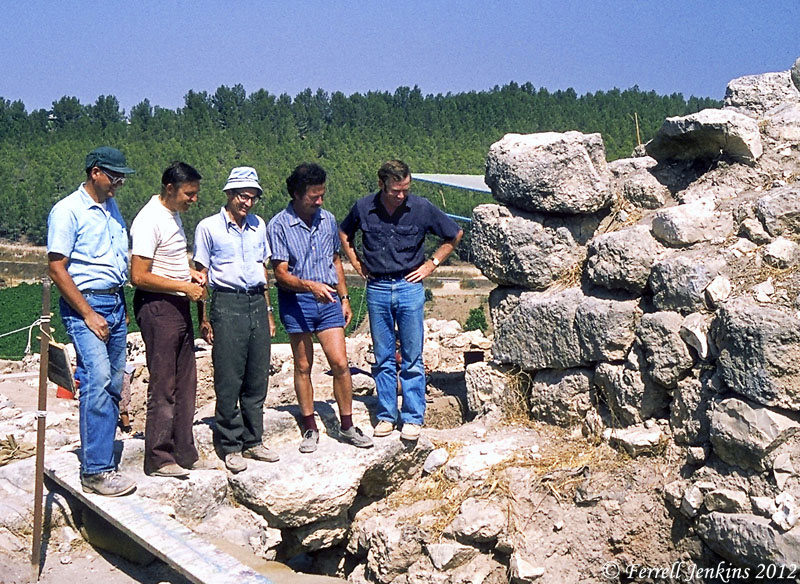
In the photo below from 1980 Jim is in the middle position.

Florida College professors Harold Tabor, Ferrell Jenkins, James Hodges, and Phil Roberts with Prof. David Ussishkin at the Gate of Lachish 1980.

Professor David Ussishkin (second from right) talks about the excavation at the Gate of Lachish with Florida College professors Harold Tabor, Ferrell Jenkins, James Hodges, and Phil Roberts (left to right) in 1980.

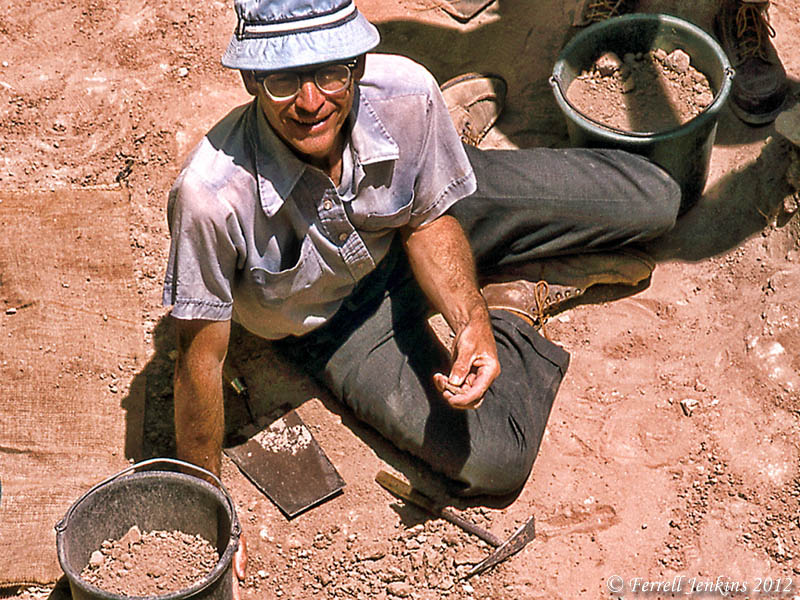
Jim worked in the Section that year. Here is a photo I made of him busy at work.

Dr. James A. Hodges in the Section at Lachish, 1980. Photo by Ferrell Jenkins.

Dr. James A. Hodges in the Section at Lachish, 1980. Photo by Ferrell Jenkins.

Hodges was a quiet and friendly man who sought to follow the example of Christ in his life. I think he was often underestimated by those who did not understand his vast knowledge in Bible, archaeology and Bible history, and the creation-evolution controversy. Several times I have remarked that he was my “go to” man. If I needed some reliable information to get by on until I had time to do a more thorough study, I often called on Jim.

Jim’s hobbies were hiking and fossil collecting. He and Wanda enjoyed traveling throughout the U.S.A. and in various foreign countries. They were part of one of my Israel tours in 1993.

Our condolences are extended to his wife Wanda (Diestelkamp), his children, and other family members.

Akrotiri archaeological site reopens after seven years

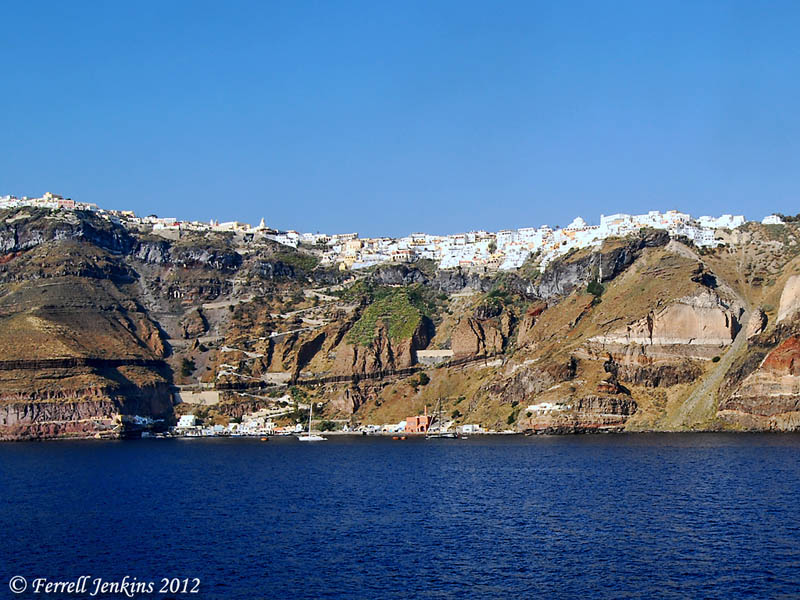
The volcanic island of Santorini, also known as Thira, is a popular stop on Aegean cruises. Eruptions are known to have occurred about 1600 B.C., 1475 B.C., and in the twelfth century B.C. The cruise ships float around in the crater and the passengers are taken by tinder to a place where they have a choice of cable car or donkey to reach the rim.

A view from inside the crater at Santorini. Photo by Ferrell Jenkins.

A view from inside the crater at Santorini. The town of Fira sits perched upon the rim of the volcanic crater. Photo by Ferrell Jenkins.

I have been to Santorini several times on my Steps of Paul and John tours. It is a “necessary” stop on the cruise that allows visits to the biblical sites of Patmos, Rhodes, and Crete. Prior to 2005 a visit to the archaeological site of Akrotiri was worthwhile. A brief description of Akrotiri is given at Wikitravel here.

Akrotiri, in the south, a roughly 3,500 year old Minoan town preserved in volcanic ash like Pompeii, is one of Santorini’s “must-sees”. The excavation site is covered by a roofing system, which makes it something that you can comfortably visit no matter what time of year. The ruins, are extremely well preserved. Streets, buildings, stairs and even second floors of buildings are still visible. Visitors can stand in the ruins and look at Minoan pottery and frescoes, and with a little imagination, feel what it would have been like to live in ancient Greece. Due to an accident in September 2005, the excavation site is still closed to the public.

Word comes from the China Post that the archaeological site reopened last Friday. I look forward to visiting it again next month. I am sure I recall making slides there, but have been unable to locate any in my files.

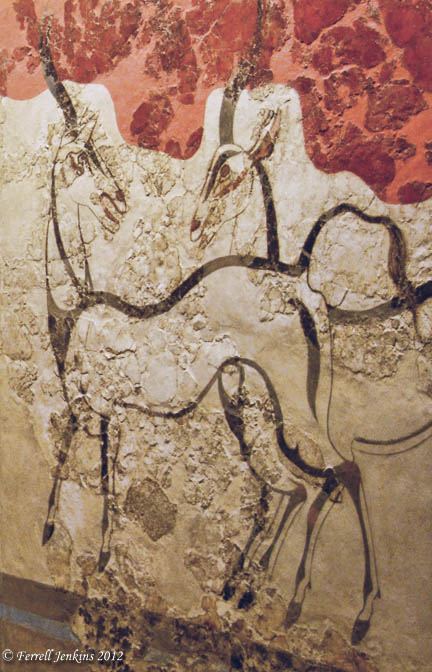
The Athens National Museum has a wonderful exhibit of fresco’s and other artifacts from Akrotiri on the second floor of the museum. The photo here is of the Antelopes fresco.

The Antelopes fresco from Akrotiri. Athens National Museum. Photo by Ferrell Jenkins.

The Antelopes fresco from Akrotiri displayed in the Athens National Museum. Photo by Ferrell Jenkins.

Professor Hans Goedicke proposed that the Exodus and the drowning of the Egyptian army was an historical event in 1477 B.C. According to the theory, a tsunami produced by volcanic eruption in the Mediterranean was responsible for the flooding that drowned the Egyptian Army. See Shanks, “The Exodus and the Crossing of the Red Sea, According to Hans Goedicki.” BAR 07:05 (Sept/Oct 1981). The dating does not fit what I understand to be the date of the Exodus, but I am unable to comment further on the theory at this time.

HT: Jack Sasson

Acco, Achziv, and Rosh Hanikra in the Plain of Acco

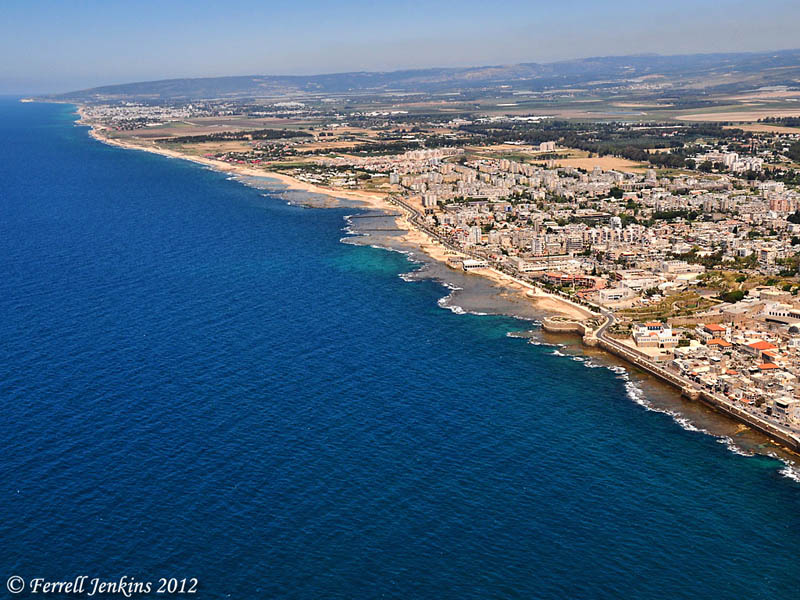
The Plain of Acco runs along the Mediterranean coast from Haifa to Rosh Hanikra and the Ladder of Tyre. The northern portion of the plain is visible in our photo today.

On the right side of the photo you will see the Crusader wall at Acco (Akko, Acre, Ptolemais). Continue along the coast to the north for about 6 miles and you will see a populated area known as Nahariya. Immediately north of Nahariya is the location of Tel Achziv (Achzib, Joshua 19:29; Judges 1:31).

On the left of the photo you see a mountain ridge with a white tip protruding into the sea. That is the Ladder of Tyre and the site of Rosh Hanikra. The Israel/Lebanon border runs along the mountain ridge (West-East).

Click on the photo for a larger image that will allow you to see the features of the plain more clearly.

Aerial View of Plain of Acco (north): from Acco to Achziv to Rosh Hanikra. Photo by Ferrell Jenkins.

The Plain of Acco (north): from Acco to Achziv to Rosh Hanikra. Photo by F. Jenkins.

In ancient times a major international road ran along this coast.

See our previous post about Achziv (here) and the links there to earlier posts about the Plain of Acco.

The 2012 Exploratory Excavation at Tel Achziv “aims to lay the foundation for the understanding of the maritime activity in the site, concentrating on three foci of excavation:”

  1. Excavation of a Roman monumental structure on the coast, connected with an elaborate fish pond (piscina), possibly the remains of a Villa Maritima
  2. An exploration of the possible harbor area, in the vicinity of an artificial rock-cut channel, looking for additional harbor installations
  3. Excavation of the Middle Bronze Age rampart.

Details about the excavation directed by Dr. Gwyn Davies of Florida International University and Assaf Yasur-Landau of the University of Haifa is available here.

Journalist accuses Turkey of Archaeology Blackmail

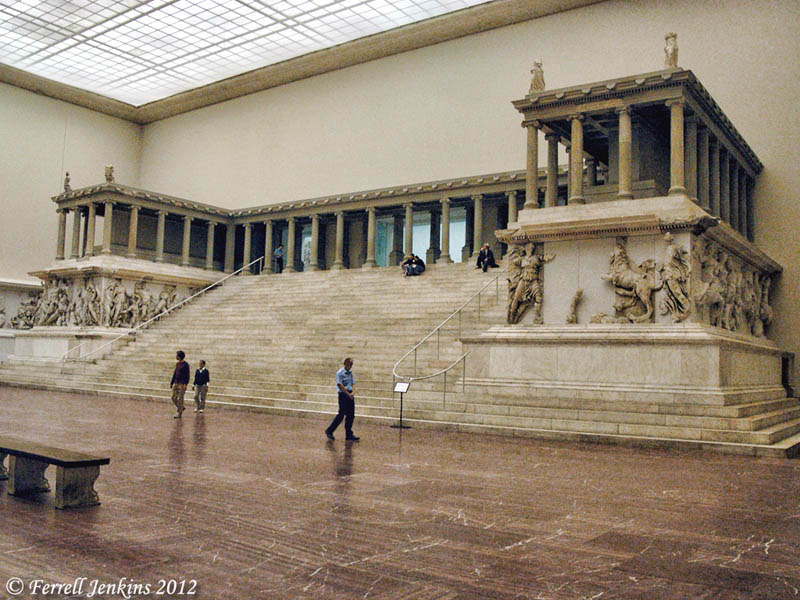
Owen Matthews, writing in Newsweek Magazine and The Daily Beast, says, “Turkey’s government is playing hardball to repatriate archaeological treasures.” He begins with the story of the German road engineer who excavated the Altar of Zeus at Pergamum (Pergamom) and arranged for the structure to be moved to Berlin and reconstructed in the museum there.

The Turkish government is now asking various museums around the world to return artifacts that  were taken from Turkey. Matthews mentions the Metropolitan Museum of Art in New York, the British Museum, and the Boston Museum of Fine Arts, along with others.

The reconstructed Pergamum Altar of Zeus in Berlin. Photo by Ferrell Jenkins.

The reconstructed Pergamum Altar of Zeus in Berlin. Photo by Ferrell Jenkins.

Today 30 young archeologists from all over the world work at Pergamon, uncovering new parts of the ancient city, meticulously recording, photographing, sketching, and cleaning the uncovered artifacts. The dig is considered the finest of its kind in the world. The state-of-the-art iDAI.field computer system for inputting real-time archeological data was pioneered here, along with many techniques for photographing, conserving, and mapping now considered standard across the world. In 2004 a complex of vulnerable newly discovered mosaics was enclosed in a beautiful wood, stone, and steel building designed by award-winning German architects and paid for entirely by the German government. The practice of hauling finds back to the home country was abandoned, of course, more than a century ago—today, all the finds remain in Turkey.

Despite a century of Germany’s investment in the fabric of Pergamon, the local authorities still view the Germans with suspicion. A recent mayor of Bergama ran on a ticket of returning the Altar of Zeus from Berlin, something the ministry itself hasn’t asked for (the paper trail clearly confirms that the altar was legally exported). And the DAI has come under pressure from tourism authorities to spend more resources rebuilding fallen temples to make them more photogenic to visitors rather than meticulously trowelling [sic] through ancient sewers and tombs.

Matthews says the Turkish authorities have decided “to play hardball” with various countries working in Turkey. Considering the remarkable work done by the Germans at Pergamum and Hattusha, the British at Carchemish, the Austrians at Ephesus, to mention just a few examples, this is an unfortunate situation. Read the article in its entirety here.

Turkish archaeologists have done significant work in numerous places throughout the country. But with more than a thousand archaeological sites, cooperation would be better.

Pergamum is the site of one of the churches addressed in the Book of Revelation (the Apocalypse) toward the end of the first century A.D. (Revelation 1:11; 2:12-17).

HT: Jack Sasson

Reclining in the Upper Room

Each of the Gospels tell us something about the last supper Jesus ate with His disciples prior to the crucifixion. Matthew says,

Now on the first day of Unleavened Bread the disciples came to Jesus, saying, “Where will you have us prepare for you to eat the Passover?” said, “Go into the city to a certain man and say to him, ‘The Teacher says, My time is at hand. I will keep the Passover at your house with my disciples.'”  And the disciples did as Jesus had directed them, and they prepared the Passover.  When it was evening, he reclined at table with the twelve. (Matthew 26:17-20 ESV)

Both Mark and Luke inform us that the room was a “large upper room furnished” (Mark 14:15; Luke 22:12). Leon Morris comments on these arrangements.

The householder would show them a large upper room furnished. This last word is literally ‘spread’ and probably means that there would be couches ready with coverings spread over them (Moffatt translates ‘with couches spread’). They followed instructions and prepared the meal. (Morris, Luke: An Introduction and Commentary. Tyndale New Testament Commentaries, 323.)

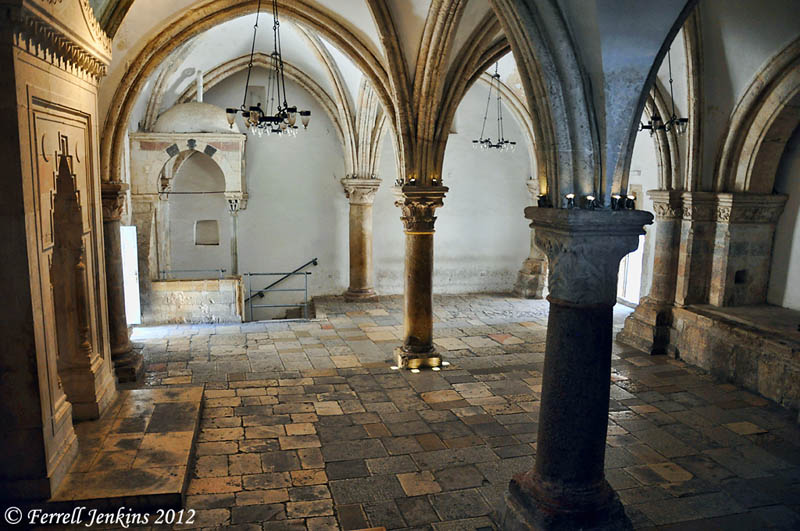
There is in the portion of the Old City of Jerusalem called Mount Zion (which really isn’t) a room known as the Cenacle (Latin) or the Room of the Last Supper. The tradition goes back further, but the building as we see it today dates back to the time of the Franciscans in 1335 A.D. (Murphy-O’Connor, The Holy Land).

The traditional room of the Last Supper (the Cenacle) on Mount Zion, Jerusalem. Photo by Ferrell Jenkins.

The traditional room of the Last Supper on Mount Zion. Photo by Ferrell Jenkins.

Jim Fleming has specialized in recreating the world of the Bible for modern students. He says,

Rather than picturing small round or rectangular standing tables, these words would have called to mind a room with a large U-shaped triclinium dining table with cushions.

Persons lying down to eat would recline around the outside of the table with the upper body supported on their left elbow. At large tricliniums the food was served from the center of the U-shaped table. (The World of the Bible Replicas)

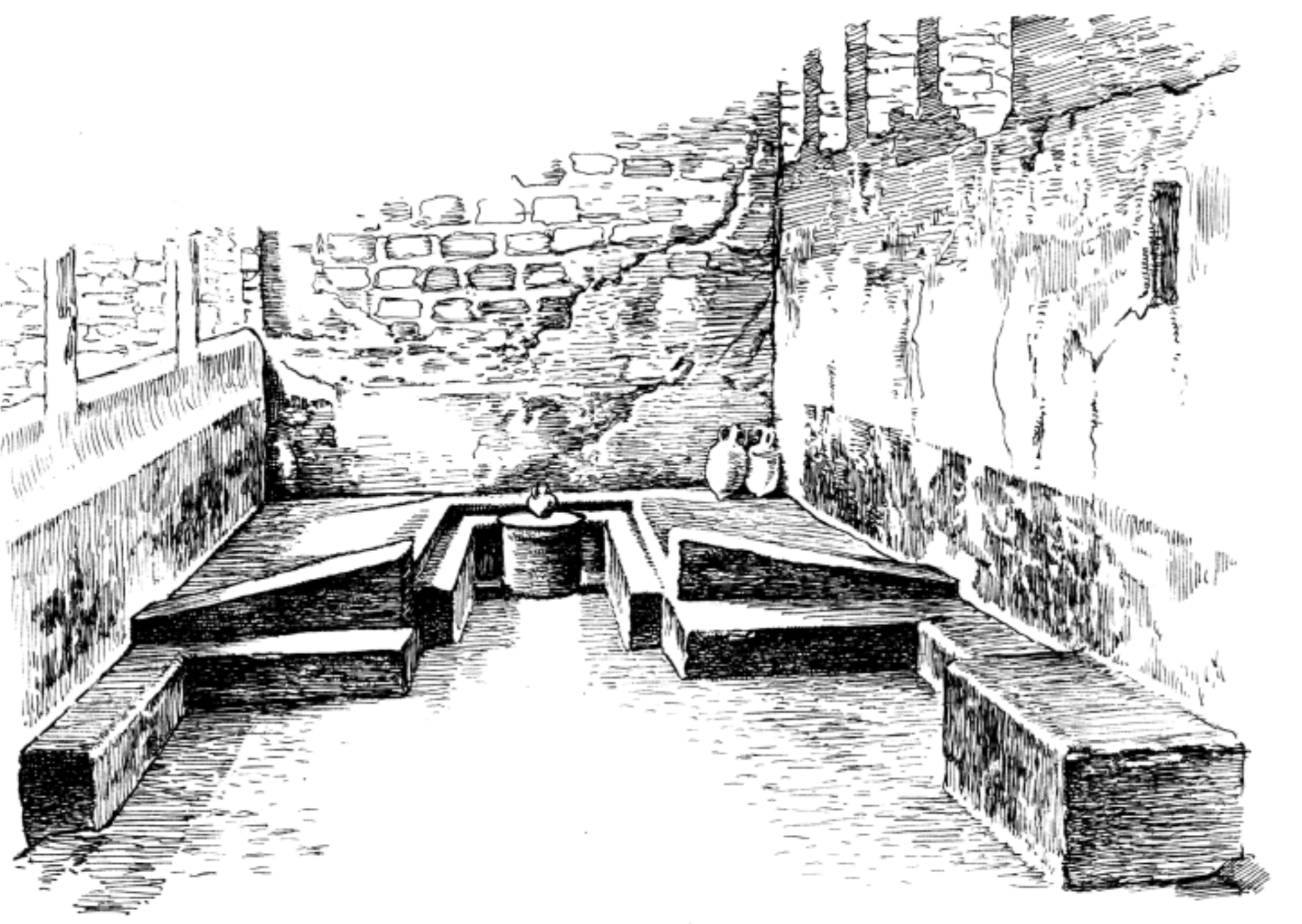
Here is a drawing of a typical Roman triclinium.

Triclinium (1000 Bible Images).

Triclinium. Credit: 1000 Bible Images.

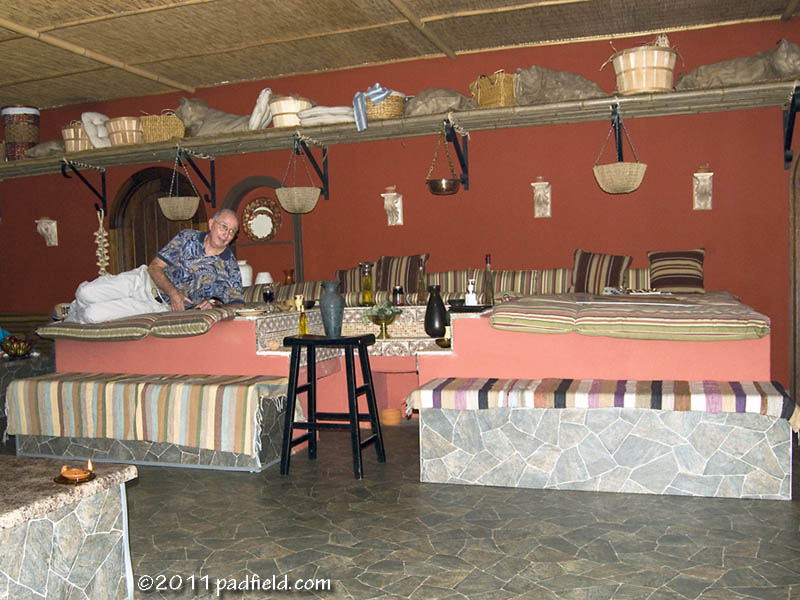
And here is a photo of a reconstructed triclinium at the Explorations in Antiquity Center in LaGrange, Georgia [Take the kids with you.]. The photo is courtesy of David Padfield.

Triclinium at Explorations in Antiquity Center. Photo by David Padfield.

Triclinium at Explorations in Antiquity Center. Photo by David Padfield.

Some of our English versions correctly use the term recline, reclined, or reclining, in the passages relating to eating meals in New Testament times. The KJV and the NKJV use “sat down” or similar terminology. Knowing that the concept of reclining is not understood by modern readers, some translations use a dynamic equivalent such as “took his place at the table” (CEB; NET, with a note of explanation).

Remember what you have learned here the next time you come across one of these references in your reading of the New Testament.

For a summary of the last week of the ministry of Jesus prior to the crucifixion, see here.

Satet — the female god of Elephantine

We noted earlier that there were three major gods worshiped on Elephantine Island and the nearby region — Khnum, Satet, and Anqet. Khnum was the river or water god and was considered the god of the Nile. Satet was his female counterpart.

Her most important role was as the goddess of the inundation (yearly flooding of the Nile). According to myth, on the “Night of the Teardrop” would shed a single tear, which was caught by Satet and poured into the Nile, causing the inundation. (Ancient Egypt Online)

Budge says that at one period,

she must have been regarded as the goddess of the inundation, who poured out and spread over the land the life-giving waters of the Nile, and as the goddess of fertility. (The Gods of Egypt, II:55)

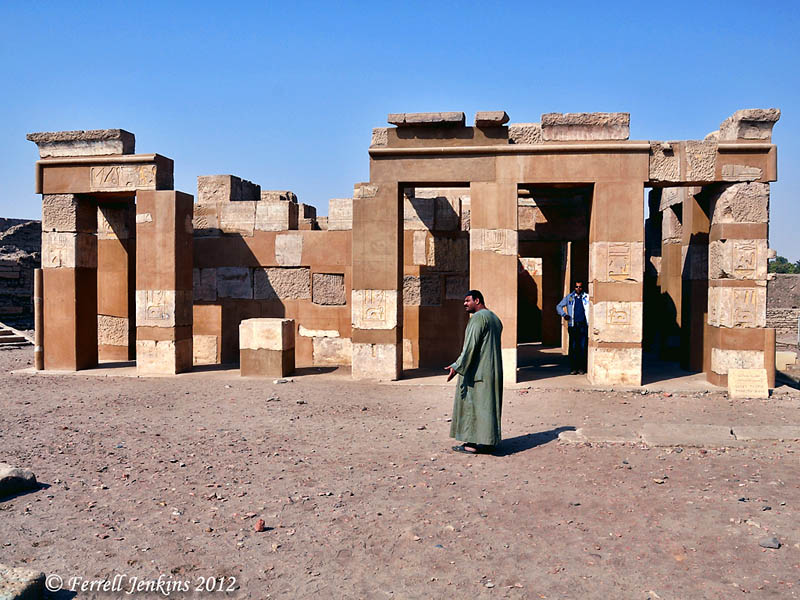
The ruins shown below belong to the Temple of Satet from Egyptian Dynasty XVIII. This was the time of Thutmose III (roughly around 1500 B.C.), during what is designated the New Kingdom Period.

Satet Temple on Elephantine Island. Photo by Ferrell Jenkins.

Satet Temple on Elephantine Island. Photo by Ferrell Jenkins.

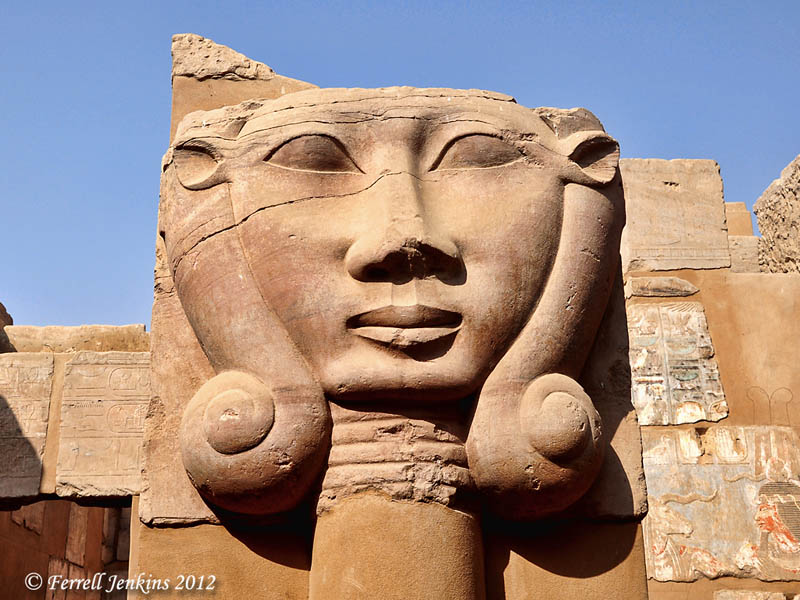
A broken relief of the head of Hathor may be seen in the ruins. Hathor portrayed herself with the head of a cow, with two horns, and a solar disc between the horns. Sometimes she was portrayed in the form of a cow.

Hathor in the Ptolemaic Satet Temple on Elphantine Island. Photo by Ferrell Jenkins.

Hathor in the Satet Temple on Elephantine Island. Photo by Ferrell Jenkins.

Temples honoring Satet continued on the island into the Ptolemaic and Roman periods.

Israel had been warned at the time of the Exodus that they should not return to Egypt.

Only he must not acquire many horses for himself or cause the people to return to Egypt in order to acquire many horses, since the LORD has said to you, ‘You shall never return that way again.’ (Deuteronomy 17:16 ESV)

After the Exile of Judah to Babylon, some of the Judeans who remained in the land of Judah returned to Egypt taking the prophet Jeremiah with them. Jeremiah continued to warn of the dangers of serving the gods of Egypt. In fact, the women of Judah are accused of leading their husbands into worshiping the gods of Egypt (Jeremiah 44).