Category Archives: Archaeology

What do you know about Tisha B’Av?

Tuesday, August 1, 2017, many of the Jewish people recently will observe Tisha B’Av. This phrase, strange to Christians, means the Fast of the Ninth. The observance “is a day of mourning to commemorate the many tragedies that have befallen the Jewish people” (Judaism 101). According to this source, five terrible events took place on or near the ninth day of the month Av, the fifth month of the Jewish calendar.

The most significant of these events are the destruction of the Temple by the Babylonians in 586 B.C. (2 Kings 25:8-9; Jeremiah 52:12-13), and the destruction by the Romans in A.D. 70.

In the past half century a considerable amount of evidence has come to light concerning the destruction of Jerusalem by the Babylonians. The temple destroyed in 586 B.C. had been constructed by King Solomon in about 966 B.C. It was rebuilt by those who returned from the Babylonian Exile (530-516 B.C.).

In the previous post we published the Israel Antiquities Authority release about additional evidence of the Babylonian destruction of Jerusalem found in the City of David. Take a look at the additional photos there.
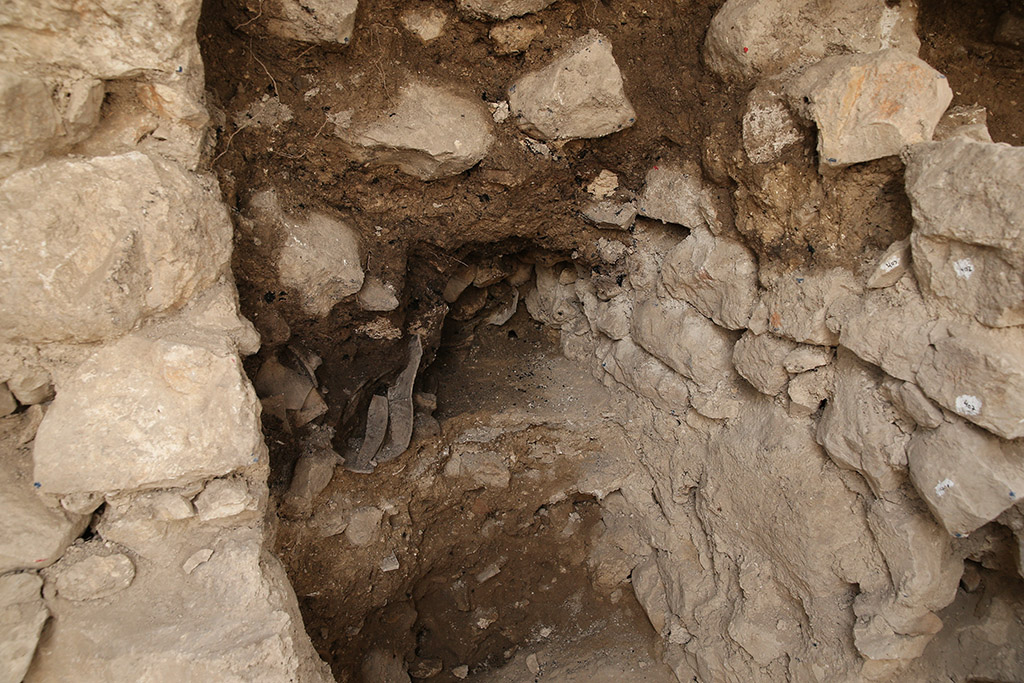
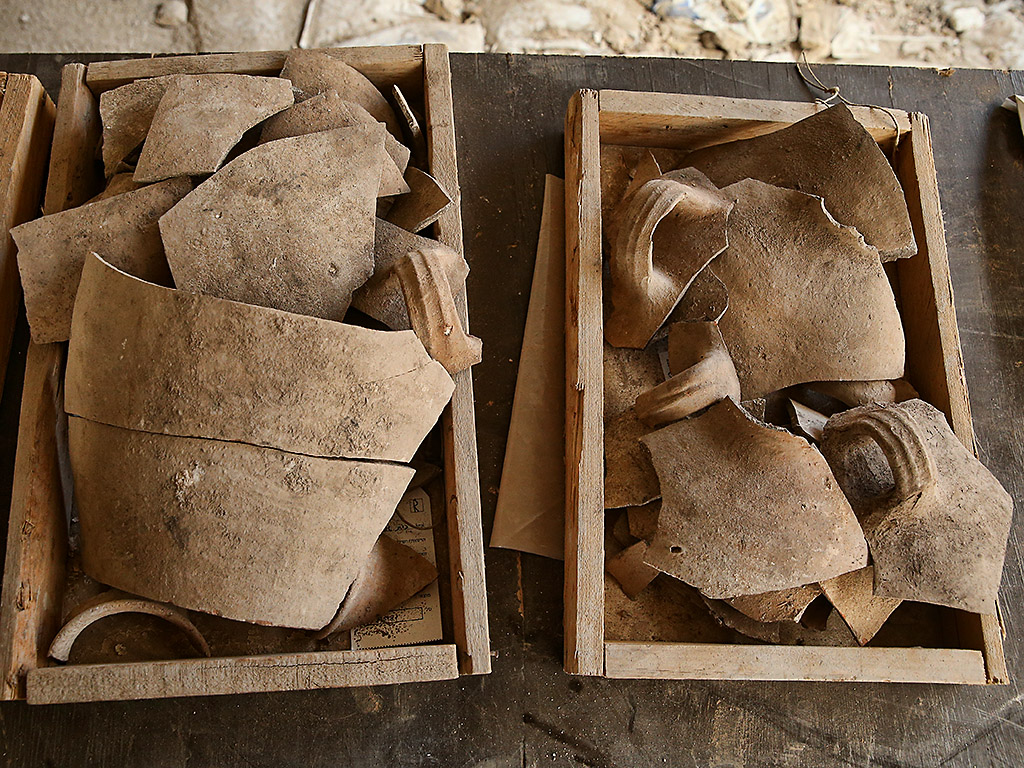
The structure in which shattered jugs were found, attesting to the destruction of Jerusalem by the Babylonians. Picture: Eliyahu Yanai, Courtesy of the City of David Archive.

The structure in which shattered jugs were found, attesting to the destruction of Jerusalem by the Babylonians. The darker area near the center of the photo shows the burn level when the city was destroyed. Picture: Eliyahu Yanai, Courtesy of the City of David Archive.

Herod the Great began about 19/20 B.C. to rebuild the temple. This work was still in progress during the ministry of Jesus.

Then the Jewish leaders said to him, “This temple has been under construction for forty-six years, and are you going to raise it up in three days?” (John 2:20 NET)

Christians take seriously the prophecy of Jesus.

Now as Jesus was going out of the temple courts and walking away, his disciples came to show him the temple buildings. And he said to them, “Do you see all these things? I tell you the truth, not one stone will be left on another. All will be torn down!” (Matthew 24:1-2 NET)

There is no archaeological evidence of the temple building itself. The site where the temple once stood is now covered with paving stones and the Dome of the Rock which was constructed by the followers of Mohamed in the 7th century A.D.
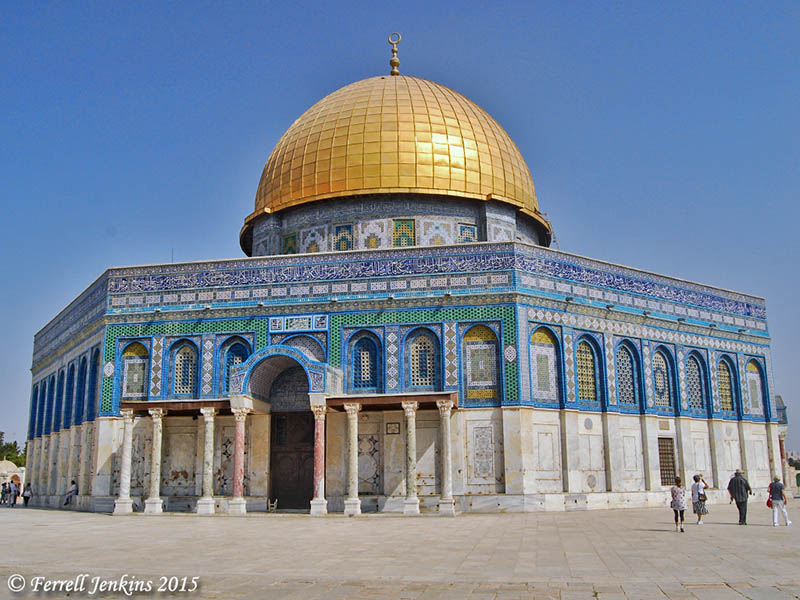
The Dome of the Rock stands where Solomon’s Temple was built. Photo by Ferrell Jenkins.

The Dome of the Rock stands where Solomon’s Temple was built. Photo by Ferrell Jenkins.

Vivid evidence of the Roman destruction of Jerusalem was discovered at the SW corner of the temple area in the Tyropean Valley. Some of the rubble can still be seen on the street which was probably built by Agrippa II in the 60s of the first century.
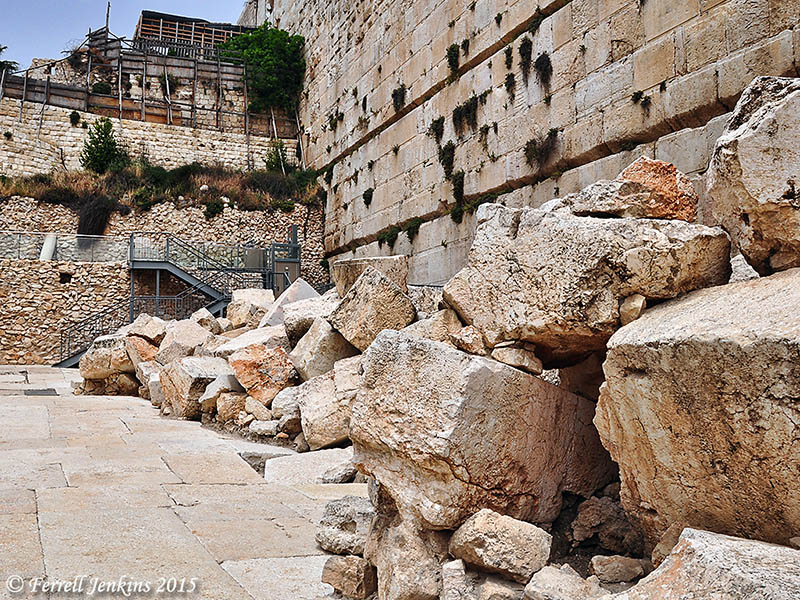
Stones that fell, or were pushed, from the Temple Mount to the street below in A.D. 70 at the time of the destruction by the Romans. Photo by Ferrell Jenkins.

Stones that fell, or were pushed, from the Temple Mount to the street below in A.D. 70 at the time of the destruction by the Romans. Photo by Ferrell Jenkins.

Wayne Stiles recently wrote an article here on this topic with several excellent photos from the Burnt House in Jerusalem, a house burned during the Roman destruction in A.D. 70.
More evidence of Babylonian destruction of Jerusalem

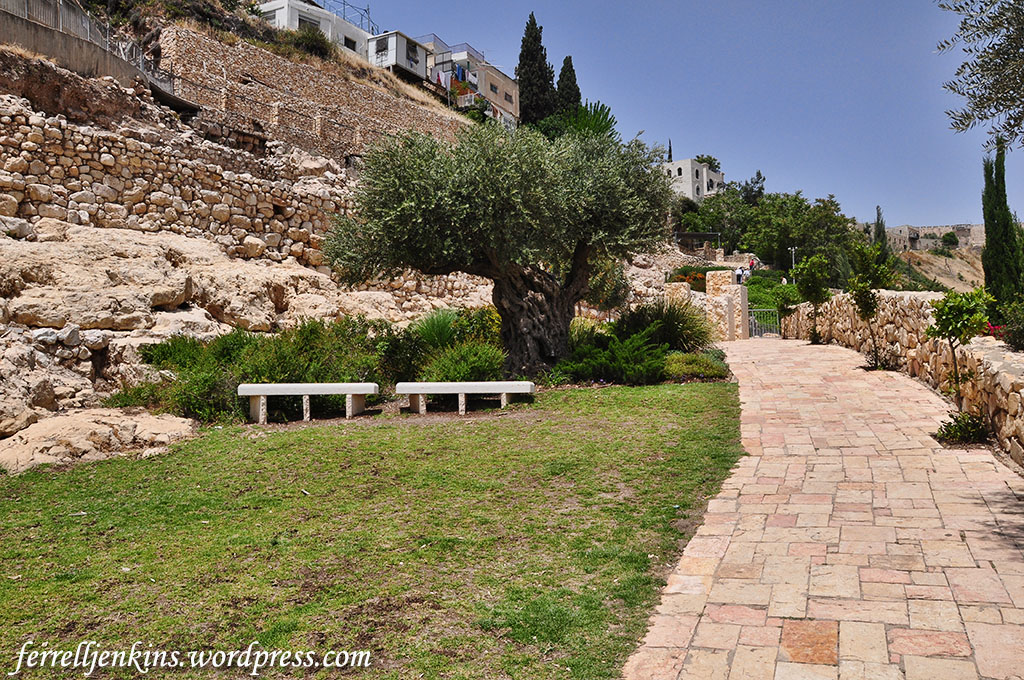
The Israel Antiquities Authority announced an important discovery in the Jerusalem Walls National Park today. Our photo below shows a portion of this park on the east slope of the city of David, overlooking the Kidron Valley. The view is north toward the southeastern corner of the Temple Mount.

Jerusalem Wall National Park on the east slope of the City of David. View North. Photo by Ferrell Jenkins.

Jerusalem Wall National Park on the east slope of the City of David. View North. Photo by Ferrell Jenkins.

I do not know the exact location of the new discovery, but this photo may give you some idea of the area.

Here is the IAA News Release.

— “ —

Evidence of the destruction of Jerusalem at the hands of the Babylonians has recently been unearthed in the City of David in excavations conducted by the Israel Antiquities Authority at the Jerusalem Walls National Park, funded by the City of David Foundation (Elad). In the excavations – concentrated on the eastern slope of the City of David, structures dating to more than 2,600 years ago have been unearthed after having been covered over by collapsed layers of stone. Nestled within the collapse, many findings have surfaced: charred wood, grape seeds, pottery, fish scales and bones, and unique, rare artifacts. These findings depict the affluence and character of Jerusalem, capital of the Judean Kingdom, and are mesmerizing proof of the city’s demise at the hands of the Babylonians.

Shattered jugs, attesting to the destruction. Photo: Eliyahu Yani, courtesy of the City of David Archive.

Shattered jugs, attesting to the destruction. Photo: Eliyahu Yani, courtesy of the City of David Archive.

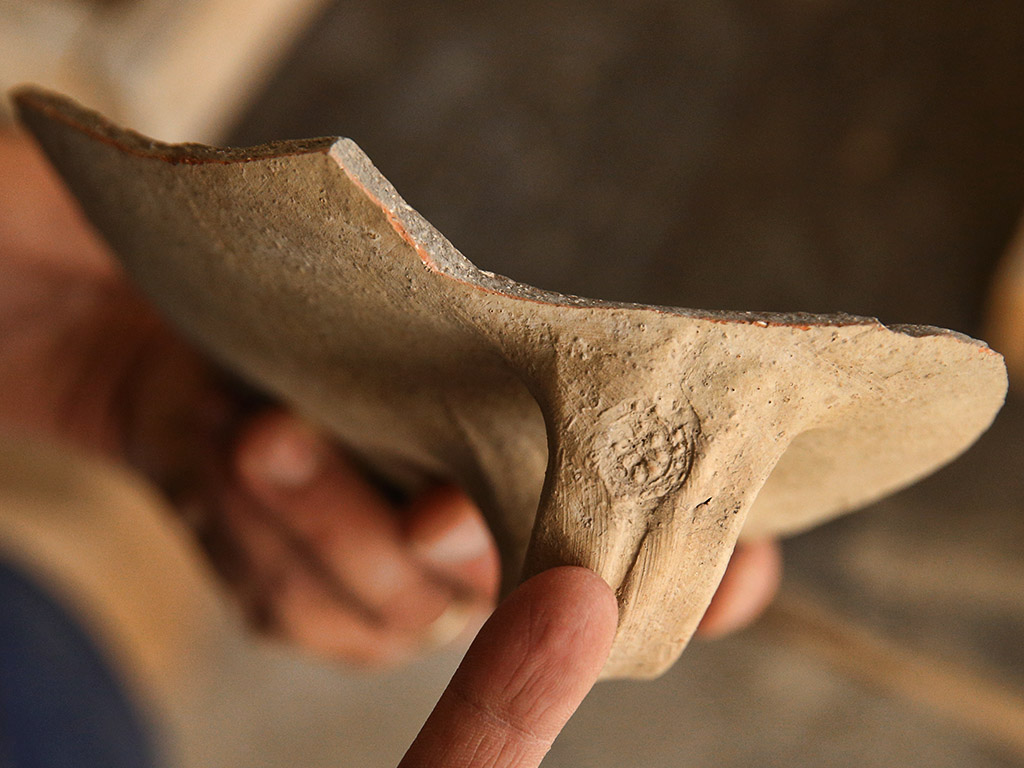
Among the excavation’s salient findings were dozens of storage jars which served to store both grain and liquids, several of which had stamped handles. Several of the seals discovered depict a rosette – a petalled rose. According to Ortal Chalaf and Dr. Joe Uziel, Israel Antiquities Authority excavation directors: “These seals are characteristic of the end of the First Temple Period and were used for the administrative system that developed towards the end of the Judean dynasty. Classifying objects facilitated controlling, overseeing, collecting, marketing and storing crop yields. The rosette, in essence, replaced the ‘For the King’ seal used in the earlier administrative system.”

Jug handles with the rosette seal used by the administrative system at the end of the Judean Kingdom. Picture: Eliyahu Yanai, Courtesy of the City of David Archive

Jug handles with the rosette seal used by the administrative system at the end of the Judean Kingdom. Picture: Eliyahu Yanai, Courtesy of the City of David Archive.

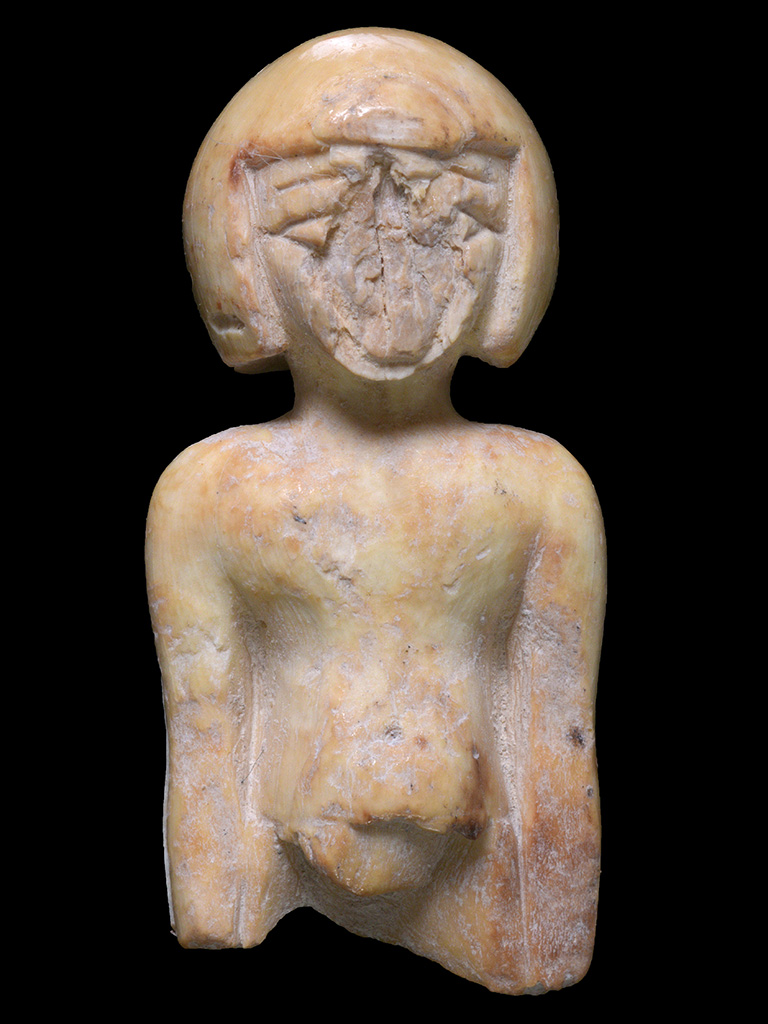
The wealth of the Judean kingdom’s capital is also manifest in the ornamental artifacts surfacing in situ. One distinct and rare finding is a small ivory statue of a woman. The figure is naked, and her haircut or wig is Egyptian in style. The quality of its carving is high, and it attests to the high caliber of the artifacts’ artistic level and the skill par excellence of the artists during this era.

Ivory statue in the image of a woman. Picture: Clara Amit, Israel Antiquities Authority

Ivory statue in the image of a woman. Picture: Clara Amit, Israel Antiquities Authority.

According to Ortal Chalaf and Dr. Joe Uziel, Israel Antiquities Authority excavation directors, “The excavation’s findings show that Jerusalem had extended beyond the line of  the city wall before its destruction. The row of structures exposed in the excavations is located outside beyond the city wall that would have constituted the eastern border of the city during this period. Throughout the Iron Age, Jerusalem underwent constant growth, expressed both in the construction of numerous city walls and the fact that the city later spread beyond them. Excavations carried out in the past in the area of the Jewish Quarter have shown how the growth of the population at the end of the 8th Century BCE led the annexation of the western area of Jerusalem. In the current excavation, we may suggest that following the westward expansion of the city, structures were built outside of the wall’s border on the east as well.”

— ” —

HT: Joseph I. Lauer

Greek Orthodox church sells property. You may be surprised.

The Times of Israel ran an article Tuesday stating that,

The Roman Amphitheater and the hippodrome in the ancient Israeli coastal city of Caesarea have been sold off, in secret, to a mysterious overseas holding company by the Greek Orthodox Patriarchate.

Earlier we had read that the Greek Orthodox sold the land where about 1,500 owners of leased property in Jerusalem live.

The Greek Orthodox Church acquired some 4,500 dunams (1,110 acres) of real estate in the center of Jerusalem during the 19th century, primarily for agriculture. In the 1950s, just after Israel’s independence, it agreed to lease its land to the JNF for 99 years — with an option to extend. Even Israel’s parliament, the Knesset, is built on Greek Orthodox-owned land.

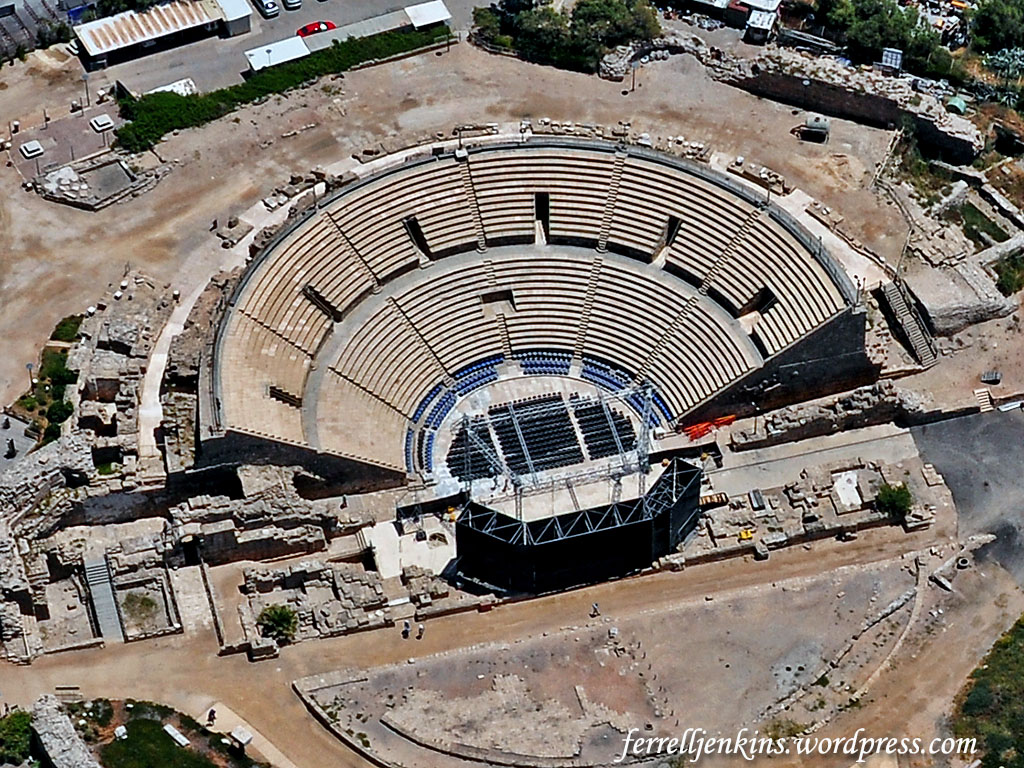
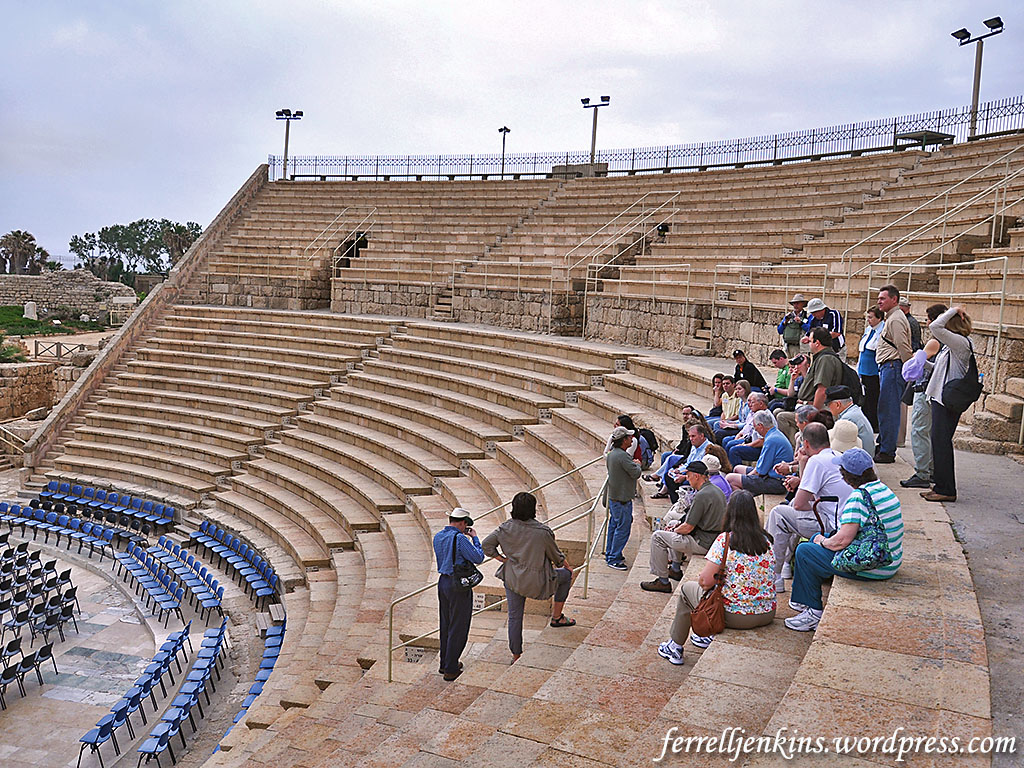
Almost anyone who has made a tour to Israel has visited the theater at Caesarea Maritima. The theater was built originally by Herod the Great but was added to and modified in later centuries. The seating capacity in its final stage was about 4,000.

This aerial photo shows the position of the theater (facing west) toward the Mediterranean Sea.

Herodian theater at Caesarea. Photo by Ferrell Jenkins.

The reconstructed theater at Caesarea. Photo by Ferrell Jenkins.

Don’t let the new seating fool you. Most of the seating has been restored since the excavation in the early 1960s. Beginning here, groups continue to the palace of the procurators, the hippodrome, and the Crusader fortress at Caesarea.

A tour group in the theater listens as the guide begins to tell them about the important of Caesarea. Photo by Ferrell Jenkins.

A tour group in the theater listens as the guide begins to tell them about the importance of Caesarea. Photo by Ferrell Jenkins.

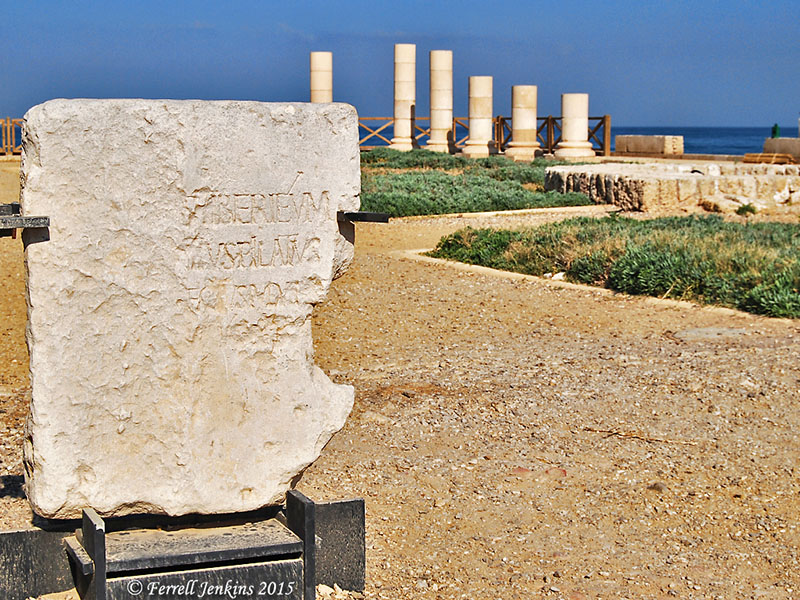
An inscription bearing the name of Pontius Pilate was found at Caesarea Maritima June 15, 1961 during the excavation of the Roman theater. The stone on which the inscription is found had been reused in the theater. The photo below shows a replica of the inscription displayed in the building described by Murphy-O’Connor as the Palace of the Procurators. The original inscription is in the Israel Museum.

Pilate inscription displayed in the Palace area at Caesarea. Photo by Ferrell Jenkins.

Pilate inscription displayed in the Palace area at Caesarea. Photo by Ferrell Jenkins.

For more information about this inscription see here.

The two articles from The Times of Israel will provide much additional information. You may locate them here and here.

An Iron Age pitcher in the Hecht Museum

The Hecht Museum is located in one of the major buildings of the University of Haifa. They have a wonderful teaching collection with some unique items. Many of the artifacts, however, are unprovenanced. This means they come from an unknown source. There is a big controversy among scholars about the publication and display of these items.

In my judgment it is better to display them with the information that is known than to store them in an inaccessible basement or warehouse.

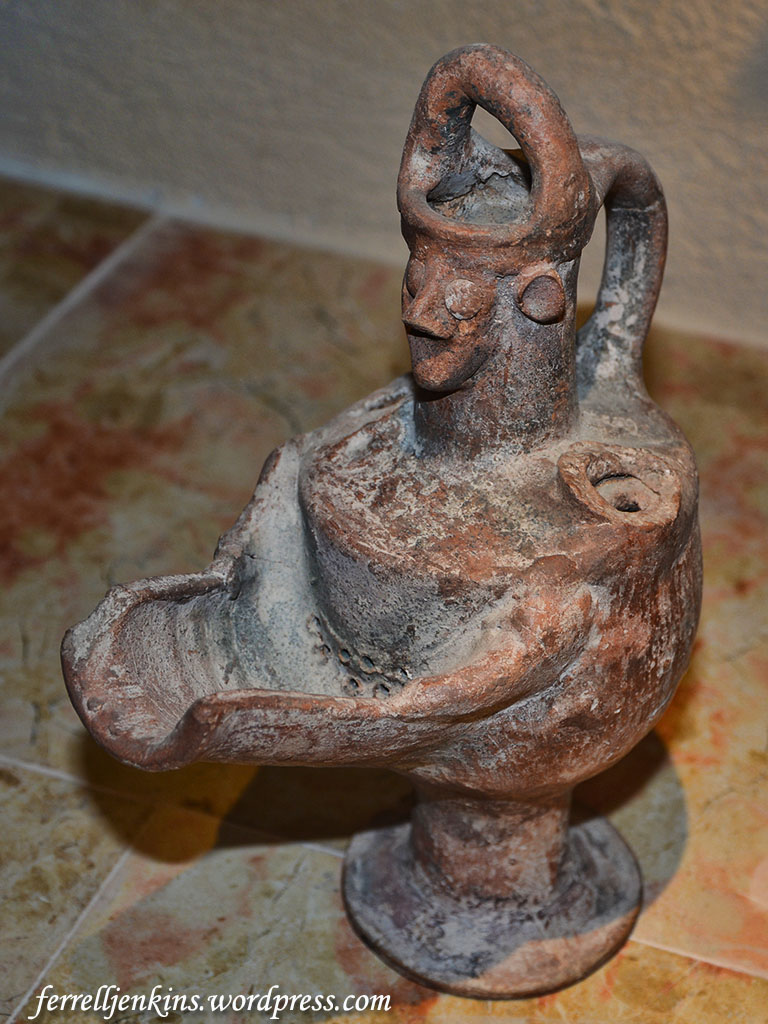
According to the information with the museum display this is a pitcher, with a spout, red burnished, 10th century B.C., Israel Iron Age.

Iron Age pitcher. Displayed in the Hecht Museum. Photo by Ferrell Jenkins.

Iron Age pitcher. Displayed in the Hecht Museum. Photo by Ferrell Jenkins.

Then I set cups and pitchers full of wine in front of the members of the Rechabite community and said to them, “Have some wine.” (Jeremiah 35:5 NET)

Guys, I suggest you don’t show this to your wife. She may want one for her china cabinet.

New discovery at Machaerus where John was imprisoned

All four of the Gospels make some reference to the imprisonment of John the Baptist (Matthew 14:3,10; Mark 6:17; Luke 3:20; John 3:24). This must have been a significant and traumatic event for both the disciples of John and the disciples of Jesus.

Mark, the shortest gospel,  gives the most complete account of why Herod Antipas arrested and executed John. See Mark 6:17-32.

Josephus, the late first century Jewish historian, includes a long section about John in Antiquities 18:116-119. Perhaps another time we will take a closer look at all of it. For now, I am concerned with the place of execution.

Accordingly he was sent as prisoner, out of Herod’s [Antipas] suspicious temper, to Machaerus [or spell it Macherus], the citadel I before mentioned, and was there put to death. Now the Jews had an opinion that the destruction of this army was sent as a punishment upon Herod, and a mark of God’s displeasure to him. (Antiquities 18:119)

Josephus also records that Herod’s wife, the daughter of Aretas IV, king of Petra (the Nabateans), learned of his plan to divorce her and marry Herodias. Without telling Antipas that she knew, she asked for permission to be sent to Machaerus.I suspect that Herod was glad to get her out-of-town. She was no dummy. She had made arrangements for her father’s army to bring her safely [from Machaerus] to Arabia [perhaps Petra]. This event led to a war between the armies of Aretas and Herod Antipas. Herod’s army was destroyed. See Antiquities 18:109-115 for the full story.

After several years of archaeological work at Machaerus, the Hungarian Archaeological Mission to Machaerus announces discovery of a large mikveh (ritual bath and immersion pool). The best report that I have seen is by Philippe Bohstrom in Haaretz here. He says,

The bath is the biggest of its kind ever found in Jordan. It boasts 12 steps and a reserve pool containing water to fill the pool when its water ran low.

Beyond its sheer dimensions, the architecture closely resembles mikvehs discovered in Qumran, on the other side of the Dead Sea, in Israel,  that had previously been considered to be unique.

The king-size mikveh was found three meters below the royal courtyard, where it had been hidden under 2,000 years of sand and dust. It had originally been equipped with a vaulted stone ceiling.

Large mikveh in Herod's palace at Machaerus, Jordan. Photo courtesy of Hungarian Archaeological Mission to Machaerus.

Large mikveh in Herod’s palace at Machaerus, Jordan. Photo courtesy of Hungarian Archaeological Mission to Machaerus.

The director of the Hungarian Archaeological Mission to Machaerus is Dr. Győző Vörös.

The location of the fortress is stunning. Herod the Great built it overlooking the Dead Sea from the east, as he had built a palace and fortress at Masada on the west side of the sea.

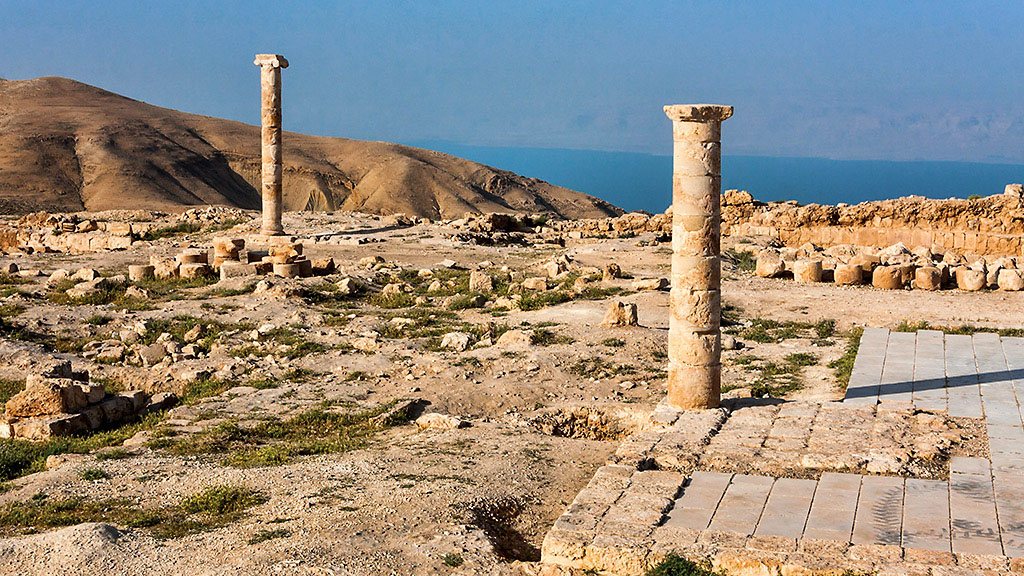
This photo gives some idea of the terrain. The citadel is located about 2300 feet above sea level. This would make it about 3600 feet above the Dead Sea.

Two columns stand on the top of Machaerus, where once the great palace of Herod the Great was located. Photo courtesty of the Hungarian Archaeological Mission to Machaerus.

A few columns stand on the top of Machaerus, where once the great palace of Herod the Great was located. Photo courtesy of the Hungarian Archaeological Mission to Machaerus.

According to an article in The Jordan Times here,

The excavation team is employing theoretical architectural reconstruction as its first step towards the restoration and presentation of the monument. Through this process, archaeologists were able to reach new findings. 

Simulation of Herod's palace-fortress at Machaerus. Photo courtestsy of the Hungarian Archaeological Mission to Machaerus.

Simulation of Herod’s palace-fortress at Machaerus. Photo courtesy of the Hungarian Archaeological Mission to Machaerus.

Here is a brief summary about Machaerus.

  • Built by Alexander Jannaeus (102-75 B.C.).
  • Rebuilt by Herod the Great. This fortress is the eastern parallel to Masada.
  • Assigned to Herod Antipas at the death of Herod the Great (4 B.C.).
  • Destroyed by the Romans (A.D. 57).
  • Occupied by Jewish rebels (A.D. 66).
  • Captured by the Romans (A.D. 71).

The photos I have used here have been sized suitable for presentations. These, and others, are found in a higher resolution in the Haaretz article.

If you could use some nice photos of Machaerus to illustrate Bible lessons, I suggest you check out those by David Padfield here. Todd Bolen, at Bible Places Blog, had already posted a photo of the newly excavated Machaerus mikveh last November.

HT: Joseph I. Lauer

Locating the Hadrian statue at Caesarea

There has been one inquiry about the specific location of the Hadrian statue and the Byzantine street. I am rather certain that in the months/years to come there will be other who will want to know how to location these things.

One interesting website (here) calls this Statues Square, and has links to some photos of the area.

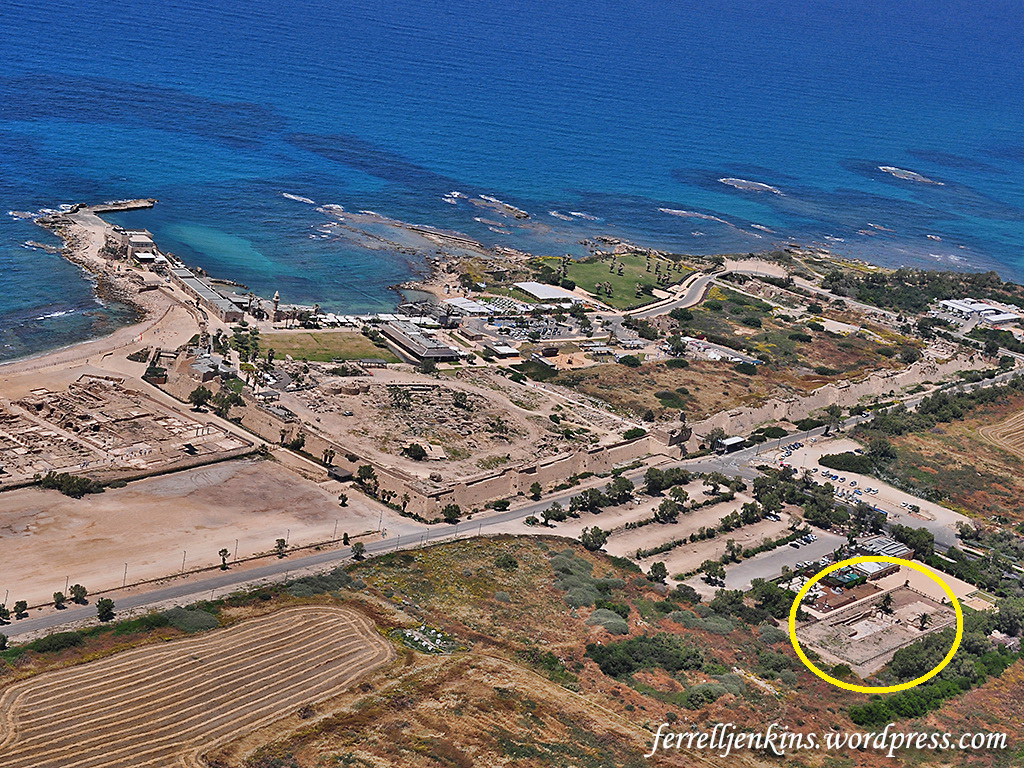
Then it occurred to me that I might have an aerial photo that includes Statues Square. The location is marked in the bottom right corner of this photo.

Aerial view of the Crusader Fortress at Caesarea. The Byzantine Street is marked in the lower right corner. Photo by Ferrell Jenkins.

Aerial view of the Crusader Fortress at Caesarea. The Byzantine Street is marked in the lower right corner. Photo by Ferrell Jenkins.

The Byzantine street, with the statues, was displayed on the first unpaved parking area parallel to the street when I first saw it years ago.

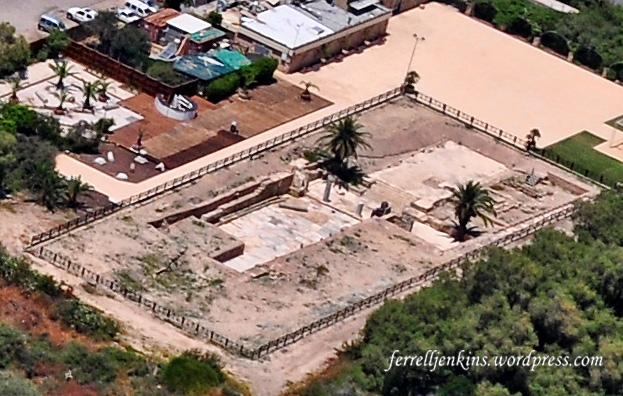
This cropped photo from the aerial shot shows the Statues Square.

Aerial view of the Byzantine and the earlier statues. Photo by Ferrell Jenkins.

Aerial view of the Byzantine and the earlier statues. Photo by Ferrell Jenkins.

Carole Madge has several web locations dealing with Hadrian. You will find photos of Caesarea here, and links to many other locations.

Having recently spent two weeks wandering about in Israel, visiting places I had never been, and places with recent changes, I noted that many of them were lacking in signs to help locate the site. Just saying …

Hadrian at Caesarea Maritima

We have written several posts about the Roman Emperor Hadrian (A.D. 117 – 138). The most recent one was about the unique Hadrian exhibit at the Israel Museum here. Others can easily be found by putting the Emperor’s name in the Search box.

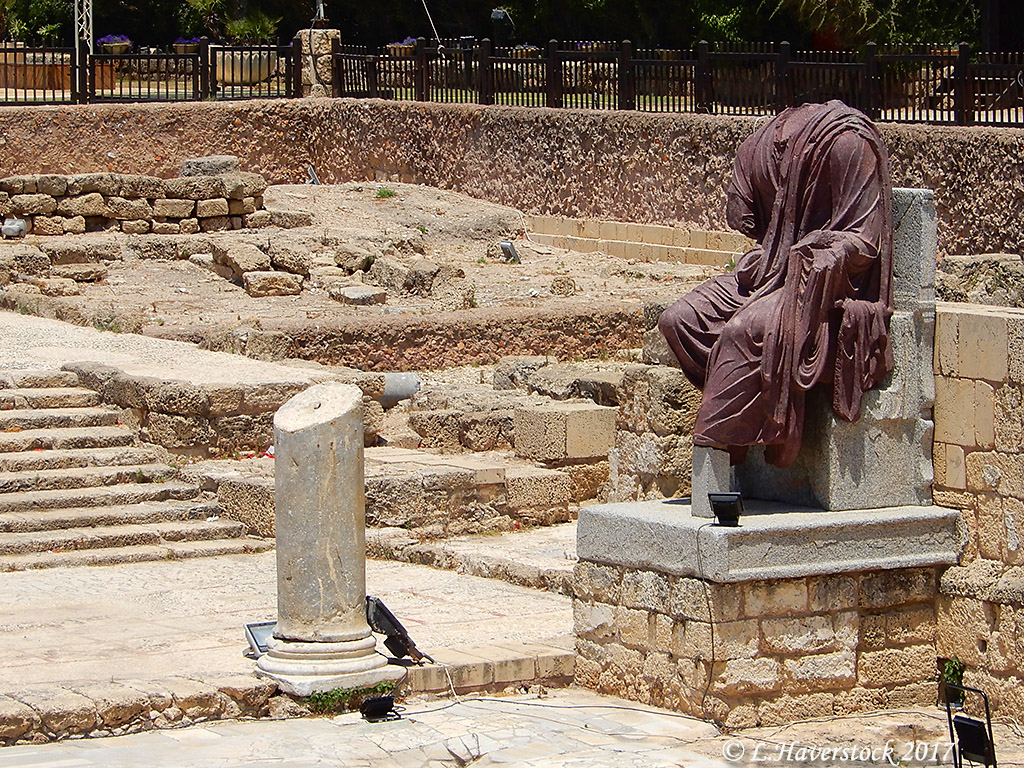
Years ago when I visited Caesarea with my groups I would see a headless statue made of porphyry thought to belong to Hadrian near the entrance to the Crusader Fortress. The statue, which was discovered accidentally in 1954, was displayed with a white marble statue on a later Byzantine street. I had asked a couple of guide friends but they did not know where the statue had been moved. A few weeks ago I spent some time trying to locate the statue in its new location but was unsuccessful.

When I realized that Larry Haverstock would be wandering around the Caesarea area for a few days ahead of joining a group tour I asked him if he would try to locate the statue.

Larry did not give up easily, and finally found the statue. Here is how he vividly describes his experience:

Turns out the elusive king’s imposing presence has been incorporated into the grounds of a large restaurant. According to Google Earth, his regal eminence is only 515 feet from the ticket seller for the Crusader Fortress / Harbor entrance at Caesarea. I just couldn’t believe it, after driving a couple of miles all around the site through banana groves and empty fields (following the museum guide’s instructions), only to discover that his headless visage had been hidden behind a fence which makes it impossible to know he’s there. In the end, I parked for free less than 200 feet from the truly impressive Emperor of Old.

A headless porphyry statue thought to be that of Emperor Hadrian displayed at Caesarea Maritima. Photo by Larry Haverstock.

A headless porphyry statue thought to be that of Emperor Hadrian displayed at Caesarea Maritima. Photo by Larry Haverstock.

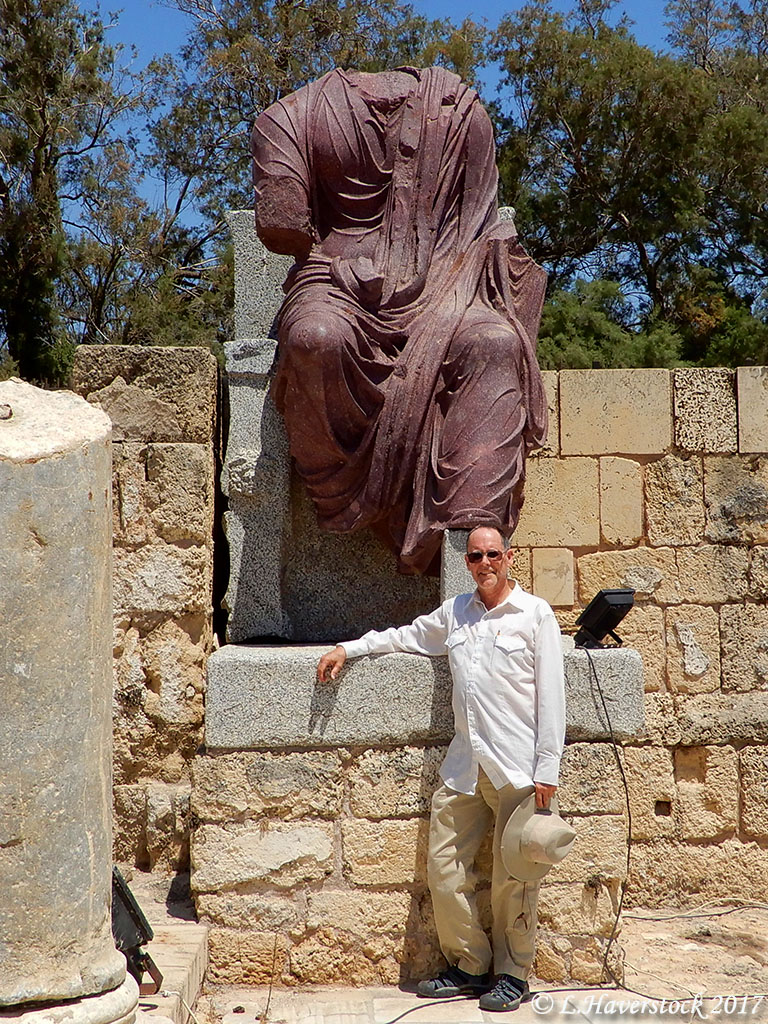
And Larry thought it helpful to pose in front of the statue to give us some idea of the size.

Larry Haverstock and the headless Emperor Hadrian. Photo by L. Haverstock.

Larry Haverstock and the headless Emperor Hadrian. Photo by L. Haverstock.

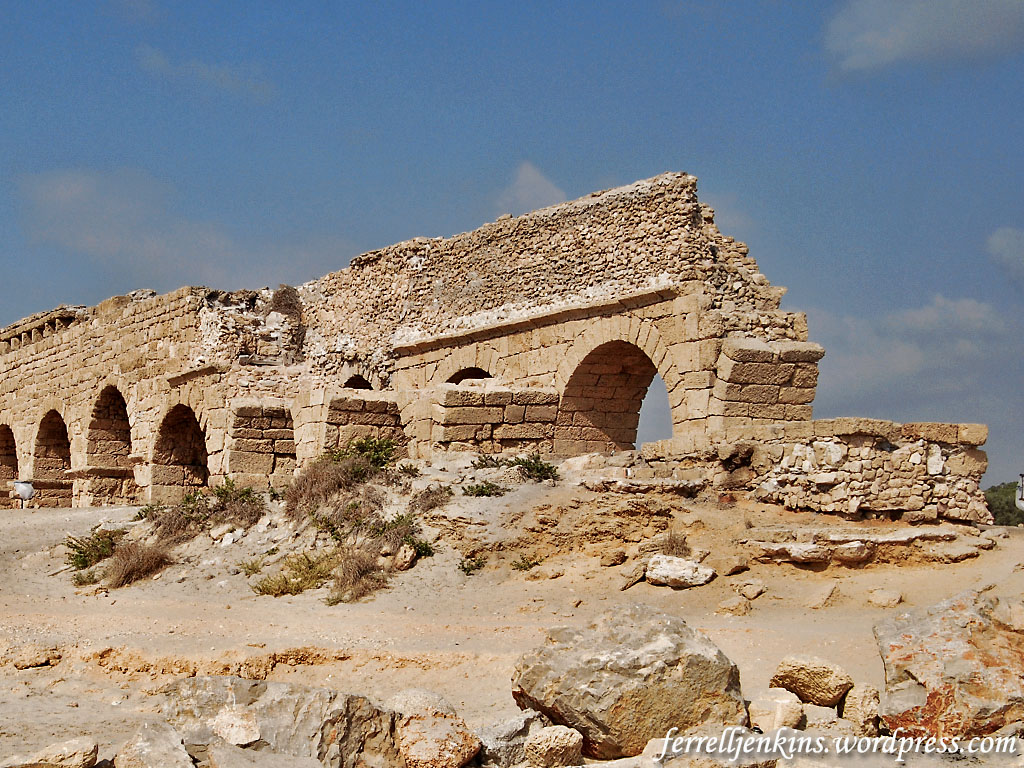
Is Hadrian important to Caesarea? Certainly. When the city began to need more water than that supplied by the aqueduct built by Herod the Great, Hadrian added another aqueduct.

High level aqueduct at Caesarea Maritima. the portion on the right of the photo (east side) was built by Herod the Great. The portion beside it on the left was added by Hadrian. Photo by Ferrell Jenkins.

High level aqueduct at Caesarea Maritima. the portion on the right of the photo (east side) was built by Herod the Great. The portion beside it on the left (west side) was added by Hadrian. Photo by Ferrell Jenkins.

Thanks to our intrepid explorer, or as he described himself in an email today, “your antiquities sleuth in the field.”

Caesarea Maritima was a first century Roman capital and seaport. The gospel was first preached to the Gentiles here when Peter came from Joppa to Caesarea to tell Cornelius words by which he could be saved (Acts 10, 11).

The Apostle Paul used the harbor at Caesarea several times. He was imprisoned in the city for two years before departing for Rome (Acts 24:27; 27:1).

Visiting the Al-Aksa Mosque

The entire Temple Precinct is called the Haram es-Sharif (Noble Sanctuary) by Moslems. They claim that the site has been identified with Islam since the religion’s beginning. The Al-Aksa (also El-Aqsa or el-Aksa) mosque is especially important because it is to this place that the Prophet Mohammad came on his night journey.

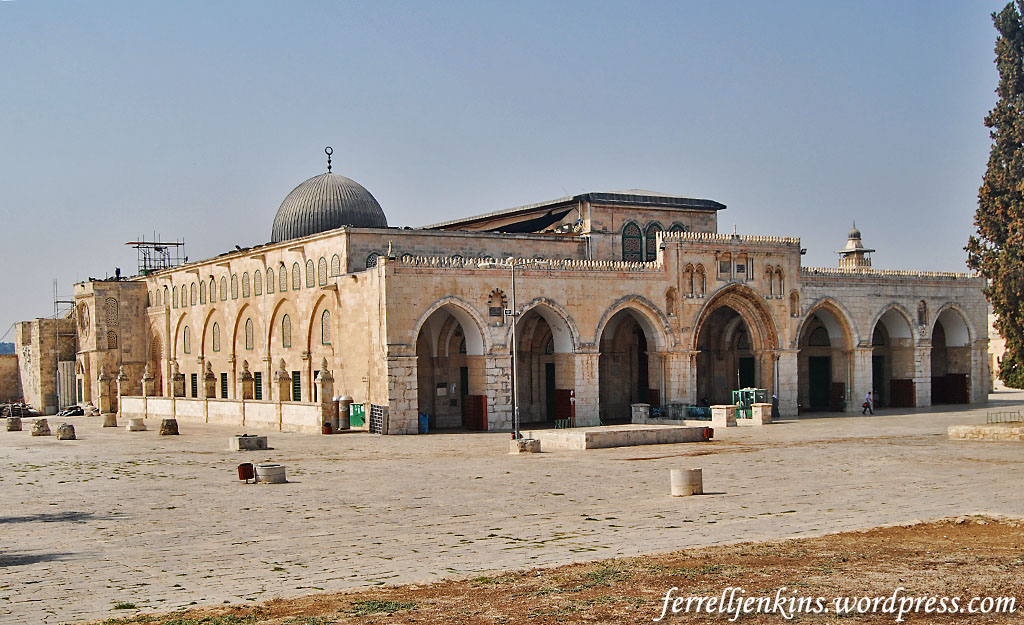
Our first photo shows the exterior of the mosque. Instead of being built on bedrock like the Dome of the Rock, this building sits on the substructure built by Herod the Great beginning in about 20 B.C. The Royal Stoa of Herod’s temple ran across the southern section of the platform at that time.

Exterior view of the Al-Aksa mosque. The dome of this building is made of lead. Photo by Ferrell Jenkins.

Exterior view of the Al-Aksa mosque. The dome of this building is plated with lead. Photo by Ferrell Jenkins.

Murphy-O’Connor describes the impression when one first enters the building.

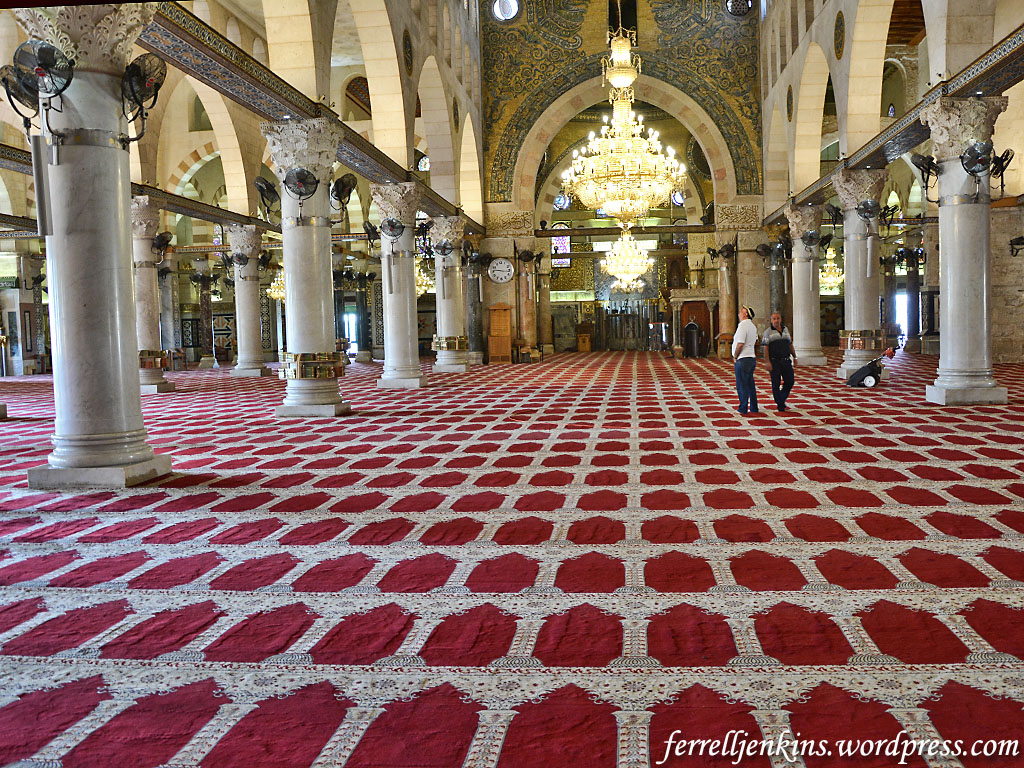
The first impression on entering is of a forest of glacial marble columns (donated by Mussolini) and a garish painted ceiling (a gift of King Farouk); they belong to the last restoration (1938-42). Virtually nothing (except perhaps the general proportions) remains of the first mosque built by the caliph al-Walid (AD 709-15), and twice destroyed by earthquakes in the first 60 years of its existence. As restored by the caliph al-Mahdi in 780 it had fifteen aisles, but these were reduced to the present seven when the caliph az-Zahir rebuilt it after the earthquake of 1033. (The Holy Land, 4th ed., 94)

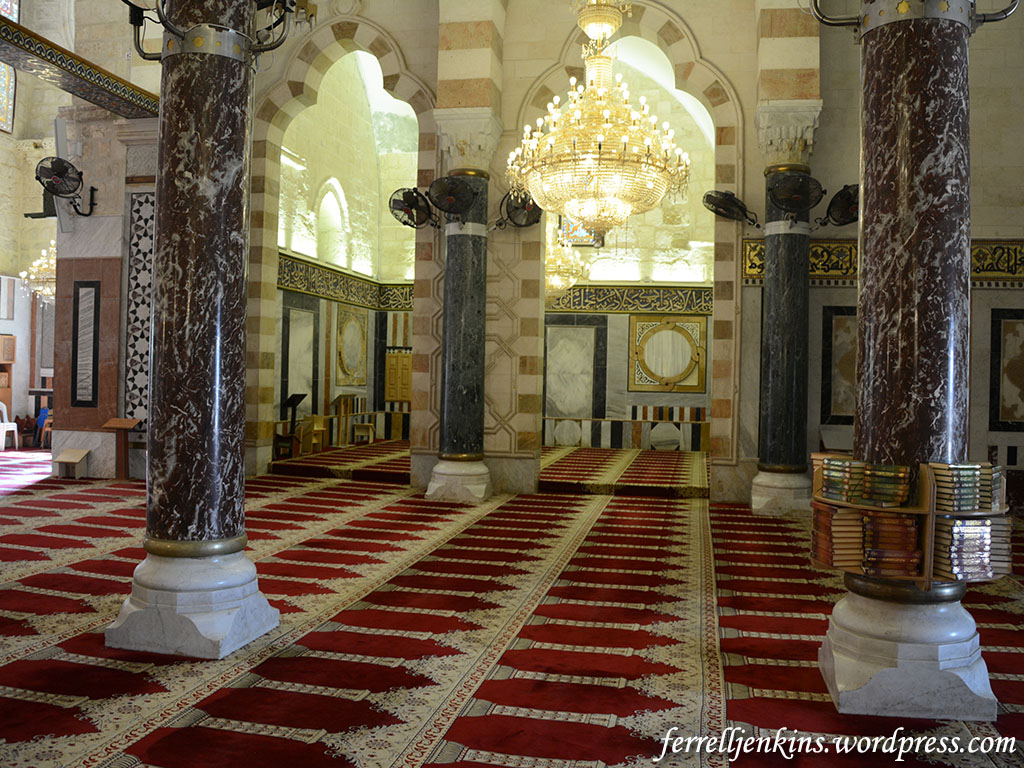
Al-Aksa has seven aisles running north-south. This is the central row. Photo by Ferrell Jenkins.

Al-Aksa has seven aisles running north-south. This is the central aisle with a view to the south. Photo by Ferrell Jenkins.

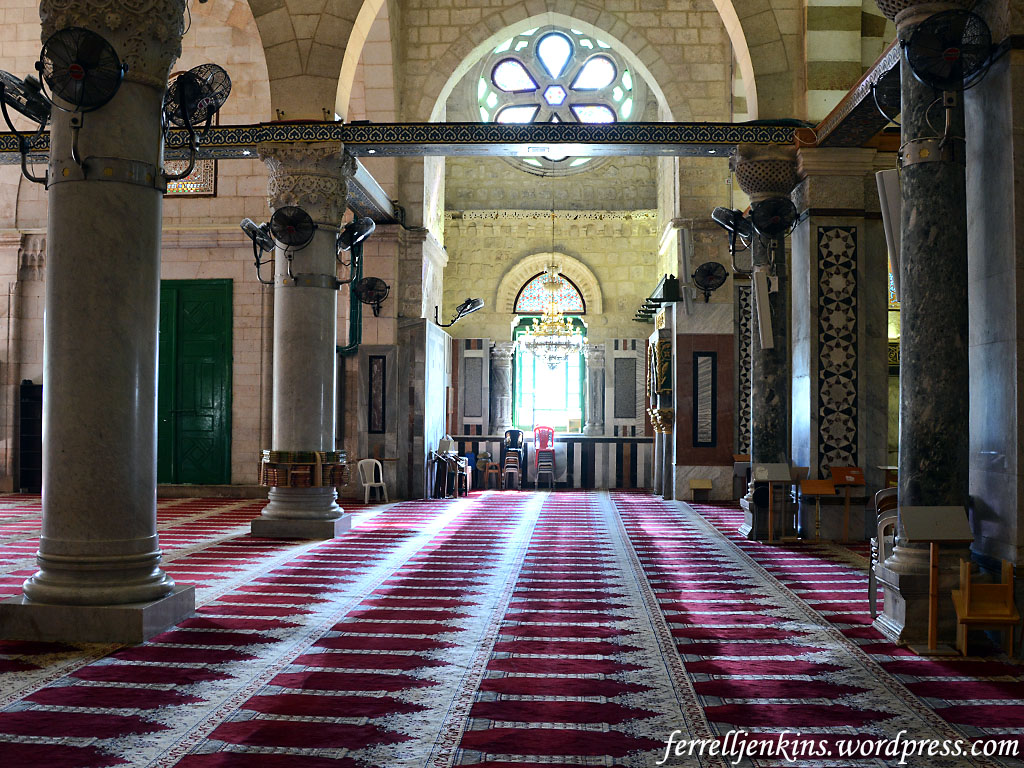
A special section of the Mosque is reserved for the Hashemite family of Jordan. Before the Six-Day war of 1967 their visits from Amman to Jerusalem must have been much more frequent. The Hashemite family claims descent from Mohammad, the name being derived from the name of the Prophet’s great-grandfather. The family is guardian of the Moslem holy places in Jerusalem.

This view to the east is reserved for the Hashemite family of Jordan. Photo by Ferrell Jenkins.

This view to the east is reserved for the Hashemite family of Jordan. Photo by Ferrell Jenkins.

Next, is a view looking west.

This view is toward the west. Photo by Ferrell Jenkins.

This view is toward the west. Photo by Ferrell Jenkins.

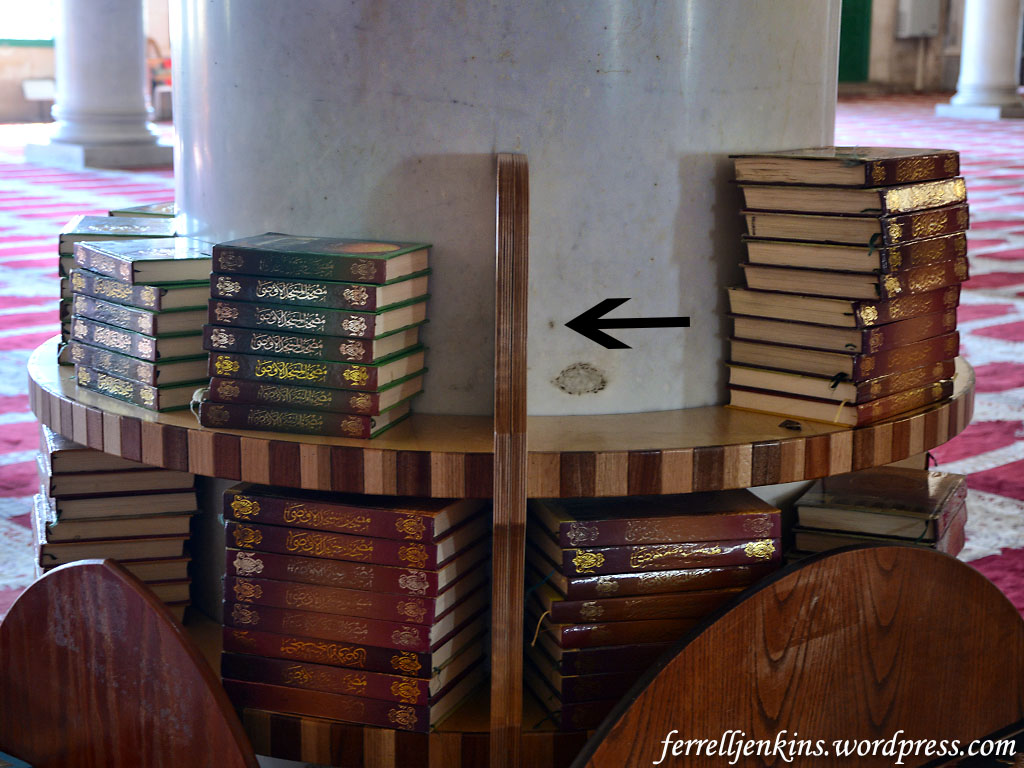
King Abdullah I was assassinated while entering the mosque in 1951. All of the sources I have read say this happened at the “entrance” to the mosque. Our guide moved aside a stack of books so we could see what he claimed was where one of the bullets lodged. I have placed the arrow to indicate the spot. This column is the first row as one enters the building. I have to leave the story there.

Our guide says that one of the bullets fired at King Abdullah I lodged in this column and was left here (where out arrow is pointing). Photo by Ferrell Jenkins.

Our guide says that one of the bullets fired at King Abdullah I lodged in this column and was left here (where out arrow is pointing). Photo by Ferrell Jenkins.

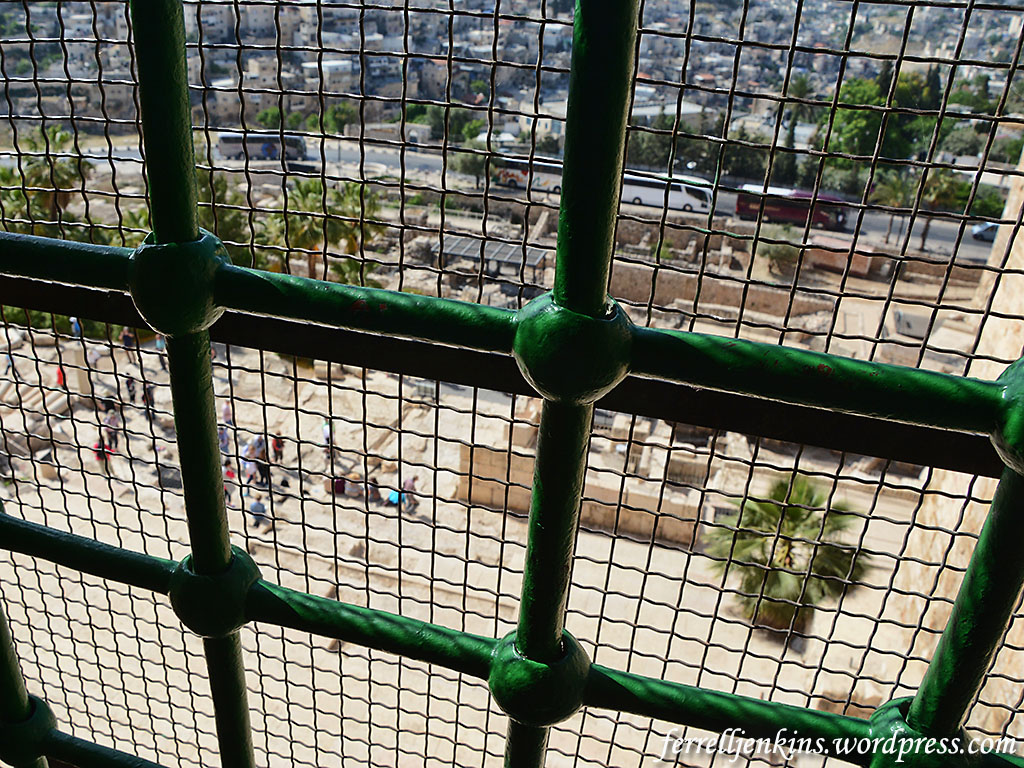
At the south end of the Mosque we were able to look down on the recently excavated steps that led to the Double Gate. This was one of the entrances to the Temple in the time of Jesus.

View of the Temple Mount steps from inside Al-Aksa moaque. Photo by Ferrell Jenkins.

View of the Temple Mount steps from inside Al-Aksa mosque. Photo by Ferrell Jenkins.

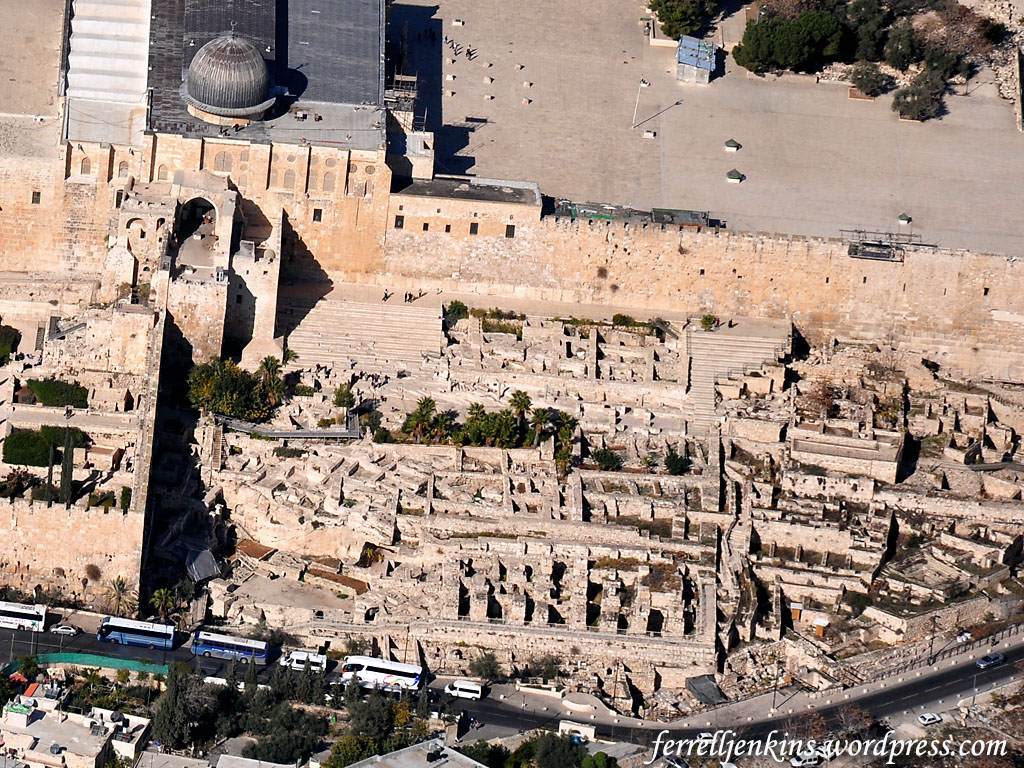
Below is our aerial photo of the Ophel excavations. The dome of the Al-Aksa Mosque is visible in the upper left. Notice the arrow-shaped shadow. Below the point we see what Benjamin Mazar called,

… a gigantic stairway which led from the Lower City (Ophel) to the [Hulda] gates. It is two hundred and fifteen feet wide; the foundation steps were cut into the natural bedrock on the slopes of the Temple Mount. The stairs were constructed of wide, trimmed and smoothed stone paving blocks, fitted together snugly. The stairway comprised thirty steps set alternately in wide and narrow rows. It ascended twenty-two feet to the upper road, also paved with large stones, immediately facing the Hulda Gates. South of it and below lay the wide plaza.” (The Mountain of the Lord, 1975, p. 143)

The window from which our previous photo was made can be seen in the wall, level with the top of the shadow arrow.

Aerial view showing the Al-Aksa dome, the Ophel, including the gigantic stairway that worshipers took to enter the temple. Photo by Ferrell Jenkins.

Aerial view showing the Al-Aksa dome, the Ophel, including the gigantic stairway that worshipers took to enter the temple. Photo by Ferrell Jenkins.

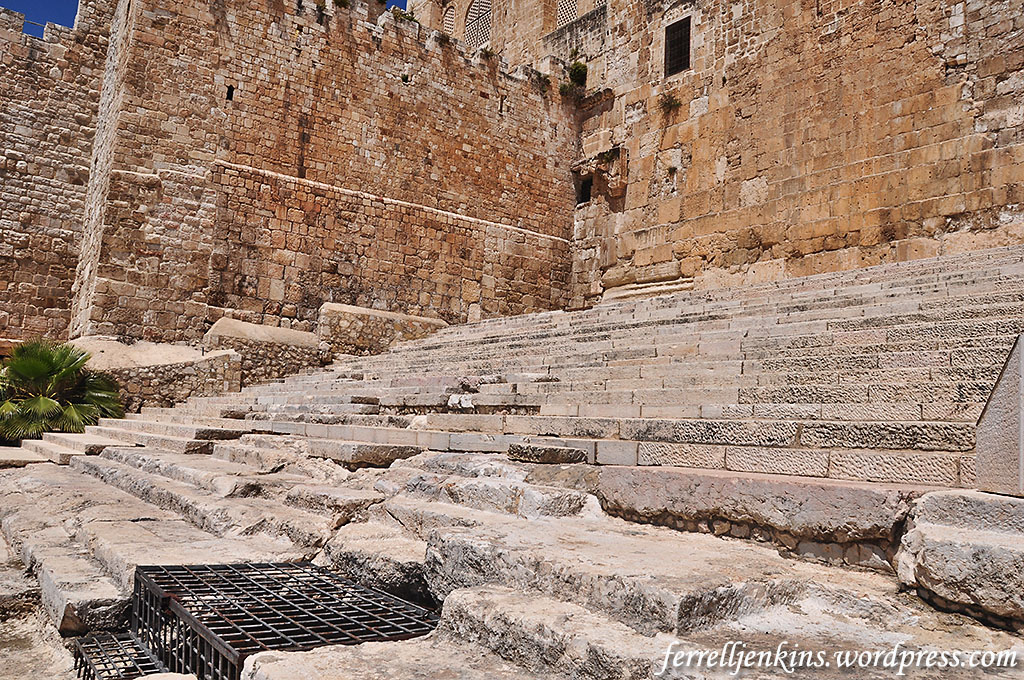
And, here is a closer view of the stairway. In this photo the window in the south wall of the Al-Aksa Mosque is visible at the top of the photo. At the time of Herod’s temple, worshipers ascended the steps, then entered through the double gates, taking more steps up to the Temple Mount platform.

The monumental steps that led to the temple in the time of Jesus. Photo by Ferrell Jenkins.

The monumental steps that led to the temple in the time of Jesus. Photo by Ferrell Jenkins.

There is good reason to believe that both Jesus and the Apostles used this entry to the Temple (Matthew 21:12-13; Acts 3:1).

More on the recently discovered Roman Road

Less than 3 months ago we reported here on the discovery of a second century Roman road uncovered in the vicinity of Beit Shemesh and the Elah Valley. Recently we came down to the area from Hwy. 60 south of Bethlehem on Hwy. 375. The information in the IAA press release indicated that the newly discovered road was near Beit Natif (Netiv), but we saw no indication of it. We went into the village of Beit Netiv and a gentleman pointed us back toward Bethlehem and told us that we would find a road on the left where he thought some work was being done.

Following the kind gentleman’s instruction we turned successively into two roads, but neither led us to the Roman road. Finally I checked this blog and downloaded the IAA Press Release for a phone number and called the IAA office. A lady there said she did not know where the road was located but that we should give her 10 minutes and then call back for the answer. When we called back there was no answer. Hmm.

Deciding to retrace our steps we headed back toward Bethlehem again. This time we had a good view to the left of the highway and saw the Roman road. The road did not come down to the modern highway 375. How would we get to it?

We had passed the satellite antennas and the Etziyona Junction of Hwy. 367 going to Neve Micha’el when we saw the Roman road on the hillside coming down from the hill on which Ramat Beit Shemesh is built. Then we realized that the Work Area, which seems to be for road work, was the only place we could turn in. This time there was not as much equipment in the area and we saw an opening leading toward the fields and the road. We took that road and found parking out of the way of any workmen that might need to come through. Note  Hwy. 3855 coming down to Hwy. 375. The Work Area is a short distance from the junction.

I am hopeful that the annotations on this previously published aerial photo will be helpful to anyone hoping to visit this road.

Aerial photograph of the road in the lower right corner of the photo. Photographic credit: the Griffin Aerial Photography Co., courtesy IAA. Annotations added.

Aerial photograph of the road in the lower right corner of the photo. Photographic credit: the Griffin Aerial Photography Co., courtesy IAA. Annotations added.

In the next photo you see the difference that a few months make in the fields. The satellite station and the turn to Hwy. 367 is a short distance to the right of this photo.

Roman road looking down to Highway 375. Photo by Ferrell Jenkins.

Roman road looking down to Highway 375. Photo by Ferrell Jenkins.

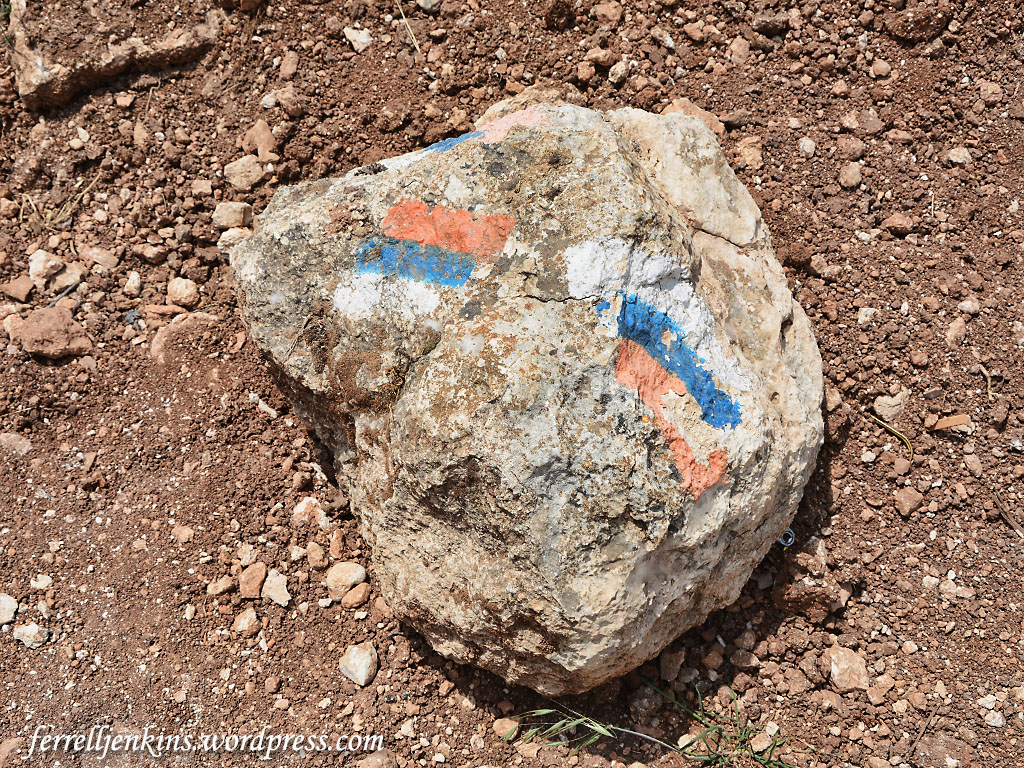
The Israel National Trail crosses the new road. The white, blue, and orange stripes mark this trail all over the country.

The Israel National Trail crosses the new road. The white, blue, and orange stripes make this trail all over the country. Photo by Ferrell Jenkins.

The Israel National Trail crosses the new road. The white, blue, and orange stripes mark this trail all over the country. Photo by Ferrell Jenkins.

In the short time we were there we saw two young men and three young ladies cross the 1800-year-old Roman road. The Trail continues up the field road and between the trees on the right.

Three young ladies take a break from hiking while standing on the Roman Road. Photo by Ferrell Jenkins.

Three young ladies take a break from hiking while standing on the Roman Road. Photo by Ferrell Jenkins.

I decided to take a little break on the curb of the road which is thought by the archaeologists to have provided a way from an ancient village to connect with the Emperor’s highway which comes down from the mountain ridge of Judea.

Ferrell Jenkins waiting on the curb of the Roman Road as it approaches the location of the Emperor's Highway. Photo by Leon Mauldin.

Ferrell Jenkins waiting on the curb of the Roman Road as it approaches the location of the Emperor’s Highway. Photo by Leon Mauldin.

The Roman Roads of which we find remnants in Israel today date mostly from the late first or early second century A.D. Israel Roll, who has written much on the subject, says,

The Roman road network in Judaea was not constructed at once, but evolved gradually from the First Revolt onward. Until then the Roman administration used roads that had been built during or prior to the reign of Herod. Our knowledge of those roads is scanty, and is based essentially on isolated written sources—mainly in the New Testament and Josephus. These sources do not
mention anything relating to road construction or maintenance before the beginning of the rebellion in 66 C.E. (Israel Roll, “The Roman Road System in Judaea,” Jerusalem Cathedra 3 (1983): 138.)

James F. Strange, in discussing the roads in Roman Galilee, says,

Paved, Roman imperial roads mostly date from the second century CE. They are broad, hard-surfaced, featuring curb stones, sometimes center stones, and even milestones. Such is not the case for village ways or paths.

Strange concludes his study with this statement:

One can readily see that a dense network of trails, tracks, and footpaths probably covered Roman-period Galilee. The network was the imprint of everyday travel in the Galilee for trade, some of it from cities like Sepphoris or Tiberias and some from villages like Nazareth or Shikhin. Part of the network is international, but the majority is formed of local trails. Some have wondered how Jesus gathered crowds, but it is simpler to imagine given such a solid web of footpaths, ways, and roads. (James F. Strange. “The Galilean Road System.” Galilee in the Late Second Temple and Mishnaic Periods. Ed. David A. Fiensy and James Riley Strange. Minneapolis: Fortress, 2014.)

The Roman road was high on my wish list for this recent personal study trip, and I am glad to have seen it with my own eyes and walked on it with my own feet. Trust you will enjoy these photos until you have the opportunity to visit the road.

Update: Reader Barry Britnell pointed out that the road I identified as Hwy. 375 (before the curve) is actually Hwy. 3855. Many thanks for the correction. I think I have made the corrections in the text for those who may be serious about locating the Roman Road.

The Arch of Titus once had a golden menorah

Many who have visited the Roman Forum have seen the Arch of Titus at the southeast of the Forum. Mark Cartwright describes the Arch in the Ancient History Encycl0pedia here. There are many links within this quotation for those interested in following them.

The Arch of is a Roman Triumphal Arch which was erected by Domitian in c. 81 CE at the foot of the Palatine hill on the Via Sacra in the Forum Romanum, Rome. It commemorates the victories of his father Vespasian and brother Titus in the Jewish War in Judaea (70-71 CE) when the great city of Jerusalem was sacked and the vast riches of its temple plundered. The arch is also a political and religious statement expressing the divinity of the late emperor Titus.

The Arch of Titus in the Roman Forum commemorates the Roman victory of the Jews in A.D. 70. Photo by Ferrell Jenkins.

The Arch of Titus in the Roman Forum commemorates the Roman victory over the Jews in A.D. 70. Photo by Ferrell Jenkins.
The original inscription on the opposite side reads,

SENATUS
POPOLUS QUE ROMANUS
DIVO TITO DIVI VESPASIANI F
VISPASIANO AUGUSTO

The inscription attributes divinity to both Vespasian and his son Titus.

One of the large panels inside the arch shows Roman soldiers parading items taken from the Temple in Jerusalem in triumph through the streets of Rome. You will see the table of showbread, and the Menorah. One of the placards carried by the soldiers mentions the laws of the Jews.

Josephus, the first century Jewish historian, provides a first person account of the procession in Jewish Wars.

… and for the other spoils, they were carried in great plenty. But for those who were taken in the temple of Jerusalem, {c} they made the greatest figure of them all; that is, the golden table of the weight of many talents; the lampstand [Menorah] also, that was made of gold, though its construction was now changed from that which we made use of;
149 for its middle shaft was fixed upon a basis, and the small branches were produced out of it to a great length, having the likeness of a trident in their position, and had everyone a socket made of brass for a lamp at the tops of them. These lamps were in number seven, and represented the dignity of the number seven among the Jews;
150 and the last of all the spoils was carried the Law of the Jews.
151 After these spoils passed by a great many men, carrying the images of Victory, whose structure was entirely either of ivory or of gold.
152 After which Vespasian marched in the first place, and Titus followed him; Domitian also rode along with them, and made a glorious appearance, and rode on a horse that was worthy of admiration. (JW 7:148-152)

Arch of Titus relief showing Roman soldiers carrying the items taken from the Temple in Jerusalem in A.D. 70. Photo by Ferrell Jenkins.

Arch of Titus relief showing Roman soldiers carrying the items taken from the Temple in Jerusalem in A.D. 70. Photo by Ferrell Jenkins.
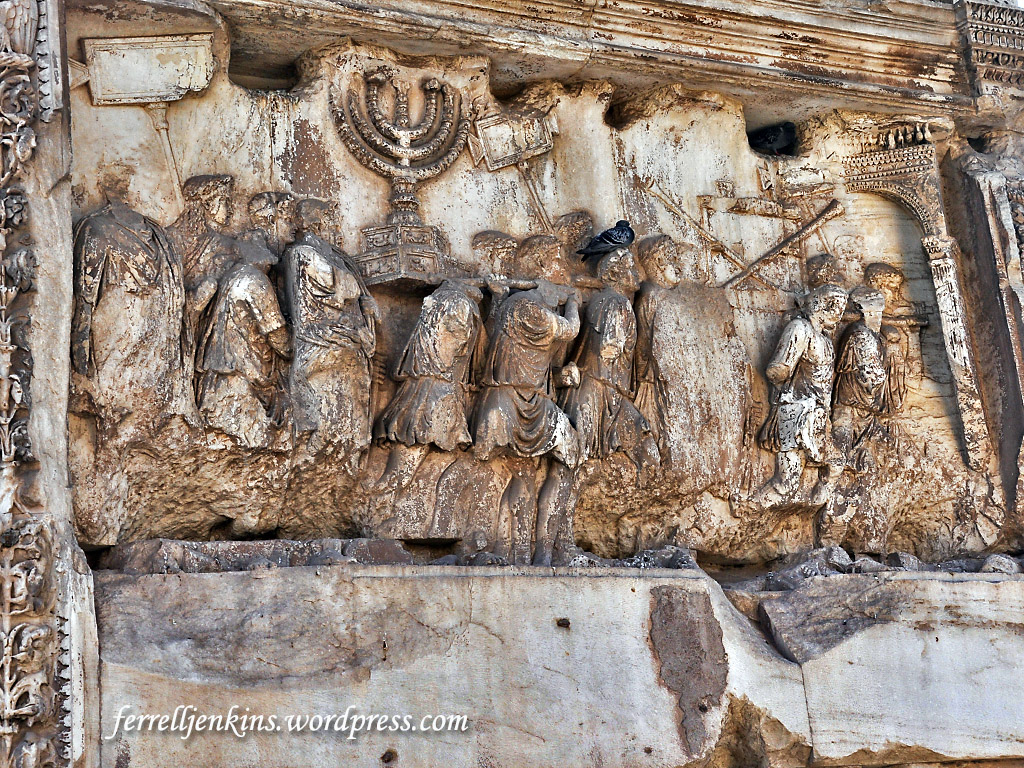
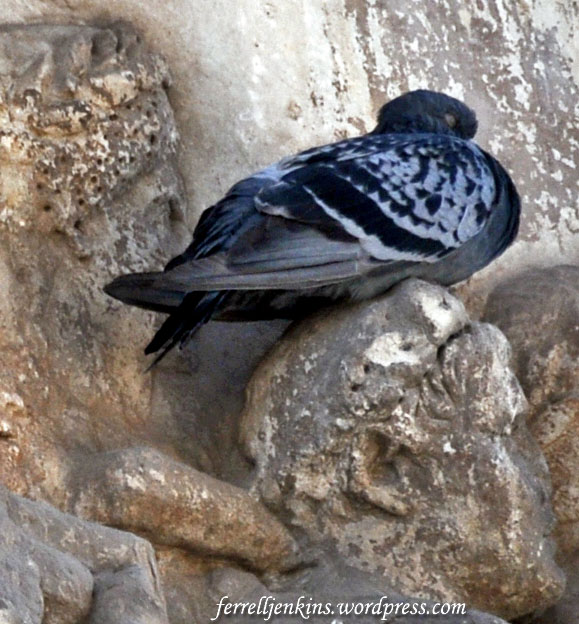
It appears that the first soldier carrying the Menorah on his shoulder is also carrying a pigeon, perhaps for an offering.  <grin>

Live pigeon on head of Roman soldier. Photo by Ferrell Jenkins.

Live pigeon on head of Roman soldier. Photo by Ferrell Jenkins.

For many years Dr. Steven Fine of Yeshiva University has been pursuing his interest in the Menorah. This, of course, led him to the Arch of Titus in Rome where the Menorah is depicted. The most recent results of his study,

includes the Digital Restoration Project, which in 2012 discovered the original yellow polychromy of the Arch menorah; numerous studies of the Arch and its menorah by Professor Fine, an upcoming exhibition and international conference on the Arch organized by Yeshiva University Museum (Summer, 2017), a free online Coursera course, The Arch of Titus: Rome and the Menorah, a 2016 summer seminar in Rome under the auspices of the Schottenstein Honors Program, and courses taught in Revel, Yeshiva College and Stern College.

Take a look at the Arch of Titus in color based on the 3D scan of the reliefs here. You will find a neat video showing the spoils panel in color, and a lecture by Dr. Fine presented at New York’s Metropolitan Museum of Art. There are also links to various articles about the project.

The emblem of the State of Israel is based on the Menorah depicted on the Arch of Titus.