Monthly Archives: February 2014

Visualizing Isaiah 12: wells of salvation

Isaiah describes the Messianic Age as one that will be characterized by many spiritual blessings. The pleasant waters of Shiloah had been rejected by God’s people, but in the time to come Judah would joyfully draw water from the wells of salvation.

With joy you will draw water from the wells of salvation. (Isaiah 12:3 ESV)

The term mayan (wells) is often used in the Old Testament of springs, fountains, wells, or pools of water.

We might think of a well like the one where Jesus stopped at Sychar in Samaria.

Jesus answered her, “If you knew the gift of God, and who it is that is saying to you, ‘Give me a drink,’ you would have asked him, and he would have given you living water.” The woman said to him, “Sir, you have nothing to draw water with, and the well is deep. Where do you get that living water? Are you greater than our father Jacob? He gave us the well and drank from it himself, as did his sons and his livestock.” Jesus said to her, “Everyone who drinks of this water will be thirsty again, but whoever drinks of the water that I will give him will never be thirsty again. The water that I will give him will become in him a spring of water welling up to eternal life.” The woman said to him, “Sir, give me this water, so that I will not be thirsty or have to come here to draw water.” (John 4:10-15 ESV)
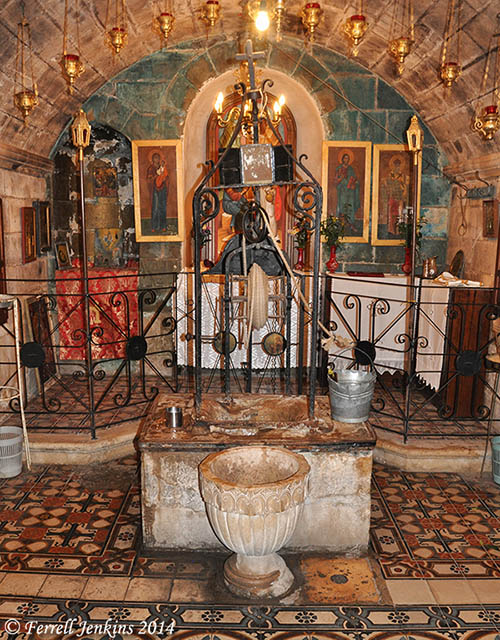
Jacob's well in Samaria. Photo by Ferrell Jenkins.

Jacob’s well in Samaria. Photo by Ferrell Jenkins.

Or, we might think of a spring like the beautiful one at the source of the Banias River at Caesarea Philippi. This spring and river becomes a major source of the Jordan River.
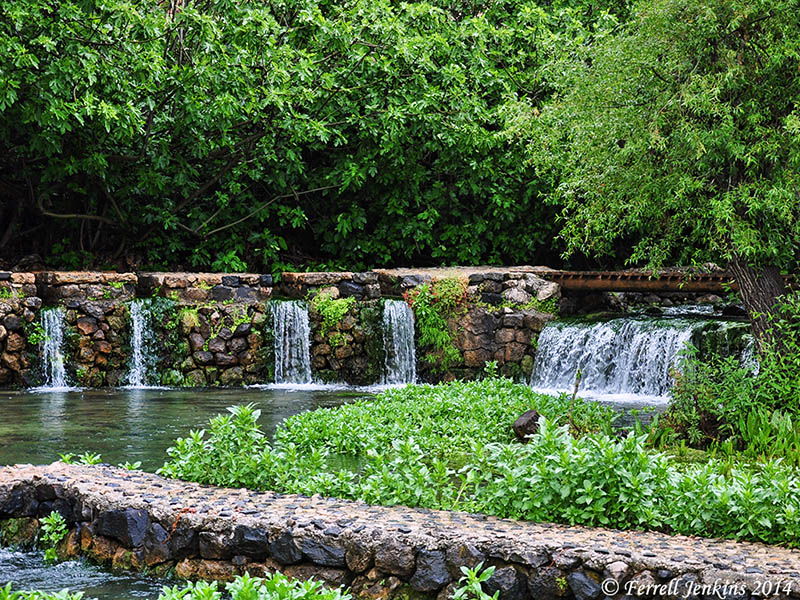
The source of the Banias River, source of the River Jordan. Photo by Ferrell Jenkins.

The source of the Banias River. Photo by Ferrell Jenkins.
 

Visualizing Isaiah 11: the River

Immediately upon looking at Isaiah 11 I think of the reference to the Messiah –  “a shoot from the stump of Jesse.” Look back to chapter 4 for an illustration for that.

I could show you individual photos of many of the animals mentioned in verses 6-7, but I do not have the wild and vicious with the tame and gentle. It doesn’t happen in the animal kingdom, but it is true in the kingdom of the Messiah. See, for example, Colossians 3:11 where there is not Greek and Jew, circumcised and uncircumcised, barbarian, Scythians, salve, free. In Christ these distinctions are broken down.

Here I have chosen to concentrate on the promise of the return of a remnant from captivity, an event that took place initially in 536 B.C.

And the LORD will utterly destroy the tongue of the Sea of Egypt, and will wave his hand over the River with his scorching breath, and strike it into seven channels, and he will lead people across in sandals. And there will be a highway from Assyria for the remnant that remains of his people, as there was for Israel when they came up from the land of Egypt. (Isaiah 11:15-16 ESV)

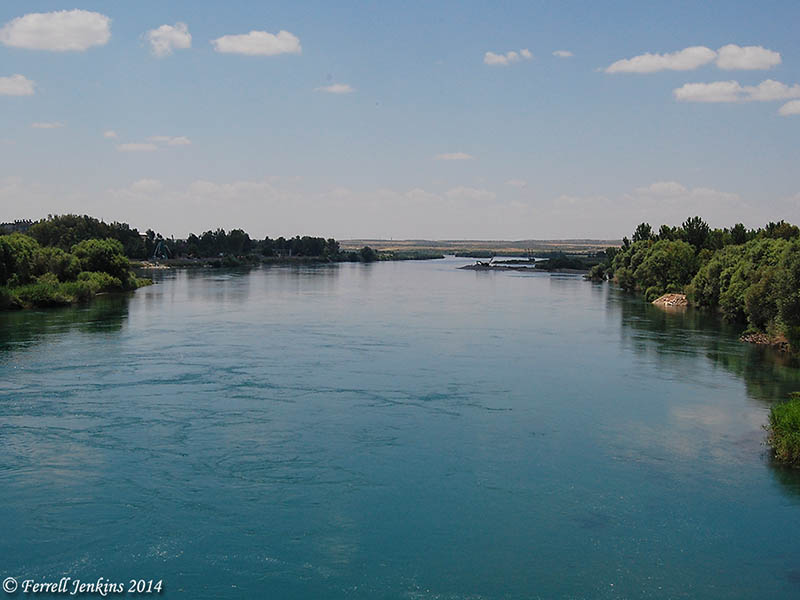
The Euphrates is the largest, longest and most important river of Western Asia. It is nearly 1800 miles long and was the northeastern boundary of the land promised to Abraham (Genesis 15:18). The empires of Assyria and Babylon, the greatest enemies of Israel, were east of the Euphrates. The Old Testament prophets often put the Euphrates by metonymy for these countries to designate the place from which the punishment of God would come (Isaiah 7:20; 8:7; Jeremiah 46:10

The Euphrates was so significant in the history of Israel that the phrase “the River” is used frequently in the Old Testament to indicate the Euphrates.

View north of the Euphrates River at Berecik, Turkey. Photo by Ferrell Jenkins.

The Euphrates River, looking north, at Birecik, Turkey. Photo by Ferrell Jenkins.

The LORD said that He would bring “the waters of the River, the king of Assyria and all his glory” like a flood to rise to the neck of His people (Isaiah 8:6-8). Now He promises to strike the River and allow His people to return from the exile in sandals. In fact, He says, “there will be a highway from Assyria for the remnant that remains of his people” 11:16).

When Assyrian kings stated in their annals that they crossed the river Euphrates they mean that they went to war against nations west of the River.

Visualizing Isaiah 10: “Assyria, the rod of my anger”

The Assyrians are first introduced in Isaiah 7. In chapter 10 we are informed that they are “the rod of [the LORD’s] anger.” They will serve the purpose of God to punish His people. Isaiah tells us that the Assyrians did not plan to be doing the will of the LORD; they only wanted to destroy many nations.

Ah, Assyria, the rod of my anger; the staff in their hands is my fury! Against a godless nation I send him, and against the people of my wrath I command him, to take spoil and seize plunder, and to tread them down like the mire of the streets. But he does not so intend, and his heart does not so think; but it is in his heart to destroy, and to cut off nations not a few; for he says: “Are not my commanders all kings? (Isaiah 10:5-8 ESV)

In the photos below I hope to illustrate a few ways the Assyrians punished the Judeans. Certainly the same was true of the northern kingdom of Israel (2 Kings 17:5-6).

The Assyrians destroyed northern cities of Israel such as Hazor and the site sometimes identified as Geshur or NT Bethsaida in 732 B.C. By 722/21 Samaria lay in ruins. Assyria continued south into Judah. Sennacherib claims to have destroyed 46 strong cities of Judea in addition to all of the nearby villages (The Taylor Prism).

Assyrian King Sennacherib left reliefs of his war against Lachish on his palace wall at Nineveh. The following photos are portions of that relief now displayed in the British Museum. Many Judeans were taken into captivity. Other begged for mercy in the hilly Shephelah of Judah.

Judeans begging for mercy. Photo by Ferrell Jenkins.

Judeans begging for mercy. Photo by Ferrell Jenkins.

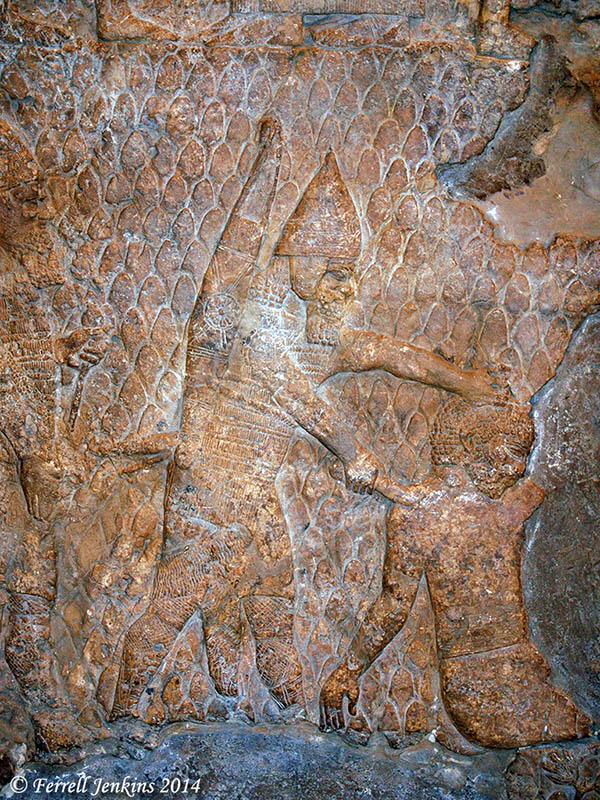
The plea was unsuccessful for some of them. This portion shows an Assyrian commander killing a Judean.

An Assyrian soldier kills a Judean. Photo by Ferrell Jenkins.

An Assyrian soldier kills a Judean. Photo by Ferrell Jenkins.

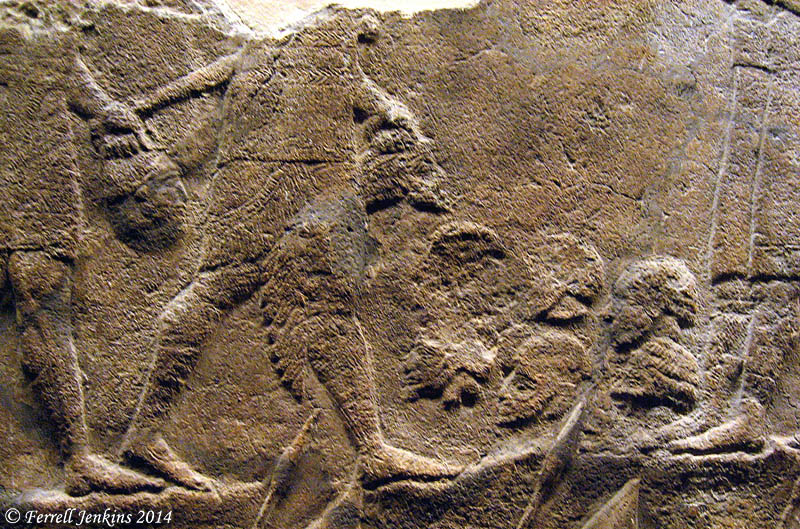
This portion of the relief shows heads of the slain being brought together for accounting. Some Egyptian reliefs show hands and other body parts being gathered for the same purpose.

Heads of Judeans being collected to get a count. Photo by Ferrell Jenkins.

Heads of Judeans being collected to get a count. Photo by Ferrell Jenkins.

A 25-minute Discovery Channel video entitled The Assyrians: Masters of War uses Assyrian reliefs to tell the story of their savagery in war. Lachish is emphasized. Click here. (HT: Bible Places Blog).

Visualizing Isaiah 9: the Philistines on the west

Isaiah 9 contains several geographical references. I decided to concentrate on the reference to the Philistines in verse 12. Notice that the text mentions the Syrians (Arameans) on the east, literally northeast of Israel and Judah, and the Philistines on the west (literally the southwest).

“The Syrians on the east and the Philistines on the west devour Israel with open mouth. For all this his anger has not turned away, and his hand is stretched out still.” (Isaiah 9:12 ESV)

Both powers were perennial enemies of Israel. Both would take part in attacks on Israel. The Philistines also are mentioned in 2:6 and 11:14.

It is commonly understoos that the Philistines of the Old Testament were the Sea People. The five major cities of the Philistines were Ashdod, Gaza, Ashkelon, Gath, and Ekron (1 Samuel 6:17).

A row of signs at the entry to Tel Ashkelon picture some of the peoples who lived there. This sign represents the Philistines. Photo by Ferrell Jenkins.

A row of signs at the entry to Tel Ashkelon picture some of the people who lived there. This sign represents the Philistines. Photo by Ferrell Jenkins.

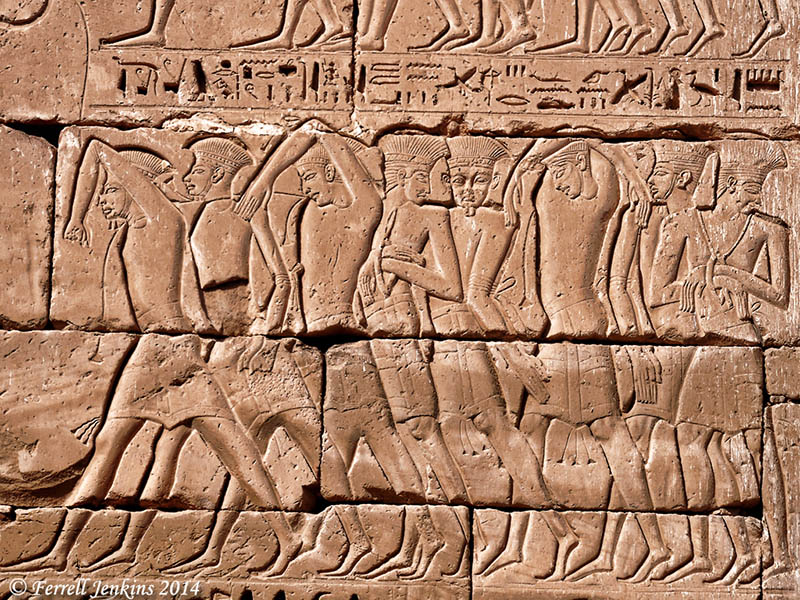
The temple of Medinet Habu is located near the Colossi of Memnon at Thebes (Luxor), Egypt. The temple was built during the reign of Rameses III (reigned 1186–1155 B.C.). The structures at the site were built by the Pharaoh to serve as an administrative complex and funerary temple. The most interesting aspects of the temple to me are the reliefs of the Sea Peoples that the king claims to have subjugated. Notice that some of these men are bound.

This is a portion of a wall at Medinet Habu showing the subjugation of the Sea People by Ramses III. Photo by Ferrell Jenkins.

A portion of a wall at Medinet Habu shows the subjugation of the Sea People by Ramses III. Notice the distinctive feathered hats and animal skin skirts. Photo by Ferrell Jenkins.

These peoples might seem more powerful than Israel at the moment, but the LORD will punish them. Both Damascus and the Philistines fell to the Assyrians within a few years.

The LORD continued to remind Israel and Judah that He was willing to save them from the coming oppression:

For all this his anger has not turned away, and his hand is stretched out still. (Isaiah 9:21 ESV)

Visualizing Isaiah 8: the gentle flowing waters of Shiloah

Isaiah 8 teaches that the rejection of the LORD by His people would bring about severe punishment. To illustrate this, the LORD says His people “refused the waters of Shiloah that flow gently,” and that He would bring up against them “the waters of the River” [Euphrates], that is, the Assyrians. This would not be gentle flowing, but would flood even to the neck. It would be impossible to stay afloat when that happens.

The LORD spoke to me again: “Because this people has refused the waters of Shiloah that flow gently, and rejoice over Rezin and the son of Remaliah, therefore, behold, the Lord is bringing up against them the waters of the River, mighty and many, the king of Assyria and all his glory. And it will rise over all its channels and go over all its banks, and it will sweep on into Judah, it will overflow and pass on, reaching even to the neck, and its outspread wings will fill the breadth of your land, O Immanuel.” (Isaiah 8:5-8 ESV)

From the earliest days of the city, the water source for Jerusalem was the Gihon Spring. The well-known Hezekiah’s tunnel and the new pool that he built on the west side of the city of David would not be constructed for about 25 to 35 years (2 Kings 20:20; 2 Chronicles 32:30).

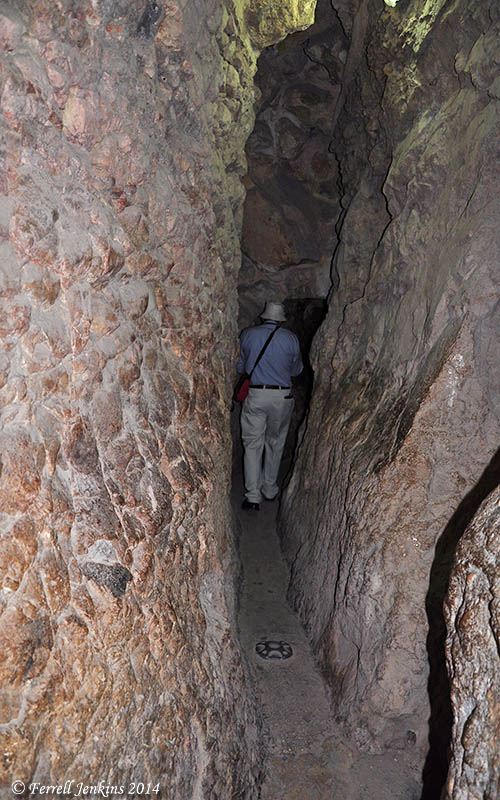
The Canaanites had cut a small tunnel through the rock to allow water to flow from the Gihon Spring into the valley on the east side of what would later be called the city of David.

The comment in The IVP Bible Background Commentary: Old Testament provides a good explanation of the tunnel and pool under consideration.

Hezekiah’s tunnel had not yet been constructed at this time. Water was conducted from the Gihon Spring (in the Kidron Valley on the east side of the city) toward the south through an aqueduct that brought the water to a reservoir at the southwestern tip of the city. This aqueduct is known as the Siloam Channel and in biblical times went by the name Shiloah.

Since 1997 it has been possible for visitors to the source of the Gihon Pool to walk through the dry Canaanite tunnel and exit in the valley which is part of the Silwan village. (That exit is now within an enclosed park area known as the City of David (Jerusalem Walls) National Park.) Our photo below show a portion of that tunnel.

The Canaanite Tunnel through which the gentle "waters of Shiloah" once flowed. Photo by Ferrell Jenkins.

The Canaanite Tunnel through which the gentle “waters of Shiloah” once flowed. Photo by Ferrell Jenkins.

Visualizing Isaiah 7: the house of David

The historical setting for Isaiah 7 concerns the efforts of Syria (Aram) and Israel (Ephraim, the northern kingdom) to form an alliance to attack king Ahaz of Judah (cf. 2 Kings 15:37). Some refer to this as the Syro-Ephraimite coalition against Judah.

The southern kingdom over which Ahaz ruled is referred to as the “house of David” twice in this chapter (7:2,13), and again in Isaiah 22:22.

In the days of Ahaz the son of Jotham, son of Uzziah, king of Judah, Rezin the king of Syria and Pekah the son of Remaliah the king of Israel came up to Jerusalem to wage war against it, but could not yet mount an attack against it. When the house of David was told, “Syria is in league with Ephraim,” the heart of Ahaz and the heart of his people shook as the trees of the forest shake before the wind. (Isaiah 7:1-2 ESV)

This chapter clearly mentions three distinct nations or governments – Syria, Israel, and Judah (the house of David). According to the Bible, the throne of David was established forever (2 Samuel 7:11-15). Christians understand that Jesus Christ is the final fulfillment of that promise (Luke 1:31-32; Acts 2:25-36).

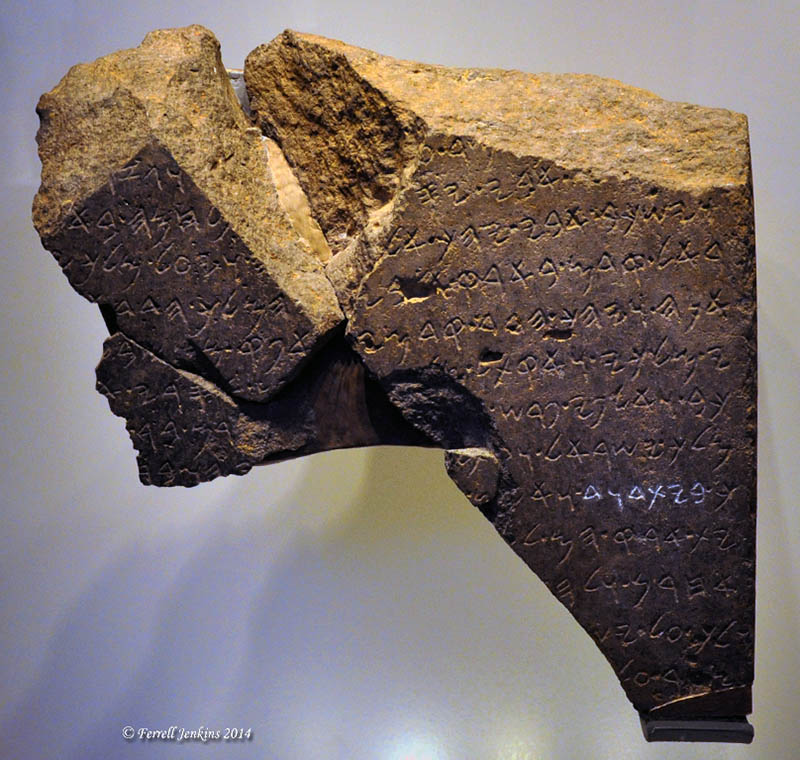
Three fragments of an Aramic inscription were found at Tel Dan in 1993/1994 mentioning the king of Israel, the “house of David” and the Aramean (Syrian) god of storms and warfare, Hadad. You may recall that some of the Syrian kings were named after Hadad (e.g., Ben-Hadad, 1 Kings 15:18). This document probably refers to a different historical setting, but the kingdoms are the same: Israel, Syria, and Judah (house of David). Because all of the kings of Judah from David to the carrying away into Babylon are of the family of David, It is appropriate to refer to the house of David as the Davidic dynasty.

The Tel Dan inscription is displayed in the Israel Museum in Jerusalem.

The Tel Dan inscription displayed in the Israel Museum. Photo by Ferrell Jenkins.

The Tel Dan inscription displayed in the Israel Museum. The term “houseofdavid”, written right to left, is highlighted in white. Photo by Ferrell Jenkins.

Paul’s Missionary Tube Map

If you have used the Tube in London, or the subway system in another major city, you might enjoy this little chart on theologygrams. HT: @alancornett

rickwyld's avatartheologygrams

Paul Tube Map Final

View original post