Tag Archives: museums

National Geographic’s Top 10 Museums and Galleries

National Geographic recently released a list of Top 10 Museums and Galleries here.

  1. Smithsonian Institution, Washington, D.C.
  2. Le Louvre, Paris, France
  3. The Acropolis Museum, Athens, Greece
  4. State Hermitage, St. Petersburg, Russia
  5. The British Museum, London, England
  6. The Prado, Madrid, Spain
  7. The Metropolitan Museum of Art, New York City
  8. The Vatican Museum, Vatican City, Italy
  9. The Uffizi Gallery, Florence, Italy
  10. Rijksmuseum, Amsterdam, the Netherlands
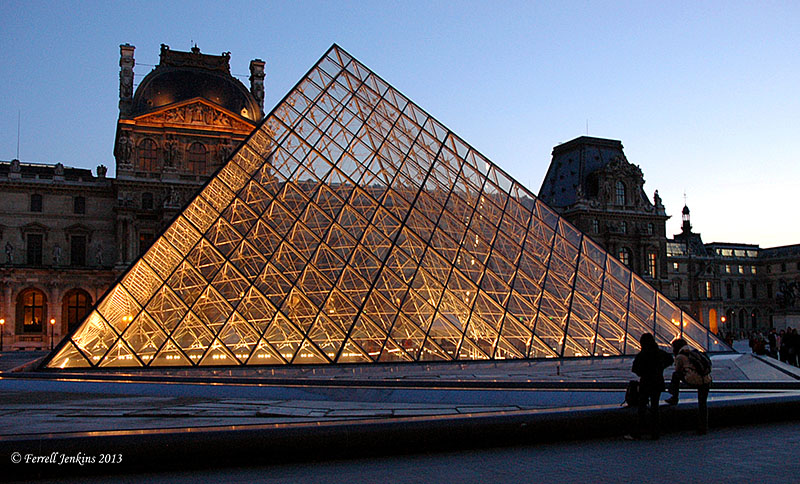
Entrance to the Louvre at night. Photo by Ferrell Jenkins.

Entrance to the Louvre at night. Photo by Ferrell Jenkins.

Over the years I have had the opportunity to visit each of these museums at least once. While I enjoy the art, I am usually looking for artifacts that provide some background for the Bible. That would make a good list.

If I should be asked to suggest number 11, it would be the Pergamon Museum, Berlin, Germany.

A miscellany of sites on Monday

There are numerous small museum scattered across Israel. I had read about the Beit Sturman Museum at En Harod and had wanted to visit it. The Israel Museum Guide describes the museum in these terms:

Beit Sturman Museum is one of the biggest archaeological museums of the country. Rich collection of flora and fauna of the region. History of Jewish settlements in Israel valley. The museum is named in honour of one of the founders of kibbutz – Haim Sturman.

What really caught my attention was when I read that the Museum had a large collection of Roman milestones that were found in the Jezreel Valley.

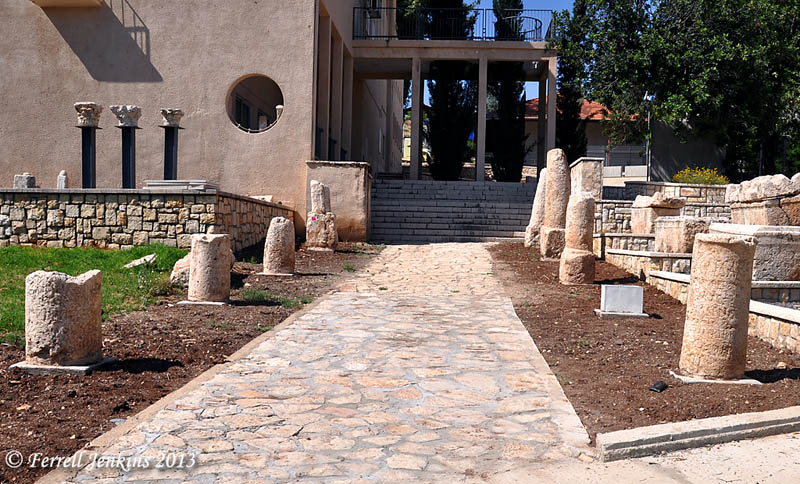
Only seven milestones are visible in the photo below but there are dozens of others in the courtyard of the Museum. Many of them are broken, and very few of them have any visible inscription. I thought I recognized TR on one of them. I think this would indicate a milestone erected during the reign of the Emperor Trajan in the early 2nd century A.D.

Roman Milestones at Beit Sturman Museum, En Harod, Israel. Photo by Ferrell Jenkins.

A few of the Roman Milestones displayed at the Beit Sturman Museum, En Harod, Israel. Photo by Ferrell Jenkins.

The museum has a display of flora and fauna of the Jezreel Valley, several cases of pottery from sites in the area, and a display of agricultural practices including the first bale of cotton grown in Israel. That brought back a lot of childhood memories of when I picked cotton and went to the gin with my father or grandfather in North Alabama.

Earlier we tried to visit the Spring of Harod, the place where Gideon gathered the 300 men to fight the Midianites (Judges 7:1-8). This site was closed when my group were scheduled to visit a few days ago. We thought, at the time, that there might be some flooding in the area. However, it was still closed today. Dan and I tried to enter through a hotel or guest house, but they refused us entry. When we asked why the park was closed they just said “bureaucracy.” I suggested it might be a form of “sequestration.”

We also visited Tell Shalim, thought to be the site of Salim in the duo Aenon near to Salim, where John the Baptist baptized after Bethany Beyond the Jordan (John 3:23; 1:28). This is a place that would be impossible for a tour bus to go. It is about 8 miles south of Beth-shan, near the Jordan River.

There were a few other stops. We were disappointed when we were unable to get to the Roman Road at Golani Junction. A new road has been built east from the McDonald’s with a metal rail and a ditch that I didn’t think I would want to try to cross. Some individual travelers will be disappointed in this change.

Visiting the Lynn H. Wood Archaeological Museum

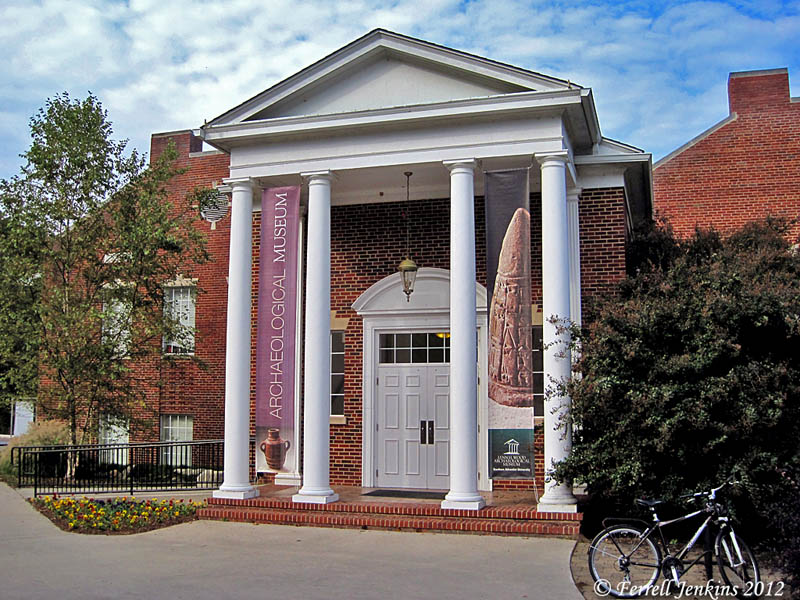
You might never expect to find an excellent archaeological museum nearly hidden in the woods of eastern Tennessee. But that is what you will find at the Lynn H. Wood Archaeological Museum on the campus of  Southern Adventist University in Collegedale, Tennessee.

When we arrived on campus we asked a student the location of the Museum. After walking up a long series of steps that some students were skipping up (ah, youth!), we asked two other students. Each of them offered to show us. And, neither had been to the Museum. Everyone on campus that we spoke with was friendly and helpful.

Inside Hackman Hall is housed a wonderful educational exhibit.

The Lynn H. Wood Archaeological Museum is located in this building.

The Lynn H. Wood Archaeological Museum is located in this building.

A few years ago William G. Dever gave his research library of nearly 3000 volumes and a large collection of archaeological artifacts to Southern. The artifacts are built into an award-winning exhibition under the title Vessels in Time: A Journey Into the Biblical World. Archaeology Professor Dr. Michael G. Hasel serves as curator of the Museum.

Iron Age IIA (1000-900 B.C.) Pottery in the Lynn H. Wood Museum.

Iron Age IIA (1000-900 B.C.) Pottery in the Lynn H. Wood Museum.

The exhibits follow a chronological order from the early days in Mesopotamia to New Testament times.  Each display has a good timeline which coordinates the archaeological periods with the Biblical record. The photo above shows some pottery from the Iron Age IIA (1000-900 B.C.). This is the period of the United Kingdom (or Monarchy). The bowl on the left has been slipped and shinned. The accompanying information explains that during this period vessels were sometimes dipped “into red watery clay” to create the colored slip. The bowl was then hand burnished with a stone like the one shown above it.

Three examples of dipper juglets from the period are shown:

  1. A Phoenician import.
  2. A simple local juglet.
  3. A black-slipped, burnished juglet.

There is a nice model of Solomon’s Temple in the same room.

If your travels take you anywhere near Chattanooga, Tennessee, I suggest you take time to drive a few miles east to Collegedale and visit the Lynn H. Wood Archaeological Museum.

Full information about the Museum including visiting hours may be found here.

Benjamin plateau, Israel Museum, and the Garden Tomb

This morning we went out to Nebi Samwil [prophet Samuel], a site suggested as the location of Mizpah by some scholars. Others suggest Tell en-Nasbeh, a mound located at Al Bira in the West Bank. (See Jeffrey Zorn, “Mizpah: Newly Discovered Stratum Reveals Judah’s Other Capital.” BAR 23:05 (Sep/Oct 1997).

  • Samuel, the last judge of Israel, called all of the people of Israel to Mizpah and judged them (1 Samuel 7:5-6).
  • Samuel also anointed Saul to be the first king of Israel at Mizpah (1 Samuel 10:1).
  • Mizpah became the headquarters of Gedaliah as governor of Judah after the Babylonian destruction of Jerusalem  (2 Kings 25:23).

From the hill, we were able to look north to the Benjamin plateau. Both King Saul and Saul of Tarsus (Paul) were from the tribe of Benjamin. El Jib, the tell of Gibeon, is also visible from Nebi Samwil.

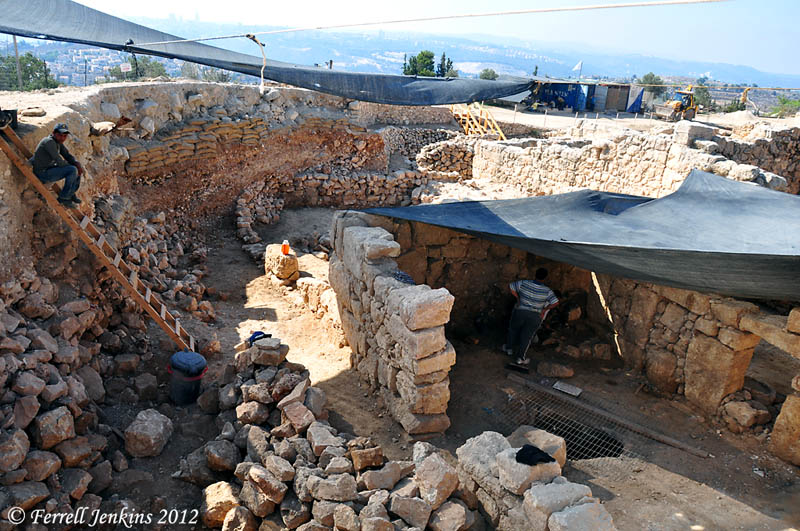
Some new excavations were underway under the direction of the National Parks Authority. We were told that Hasmonean ruins has been excavated, and there was some evidence from the Persian and Babylonian periods.

Excavations at Nebi Samwil - Sept. 13, 2012. Photo by Ferrell Jenkins.

Excavations at Nebi Samwil – Sept. 13, 2012. Photo by Ferrell Jenkins.

After Nebi Samwil we went to the Israel Museum campus for a visit of the Second Temple Model, the Shrine of the Book, and the Israel Museum. This is the first time I have been in the Museum since photos (without flash) have been allowed.

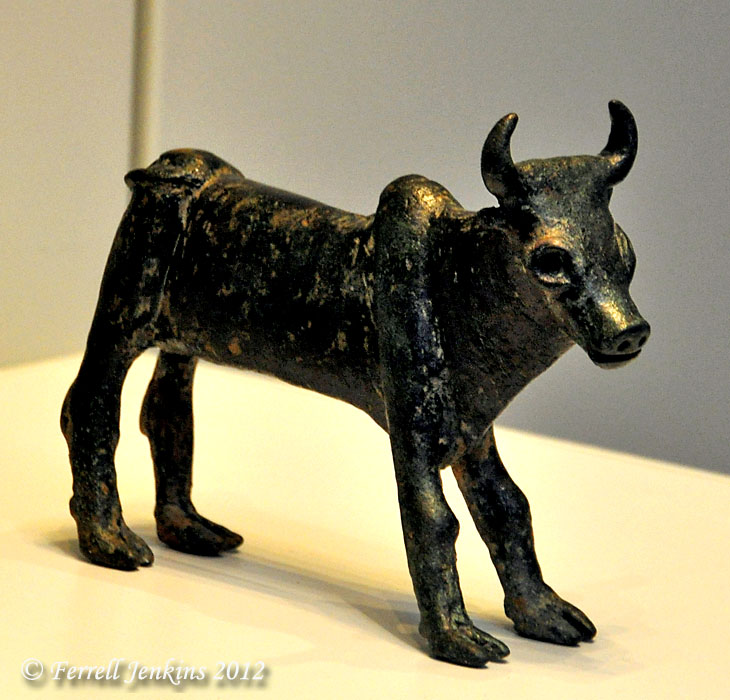
I will share one photo that I am pleased to have in my collection. It shows a bronze bull, dating to the 12th century B.C., found in the Samaria region.

Bronze Bull from Samaria Region - Israel Museum. Photo by Ferrell Jenkins.

Bronze Bull from Samaria Region – Israel Museum. Photo by Ferrell Jenkins.

This bull, and others those that have been found at Ashkelon and Hazor, remind us of the calf at Sinai (Exodus 32:24) and the calves set up by Jeroboam at Dan and Bethel (2 Kings 10:29).

The information posted with the statuette says,

Canaanite in inspiration, it attests to Israelite adoption of Canaanite motif. For the Israelites it may have symbolized God, or the pedestal of an unseen God.

Thank you, Israel Museum, for allowing photos.

In the late afternoon we visited The Garden Tomb. While this tomb is clearly not the tomb of Jesus, it provides a good illustration in a natural setting — far different from the Holy Sepulcher.

A new Archaeology Museum in Turkey

Turkey is a marvel of historical sites, and many of them have their own archaeological museum. A new museum has opened in Aydin, due east of Kusadasi (near Ephesus). Here is a description of the museum and its contents.

Aydın Provincial Culture and Tourism Director Nuri Aktakka said around 3,000 historical artifacts are on display in the 2,500-square-meter museum. “Most of the artifacts were discovered at the Tralleis, Magnesia, Alinda, Nysa, Alabanda and Ortasia historical sites in Turkey. We hope to increase the number of artifacts in the museum in the future. We have many historical sites in Aydın, and excavations are under way to discover more artifacts,” he said.

Aktaka also said 11,000 archeological and 45,000 numismatic and 4,000 ethnographic artifacts are currently registered at the museum and they will be on display by turns.

Read the full news article here. The name that first caught my attention is Nysa (also Nyssa). Back in 2006 my friend Leon Mauldin and I were driving from Kusadasi to the Hierapolis area. I think I am correct in saying that neither of us knew anything about Nysa, but when we saw the usual brown sign that marks archaeological sites we decided to take the short detour to visit Nysa. It was a pleasant stop.

Nysa (Nyssa), Turkey, archaeological excavation. Photo by Ferrell Jenkins.

Nysa (Nyssa), Turkey, archaeological excavation. Photo by Ferrell Jenkins.

Nysa is also known as Nysa Ad Maeandrum, and became famous as an educational center. The Meander River flows past the city only a few miles south. The city was the home of the ancient geographer Strabo (63 B.C. – A.D. 25).

Another museum to visit.

HT: Jack Sasson

Photography in the Israel Museum. Can it be?

Carl Rasmussen, author of the Zondervan Atlas of the Bible, reports here on his HolyLandPhotos’ Blog that he took a group to the Israel Museum today and that photography (without flash) was allowed in the archaeology section. Prof. Rasmussen concludes, “A new era has begun!!”

Several times I have criticized museums that do not allow photography of archaeological artifacts.

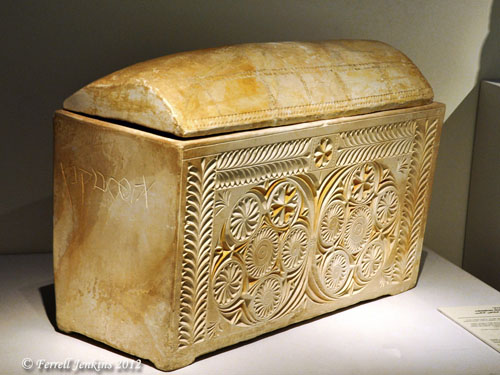
A photo such as the one below can be helpful to teachers who prefer to have their own photos for use in teaching. The highly decorated Caiaphas Ossuary was discovered during the construction of a water park in Jerusalem’s Peace Forest. The remains of six individuals were found inside the ossuary including that of a man about 60 years of age. The name of Caiaphas is inscribed on both ends of the “bone box.” The single line visible in this photo is translated “Joseph son of Caiaphas.” Many scholars believe that this is likely the high priest Caiaphas before whom Jesus stood prior to His crucifixion.

So Annas sent Him bound to Caiaphas the high priest. (John 18:24 NAU)

The Caisaphas Ossuary in the Israel Museum, Jerusalem.

The Caiaphas Ossuary in the Israel Museum, Jerusalem. Photo by Ferrell Jenkins.

HT: Barry Britnell

The Samsun Archaeological Museum

Hidden in Plain Sight. While driving around Samsun we saw a brown sign pointing to the Archaeology Museum, but we were not able to locate the building. We knew it was there because Mark Wilson mentions it in Biblical Turkey (340), as do some other guide books. I mentioned earlier that very few people in this region speak English. There was one girl at the hotel who could speak English. We met one young man in a local store who had been living in New York who spoke English, and a lady from the Netherlands. We always get by, and the locals are almost always helpful.

When we inquired about the Archaeology Museum we were always directed to the Gazi Museum. That is a museum devoted to the early history of Mustafa Kemal Atatürk, the founder of the Republic of Turkey. We enjoyed visiting that museum, but it still was not what we were looking for. After much effort, we finally found a policeman who pointed us in the right direction. Then, while we were standing on the street corner with an inquiring look, a Moslem lady asked if she could help us. She was from the Netherlands. She went in a store to inquire. They pointed us back to the Gazi Museum. When we indicated that was not the museum, we were finally pointed directly across the main street, beyond a little park, to the Archaeology Museum. By this time one of the local men indicated we should follow him. Success, at last.

The museum is small, but contains artifacts ranging from the Chalcolithic Period (as early as 4300 B.C.) to the Roman Period.

Excavation at Ikiztepe. Ikiztepe is a site located about 4 miles northwest of Bafra (see our discussion of the Halys River in yesterday’s post). In recent excavations, evidence of “cultures of the Chalcolithic Age, the Bronze Age and the Transition Age (Before Hittites) have been determined” (Museum brochure).

An article in Hurriyet Daily News says that discoveries at Ikiztepe range from the Chalcolithic Age to the Hellenistic period.

The most interesting findings unearthed during the excavations are skulls, which underwent surgical operation. In the graveyard on the highest hill in the ancient site, dating back to 2300-2100 BC, eight out of the 690 skeletons had skulls with traces of surgical operation. These skulls have archaeological importance since they are the only ones unearthed in Anatolia. They also show that people who lived there did not have the characteristics of Mediterranean people but of southern Russians and Bulgarians.

Read the full article here.

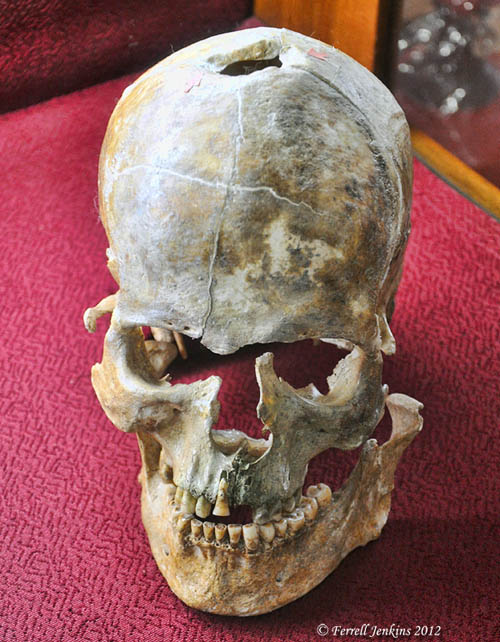
Ancient brain surgery that cut a hole in the skull to relieve pressure is referred to as trepanation. A few of the skulls found at Ikiztepe are displayed in the museum. They are said to belong to Bronze Age III. I think that would be in the neighborhood of 1600 B.C. Here are two of the photos I made that show the hole drilled in the skull.

Example of Trepanation, Bronze Age III, Ikiztepe. Samsun Archaeological Museum. Photo by Ferrell Jenkins.

Example of Trepanation, Bronze Age III, Ikiztepe. Samsun Archaeological Museum. Photo by Ferrell Jenkins.

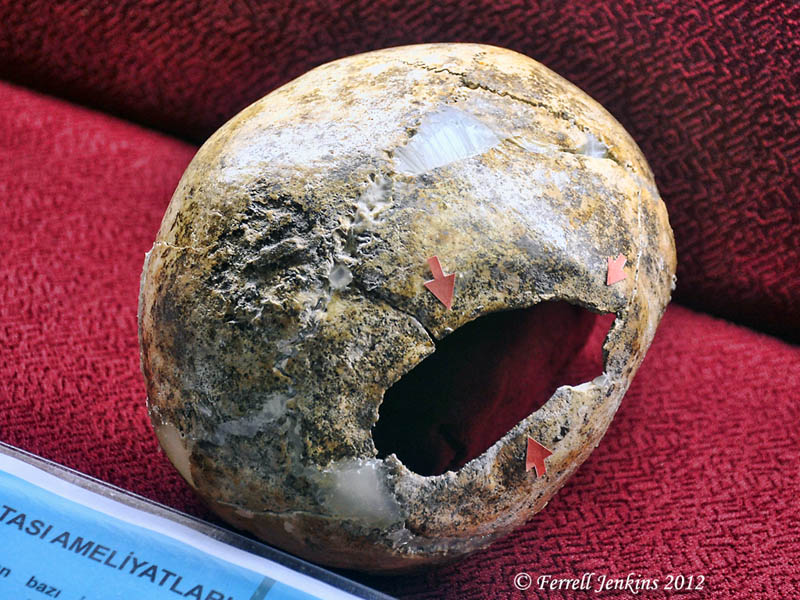
The surgery in the case below required a much larger hole.
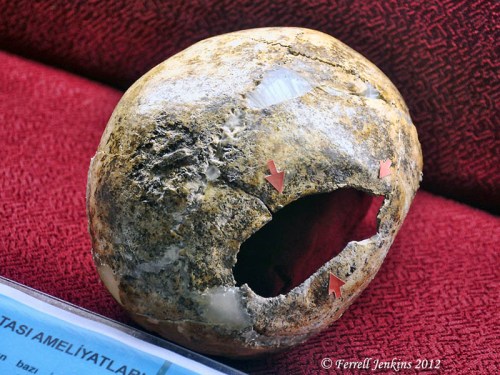
Example of Trepanation, Bronze Age III, Ikiztepe. Samsun Archaeological Museum. Photo by Ferrell Jenkins.

Example of Trepanation, Bronze Age III, Ikiztepe. Samsun Archaeological Museum. Photo by Ferrell Jenkins.

There is no indication whether the surgery was successful, or what happened to the surgeon if it failed.

Joe Zias, in an article in Mikhmanim (Spring 1999), says there have been 29 skulls showing trepanation (trephination) discovered in Israel. He says the survival rate based on “inflammatory or bone remodeling” indicate a 77 percent survival rate in these cases. You may read his entire article about this and other medical issues in ancient Israel here.

In a future post I plan to show you a few of the Roman period ruins, the time of Peter’s epistles (1 Peter 1:1).

The Antikythera Shipwreck and “Danger at sea”

The Antikythera Shipwreck is a special exhibition at the Athens (Greece) National Museum which is scheduled to run from April 2012 to April 2013.

The shipwreck off the eastern coast of Antikythera is dated to 60-50 BC, a period during which maritime trade and transportation of works of Greek art from the Eastern Mediterranean to Italy flourished. Its cargo dates from the 4th to the 1st century BC. The ship was a freighter of about 300 tons capacity and was sailings towards Italy.

We had visited Thera (aka Santorini) during our Aegean cruise. Antikythera (“opposite Kythera”) is a Greek island between Crete and the Peloponnese (where Corinth is located).

The statue below is made of Parian marble. Scholars in the field suggest that this is possibly Achilles. Being on the bottom of the Aegean Sea for centuries shows its effects on the statue.

Possibly Achilles. The Antikythera Shipwreck. Athens National Museum. Photo by Ferrell Jenkins.

Possibly Achilles in Parian Marble. The Antikythera Shipwreck. Athens National Museum. Photo by Ferrell Jenkins.

Numerous bronze pieces are displayed. The bust below is part of a portrait statue known as “The Antikythera Philosopher.” The head, hands, feet, and pieces of the himation were recovered and are displayed. This piece of art is said to date to about 230 B.C.

The Antikythera Philosopher. Athens National Museum. Photo by Ferrell Jenkins.

The Antikythera Philosopher. Athens National Museum. Photo by Ferrell Jenkins.

We typically think of ships from the Roman period, and earlier, staying near the shore. This was certainly true of many of the sea journeys of the Apostle Paul (Acts 20:5, 13-16 27:5-7).

Greek archaeologists announce here the discovery of two Roman-era shipwrecks in water nearly a mile deep. Sailing to Italy required leaving the safety of the nearby shore for deep waters. Such was true of Paul’s journey to Rome after leaving Crete (Acts 27).

Paul spoke of the dangers at sea in his second letter to the Corinthians (11:24-29) about A.D. 55.

  • Three times I was shipwrecked.
  • A night and a day I was adrift at sea.
  • He mentioned “Danger at sea.”

The Malta shipwreck is the only one recorded in Acts, and it occurred after the writing of 2 Corinthians. Hughes mentions at least nine voyages between Acts 9 and 18. Paul says three of these ended in shipwreck. Hughes says there were at least another nine voyages between the writing of 2 Corinthians and the Malta shipwreck (The Second Epistle to the Corinthians, NICNT, 410-411).

At least some of the ships used by Paul seem to have been grain ships (Acts 27:38), but there may have been other cargo on some of them.

If you visit Athens between now and April 2013, be sure to take some time for The Antikythera Shipwreck.

The looting of Sardis

Finally, Greece and Turkey can agree on something. They wish they had back the archaeological treasures that have been taken to other countries in the past. Greece wants back the Elgin marbles taken from Athens to the British Museum. Turkey wants back the treasures taken from Sardis in September 1922, the days of unrest during the fall of the Ottoman Empire. According to the article by John Leonard in Athens News, the port city of Smyrna (modern Izmir) was burning when John Horton sent crates of antiquities to the United States.

Numerous Turkish artifacts, including some real big ones (in size and importance), are displayed in the British Museum, and in the Pergamum Museum in Berlin.

It is a fascinating story with two sides. Read Leonard’s article here.

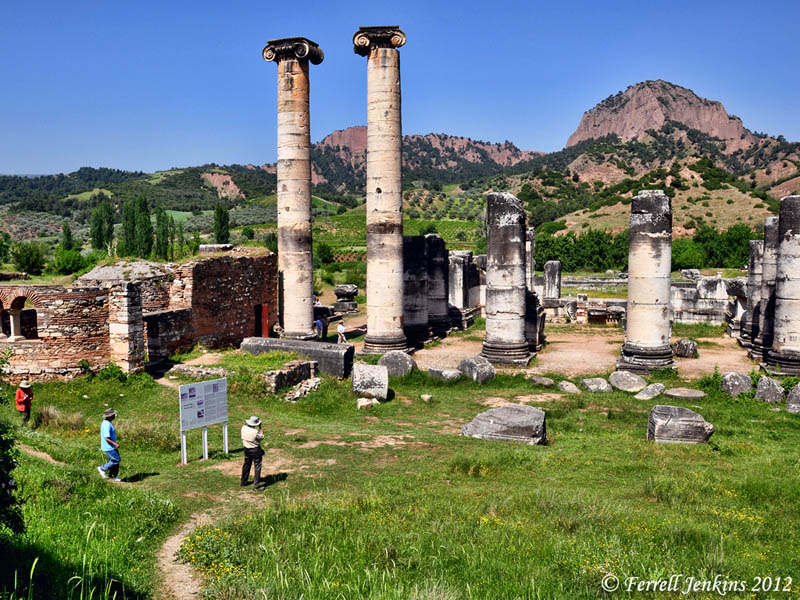
The photo below is one I made at Sardis earlier this month. The view is West over the ruins of the Temple of Artemis. One of the Ionic capitals is in the Metropolitan Museum in New York. The temple dates back to at least the 6th century B.C., but was destroyed in 499 B.C., and then underwent three rebuilding phases. The columns seen here date to the third rebuilding phase (ca. A.D. 150). Ruins of a restored Byzantine church from the fourth century A.D. may be seen in the left corner of the photo.

Sardis. Temple of Artemis. View West. Photo by Ferrell Jenkins.

Sardis. View west over the Temple of Artemis. Photo by Ferrell Jenkins.

Sardis is mentioned in the Bible only in Revelation (Apocalypse) 1:11 and 3:1-6.

saying, “Write what you see in a book and send it to the seven churches, to Ephesus and to Smyrna and to Pergamum and to Thyatira and to Sardis and to Philadelphia and to Laodicea.”  (Revelation 1:11 ESV)

Another post about efforts to retrieve artifacts from foreign museums may be read here.

HT: Jack Sasson

Mummies of the World at MOSI in Tampa

Mummies of the World Exhibition opens at MOSI in Tampa, Florida, today. Details here. The exhibition includes mummified humans and animals from several places around the world in addition to those from Egypt.

According to local television reports, the exhibit runs through September 9, 2012.

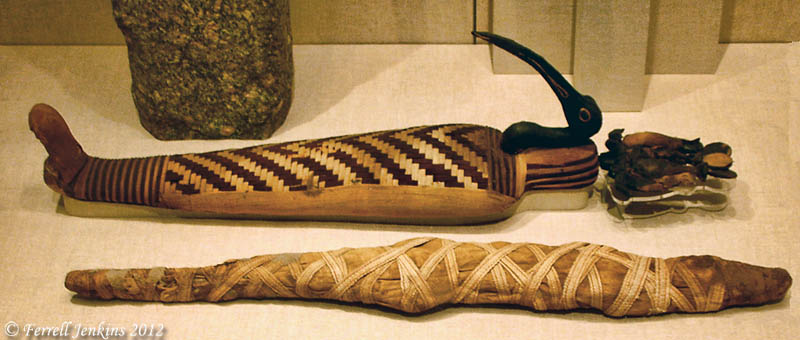
In the photo below we see a mummified Ibis and a mummified Crocodile from the Roman period of Ancient Egypt. The Egyptians considered various animals as gods and mummified them when they died.

Mummiried Ibis and Crocodile from Egypt. Roman Period. Brooklyn Museum.

Mummified Ibis and Crocodile from Egypt. Roman Period. Brooklyn Museum.

The Apostle Paul describes the condition of the Gentiles in the Greco-Roman world in these words:

Claiming to be wise, they became fools,  and exchanged the glory of the immortal God for images resembling mortal man and birds and animals and creeping things. (Romans 1:22-23 ESV)

Two Biblical characters  from the Patriarchal period were mummified in Egypt.

Then Joseph fell on his father’s face and wept over him and kissed him. And Joseph commanded his servants the physicians to embalm his father [Jacob]. So the physicians embalmed Israel. Forty days were required for it, for that is how many are required for embalming. And the Egyptians wept for him seventy days.  (Genesis 50:1-3 ESV)

So Joseph died, being 110 years old. They embalmed him, and he was put in a coffin in Egypt. (Genesis 50:26 ESV)