Selecting a Bible Atlas

A few weeks ago I had a request to recommend a good Bible Atlas. In recent years I have found it difficult to recommend any “good” book unless I have extensive knowledge about the ability of the person making the request, and understand why they need the book. I have more than 15 Bible atlases in my study, and have used others, but no one of them completely satisfies when I get to looking for something special.

Some reader might be thinking, “I have maps in my Bible.” You should either stop reading or continue reading. Maps included in various Bibles can be helpful in seeing a general area, but are of little value in studying details. And, I note that many people have old Bibles that can not have the benefit of the latest research.

So, I have turned to the judgment of someone I trust in this area.

Todd Bolen is Associate Professor of Biblical Studies at the Israel Bible Extension of The Master’s College in Israel. He has been teaching in Israel in the area of biblical archaeology, geography and history for the past ten years, but is currently on leave to continue his studies in the USA. Take a look at his Annotated Bibliography of Selected Books for Israel Studies. Click here.

Among the atlases briefly mentioned are the following:

The Carta Bible Atlas, by Aharoni.
The Moody Atlas of Bible Lands, by Beitzel.
The Holy Land Satellite Atlas, by Cleave.
Student Map Manual: Historical Geography of the Bible Lands, by Monson.
Zondervan NIV Atlas of the Bible, by Rasmussen

Bolen says,

“This [Zondervan NIV Atlas of the Bible] is the atlas to buy to *read* – and therefore is the first choice for a beginning student who can read only one work on the geography of the land. Though the maps are not as extensive or detailed as Macmillan, the text is well-organized, well-written, and trustworthy. The first seventy pages are a geographical overview of the land, region by region. The remaining 130 pages is a historical overview of the lands of the Bible through the biblical periods.”

Bolen also has helpful lists of books on Geography, Old Testament Archaeology, Archaeology Periodicals, Jerusalem Archaeology, New Testament Background, History of Ancient Israel, Modern Israel, et al. The list was last updated October 26, 2007.

On the Bible Places Blog, Bolen comments on “Two New Bible Atlases.” The IVP Atlas of Bible History, by Paul Lawrence, and the Oxford Bible Atlas (4th ed.), by Adrian Curtis.

Here is a review of Carta’s New Century Handbook and Atlas of the Bible. This is an abridgement of The Sacred Bridge. Bolen says,

“Just to be clear, there are many things in this book that I disagree with. If you’re looking for something more conservative, try the NIV Atlas of the Bible, by Carl Rasmussen or the Moody Atlas of Bible Lands, by Barry Beitzel.”

Bolen also has some information on Electronic Maps for Bible Teaching here. Written in 2004, the following works are reviewed or mentioned prominently:

Carta’s Comprehensive Bible Atlas
Bible Maps from Manna
Logos Deluxe Map Set
Nelson’s 3-D Bible Mapbook
Logos Bible Atlas

Below I will list some additional information I have gathered on some other digital sources.

OpenBible.info Bible Atlas (uses satellite photos as the basis of the maps). This includes links to some photos, but many are of no value. Scripture references open to the English Standard Version.

BibleMap. In this program you start with the Bible text to locate places marked on Google satellite maps (photos) or modern road maps. Information from the outdated (1913) International Standard Bible Encyclopedia is also included in the program.

Bible Geocoding claims to contain the location of every identifiable place mentioned in the Bible.

Prof. Mark V. Hoffman writes a blog called Biblical Studies and Technological Tools (From scroll to screen… codex to computer…). Scroll down on the right and click on the label for bible mapping to find information on various digital programs.

American Bible Society has some very nice Interactive Maps in flash format. These would be fine for online study, and it would be great if ABS would make them available in a larger format. The maps require Flash which I was unable to use in Firefox, but I did see the maps in Internet Explorer.

In preaching, and in much teaching, I find that a map showing the general area is adequate for the purpose. I use these various maps in my PowerPoint presentations, but none of these really get at the issue of topography and geography. I use some of the Manna Bible Maps by my friend Matt Hennecke. Scott Richardson, a friend and former student, has prepared some good general purpose Bible Study Maps that I sometimes use in PowerPoint.

For more detailed work I often use the NASA satellite photos and work up maps that will allow me to show not only the place name, but also the terrain and travel routes. Here is an example of what I am talking about.
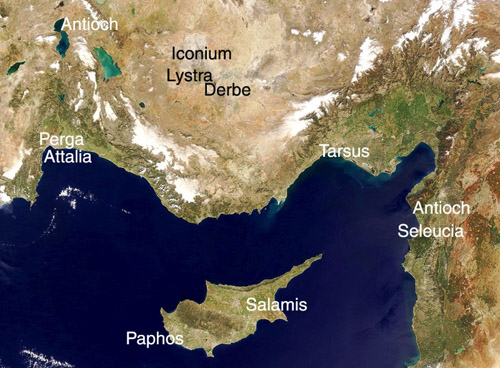
Satellite View of Area of Paul’s First Journey

Even though I note that several preachers seem excited about some of the programs using satellite imagery, I wonder if a person who has not visited the lands of the Bible can really use these to good advantage.

Visit BiblicalStudies.Info, click on Scholarly, then Maps of Bible Lands, for some additional sources of maps. These vary in quality but may be useful for some purposes.

January 3rd in (my) History

I am sure that many significant things have happened on January 3rd, but the one most important to me was my birth on this day. One day I was looking for some photos of the old cotton mills from Huntsville, Alabama, and ran across a site that also had a vintage post card of the City Hospital. This is the way I remember the hospital when I was a kid.

Huntsville, AL, city hospital on an old postcard.

My parents lived in the New Hope area when I was born. About three years later we moved to Harvest, a rural community with a population of about 200. I attended a four-room school for the first 8 years of schooling. There were 2 grades in each room with one teacher. When I was about 10 years of age I was back in the hospital overnight to have a tonsillectomy.

Little could I have imagined in those formative years that I would be able to travel around the world (1995), and to many diverse and exotic places. I don’t even remember when I first learned about China or Egypt or Russia. There was no State of Israel back then, only a Zionist dream. My first remembrance of hearing about Japan was on December 7, 1941, the day of the infamous attack on Pearl Harbor.

I wish my Mother, now 94, could still remember this day in our history.

2008 Five Day Bible Reading Program

Mark and Dena Roberts prepared a Bible Reading Program a few years ago that allows one to read through the Bible in a year by reading the assignment for five days each week. This is practical, as many find they are unable to maintain a daily schedule. It allows for the reading of both the Old Testament and the New Testament.

You may download a free copy of the program by clicking here. Churches may purchase the right to duplicate multiple copies.

Happy New Year – 2008

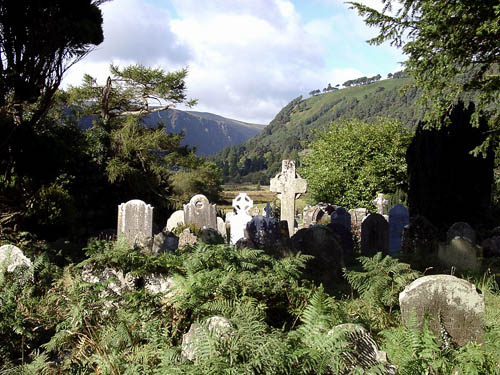
One of the most leisurely tours we have conducted was the Emerald Ireland tour in 2003. There are so many photos that would illustrate the serenity of the trip. I have chosen a scene from Glendalough in County Wicklow, the home of one of my forebears, Matthew Lyon (1746-1822). Lyon came to American as a poor emigrant but rose to be a colonel in the American war of independence and a member of Congress.

Glendalough in County Wicklow, Ireland. Photo by Ferrell Jenkins.

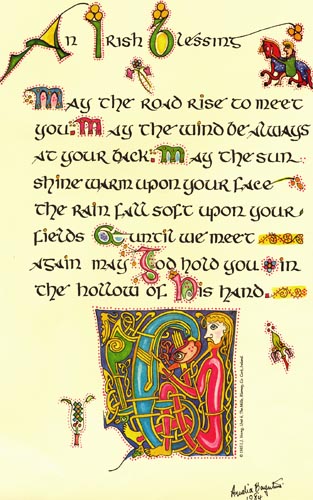
I think The Irish Blessing will be a wonderful wish that we can leave for our travelers for the years 2008. I picked up this copy at the Blarney Woolen Mills. Blarney is always a favorite stop on the Ireland itinerary. Those who need it want to kiss the Blarney Stone and others spend their time in the woolen mills. This beautiful calligraphy is copyrighted by L. J. Young. I hope you will pick up one of the large copies suitable for framing the next time you are in Blarney.

The Irish Blessing

Happy New Year, and enjoyable travels in 2008.

Some favorite travel photos of 2007

In the olden days of 35mm I made about 300 to 400 photos on each trip. Now, with digital photography I make 3000 to 4000. Out of that number I find a few good ones that can be used in various presentations. Pardon me for sharing with you a few of my personal favorites of our foreign tours in 2007.

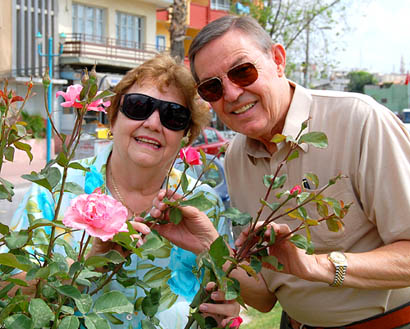
This photo was made in Tarsus of Cilicia (now in Turkey). This was the hometown of Saul, later the Apostle Paul. Elizabeth and I stopped to smell the roses. I think few of us really take enough time to do that. I don’t remember who made the photo. Maybe Larry or Olen. Leave a comment if you remember.

Ferrell and Elizabeth at Tarsus in Cilicia

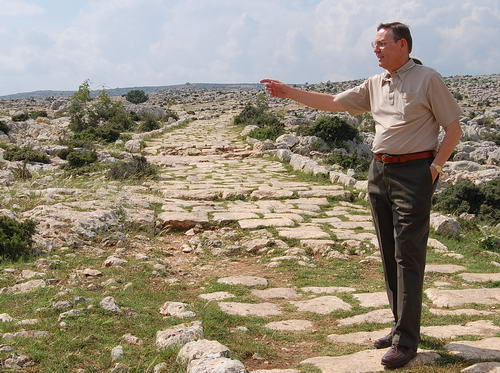
One of the highlights of the Ancient Crossroads Tour of Historical and Biblical Sites in Turkey was locating the ancient Roman Road north of Tarsus. I had known of this road for a long time but had been unable to get to it. What a thrill!

Ferrell Jenkins on the Roman Road North of Tarsus.

David Padfield made this photo. David is a great photographer and knowledgeable in photographic equipment and techniques. He also made the photo below. In fact, he has a little story behind it. This was made at Arsameia in the mountains of Eastern Turkey. This was the capital of the Kingdom of Commagene in the first century B.C. Elizabeth made David, Gene, and Leon promise that they would not let me fall off a cliff. David sent her an enlargement of this photo with a note that this was as close as he could get to me.

Ferrell Jenkins at Arsameia. Photo by David Padfield.

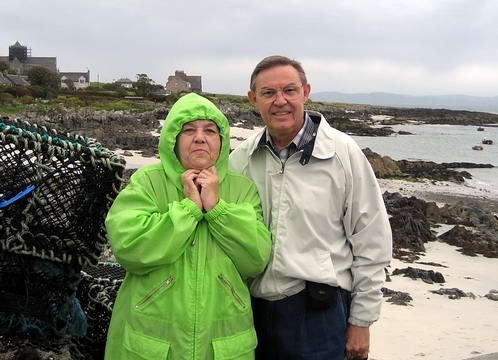
On our September trip to Scotland I enjoyed going to the Isle of Iona, site of a medieval monastery. It was an always misty, and often rainy, experience. I am not sure, but think Jim made this photo.

Ferrell and Elizabeth on the Isle of Iona in Scotland.

Those who traveled with us must have their own favorites. Send a comment to tell us about it.

We have been greatly blessed to travel to so many places on earth over the past 40 years, and to be able to share them with others. Thanks for the memories!

Bethlehem and the birth of Jesus

The media is giving its usual Christmas Eve attention to Bethlehem today. The New Testament teaches that Jesus was born in Bethlehem of Judea in the days of Herod the king (Matthew 2:1). The month, day, and year of the birth of Jesus is not stated in the New Testament. We do have some historical information that helps with the date, but not precise information is available (Luke 2).
Do we know the place of the birth of Jesus in Bethlehem? About A.D. 160 Justin Martyr said, “when the child was born in Bethlehem, since Joseph could not find a lodging in that village, he took up his quarters in a certain cave near the village” (Dialogue With Trypho, 78). Near the middle of the third century Origen said that the cave where Jesus was born was being shown and that even the enemies of the faith were talking of it. Jerome was a resident of Bethlehem from A.D. 386 until his death in A.D. 420. He tells how the birthplace of Jesus, the place of the crucifixion and the tomb where Jesus had lain were defiled from the time of Hadrian to the reign of Constantine. The Church of the Nativity now stands at this spot. Of this location, Dalman says:

No one could discern in this former rocky chamber the place of the Nativity. The altar at the east end was perhaps not erected originally to designate the exact spot, although the background of the grotto would make it probable. Here also is the only remarkable feature in it, namely a small adjoining room which contains in the right wall a low niche resembling a manger (Sacred Sites and Ways, 38).

Typical of so many, this site has enjoyed its share of fanciful speculations. Tradition locates the spot where the adoration of the Magi took place and a projection in the background is taken to be the table at which the Virgin ate with the Magi. Like so much speculation, these overlook the fact that the gospel account represents the Magi as arriving at some time after the birth of Jesus and that they found the child with Mary in a “house.” The Wise Men may have had a fast means of transportation, but one should not forget that they traveled by plain, not plane; they came not from the east side of town, but from the East.
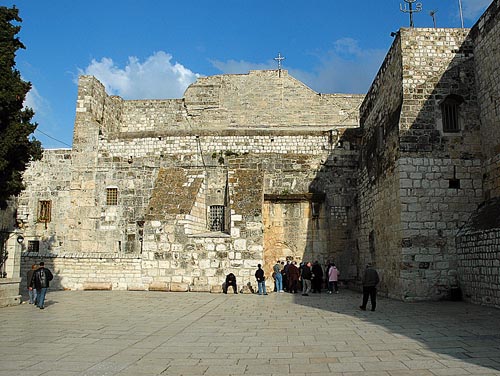
This photo shows the exterior of the Church of Nativity in Bethlehem.

Bethlehem - The Church of Nativity

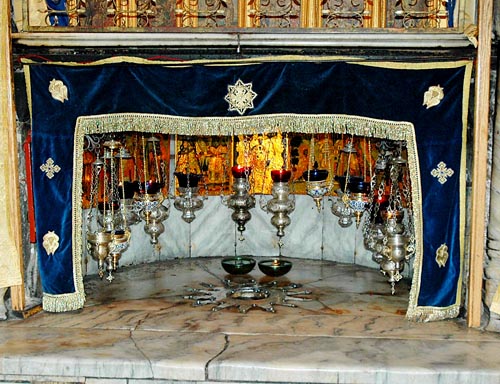
The Church of the Nativity has a long history. It is now a Greek Orthodox church. Underneath the altar is the Grotto of the Nativity where it is said that Jesus was born. Maybe, maybe not. A silver star was set in the marble pavement in 1717. The Latin inscription, “HIC DE VIRGINE MARIA JESUS CHRISTUS NATUS EST.” The translation: “Here Jesus Christ was born of the Virgin Mary.”

Bethlehem - The Church of Nativity - Star in the Grotto of the Nativity

Among the confusion of the date of the birth of Jesus, and the lack of New Testament authority for a church celebration on a certain day, let us not forget that the eternal Word became flesh, and dwelt among men in order to bring salvation to those who obey Him through his death upon the cross (John 1:1, 14; Luke 19:10).

“Although he was a son, he learned obedience through what he suffered. And being made perfect, he became the source of eternal salvation to all who obey him.” – Hebrews 5:8-9, ESV

How much is my blog worth?


My blog is worth $3,951.78.
How much is your blog worth?

Where did Noah’s Ark land?

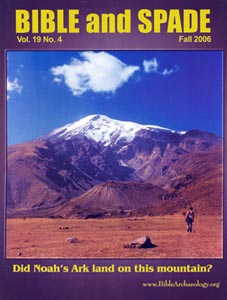
Bible and Spade has made the Fall 2006 issue available in PDF. The entire issue deals with questions of current interest to scholars about the landing of Noah’s Ark. Some recent claims that the ark might have landed in Iran are discussed. The evidence for the two main sites (or regions) in Eastern Turkey are discussed in detail.

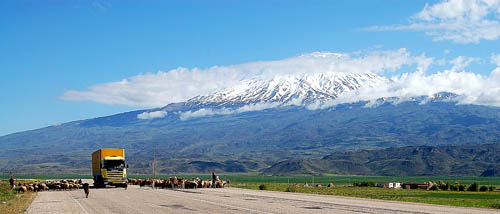
One of the main sites is on, or near, Mount Ararat. The mountain is located just a few miles from the Iranian border in eastern Turkey. Here is a photo I made at Mount Ararat earlier in the summer.

Mount Ararat in Eastern Turkey. Photo by Ferrell Jenkins

The other location is Mount Cudi in southeastern Turkey near the border with Iraq. We were unable to visit this site due to the issues between Turkey and the PKK (very much in the news lately).

The Bible says the ark came to rest on the “mountains of Ararat” (Genesis 8:4). Either of these sites fall within that description.

You may download the Fall 2006 issue of Bible and Spade here in PDF (2.0 MB).

Bible and Spade - Fall 2006

I recommend Bible and Spade. I subscribe and have the back issues in Logos Libronix format for easy searching. Go here for more information about subscribing or securing the back issues. Dr. Bryant G. Wood is the editor of Bible and Spade.

C. S. Lewis on the cover of Time

Time announced Vladimir Putin as Person of the Year today.

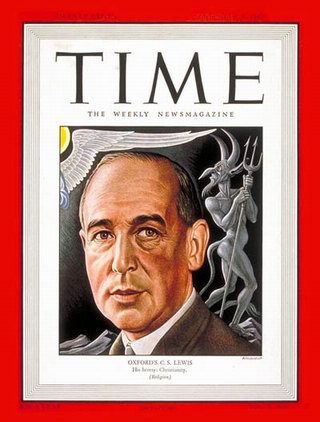
Many do not know that C. S. Lewis was featured on the cover of Time, September 8, 1947. The article about him was titled, “His heresy: Christianity.” If you have enjoyed the Narnia books and movie, or if you have read his apologetic books, I think you would enjoy our pictorial essay on sites associated with Lewis at Oxford, England. Click here.

C. S. Lewis on the cover of Time.

You may view the first trailer for The Chronicles of Narnia: Prince Caspian here.

I Hope You Won’t Get Jerusalem Syndrome

Journalist Ari Rabinovich has written about the Jerusalem Syndrome here. He briefly describes JerSyn in these words:

Only about a dozen Jerusalem tourists per year suddenly get agitated, imagine themselves to be characters from the Bible, fashion makeshift togas out of hotel sheets and go out to holy sites to recite the Psalms, sing hymns or harangue passers-by to repent.

It is a fascinating article, and also has a link to another article he has written, “Come to Jerusalem, see the Messiah?”

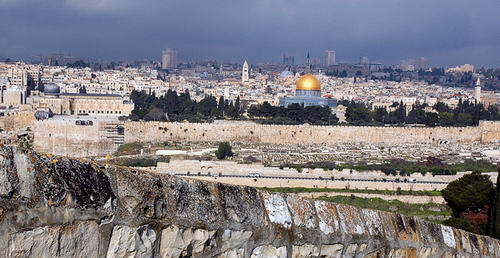
Jerusalem From the Mount of Olives

I think you will admit that the view of Jerusalem from the descent of the Mount of Olives is breathtaking. It is even more so when you see it in person.