The Arrogance of Atheism

The study of apologetics or evidences for the defense of Christianity has been a special interest of mine for half a century now. While there has been opposition to Christianity as a divinely revealed religion, and to the Bible as the special revelation of the mind of God all along, much of it has been subtle. Of late we have begun to notice that Atheism has become evangelistic in their opposition to the Faith.

Time publishes a list of Top 10 this and that at the end of the year. I took a look at the Top 10 Religion Stories. Number 7 in that list is “The Roar of Atheist Books.” Here is a brief summary:

Statistics may or may not show that there has been an actual increase in the number of Americans who believe there is no God. But one thing is certain: Conservative religious influence riled up enough secular authors to produce a slew of skeptical literature, and enough readers were intrigued to turn Richard Dawkins (The God Delusion) and Sam Harris (Letter to a Christian Nation) into bold-faced names and turn Christopher Hitchens (God Is Not Great: How Religion Poisons Everything), bold-faced already, into a one-man literary cottage industry.

Christians must not hide their heads in the sand and hope no one notices these works. Even in New Testament times, Peter urged the Christians who were living in a society a lot like ours to be set for the defense of the Gospel.

But set Christ apart as Lord in your hearts and always be ready to give an answer to anyone who asks about the hope you possess. Yet do it with courtesy and respect, keeping a good conscience, so that those who slander your good conduct in Christ may be put to shame when they accuse you. (1 Peter 3:15-16, NET Bible)

At BiblicalStudies.info, there are many good links under Apologetics that will help you prepare to answer attacks on the faith. Become acquainted with these materials.

The arrogance of atheism is astounding. Imagine a person who lives on one square meter of the earth (at any given time) for a total of 60 to 100 years, being able to make pronouncements about eternity and all things. The writer of Hebrews says, “For every house is built by someone, but the builder of all things is God” (Hebrews 3:5, NET Bible). It is amazing that individuals who attribute everything to chance think they are so smart. And if they are right, we can’t help being believers!

This morning Time has an article about Sunday School for Atheists. The children in our Bible classes need to learn Bible stories, but they also need to learn the evidences that help to sustain the faith against various cultural attacks.

You might want to take a look at the Blog of Dr. Albert Mohler, president of the Southern Baptist Seminary. He regularly writes blogs dealing with these cultural issues. Be sure to note what he has said about The Golden Compass.
Todd Bolen and the BiblePlaces Newsletter

Just when I had about given up,
what to my wondering eyes did appear,
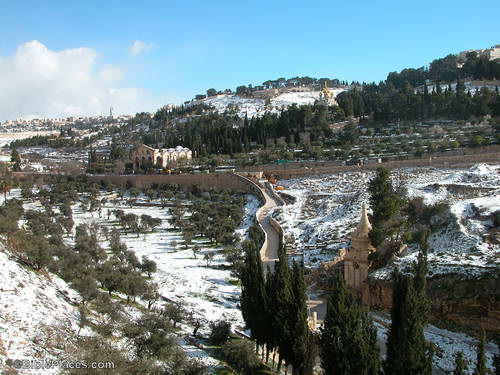
but a BiblePlaces Newsletter with 8 tiny photos of Jerusalem and Judah in Snow. (with apologies to no one!)

When Todd Bolen left Israel to come to the USA to pursue doctoral work I surmised that he would soon become too busy to continue with his Newsletter. He has done a fine job of keeping the Bible Places Blog up to date with notices of important archaeological news from Israel.

I have encouraged many people to subscribe to Todd’s BiblePlaces Newsletter and to buy his wonderful Pictorial Library of Bible Lands. After nearly forty trips to Israel, I still find that I am sometimes lacking the exact photo I need. I often find just the right one in this collection.

In the December BiblePlaces Newsletter there are 8 beautiful photos of Jerusalem and Judah in the snow. Todd was in the country about 10 years and had the opportunity to get photos at the right time.

Here is a small photo of the Mount of Olives and Kidron Valley. From the Newsletter you may download high resolutions copies of all eight photos. For those who use PowerPoint the photos are also available in PowerPoint format.

Mount of Olives and Kidron Valley in Snow

Here is Todd’s comment on the photo:

Looking northeast from the City of David, one gets an impressive view of the Kidron Valley and the Mount of Olives. Several stories occurred within the view of this photo, including David’s fleeing from Absalom (2 Sam 15:30) and Jesus’ crossing the Kidron Valley on his way to Gethsemane (John 18:1). The church in the center left of the photo is built over the traditional Gethsemane and the impressive tomb monument in the lower right is incorrectly known as the “Pillar of Absalom.”

To see the BiblePlaces Newsletter, December, 2007, click here. Opportunity to subscribe to the Newsletter is available at the bottom of the page. You can also learn how to order the Pictorial Library there.

Thanks, Todd. Your work has been a blessing to many.

Christmas, St. Nicholas, and Myra

Christmas is approaching. I would like to call your attention to an article I have written about Christmas. You may read it here. A more detailed outline, The Truth About Christmas, giving both biblical and historical information is available in PDF at BibleWorld.com. You are welcome to duplicate these articles for your own use. Please do not make changes in them.

Even by the end of the first century the church was beginning to move away from the apostolic pattern. One of the earliest departures was in church government. Instead of each church having a plurality of elders (bishops, overseers, pastors) (Acts 14:23; Philippians 1:1), it became popular to elevate one man to the position of Bishop over the elders.

In the fourth century there was a bishop at Myra, by the name of Nicholas, who was benevolent to those in need. From this historical person there arose the legend of Saint Nicholas, eventually Santa Claus.

Myra was a town of Lycia about 85 miles from Antalya, Turkey (biblical Attalia, Acts 14:25). The town is located a few miles away from the Mediterranean, but has a port. When Paul was being escorted by a Roman centurion from Caesarea Maritima to Rome, the ship sailed along the coast of Cilicia and Pamphylia, and landed at Myra in Lycia (Acts 27:5). There they found an Alexandrian ship sailing for Italy.

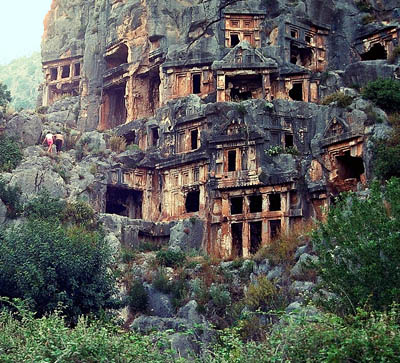
Whether Paul was close enough to see any of Myra we do not know. There are several interesting things that could have been seen. I have only visited Myra once, in 1987. I mention this to say that it was before the days of digital photos. Here is a photo of the house-type tombs in the cliffs at Myra dating from the 4th century B.C.

Rock Cut Tombs at Myra in Lycia

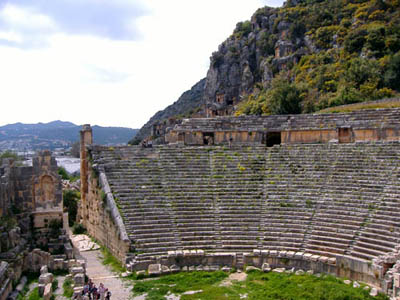
The theater at Myra dates from the 2nd century B.C., and had a capacity of 10,000 spectators. The following photo comes from the Wikipedia entry on Myra.

Theater at Myra in Lycia

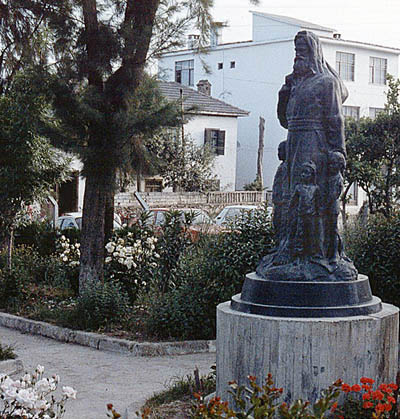
Ruins of the Church of Saint Nicholas can be seen at nearby Demre. Here is a photo I made of the statue of St. Nicholas in 1987.

St. Nicholar at Demre (Myra) in Lycia

And that’s how legend grows!

The Executable Preacher

Mark Copeland, over at Executable Preacher, has been kind enough to mention Ferrell’s Travel Blog. Mark and his wife were among my early students. He has preached for years at Fortune Road in Kissimmee, FL. Anyone visiting the Disney/Universal area should look up these brethren. I keep a link to both Fortune Road and Executable Preacher at the Biblical Studies Info Page under Links.

Mark mentions that his father-in-law, Steve Hudgins, was on one of my earliest tours. It fact, it was the first one in 1967. If you know Steve you can locate him in the photo of that group at the Jordan River in our post of September 4. For many years Steve supplied the pens and travel bags that we distributed to tour members. He also painted many of the banners that we used in the group photos.

Thanks, Mark. If there are any readers here that do not visit your blog with regularity, I hope that will do so now. I miss it when you go too long without writing. The page should be of interest to preachers, elders, and Bible teachers generally.

Our New Travel Bus and Hotel

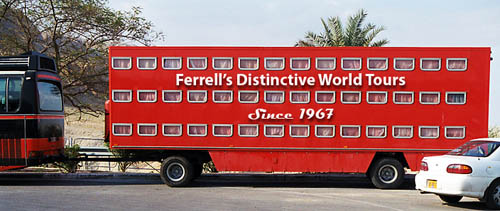
Some of you may wonder what kind of accommodations we have on the tours, so I thought I would share this photo with you. Note that every person has a window. We do suggest that our tour members pack light.

Rolling Hotel at the Dead Sea.

This is actually the way some European groups travel in Israel. The photo was made in 2000 at Qumran on the shores of the Dead Sea. It could get hot in there, don’t you think? I am concerned about the Internet connection.

Good preachers could learn from a trip to Israel

Todd Bolen, of Bible Places fame, spent about 10 years teaching in Israel. In a recent blog at Todd’s Thoughts, he made this comment:

“…even really good preachers could learn something from a trip to Israel.”

How true! Occasionally I have a preacher tell me that he plans to retire in a year or two and hopes to travel with me to the Bible Lands. My thought is that a visit to the Bible Lands is a tool; not a crown!

The only thing I could add to Todd’s comment, and I think he would agree, “not only Israel, but Jordan, Egypt, Turkey, Greece, and other parts of the Bible world.”

Movie and TV writers plan strike

That is the “very latest” as they say on TV.

Comment: There are writers?

Drew is Three!

Drew’s third birthday was October 24th. He has been a real blessing to us. Grandmother and I keep him as often as possible. He is a good learner. I am hopeful that I will be able to share some travel experiences with him.

His dad made him a “Big Boy Bed” like a fire engine for his birthday. Yes, I mean that his dad made it all by himself. What talent! You might enjoy this photo that I made when Drew first saw the bed.

Drew’s Third Birthday. Photo by Ferrell Jenkins.

Archaeological work at Ephesus might take centuries

Today’s Zaman, reports that the archaeological excavation at Ephesus may continue “for centuries.” The article says that work began at Ephesus 138 years ago. This reference seems to be to 1869 when the English architect J. T. Wood found the marble floor of the temple of Diana. Some research had been done as early as 1845.

Most of the archaeological work at Ephesus has been done by Austrians. They began the work in 1895 and have continued until the present time.

The article reports an interview with Dr. Fritz Krinziner, director of the dig and head of the Austrian Archaeology Institute. I note that Dr. Krinziner wrote Preface 2 in Ephesus: 100 Years of Austrian Research, published in 1996. Here are a few interesting comments from the article.

” He [Krinziner] stressed that it would be impossible to uncover the entire ancient city at once, underlining that only 10-15 percent of the site has been unearthed so far.”

“The excavation work may last for centuries. This is not an easy job. We focus on spots where we are likely to find something important as we cannot carry out the entire excavation at once.”

The article says that 1.5 million people visited Ephesus last year. An added note says that the Greater Izmir Municipality has announced plans “to establish an electric railway connection, similar to a tram, in Ephesus.”

The complete article may still be available here.

I speak to some people who seem to think that most of the archaeological work in various biblical cities has already been done. The work is complete! Think again.

Ephesus is visited by many tourists who have no interest in the Bible. They arrive on the cruise ships that dock at nearby Kusadasi. Others find the ruins interesting because the city was the site of Paul’s work (Acts 19). I think the tradition that the apostle John was here prior to being exiled to Patmos is a reliable one. The first letter within the book of Revelation is addressed to the church at Ephesus (Rev. 2).

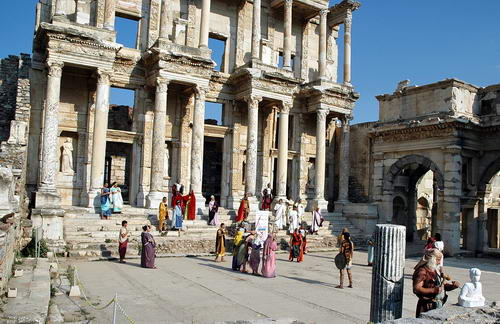
This photo shows the Library of Celsus and some costumed actors from one of the cruise ships putting on a show for the passengers.

Library of Celsus at Ephesus. Photo by Ferrell Jenkins.

The Library was built in A.D. 135, after the time of Paul and John. The first time I saw this area, in 1968, only the steps were visible. The Austrian excavators did a marvelous job of reconstruction between 1970 and 1978. It is estimated that the Library could hold between 9,500 and 12,000 rolls. The arch to the right leads to the ancient agora.

We visit Ephesus on our Steps of Paul and John tour.

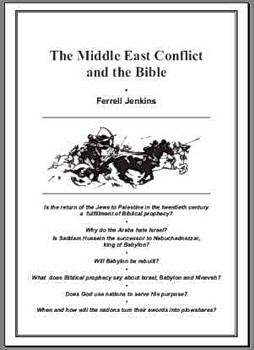
The Middle East Conflict and the Bible

Shortly before the first Gulf War I pulled together some of the material I had prepared about various problem associated with the Middle East conflict and the Bible. After going through several printings I allowed Mark Roberts to put the material for sale online at BibleClassMaterial.com. A single copy may be purchased, or a church may secure a license to use the material in classes. Take a look.

The Middle East Conflict and the Bible by Ferrell Jenkins

The book deals with the Arab-Israeli problem, whether the modern state of Israel is in fulfillment of Bible prophecy, and other important issues. There is also material about Iraq and Islam. At the BibleClassMaterial website you will find more details about the content.