LMLK jar handles

During the time of the Divided Kingdom, pottery jars with handles bearing the Hebrew letters LMLK seem to have been in common use. T. C. Mitchell comments briefly on these handles:

These handles of pottery jars which had been stamped before baking, with seals show symbols, either a four-winged scarab or a two-winged disc, with lmlk, ‘belonging to the king’ written above it in Hebrew script and a place-name below it. Over eight hundred of these stamped handles have been found at over twenty excavated sites in Palestine, nearly all in the territory to which Judah was confined by about 700 BC. (The Bible in the British Museum, page 55).

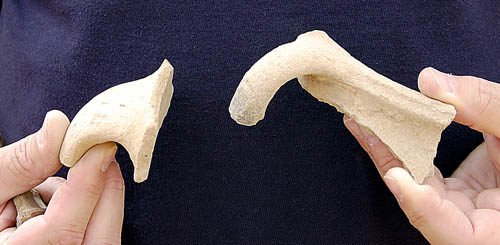
Tourists who have an interest in archaeology often pick up shards of pottery as they walk across various tells. It is not uncommon to locate a jar handle or the rim of a bowl. Recently a college student found a LMLK handle at Ramat Rahel, a site between Jerusalem and Bethlehem. Several blogs have commented on it. Todd Bolen has a nice photo of the handle here. A newspaper article about the chance find is here.The LMLK web site has a report here.

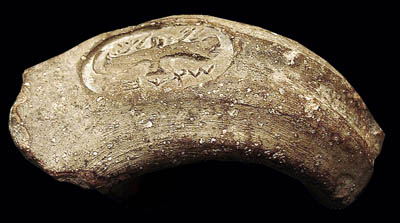
This is a photo of a LMLK jar handle that I made in the British Museum. The handle was found at Lachish. The LMLK handles have the phrase LMLK (“belonging to the king”) and the name of one of the cities that served as a distribution center: HBRN (Hebron), ZP (Ziph), SWKH (Socoh), or MMST. This one has SWKH.

King Hezekiah built “storehouses…for the produce of grain, wine and oil” (2 Chronicles 32:28). Mitchell says that the LMLK vessels “would have been suitable for any of the three staples derived from the land, grain, wine or oil.”

A New, Smaller Bible Atlas

Carta's New Century Handbook and Atlas of the Bible

Carta’s New Century Handbook and Atlas of the Bible
Abridgment of The Sacred Bridge

by Anson F. Rainey and R. Steven Notley
Carta, Jerusalem, 2007
280 pages + full color illustrations and maps, English. Cloth, 9 x 12 inches
ISBN: 9789652207036
List Price: $50.00. Your Price: $45.00

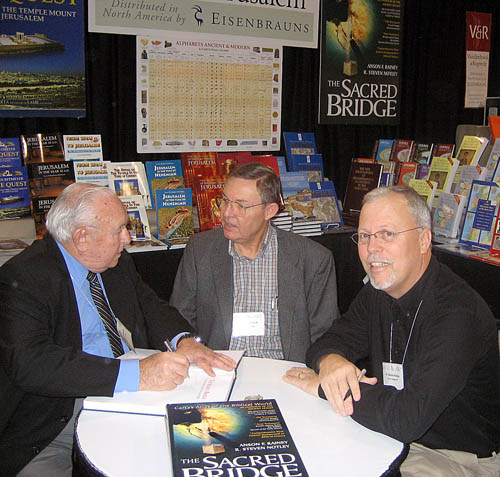
Several times we have mentioned the important of the Bible student having a good atlas. Check here. Two years ago Carta brought out The Sacred Bridge, by Rainey and Notley. The book is large, and the content is more than most students want or need. And the price was $100. In response to a request from many professors, the same authors have prepared Carta’s New Century Handbook and Atlas of the Bible. I have not seen this book, but I have been using the larger atlas, and I plan to get a copy of the abridged edition. Fortunately I was able to get The Sacred Bridge autographed by Rainey and Notley.

Eisenbrauns is the US distributor of Carta books and maps. A click on the title at the top will take you to their web page.

Ramoth in Gilead

Ramoth in Gilead (or Ramoth-gilead) was a town in Gilead that was included in the territory of the Israelite tribe of Gad in Transjordan (Joshua 20:8). It was one of the Levitical cities of refuge for the Israelites (Joshua 21:38). The most memorable associated with Ramoth-gilead recorded in the Bible is the battle with Aram (Syria) in which Ahab was killed (1 Kings 22). Elijah sent one of the sons of the prophets to Ramoth-gilead to anoint Jehu as king of Israel (2 Kings 9:1).

The identity of Ramoth-gilead is uncertain. Two sites are frequently mentioned by scholars: Tall ar-Rumeith and Ar-Ramtha.

Burton MacDonald, in East of the Jordan, says,

There is also archaeological support for choosing Tall ar-Rumeith, situated in the fertile plain area just to the southeast of the junction of the ‘Amman-Damascus and Irbid-Mafraq highways, as the location for Ramothgilead. (page 200)

Paul Lapp excavated at Tall ar-Rumeith in 1967. Little archaeological work has been done at Ar-Ramtha. I have not gone into the Jordanian city of Ramtha, but understand that the mound is covered by the town, thus making it difficult to conduct an excavation.

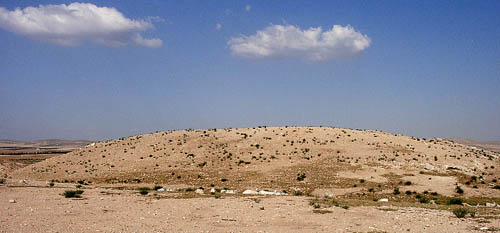
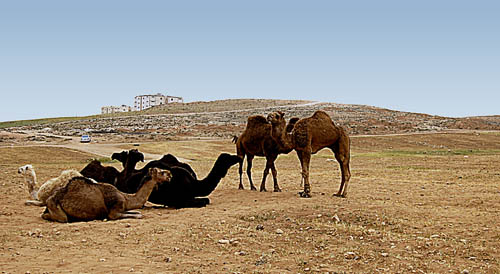
Here is a photo I made at Tall ar-Rumeith in 2002. It is not surprising to see camels here because the desert is near (to the east). From the top of the tell there is a great view looking north across a fertile plain to the border with Syria.

Earlier this year I went back to the site, but found that some modern housing has been built adjacent to the east side of the tell. It appears to be serving as housing for Indian students. I speculate that they attend a nearby university.

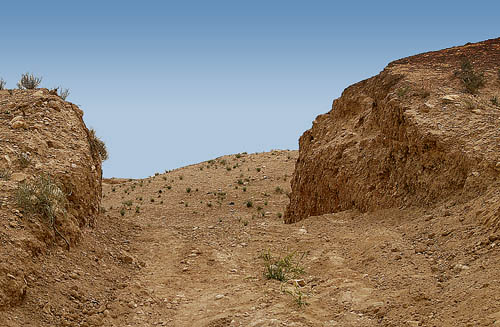
This photo shows a modern trench made to make a road to part of the construction site.

We found some pottery in the road, but can not be certain that it came from the damage to the tell. I did not see any shards along the edge of the cut.

This illustrates a real problem associated with ancient sites in isolated places. In a place like Jordan there are so many sites that it is impossible to excavate, preserve, and guard all of them.

A note on spelling. You may note different spellings of the word describing an archaeological mound. In Israel the term Tel is used. Earlier the term Tell was used throughout the Middle East. In Jordan the term Tall has come into common use.

There is also much variation in the spelling of some of the compound biblical names in scholarly sources, and even in English translation of the Bible. This is illustrated in this post and the previous one on Bethshan.

Bethshan – Bet She’an

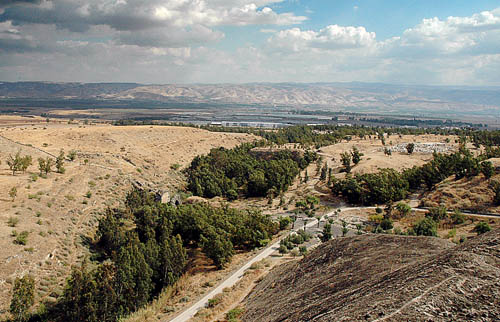
Bethshan is mentioned only a few times in the Old Testament. The New American Standard Bible uses the following spellings for this town: Beth-shean; Beth-shan; Bethshan. Today the modern town and ancient site go by the name Bet-She’an. The site was important because of its location at a major junction of two valleys, the Jordan valley with the Jezreel valley. The tell, called Tell el-Husn or Tel Bet She’an, commands an impressive view of the area, including a great view of the land of Gilead.

Today I am preparing a class dealing with the account of the eastern tribes building an altar “in the region of the Jordan which is in the land of Canaan” (Joshua 22:10). While looking for some photos to illustrate this episode in the history of Israel I thought of the view from the tell of Bethshan. We do not know the exact location, but this view provides a wonderful view of the land of Gilead (now in Jordan) which was given to Gad and Manasseh. You will observe trees below the tell. This is the where the River Harod flows, continuing down to the Jordan. You will notice ruins of a bridge that once crossed the river.

Father’s Day

According to the entry in Wikipedia, Father’s Day was first celebrated in the United Stated in 1908.

In the United States, the first modern Father’s Day celebration was held on July 5, 1908, in Fairmont, West Virginia or on June 19th of the same year, in the state of Washington. Today, Father’s Day is celebrated on the 3rd Sunday of June.

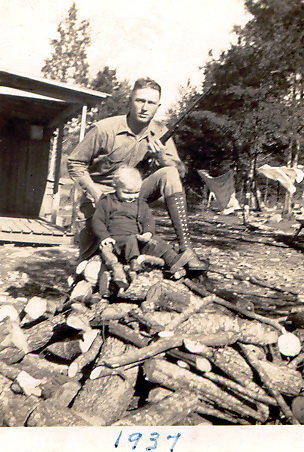
My father was a good man who sought to do the best for his wife and son, his family and the church. He was a faithful Christian who sought to serve the Lord Jesus Christ, as I account him. I am not sure of my earliest memory of my dad, but I am confident that those very early years were important ones. A few years ago one of my cousins sent me some photos she found among her mother’s belonging. Her mother was my father’s sister who became an icon in Huntsville, Alabama, with her Aunt Eunice’s Country Kitchen. If you don’t know about this, just put “Aunt Eunice” in your Google search engine and take a look.

Anyway, this small collection of photos included the earliest photo I have of my father. I was one year old; he was about 23 or 24. This scene shows the back porch of our little frame house, the wood pile, and some clothes hanging on the line. In those years there was no Internet, no telephones, no running water, and no central heating. We would have none of these things until I was about 10 years of age. Yet, I had a good childhood and a firm foundation for future life. My father worked as a farmer, a carpenter, ran a small produce (fruits and vegetable) company, did some hauling, and ran a small grocery. His life was cut too short at the age of 65. I think about him almost every day.

While sharing old family photos I thought I would share one that includes both my mother and my father. This photo was probably made about 1954 in their small neighborhood grocery. Mother is nearing 95 now, but she has not known me for the past few years. My Father never was able to travel with me to the Bible Lands, but Mother was able to join me twice.

I trust that every reader will take heed to the instruction of the Apostle Paul to the saints at Ephesus:

“Honor your father and mother” (this is the first commandment with a promise). Ephesians 6:1 ESV

More on the Jordan church

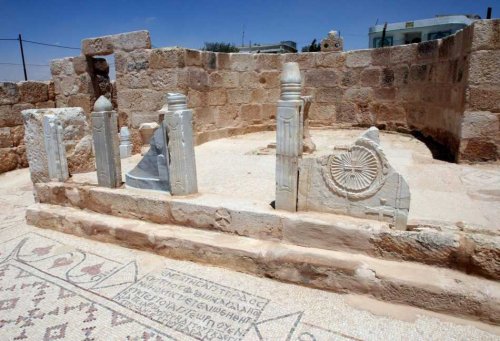
Monster Critic has posted some small photos of the Rehab, Jordan, Byzantine church building, and of the cave under the church. Detailed information is still sketchy. Ruins of Byzantine period church buildings are prevalent in both Jordan and Syria.

I think you will need to click on these thumbnail images a second time to see the largest size.

HT: Calude Mariottini

“You cows of Bashan”

Amos of Tekoa is recognized as a straight forward, no nonsense, prophet (Amos 1:1). He called the women of the northern kingdom of Israel cows. Nothing politically correct about that.

Hear this word, you cows of Bashan who are on the mountain of Samaria, Who oppress the poor, who crush the needy, Who say to your husbands, “Bring now, that we may drink!” (Amos 4:1)

The sn (study note) in the NET Bible is worth reading.

The expression cows of Bashan is used by the prophet to address the wealthy women of Samaria, who demand that their husbands satisfy their cravings. The derogatory language perhaps suggests that they, like the livestock of Bashan, were well fed, ironically in preparation for the coming slaughter. This phrase is sometimes cited to critique the book’s view of women.

Bashan is in the area we now call the Golan Heights. It is located to the east of the Sea of Galilee and northward. Golan in Bashan was one of the cities of refuge located in the territory of eastern Manasseh (Joshua 20:8). The region was noted as good pasture land.

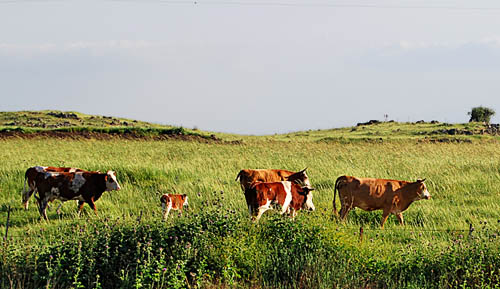
In the modern state of Israel we notice an attempt to grow crops known from biblical times in the same area where they were grown then. And the same is true of cattle. Here is a photo I made this year of some of the cows grazing in ancient Bashan (modern Golan Heights).

First century church (building) found?

Several blogs have noted the report of a claim out of Jordan than a first century church has been found. The Jordan Times report by Rula Samain follows:

AMMAN – Lying underneath Saint Georgeous Church in Rihab, Mafraq, is what archaeologists describe as the first Christian church in the world.

“We have uncovered what we believe to be the first church in the world, dating from 33 AD to 70 AD,” said Archaeologist Abdul Qader Hussan, head of the Rihab Centre for Archaeological Studies.

The discovery was “amazing”, Hussan told The Jordan Times.

“We have evidence to believe this church sheltered the early Christians: the 70 disciples of Jesus Christ,” the scholar said.

The early Christians, described in the mosaic inscription on St. Georgeous floor as “the 70 beloved by God and Divine”, are said to have fled from Jerusalem during the persecution of Christians, to the northern part of Jordan, particularly to Rihab, he added.

Citing historical sources, the expert said the 70 lived and practised their rituals in secrecy in this underground church.

We believe that they did not leave the cave and lived until the Christian religion was embraced by Roman rulers.

“It was then when St. Georgeous was built,” said Hussan.

Saint Georgeous is believed to be the oldest “proper” church in the world, built in 230 AD. This status is only challenged by a church unearthed in Aqaba in 1998, also dating back to 3rd century.

The findings in the graveyard near the cave offer valuable clues, according to Hussan.

“We found pottery items that date back from the 3rd to 7th century,” he added. The findings show that the first Christians and their offshoot continued living in the area till the late Roman rule.

“Going down a few steps into the cave, one would see a circle shape area, believed to be the apse, and several stone seats for the ecclesiastics,” he added.

Archimandrite Nektarious, Bishop Deputy of the Greek Orthodox Archdiocese, described the discovery of the cave as an “important milestone for Christians all around the world”.

“The only other cave in the world similar in shape and purpose is in Thessalonica, Greece,” the bishop said in an interview in Amman.

The cave also embraces the living place of the first Christians. “A wall with an entrance is the only partition separating the altar from the living area,” Hussan said.

There is also a deep tunnel, which is believed to have led the 70 Christians to their source of water, the archaeologist added.

Officials in Mafraq say they will capitalise on the discovery to further promote the area.

Governor Zeid Zreiqat, who noted Rihab is rich in unique archaeological sites, said that together with the new discovery, these sites can be invested to attract religious tourism.

“We are working on developing Rihab to become a major tourist attraction in the near future,” he told The Jordan Times.

So far, 30 churches have been discovered in Rihab,” Hussan said. It is also believed that Jesus Christ and the Virgin Mary have passed through this area, he added.

Are you excited about this discovery? Note that the report claims that the St. Geogeous Church “is believed to be the oldest proper church in the world, built in 230 AD.” The new discovery seems to have been a cave under the third century church. We must await further information on the inscription about the 70 disciples of Jesus.

There are several things in this report that arouse suspiction. Who were the 70 disciples? Were they the 70 of Luke 10:1-12? What rituals did they practice in secret? The church dates from 33 AD to 70 AD, yet they stayed in the cave until Christianity was embraced by the Roman government (early 4th century).

The pottery is said to date from the 3rd to the 7th century. Did the first century residents of the cave church leave no pottery? Do you really think a first century church had circular shaped seats for the clergy? (This is stated in the caption under a photo with the article.) We have no historical evidence for this clergy-laity distinction until well into the 2nd century.

We are told that the city of Mafraq will “capitalize on the discovery to further promote the area” and to help it become a major tourist attraction.

An MSNBC report cites Thomas Parker, of the University of North Carolina-Raleigh, as saying that this information should be greeted with a degree of caution. Read it here.

Pseudo Archaeologists

Gordon Govier, editor of Artifax, and producer of The Book & the Spade weekly radio program and podcast, has written about about a group of amateur archaeologists who are now being called Pseudo Archaeologists. These individuals, such as the late Ron Wyatt, Robert Cornuke. The discoveries claimed by these men make Indiana Jones look like a kid playing with his first shovel.

Several times a year someone sends me information about the claim of Ron Wyatt that he found Pharaoh’s chariot wheels in the Red Sea, etc. The ABR (Associates for Biblical Research) web page includes several articles dealing with these subjects. The page has been recently redesigned and you will profit by spending some time there. I also urge you to read Govier’s good article in Christianity Today here.

Some people think I know a lot about archaeology, but they know very little. I have been a student of the subject for more than 50 years, have participated in a dig, and am acquainted with several real archaeologists, but I am not an archaeologist. I frequently presents lessons on Bible History and Archaeology because I think the information can be extremely helpful to Bible students.

Sometimes we expect too much of archaeology. We should remember the old maxim, “If it sounds too good to be true, it probably isn’t true.”

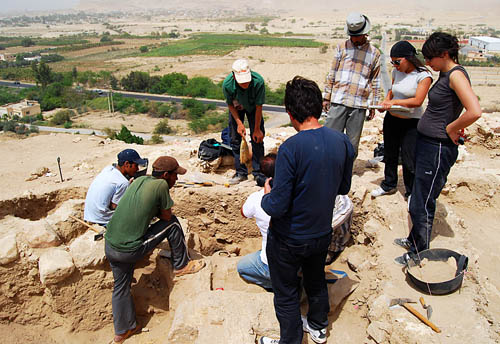
Archaeology is hard work, and often requires many years of diligent work at a single tell. In April I stopped at Tell Kafrein in the Jordan Valley and visited with the staff there for a while. This view shows a group gathered to hear the supervisor explain how to remove a Middle Bronze jar. The excavation at this yet unidentified site is under the direction of Professor Thanasis Papadopoulos of the University of Ioannina in northern Greece. I promised that I would not publish a photo of the jar, but I can tell you that it was beautiful (if you like that sort of thing). Notice that none of the works have a whip or a leather jacket. I don’t even see a fedora.

Man of Galilee now available

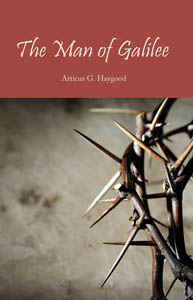
The Man of Galilee by Atticus G. Haygood is a small book that should be read by every person interested in the identity of Jesus of Galilee. The book was first published in 1889, and has been republished several times. I published it as part of Evidence Quarterly in 1963. It has been available at our Biblical Studies Info Page for a number of years. Now DeWard Publishing Company has published The Man of Galilee in an attractive paperback edition of 108 pages. This book will make an excellent gift to any young person who is of an age to be thinking about the Jesus of the New Testament.

Melvin Curry comments about this book:

Some big books need to die; this little one needs to live. Haygood’s Man of Galilee is a profound argument about the uniqueness of Jesus.

Dan Petty says,

Haygood discusses the truly unique and universal quality of the character of Jesus in a manner that is thoughtful, thorough, and logical. It is presented in terms that the student will find interesting, refreshing, and in the end, compelling.

Order The Man of Galilee.

I wish to commend DeWard Publishing Company for making this book available. Take a look at their web page.