Philadelphia, the church with an open door

Philadelphia is located about 30 miles southeast of Sardis in the valley of the Cogamis, a tributary of the Hermus. The city is built on the slope of Mount Tmolus overlooking a fertile valley. Philadelphia was in the province of Lydia in Western Asia Minor.

Philadelphia stood at the place where the borders of Mysia, Lydia, and Phrygia met. “It was characteristically a border town” (Barclay). This position made it the gateway to the East. Ramsay says,

“the Imperial Post-Road of the first century, coming from Rome by Troas, Pergamum and Sardis, passed through Philadelphia and went on to the East; and thus Philadelphia was a stage on the main line of Imperial communication” (The Letters to the Seven Churches 395).

The site of ancient Philadelphia is now covered by the Turkish agricultural town of Alashehir which has a population of about 20,000. Alashehir (Red City) is named for the volcanic earth in the area (Blaiklock 122). The plain is filled with vineyards. If Philadelphia were not a Biblical city very few tourists would put forth the effort to visit it.

According to Hemer, the location had one great disadvantage.

“It lies perilously close to the region known as the Catacecaumene (“the burnt land”) of Lydia, a hilly tract to the northeast which contained volcanic cones which had been active in recent geological time. And the whole area lies in the Anatolian fault system. Philadelphia was peculiarly liable to earthquake” (Hemer, “Unto the Angels of the Churches,” Buried History 11 (1975), 166).

Trench says, “No city of Asia Minor suffered more, or so much, from violent and often recurring earthquakes.” In A.D. 17 there was a destructive earthquake in the region which affected 12 cities. Sardis suffered worst, but Philadelphia is also mentioned. The cities were exempted from direct taxation and Tiberius provided personal funds for relief (Tacitus. Annals. 2.47).

Ramsay, who spent much time in Asia, reports that “the first great shock of earthquake is not so trying to the mind as the subsequent shocks, even though less severe, when these recur at intervals during the subsequent weeks and months….” Colin J. Hemer visited Philadelphia in 1969 just a few days after an earthquake (172-73). The people would leave the city and go out into the open fields and live in tents. When all danger was passed, and they did the necessary rebuilding, they would go back into the city. Strabo reports this in A.D. 20 (Ramsay), and Hemer provides a photograph of people living in tents outside their houses in 1969.

Our photo shows the ruins of the Byzantine church. Local tradition says this building served as a cathedral dedicated to St. John the Theologian. In Turkey the minaret is positioned to be in almost every tourist photo.
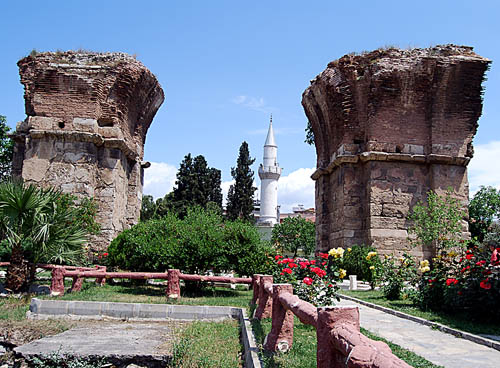
Toward the end of the first century the Lord sent a letter to the church at Philadelphia (Revelation 1:11; 3:7-13). The Lord commended the church with these words:

Behold, I have put before you an open door which no one can shut, because you have a little power, and have kept My word, and have not denied My name. Revelation 3:8
Another kind of Poppy

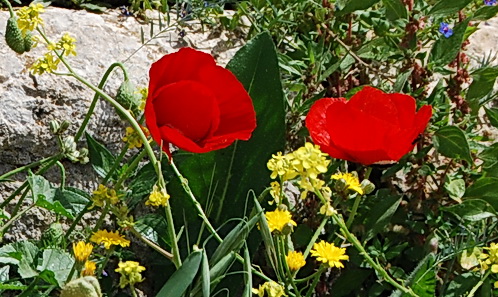
A few days ago I posted a photo of some poppies in Turkey and included the term anemone with it here. Reader J. P. Van de Griessen, of the Netherlands, informed us that he thinks that this is the “Papaver rhoeas or family of it.” I do not have much knowledge about plants, but I had noticed that the poppies in Turkey were a bit different from the ones I have seen in Israel and Jordan in the spring of the year. J. P. has a section of his blog dealing with flora. Even if you can not read the Dutch you might be able to make a suitable translation using the Google language tools.

In the past three trips to Israel, with good digital equipment, I have not seen many poppies growing. In past visits, earlier in the year, we have seen entire fields colored with them. Here is a photo of some poppies among the ruins at Jerash in Jordan.

I understand this to be the anemone. Dr. David Darom, in Beautiful Plants of the Bible, calls it the common poppy (Papaver sp.). One Wikipedia article indicates that there are more than 150 varieties of the poppy. Darom links this plant with the “lilies of the field” mentioned by Jesus.

And why are you worried about clothing? Observe how the lilies of the field grow; they do not toil nor do they spin, yet I say to you that not even Solomon in all his glory clothed himself like one of these. “But if God so clothes the grass of the field, which is alive today and tomorrow is thrown into the furnace, will He not much more clothe you? You of little faith! (Matthew 6:28-30)

The UBS Fauna and Flora of the Bible comments on the New Testament word krinon:

It is used by Jesus in the Sermon on the Mount, when he says: ‘Even Solomon in all his glory was not arrayed like one of these.’ Most commentators now think of the Anemone coronaria, the anemone with beautiful bright colours which is to be found on the hills of Galilee, where it would undoubtedly have been seen by the people listening to Jesus. (page 135)

Thanks, J.P. Any other help will be appreciated.

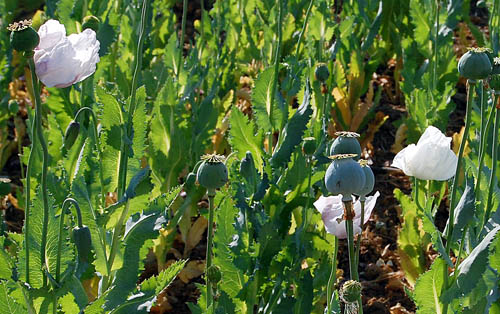
Speaking of poppies. In Turkey, another type of poppy is legally cultivated. On the outskirts of Yalvac (near Pisidian Antioch of Acts 14), I have seen cultivated fields of white poppies along the road. Under U. S. pressure, Turkey outlawed the growing of poppies in 1971. By 1974 they were allowing them to be grown under strict government control. Government factories convert the dried stems into poppy-straw concentrate (PSC) and then into morphine and codeine (See “The Poppy,” National Geographic, Feb., 1985, pp. 143-189). Here is a photo I made last year. I trust that I will not be charged with possession of a poppy photo!

From the mountains of Ararat to the island called Patmos

Or, from Genesis to Revelation. I did not make an intentional plan to do so, but within the past twelve months I have visited areas of the Bible world, from the mountains of Ararat to the island of Patmos. What a blessing to have the opportunity to spend about four weeks in Turkey, covering most of the sites mentioned in the Bible, about 10 days in Greece, more than a week in Israel, and a week in Jordan.

This means that I have been able to visit some of the most significant portions of the Bible world. Better than visiting the area alone, I have been able to share the area with other teachers (both men and women) who will be incorporating this information into their lessons for years to come.

When I first reflected on the past year and realized that I had been to Mount Ararat, in the mountains of Ararat, and on the Island of Patmos, I realized that this covers from Genesis 6 to the book of Revelation. Of course, this doesn’t mean that I have visited every place in between, but it does give a sense of comprehensive overview.

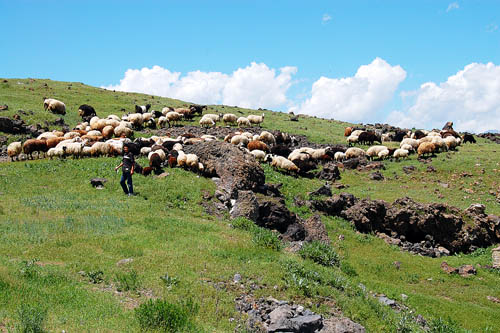
Here are a couple of photos I trust you will find helpful. The first is of a shepherd with his sheep in the mountains of Ararat. Remember that the book of Genesis records that Noah’s ark rested “upon the mountains of Ararat” (Genesis 8:4).

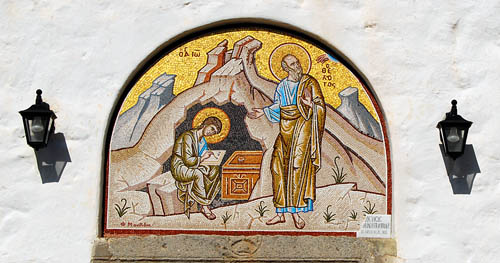
This photo was made at the entry to the cave of the Apocalypse on “the island called Patmos” (Revelation 1:9). John was exiled here during the reign of the Roman emperor Domitian. Whether the book of Revelation was written on Patmos, or after John’s release, we can not say with certainty. The mosaic over the entry to the cave shows John dictating the revelation given to him by the Lord.

It is my conviction that Bible land travel can enhance one’s Bible study and improve one’s understanding of the text. This, in turn, needs to be converted to action in obedience to the will of the Lord, and in service to Him.

Be sure to read…

I want to encourage you to go back to the post on “The historical credibility of the Gospel of John” and read the comment by my friend Bruce Hudson. Prof. F. F. Bruce was at the University of Manchester for many years. You might enjoy some comments I made about Prof. Bruce last Septermber when I was in Scotland. Click here.

A pretty picture

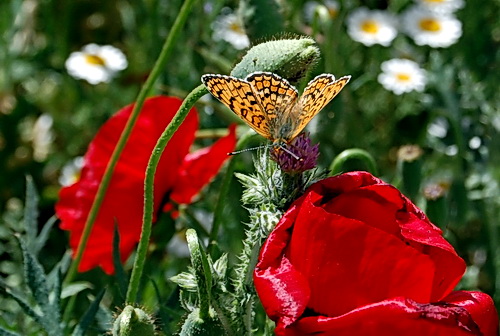
While looking for a photo for use in a lesson for Sunday I noticed this photo that I made near Konya, Turkey. This is the site of biblical Iconium (Acts 13:51-14:5). I was lucky to catch the butterfly on a poppy (anemone). Enjoy.

Unleash your inner Indy

Anything Indiana Jones is the fad now since the release of the fourth movie featuring the adventuresome archaeologist. The USA Today Travel Newsletter (May 27, 2007) lists 10 great places to unleash your inner Indy. One of the places mentioned is Petra in Jordan. The article says,

“Hike or ride donkey-drawn carts through a slot canyon to arrive at this ancient city carved out of the sandstone cliffs,” [National Geographic’s Boyd] Matson says. “Petra offers the chance to hook up with nomadic tribesmen and do either a one-day or multi-day camel safari in the desert.” Now a UNESCO World Heritage Site, this once-vibrant Nabataean city was an oasis where Greeks, Romans and Arabs met for caravan trading. visitjordan.com

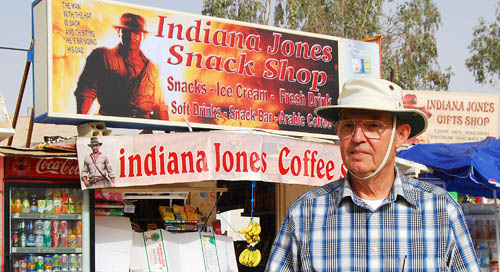
Parts of Indiana Jones and the Last Crusade was filmed at Petra. In this photo we see the snack shop, coffee shop, and gifts shop, all named for Indiana Jones.

The site of Petra is identified as the biblical Sela (rock; 2 Kings 14:7; Isaiah 16:1), and the home of the ancient Edomites (descendants of Esau). From about 300 B.C. the area was inhabited by the Nabataeans from North Africa. G. Ernest Wright once described them as,

one of the most gifted and vigorous peoples in the Near East of Jesus’ time. (Biblical Archaeology, 229).

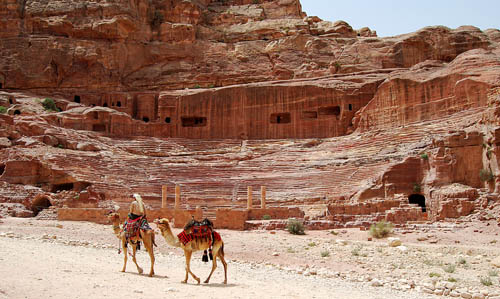
This photo shows the Roman theater at Petra which was cut out of the rock in the 2nd or 3rd century A.D. The theater seated about 3,000.

Several archaeologists have already pointed out that what Indiana Jones does is a far cry from real archaeological work. The real work is sometimes exciting, but always tedious. Bryant Wood is cited here:

“It is rather adventurous in a way, because for the most part, you’re going to some exotic country and delving into their past. But it’s not an adventure with a whip and chasing bad guys and looking for treasure,” said Bryant Wood, an archaeologist with Associates for Biblical Research.

“You’re working at one site tediously, probably for many, many years and spending more time processing the finds and writing reports than you do actually digging at the site. But that wouldn’t make for a very good story, spending 70 percent of the time in a library.”

The historical credibility of the Gospel of John

Over at Parchment and Pen, Dan Wallace has written on “The Gospel of John and Historical Realibility – Part 1. Already I am looking forward to Part 2+. Wallace says,

In 1844, the Tübinger Jahrbuch published an essay by F. C. Baur to the effect that John’s Gospel should be dated no earlier than AD 160, and probably closer to 170.

Everyone who has studied New Testament introduction knows that this view was dominant for nearly a century. Wallace tells what rocked Baur’s view:

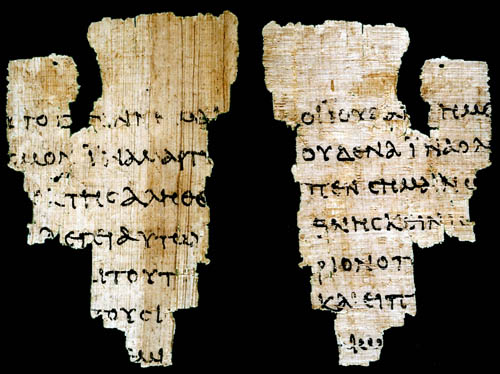
Ninety years after Baur first published his thesis on John, a young doctoral student studying at Manchester University came across a scrap of papyrus in the John Rylands Library. Colin H. Roberts was intrigued by the papyrus fragment, which had been excavated decades earlier from rubbish heaps in Egypt. It was only 2 & ½ inches by 3 & ½ inches, but its importance far outweighed its size. Roberts immediately recognized it as a fragment of John’s Gospel—chapter 18, verses 31 to 33 on one side, and chapter 18, verses 37 and 38 on the other, to be exact. He sent the photographs of the fragment to three of the leading papyrologists in Europe. Each one reported independently that this fragment should be dated, on paleographical grounds, between AD 100 and AD 150. A fourth scholar disagreed, arguing that the fragment should be dated in the 90s of the first century!

This tiny fragment of John’s Gospel rocked the scholarly near-consensus on the date of John, for it is impossible for a copy to be written before the original text is produced. It effectively sent two tons of German scholarship to the flames. As one wag put it, “This manuscript must have been written when the ink on the original text was barely dry.”

A number of years ago, while leading a tour of the British Isles, I called the Rylands Library at the University of Manchester to ask if I could see the Rylands Fragment. After being assured that I could, I took the train from York to Manchester. At the time, the little fragment was between two pieces of glass taped around the edge. There is only one piece of the fragment, but the image below (from a library slide) shows both sides.

We think the Gospel of John was written by John in Ephesus sometime during the 80s, but this manuscript is thought to have originated in Egypt between A.D. 100 and 150 (or earlier?). This is a small illustration of the rapid spread and copying of the Gospel.

The John Rylands Library has a page devoted to the fragment here.

Memorial Day

Memorial Day (Monday) honors all the men and women who have died in military service in the defense of our country. There were 1,465 USA deaths in the Battle of Normandy. In addition, 2,700 UK soldiers and 500 Canadian soldiers died. It is estimated that between 4,000 and 9,000 German soldiers died.

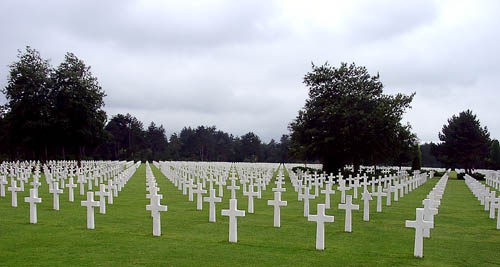
D-Day, June 6, 1944, is a very important day in American history. Here is one of the photos I made at the American Cemetery at Normandy in 2002.

A visit to this cemetery, or any other military cemetery, helps us realize what a great debt we owe to those who gave their lives while fighting for freedom. A few years ago, prior to his death, I visited regularly with a veteran of World War II who was at Normandy. I enjoyed hearing him talk about the war, and asking him questions. I was always encouraged when I left his home.

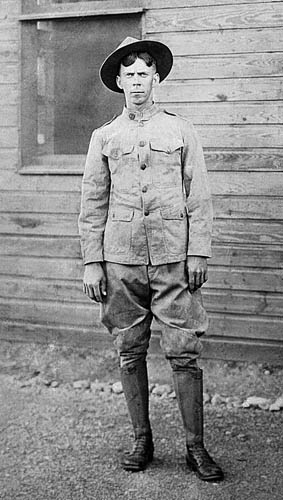
My wife’s father was in World War I. Here is a photo (after a few Photoshop enhancements to take out scratches) of Karl Wayne Williams made in 1917. Thankfully he made it aback alive. Elizabeth says he was born 114 years ago. We honor his memory along with others who have touched our lives.

When I was a youngster Memorial Day was called Decoration Day because folks decorated the graves of those who died in war. In addition, graves of family members were decorated. Not a bad custom.

The Encyclopedia Britannica’s Guide to Normandy 1944 has some good maps and charts. Take a look.

Home again!

We arrived at our normal abode a short time ago (Friday evening about 9 p.m.). Traveling to educational, inspirational, and exciting places is rewarding, but there is no place like home.

Hopefully we can continue several times a week to post a few photos of places we visited. First, some rest.

More tourists visiting Israel

Todd Bolen of BiblePlaces is now in Israel with a student group. He calls attention to this news item:

The Ministry of Tourism reports that 290,000 tourists visited Israel in April 2008, an amount similar to that recorded in Israel’s record-breaking tourism year, 2000.

The totals for this past April were 26% over April 2006, as well as 41% more than April 2007, when tourism was still negatively affected by the Second Lebanon War eight months earlier.

Annual Rate Up 43%
During the first four months of 2008, 936,000 tourists arrived in Israel – an increase of 43% from the same period in 2007, and 34% more than the same period in 2006.

The current pace of growth is consistent with Tourism Ministry goals to attract 2.8 million tourists to Israel this year. However, Tourism Ministry Director General Sha’ul Tzemach says that this blessing places in bold relief the increasing shortage of available guest rooms in Israel.

“The current number of guest rooms does not match future demands,” Tzemach said. The Ministry hopes to attract 5 million tourists in 2012. “We hope to build another 2,500 rooms within three years, and to increase the budget for building hotels and assisting local and foreign entrepreneurs who have recently shown great interest in investing in the Israeli hotel industry.”

For the full report click here.

When we were there in April, we could see the increase over 2006. We did not see quite as many Americans, but there were more tourists. Hotel space is difficult to get, and I hear that hotel prices are going up. Sort of like oil; the more they sell, the higher they price it!