The Dead Sea is dying!

Not exactly current news, but ABC News, Saturday, July 12, 2008, had a report about this. Read the story, and find a link to the video here. In a word, the Dead Sea is drying up because of a lack of water. Water that once flowed into the Dead Sea from the Jordan River is now being diverted primarily by Israel, and Jordan for domestic and agricultural use. The Jordan River no longer experiences the annual flooding that was known even fifty years ago. I have seen a tremendous change in the 41 years that I have been traveling in the area.

The Dead Sea is called the Salt Sea in the Bible (Genesis 14:3; Numbers 34:3, 12). Josephus knew the Dead Sea at Lake Asphaltites in Roman times (Antiquities 1.174; 15:168).

Many old sources have listed the Dead Sea as being 1,292 feet below sea level. According to a study in 2005, the sea was 1,368 feet below sea level. That number would be greater now. The lowest point in the United States is 282 feet below sea level, at Death Valley in California.

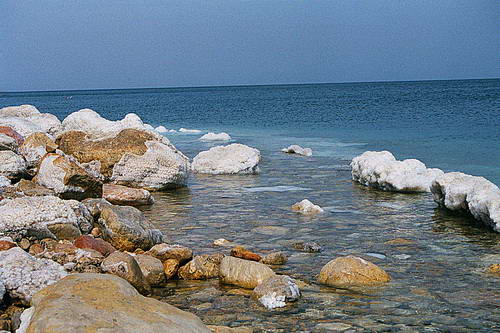
This photo shows encrustations of salt that build up on the rocks along the shore of the Dead Sea.

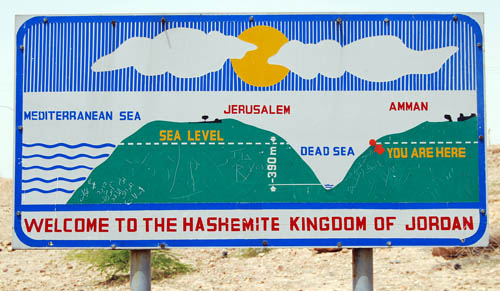
Here is a photo of a sign, a bit defaced, in Jordan at sea level showing a cross-section topography of the Dead Sea.

Good illustrations for teaching

Every teacher of the Bible should be looking for good illustrations to help convey biblical truths. Ezekiel used a brick with a sketch of Jerusalem on it to teach about the destruction of the city (Ezekiel 4:1). Jeremiah broke a clay vessel to teach the same lesson (Jeremiah 19).

Jesus used sowers, birds, and flowers of the field to teach important lessons (Mt. 13:18; 6:26; 6:28).

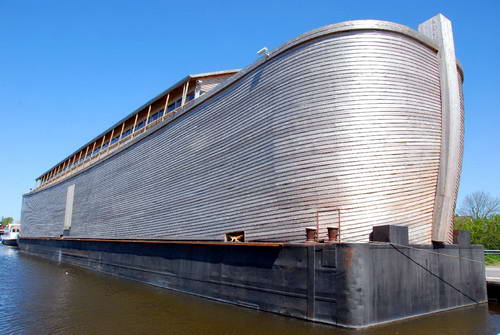
About a year ago we learned that a contractor in the Netherlands has built a replica of Noah’s ark. W. Frank Walton has called my attention to a series of photos by “Paul the Dane” showing both replica from both the outside and the inside. These photographer holds copyright to the photos, but his page says “permission from author required for commercial use.” I take this to mean that non-commercial use, such as Bible classes, is allowed. For information about Noah’s ark read Genesis 6-9.

Paul the Dane has these photos posted at Pbase. Click here for his page. He also has some nice photos of Damascus. He says this of the ark photos:

It was built approximately to scale, however is 1/2 the length and 1/3 the width of the Biblical dimensions. It was built to show the world how massive the Ark was and how so many animals could have been housed for a long time.

Here is one of the nice exterior views.

Frequently I go to Pbase to search for photos I might need of some historical site that I have not visited. Be sure you ask for permission if the photographer does not grant such.

A few years ago I wrote an article, “Using Photographs to Ilustrate Lessons” for Biblical Insights. Read it here. At the Biblical Studies Info page I have links to numerous sources of good photos of the Bible lands. Look here, then under Photos.

Update: J. P. van de Giessen has pointed me to his post about the ark here. He has some photos of the ark while under construction. Nothing quite like having a “reporter” on the spot! The official web page is here. It also includes photos of the construction.

The joy of traveling together

It is unfortunate that many younger couples are not able to travel to the lands of the Bible. This is especially true of young preachers who need the knowledge they could gain in their ministry. Some young folks could travel to these places if they wanted to. One fine lady who, along with her husband, had been on a tour to Israel and Greece, told me that she had rebuked (not her word) some of the young professionals she knew. She told them that they ought to give up a few ski trips and go to the Bible lands. A matter of priorities, isn’t it.

I find that many women want to travel, but their husbands refuse to do so. It often happens that the husband dies and the wife gets to travel. Too bad they could not have made these memories together. Elizabeth and I have enjoyed being blessed to travel to many parts of the world. We realize that most of those years are behind us and we have great memories to share. And we have made many wonderful friends in our travels.

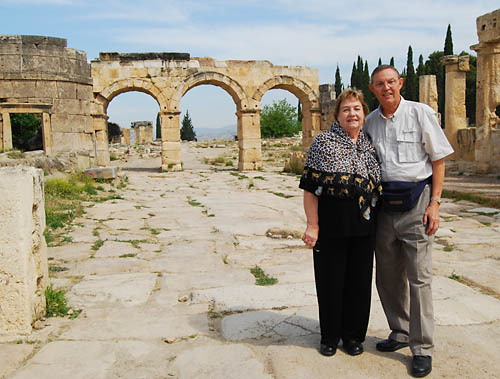
The photo below was made at Pamukkale, Turkey (ancient Hierapolis). We are standing on the colonnaded Roman road, and the monumental gateway behind us is the Arch of the Emperor Domitian (A.D. 81-96). It was constructed in A.D. 82-83.

Hierapolis was the home of Papias (c. A.D. 60 to c. A.D. 130). He was a disciples of the apostle John and a companion of Polycarp. There are some traditions associating Philip (apostle?, evangelist?) with the city.

The city of Hierapolis is one of the three cities of the Lycus River valley named in the New Testament.

For I testify for him that he has a deep concern for you and for those who are in Laodicea and Hierapolis. (Colossians 4:13).

Enjoying the local customs

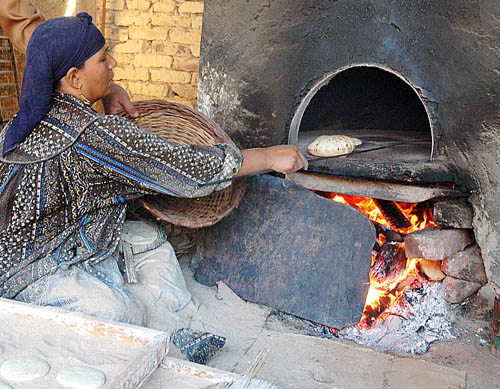
One of the joys of travel is learning about the customs of the local people. Of course, I have a special interest in finding customs that remind us of customs in Bible times. In many places the local entrepreneurs realize that tourist enjoy this so they make it possible for you to see and participate in the customs. This woman at a restaurant near Memphis, Egypt, is baking bread as it has been done for centuries in Egypt. Yes, the bread was delicious.

Perhaps you can recall the episode in Genesis 40 about “the cupbearer and the baker for the king of Egypt.”

Sunset at Lachish

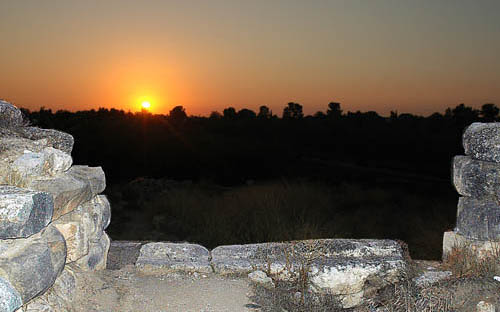
This photo was made from inside the gate at Lachish looking west toward the Mediterranean Sea. The city faced two significant sunsets. It fell to the Babylonians in 587 B.C. The Lachish Letters were found immediately outside this gate in a room on the left. My friend and colleague, the late Phil Roberts, worked in the gate when we were at Lachish in 1980. Phil continued to work there each year until the excavation came to a close. When the prophet Jeremiah wrote, only Lachish and Azekah remained of the fortified cities of Judah (Jeremiah 34:7).

Lachish fell to the Assyrians more than a hundred years earlier in 701 B.C.The Bible records the events after the fall of Samaria this way,

Now in the fourteenth year of King Hezekiah, Sennacherib king of Assyria came up against all the fortified cities of Judah and seized them. Then Hezekiah king of Judah sent to the king of Assyria at Lachish, saying, “I have done wrong. Withdraw from me; whatever you impose on me I will bear.” So the king of Assyria required of Hezekiah king of Judah three hundred talents of silver and thirty talents of gold. Hezekiah gave him all the silver which was found in the house of the LORD, and in the treasuries of the king’s house. At that time Hezekiah cut off the gold from the doors of the temple of the LORD, and from the doorposts which Hezekiah king of Judah had overlaid, and gave it to the king of Assyria. Then the king of Assyria sent Tartan and Rab-saris and Rabshakeh from Lachish to King Hezekiah with a large army to Jerusalem. So they went up and came to Jerusalem. And when they went up, they came and stood by the conduit of the upper pool, which is on the highway of the fuller’s field. (2 Kings 18:13-17)

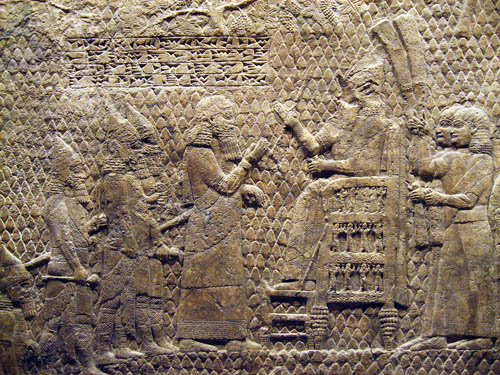
Sennacherib was unable to capture Jerusalem. I take it that the destruction of Lachish was his greatest achievement because he plastered the walls of his palace in Nineveh. This photo shows the king receiving the surrender of Lachish.

The cuneiform inscription reads as follows:

Sennacherib, king of the world, king of Assyria, sat upon a (nîmedu) -throne and passed in review the booty (taken) from Lachish (La-ki-su). (ANET 288).

Lachish on July 4th

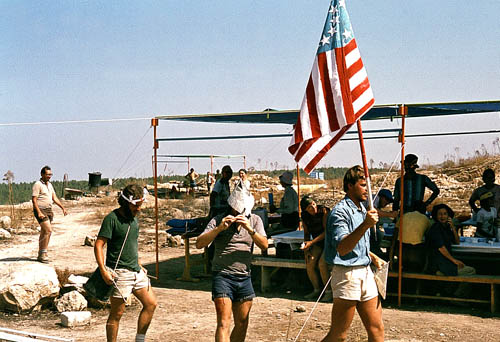
On July 4, 1980, I was participating in the excavation at Tel Lachish in Israel along with three of my colleagues from Florida College (James Hodges, Phil Roberts, and Harold Tabor). There were sizable numbers of participants from Israel, United States, Australia, South Africa, and Germany. In addition to the hard work out in the sun, we had some fun. On the morning of July 4th a few of the guys got an American flag and put together a drum and bugle corp and marched across the tel. Note especially the plastic bucket being used as a drum in this photo.
Lachish is identified with Tell ed-Duweir, located in the shephelah (lowlands) of Judah about 30 miles south west of Jerusalem. It is mentioned in Scripture during the period of the conquest (Joshua 10, 12, 15). Lachish served as one of the Judean store cities during the period of the kingdom Judah. Many of the LMLK jar handles have been found here. The city fell both to the Assyrians and the Babylonians.

Excavations were carried out by the British between 1932 and 1938 under the direction of J. L. Starkey. Starkey was murdered in 1938 while en route to the opening of the Palestine Archaeological Museum (later the Rockefeller Museum) in Jerusalem. Professor Yohanan Aharoni of Tel Aviv University excavated the “Solar Shrine” in 1966 and 1968. A new excavation was begun in 1973 under the auspices of The Institute of Archaeology of Tel Aviv University and The Israel Exploration Society. Dr. David Ussishkin served as the director until 1994.

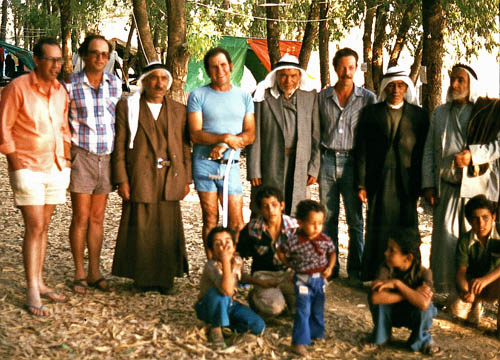
One afternoon while we were in our tented camp a short distance from the tel, a bus load of Arabs from Jordan arrived. They had once lived in the area, prior to the founding of the State of Israel. Some of the older men had worked with Starkey. This photo which I took shows four of the Arab men and three of the Israeli archaeologists, along with one American. See if you recognize Gabriel Barkay, Richard Whitaker, Adam Zertal, and David Ussishkin.
The Arab men enjoyed seeing the old photos from the Starkey excavations and pointing out themselves as much younger men. I think you will see Ussishkin’s head to the left of the Arab, and Barkay on the right.
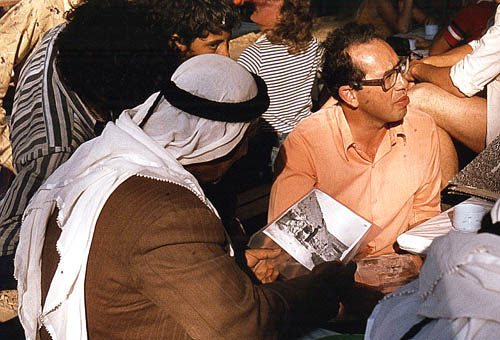
I thought you might enjoy this little bit of recent history from 28 years ago.

Update (July 6, 2008). Todd Bolen, at BiblePlaces.com has commented on this blog under the title Reminiscences of Lachish. He says he heard Gabriel Barkay tell about this event, but he includes some additional information that I did not know, including the name of the village where the Arabs previously lived.

The town of Qubeibe was leveled by the Israeli military in the 1960s and the stones of the village, probably many taken from the ruins of Lachish, were sold to building contractors.  Who knows but some ancient inscription was unknowing transferred from Lachish to Qubeibe and is now part of a wall in the area?

I recall that Richard Whitaker was the one best able to converse in Arabic.

Assos temple to be restored

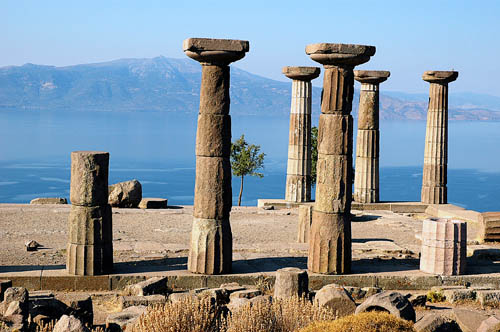
The current issue of Artifax reports that the temple of Athena at Assos in northwestern Turkey is to be restored. The temple was built originally about 540-530 BC. The project is expected to take about three years. Many pieces of the temple are scattered in museums (Istanbul Archaeological Museum, Louvre, Boston Museum of Fine Arts). The temple is built on a high cliff overlooking the sea. Here is the way the temple looks now.

The apostle Paul undoubtedly saw the temple of Apollo when he traveled the approximate 20 miles from Alexandria Troas to Assos by land. His companions had traveled by boat from Troas to Assos. The historical account reads this way:

But going ahead to the ship, we set sail for Assos, intending to take Paul aboard there, for so he had arranged, intending himself to go by land. And when he met us at Assos, we took him on board and went to Mitylene. (Acts 20:13-14 ESV)

The island across the strait is Lesbos. Further south is the town of Mitylene on Lesbos. Lesbos is now a Greek island in the Aegean.

Sunset over Edom

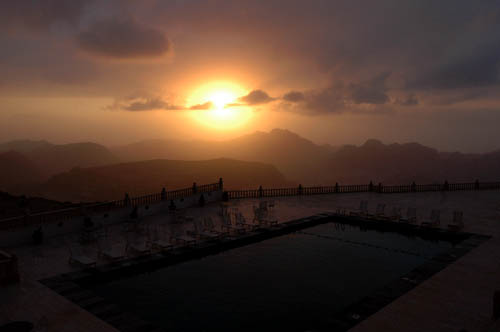
I ran across this beautiful sunset photo that I made from a hotel above Petra, Jordan, in 2006.

The oracle concerning Edom. One keeps calling to me from Seir, “Watchman, how far gone is the night? Watchman, how far gone is the night?” The watchman says, “Morning comes but also night. If you would inquire, inquire; Come back again.” (Isaiah 21:11-12)

There are some text critical issues with the term Edom in this verse, but I will leave that for you to work on. Keil and Delitzsch call attention to a comment by Luther that illustrates the certain judgment that would come upon ancient Edom, the descendants of Esau.

But what is the meaning? Luther seems to me to have hit upon it: “When the morning comes, it will still be night.”

The decline and fall of any nation ought to cause one to take a pause and think about it.

U.S. Religious Landscape Survey

Anyone interested in reaching citizens of America with the gospel of Christ should be interested in the Pew Forum report on the Religious Landscape Study. You may read a summary of the key findings here. You may download the 18 page report and/or the full report of 268 in PDF.

According to the report, among Evangelical churches 57% believe many religions can lead to eternal life. Eighty seven percent of mainline Protestant churches believe that. Not far behind 89% of Buddhists. The same view is held by 56% of Muslims in America.

Imagine Jesus saying, “I am the way, and the truth, and the life; no one comes to the Father, but through Me” (John 14:6). “At least that’s what I think 57% of the time.”

One interesting aspect of the report is the percent who see a conflict between religion and modern society. The total of all Americans is 40%. And 42% of these say their values are threatened by Hollywood. You might find the views on abortion and homosexuality surprising, too.

The summary concludes with two paragraphs on the effect of secularization.

The U.S. has largely avoided the secularizing trends that have reshaped the religious scene in recent decades in European and other economically developed nations – but not entirely. The
Landscape Survey documents, for example, that the number of Americans who are not affiliated with a religion has grown significantly in recent decades, with the number of people who today say they are unaffiliated with a religious tradition (16% of U.S. adults) more than double the number who say they were not affiliated with a religion as children (7%).

It remains to be seen how this trend toward secularization will ultimately impact religion in the U.S. But what is clear is that religion remains a powerful force in the private and public lives of most Americans, a fact amply illustrated by the findings of the U.S. Religious Landscape Survey discussed in this report.

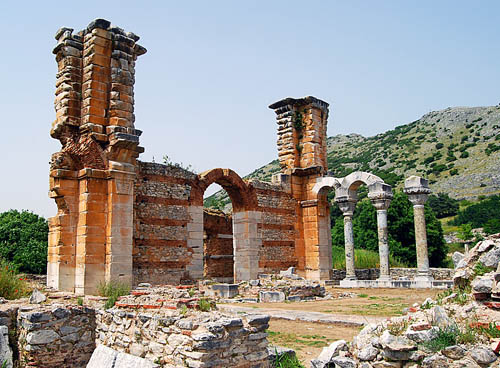
Will the buildings in which we meet one day stand in ruins (physically or spiritually) like this 550 A.D. building, called Basillica B, at Philippi? Read Acts 16 and Paul’s Epistle to the Philippians.

Go read, and learn.

The Fascination of Egypt

Egypt has a grip on the imagination of each of us. We probably first learned something about it in our elementary school studies. We have seen it portrayed in movies and television programs.

Every Bible student has studied about Egypt in numerous contexts. Not only did the tribes of Israel grow into a nation while in Egyptian bondage, but we know of the following characters who visited Egypt: Abraham, Jacob, Joseph, Moses, Joshua, Jeremiah, Jesus, Mary and Joseph. The prophets spoke much about the land of Egypt. Egypt is mentioned more than 600 times in the Bible.

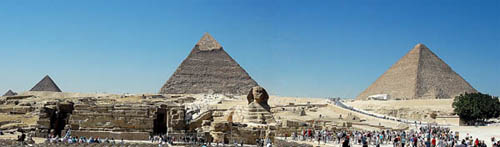
This is a panoramic photo I made of the Pyramids of Giza in 2005. The pyramids, from left to right, are Mycerinus, Chephren, and Cheops. These structures were built about 2500 B.C. Some people have the mistaken idea that the Israelites in Egyptian bondage built the pyramids. You can see from the date that these pyramids were built about 1000 years before the Israelites did their building (Exodus 1:11).