Thanksgiving — 2011

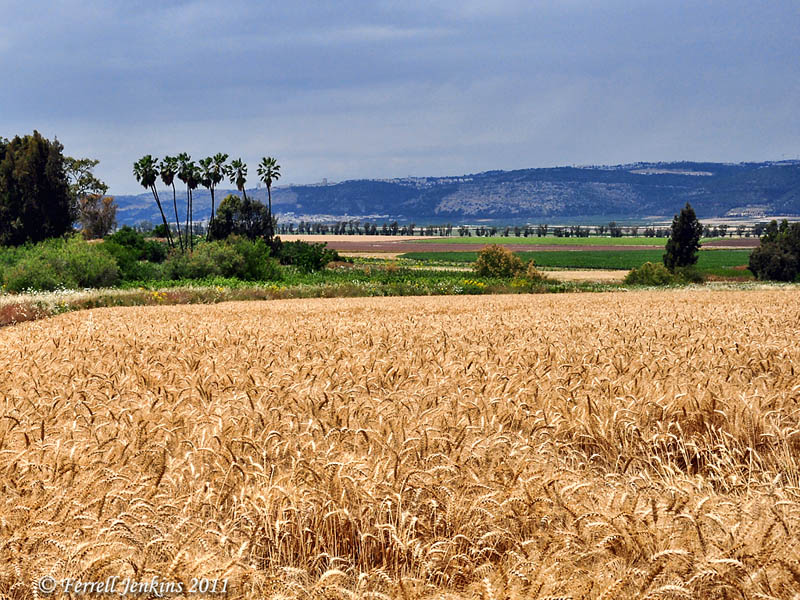
Abundant wheat fields near biblical Endor. Photo by Ferrell Jenkins.

Abundant wheat fields near biblical Endor. Photo by Ferrell Jenkins.

I will give thanks to the LORD with all my heart; I will tell of all Your wonders. (Psalm 9:1 NAU)

Enter His gates with thanksgiving And His courts with praise. Give thanks to Him, bless His name. (Psalm 100:4 NAU)

Let us come before His presence with thanksgiving, Let us shout joyfully to Him with psalms. (Psalm 95:2 NAU)

I will praise the name of God with song And magnify Him with thanksgiving. (Psalm 69:30 NAU)

Be anxious for nothing, but in everything by prayer and supplication with thanksgiving let your requests be made known to God. (Philippians 4:6 NAU)

Herod the Great didn’t do it all

Archaeologists in Jerusalem announced yesterday a new discovery that changes popular thinking about the building of the walls around the Temple Mount. It is not much of a surprise. We already knew that the Roman Street found at the SW corner of the wall dates to the period just before the destruction of Jerusalem by the Romans in A.D. 70. The last paragraph of the press release mentions that what was found was in harmony with the account of Josephus.

I have understood John 2:20 to be saying that work on the temple precinct was continuing as late as A.D. 26/27. That is a major reason this is not a surprise.

Then the Jewish leaders said to him, “This temple has been under construction for forty-six years, and are you going to raise it up in three days?” (John 2:20 NET)

Here is a portion of the press release issued by the Israel Antiquities Authority. I am leaving it full width for easier reading.

— • —

Professor Ronny Reich of the University of Haifa and Eli Shukron of the Israel Antiquities Authority: A ritual bath exposed beneath the Western Wall of the Temple Mount shows that the construction of that wall was not completed during King Herod’s lifetime.

Who built the Temple Mount walls? Every tour guide and every student grounded in the history of Jerusalem will immediately reply that it was Herod. However, in the archaeological excavations alongside the ancient drainage channel of Jerusalem a very old ritual bath (miqwe [mikve]) was recently discovered that challenges the conventional archaeological perception which regards Herod as being solely responsible for its construction.…

In an excavation beneath the paved street near Robinson’s Arch, sections of the Western Wall’s foundation were revealed that is set on the bedrock — which is also the western foundation of Robinson’s Arch — an enormous arch that bore a staircase that led from Jerusalem’s main street to the entrance of the Temple Mount compound.

According to Professor Reich, “It became apparent during the course of the work that there are rock-hewn remains of different installations on the natural bedrock, including cisterns, ritual baths and cellars. These belonged to the dwellings of a residential neighborhood that existed there before King Herod decided to enlarge the Temple Mount compound. The Jewish historian Josephus, a contemporary of that period, writes that Herod embarked on the project of enlarging the compound in the eighteenth year of his reign (that is in 22 BCE) and described it as “the largest project the world has ever heard of.”

When it was decided to expand the compound, the area was confiscated and the walls of the buildings were demolished down to the bedrock. The rock-cut installations were filled with earth and stones so as to be able to build on them. When the locations of the Temple Mount corners were determined and work was begun setting the first course of stone in place, it became apparent that one of the ritual baths was situated directly in line with the Western Wall. The builders filled in the bath with earth, placed three large flat stones on the soil and built the first course of the wall on top of this blockage.

While sifting the soil removed from inside the sealed ritual bath, three clay oil lamps were discovered of a type that was common in the first century CE. In addition, the sifting also yielded seventeen bronze coins that can be identified. Dr. Donald Ariel, curator of the numismatic collection of the Israel Antiquities Authority, determined that the latest coins (4 in all) were struck by the Roman procurator of Judea, Valerius Gratus, in the year 17/18 CE. This means that Robinson’s Arch, and possibly a longer part of the Western Wall, were constructed after this year – that is to say: at least twenty years after Herod’s death (which is commonly thought to have occurred in the year 4 BCE).

This bit of archaeological information illustrates the fact that the construction of the Temple Mount walls and Robinson’s Arch was an enormous project that lasted decades and was not completed during Herod’s lifetime.

This dramatic find confirms Josephus’ descriptions which state that it was only during the reign of King Agrippa II (Herod’s great-grandson) that the work was finished, and upon its completion there were eight to ten thousand unemployed in Jerusalem.

— • —

If you wish to see the complete press release click here.

Below are a few of the photos provided by the IAA. The first shows the lowest course of the wall resting on bedrock.
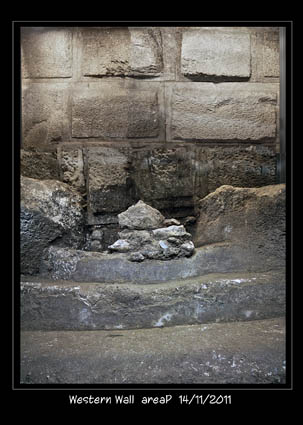
The first course of the wall resting on the bedrock. Photograph: Vladimir Naykhin.

The first course of the wall resting on the bedrock. Photograph: Vladimir Naykhin.

The next photo shows one of the coins dating to the time of Roman Procurator Valerius Gratus in the year A.D. 17/18. He was procurator A.D. 15-26, and followed by the better known Pontius Pilate (A.D. 26-36).

A coin of the Roman procurator Valerius Gratus, which helped in dating the construction of Robinson’s Arch.

A coin of the Roman procurator Valerius Gratus, which helped in dating the construction of Robinson’s Arch. Courtesy IAA.

The third photo shows some of the workers excavating the area.
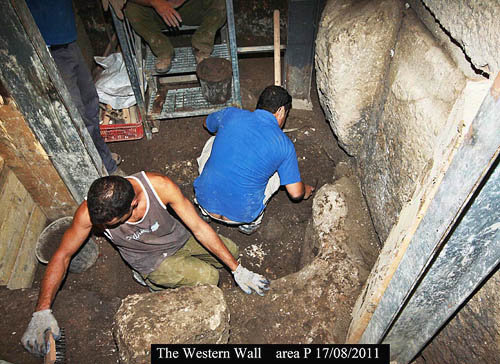
Archaeologists working at bedrock below Robinson's Arch. Photo: IAA.

Archaeologists working at bedrock below Robinson's Arch. Photo: IAA.

After writing my post, I see that Todd Bolen accuses the IAA of being “desperate for headlines.” See his comments here.

HT: Joseph I. Lauer

New insights into the clothing of the Qumran inhabitants

The recent edition of Dead Sea Discoveries has an article by Orit Shamir and Naama Sukenik on “Qumran Textiles and the Garments of Qumran’s Inhabitants.” The article costs $35 from Brill. To order click here. Here is the abstract.

Among the Qumran textiles that were kept at the Rockefeller Museum was a group of textiles that were unusual for Qumran. Most of them were made of wool, and some were dyed or decorated. Their marking QCC—Qumran Christmas Cave indicates their origin. In 2007 the cave was investigated by Porat, Eshel, and Frumkin. The cave is located in the bottom section of Kidron valley and doesn’t belong to Qumran caves. It can now be determined that all of the textiles from Qumran are made solely of linen. They were free of any colored decoration, except for scroll wrappers that decorated in blue. This, and the simplicity and whiteness of the textiles from Qumran, is compatible with the literary sources. It appears that the people of Qumran wished to differentiate themselves from the rest of the population also on the basis of their style of garments.

A popular article based on the technical paper appears in LiveScience here. Some speculation about the writers of the scrolls is based on the cloths found with the scrolls. Look also for an Image Album of 8 captioned photos including the textiles from Qumran and the Christmas Cave.

Most of the cloth wrappings found at Qumran were white and made of linen. The wrappings found at Christmas Cave were colorful and made of wool. The Mosaic law was clear about the clothing to be worn by the Israelites.

Do not wear clothes made of both wool and linen. (Deuteronomy 22:11 CSB)

Jodi Magness cites the War Scroll to illustrate that the “Qumran sectarian clothing must be made entirely of linen” (Stone and Dung, Oil and Spit, 116).

Most Bible students probably think of the Kidron valley running north to south between Jerusalem and the Mount of Olives. That is correct, except that the brook joins with the Hinnom valley and continues east to the Dead Sea.

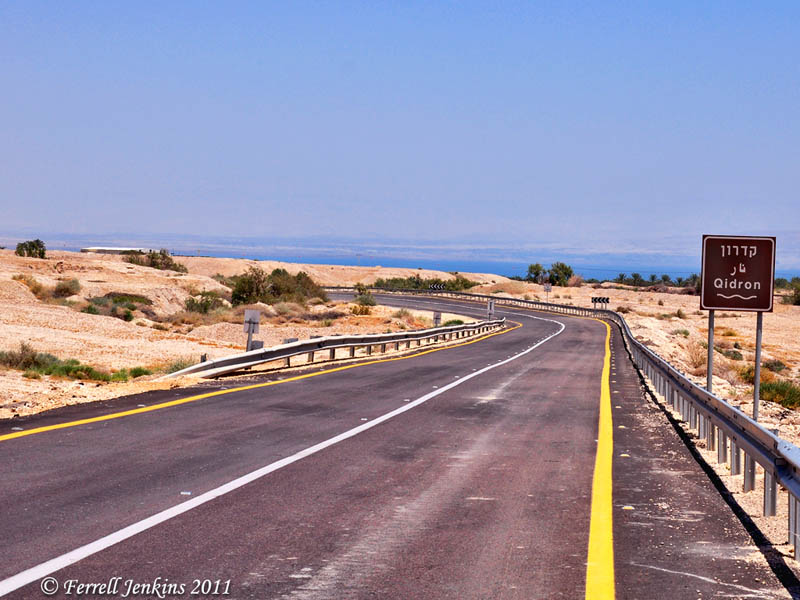
The photo below was made about 4.25 miles south of Qumran along the Dead Sea Road (Hwy. 90) as it crosses the brook Kidron (Qidron). The Christmas Cave mentioned in the article is to the west (left) of the highway as the brook comes down from Jerusalem. (Click on the photo for a larger image.)

Location of the Brook Kidron on Dead Sea Road (view north). Photo by Ferrell Jenkins.

Crossing Brook Kidron on Dead Sea Road (view northeast). Photo by Ferrell Jenkins.

When David fled from Jerusalem at the time of Absalom’s rebellion, he crossed the Kidron “toward the way of the wilderness.”

Everyone in the countryside was weeping loudly while all the people were marching past. As the king was crossing the Kidron Valley, all the people were marching past on the road that leads to the desert. (2 Samuel 15:23 CSB)

HT: Joseph I. Lauer

Pisidian Antioch was the site of an important announcement

One of the important cities visited by Paul and Barnabas on the first preaching journey was Pisidian Antioch.

Moving from Perga, they arrived at Pisidian Antioch, and on the Sabbath day they went into the synagogue and sat down. After the reading from the law and the prophets, the leaders of the synagogue sent them a message, saying, “Brothers, if you have any message of exhortation for the people, speak it.” (Acts 13:14-15 NET)

Don’t confuse this Antioch in Pisidia, about 100 miles north of Perga, with Antioch in Syria where Barnabas and Saul began their journey (Acts 13:1-4).

Pisidian Antioch had been founded about 350 B.C. by either Seleucus Nicator or his son Antiochus I in ancient Phrygia, near Pisidia. About two thousand Jewish families were brought to Phrygia from Babylon about 200 B.C. (Josephus Ant. xii.3.4). This explains the presence of Jews and the synagogue.

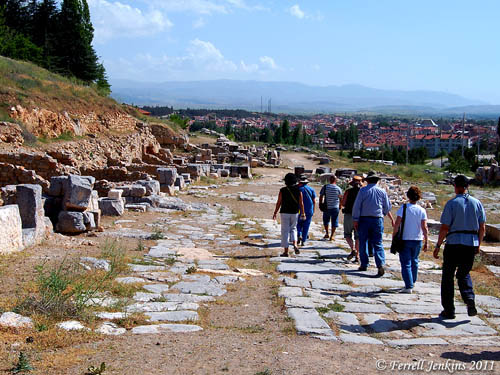
Our photo shows one of the Roman streets at Antioch. The modern Turkish town of Yalvac can be seen in the distance.

Roman Street in Pisidian Antioch. Photo by Ferrell Jenkins.

Roman Street in Pisidian Antioch. Photo by Ferrell Jenkins.

Acts 13 should be remembered as the chapter in which Luke records Paul’s sermon on the history of Israel to both Jews and God fearing Gentiles. The sermon recounted here is similar to the sermon Paul heard from the martyr Stephen (Acts 7).

The events at Pisidian Antioch are significant because it is here that we have many Jews and devout god-fearing proselytes accepting the message of Paul and Barnabas (Acts 13:43). When the Jews began contradicting the gospel we hear the announcement of a more concentrated effort to reach the Gentiles with the Gospel.

Both Paul and Barnabas replied courageously, “It was necessary to speak the word of God to you first. Since you reject it and do not consider yourselves worthy of eternal life, we are turning to the Gentiles. For this is what the Lord has commanded us: ‘I have appointed you to be a light for the Gentiles, to bring salvation to the ends of the earth.'” When the Gentiles heard this, they began to rejoice and praise the word of the Lord, and all who had been appointed for eternal life believed. So the word of the Lord was spreading through the entire region. (Acts 13:46-49 NET)

Approaching Gennesaret

The Sea of Galilee is called the “lake of Gennesaret” (Luke 5:1), and the “Sea of Tiberias” (John 6:1; 21:1). This indicates that both Tiberias, where Herod Antipas had built his capital in the mid-20s of the first century, and Gennesaret were significant places. When one traveled from Nazareth, Cana, or others places west of the Sea of Galilee, he would pass by Mount Arbel into the plain or land of Gennesaret.

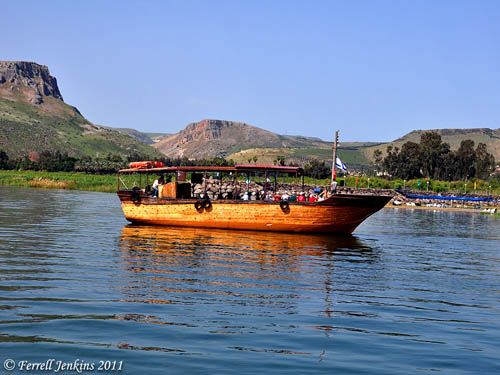
This photo, taken on an unusually clear day, shows a small ship about to anchor at Nof Ginosaur (= Gennesaret). To the west we see Mount Arbel and the pass below allowing travel and commerce between lower Galilee and the towns around the Sea of Galilee.

Boat approaches the land of Genessaret. Photo by Ferrell Jenkins.

Boat approaching the land of Gennesaret. Photo by Ferrell Jenkins.

The photo nicely illustrates the text of Mark 6.

When they had crossed over they came to land at Gennesaret, and moored to the shore. When they got out of the boat, immediately the people recognized Him, and ran about that whole country and began to carry here and there on their pallets those who were sick, to the place they heard He was. Wherever He entered villages, or cities, or countryside, they were laying the sick in the market places, and imploring Him that they might just touch the fringe of His cloak; and as many as touched it were being cured. (Mark 6:53-56 NAU. cf. Matthew 14:34-36)

The first disciples of Jesus were called by the lake of Gennesaret (Luke 5:1).

The Patriarchs lived in the Negev

English Bibles translate the Hebrew word negev in a variety of ways.

  • South — KJV; NKJV
  • “the South [country]” is the Translator’s Note in the NET Bible. A study note says, “Negev is the name for the southern desert region in the land of Canaan.”
  • Negeb — ESV
  • Negev — most modern English versions.
  • eremos — the word for desert or wilderness is used in the LXX. This word does not describe the Negev precisely enough.

I am away from home and most of my resources, but I recall hearing the late Anson Rainey describe the Negev like the figure 8. Turn the 8 horizontal with Beersheba in the center. The area is one that is often subject to drought and famine.

The Patriarchs, Abraham, Isaac, and Jacob spent much time in the Negev (Genesis 12:9; 13:1,3; 20:1; 24:62).

The Israelite spies were sent by Moses from the Sinai to investigate Canaan. The text makes it clear that they had to go through the Negev to get to the hill country and Hebron. Hebron is only about 25 miles north of Beersheba. Once we head south from Hebron we begin to notice a change from the hill country to a more dry clime.

When Moses sent them to investigate the land of Canaan, he told them, “Go up through the Negev, and then go up into the hill country (Numbers 13:17 NET)

When they went up through the Negev, they came to Hebron… (Numbers 13:22 NET)

The Canaanite king of Arad lived in the Negev (Numbers 21:1). Arad is located east of Beersheba as the land slopes down to the Dead Sea.

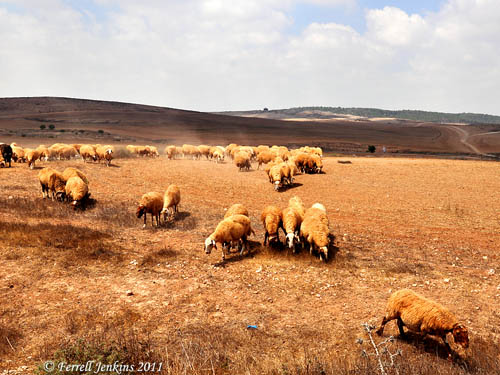
Our photo today was made a few miles north of Beersheba. I think it illustrates the typical dryness of the region.

Sheep in the Negev. Photo by Ferrell Jenkins.

Sheep in the Negev. Photo by Ferrell Jenkins.

Keep your lamps burning

Light is necessary for life and growth. We are introduced to light in the biblical account of creation.

And God said, “Let there be light,” and there was light.  And God saw that the light was good. And God separated the light from the darkness.  God called the light Day, and the darkness he called Night. And there was evening and there was morning, the first day.  (Genesis 1:3-5 ESV)

Of Jesus, the Gospel of John says, “In him was life, and the life was the light of men” (John 1:4 ESV).

David spoke of meditating on God during the watches of the night (Psalm 63:6). He watched his sheep by night, but most work was not done in the night prior to the introduction of electric power. We used one Aladdin lamp and a few kerosene lamps in our home in the rural South until I was about 8 or 10 years old. Then we began to use a single electric bulb in a room when we needed to be in the room.

Jesus said,

We must work the works of of him who sent me while it is day; night is coming, when no one can work.  As long as I am in the world, I am the light of the world” (John 9:4-5 ESV).

Herodian period lamp burning. Photo by Ferrell Jenkins.

Herodian period lamp from the time of Jesus. Photo by Ferrell Jenkins.

The photo above is one of the Herodian period lamps I have purchased in the Bible lands over the past 44 years. Two or three times I have used some olive oil (or Wesson oil, or a small piece of a candle) to show how much light the lamp gives.

In the parable of the watchful slaves Jesus said,

“Stay dressed for action and keep your lamps burning,  and be like men who are waiting for their master to come home from the wedding feast, so that they may open the door to him at once when he comes and knocks. (Luke 12:35-36 ESV)

The Apostle Paul commanded the saints at Philippi to shine as lights in the world.

Do all things without grumbling or questioning,  that you may be blameless and innocent, children of God without blemish in the midst of a crooked and twisted generation, among whom you shine as lights in the world, (Philippians 2:14-15 ESV)

Finally got the photo uploaded

I was unable to upload one of the photos about goats in the Sinai peninsula earlier. Finally got it uploaded. If you missed seeing the photo of the nanny goat caring for the newborn kid, please take a look now.

Goats in the Bible world

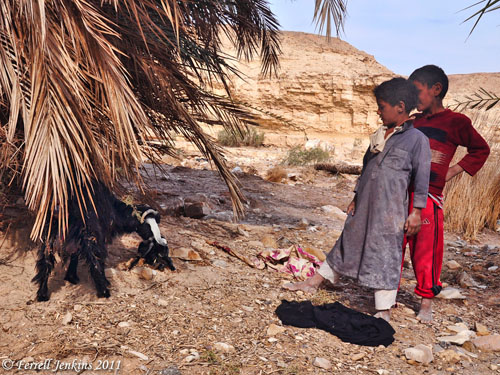
Travel in the Middle East provides many illustration similar to life in Bible times. We are more likely to see these illustrations where we have less modernization. The photos I wish to share today come from the Sinai peninsula. Last January we stopped at a Bedouin settlement on the way from the Suez Canal to Mount Sinai. Our timing was good. A goat had just given birth to a kid. While the nanny was keeping the kid moving around, two of the Bedouin boys were standing by keeping watch. Remembering my own childhood on a farm, I am sure the boys could hardly contain themselves from helping the kid. They had probably been told many times that it would be a big mistake to do so.

Bedouin boys keeping watch over a goat and newborn kid. Photo by Ferrell Jenkins.

Bedouin boys keeping watch over a goat and newborn kid. Photo by Ferrell Jenkins.

The earliest biblical reference to the goat is in Genesis 15:9, the account of Abraham’s sacrifice after the giving of the land covenant. A three year old female goat was among the animals offered. The LORD later commanded Israel to offer goats in their sacrifices.

This photo shows the nanny’s care for the still-wet newborn.

Mother goat cares for newborn kid in the Sinai Peninsula. Photo by Ferrell Jenkins.

Mother goat cares for newborn kid in the Sinai Peninsula. Photo by Ferrell Jenkins.

Goats were used for food. In Rachel’s attempt to have Isaac bless Jacob she prepared “delicious food” for Isaac.

Now therefore, my son, obey my voice as I command you. Go to the flock and bring me two good young goats, so that I may prepare from them delicious food for your father, such as he loves. And you shall bring it to your father to eat, so that he may bless you before he dies. (Genesis 27:8-10 ESV)

Goats’ hair and goatskins were used In the construction of the Tabernacle (Exodus 25:4-5 et al.).

The goat was among the clean animals that could be eaten (Deuteronomy 14:4).

One of the wise sayings of Solomon mentions goats’ milk for food.

There will be enough goats’ milk for your food, for the food of your household and maintenance for your girls. (Proverbs 27:27 ESV).

Photos that are worth 1000 words each

Photos can be used effectively to illustrate Bible lands and customs. Otherwise dull presentations can come to life with the use and explanation of appropriate photos.

Pictorial Library of Bible Lands. We have suggested frequently that every Bible teacher needs access to Todd Bolen’s Pictorial Library of Bible Lands. Todd publishes a Newsletter every few months in which he gives away a few excellent photos already in PowerPoint format. If you don’t receive the Newsletter I suggest you download the November issue here. It contains several panoramic photos that give you the opportunity to see and understand a lot at once. And while you are there you should sign up to receive the Newsletter when it is published. Also take a look at the BiblePlaces Blog and the BiblePlaces.com web site. See also LifeintheHolyLand.com. BiblePaces is now availabe in French at BibleLieux.com and Spanish at LugaresBiblicos.com.

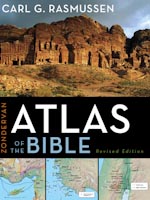
Holy Land Photos. Carl G. Rasmussen, author of the revised Zondervan Atlas of the Bible, is now posting the photos used in the Atlas at his Holy Land Photos site. Begin here. You will find thousands of useful photos at this site. These photos will be especially helpful to those seeking to teach Bible geography or to incorporate geographical information into lessons. These photos are in PowerPoint format. You also need the have and study the Atlas. Also check the HolyLandPhotosBlog for more recent photos and updates.

Order the Zondervan Atlas of the Bible from Amazon (currently $26.12).

David Padfield has a large number of photos of Bible lands available for free download here. Thanks to these men who have devoted much time and money to acquiring the photos and preparing them for others to use. I have used the work of all three in my presentations in recent years.