New religious finds from Khirbet Qeiyafa

Luke Chandler shares some photos sent to him by Prof. Yossi Garfinkel. Luke says,

Yossi Garfinkel recently presented finds from a cultic room unearthed at Khirbet Qeiyafa in 2010. He sent me some photos for this blog just before his presentation in Jerusalem. They are shown here with his permission.

Luke gives his own summary of what is currently known of Khirbet Qeiyafa.

It was a planned fortress city constructed around the beginning of the 10th century B.C. – the time of David’s monarchy in the Bible. It sits at the border of ancient Judah and Philistia along the Elah Valley, where David fought Goliath in 1 Samuel 17.

Chandler then enumerates a summary of six reasons why the site should be considered part of Judah.

Read Luke Chandler’s Blog and see Prof. Garfinkel’s photos here.

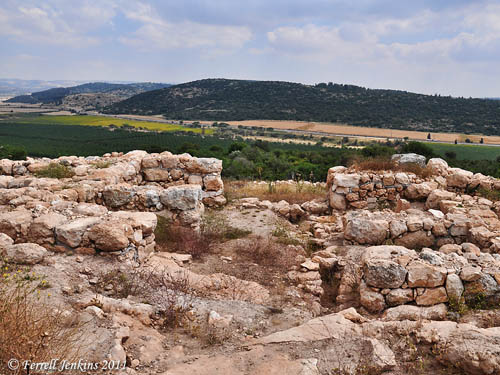
View SE over Valley of Elah toward Socoh from Kh. Qeiyafa. Photo by Ferrell Jenkins.

View SE over Valley of Elah toward Socoh from Kh. Qeiyafa. Photo by Ferrell Jenkins.

I prepared the above material Saturday evening with the intention of posting it on Sunday morning. It was a bit surprising this morning to note that Joseph Lauer calls attention to Luke’s blog. He does so as a foreword to an article in the Huffington Post here by Douglas Knight and Amy-Jill Levine. If you have wondered how liberal scholars deal with biblical history, this is your opportunity to see.

Wallace-Ehrman debate on the reliability of the text of the New Testament

The following announcement comes from the Center for the Study of New Testament Manuscripts web site here:

On October 1, 2011 Dr. Bart D. Ehrman and CSNTM’s Executive Director, Dr. Daniel B. Wallace, debated the reliability of the text of the New Testament at Southern Methodist University. This was the largest debate over the text of the New Testament in history. A professional film crew recorded the debate, which is now available to you. In this exciting dialogue you have the opportunity to listen to two leading scholars talk about this issue from opposing viewpoints. Can we trust the text of the New Testament? You decide.

The DVD is priced at only $15.50 plus shipping and handling. Currently only the USA format (NTSC) is available. Pick yours up today.

The DVD is copyrighted by CSNTM; please do not replicate or distribute it.

Click here to order the DVD.

“Tischendorf was an honorable man and not a thief!”

If you have an interest in learning the “other side” of the Tischendorf-Sinaiticus matter, I suggest you read the English article from The Art Newspaper here.

What follows below is the comment left by Alexander Schick yesterday. I found it in my spam this morning and have marked it as approved. So far it has not shown up among the comments. I wanted to share this info with our readers, so I have elevated it to a blog entry. I knew there was controversy over the matter. Schick’s mother tongue is German. I have corrected spelling of a few words, but otherwise left the comment as I received it. In my post of yesterday I was telling about the letter posted at Saint Catherine’s. Here is the “other side” of the story. Our thanks to Schick for this information.

— • —

Alexander Schick (responsible for the edition of the Tischendof letters still in posession of the Tischendorf-family)

Your comment about Tischendorf”s letter at St. Catherine monastery. The letter and the explanation of the monks must be seen in a total new light!

The new discovery of the documents related to the Codex Sinaiticus in the archives of the Russian foreign ministry was a big surprise! Scholars hoped, that these documents could appear [be]cause of the international digital-project. A scholar-dream comes true! These donation documents which show, that the Codex Sinaticus was given by the monks as a gift to Alexander II. you can find online with pictures and translations http://www.nlr.ru/eng/exib/CodexSinaiticus/zah/

Worth to study! Everyone can now see, that Tischendorf was an honorable man and not a thief!

You can also find inline the letter of guarantee by Prince A. B. Lobanov-Rostovsky to Archbishop and the community of Mt Sinai Monastery,
from 10th September 1859, which was part of the agreement in Tischendorf’s receipt. See here the picture:
http://www.nlr.ru/eng/exib/CodexSinaiticus/zah/1_1.html

Working on the letters of Tischendorf (still in the possession of the Tischendorf-Family) shows also: it was a difficult donation but it was correct done! Hopefully all the letters of Tischendorf can be published in the near future for the scholarly world. Alexander Schick

http://www.bibelausstellung.de
See the section about Tischendorf here:
http://bibelausstellung.eduxx-irs.de/home/abteilung_05b.php
Read also this article:
http://www.theartnewspaper.com/articles/Key-document-on-Codex-Sinaiticus-discovered/20216

— • —

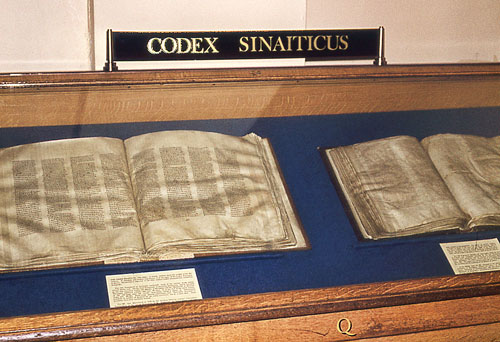
The photo below is from a slide I made at the British Museum in 1976. It shows Codex Sinaiticus and Codex Alexandrinus in a display case at the Museum. The manuscripts are now in the new British Library near the King’s Cross tube station.

Codex Sinaiticus and Codex Alexandrinus displayed in the British Museum in 1976. Photo by Ferrell Jenkins.

Codex Sinaiticus (left) and Codex Alexandrinus (right) displayed in the British Museum in 1976. Photo by Ferrell Jenkins.

The Tischendorf letter at Saint Catherine’s Monastery

Reader Ted Weis wrote,

Do you happen to have a photo of the letter that von Tischendorf wrote, saying that he would return codex Sinaiticus?

Well…, yes and no. A picture. But not a good one. There is now a museum or display area of a few small rooms in the Monastery near Moses’ Well. Signs are posted to restrict photography. A photo that I have from this year is too blurry to make sense of. A copy of the letter is posted on one wall and a sign about Codex Sinaiticus (in Greek, English, and Arabic), reads this way:

Codex Sinaiticus

The Codex Sinaiticus dates to the middle of the fourth century, and is possibly one of the fifty copies of the Holy Scriptures sent to Constantine the Great by Eusebius of Caesarea. This same manuscript was likely donated to the Monastery of Sinai at its foundation, where it was preserved until the middle of the nineteenth century. It was seen in the library of the Monastery by the German scholar Constantine Tischendorf on his visits in 1844 and 1859. The first folios that he took, he presented to the University of Leipzig. The rest he gave to the Emperor of Russia, folios he had received as a loan so that they might be published, secured with lying promises to the monks. In Russia they remained until 1933, when they were sold by the Soviet Union to the British Library in London, where they are to this day. In 1975, certain folios of the Codex came to light among the New Finds in the tower of Saint George. The monks of Sinai have never ceased in their justified request for the return of their Codex.

The photo below shows the sign on the right and a copy of the Tischendorf letter on the left.
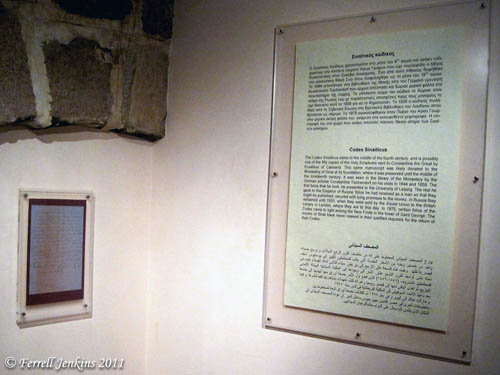
Sinaticus Sign and Tischendorf Letter at Saint Catherine's Monastery. Photo by Ferrell Jenkins.

Tischendorf letter & sign at Saint Catherine's Monastery. Photo by Ferrell Jenkins.

I remember visiting the Monastery library on two previous occasions. At that time we were taken into the library during the visit. I saw a copy of the Tischendorf letter and an English translation. Here is a scan of a slide I made in 1986. Click on image for a larger photo.

Tischendorf Letter at Saint Catherine's in 1986. Photo by Ferrell Jenkins.

Tischendorf Letter at Saint Catherine's in 1986. Photo by Ferrell Jenkins.

The letter on the left is written in Greek. James Bentley says it was “bad Greek” and that the translation is “not very competent.” Here, he says, is what Tischendorf wrote:

I the undersigned, Constantin von Tischendorf, sent at present to the East by orders of Alexander, Tsar of All Russias, testify by the present letter that the Holy Confraternity of Mount Sinai, in accordance with the letter of His Excellency Ambassador Lobanov, has handed over to me, as a loan, an ancient manuscript of both Testaments, being the property of the aforementioned monastery and consisting of 346 folia and a small fragment. These I wish to take with me to St Petersburg in order that I may compare the original with the copy made by me when that is printed.

This manuscript is entrusted to me under the conditions laid down in the aforementioned letter of Mr Lobanov, dated 10 September 1859, numbered 510. I promise to return it, undamaged and in a good state of preservation, to the Holy Confraternity of Mount Sinai at its first request.

Several years ago I read James Bentley’s Secrets of Mount Sinai: The Story of the World’s Oldest Bible — Codex Sinaiticus (Doubleday, 1986). It is an interesting book and may still be available. The foreword is by James H. Charlesworth.

Sorry I can’t do better, but I hope this will be helpful to those who are interested in the history of Codex Sinaiticus, the oldest complete manuscript of the New Testament.

The largest part of Codex Sinaiticus is now in the British Library, but there are portions in three other places including Saint Catherine’s. The available pages of the manuscript are available online at the Codex Sinaiticus website.

The “Burning Bush” in Saint Catherine’s Monastery

Bible students are familiar with the Exodus account of Moses and the burning bush. Note these verses.

Now Moses was keeping the flock of his father-in-law, Jethro, the priest of Midian, and he led his flock to the west side of the wilderness and came to Horeb, the mountain of God.  2 And the angel of the LORD appeared to him in a flame of fire out of the midst of a bush. He looked, and behold, the bush was burning, yet it was not consumed.  3 And Moses said, “I will turn aside to see this great sight, why the bush is not burned.”  4 When the LORD saw that he turned aside to see, God called to him out of the bush, “Moses, Moses!” And he said, “Here I am.”  5 Then he said, “Do not come near; take your sandals off your feet, for the place on which you are standing is holy ground.”  (Exodus 3:1-5 ESV)

There are later biblical references to this event. Deuteronomy 33:16 speaks of “Him who dwelt in the bush.” Jesus called attention to the account in his answer to the questions about the resurrection.

And as for the dead being raised, have you not read in the book of Moses, in the passage about the bush, how God spoke to him, saying, ‘I am the God of Abraham, and the God of Isaac, and the God of Jacob’? (Mark 12:25 ESV)

Both Mark and Luke use the Greek term batos for the bush. This word describes a thorn bush or a bramble bush. Luke’s account of Stephen’s speech also mentions the “burning thorn bush” (Acts 7:30, 35). Josephus also refers to a “thorn bush” (Ant. 2:266).

for a fire fed upon a thornbush, yet did the green leaves and the flowers continue untouched, and the fire did not at all consume the fruit branches, although the flame was great and fierce.

From this event follows the commissioning of Moses to go to Pharaoh to bring God’s people out of oppression in Egypt. When Moses has brought the people out of Egypt he is to “serve God on this mountain” (Exodus 3:12).

Brown-Driver-Briggs define the Hebrew word seneh as “a thorn bush, perh. black-berry bush.”

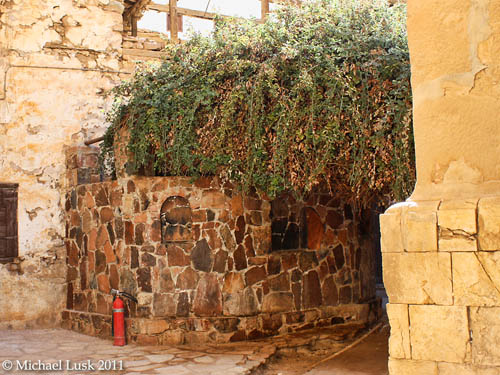
Another of the traditions associated with Saint Catherine’s Monastery is the burning bush. I am using another of the photos by Michael Lusk. Our visit to the Monastery was in the morning — a time when the lighting was bad for a photo of this bush. Michael went a little later than I did and his phot0 is better. I think the fire extinguisher is a nice touch.

The "burning bush" in Saint Catherine's Monastery. Photo by Michael Lusk.

The "burning bush" in Saint Catherine's Monastery. Photo by Michael Lusk.

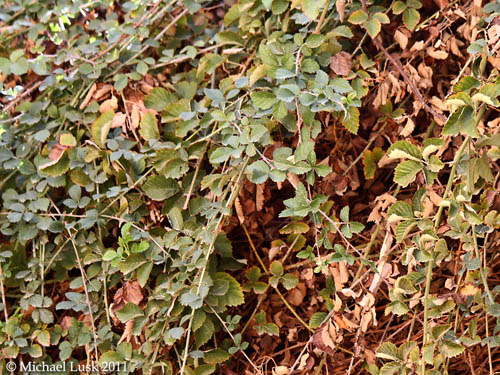
I have no idea about the specific kind of bush mentioned in Exodus. Here is a close up of the bush in Saint Catherine’s Monastery. A careful look reveals that this bush has small thorns on it.

Close up of "burning bush" in St. Catherine's Monastery. Photo by Michael Lusk.

Close up of "burning bush" in St. Catherine's Monastery. Photo by Michael Lusk.

The “Well of Moses” at Saint Catherine’s Monastery

In addition to the unique setting deep in the granite mountains of the Sinai peninsula, Saint Catherine’s Monastery is significant because it marks some important traditions relating to biblical characters and events. Geographers and other scholars make numerous suggestions for the location of Mount Sinai where the law was given to Moses and Israel. I am not entering that discussion at the moment, but am writing about the traditions associated with Saint Catherine’s Monastery.

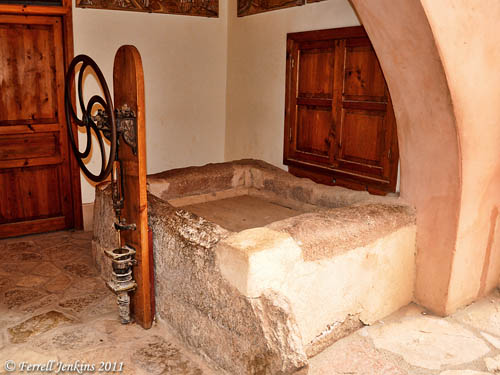
The well pictured below is shown as the Well of Moses and related to the biblical event described in Exodus.

When Pharaoh heard of it, he sought to kill Moses. But Moses fled from Pharaoh and stayed in the land of Midian. And he sat down by a well. Now the priest of Midian had seven daughters, and they came and drew water and filled the troughs to water their father’s flock. The shepherds came and drove them away, but Moses stood up and saved them, and watered their flock. (Exodus 2:15-17 ESV)

Moses Well at Saint Catherine's Monastery. Photo by Ferrell Jenkins.

Moses Well at Saint Catherine's Monastery. Photo by Ferrell Jenkins.

R. Alan Cole says the location of the land of Midian is uncertain, but that it could be somewhere in the Sinai peninsula.

The location is quite uncertain, but clearly it was somewhere beyond the Egyptian frontierposts, and to the east. Somewhere in the Sinai peninsula, or the Arabah (the area south of the Dead Sea), or that part of Arabia east of the gulf of Aqaba, would suit. (Cole, R. A. (1973). Vol. 2: Exodus: An introduction and commentary. Tyndale Old Testament Commentaries (66). Downers Grove, IL: InterVarsity Press.)

We have no way to know with certainty that Moses was at this specific place. The best we can say is that he may have been here.

Saint Catherine’s Monastery

The Monastery of St. Catherine is located at an altitude of about 4925 feet in the Wadi el-Deir at the foot of Gebel Musa. Tradition identifies this as the site where Moses tended the flocks of Jethro and saw the burning bush (Ex. 3:1-4:17). The Monastery was built near the middle of the sixth century A.D. during the reign of the emperor Justinian. It is dedicated to Saint Catherine of Alexandria and is the oldest continuously inhabited monastery in the Christian world. Through the centuries many monks have lived there; today it houses fewer than a dozen Greek Orthodox monks. The monastery became a great center of over 3000 old manuscripts and over 2000 icons. Only the Vatican library has more manuscripts.

Here is a new photo of the Monastery that I made in January.

View of St. Catherine's Monastery. Photo by Ferrell Jenkins 2011.

View of St. Catherine's Monastery. Photo by Ferrell Jenkins 2011.

The bedouin who work at the Monastery are called Jabaliye (Arabic for People of the Mountain).

“According to their tradition they are descendants of Christian slaves who were brought here by Emperor Justinian from Wallachia, today Rumania [Romania], as builders of the monastery and later its guards. In the course of time, when Sinai came under strict Moslem rule they were compelled to embrace Islam” (Vilnay, The Guide to Israel, 564).

There is a mosque within the monastery walls.

The rock of Van in Eastern Turkey

Paul Zimansky, in an article on Rusa II, the seventh century B.C. king of Urartu, describes the extent of the territory:

“The kingdom that Rusa controlled in the second quarter of the seventh century BCE stretched across the mountainous terrain of eastern Anatolia approximately eight hundred miles from east to west and five hundred from north to south” (“An Urartian Ozymandias,” Biblical Archaeologist, June, 1995, 94).

Dr. Oktay Belli says the name Urartu is not an ethnic term but a geographical one meaning “mountainous terrain” (The Capital of Urartu: Van, 20). Prior to the Urartians, this region was the home of the Hurrians.

There is a small museum in Van (unless enlarged since my last visit). Many inscriptions in the cuneiform language which the Urartians borrowed from the Assyrians are displayed. There were several pieces of gold jewelry and works of bronze on exhibit.

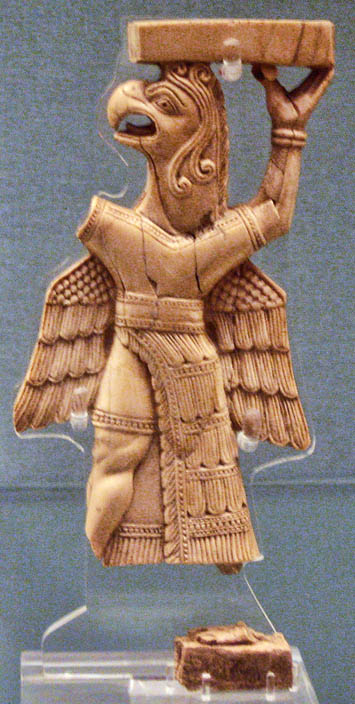
Urartian Ivory. British Museum.

Urartian Ivory. British Museum. Photo by Ferrell Jenkins.

The British Museum displays some Urartian pottery and ivories. The sign under this ivory piece reads,

Ivory objects were prized luxury items throughout the Near East. Some were made in Urartu and elephant tusks are listed by the Assyrians as booty from Urartian temples and palaces.

The photo below shows the castle or rock of Van. It is the site of Tushpa, an ancient city of the Urartians.

The Rock of Van, ancient Tushpa. Photo by Ferrell Jenkins.

The Rock of Van, ancient Tushpa. Photo by Ferrell Jenkins.

Tushpa, the ancient city of the Urartians, was built on this rock, which provides a commanding view over the lake, and at the base of the rock. At the beginning of the 20th century the city of Van was built over the ancient ruins, but was destroyed by the Russians in 1916. The area now is nothing more than a grassy knoll. On the side of the rock and at the top there are inscriptions, the tombs of eighth and ninth century B.C. Urartian kings, and ruins of a temple. A short distance from Van is another site called Toprakkale which marks the Urartian fortress of Rusahinili.

We know that the Assyrians were a threat to the kingdoms of Israel and Judah for about two hundred years. It is impressive to know that they also maintained an active engagement with the kingdom of Urartu closer to home. The distance from Nineveh to Tushpa on Lake Van is about 150 miles in a straight line. Think much further by mountainous road.

Sunset on Lake Van in Eastern Turkey

Lake Van in eastern Turkey is a large inland body of water of about 1400 square miles at an elevation of 5737 feet. The lake is fed by a number of rivers and is highly alkaline. It is said that folks sometimes wash their clothes in the lake. Along the south side of the lake the elevation reaches 7324 feet at one point.

Sunset on Lake Van. Photo made June 5, 2007 by Ferrell Jenkins.

Sunset on Lake Van. Photo made June 5, 2007 by Ferrell Jenkins.

In Assyrian records this area was called Urartu. In the Bible it is called Ararat. The English term Ararat is a transliteration of the Hebrew term. The four references where the term appears are Genesis 8:4, 2 Kings 19:37 = Isaiah 37:38, and Jeremiah 51:27. The King James version uses the term Armenia in 2 Kings 19:37 and Isaiah 37:38 because that is what the territory was later called. The Septuagint uses Armenia only in Isaiah 37:38.

The ark of Noah is said to have “rested upon the mountains of Ararat” (Gen. 8:4). Note that it does not say “Mount Ararat” but the “mountains of Ararat.” The assassins of Sennacherib, after killing the king of Assyria at Nineveh in 681 B.C., escaped into “the land of Ararat” (2 Kings 19:37; Isaiah 37:38). Jeremiah called upon the kingdom of Ararat to fight against Babylon (Jeremiah 51:27).

Quake survivors plead for tents

With the death toll approaching 300 in Eastern Turkey, a headline from MSNBC says, “Turkish quake survivors plead for tents.” It is easy to locate photos of tent cities set up in the area of the earthquakes. Such is often true even for those whose houses were not destroyed. The fear of after shocks cause people to leave their houses.

One of the first questions we should ask in Bible study is “What did this text mean to the original readers?” Until we know the answer to that question we should not try making applications of our own. Sometimes we fail to understand a text because we do not understand the customs and conditions of the time in which the text was written.

The letters to the Seven Churches of Revelation are especially filled with local allusions to things common in that time and place. The saints at Philadelphia were told that the one who overcomes (conquers) would be made a pillar in the temple of God. Notice the next phrase: “Never shall he go out of it.”

The one who conquers, I will make him a pillar in the temple of my God. Never shall he go out of it, and I will write on him the name of my God, and the name of the city of my God, the new Jerusalem, which comes down from my God out of heaven, and my own new name. (Revelation 3:12 ESV)

Philadelphia was especially noted for volcanoes and earthquakes. We discussed this earlier here. Pillars crumble during earthquakes and people leave their houses to live in tents. The promise in this text is that the one who overcomes will become a pillar in the temple of God and “never shall he go out of it.” This was a wonderful promise to those saints who had suffered from earthquakes on several occasions.

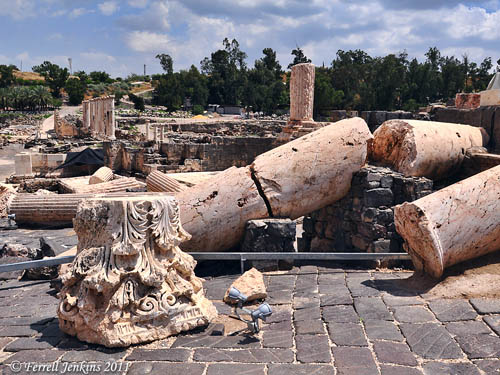
The photo below illustrates the effect of an earthquake on the pillars of temples and other buildings. It was made at Bethshan (Beth-shean) where an earthquake hit the city in 749 A.D.

Columns broken by earthquake at Bethshan. Photo by Ferrell Jenkins.

Columns broken by earthquake at Bethshan. Photo by Ferrell Jenkins.