Category Archives: Turkey

Huge columns said to be 1900-years-old found buried at Laodicea

Hurriyet Daily News reported today the discovery of a large number of “1,900-year-old huge columns” at Laodicea.

Excavations in the Aegean province of Denizli’s ancient city of Laodicea have revealed 1,900-year-old huge columns seven meters underground. The columns were found in the area known as the northern agora, one of the oldest faith centers in Anatolia.

The head of the excavations, Professor Celal Şimşek, said the northern agora had been discovered last year and they were continuing restoration and conservation work there. He said the area was one of the largest agoras in Anatolia. “The columned galleries here are in a rectangular shape on an area of 35,000 square meters. We previously revived the columned galleries that we call the eastern porch. This year we found the extension of these columns seven meters underground. They were in the same condition as when an earthquake ruined them. The columns date back to 1,900 years ago. Dust erosion and residue have filled the earth here and preserved the columns.”

Şimşek said their goal was to finish the excavations by the end of the year and to revive the columns in the beginning of the next year. He said the ancient city of Laodicea had served as a religious center.

“When the columned galleries are completely unearthed, there will be a very nice touring area. Tourists will have the chance to see traces from the past up close.”

A nice gallery of photos illustrate the article. One is a drawing showing how the area may have looked before being destroyed by earthquake. We are given no hint how the age of the columns was determined and whether the earthquake that felled them was also about 1,900 years old. Mark Wilson says,

Because of earthquakes the city was rebuilt numerous times during its history. A devastating earthquake during the reign of Focas (AD 602-10) finally caused the site to be abandoned. The residents founded a new city called Ladik, now the Kaleiçi district of Denizli. — Biblical Turkey, 247.

Laodicea is mentioned only in Paul’s epistle to the Colossians (2:1; 4:13-16) and in the Book of Revelation (1:11; 3:14). Paul says that Epaphras worked diligently for the saints in Colossae, Laodicea, and Hierapolis. These were cities of the Lycus River valley.

We have visited Laodicea several times over the years and been delighted with the archaeological reconstruction underway. The city should be on everyone’s list of “must see” sites of Turkey. Turkey has approximately 1100 historical sites, and the country has made considerable progress in preparing some of them for visitors. Use the search box on this blog to locate previous entries about Laodicea.
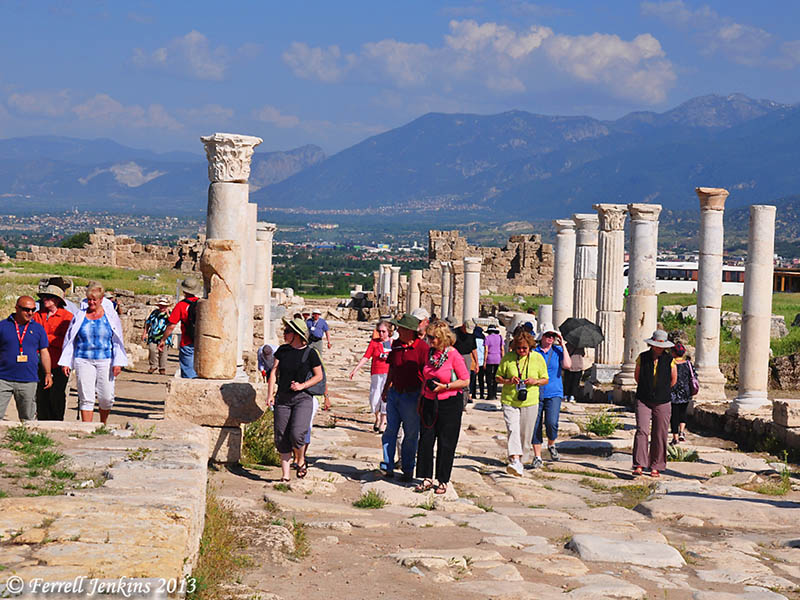
Tourists on the Syrian Street at Laodicea. Colossae is located at the foot of Mount Cadmus, seen in the distance to the east. Photo by Ferrell Jenkins.

Tourists on the Syrian Street at Laodicea. Colossae is located at the foot of Mount Cadmus, seen in the distance to the east. Hierapolis is to the north (our left as we view the photo). Photo by Ferrell Jenkins.

HT: Joseph I. Lauer
Following the news in the Bible World

Beginning with the Six Day War (June 5-10, 1967) I have tried to keep alert to the situation in the countries that are often called the Bible lands or the Bible World. This phrase is given to the countries of Iran, Iraq, Turkey, Syria, Lebanon, Jordan, Israel, Egypt, Greece, et al. where the events of the Bible transpired. Over the past 47 years I have traveled in all of these countries, some extensively, except Iran.

The current news coming out of Egypt is not good, and it is sad to see the conditions there. I wish for peace and justice for the people of Egypt, and the other countries mentioned above. I wish it also for those who would like to travel to these ancient lands to better learn the history, both secular and biblical.

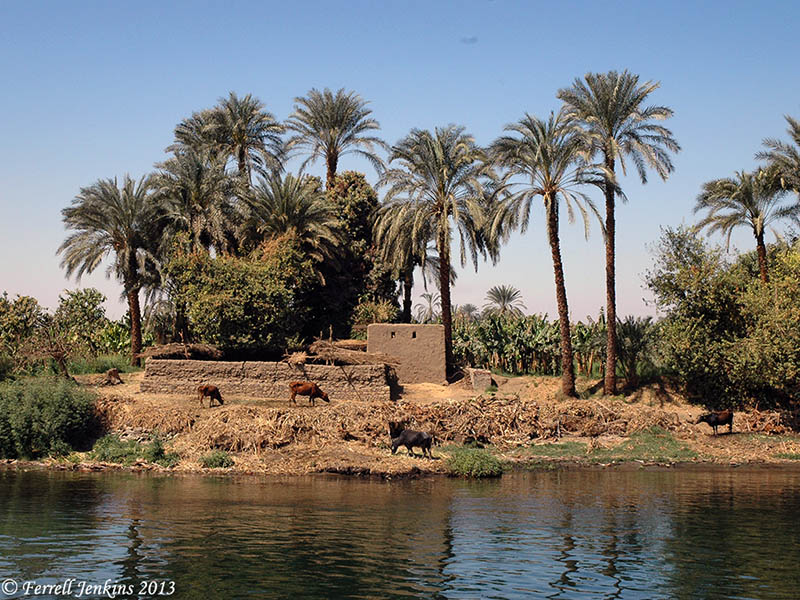
A scene on the Nile River in Upper Egypt. Photo by Ferrell Jenkins.

A scene on the Nile River in Upper Egypt. Photo by Ferrell Jenkins.

The photo above was made from the Nile River in Upper Egypt, near the ancient town of Edfu. When I look at it I am reminded of the Genesis account of the seven lean cows and seven plump cows that Joseph saw coming up out of the Nile (Genesis 41).

Hidden treasure

The discovery of hidden treasure is fairly common in and near ancient sites. Individuals may not have a bank account, but they keep the funds they have stored in what they consider a safe place.

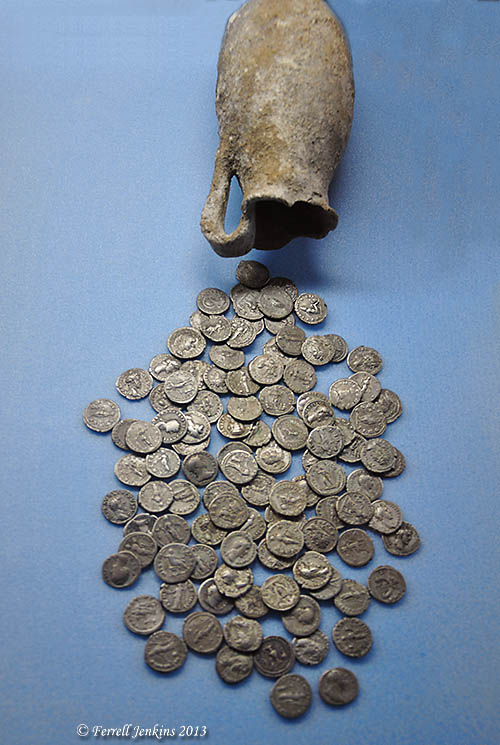
The photo below shows a clay jar with a hoard of silver coins displayed in the Samsun (Turkey) Archaeological Museum. These coins date from the Roman Imperial Period (69-79 A.D. and 238/244 A.D.). The earliest coins are not far removed from the time of the delivery of Peter’s Epistles to saints in Pontus and other Roman provinces (1 Peter 1:1). For more information about the delivery of Peter’s Epistles, see here.

For more information about the museum, check here and here.

Hoard of Roman coins displayed in Samsun Archaeological Museum. Photo by Ferrell Jenkins.

Roman coins displayed in Samsun Archaeological Museum. Photo by Ferrell Jenkins.

Photos such as this remind us of several Biblical passages. For today, consider Paul’s instruction to Timothy regarding what he was to teach those who set their hope on the uncertainty of riches.

 17 As for the rich in this present age, charge them not to be haughty, nor to set their hopes on the uncertainty of riches, but on God, who richly provides us with everything to enjoy.
18 They are to do good, to be rich in good works, to be generous and ready to share,
19 thus storing up treasure for themselves as a good foundation for the future, so that they may take hold of that which is truly life. (1 Timothy 6:17-19 ESV)

Restoration of historic sections of Izmir (biblical Smyrna)

Izmir is looking for local input on a restoration plan of the historic areas of Kadifekale and the agora.

On my last visit to Izmir I could see new work underway, especially in the area of the agora. The city now is developing a plan to restore an area of the city to make it more desirable for local citizens as well as tourists.

An article in Hurriyet Daily News (here) reports,

Municipal authorities in İzmir are calling for public participation amid an ambitious new project to redevelop some of the Aegean province’s most famous tourists sites in a bid to draw more visitors.

“We want to share ideas with scientists and the residents of İzmir. If we cannot get the support of citizens, it will not be possible to realize this project,” İzmir Metropolitan Mayor Aziz Kocaoğlu said.

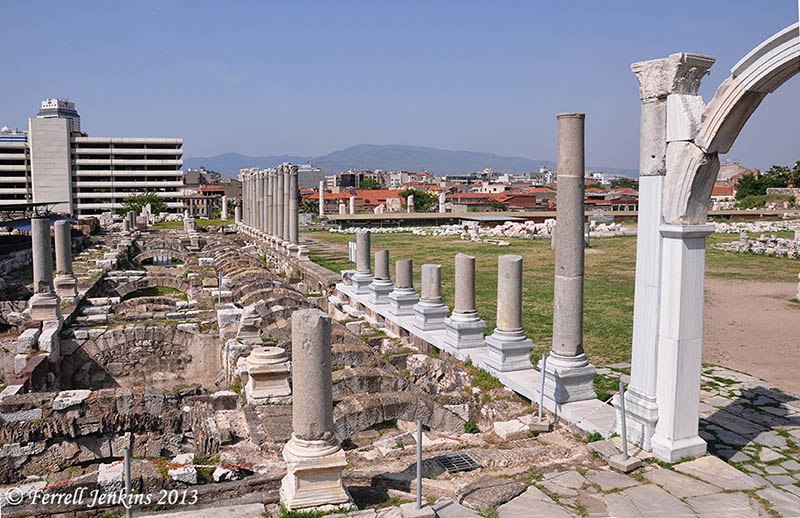
Our first photo shows a portion of the Roman agora. The arches which appear to be at ground level are actually the lower level of a two-story building.

The Roman agora of Izmir, biblical Smyrna. Photo by Ferrell Jenkins.

The Roman agora of Izmir, biblical Smyrna. Photo by Ferrell Jenkins.

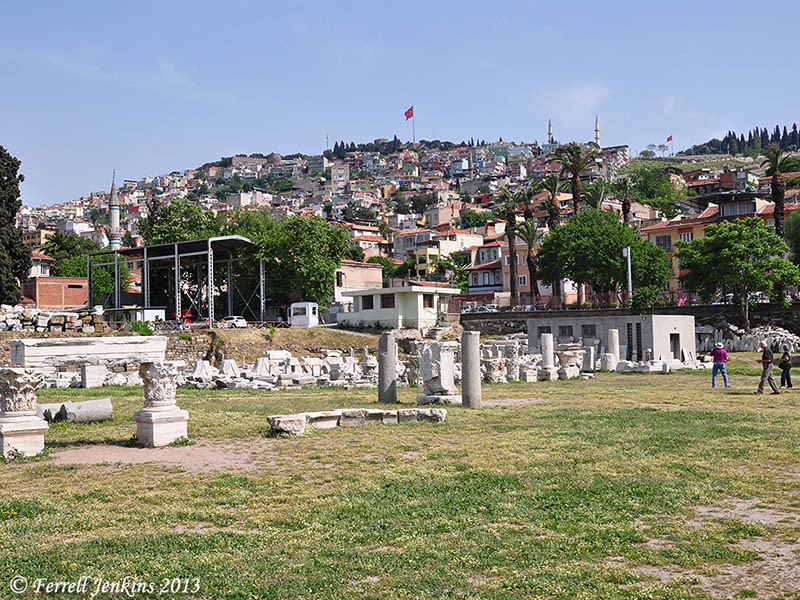
The second photo was made from the agora, with a view of Kadifekale. The word Kadifekale means velvet castle. In ancient times this hill was called Mount Pagos. The article mentions plans to include a restored area on the mountain, including the theater which was built on the hillside. Mark Wilson says the ancient theater, now build over by houses, seated 16,000 persons (Biblical Turkey, 312).

A view of Kadifekale (Mount Pagos) from the agora. Photo by Ferrell Jenkins.

A view of Kadifekale (Mount Pagos) from the agora. Photo by Ferrell Jenkins.

Smyrna is mentioned in the Bible as the location of one of the Seven Churches addressed in the book of Revelation (the Apocalypse).

“And to the angel of the church in Smyrna write: ‘The words of the first and the last, who died and came to life. (Revelation 2:8 ESV; see also 1:11)

Here’s hoping for a speedy and accurate restoration of the ancient city.
HT: Jack Sasson

Speaking at Florida College Annual Lectures

Tuesday morning at 10 a.m. I am scheduled to present an illustrated lecture on Biblical Coastal Towns of Turkey in Puckett Auditorium at the Florida College Annual Lectures. Normally in these sessions, in which I have participated in for many years, I present material on lesser-visited places that are important to Bible study.

There are several important coastal towns in Turkey that are mentioned in the Bible, mostly in connection with the journeys of Paul. These include Troas, Assos, Ephesus, Miletus, Patara, Myra, Attalia, Perga, and Seleucia. I have chosen to discuss two Black Sea cities (Sinope and Samsun) that are related to the discussion of the route of delivery of the Epistles of Peter, and to two cities on the Mediterranean Sea (Patara and Myra). I was able to visit all of these cities during the past year.

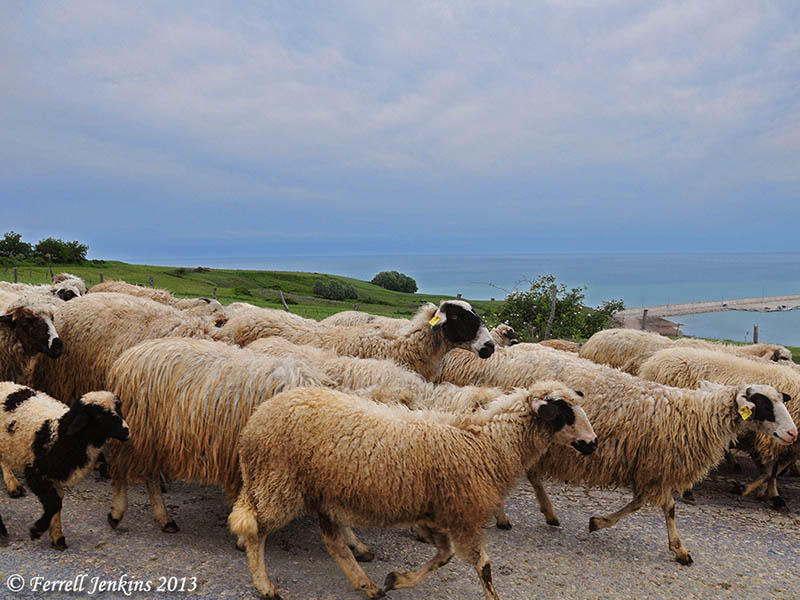
The photo below was made a few miles east of Sinope along the Black Sea (ancient Euxine). The territory is mountainous and the road is often far enough inland that the sea is not visible. Here the road runs along the sea, but still considerably above it. To the south, the mountains are much higher.

Sheep on the road east of Sinope, above the Black Sea. Photo by Ferrell Jenkins.

Sheep on the road east of Sinope, above the Black Sea. Photo by Ferrell Jenkins.

Xanathos in Lycia

The photo I am sharing today was made at ancient Xanthos, a city of Lycia, now in southwestern Turkey. The city is situated in the Lycian mountains a few miles from the Mediterranean coast and the ancient city of Patara (Acts 21:1). The small town of Kinik lies in the valley below Xanthos.

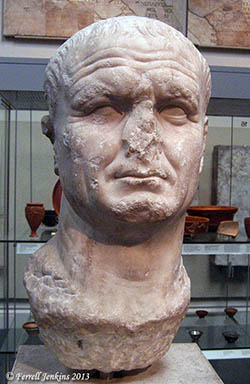
Roman Emperor Vespasian

Emperor Vespasian. BM. Photo by F. Jenkins

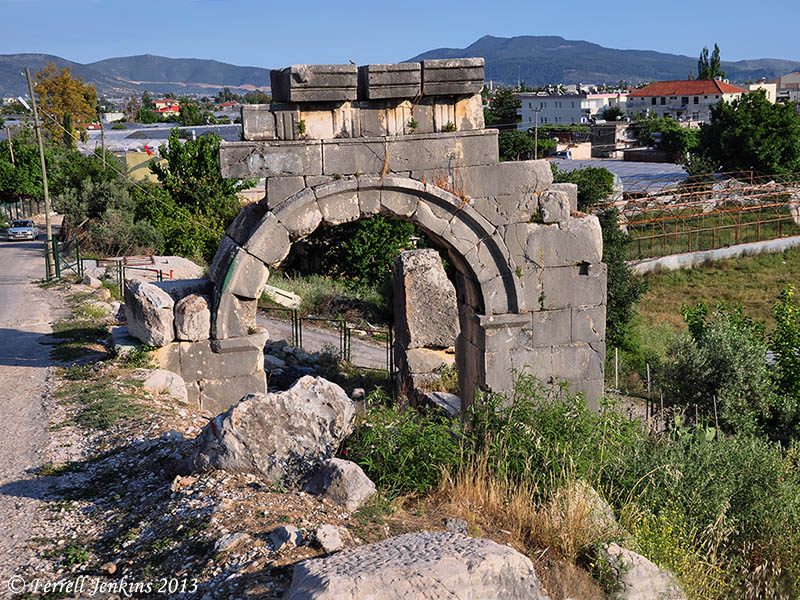
A road runs up the hill through the ancient ruins. One of the first monuments we come to is a Roman arch dedicated to the emperor Vespasian  (A.D. 69-79) by the Council and People of Xanthos. George E. Bean says,

The pavement which survives in part belongs to an ancient road which led up from Patara and the Letoum. – Lycian Turkey, 60.

Our view is made from above the arch. To the left you can see the narrow modern road leading to the parking lot at Xanthos.

Arch built by Vespasian partially below modern road level. Photo by Ferrell Jenkins.

Arch built by Vespasian partially below modern road level. Photo by Ferrell Jenkins.

This photo illustrates the build up of debris over the centuries.

Writers such as Bean tell of the time when the Persians conquered western Asia about 540 B.C. Rather than surrender, the fighting men of Xanathos placed their women, children, slaves, and property on the acropolis and set fire to it. These men then went forth and fought to the death.  This account reminds us of the one recorded by Josephus about the fall of Masada during the Jewish Wars against the Romans (The Jewish War 7.8.6).

For more information about Xanathos, and Lycia in general, see the nice Lycian Turkey website here.

Monument from Xanathos now in British Museum

The ancient Greek city of Xanthos (Xanthus) is mentioned in the Iliad as the greatest of the cities of Lycia. The site is located near Letoon, and a few miles north of Patara, the port where the Apostle Paul changed ships on the return from the Third Journey (Acts 21:1-2).

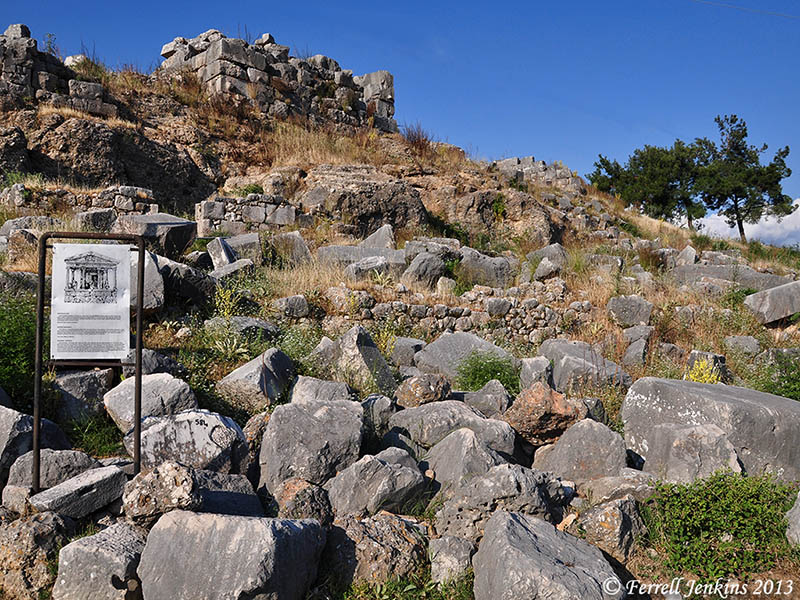
Our visit to Xanathos was limited due to the lateness of the day, but we took time to get a few photos of some significant ruins. Our first stop was what the Blue Guide Turkey calls “the few sad remains of the Nereid Monument.”

Xanathos_site-of-Nereid-Mon_fjenkins052012_043t

The site of the Nereid Monument at Xanathos. Photo by Ferrell Jenkins.

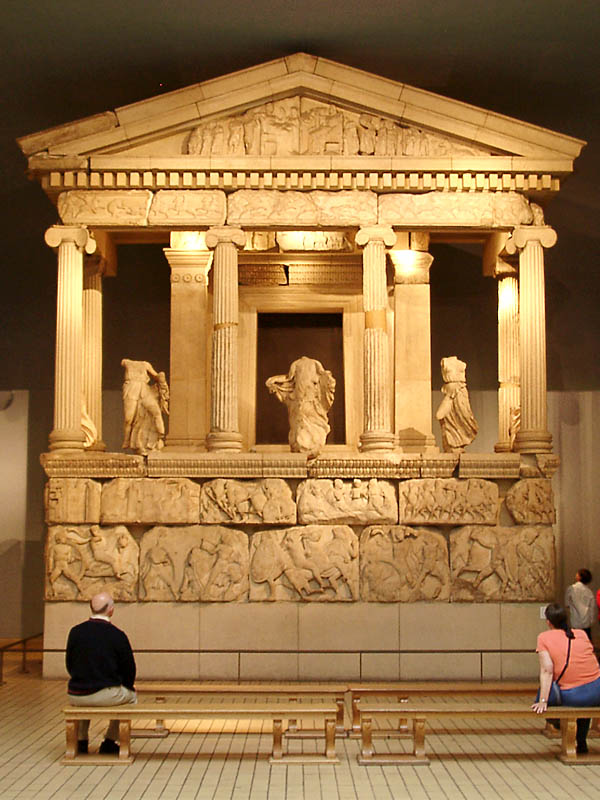
Charles Fellows took statues and friezes from the Monument to the British Museum in 1841-42, where they have been reconstructed.

Nereid Monument in British Museum. Photo by Ferrell Jenkins.

Nereid Monument in the British Museum. Photo by Ferrell Jenkins.

The sign at the original site (visible in the first photo) says,

This famous classical era monument was removed in its entirety to the British Museum in the last century [an old sign] and all that remains are a few rows of stones from the foundations and podium. This 4 by 6 columns Ionic temple style monument is embellished with reliefs and statues [sic]. The statues of twelve females between the columns are those of water spirits known as Nereids.

The Monument dates as early as 390 B.C.

“Every man under his vine…”

A biblical way of describing a time of peace and prosperity is expressed in the following passage describing the time of King Solomon.

And Judah and Israel lived in safety, from Dan even to Beersheba, every man under his vine and under his fig tree, all the days of Solomon. (1 Kings 4:25 ESV)

It is not uncommon in the middle east to see vines used as a shade. Sometime the vine runs up the side of a house and covers a porch on the roof. When I saw this single vine by itself in front of the theater at Miletus I could not help but think of the biblical saying. I asked my traveling buddy, Leon Mauldin, to make a picture of me sitting under my vine.

I can imagine a person sitting under the vine in the late summer and enjoying the fresh grapes from the vine.

Miletus-theater_fj-vine_fjenkins072906_07t

Sitting under the vine at the theater of Miletus. Photo by Leon Mauldin.

Miletus is the city where the Apostle Paul met with the elders from the church at Ephesus as he returned to Jerusalem at the end of his third journey (Acts 20).

The prophet Micah used the same illustration to describe the nature of the Messiah’s kingdom.

It shall come to pass in the latter days that the mountain of the house of the LORD shall be established as the highest of the mountains, and it shall be lifted up above the hills; and peoples shall flow to it, 2 and many nations shall come, and say: “Come, let us go up to the mountain of the LORD, to the house of the God of Jacob, that he may teach us his ways and that we may walk in his paths.” For out of Zion shall go forth the law, and the word of the LORD from Jerusalem. 3 He shall judge between many peoples, and shall decide for strong nations far away; and they shall beat their swords into plowshares, and their spears into pruning hooks; nation shall not lift up sword against nation, neither shall they learn war anymore; 4 but they shall sit every man under his vine and under his fig tree, and no one shall make them afraid, for the mouth of the LORD of hosts has spoken. (Micah 4:1-4 ESV)

Myra, home of Saint Nicholas

The town Myra is known to students of the New Testament as a place where Paul transferred ships while he was being taken to Rome for trial before Caesar (Acts 27:5).

In the centuries following, Myra became the home of a (Greek Orthodox) bishop known as Nicholas. Born in Patara, Nicholas died December 6, 343. Several legends arose around Nicholas who was noted for giving gifts to the poor and raising the dead.

Highly revered in Greece and Russia, St. Nicholas is known as the patron saint of children, sailors, merchants, and scholars. From his life of piety, kindness, and generosity arose the legendary figure celebrated today as St. Nicholas, Father Christmas, or Santa Claus. (Fant & Reddish, A Guide to Biblical Sites in Greece and Turkey, 256)

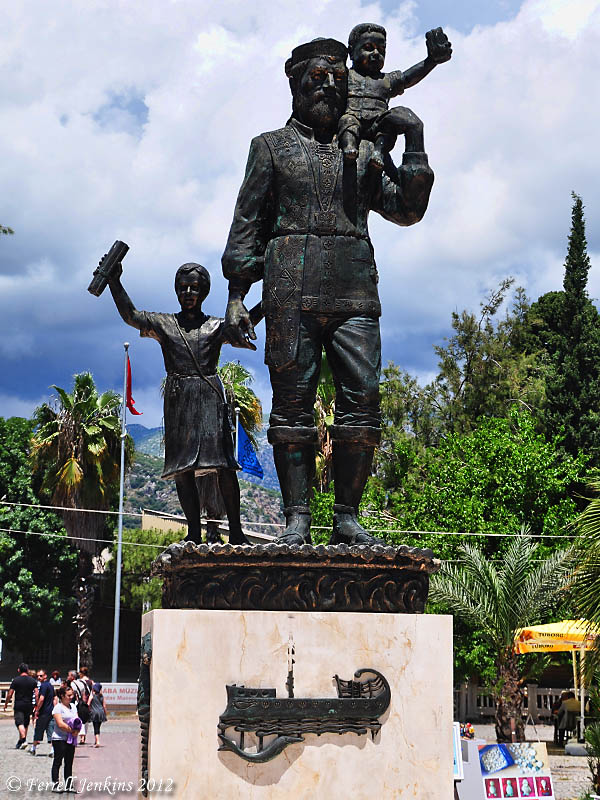
The ancient Myra is associated with the modern Turkish town Demre (or Kale). I thought you might enjoy seeing a few pictures related to Saint Nicholas. In the town square is a recent statue showing St. Nicholas with children. The statue was a gift of the Russian government in 2000. Many Russian tourists were visiting the day I was there.

Modern statue of Saint Nicholas at Myra. Photo by Ferrell Jenkins.

Modern statue of Saint Nicholas at Myra. Photo by Ferrell Jenkins.

A few decades ago I saw an older statue near the entrance to the church. It now has a fresh coat of black paint.

Older statue of St. Nicholas near the entrance of the Byzantine church ruins. Photo by Ferrell Jenkins.

Older statue of St. Nicholas near the entrance of the Byzantine church ruins.This statue depicts him carrying a bag of gifts.  Photo by Ferrell Jenkins.

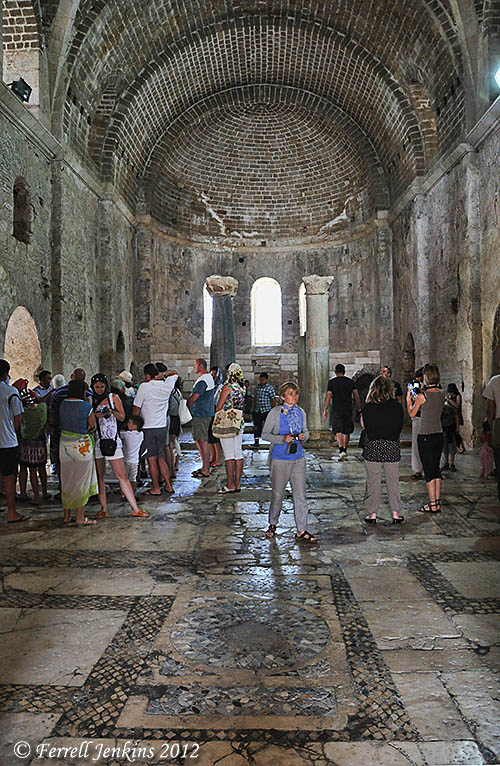
The Byzantine church dates to the 6th century A.D. Several writers point out that the sarcophagus of Nicholas was broken into by Italian merchants in the 1087 A.D., and his bones were taken to Bari, Italy.

Wilson says the church is built like a basilica “in the shape of an orthodox cross” (Biblical Turkey 88).

St. Nicholas Byzantine church, Myra, Turkey. Photo by Ferrell Jenkins.

Ruins of the St. Nicholas Byzantine church, Myra, Turkey. Photo by Ferrell Jenkins.

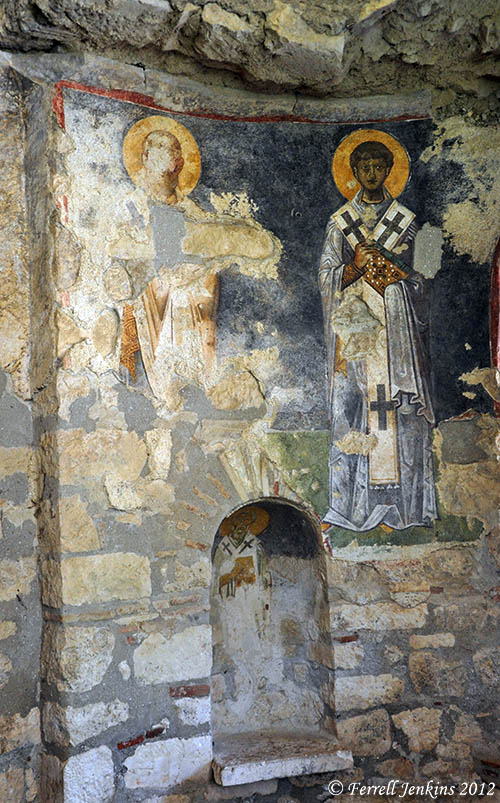
This last photo shows one of the poorly preserved frescoes.

Fresco on the wall of St. Nicholas church in Demre. Photo by Ferrell Jenkins.

Fresco on the wall of St. Nicholas church in Demre. Photo by Ferrell Jenkins.

Tourism seems to be thriving at Myra even though the town is off the beaten track. Whether there are any Christians in the town is doubtful.

For an earlier post about Myra and St. Nicholas, see here.

Acts 27 #2 — Did Paul dock at Cnidus (Knidos)? — Photo Illustration

Paul’s voyage to Rome, as it is often called, was actually a trip as a prisoner on a variety of ships from Caesarea Maritima to Puteoli in Italy (Acts 27:1 – 28:13. The trip westward from Myra, on the Mediterranean coast, took the ship near Cnidus (also spelled Knidos) (Acts 27:6-7).

We sailed slowly for many days and arrived with difficulty off Cnidus. Because the wind prevented us from going any farther, we sailed under the lee of Crete off Salmone. (Acts 27:7 NET)

Mark Wilson says,

Paul would have passed within sight of Cnidus on his return to Jerusalem during his second and third journeys, possibly even stopping at the city (Acts 18:21-22; 21:1). The grain ship upon which Paul was traveling on his captivity voyage to Rome encountered fierce head winds as it tacked westward along the coast of Asia Minor. It is not clear if Paul’s ship was able to make port in Cnidus’ commercial harbor, but the sailing conditions probably prevented it (Acts 27:7). — Biblical Turkey, 192.

A British archaeologist excavated at Cnidus in 1957-59. A colossal marble lion that once rested on a monumental tomb was taken to the British Museum where it is displayed in the Queen Elizabeth II Great Court. The lion dates to the late 4th-early 3rd century B.C.

Colossal marble lion from Cnidus. British Museum. Photo by Ferrell Jenkins.

Colossal marble lion from Cnidus. British Museum. Photo by Ferrell Jenkins.

The sign in the British Museum informs us that,

This lion crowned a monumental tomb at the edge of a cliff overlooking the sea. The hollow eyes were probably inset with glass to catch the light.

Did Paul see this lion? More than likely, I think, during the return from the second and third journeys.

The map below shows the location of Cos, Cnidus, Rhodes and Patara. Click the image for a higher resolution.

Map showing Cnidus, Rhodes, and Patara. Made with Bible Mapper 4.

Map showing Cnidus, Rhodes, and Patara. Made with Bible Mapper 4.