Category Archives: Travel

More on Paul’s shipwreck on Malta

Gordon Franz has written a critique on his Life and Land blog (here) of the CBN 700 Club’s program about Robert Cornuke’s “amazing Biblical discovery” on Malta. Previously we have called attention to Gordon’s blog and writings, and especially to his series on “Cracked Pot Archaeology” here.

The CBN video includes some nice footage and is, for that reason, worth viewing. If you have interest in this subject, I suggest you go to Life and Land and take a look at the video and read the critique.

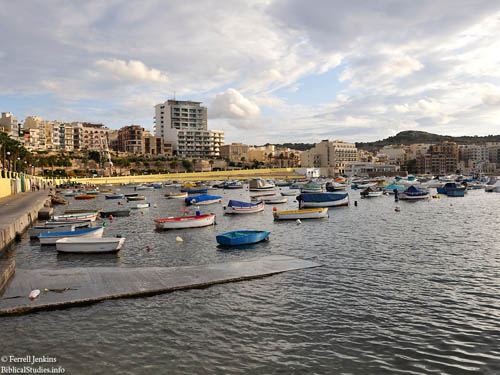
Our photo below shows one of the small pleasure harbors around St. Paul’s Harbor on Malta.

St. Paul's Harbor at Malta. Photo by Ferrell Jenkins.

St. Paul's Harbor at Malta. Photo by Ferrell Jenkins.

You may read our account of visiting Malta here and here. This is a significant topic because of the account of Paul’s shipwreck in Acts 28.

After we had safely reached shore, we learned that the island was called Malta. (Acts 28:1 NET)

Jaffa Gate and the Christian Quarter from the air

In the past few days we have called attention to the excavations being conducted by the Israel Antiquities Authority at Jaffa Gate in Jerusalem. Archaeologists working in the area announced the discovery of an East-West road of the 4th century Byzantine city and the high-level aqueduct that brought water into the city in the second and third century.

The photo below shows Jaffa Gate and the Citadel from the air. Hezekiah’s Pool is visible just to the left (north) of the main street (David Street), almost in the center of the photo. The dome of the Church of the Holy Sepulchre is visible on the upper left side of the photo. Most of the area shown in this photo is called the Christian Quarter of the Old City of Jerusalem.

    Aerial view of the Christian Quarter of the Old City. Photo by Ferrell Jenkins.

Aerial view of the Christian Quarter of the Old City. Photo by Ferrell Jenkins.

Click on the photo for a larger image.

Roman Legions in Jerusalem

Rome gained control over the western Mediterranean in 146 B.C. By 131 B.C. Rome controlled the previous territory of Attalus, king of Pergamum. By 64 B.C., the Roman general Pompey ended the Seleucid dominion in Syria and the territory was annexed as another Roman province. Judea became a part of the Roman province of Syria. The Romans occupied the land they would name Palestine until the 4th century A.D.

There are numerous tangible evidences of the Roman rule of the country. One Roman column is located inside the Old City at Jaffa Gate. If you enter the Old City through Jaffa Gate, look to the left. I think the first street is Latin Patriarchate. The next “street” is a covered entry to several small businesses. Anyway, if you get to Jaffa Gate you can look down the little streets until you see the Roman Column serving as a lamp-post. (It appears that this was never any higher; not a column, but a post.)

Roman Legions Column near Jaffa Gate. Photo by Ferrell Jenkins.

Roman Legions Post near Jaffa Gate. Photo by Ferrell Jenkins.

Murphy-O’Connor (The Holy Land) says the post honors the Legate of the emperor Septimius Severus, and was erected about A.D. 200. He gives the following reading of the inscription:

M(arco) Iunio Maximo leg(ato) Aug(ustorum) Leg(ionis) X Fr(etensis) — Antoninianae — C. Dom(itius) Serg(ius) str(ator) eius.

The tenth legion participated in the destruction of Jerusalem in A.D. 70, and remained in the city for about 200 years.

Roman Column of Tenth Legion in Jerusalem. Photo by Ferrell Jenkins.

Roman Post of Tenth Legion in Jerusalem. Photo by Ferrell Jenkins.

Flash floods in the Sinai peninsula

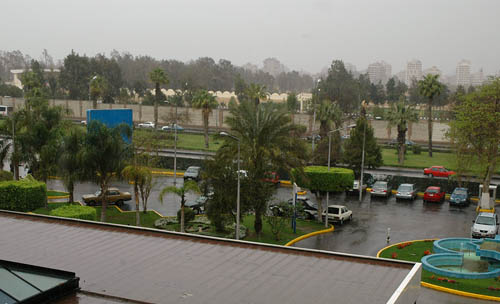
Travel in Egypt is sometimes hindered by small amounts of rain. In flat areas such as the delta an inch of rain can flood the area and make automobile travel impossible, or at least impractical. In early March, 2005, Elizabeth and I had remained in Egypt for a few days after the tour group returned home. We planned one day to go to Goshen. That morning when we looked from the hotel window in Heliopolis we observed rain. The guide scheduled to go with us on the excursion arrived, but explained that we would not be able to go due to the 1/2 to 1 inch of rain that had fallen during the night. The annual rainfall in the Cairo area is 1 1/2 to 2 inches. In Upper Egypt years may pass with no rainfall.

Rain in Cairo - March 9, 2005. Photo by Ferrell Jenkins.

Rain in Cairo - March 9, 2005. Photo by Ferrell Jenkins.

Egypt is less prepared for an inch of rain than many southern USA cities are for an inch of snow.

On another excursion we went to Jebel Musa, the traditional Mount Sinai, in the Sinai Peninsula. As we traveled through the Wadi el-Tor (el-Tur or al-Tur) shortly before arriving at Feiran, I noted that there had been a flash flood in the wadi. Our guide explained that this typically happened at least once each winter. He said that the asphalt paved road could be washed out by less than an inch of rain.

Wadi el Tor in the Sinai Peninsula after a flash flood. Photo by Ferrell Jenkins.

Wadi el Tor in the Sinai Peninsula after a flash flood. Photo by Ferrell Jenkins.

Rocks polished by the winter flood were strewn across the wadi. These stones show the different rocks found in the Sinai. The red stones indicate iron. The green is copper. The black is basalt, indicating a volcanic area.

Rocks in the Wadi el Tour in the Sinai Peninsula. Photo by Ferrell Jenkins.

Rocks in Wadi el Tor of the Sinai Peninsula. Photo by Ferrell Jenkins.

Let us recall that the normally dry wilderness (midbar, desert) once flowed with water for the Israelites.

“He led you through the great and terrible wilderness, with its fiery serpents and scorpions and thirsty ground where there was no water; He brought water for you out of the rock of flint. (Deuteronomy 8:15 NAU)

He split the rocks in the wilderness And gave them abundant drink like the ocean depths. (Psalm 78:15 NAU)

Speaking at Florida College lectures

This is the week for the annual Bible lectures at Florida College in Temple Terrace, FL. Even though I retired from teaching in 2001, I have been invited to speak each year. Most of these have been lectures that do not require writing a manuscript for publication. That is my preference, of course.

Yesterday I spoke in Puckett Auditorium on Roads and Seas Less Traveled. For a 45 to 50 minute presentation I had to be very selective. I explained what I meant by the title. I was speaking of places (roads and seas) that tourists rarely visit. I limited myself to the land of Goshen and Malta.

Using a map, I showed the location of the land of Goshen in the eastern Nile Delta. This is where Jacob’s family settled when they went from Canaan to Egypt (Genesis 45:10), and where they grew to a nation and spent time in bondage. This area was also called the “land of Rameses.”

Then Joseph settled his father and his brothers and gave them a possession in the land of Egypt, in the best of the land, in the land of Rameses, as Pharaoh had commanded. (Genesis 47:11 ESV)

Dr. Manfred Bietek of the Austrian Institute in Cairo has excavated since the mid-1960s at Tell el-Dab’a, Ezbet Helmi, and Qantir. All of these sites are located a few miles north of modern Faqus in the eastern Delta. I have taken my tour group to visit sites in Goshen on two tours, but tourists are not allowed to visit Tell el-Dab’a. In fact we were not allowed to get off the bus to make photographs of the canal that follows the path of the ancient Pelusiac branch of the Nile. I have a friend in Egypt who knows the territory and offered to take me to visit some of these places. We went late in the afternoon. In fact, by the time we arrived at Tell el-Dab’a it was already dark.

Here is the original photo:
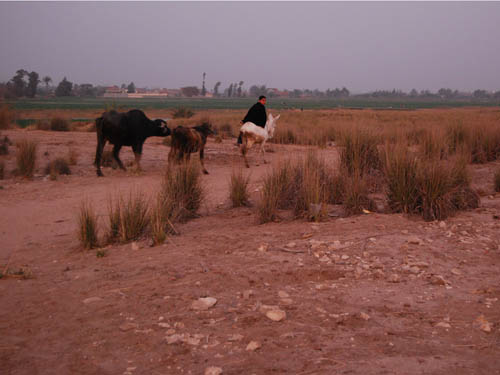
Tell el-Dab'a in the Eastern Nile Delta. Photo by Ferrell Jenkins.

Tell el-Dab'a in the Eastern Nile Delta. Original Photo by Ferrell Jenkins.

After a little work in Photoshop, the photo looks as if it were taken during a hazy day.

Tell el-Dab'a in the Eastern Nile Delta. Photo by Ferrell Jenkins.

Tell el-Dab'a in the Eastern Nile Delta. Photo by Ferrell Jenkins.

In the original larger photo it is easy to see shards of pottery scattered in the area.

The children of Israel once lived in this flat, fertile area of Egypt. In fact, if this is indeed the land of Rameses, the Israelites departed from this region for the promised land (Exodus 12:37).

A fuller discussion about the Land of Rameses may be read here.

A scholarly article by Dr. Bryant  G. Wood about New Discoveries at Rameses is available at the Associates for Biblical Research web site here. I also recommend the article on Israel in Egypt by Gary Byers at the same site (here).

Ponder the path of your feet

From this narrow dirt path one can see the mountains that surround Samaria (Amos 3:9).

A path at Samaria. Photo by Ferrell Jenkins.

A path at Samaria. Photo by Ferrell Jenkins.

Ponder the path of your feet; then all your ways will be sure. Do not swerve to the right or to the left; turn your foot away from evil. (Proverbs 4:26-27 ESV)

The land of Gennesaret

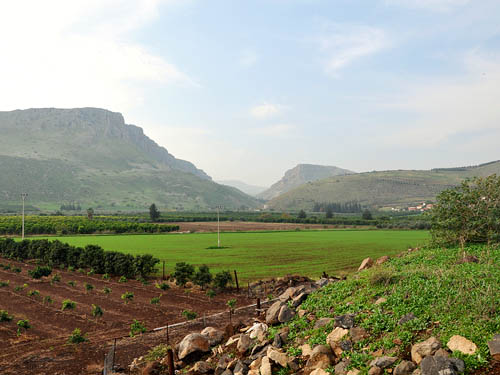
The Sea of Galilee is called the “lake Gennesaret” by Luke (Luke 5:1). The area on the northwest corner of the Sea of Galilee is called the “land at Gennesaret.” In the view below we see the land of Gennesaret and the Via Maris. The route here leads to the Beit Netofa Valley and the sites of (Khirbet) Cana, Sepphoris, Nazareth, and Yodfat (Jotapata). Yodfat was fortified by Josephus during the Jewish revolt against Rome. Josephus, commander of the Jewish rebels, surrendered to the Roman Emperor Vespasian at Yodfat.

The land of Gennesaret and the Via Maris. Photo by Ferrell Jenkins.

The land of Gennesaret and the Via Maris. Photo by Ferrell Jenkins.

Many of the miracles of Jesus were performed in this area.

When they had crossed over, they came to land at Gennesaret. And when the men of that place recognized Him, they sent word into all that surrounding district and brought to Him all who were sick; and they implored Him that they might just touch the fringe of His cloak; and as many as touched it were cured. (Matthew 14:34-36 NAU)

Jerusalem at 3800 feet altitude

In the last post about the aerial photos (January 18) we showed the mountains of Judea as we approached the central mountain ridge. Today’s photo shows the Old City of Jerusalem from about 3800 feet above sea level. The city itself is about 2400 to 2500 feet above (Mediterranean) sea level. The view is looking southeast across the Wilderness of Judea to the mountains of Moab in the Transjordan tableland.

Old City of Jerusalem - view toward SE. Photo by Ferrell Jenkins.

Old City of Jerusalem - view toward SE. Photo by Ferrell Jenkins.

In this photo one can see the proximity of Jerusalem to the Wilderness of Judea. The distance from Jerusalem to the Dead Sea is not more than 20 miles. The elevation drops from about 2600 at the Mount of Olives to (currently) about 1384 feet below sea level at the surface of the Dead Sea. The Transjordan Tableland is about 3000 above sea level.

As the mountains surround Jerusalem, So the LORD surrounds His people From this time forth and forever. (Psalm 125:2 NAU)

Deadly flash floods in the Negev

Todd Bolen has been teaching in Israel for the past two or three weeks. He reports on heavy rains in the Negev that resulted in flooding in the area. Read the full report here.

Sometimes individuals fail to realize the force of the water and drive their vehicles into it. This often results in danger, and even death.

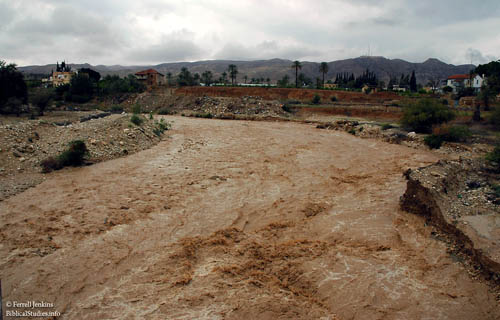
Nearly two years ago I wrote about Rivers in the Desert with photos showing a wadi after a night of rain. Read that article here. One of the photos I made the morning after a heavy rain in the mountains of Judea is included below. This photo show the normally dry Wadi Kelt (Qilt) at Jericho.

Wadi Kelt (Qilt) at Jericho after rain in the mountains of Judea. Photo by Ferrell Jenkins.

Wadi Kelt at Jericho after rain in the mountains of Judea. Photo by Ferrell Jenkins.

Planning for earthquakes in Eastern Turkey

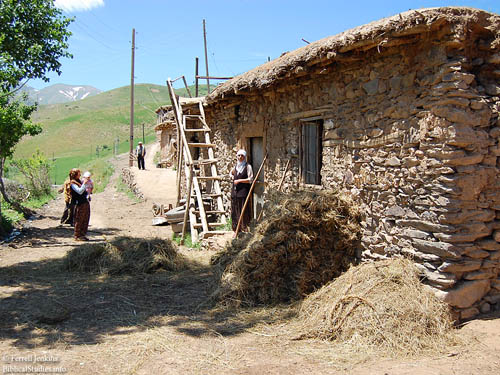
Last week I wrote about references to earthquakes in the Bible. In 2007 I traveled in Eastern Turkey, in the Biblical land of Ararat (Urartu) (2 Kings 19:37). Along the road between Van and Batman we saw a group of men adding a room to a house.

Notice that the house is built of field stones. Above the window there is a lintel of wood. To the right side of the window you may also see a long piece of wood. I will come back to that later. Notice the roof. It is made of timber, straw, and mud.

House between Van and Batman in Eastern Turkey. Photo by Ferrell Jenkins.

House between Van and Batman in Eastern Turkey. Photo by Ferrell Jenkins.

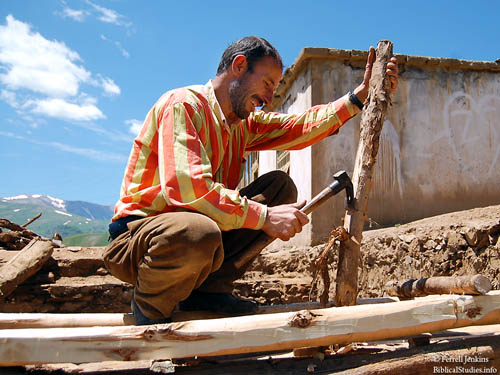
The photo below shows one of the men working on the roof of the new room. Notice the mud roof of the existing room.  The worker is preparing a piece of timber with a simple hand tool similar to those used three to four thousand years ago.

Adding a new room in the land of Ararat. Photo by Ferrell Jenkins.

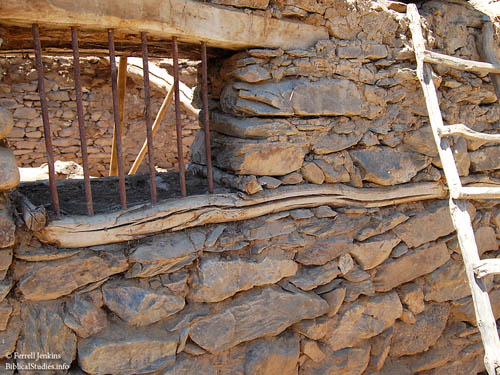
Here we see part of the new wall. Notice the field stone filled with smaller stones. A wooden lintel is used over the window. That might not be unusual to us. Look below the window. The timber is not only under the window, but also extends several feet to the right.

Preparing for an earthquake in Eastern Turkey. Photo by Ferrell Jenkins.

Preparing for an earthquake in Eastern Turkey. Photo by Ferrell Jenkins.

My friends and I spoke only a few words in Turkish. The men building the house spoke no English. I pointed to the wood below the window and did my imitation of the shaking of an earthquake. This evoked a good smile from one of the Turkish men. He nodded to indicate that I had the right idea. The wood helps to absorb the shock of an earthquake.

In our modern housing we use rebar to strengthen our buildings. This, along with metal ties help reinforce our buildings to resist the damage from hurricanes, tornadoes, and earthquakes. If an earthquake similar to the one in Haiti had hit southern California there likely would have been little loss of life. The buildings in Haiti were made of concrete blocks without any reinforcement. Ancient people knew they had to find ways to cushion the shock. The people of Eastern Turkey have learned the same.

In principle, Jesus taught the same thing about building.

“Everyone then who hears these words of mine and does them will be like a wise man who built his house on the rock. And the rain fell, and the floods came, and the winds blew and beat on that house, but it did not fall, because it had been founded on the rock. And everyone who hears these words of mine and does not do them will be like a foolish man who built his house on the sand. And the rain fell, and the floods came, and the winds blew and beat against that house, and it fell, and great was the fall of it.” And when Jesus finished these sayings, the crowds were astonished at his teaching, for he was teaching them as one who had authority, and not as their scribes. (Matthew 7:24-29 ESV)

Are you building on the rock?