Category Archives: New Testament

Jesus rides a donkey from Bethphage to Jerusalem

Bethphage is mentioned in the New Testament in only one incident from the ministry of Jesus (Matthew 21:1, Mark 11:1; Luke 19:29).

And when he had said these things, he went on ahead, going up to Jerusalem.  When he drew near to Bethphage and Bethany, at the mount that is called Olivet, he sent two of the disciples,   saying, “Go into the village in front of you, where on entering you will find a colt tied, on which no one has ever yet sat. Untie it and bring it here.  If anyone asks you, ‘Why are you untying it?’ you shall say this: ‘The Lord has need of it.'”  So those who were sent went away and found it just as he had told them.  And as they were untying the colt, its owners said to them, “Why are you untying the colt?”  And they said, “The Lord has need of it.”  And they brought it to Jesus, and throwing their cloaks on the colt, they set Jesus on it. (Luke 19:28-35 ESV)

John records the event but does not mention Bethphage (John 12:12ff.).

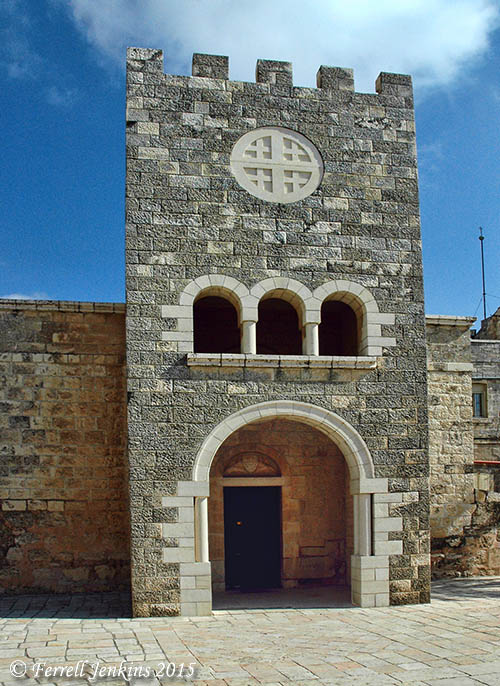
The exact site of Bethphage is not known, but it certainly was not far from Kefr et Tur, the place of Byzantine traditions. The present Franciscan chapel was built there in 1883.

Franciscan chapel at Bethphage. Photo by Ferrell Jenkins.

Franciscan chapel at Bethphage. Photo by Ferrell Jenkins.

The Roman road from Jericho to Jerusalem went over the Mount of Olives between Mount Scopus and the Mount of Olives. Before reaching the top of the mountain a spur or bypass turned south to Bethphage and Bethany.

A colt at Nazareth Village. Photo by Ferrell Jenkins.

A colt at Nazareth Village. Photo by Ferrell Jenkins.

In a 1975 article in Biblical Archaeologist (Vol. 38, No. 1), John Wilkinson wrote about “The Way from Jerusalem to Jericho.” He and his party tried to trace out known remnants of the old Roman road between the two cities. This 12½ mile trip from Jericho up to Jerusalem took 7 hours and forty-nine minutes.

Fishing all night and the Galilee sunrise

Sunrise on the Sea of Galilee (Lake Kinneret; Sea of Tiberias) evokes many memories of the ministry of Jesus and His disciples. No matter how many photos one takes, each one is unique.

I usually make these sunrise photos with two cameras, using multiple settings. The photo today is one that I especially like because I was able to catch the fisherman heading to harbor after a night of fishing.

Sunrise on the Sea of Galilee, May 17, 2015, 5:54 a.m. Photo by Ferrell Jenkins.

Sunrise on the Sea of Galilee, May 17, 2015, 5:54 a.m. Photo by Ferrell Jenkins.

Notice this text detailing the third appearance Jesus made to His disciples after the resurrection.

 1 After this Jesus revealed himself again to the disciples by the Sea of Tiberias, and he revealed himself in this way.
2 Simon Peter, Thomas (called the Twin), Nathanael of Cana in Galilee, the sons of Zebedee, and two others of his disciples were together.
3 Simon Peter said to them, “I am going fishing.” They said to him, “We will go with you.” They went out and got into the boat, but that night they caught nothing.
4 Just as day was breaking, Jesus stood on the shore; yet the disciples did not know that it was Jesus.
5 Jesus said to them, “Children, do you have any fish?” They answered him, “No.”  (John 21:1-5 ESV)

Read the rest of the story and the miraculous catch of fish in John 21:6-14.

The Jordan River

Bible students enjoy visiting the Jordan River for several reasons.

  • The ancient Israelites crossed the Jordan to enter the land that had been promised to the seed of Abraham (Joshua 3).
  • Elijah and Elisha crossed the river (2 Kings 2).
  • John baptized in the Jordan (Matthew 3:6ff.; Mark 1:5-9; John 1:28; 10:40).
  • Jesus was baptized in the Jordan (Matthew 3:13).
  • Naaman, the Aramean [Syrian] military commander, dipped in the Jordan at a site further north (2 Kings 5).

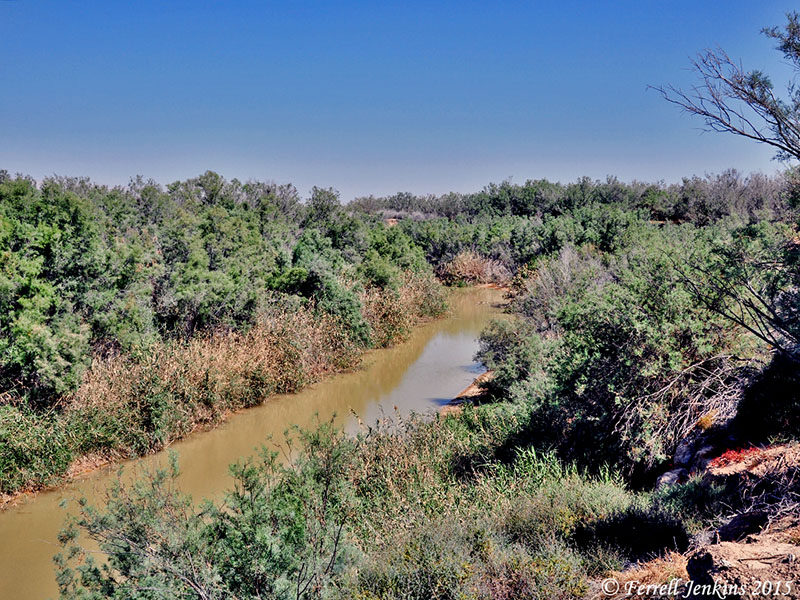
This photo of the Jordan River was made from Bethany Beyond the Jordan, in Jordan, May, 2010.

The Jordan River at Bethan Beyond the Jordan. Photo by Ferrell Jenkins.

The Jordan River at Bethany Beyond the Jordan. Photo by Ferrell Jenkins.

At this point the river is about 405 meters (1330 feet) below sea level.

Index of articles about Peter’s Epistles

Pontus and Peter’s Epistles. [Amasus, Amisos, Samsun, Black Sea coast]

Persecution of Christians in Pontus. [Pliny, Sinope, Sinop, Pontus, Bithynia, Pontus]

Black Sea coastal town of Sinop.

Sinop is the northernmost city of Asia Minor (now Turkey).

Some famous Sinopeans. [Diogenes the Cynic, Serapis]

More famous Sinopeans. [Aquila (2nd century), Marcion, Phocas (Phokas), Sinop Gospels]

The Halys (Kizilirmak) River.

The delivery of Peter’s Epistles.

The Samsun Archaeological Museum.

Hidden treasure. [Samsun, Turkey]

Visiting the Black Sea coast of Turkey. [Samsun, Sinop, Pontus, Aquila]

The Bosphorus – “a liquid line”.

Selected Related Posts Pertaining to Peter’s Epistles

Cappadocia was home to early Christians.

Cappadocian sunrise.

The Bosphorus. [Bythinia]

Elaborate hairstyles in New Testament times.

A nostalgic remembrance

In May, 1984 I directed at tour to Israel, Egypt, and Rome. With the group ready to return from Rome to the USA, I went to Athens to meet two of my Florida College colleagues, Melvin Curry and Phil Roberts. The next day we took a flight to Samos, Greece and a ferry to Kusadasi, Turkey. There we picked up a car and visited the sites of the seven churches of Revelation, and other biblical-related places, in western (or Aegean) Turkey.

The photo below was made at Colossae. It was difficult to get to Colossae in those days, but we had come a long way and did not want to be denied. I had read an article by Dr. Harold Mare about a visit to the site and the wish that an excavation could be undertaken. We followed the dirt road to the bank of the Lycus River where this photo was made. Beyond the tell (huyuk, in Turkish) of Colossae is the snow covered Mount Cadmus. The city of Honaz is hidden from view by the mound.

Melvin Curry and Ferrell Jenkins at Colossae. Photo by Phil Roberts.Melvin Curry and Ferrell Jenkins at Colossae in 1984. Photo by Phil Roberts.

After our visit in Turkey we took a variety of boats to Samos, Patmos, Rhodes, and Crete. From there we took a flight back to Athens to complete our tour together.

Melvin served as chair of Biblical Studies at Florida College prior to my stint. We see each other occasionally and enjoy a short visit now and then. Phil succumbed to pancreatic cancer at the young age of 57 in 2005.

After Phil’s passing, Marty Pickup, a younger teacher at Florida College, and I prepared brief tributes to him. I am posting, for the first time, a link to these tributes at BibleWorld.com here. Former students and friends might enjoy reading these after a 10 year lapse. Marty died suddenly at the age of 53 in 2013.

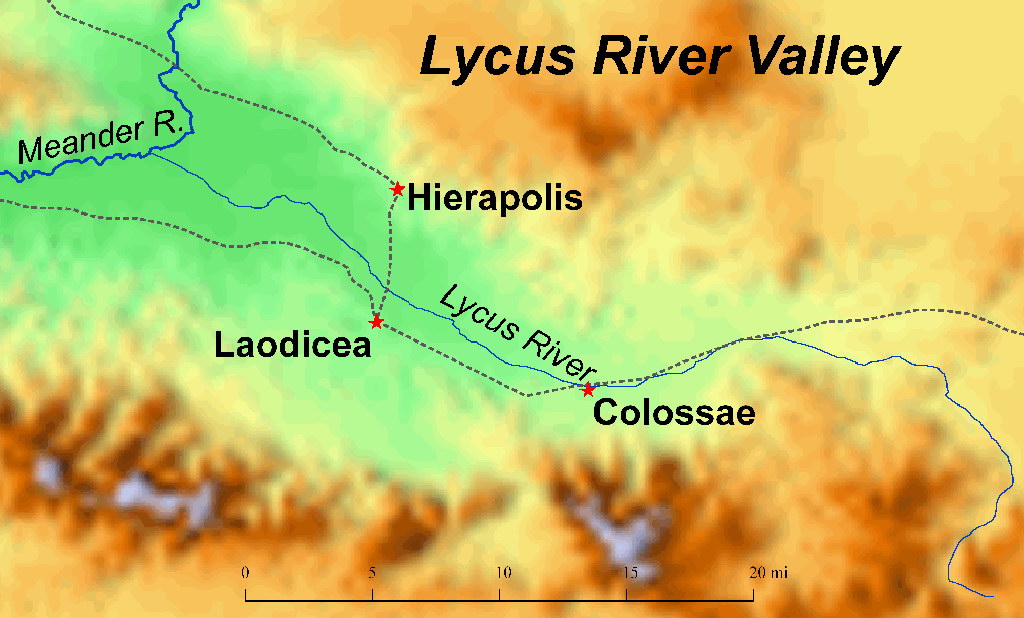
Three cities of the Lycus River valley are significant to New Testament studies. The saints at Colossae were the recipients of one of Paul’s epistles (Colossians 1:1-2). Hierapolis is mentioned in Colossians 4:13. Laodicea is mentioned in Colossians (2:1; 4:13-16), and was the recipient of one of the letters of the Book of Revelation (Revelation 1:11; 3:14).

Cities of the Lycus River Valley.

Cities of the Lycus River Valley. Made with Bible Mapper.

That was a wonderful trip, and one of many such personal study trips I have been blessed to make in the Bible World.

In search of the Tombs of the Maccabees

Much attention has been given to speculation about the location of the graves of the Maccabees. The search is important to Jews because it is an important part of their history, leading to the overthrow of the Seleucid oppressors, and the cleansing of the temple. It is also important to the rest of us who study the Bible and understand the part the Maccabees played in the history of Israel.

At Modin, a village north-west of Jerusalem, on the way from Jerusalem to Lod, the Syrians tried to force an old priest by the name of Mattathias to offer a pagan sacrifice. The priest refused, but another Jew volunteered to offer the sacrifice. Mattathias killed his fellow Jew and the Syrian officer. As word spread, Mattathias became a national hero. He was of the family of Hasmon (or Asmoneus). Thus began the Hasmoneans.

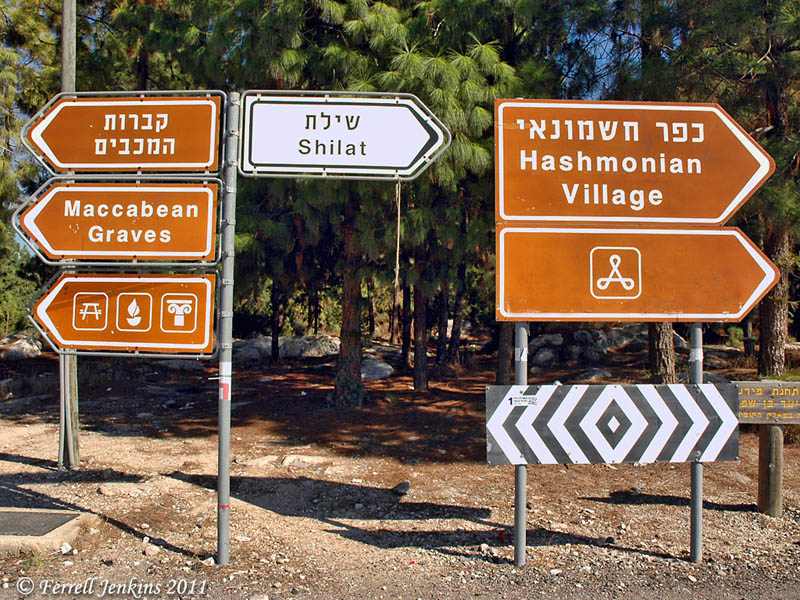
Sign marking location of the possible Maccabean Graves at Modin. Photo by Ferrell Jenkins.

Location of the possible Maccabean Graves at Modin, 2005. Photo by Ferrell Jenkins.

The discovery of a burial cave at Modin thought to have been used by the Maccabees and/or their descendants was reported in November, 1995. There are Israeli scholars who have argued that this is not the true grave of the Maccabees. They say that it is the location of graves belonging to Christians and others during the Byzantine Period. An article in Haaretz back in 2011 quotes one of the Israeli archaeologists.

Amit Re’em, an archaeologist of the Israel Antiquities Authority says all the evidence points to the fact that these graves are of Christians and pagans and that this burial site actually belongs to an ancient monastery.

A news release issued Tuesday by the Israel Antiquities Authority, quoting the same scholar, states that these tombs may be the Tomb of the Maccabees, or at least tombs thought to be such by the Byzantine Christians.

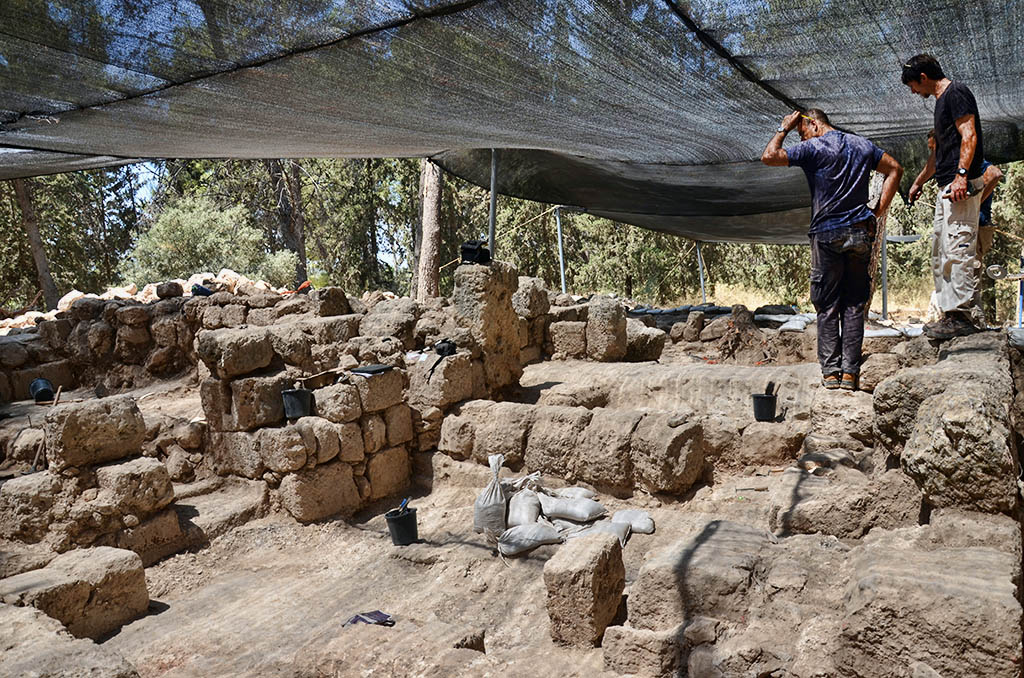
According to Amit Re’em and Dan Shahar, excavation directors on behalf of the Israel Antiquities Authority, “There is no doubt that the structure that was uncovered is unusual. The descriptions from 150 years ago were revealed right here in front of our eyes, and we discovered the magnificent burial vaults, enormous pillars that apparently supported a second story, a forecourt that led to the tomb and other associated buildings. To our disappointment, the building seen by our predecessors had been robbed, and its stones were taken to construct settlements in the vicinity; nevertheless, the appearance of the place is impressive and stimulates the imagination. The archaeological evidence currently at hand is still insufficient to establish that this is the burial place of the Maccabees. If what we uncovered is not the Tomb of the Maccabees itself, then there is a high probability that this is the site that early Christianity identified as the royal funerary enclosure, and therefore, perhaps, erected the structure. Evidently one cannot rule out the assumptions of the past, but an excavation and a lot of hard work are still required in order to confirm that assumption unequivocally, and the riddle remains unsolved–the search for the elusive Tomb of the Maccabees continues”.

Archaeologists ponder whether these tombs actually belong to the Maccabeans. Photo by Israel Antiquities Authority.

Archaeologists ponder whether these tombs actually belong to the Maccabeans. Photo by Israel Antiquities Authority.

Of Interest to Christians. The Gospel of John records more visits to Jerusalem by Jesus than any other of the Gospels. John is the only one to record the visit during the Feast of Dedication.

At that time the Feast of Dedication took place at Jerusalem. It was winter,  and Jesus was walking in the temple, in the colonnade of Solomon. (John 10:22-23 ESV)

BDAG translates the Greek term egkainia as “festival of rededication.” The feast is also known as Hanukkah and the Feast of Lights.

What is the Feast of Dedication? This feast, observed on the 25th of Kislev (roughly our December), had its origin in the period between the testaments. The desecration of the temple by the Seleucid ruler Antiochus Epiphanes took place in 168 B.C. The climax of the Maccabean revolt was the removal of all evidences of pagan worship from the temple. An eight day feast of dedication was observed in 165 B.C., and continued to be observed annually by the Jews.

The current IAA news release may be read here.

Ram’s horn announces Rosh Hashanah

Jews will celebrate Rosh Hashanah, the Jewish new year, for two days beginning at sunset September 13. Leading up to the celebration the ram’s horn is blown.

The ram’s horn was important in the history of Israel. One of the words often used for the horn is shofar (or shophar).

  • A long blast on the ram’s horn was used to alert the Israelites when they could approach Mount Sinai (Exodus 19:13).
  • The ram’s horn was sounded at the beginning of important feast days (Leviticus 25:9). On the first day of the seventh month of the Jewish calendar trumpets were to be blown (Numbers 29:1). This festival was known as the Feast of Trumpets.
  • After Israel marched around Jericho they would hear a long blast on the ram’s horn (Joshua 6:5). The word horn in this verse is qeren, but the word shofar is translated trumpet.

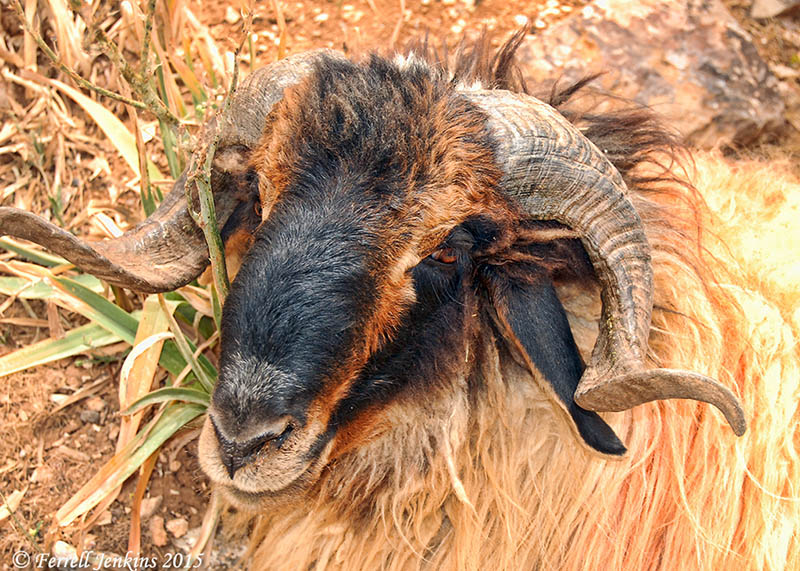
I have observed that shepherds are proud of the ram of the flock. This photo was made in April, 2008, in northern Jordan not very far from Ramoth in Gilead and the border with Syria.

Ram with large horns. Photo taken in northern Jordan near ancient Ramoth Gilead, near the Syrian border in 2008. Photo by Ferrell Jenkins.

Ram with large horns. Photo taken in northern Jordan near ancient Ramoth Gilead, near the Syrian border in 2008. Photo by Ferrell Jenkins.

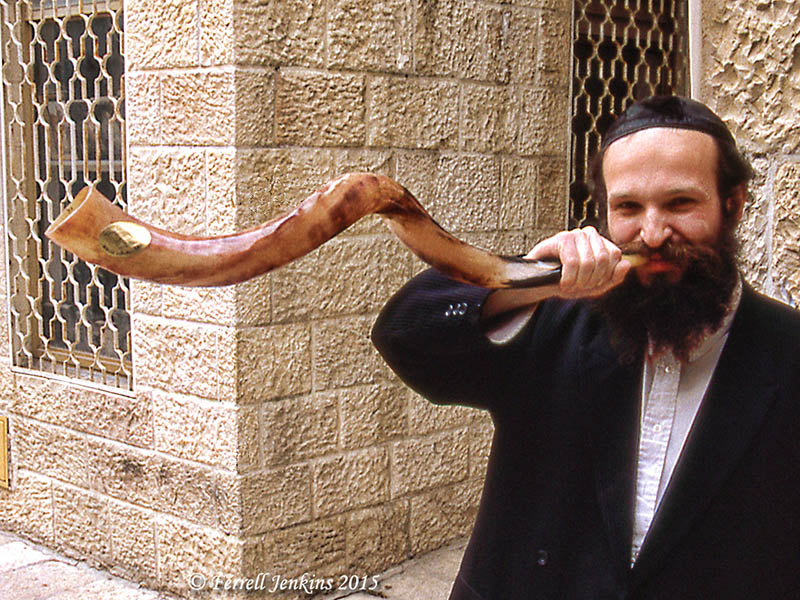
Sometimes in the Jewish Quarter of Jerusalem one of the shopkeepers will demonstrate the sounding of the shofar in hopes of attracting customers. That beautiful horn was a little above my budget. I do not know the animal from which it came. It may be a Yemenite shofar made from the horn of an African kudu. If a reader knows for sure, your comment would be appreciated.

Shofar being sounded in the Jewish Quarter, Jerusalem, in 1993. Photo by Ferrell Jenkins.

Shofar being sounded by a shop owner or clerk in the Jewish Quarter, Jerusalem, in 1993. Photo by Ferrell Jenkins.

Silver trumpets were also to be blown on certain occasions (Numbers 10:1).

For Christians, the sound of a trumpet will signal the coming of the Lord and the resurrection.

For the Lord himself will descend from heaven with a cry of command, with the voice of an archangel, and with the sound of the trumpet of God. And the dead in Christ will rise first.  Then we who are alive, who are left, will be caught up together with them in the clouds to meet the Lord in the air, and so we will always be with the Lord.  Therefore encourage one another with these words. (1 Thessalonians 4:16-18 ESV)

Behold! I tell you a mystery. We shall not all sleep, but we shall all be changed,
52 in a moment, in the twinkling of an eye, at the last trumpet. For the trumpet will sound, and the dead will be raised imperishable, and we shall be changed.
(1 Corinthians 15:51-52 ESV)

Philistines introduced new plants to the coastal plain

One of my neighbors came to the USA from an Asian country spelled with five letters beginning with “I”. After he moved in, some strange plants that I had not seen in our part of the world began to grow. Perhaps he got then at  Exotic Plants R Us, but I doubt it.

Maybe you have had the same experience. Apparently the same thing happened to ancient Israel. Typical plants known to the Biblical Israelites include wheat, barley, grapes, olives, pomegranate, date, and fig.
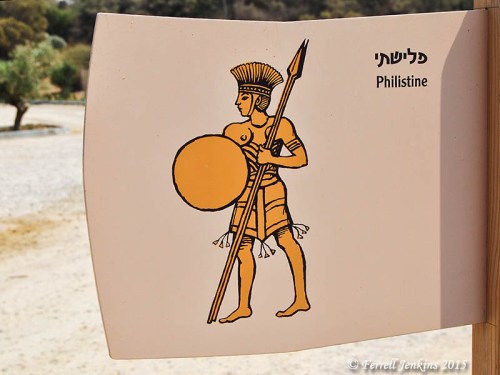
Sign in the Ashkelon National Park indicating one of the groups that inhabited the city. Photo by Ferrell Jenkins.

Sign in the Ashkelon National Park indicating one of the groups that inhabited the city. Photo by Ferrell Jenkins.

What happened when the Philistines moved in? A recent article by Frumin, Maeir, Horwitz, and Weiss in Scientific Reports provides an answer. The authors describe their approach.

Here we propose a novel research approach aiming to study the different anthropogenic impacts on an ecosystem resulting from the advent of an extinct historical culture, the Philistines–one of the so-called “Sea Peoples”–that appeared in the southern Levantine littoral, after ca. 1,200 BCE. Until quite recently, the accepted view was that the Philistines originated from a single region, most likely somewhere in the Aegean. Recent research has revised this view and shown that in fact, the Philistine culture is comprised of migrants of multiple foreign origins, including the Aegean, who, when arriving in Canaan, intermingled with local Canaanites. The non-Levantine origin of a substantial portion of the Philistine culture is evidenced by their distinctive architecture, ceramic ware, technologies and ritual activities that point to their diverse and multifaceted origins with different components resembling Aegean, Cypriot, Anatolian, Egyptian and even Southeast European cultures.

The article is chocked-full of maps and diagrams which I will leave for you to explore at your leisure. What really caught my attention was the introduction of new species of plants by the Philistines. The three plants were,

  1. Cumin (Cuminum cyminum), found at Aphek in the early Iron Age.
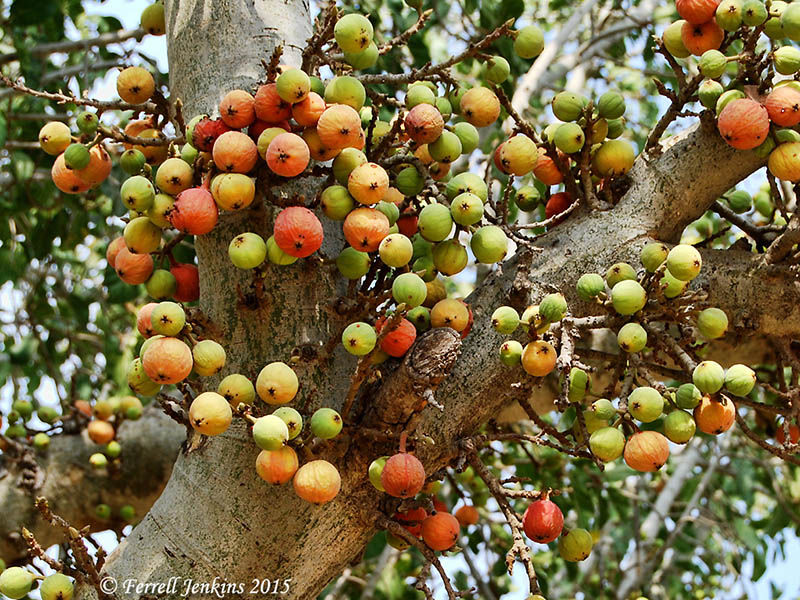
  2. Sycamore (Ficus sycomorus) found at Ashkelon in the late Iron Age.
  3. Opium poppy (Papaver somniferum) found at Ashkelon in the late Iron Age.

Cumin and sycamore came from the Eastern Mediterranean, but opium came from west Europe.

Let’s take a look at a few Biblical references to cumin and sycamore.

Cumin is mentioned by the prophet Isaiah in the 8th century B.C. (28:25, 27), and then by Jesus in the first century A.D.

“Woe to you, scribes and Pharisees, hypocrites! For you tithe mint and dill and cumin, and have neglected the weightier matters of the law: justice and mercy and faithfulness. These you ought to have done, without neglecting the others. (Matthew 23:23 ESV)
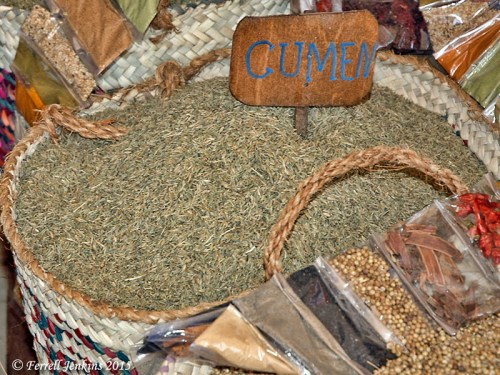
Cummin for sale at Aswan, Egypt. Photo by Ferrell Jenkins.

Cummin for sale at Aswan, Egypt. Photo by Ferrell Jenkins.

The sycamore is mentioned in connection with Solomon who wanted to make cedars as plentiful in Jerusalem as the sycamores were in the Shephelah.

And the king made silver as common in Jerusalem as stone, and he made cedar as plentiful as the sycamore of the Shephelah. (1 Kings 10:27 ESV)

Amos of Tekoah claimed to be one who took care of the sycamore fig trees.

Then Amos answered and said to Amaziah, “I was no prophet, nor a prophet’s son, but I was a herdsman and a dresser of sycamore figs. (Amos 7:14 ESV)

And there is the well known story of Zacchaeus who climbed up into a sycamore tree at Jericho in order to see Jesus as He passed by.

So he ran on ahead and climbed up into a sycamore tree to see him, for he was about to pass that way. (Luke 19:4 ESV)
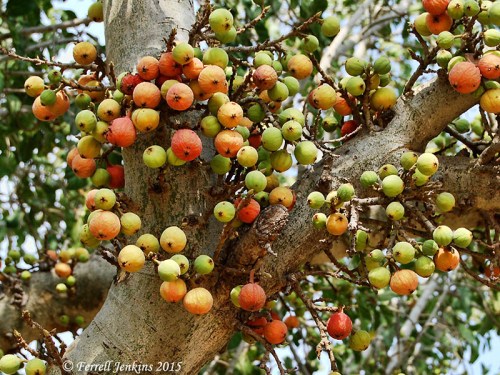
Sycamore figs at Ashkelon. Photo by Ferrell Jenkins.

Sycamore figs at Ashkelon. Photo by Ferrell Jenkins.

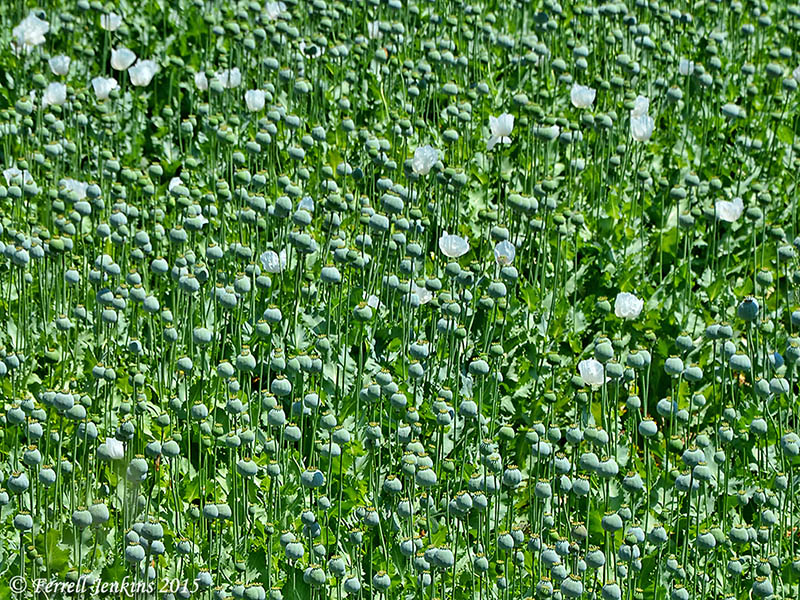
The opium poppy is not mentioned in the Bible and is not currently grown in Israel. Turkey is one of three countries where it is grown for medicinal purposes . I have seen small fields of it in several places in Turkey.
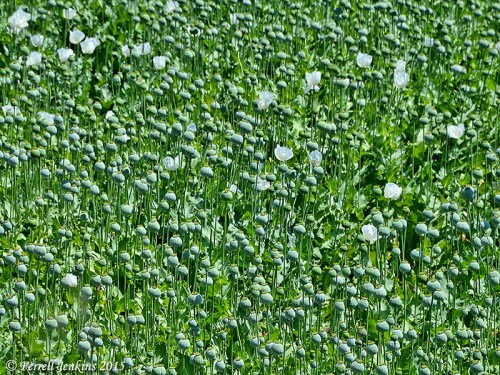
Opium poppies are grown for medicinal purposes in Turkey. Photo by Ferrell Jenkins.

Opium poppies are grown for medicinal purposes in Turkey. Photo by Ferrell Jenkins.

The link to the full article by Frumin, Maeir, et al. is here. Near the top there is a link to the PDF file. An informative article by Nir Hasson appeared in Haaretz here earlier this week.

Archaeology does not consist solely of stone walls and broken pottery. It also includes uncovering and identifying the tiniest of seed.

HT: Thanks to Aren Maeir, director of the excavation at Gath for the original article. Check out his blog.

Possible speaker’s podium found in City of David

The first headline I clicked on this morning when Haaretz arrived was the one reading “Second Temple-era Soapbox Found in City of David?” I located the IAA press release, and then a few hours later my inbox was loaded with links to various coverage of the find.

Several years ago the archaeologists working in the City of David uncovered a staircase and a drainage channel leading from the Temple Mount to the Pool of Siloam.

My group was one of the first to walk through the drainage channel in May, 2010. See my report and photos here.

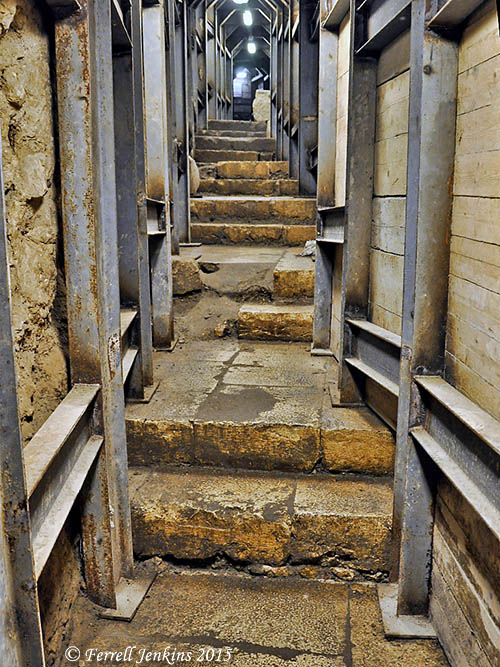
Here is a photo of the steps leading from the Pool to the Temple Mount.

Steps leading from the Pool of Siloam to the Temple Mount. Photo by Ferrell Jenkins.

Steps leading from the Pool of Siloam to the Temple Mount. Photo by Ferrell Jenkins.

The discovery we report today was somewhere along those steps. The press release issued today by the Israel Antiquities Authority says,

This structure, situated alongside the 2,000 year old Second Temple stepped street, which carried pilgrims on their way from the Shiloah (Siloam) Pool to the Temple, which stood atop the Temple Mount. The street, a section of which was excavated in the past, is remarkably well-preserved and is built of enormous stone slabs. The street most likely runs above the 2,000 year old drainage channel, discovered a number of years ago, which carried rain water out of the city. It was constructed sometime in the fourth decade of the first century CE, and was one of the largest construction projects undertaken in Jerusalem during the Second Temple period. Dozens of whole pottery vessels, stone vessels and glassware were found at the foot of the pyramid-shaped staircase.

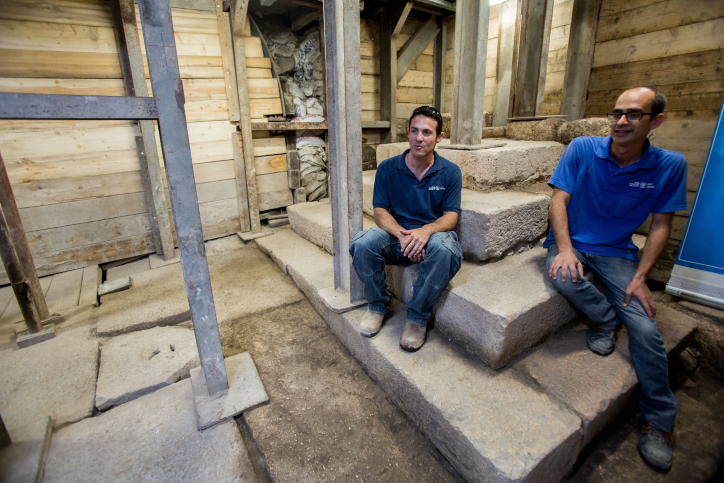
Szanton and Uziel sit on the recently uncovered podium. Photo: IAA

Szanton and Uziel sit on the recently uncovered podium. Photo: IAA

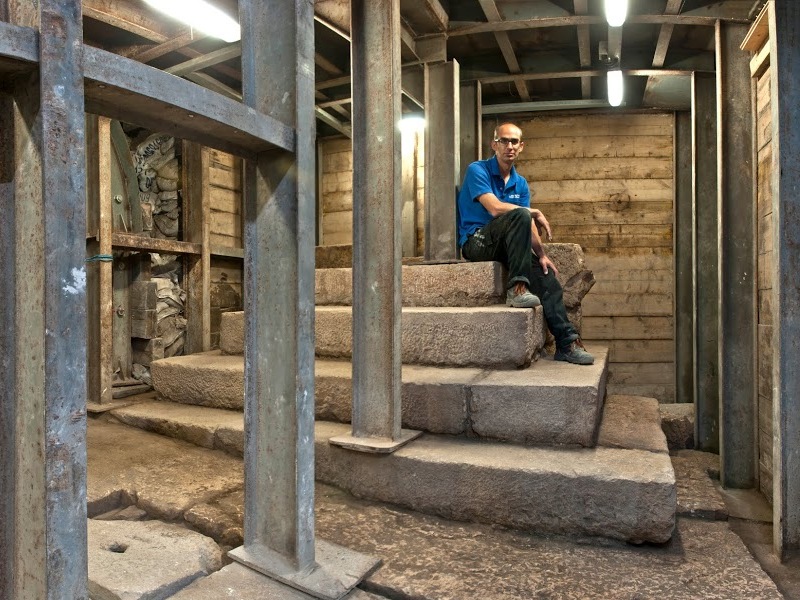
According to archaeologists Nahshon Szanton and Dr. Joe Uziel, who direct[ed] the excavation on behalf of the Israel Antiquities Authority, “The structure exposed is unique. To date such a structure has yet to be found along the street in the numerous excavations that have taken place in Jerusalem and to the best of our knowledge outside of it. For this reason, its exact use remains enigmatic. The structure is built along the street in a place that is clearly visible from afar by passers-by making their way to the Temple. We believe the structure was a kind of monumental podium that attracted the public’s attention when walking on the city’s main street. It would be very interesting to know what was said there 2,000 years ago. Were messages announced here on behalf of the government? Perhaps news or gossip, or admonitions and street preaching – unfortunately we do not know. Bliss and Dickie, two British archaeologists who discovered a small portion of this structure about 100 years ago, mistakenly thought these were steps that led into a house that was destroyed. They would certainly be excited if they could come back today and see it completely revealed.”

Rabbinic sources speak of an “auction block” where slaves could be sold, and of a “Stone of Claims” where one who had found an item might announce it and the owner might claim it. The IAA Press release provides the references here.

Dr. Joe Uziel seated on the top step of the "podium." Photo: IAA.

Dr. Joe Uziel seated on the top step of the “podium.” Photo: IAA.

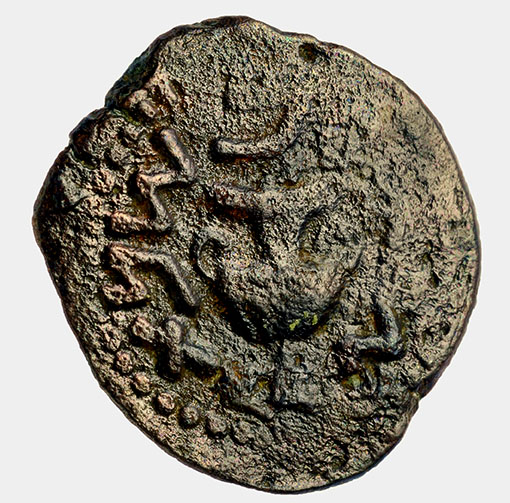
The coin below, from the Second Temple period, was found in the destruction layer atop the street.

Coin from period of the Great Revolt against the Romans. Copyright Clara Amit, IAA.

Coin from period of the Great Revolt against the Romans. Copyright Clara Amit, IAA.

We had already made a possible association of these steps with the blind man who left the Temple precinct to go to the Pool of Siloam at the bidding of Jesus (John 9).

A passage that now comes to my mind is from the Sermon on the Mount when Jesus teaches His disciples how to (and not to) pray.

And when you pray, you must not be like the hypocrites. For they love to stand and pray in the synagogues and at the street corners, that they may be seen by others. Truly, I say to you, they have received their reward. (Matthew 6:5 ESV)

HT: Joseph I Lauer for the additional links.

New “water law” inscription from Laodicea

Hurriyet Daily News reports here the discovery at Laodicea of a marble slab containing a code of laws pertaining to the water supply of the city during the reign of the Roman Emperor Trajan in 114 A.D. The article says,

The rules were prepared by Anatolian State Governor Aulus Vicirius Matrialis.

This marble slab discovered at Laodicea contains a code of laws protecting the water supply of the city of Laodicea in the early second century A.D. (Photo credit: AA photo)

This marble slab discovered at Laodicea contains a code of laws protecting the water supply of the city of Laodicea in the early second century A.D. (Photo credit: AA photo)

Here is some further information about the discovery.

The excavation works, led by Pamukkale University and supported by Denizli Municipality, have continued on Stadium Street in the ancient site. Excavations head Professor Celal Şimşek of Pamukkale University, said, “The Laodicea Assembly made this law in 114 A.D. and presented it to a pro council in Ephesus for approval.

The pro council approved the law on behalf of the empire. Water was vital for the city. This is why there were heavy penalties against those who polluted the water, damaged the water channels or reopening the sealed water pipes. Breaking the law was subject to a penalty of about 12,500 denarius – 125,000 Turkish Liras.”

One hundred twenty-five thousand Turkish Liras amount to approximately $42,700. Fairly stiff fine.

The full article is accompanied by several nice photos and will be well worth your time. Another article about the discovery appears in Ancient Origins here.

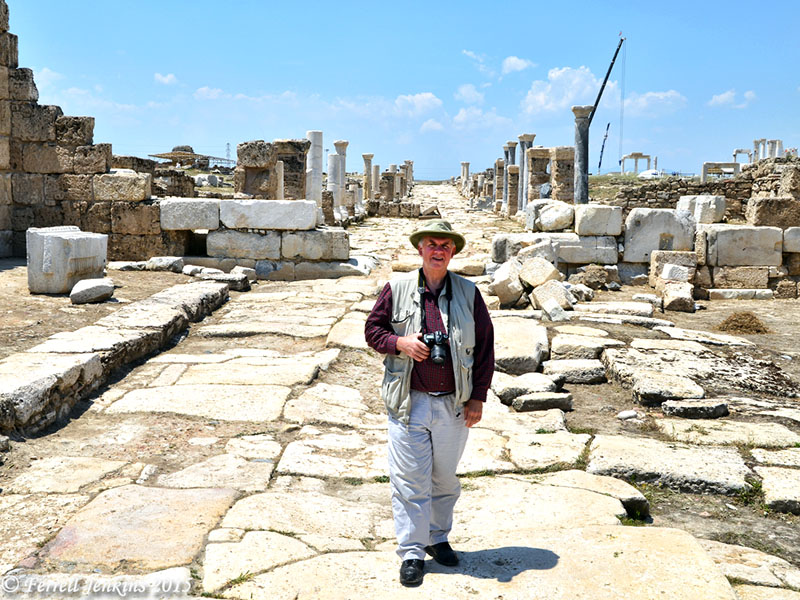
Last year my fellow-traveler Leon Mauldin and I made a personal study tour in Turkey. We had the opportunity to make a return visit to Laodicea and see the continuing excavations at the site. I think the city is destined to become one of the most popular sites in the country.

Leon Mauldin on Syria Street in Laodicea. Photo by Ferrell Jenkins.

Leon Mauldin on Syria Street in Laodicea. Photo by Ferrell Jenkins.

Laodicea is known to us from the book of Revelation (1:11; 3:14-22), and from Paul’s epistle to the Colossians.

For I testify for him that he has a deep concern for you and for those who are in Laodicea and Hierapolis. Luke, the beloved physician, sends you his greetings, and also Demas. Greet the brethren who are in Laodicea and also Nympha and the church that is in her house. When this letter is read among you, have it also read in the church of the Laodiceans; and you, for your part read my letter that is coming from Laodicea. (Col 4:13-16 NAU)

One might easily connect this discovery to what we already knew about the water system at Laodicea. I was rather sure that I had written about the source of water and the water distribution tower, but I find only the photo of the tower here. I have written about the subject in material distributed to my tour members. Perhaps I will be able to reprint some of that material in another post. Meanwhile, I call attention to the recent good post by Carl Rasmussen about this same discovery. He includes comments about the “lukewarm” water at the Holy Land Photos’ Blog here.

HT: Joseph I. Lauer