Category Archives: Jordan

Great deal for Logos (or Libronix) users

Logos has a feature called Community Pricing. It works like this. A book (or set) is chosen for publication. Interested persons are asked to place a bid on the completed digital publication. When there are enough bids to pay for publication the book is published. After the initial publication, the price goes up. I have purchased many Logos publication using Community Pricing and Pre-Publication Specials.

To use the Community Pricing or Pre-Pub specials you must already have Logos (or Libronix) on your computer. You may purchase a base package from Logos, or buy a relatively inexpensive set of books from someone like Rejoice Christian Software. I suggestion you buy something like the  Baker New Testament Commentary ($50 here), the Norman Geisler Apologetics CD-Rom Library ($25 here), or one of the other great specials they offer.

Back to the Community Pricing. The Travels through Bible Lands Collection (15 vols.) is now available for $15 (and it might go lower if more people purchase before noon Friday). I bid $20 several months ago. Just saved $5.
Travel through Bible Lands collection. Only in digital format.

Travel through Bible Lands collection. Only in digital format.

Here is some info about the set of nearly 7,000 pages. Just the four volumes by Tristram and Layard are worth far more than the asking price. The works are all old, but sometimes old is good.

The Dead Sea. Bethlehem. The Sea of Galilee. Jericho. Babylon. Cairo. These are but a few of the places visited by these courageous writers in the Travels through the Bible Lands Collection (15 Vols.). During the turn of the nineteenth century, traveling to and across the Holy Land was a dangerous and arduous journey for a Westerner. These diverse explorers—missionaries, writers, cartographers, theologians, ethnographers, diplomats, archeologists—risk the danger to trek the deserts between Egypt and Turkey, survey the caves of the Dead Sea, dig in the dirt of Babylon, fight disease in Beirut, spread the gospel in Turkey, and stand in awe of the pyramids of Egypt.

These fifteen volumes embody some of the best travel writing of the nineteenth century. After two failed expeditions, Henry Baker Tristram finally gets his chance to explore the east shore of the Dead Sea with the help of a prominent sheik and his armed men. Charles Warner chronicles his winter-long voyage through Egypt, culminating in an unforgettable Christmas spent on the Nile River. Austen Henry Layard and his team survive a perilous journey to The Holy Land, and make historical discoveries at the ruins of Nineveh and Babylon for their efforts. Ella Sykes, exploring the alleyways of Tehran and the beauty of the Indian desert, becomes one of the first European women to travel across Persia. William Wittman, a British surgeon, battles unfamiliar diseases as he treats patients from Turkey to Egypt on his long expedition with the British Army.

Each volume in this collection is rich with Scriptural landmarks, highlighting some of the most significant places from the Bible. Full of adventure and inspiration, Travels through Bible Lands Collection (15 Vols.) is a fascinating window into history that is perfect for any Logos collection.

Logos is also giving away a free book each month. The free one for February is The Works of B. B. Warfield, Vol. 1: Revelation and Inspiration.

To check out either offer, just go to Logos.com, and then click on the appropriate tab.
Was Jesus born in winter?

One of my readers left a comment on facebook saying the Bible indicates that Jesus was “born in winter.” She added, “That could be anytime between mid-October and mid-March.” Another reader said, ” I didn’t know the Bible said he was born in winter — I know shepherds were grazing their sheep when he was born…does this happen in winter in that part of the world?”

I am not aware of any suggestion in the Bible regarding the time of the year when Jesus was born. Luke tells us that shepherds were out in the field at the time.

And in the same region there were shepherds out in the field, keeping watch over their flock by night. (Luke 2:8 ESV)

Some writers have suggested that the birth was not likely in December. They say that shepherds did not watch flocks by night during December. In my outline study about Christmas, available here, I have a quotation by the late Dr. William Arndt, (of Bauer, Danker, Arndt, Gingrich fame) replying to this suggestion:

“Scholars have pointed out that the considerably lower altitude of the field may not be without significance, but may explain why even in winter shepherds would not find these fields too cold for their flocks.”  (From the Nile to the Waters of Damascus, p. 52)

In fact, when I first began traveling to Israel and Jordan in the mid-60s it was common for Bedouin shepherds to move with the seasons. In the summer we would see them in the mountains of Lebanon. In winter months they would move to warmer, desert areas. Today, we find many Bedouin shepherds watching their sheep on the eastern slopes year round, including the winter months.

The temperature around Jerusalem and Bethlehem is fairly temperate in the winter. Only a small amount of rain falls on the eastern slopes of the central mountain range. Both Jerusalem and Bethlehem are located on this ridge. We have written about the watershed ridge here and here.

The average monthly temperature for Jerusalem ranges from 47° to 56°. Rain can make it chilly.

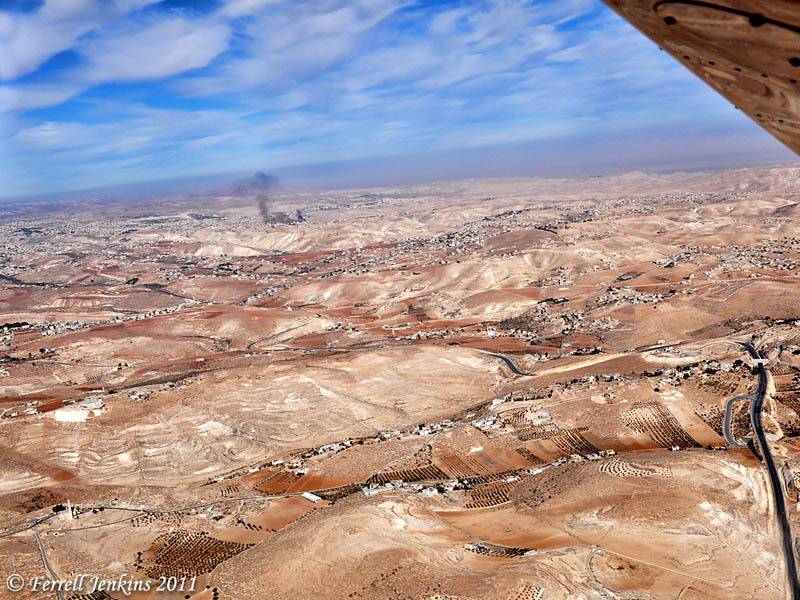
The photo below provides an aerial view from over the Herodium (about 3 miles east of Bethlehem). This illustrates the terrain where shepherds might care for their flocks.

View east toward the Dead Sea and the the land of Moab in Jordan from over the Herodium. Photo by Ferrell Jenkins.

View east toward the Dead Sea and the the land of Moab in Jordan from over the Herodium. Photo by Ferrell Jenkins.

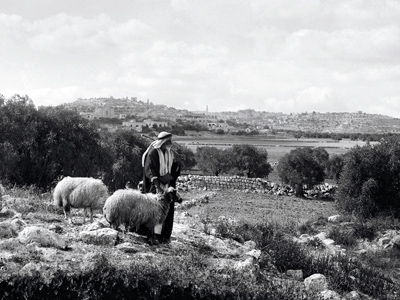
The American Colony and Eric Matson Collection of photos includes some photos of shepherds with their flocks in the Bethlehem area on Christmas day. (Information about the collection is available at LifeintheHolyLand.com.) The photo below was made sometime between 1898 and 1946. It was taken either by the American Colony Photo Department or its successor, the Matson Photo Service.

Shepherds with sheep on Christmas day. Bethlehem on the ridge. Photo: LifeintheHolyLand.com.

Shepherds with sheep on Christmas day. Bethlehem is on the ridge. Photo: LifeintheHolyLand.com.

I am not saying that Jesus was born in December. Only that the common misunderstanding about Bethlehem winters is based on our lack of knowledge about the local terrain.

Frankincense comes from a tree

In the previous post we looked at a few Biblical references that mention both frankincense and myrrh. We called attention to the Incense Route which ran from Arabia through Petra (now in Jordan) and Avdat in the Negev. In New Testament times this route was controlled by the Nabateans.

Frankincense is described in the Fauna and Flora of the Bible:

Frankincense is a balsamic gum exuding from the wood of different species of shrubs and trees belonging to the genus Boswellia. The bark is incised, and the finest quality of resin is obtained if this is done not too early in the year. The different species of Boswellia are native to India, the Somali coast and Arabia; the Midianites imported frankincense from Ephah and Sheba, Is 60:6; Jer. 6:20. Whether the Boswellia was grown in Palestine is rather doubtful. (121-122)

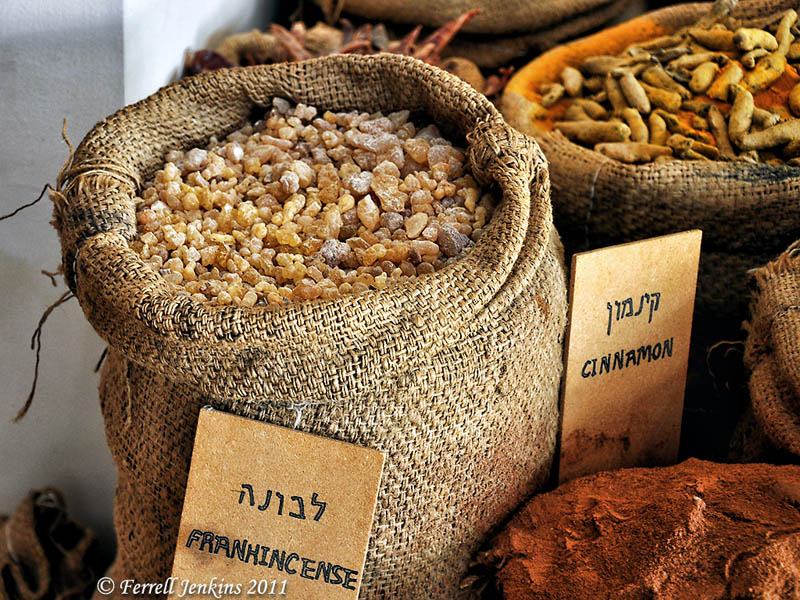
Frankincense is displayed at Avdat, stop number 62 on the famous Incense Route. Click on the photo for a larger image.

Frankincense at Avdat on the Incense Route. Photo by Ferrell Jenkins.

Frankincense at Avdat on the Incense Route. Photo by Ferrell Jenkins.

The Bible indicates several uses for frankincense.

  • Used in the incense associated with the anointing of the priests (Exodus 30:32).
  • Placed on a grain offering (Leviticus 2:1-2).
  • Placed on the bread for the tabernacle (Leviticus 24:7).

Levites were appointed to take care of the frankincense used in the temple (1 Chronicles 9:29). Eliashib the priest hid Tobiah in a large room where frankincense and other sacrificial items were stored (Nehemiah 13:5, 9).

Gold is mentioned with frankincense in Isaiah 60:6 and Matthew 2:11. Both are mentioned among the goods the merchants could no longer sell because of the fall of Babylon (Revelation 118:11-13).

The illustration showing the frankincense tree comes from 1000 Bible Images (Logos digital edition).

Frankincense Tree. 1000 Bible Images.

Frankincense Tree. 1000 Bible Images.

Our current header photo was made at Avdat, and indicates the importance of the city as an important stop on the Incense Route.

Photos that are worth 1000 words each

Photos can be used effectively to illustrate Bible lands and customs. Otherwise dull presentations can come to life with the use and explanation of appropriate photos.

Pictorial Library of Bible Lands. We have suggested frequently that every Bible teacher needs access to Todd Bolen’s Pictorial Library of Bible Lands. Todd publishes a Newsletter every few months in which he gives away a few excellent photos already in PowerPoint format. If you don’t receive the Newsletter I suggest you download the November issue here. It contains several panoramic photos that give you the opportunity to see and understand a lot at once. And while you are there you should sign up to receive the Newsletter when it is published. Also take a look at the BiblePlaces Blog and the BiblePlaces.com web site. See also LifeintheHolyLand.com. BiblePaces is now availabe in French at BibleLieux.com and Spanish at LugaresBiblicos.com.

Holy Land Photos. Carl G. Rasmussen, author of the revised Zondervan Atlas of the Bible, is now posting the photos used in the Atlas at his Holy Land Photos site. Begin here. You will find thousands of useful photos at this site. These photos will be especially helpful to those seeking to teach Bible geography or to incorporate geographical information into lessons. These photos are in PowerPoint format. You also need the have and study the Atlas. Also check the HolyLandPhotosBlog for more recent photos and updates.

Order the Zondervan Atlas of the Bible from Amazon (currently $26.12).

David Padfield has a large number of photos of Bible lands available for free download here. Thanks to these men who have devoted much time and money to acquiring the photos and preparing them for others to use. I have used the work of all three in my presentations in recent years.

“Known but mostly unknown”

The late Paul W. Lapp is well known among students of archaeology for his 1963 article saying that the archaeology of Palestine (West Bank and Israel) is “known but mostly unknown.” Lapp died in a swimming accident in Cyprus in April, 1970) a few months prior to his 40th birthday.

Lapp’s article in Biblical Archaeologist (Vol. 26) begins this way:

Palestine (West Bank Jordan and Israel today) is perhaps the most excavated land in the world. Certainly the archaeological history of no country is better known. Since the beginning of archaeological work in Palestine at Tell el-Ḥesī in 1890 there have been few periods when there were not several expeditions in the field.

He continues by asking,

How Much Do We Know?

With some knowledge of the scope of archaeological activity in Palestine visitors in Jerusalem frequently ask: Are there still new sites to dig? Are there still exciting finds to be made in Palestine? One might go on to ask: Isn’t our knowledge of biblical times fairly complete? Don’t we have a picture of daily life at the time of Jesus which can be modified only in detail by future discoveries? The confidence with which archaeological conclusions are frequently drawn and the long books devoted to daily life in Palestine at the time of Jesus might suggest an affirmative answer.

My viewpoint here is that such a tiny fraction of the archaeological material has been excavated, and such a small fraction of that satisfactorily published, that even the most assured archaeological conclusions must still be considered far from final. This does not mean that all archaeological conclusions must be basically vague and noncommittal. Our knowledge of Palestinian archaeology has been built step by step, from the best hypothesis explaining evidence available at an early stage of exploration to the best hypothesis to explain evidence currently at hand. Without the discipline of continuous updating of hypotheses as new evidence comes to light chaos would prevail. The nonspecialist would find it much more difficult to judge among interpretations than is now the case. All that is stressed here is that in view of the vast amount of unknown material, archaeologists will be forced to modify or reformulate many, if not all, their hypotheses regarding the development of Palestine as the flood of new evidence continues to grow. Palestinian archaeology may be past infancy but has hardly gotten beyond childhood.

I have no current figures about the percentage of known sites that have been excavated. Often in speaking about the archaeology of Israel and the West Bank I say that the surface has hardly been scratched.

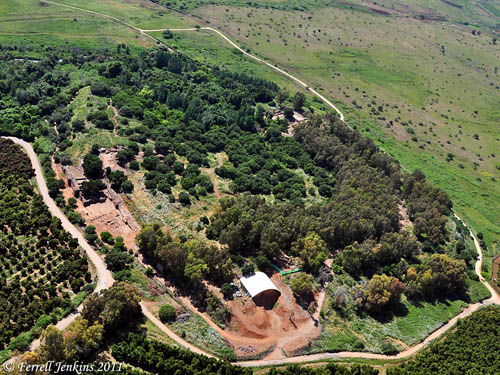
What got me to thinking about Lapp’s article was this aerial photo of Tel Dan that I made in May. Prof. Avraham Biran began the excavations at Tel Dan in 1966 and worked at the site for more than 30 years. Others have continued the work. If you have been to Tel Dan you will recognize the three main areas that have received attention (1) the Middle Bronze city gate, (2) the Iron Age gate complex, and (3) the High Place (bama). Would you agree that there may still be some work to be done at the site?

Aerial view of Tel Dan. Photo by Ferrell Jenkins. 2011.

Aerial view of Tel Dan. Photo by Ferrell Jenkins. 2011.

Is there still much archaeological work to be done? Is it still mostly unknown? Are you kidding? Extend this thought to Jordan, Syria, Lebanon, Turkey, Greece, Turkey, et al.  This is why we must sometimes be satisfied with a limited amount of evidence.

Got to go. Today is Grandson Day prior to school beginning tomorrow.

Roman sword & menorah engraving discovered

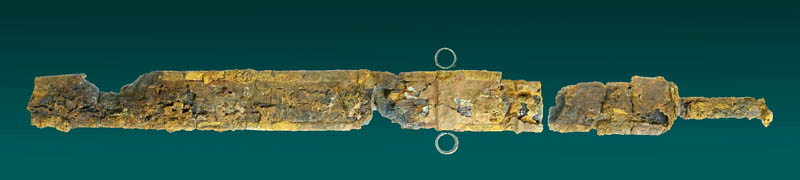
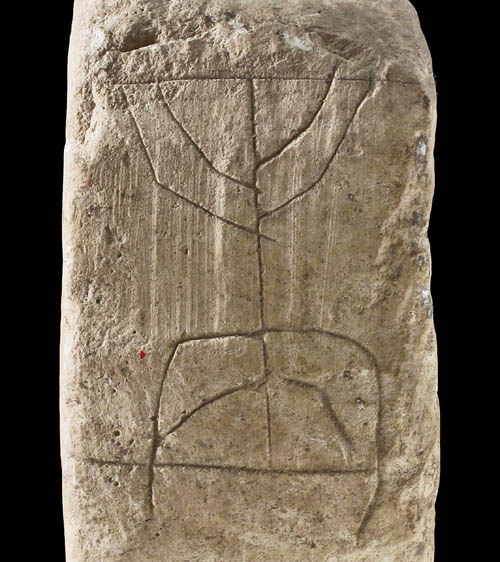
The Israel Antiquities Authority announced Monday the discovery of a Roman sword still in a scabbard and a stone with the engraving of the temple menorah.

Roman sword in scabbard. IAA photo by Clara Amit.

Roman sword in scabbard. IAA photo by Clara Amit.

During the course of work the Israel Antiquities Authority carried out in Jerusalem’s ancient drainage channel, which begins in the Siloam Pool and runs from the City of David to the archaeological garden (near the Western Wall), impressive finds were recently discovered that breathe new life into the story of the destruction of the Second Temple. The excavations are being conducted on behalf of the Israel Antiquities Authority, in cooperation with the Nature and Parks Authority and are underwritten by the City of David Foundation.

A 2,000 year old iron sword, still in its leather scabbard, was discovered in work the Israel Antiquities Authority is doing in the channel, which served as a hiding refuge for the residents of Jerusalem from the Romans at the time of the Second Temple’s destruction. In addition, parts of the belt that carried the sword were found. According to the excavation directors Eli Shukron of the Israel Antiquities Authority and Professor Ronny Reich of the University of Haifa, “It seems that the sword belonged to an infantryman of the Roman garrison stationed in Israel at the outbreak of the Great Revolt against the Romans in 66 CE. The sword’s fine state of preservation is surprising: not only its length (c. 60 cm), but also the preservation of the leather scabbard (a material that generally disintegrates quickly over time) and some of its decoration”.

A stone object adorned with a rare engraving of a menorah was found in the soil beneath the street, on the side of the drainage channel. According to Shukron and Professor Reich, “Interestingly, even though we are dealing with a depiction of the seven-branched candelabrum, only five branches appear here. The portrayal of the menorah’s base is extremely important because it clarifies what the base of the original menorah looked like, which was apparently tripod shaped”. The fact that the stone object was found at the closest proximity to the Temple Mount to date is also important. The researchers suppose a passerby who saw the menorah with his own eyes and was amazed by its beauty incised his impressions on a stone and afterwards tossed his scrawling to the side of the road, without imagining that his creation would be found 2,000 years later.

Menorah found beneath 1st century street. IAA photo by Vladimir Naykhin.

Menorah found beneath 1st century street. IAA photo by Vladimir Naykhin.

An AP report with several enlargeable photos is available here.

I think this blog was the first one to report walking through the sewer more than 15 months ago. See here.

Two words are used for sword in the Greek New Testament. The more common word is machaira which describes a short, tongue-shaped sword or dagger. The term rhomphaia, which describes a long sword, is used only in Luke 2:35 outside the book of Revelation. It is used 6 times in Revelation. Probably all but one of these finds Christ as the bearer of the sword (1:16; 2:12; 2:16; 6:8; 19:15; 19:21). The book of Revelation has a setting in the Roman Empire outside of Palestine. The use of rhomphaia seems to be the appropriate term.

In one of the news reports about the recently found sword, archaeologist Elie Shukron is quoted as saying that the sword was the type used by Roman centurions, but that it was probably taken from the Roman garrison by one of the Jewish rebels (see here). This seems much more plausible to me.

G. K. Beale comments on the sword coming out of the mouth of Jesus:

The Christians in Asia are to understand that Jesus will do battle in this manner not only against the evil nations (19:15) but also against all those among the churches who compromise their faith (2:16). The consensus is that this sword alludes to that of the Roman soldier, used in battle, further enhancing this idea. (The Book of Revelation in NIGTC, 212)

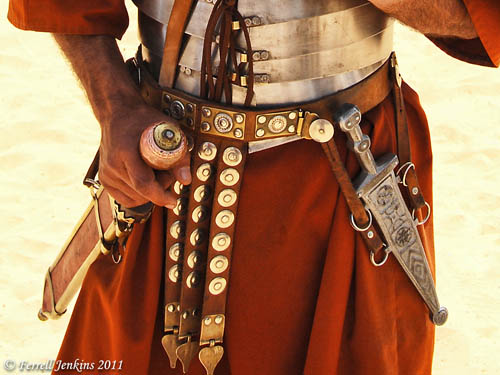
This photo was made at the RACE show (Roman Army and Chariot Experience) in the hippodrome at Jerash, Jordan. It shows the centurion wearing both swords.

Roman Centurion at Jerash with two swords. Photo by Ferrell Jenkins.

Roman Centurion at Jerash with two different swords. Photo by Ferrell Jenkins.

HT: Bible Places Blog; Joseph Lauer.

Peeking into the Great Rift Valley

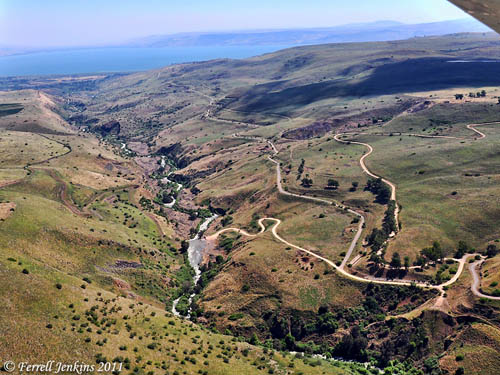
The natural depression that runs from northern Syria, through Lebanon, Israel/Jordan, continuing into the Gulf of Eilat/Aqaba, into eastern Africa, is known as the Great Rift. This rift has an important effect on travel and the life of the people of the area — perhaps more in ancient times than now.

This aerial view was made south of Lake Huleh, looking south toward the Sea of Galilee. You can see the Jordan River descending from north to south. Glueck calls this the Jordan Rift.

Jordan Valley north of the Sea of Galilee. Photo by Ferrell Jenkins.

The Jordan Valley north of the Sea of Galilee. Photo by Ferrell Jenkins.

The elevation at Lake Huleh is 230 feet above sea level. By the time the Jordan River flows into the Sea of Galilee, ten miles south, the elevation of about 700 feet below sea level. This is the area of most rapid descent.

Nelson Glueck describes this portion of the Jordan River.

…it tears out on a run that, for some distance, brooks no restraint. It tumbles and cascades almost continuously through a forbidding, black basalt gorge. Foaming and muddy, it bursts out of the ravine. Then, collecting itself somewhat, it wriggles its way for about another mile through a small plain and a delta of its own making into the clear waters of the Lake of Galilee. (The Jordan River, 35)

Jordan River baptism site reported to be open

Several media outlets have reported the permanent opening of the Qasr el-Yahud Baptismal site. Our group made arrangements to visit the site May 3, but we had to wait for military personnel to open the gate. Some construction work was going on, and the road to the site needed repair. See here. See earlier reports here, and here.

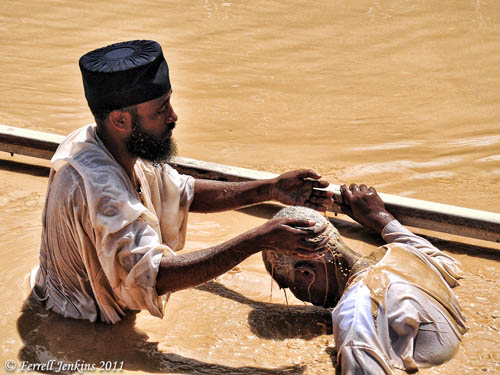
Some reports have warned about the impurity of the water. I advised my group not to touch it. A group of Ethiopians were dipping themselves, dipping others, and pouring water on themselves while we were there. A hand full of water looked like mud as it left the hand.

Ethiopians in the Jordan River at Qasr el-Jahud. Photo by Ferrell Jenkins.

Ethiopians in the Jordan River at Qasr el-Yahud. Photo by Ferrell Jenkins.

Personally I understand baptism to be a one-time act “for the forgiveness of your sins” (Acts 2:28; 8:12; Matthew 28:19; Mark 16:16; Romans 6:3-4; et al.).

Bible students like to visit the Jordan River at this site for several reasons.

  • Ancient Israel crossed the Jordan to enter the promised land (Joshua 3).
  • Elijah and Elisha crossed the river (2 Kings 2).
  • John baptized in the Jordan (Matthew 3:6ff.; Mark 1:5-9; John 1:28; 10:40).
  • Jesus was baptized in the Jordan (Matthew 3:13).
  • Naaman dipped in the Jordan at a site further north (2 Kings 5).

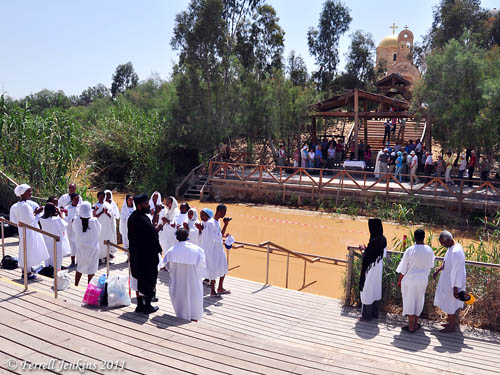
The view was made from the West Bank site looking northeast. A group of western pilgrims are visible on the (Hashemite Kingdom of) Jordan side of the river.

Jordan River Baptismal Site. Photo by Ferrell Jenkins.

Jordan River Baptismal Site. View to the NE. Photo by Ferrell Jenkins.

HT: Bible Places Blog.

Continuing dispute over the Mughrabi Bridge

For many years visitors to the Western Wall in Jerusalem were able to climb the earthen ramp up to the Mughrabi Gate and enter the Temple Mount platform. In biblical times the temple of Solomon was located there, then the rebuilt temple of Zerubbabel after the return from Babylonian captivity, and then Herod’s Temple. Today this is where we find the Mosque of Omar (commonly called the Dome of the Rock) and the Al Aska Mosque.

Israel built wooden bridge from the Western Wall Plaza to the Temple Mount platform and excavated the earthen ramp. This has become a controversial diplomatic issue. Itamar Eichner reports in Ynet here.

A diplomatic crisis is brewing between Israel and Jordan over the planned renovations of the Mughrabi Gate Bridge, Yedioth Ahronoth reported Monday.

Plans for razing the old Mughrabi Gate bridge, which leads from the Western Wall plaza in Jerusalem to the to the al-Aqsa Mosque and Temple Mount, in favor of a new one have been in the works for a while. According to the report, the bridge was to be torn down next week, but upon signing the final agreement, Israel was stunned to learn that Jordan, along with Egypt, Iraq and Bahrain, filed a complaint against Israel with the United Nations Educational, Scientific and Cultural Organization (UNESCO) over the planned renovations. The motion asks for a UNESCO censure of Israel. Jordan is also demanding that UNESCO order Israel to stop the archeological excavations in the Old City.

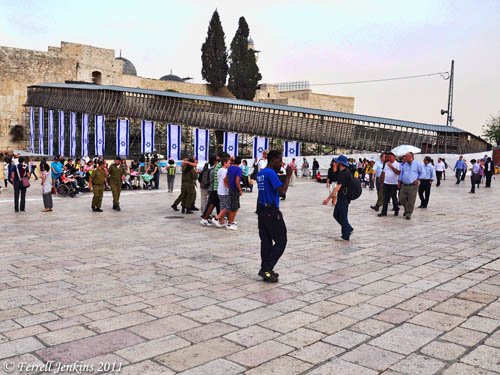
This photo of the bridge was made in early May.

Mughrabi Bridge from the Western Wall Plaza. Photo by Ferrell Jenkins.

Mughrabi Bridge from the Western Wall Plaza. Photo by Ferrell Jenkins.

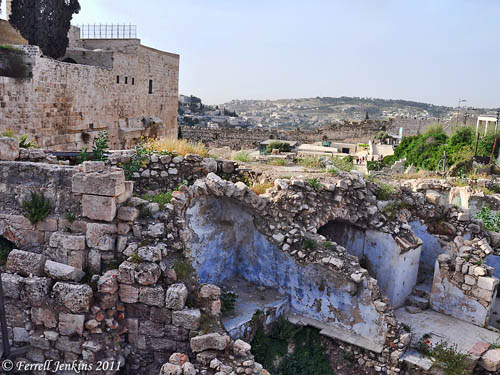
We know that the level below the bridge, both north and south, is from the first century. Here is the view from the bridge looking down on the former earthen ramp.

Excavation below Mughrabi Gate Bridge. View to the south. Photo by Ferrell Jenkins.

Excavation (or clean up?) below Mughrabi Gate Bridge. View to the south. Photo by Ferrell Jenkins.

I have no specific knowledge about the dating of these ruins, but I would venture to say that they are later than the 7th century A.D. Perhaps a reader can help.

Update. After completing this post last evening, I was looking at the Bible Places Blog and noted that Todd Bolen has written about this bridge. He has given links to the background of the controversy and posted some photos. Check here.

Ha’aretz has two more articles for those who are interested in the far-reaching repercussions over what happens in Jerusalem. Check here and here.

HT: Joseph Lauer

The Cardo Maximus in Jerusalem

Reconstructing the Jerusalem of the time of Jesus and the Apostles is not as easy as one might think. We have little bits of evidence here and there in basements. I am thinking of the evidence of the pre-70 A.D. ruins such as the Burnt House and the Herodian Mansion. We also have the Herodian Temple Precinct walls, the Temple Mount steps and the street in the Tyropoeon Valley. (This is not intended as a complete list. Just suggestive.)

Some Roman ruins in Jerusalem date to the period after the Bar Kochba revolt in 135 A.D. One impressive site in the Jewish Quarter of the Old City is the Cardo. The Cardo Maximus was the main north-south street running from one end of the city to the other. An east-west street was called the Decumanus Maximus.

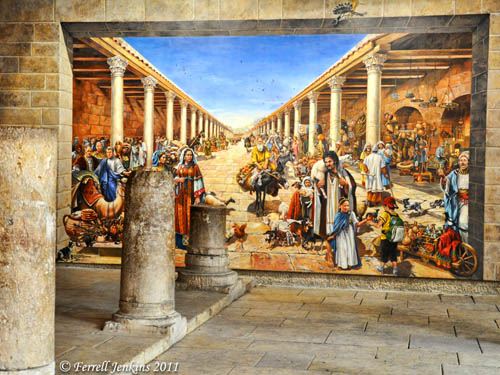
The Emperor Hadrian rebuilt Jerusalem and named it Aelia Capitolina. The photo below shows a portion of the Cardo of that city. We see paving stones and columns that ran along the length of the street. A mural has been placed at one portion of the street to illustrate typical life in the city at that time.

The Roman Cardo in Jerusalem. Photo by Ferrell Jenkins.

The Roman Cardo in Jerusalem. Photo by Ferrell Jenkins.

We are reminded of one of the many references Jesus made to the marketplace (Greek, agora).

And in his teaching he said, “Beware of the scribes, who like to walk around in long robes and like greetings in the marketplaces (Mark 12:38 ESV)

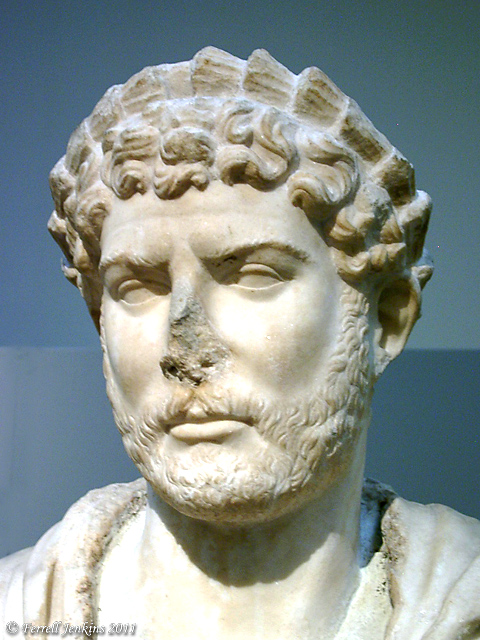
Hadrian was Roman Emperor from 117-138 A.D. Streets, arches, and gates were erected in his honor all over the Roman Empire during his reign. The photo below shows the head of a marble statue in the British Museum showing Hadrian in Greek dress. The statue comes from the Temple of Apollo at Cyrene in northern Africa (modern Libya).

Hadrian in Greek Dress. Temple of Apollo, Cyrene. British Museum. Photo by Ferrell Jenkins.

Hadrian in Greek Dress. Temple of Apollo, Cyrene. British Museum. Photo by Ferrell Jenkins.

A larger image of the Cardo scene suitable for use in teaching is available by clicking on the photo.