Category Archives: Israel

Massive Iron Age fortifications found at Ashdod-Yam

The American Friends of Tel Aviv University announced Monday the discovery of a massive fortification from the Iron Age.

— ♦ —

Researchers from Tel Aviv University have unearthed the remains of massive ancient fortifications built around an Iron-Age Assyrian harbor in present-day Israel.

At the heart of the well-preserved fortifications is a mud-brick wall up to more than 12 feet wide and 15 feet high. The wall is covered in layers of mud and sand that stretch for hundreds of feet on either side. When they were built in the eighth century B.C.E., the fortifications formed a daunting crescent-shaped defense for an inland area covering more than 17 acres.

The finding comes at the end of the first excavation season at the Ashdod-Yam archaeological dig in the contemporary Israeli coastal city of Ashdod, just south of Tel Aviv. Dr. Alexander Fantalkin of TAU’s Department of Archaeology and Ancient Near Eastern Cultures is leading the project on behalf of the Sonia and Marco Nadler Institute of Archaeology.

“The fortifications appear to protect an artificial harbor,” says Fantalkin. “If so, this would be a discovery of international significance, the first known harbor of this kind in our corner of the Levant.”

Building up and putting down. When the fortifications were built, the Assyrians ruled the southeastern part of the Mediterranean basin, including parts of Africa and the Middle East. Assyrian inscriptions reveal that at the end of the century, Yamani, the rebel king of Ashdod, led a rebellion against Sargon II, the king of the Assyrian Empire. The Kingdom of Judah, under King Hezekiah, rejected Yamani’s call to join the insurrection.

The Assyrians responded harshly to the rebellion, eventually destroying Philistine Ashdod. As a result, power shifted to the nearby area of Ashdod-Yam, where the TAU excavations are taking place. The fortifications seem to be related to these events, but it is not yet clear exactly how. They could have been built before or after the Ashdod rebellion was put down, either at the initiative of the locals or at the orders of the Assyrians.

“An amazing amount of time and energy was invested in building the wall and glacis [embankments],” says Fantalkin.

3D castles in the sand. More recent ruins — from the Hellenistic period, between the fourth and second centuries B.C.E. — were also found on top of the sand of the Iron Age fortifications. The buildings and walls were apparently built after the fortifications were abandoned and then probably destroyed by an earthquake in the second half of the second century B.C.E. Among the unusually well-preserved ruins were artifacts, including coins and weights.

The researchers employed a powerful new digital technique, photogrammetry, to create a 3D reconstruction of all the features of the excavation. The University of Nebraska-Lincoln provided the equipment. Dr. Philip Sapirstein, a postdoctoral fellow at TAU, served as a digital surveyor on the project.

The only archaeological work done previously at Ashdod-Yam was a series of exploratory digs led by late Israeli archaeologist Dr. Jacob Kaplan on behalf of the Tel Aviv-Jaffa Museum of Antiquities between 1965 and 1968. Kaplan believed the Ashdod rebels built the fortifications in anticipation of an Assyrian attack, but Fantalkin says the construction appears too impressive to have been done under such circumstances.

— ♦ —
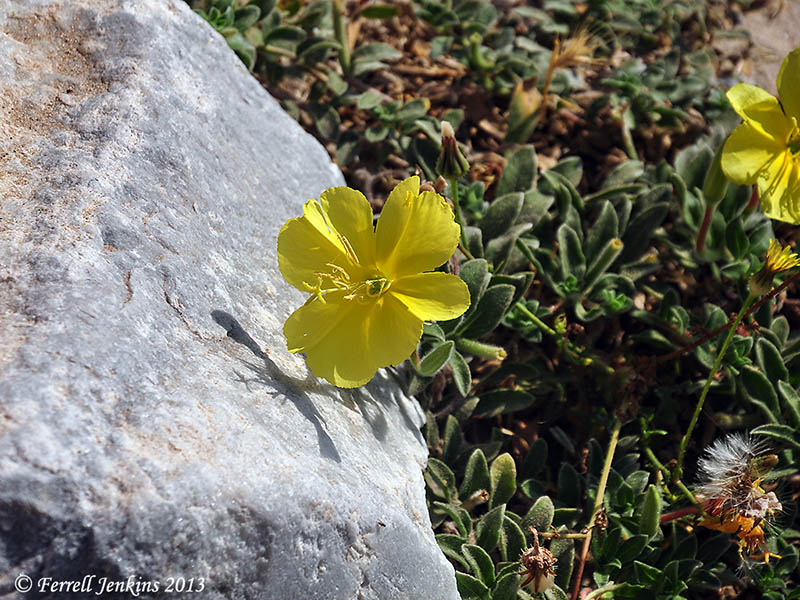
Broken columns lie scattered among the wild flowers on the sand dunes covering Ashdod-Yam. Photo by Ferrell Jenkins.

Broken columns lie scattered among the wild flowers on the sand dunes covering Ashdod-Yam. Photo by Ferrell Jenkins.

The Ashdod-Yam Excavations website is here.

HT: Joseph Lauer
Visiting Ashdod-Yam — New Testament Azotus

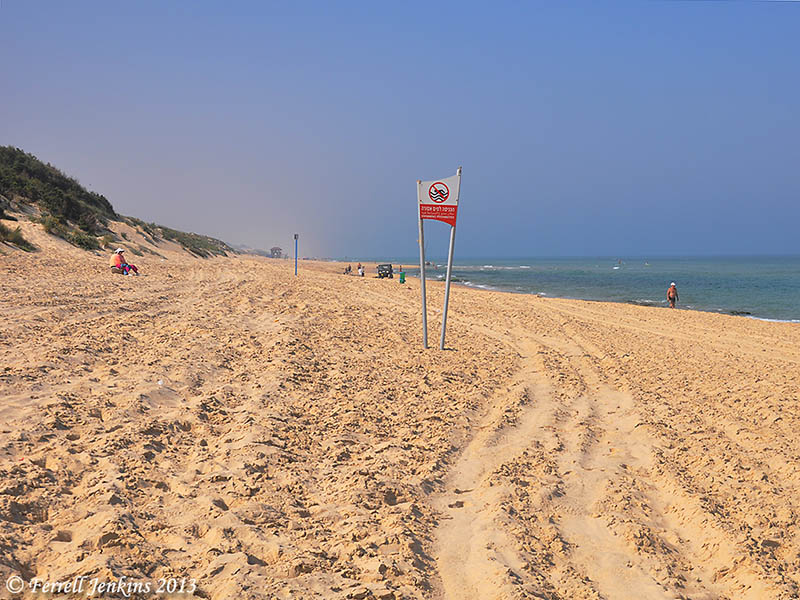
Back in May, my friend Dan and I visited the site of Ashdod-Yam. The site is located a little over 3 miles NW of Tel Ashdod. Tel Ashdod, the city mentioned in the Old Testament, is difficult to visit. My young friends, Trent and Rebekah, mentioned visiting Ashdod a few weeks ago. The site, “now a cow pasture,”  is enclosed by a highway and railroad track on one side and an industrial park on the other. Finding the right hole in the fence is not easy.

You can see a small photo of the excavated area at Tel Ashdod in Journal 118 of Hadashot Arkheologiyot here. Biblical Archaeological Review has a full page photo of the Assyrian palace excavated at Tel Ashdod. (See “Assyrian Palace Discovered in Ashdod.” BAR, Jan/Feb 2007.)

Sargon II took the city of Ashdod in 712/711 B.C., an event mentioned in Isaiah 20:1. By Roman times Ashdod consisted of two cities, the coastal town of Azotus Paralios and the inland town of Azotus Mesogeius. (There is too much history for inclusion here.)

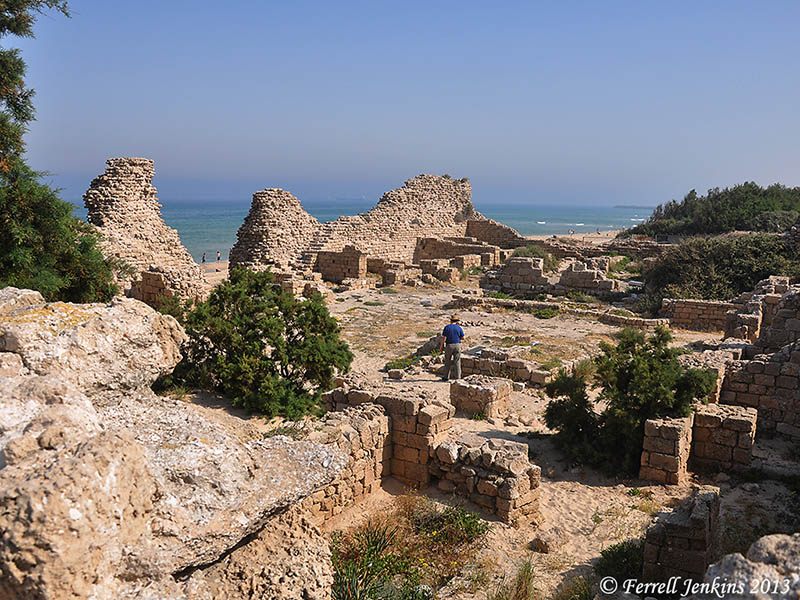
The citadel at Ashdod-Yam with a view north toward the modern city of Ashdod. Photo by Ferrell Jenkins.

The citadel, an early Islamic and Crusader fortress, at Ashdod-Yam with a view north. Photo by Ferrell Jenkins.

Azotus is mentioned only once in the Bible. After the baptism of the man of Ethiopia, the evangelist Philip “found himself at Azotus.”

But Philip found himself at Azotus, and as he passed through he preached the gospel to all the towns until he came to Caesarea. (Acts 8:40 ESV)

Except for the fortress, the large site of Ashdod-Yam resembles sand dunes. A joint excavation conducted by the Institute of Archaeology of Tel Aviv University and the Institut für Alttestamentliche Wissenschaft of the Leipzig University has just completed the current season. The excavation web site may may be accessed here.

Ashdod Yam. A view south toward Ashkelon. The large tel can be seen sloping down on the left of the photo. Photo by Ferrell Jenkins.

Ashdod-Yam. A view south toward Ashkelon. The large tel can be seen sloping down on the left of the photo. Photo by Ferrell Jenkins.

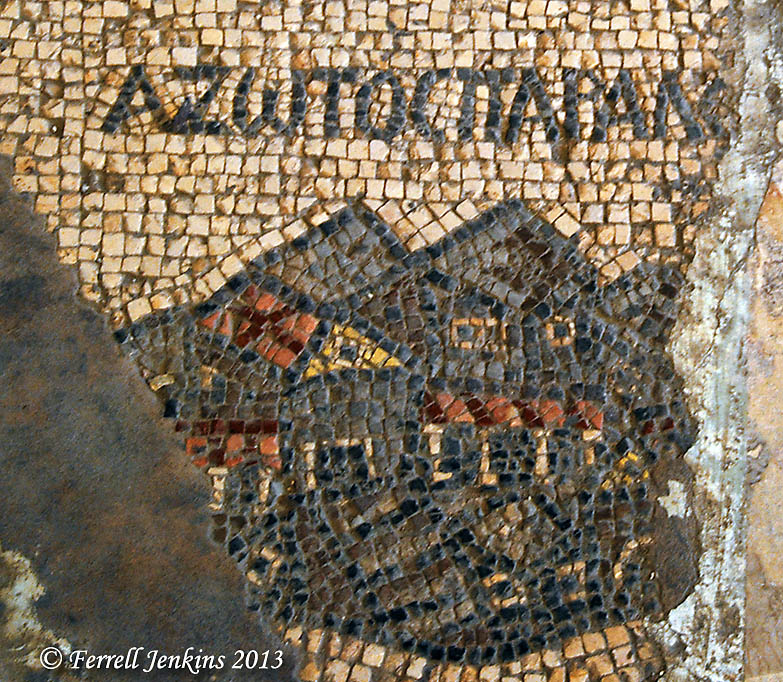
Below is a photo of the name of Azotos Paralios in the 6th century Madaba mosaic map.

Azotus Paralios is portrayed on the 6th century A.D. Madaba mosaic map. Photo by Ferrell Jenkins.

Azotos Paralios is portrayed on the Madaba mosaic map. Photo by Ferrell Jenkins.

City of David inscription may name a Bible character

The Israel Antiquities Authority announced Sunday the discovery of “a layer of rich finds including thousands of broken pottery shards, clay lamps and figurines … in the area of the Gihon Spring in the City of David, in the Walls around Jerusalem National Park.”

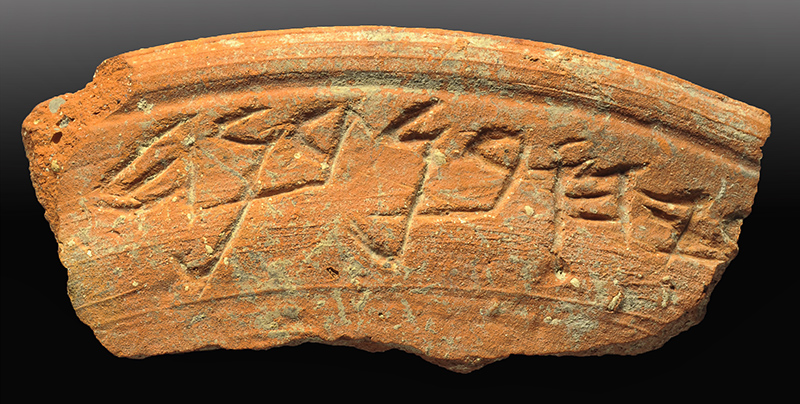
Most intriguing is the recent discovery of a ceramic bowl with a partially preserved inscription in ancient Hebrew. While not complete, the inscription presents us with the name of a seventh century BCE figure, which resembles other names known to us from both the Biblical and archaeological record [see Press Release] and providing us with a connection to the people living in Jerusalem at the end of the First Temple period.

Pottery sherd of a bowl from the end of the First Temple Period, bearing the inscription "ryhu bn bnh." Photo: Clara Amit, Israel Antiquities Authority.

Pottery sherd of a bowl from the end of the First Temple Period, bearing the inscription “ryhu bn bnh.” Photo: Clara Amit, Israel Antiquities Authority.

Dr. Joe Uziel and Nashon Zanton, directors of the dig, were working in ruins belonging to the period of the destruction of the Temple by the Babylonians when the inscription was found. They say that the name most similar to the inscription is “Zechariah the son of Benaiah, the father of the Prophet Jahaziel.”

 And the Spirit of the LORD came upon Jahaziel the son of Zechariah, son of Benaiah, son of Jeiel, son of Mattaniah, a Levite of the sons of Asaph, in the midst of the assembly.  And he said, “Listen, all Judah and inhabitants of Jerusalem and King Jehoshaphat: Thus says the LORD to you, ‘Do not be afraid and do not be dismayed at this great horde, for the battle is not yours but God’s. (2 Chronicles 20:14-15 ESV)

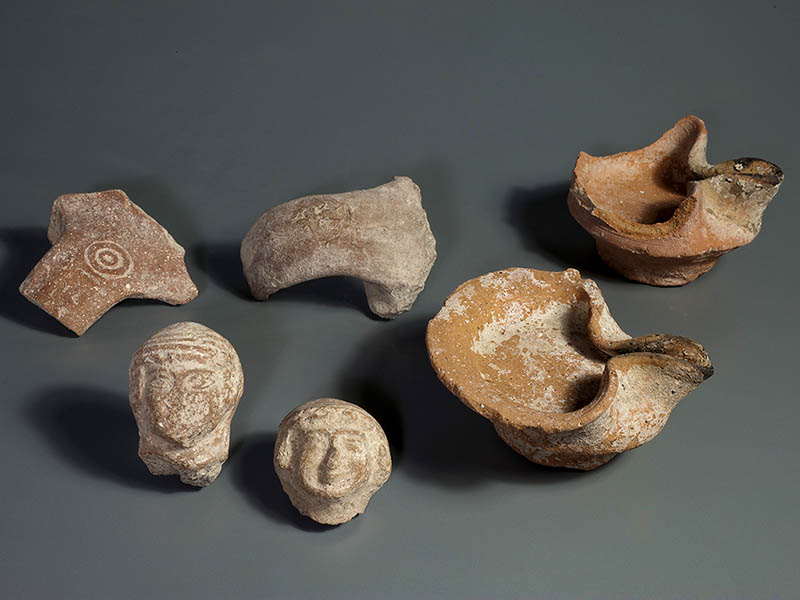
More information about this discovery is available in the IAA Press Release here. Other finds from the same area, shown in the photo below, are impressive.

Various finds from the fill layer of the end of the First Temple Period: oil lamps, LMLK stamped handles and female figurines. Photo: Clara Amit, Israel Antiquities Authority.

Various finds from the fill layer of the end of the First Temple Period: oil lamps, LMLK stamped handles and female figurines. Photo: Clara Amit, Israel Antiquities Authority.

HT: Joseph I. Lauer; Todd Bolen, Bible Places Blog (see here for more news links)

Google Earth helps you see Biblical Sites

About a month ago Wayne Stiles posted an illustrated article about “Google Street View of 7 Biblical Sites.” There is some pretty neat stuff there, especially for those who have stood in these places and looked in all directions. Check all 7 views here.

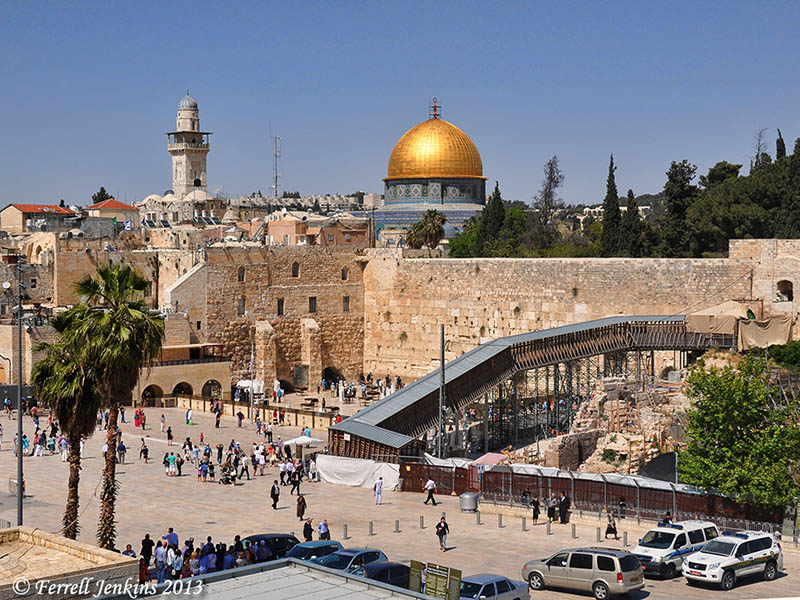
Look at the photo below, and then see the same area in Google Earth.

The Western Wall, the Dome of the Rock, and the Mughrabi Gate are visible in this single photo. Photo by Ferrell Jenkins.

The Western Wall, the Dome of the Rock, and the Mughrabi Gate Bridge are visible in this single photo. Photo by Ferrell Jenkins.

Walking up the Roman siege ramp at Masada

Masada has caught my attention in the past few days. Those who have visited the site are aware of the Byzantine ruins, including a church, on the top of the plateau. A brochure published by the The Israel Nature and Parks Authority points out that Masada “sank into oblivion until the nineteenth century.”

The first scholars to identify Masada with the plateau known in Arabic as es-Sebbeh were Smith and Robinson in 1838, and the first to climb it were Wolcott and Tipping in 1842. Warren climbed Masada in 1867, Conder described and mapped it in 1875, Sandel discovered the water system in 1905, and Schulten studied mainly the Roman siege system in 1932.

Perhaps most visitors today associate the excavation of Masada with the late Yigael Yadin from 1963 to 1965. Masada National Park opened in 1966, and the first cable car to take visitors to the top was in 1971. The larger cable cars, holding about 40 passengers each, were added several years later.

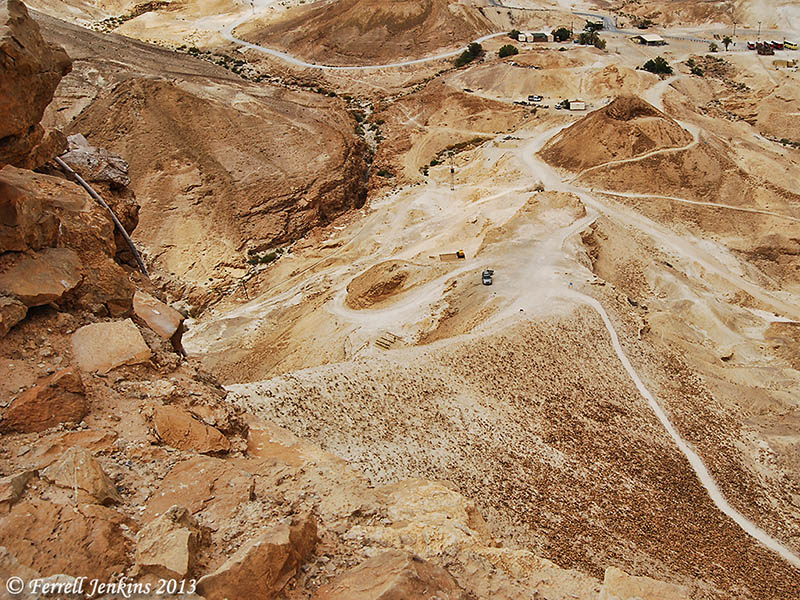
My first visit to Masada was in 1969. At that time it was necessary to walk up the path on the siege ramp made by the Romans. In A.D. 73 or 74, “the Roman Tenth Legion Fretensis, led by Flavius Silva, laid siege to the mountain.” The ramp was built so the Romans could move their battering ram up to the western gate of Masada. The photo below was made from the plateau. The ramp is visible just below the bottom half of the photo, and the path is on the ridge. The path leading to our right (view from the top) goes to the large water cisterns.

The Roman siege ramp at Masada. Photo by Ferrell Jenkins.

The Roman siege ramp at Masada. Photo by Ferrell Jenkins.

Is Masada mentioned in the Bible?

N.B. This is post number 1500 since our beginning in 2007.

— ♦ —

The Hebrew word masada is generally translated stronghold or fortress in the English Bible. Gordon Franz (lifeandland.org) says King David visited the site of Masada at least three times.

  1. After sending his parents to Moab (1 Samuel 22:1-5). Take a look at the previous post with the photos and map showing the lisan (tongue) of the Dead Sea. I envision this as the place where David could most easily cross to Moab and then return to the stronghold.
  2. After he spared Saul’s life at Engedi (En Gedi) (1 Samuel 24:22).
  3. When the Philistines were searching for him (2 Samuel 5:17).

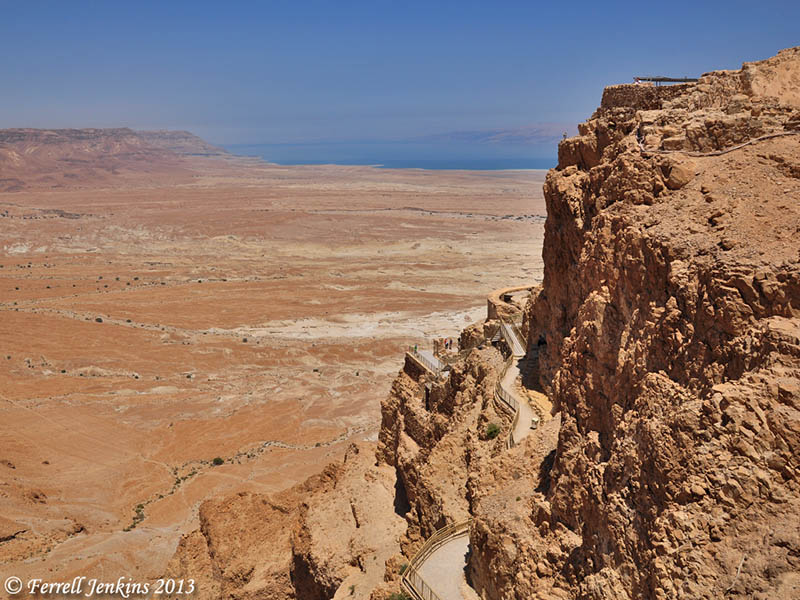
This photo gives some idea of the fortress-like quality under consideration. Note the Dead Sea, the Lisan, and the mountains of Moab in the distance.

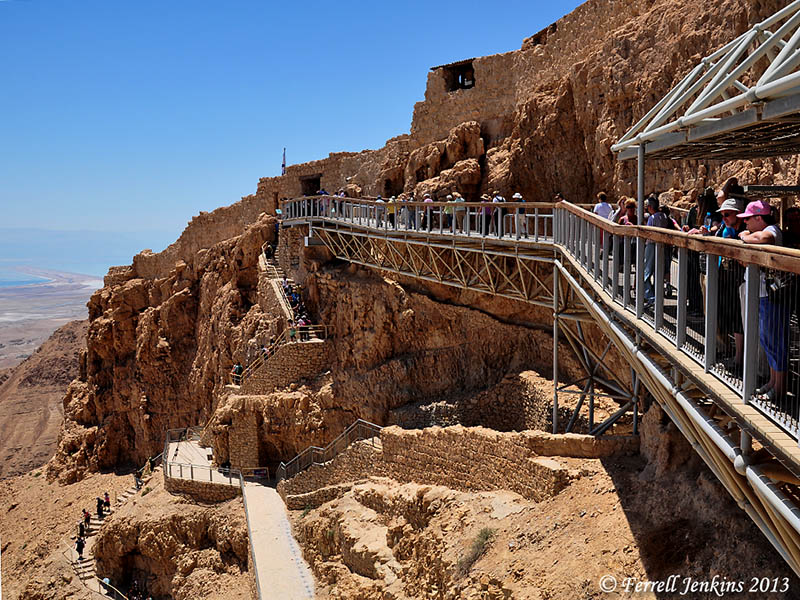
After a cable-car ride, or by walking the snake path for about an hour one reaches the entrance to the rock fortress of Masada. Photo by Ferrell Jenkins.

After a cable-car ride, or by walking the snake path for about an hour one reaches the entrance to the rock fortress of Masada. Photo by Ferrell Jenkins.

At least four of David’s psalms mention masada.

  1. Psalm 18:2 (fortress). — “The LORD is my rock and my fortress and my deliverer, my God, my rock, in whom I take refuge, my shield, and the horn of my salvation, my stronghold.” (ESV)
  2. Psalm 31:2-3 — “Incline your ear to me; rescue me speedily! Be a rock of refuge for me, a strong fortress to save me! For you are my rock and my fortress; and for your name’s sake you lead me and guide me;”  (ESV)
  3. Psalm 71:1, 3 (fortress). — “In you, O LORD, do I take refuge; let me never be put to shame!  2 In your righteousness deliver me and rescue me; incline your ear to me, and save me!  3 Be to me a rock of refuge, to which I may continually come; you have given the command to save me, for you are my rock and my fortress.” (ESV)
  4. Psalm 144:1-2 (fortress). — “Of David. Blessed be the LORD, my rock, who trains my hands for war, and my fingers for battle;  2 he is my steadfast love and my fortress, my stronghold and my deliverer, my shield and he in whom I take refuge, who subdues peoples under me.”  (ESV)

We are uncertain about authorship of Psalm 91:1-2 (fortress). Beitzel, in The New Moody Atlas of the Bible, places David at Masada (p. 151; map 58).

Psalm 66:11 uses the word masada (translated net, trap or prison).

This photo was made from the top of Masada toward the Dead Sea. Photo by Ferrell Jenkins.

This photo was made from the top of Masada with a view toward the Dead Sea. The walk below leads to the site of Herod’s palace. Photo by Ferrell Jenkins.

Understand that we are not referring to the Masada built by Herod the Great and later used by Jewish zealots during the period of A.D. 70-72. The stronghold had already been there for millennia.

The article by Gordon Franz is brief, but well documented. Read it here.

Crusader period hospital building in Jerusalem

The Israel Antiquities Authority announced yesterday that a building from the Crusader period (1099–1291 A.D.) has been excavated. The building is in an area of the Christian Quarter of Jerusalem known as the Muristan (“a corruption of the Persian word for hospital”). Our first photo shows part of the Muristan near the old structure. You can see the tower of the Lutheran Church of the Redeemer. This is near the Church of the Holy Sepulcher.

The Muristan in the Christian Quarter of the Old City of Jerusalem. The tower of the Lutheran Church of the Redeemer is visible. Photo by Ferrell Jenkins.

The Muristan in the Christian Quarter of the Old City of Jerusalem. The tower of the Lutheran Church of the Redeemer is visible. Photo by Ferrell Jenkins.

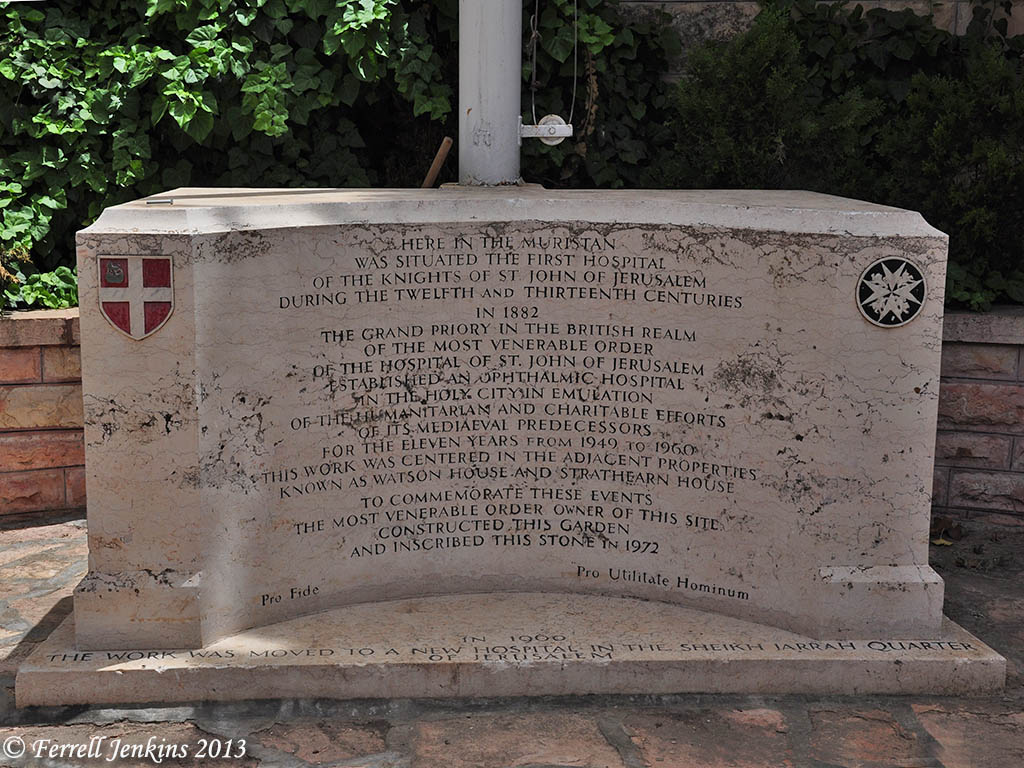
Between the Lutheran Church and the Armenian Quarter on Muristan Street stands a monument identifying the area where the hospital of St. John of Jerusalem was established. Click on the image if you wish to read the inscription.

Marker identifying the location of the hospital built by the "Order of St. John of the Hospital in Jerusalem." Photo by Ferrell Jenkins.

Marker identifying the location of the hospital built by the “Order of St. John of the Hospital in Jerusalem.” Photo by Ferrell Jenkins.

The Press Release contains several bits of historical information that may be of interest to readers. Here is the full Press Release.

— ♦ —

The Israel Antiquities Authority conducted an excavation in the impressive Crusader building, which is similar in appearance to the Knights Halls in Akko and stands 6 meters high, prior to the construction of a restaurant by the Grand Bazaar Company

Part of an enormous structure dating to the Crusader period (1099–1291 CE), which was a busy hospital,  has currently been revealed to the public following excavations and research by the Israel Antiquities Authority there in cooperation with the Grand Bazaar Company of East Jerusalem. The building, owned by the Waqf, is situated in the heart of the Christian Quarter in the Old City of Jerusalem, in a region known as “Muristan” (a corruption of the Persian word for hospital), near David Street, the main road in the Old City.

Until a decade or so ago the building served as a bustling and crowded fruit and vegetable market. Since then it stood there desolate. In the wake of the Grand Bazaar Company’s intention to renovate the market as a restaurant, the Israel Antiquities Authority conducted archaeological soundings there.

The structure, only a small part of which was exposed in the excavation, seems to extend across an area of fifteen dunams! Its construction is characterized by massive pillars and ribbed vaults and it stands more than six meters high. The image we have is that of a great hall composed of pillars, rooms and smaller halls.

Ruins of the Crusader hospital built by the Order of St. John of the Hospital in Jerusalem. Yoli Shwartz, courtesy of the Israel Antiquities Authority.

Ruins of the Crusader hospital built by the Order of St. John of the Hospital in Jerusalem. Photo by Yoli Shwartz, courtesy of the Israel Antiquities Authority.

According to Renee Forestany and Amit Re’em, the excavation directors on behalf of the Israel Antiquities Authority, “We’ve learned about the hospital from contemporary historical documents, most of which are written in Latin.  These mention a sophisticated hospital that is as large and as organized as a modern hospital. The hospital was established and constructed by a Christian military order named the “Order of St. John of the Hospital in Jerusalem” and known by its Latin name the Hospitallers (from the word hospital). These righteous warriors took an oath to care for and watch over pilgrims, and when necessary they joined the ranks of the fighters as an elite unit.

The hospital was comprised of different wings and departments according to the nature of the illness and the condition of the patient – similar to a modern hospital. In an emergency situation the hospital could accept as many as 2,000 patients. The Hospitallers treated sick men and women of different religions. There is information about Crusaders who ensured their Jewish patients received kosher food. All that notwithstanding, they were completely ignorant in all aspects of medicine and sanitation: an eyewitness of the period reports that a Crusader doctor amputated the leg of a warrior just because he had a small infected wound – needless to say the patient died. The Muslim Arab population was instrumental in assisting the Crusaders in establishing the hospital and teaching them medicine. Arab culture has always held the medical profession in high regard and Arab physicians were famous far and wide.

In addition to the medical departments, the hospital also functioned as an orphanage where abandoned newborns were brought. Mothers who did not want their offspring would come there with covered heads and hand over their infants. In many instances when twins were born, one of them was given to the orphanage. The orphans were treated with great devotion and when they reached adulthood they served in the military order.

We can learn about the size of the hospital from contemporary documents. One of the documents recounts an incident about a staff member who was irresponsible in the performance of his work in the hospital. That person was marched alongside the building awhile, and the rest of the staff, with whips in hand, formed a line behind him and beat him. This spectacle was witnessed by all of the patients.

The Ayyubid ruler Saladin lived near the hospital following the defeat of the Crusaders, and he also renovated and maintained the structure. He permitted ten Crusader monks to continue to reside there and serve the population of Jerusalem.

The building collapsed in an earthquake that struck in 1457 CE and was buried beneath its ruins, which is how it remained until the Ottoman period. In the Middle Ages parts of the structure were used as a stable and the bones of horses and camels were found in excavations, alongside an enormous amount of metal that was used in shoeing the animals.

According to Monser Shwieki, the project manager, “The magnificent building will be integrated in a restaurant slated to be constructed there, and its patrons will be impressed by the enchanting atmosphere of the Middle Ages that prevails there”. According to Shwieki, “The place will be open to the public later this year”.

Click here to download high resolution pictures . Photograph credit: Yoli Shwartz, courtesy of the Israel Antiquities Authority.

HT: Joseph I. Lauer

A sunrise few have seen

Trent and Rebekah are “vagabonding” for forty days in Israel between the close of the Ashkelon excavation and the opening of their fall semester at Jerusalem University College (also known as the American Institute of Holy Land Studies). Last Thursday morning they were at Masada for the sunrise. I didn’t ask if they spent the night there.

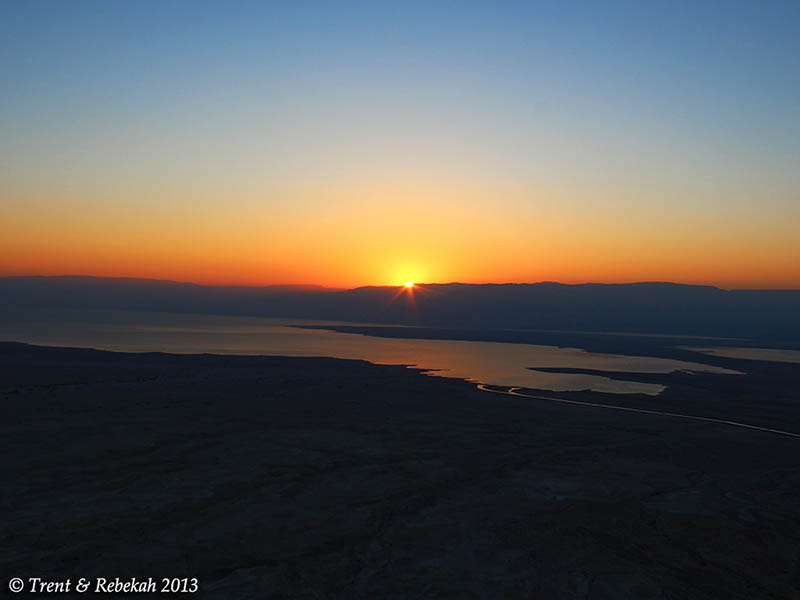
This view from Masada to the east at sunrise is one I have not seen. They graciously allowed me to post it here.

Sunrise from Masada. Photo by Trent and Rebekah, Aug. 01, 2013.

Sunrise from Masada. Photo by Trent and Rebekah, Aug. 01, 2013.

There is more to this photo than just the beauty of it. In their photo you see the Lisan (or Tongue) that extends from the east into the Dead Sea. You may also see the canal through which water is pumped to the southern end of the Sea.

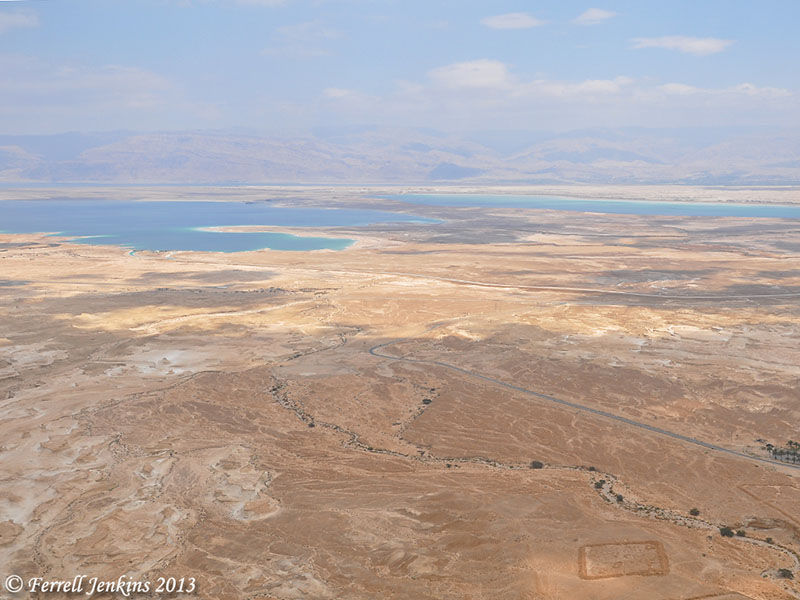
The photo below was made near mid-day from Masada.

View east from Masada near mid-day. Photo by Ferrell Jenkins.

View east from Masada near mid-day. Photo by Ferrell Jenkins.

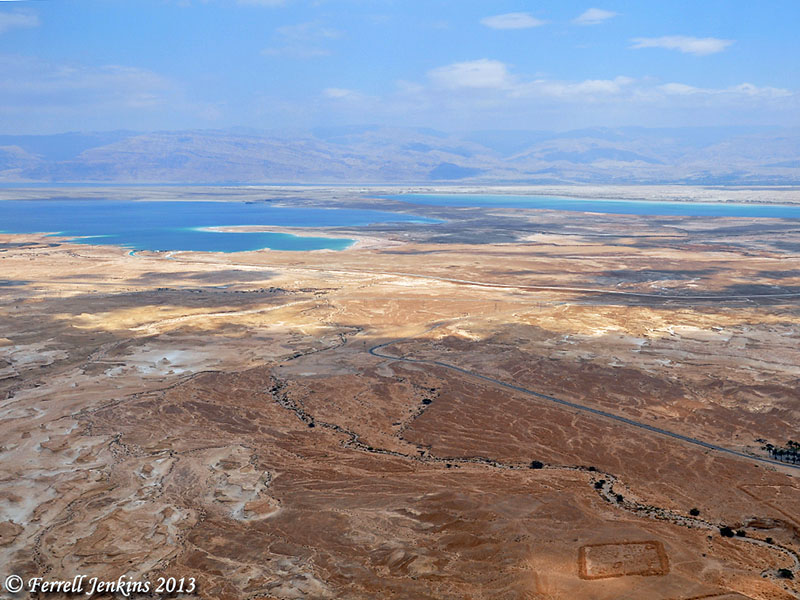
The same photo below has been enhanced further in Photoshop to reveal the details a little better.

View from Masada (enhanced to show features). Photo by Ferrell Jenkins.

View east from Masada (enhanced to show features). Photo by Ferrell Jenkins.

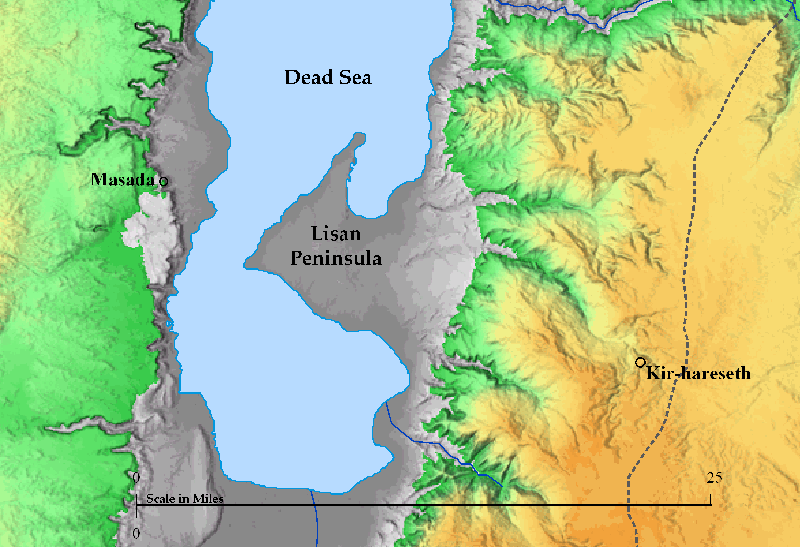
Last month I wrote about “The topography of Kir-hareseth” here. This map shows the valley that goes down from the Transjordan Plateau in a northwesterly direction to the Lisan Peninsula (tongue) of the Dead Sea. Masada is located directly across from that valley. The Lisan now extends completely across the Dead Sea, as the photos above show. Water is pumped to the southern end of the Sea to allow for the chemicals and minerals to be mined.

Map of the southern end of Dead Sea.

Map of the southern end of Dead Sea. Today the Lisan extends completely across the Dead Sea.

Dr. Rasmussen (HolyLandPhotos’Blog) says,

The Dead/Salt Sea can be divided into two unequal sections by a tongue-shaped peninsula that protrudes into it from the eastern shore (= Lisan in Arabic, Lashon in Hebrew). – Zondervan Atlas of the Bible, 49.

Trent and Rebekah continue to post about the places they are visiting in Israel. Take a look at TrentandRebekah.wordpress.com.

The Acacia in the Sinai Wilderness

Most travelers to Israel have probably seen acacia trees growing along the shore of the Dead Sea. Fewer travelers have visited the Sinai Peninsula, now part of Egypt. The term acacia is used in most English versions of the Bible, but the King James version (1611) simply transliterated the Hebrew word shittim.

The Fauna and Flora of the Bible comments on the acacia:

The acacia is a member of the Mimosa family. Four different species are found in Palestine, the most common being the A. raddiana, which grows in the valleys around the Dead Sea. It is an evergreen tree, 3 to 5.5 m high, with spiny branches carrying yellow flowers; its wood is very useful for building purposes.

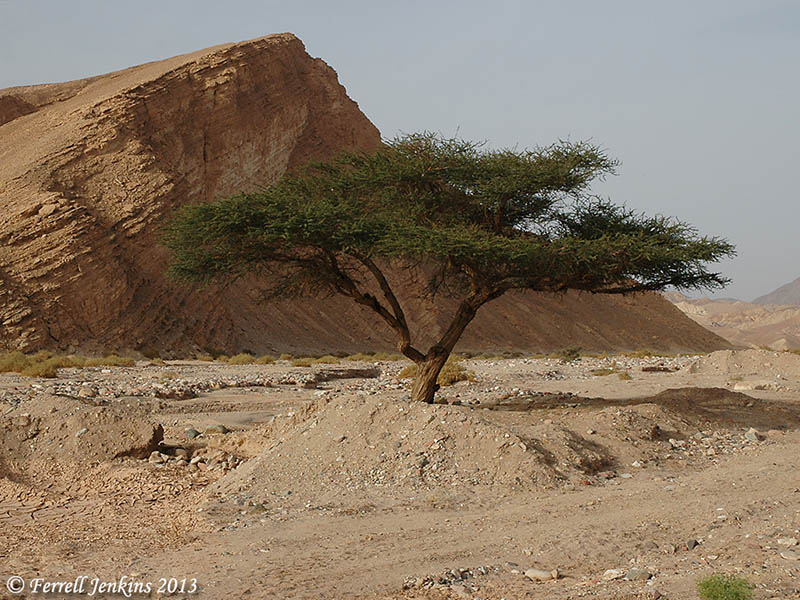
The acacia below is in the Wadi el-Tor in the Sinai Peninsula between the Gulf of Suez and Mount Sinai.

Acacia growing in Wadi el-Tor in the Sinai Peninsula. Photo by Ferrell Jenkins.

Acacia growing in Wadi el-Tor in the Sinai Peninsula. Photo by Ferrell Jenkins.

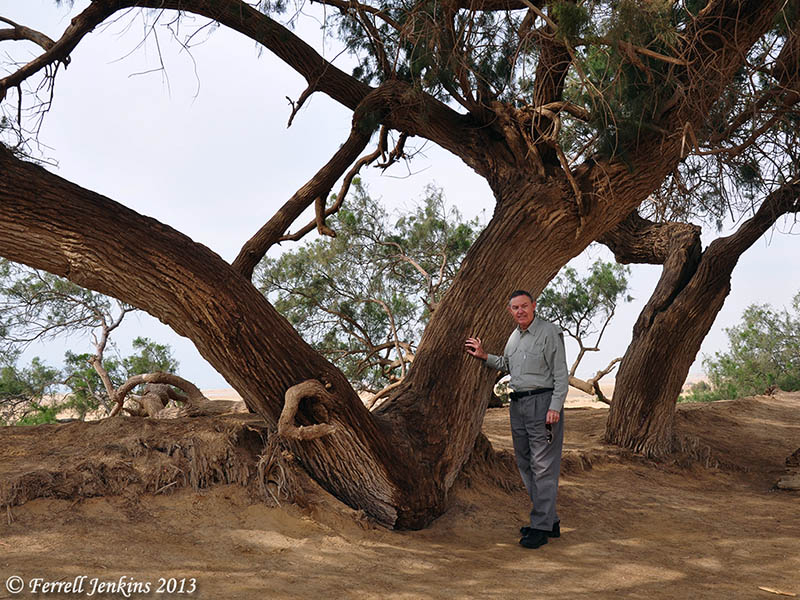
In the description of the construction of the tabernacle, the book of Exodus uses the word acacia 26 times from chapter 25 to chapter 38. When we see the smaller trees today we may wonder about finding enough wood for the tabernacle. At Ain Musa (Spring of Moses), the traditional place of Marah (Exodus 15:23), there are a few older large Acacia growing. Could it be possible that 3500 years ago there were many this size?

Large acacia at Ain Musa (Spring of Moses) on the east shore of the Gulf of Suez. Photo by Ferrell Jenkins.

Large acacia at Ain Musa (Spring of Moses) on the east shore of the Gulf of Suez.

Seeking the history beneath Solomon’s city at Gezer

Southwestern Baptist Theological Seminary has released information about the most recent season of archaeology at Tel Gezer here.

Aerial view of Tel Gezer toward the coastal plain, SW from the site. Photo by Ferrell Jenkins.

Southwest aerial view of Tel Gezer toward the coastal plain. Photo by Ferrell Jenkins.

This summary of the most recent season was written by Steven Ortiz and Samuel Wolff.

The excavations at Gezer are sponsored by the Tandy Institute of Archaeology at Southwestern Baptist Theological Seminary with several consortium schools. The excavations are directed by Steven Ortiz of the Tandy and Samuel Wolff of the Israel Antiquities Authority.

In this, the sixth season of excavation, one goal was to remove a portion of the city wall built in the Iron IIA period (10th century BCE) in order to investigate a Late Bronze age destruction level (ca. 1400 BCE) that lay below it. To the surprise of the team, in the process of excavating the city wall, an earlier wall system dating to the Iron Age I (1200-1000 BCE) was discovered. This wall was one meter thick with several rooms attached to it. These rooms were filled by a massive destruction, nearly one meter in height,that included Canaanite storage jars, Philistine pottery and other items. A fragment of a Philistine figurine was also found this season. The biblical text record that the king of Gezer organized a Canaanite coalition against Joshua and David had a battle with the Philistines where he chased them “all the way to Gezer.” Perhaps the biblical accounts retain a memory of the importance of Gezer and its close relations to the Philistines during this period.

Beneath this city was an earlier city that was destroyed in a fierce conflagration. This city was functioning during the Egyptian 18th Dynasty’s rule over the southern Levant. Within the destruction debris were several pottery vessels along with a cache of cylinder seals and a large Egyptian scarab with the cartouche of Amenhotep III. This pharaoh was the father of the heretic King Akenaton and grandfather of the famous Tutankhamun (King Tut). This destruction corresponds to other destructions of other cities in the region, a reflection of the internecine warfare that was occurring between the Canaanite cites as reflected in the well-known Tell el-Amarna correspondence.

The archaeology of Solomon has been controversial, fueled by various theories over the dating of the archaeological record. The dating of the Gezer Iron Age Gate is at issue. The Gezer expedition is slowly stripping away layers of public and domestic structures of the 8th and 9th centuries BCE in order to reveal the 10th century city plan adjacent to the City Gate. This summer the tops of the 10th century walls began to poke out, making the archaeologists optimistic that in future seasons more of the Solomonic city will be exposed.

For more information see www.telgezer.com.

Steven Ortiz, professor of archaeology at Southwestern Seminary, is co-director of the archaeological excavations at Tel Gezer, site of one of the famed cities of Solomon located between Jerusalem and Tel Aviv.  Photo by Matt Miller.

Steven Ortiz, professor of archaeology at Southwestern Seminary, is co-director of the archaeological excavations at Tel Gezer, site of one of the famed cities of Solomon located between Jerusalem and Tel Aviv. Photo by Matt Miller.

For earlier posts about Gezer, see the following: aerial photo with a view toward the hill country, boundary stones, and the water system.

HT: Joseph Lauer