Category Archives: Books

Max McLean in C. S. Lewis The Screwtape Letters

During World War II when Great Britain was dealing with the threat of extinction,  C. S. Lewis wrote The Screwtape Letters. These letters of unknown provenance are from the senior devil Screwtape to a junior tempter named Wormwood.

Saturday afternoon I saw actor Max McLean in a Broadway-type production, C. S. Lewis The Screwtape Letters. The production begins with Screwtape giving the graduation address at the Tempters’ Training College for Young Devils. After that, everything else takes place in Screwtape’s Office in Hell.

C. S. Lewis The Screwtape Letters

Screwtape writes a series of letters to his nephew Wormwood to help him in working with one of his “patients” – a young Christian man on earth. Wormwood is supposed to keep the patient distracted from serving the Enemy (God), and to deliver him to “our Father below” (the Devil).

In addition to McLean’s superb acting, Toadpipe is a delightful addition to the stage production. She is Screwtape’s secretary in his office in Hell.
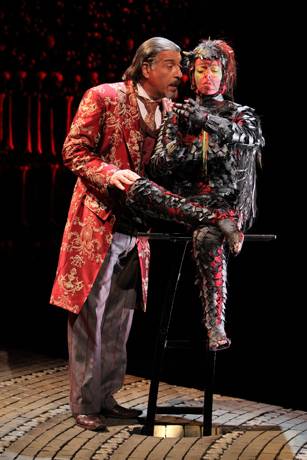
Max McLean as Screwtape and his secretary Toadpipe.

Max McLean as Screwtape and his secretary Toadpipe in The Screwtape Letters.

If you have never read The Screwtape Letters, you should do so. The book is available from Amazon in both print and Ebook.

This little except from Letter XII shows us how easily it is for the Devil to distract one from genuine service to the Enemy (God).

You will say that these are very small sins; and doubtless, like all young tempters, you are anxious to be able to report spectacular wickedness. But do remember, the only thing that matters is the extent to which you separate the man from the Enemy. It does not matter how small the sins are provided that their cumulative effect is to edge the man away from the Light and out into the Nothing. Murder is no better than cards if cards can do the trick. Indeed the safest road to Hell is the gradual one—the gentle slope, soft underfoot, without sudden turnings, without milestones, without signposts.

C. S. Lewis The Screwtape Letters is scheduled for several other cities. Take a look at the ScrewtapeOnStage.com for details.

If you are interested in C. S. Lewis, take a look at this photo essay about Lewis here.

Two references from Paul’s second letter to the church at Corinth are appropriate here.

And no wonder, for even Satan disguises himself as an angel of light. (2 Corinthians 11:14 ESV)

so that we would not be outwitted by Satan; for we are not ignorant of his designs. (2 Corinthians 2:11 ESV)
“From the Land of Black Tents”

In his book The Apostle: A Life of Paul, noted biographer John Pollock begins his book with information about Paul’s background at Tarsus. He calls the first chapter, “From the Land of Black Tents.”

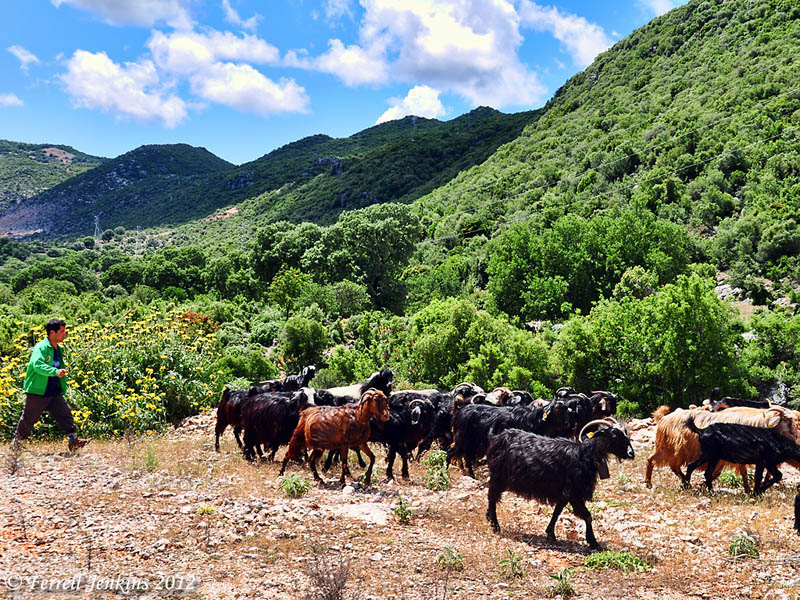
His father most likely was a master tentmaker, whose craftsmen worked in leather and in cilicium, a cloth woven from the hair of the large long-haired black goats that grazed (as they still do) on the slopes of the Taurus. The black tents of Tarsus were used by caravans, nomads, and armies all over Asia Minor and Syria.

We still see these herds of long-haired black goats in many parts of Turkey. The photo below was made east of Myra near the Mediterranean coast of Turkey.

Goats with long black hair, east of Myra, Turkey. Photo by Ferrell Jenkins.

Goats with long black hair east of Myra, Turkey. Photo by Ferrell Jenkins.

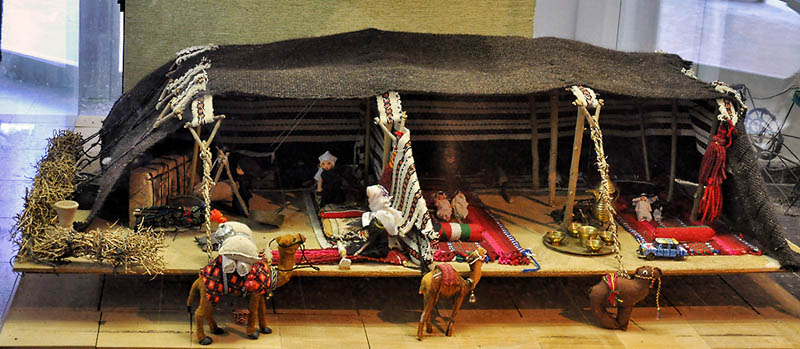
The Museum for Beduin Culture at Kibbutz Halav in the Negev of Israel displays a small model of a beduin (bedouin) tent. This museum intends to preserve the memory of the original bedouin life that is quickly being replaced by a permanent life and housing.

Bedouin Tent Model displayed at the Museum for Beduin Culture. Photo by Ferrell Jenkins.

Tent Model displayed at the Museum for Beduin Culture. Photo by Ferrell Jenkins.

Paul said,

But Paul said, “I am a Jew of Tarsus in Cilicia, a citizen of no insignificant city; and I beg you, allow me to speak to the people.” (Acts 21:39 NAU)

Thomson’s “The Land and the Book” on Logos community pricing

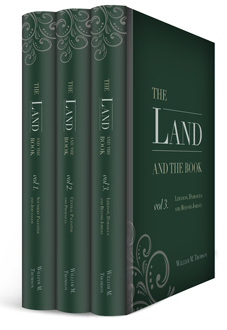
William Thomson’s 3-volume set, The Land and the Book, is now on community pricing at Logos.

http://www.logos.com/product/26753/the-land-and-the-book

Thomson - The Land and the Book

The Land and the Book

This set of books was published by Harper & Brothers between 1880 and 1886.

Thomson spend many years living in Beirut and traveling throughout the region. This is one of the excellent books telling of travel in those days, and of the then-current understanding of the location of various sites.

I am delighted that this book is now on community pricing for $18. If enough people place a bid the price could be lower. Place your bid today.

HT: Brooks Cochran

Logos Book of the Month — Psalms and Hymns of Isaac Watts

Pick up almost any book of hymns and you will note several songs by Isaac Watts (1674-1748), a native of Southhampton, England. The Dictionary of the Christian Church says,

Watts deservedly holds a very high place among English hymn-writers. His hymns reflect his strong and serene faith and did much to make hymn-singing a powerful devotional force, especially in Nonconformity… [especially nonconformity to the Church of England at the time, but used of nonconformity to any Established Church]

Logos is offering The Psalms and Hymns of Isaac Watts free to Logos users for the month of September. See details here.

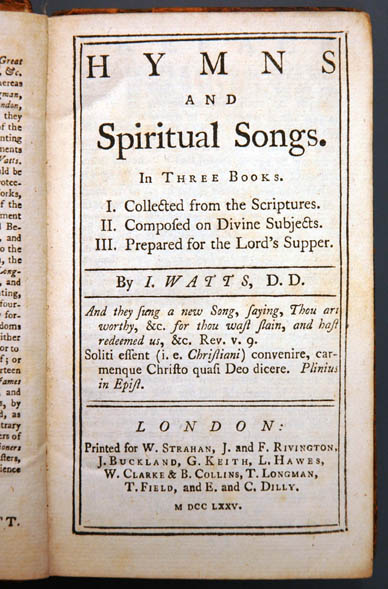
A 1775 edition of a book by Isaac Watts. U. of Otago.

I have Logos Bible Software 4 open now to a hymn based on Galatians 6:14. The title is “Crucifixion to the world by the cross of Christ.” We probably know this song by the first words, “When I survey the wondrous cross.”

Crucifixion to the world by the cross of Christ.
(Gal. 6:14)

 When I survey the wondrous cross
On which the Prince of glory died,
My richest gain I count but loss,
And pour contempt on all my pride.

Forbid it, Lord, that I should boast,
Save in the death of Christ my God!
All the vain things that charm me most,
I sacrifice them to his blood.

See from his head, his hands, his feet,
Sorrow and love flow mingled down!
Did e’er such love and sorrow meet,
Or thorns compose so rich a crown!

[His dying crimson, like a robe,
Spreads o’er his body on the tree:
Then am I dead to all the globe,
And all the globe is dead to me.]

Were the whole realm of nature mine,
That were a present far too small;
Love so amazing, so divine,
Demands my soul, my life, my all.

Watts, I. (1998). The Psalms and hymns of Isaac Watts. Oak Harbor, WA: Logos Research Systems, Inc.

Don’t expect modern shaped notes. And if you know nothing of the Meters that were used in Watts’ time, you may simply use the book for devotional readings.

Notice the vivid fourth stanza describing the dying Christ which is often left out of modern hymn books.

More famous Sinopeans

In addition to Diogenes and Serapis, Sinop in Pontus was the home of several other well known people in early church history.

Aquila. (Not the Aquila of Acts 18:2.) This Aquila, a native of Sinop in Pontus, is said to have been a relative of the Emperor Hadrian (A.D. 117-138). He was converted to Christianity during a visit to Jerusalem, but was rejected because he refused to give up his studies of astronomy. Later he became a proselyte to Judaism.

Having become a disciple of the Rabbis, from whom he learned Hebrew and the rabbinical method of exegesis, he used his knowledge to make a revision of the Septuagint, bringing it into line with the official Hebrew text. It was soon adopted by Greek speaking Jews in preference to the LXX, which was used by the Christians. His translation, which was finished probably c. 140, was extremely literal, attempting to reproduce individual Hebrew words and phrases exactly. This procedure frequently obscured the sense; but the fidelity of Aquila’s version to the Hebrew original was admitted by the Fathers most competent to judge, such as Origen and Jerome. (Dictionary of the Christian Church, ed. Cross & Livingstone, 94).

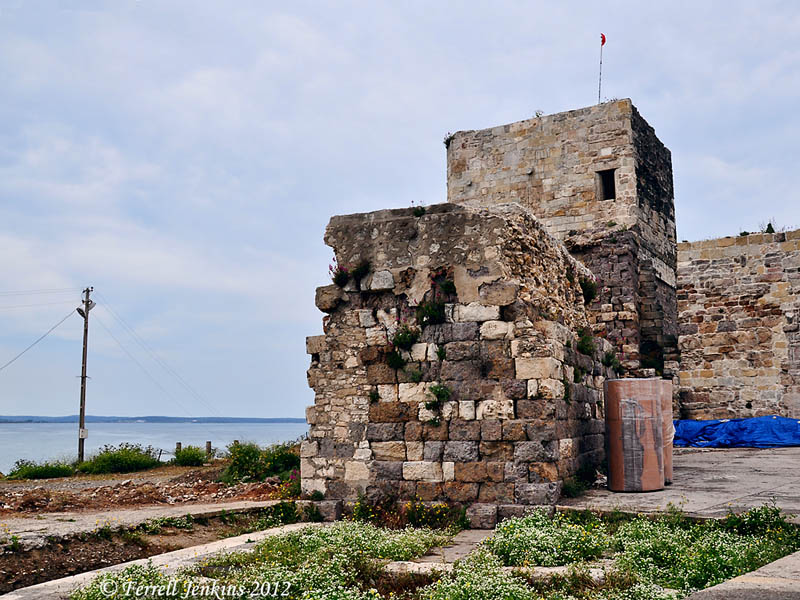
Tower and wall on the Black Sea at Sinop, Turkey. Photo by Ferrell Jenkins.

Tower and wall on the Black Sea at Sinop, Turkey. Photo by Ferrell Jenkins.

Marcion (died c. 160 A.D.). We rarely read or hear the name Marcion without the word heretic attached to it. None of his writings have survived, but his success can be seen by the many early Fathers who spoke of him. (For a list of these see Bercot, ed., A Dictionary of Early Christian Beliefs.) This influential ship master of Pontus rejected the God of the Old Testament who he described as evil and vengeful. According to him, the Christian gospel was a message of love, and the Father of Jesus was not the God of the Old Testament. Many of his views were similar to those of Gnosticism. Marcion accepted only the Gospel of Luke among the Gospels, and the writings of Paul.

Marcion went to Rome about A.D. 140, but within 4 years he was excommunicated from the church. From Rome he spread his teachings all over the Empire.

Phocas (Phokas). Phocas was martyred at Sinop in A.D. 117 during the reign of the Roman Emperor Trajan.

According to the Dictionary of the Christian Church (1282), a different man named Phocas “the Gardener” was martyred  during the persecution by the Roman Emperor Diocletian in A.D. 303. I haven’t determined if he was associated with the port city of Sinop. Wilson seems to confuse these two persons (Biblical Turkey, 342).

The Sinop Gospels is not a person, but should be mentioned in connection with the Black Sea port of Turkey. This parchment document was dyed purple and written in gold ink. The uncial manuscript 023 contains 43 pages of the gospel of Matthew. The manuscript was discovered in Sinop in the late 19th century is thought to have originated in Syria or Mesopotamia in the 6th century A.D. It is now in the Bibliothèque Nationale in Paris.

A brief description in French, and a small image of two pages of the manuscript may be found here. The manuscript features small drawings to illustrate the biblical text. The displayed page shows Jesus healing a blind man.

Free Kindle book on the Sermon on the Mount

DeWard Publishing Company is offering a free Father’s Day Kindle download for a limited time.

Invitation to a Spiritual Revolution (Studies in the Sermon on the Mount) by Paul Earnhart is available for free download from this link.

Paul Earnhart has served as minister at the Douglass Hills Church of Christ, Louisville, Kentucky, for many years. He is recognized for both his scholarly and practical approach to Biblical subjects.

The Sermon on the Mount (Matthew 5-7) is the seminal announcement of the teaching of Jesus.

This is a great book for any father, or anyone else interested in spiritual matters.

Thanks to DeWard Publishing Company for this gracious gift. Take a look at their other publications.

The Man of Galilee available in Kindle format for 99¢

DeWard Publishing Company announces today that Atticus G. Haygood’s The Man of Galilee in available in Kindle format for 99¢. This, in my judgment, is one of the finest books written, apart from the Bible, to direct people to a proper understanding of Jesus..

The Man of Galilee by Atticus G. Haygood.
I don’t know how long it will be available for this incredibly low price, but I suggest you get it now from this link.

Eisenbrauns 2012 Mug announced

Scholarly book publisher Eisenbrauns announces the Eisenbrauns 2012 Mug.

Eisenbrauns 2012 Mug

Eisenbrauns 2012 Mug
A Hittite Proverb

Eisenbrauns, Forthcoming June 2012
14 ounces, Hittite and English
Ceramic
Your Price: $7.50
www.eisenbrauns.com/item/EISMUG2012

If you want to know what the Hittite proverb says, click on the link to Eisenbrauns.

Just something on the lighter side for you to enjoy while I make my way across the Atlantic.

Scribes kept important records

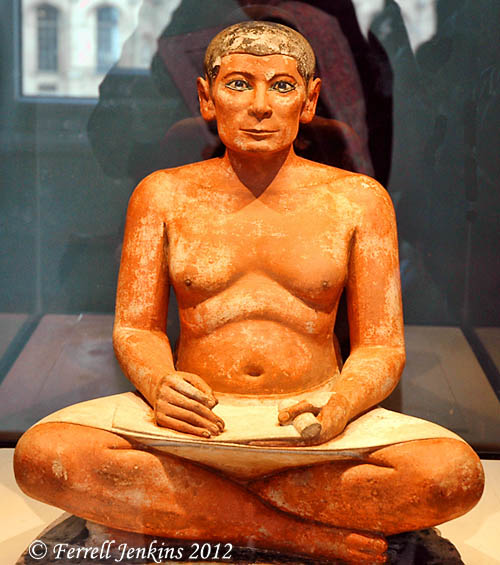
The picture below shows a scribe from ancient Egypt. The statue from Saqqara dates to the 4th or 5th dynasty — about 2600 to 2350 B.C. The limestone statue is painted with encrusted eyes of rock crystal. The statue is on display in the Louvre.

Scribe from Saqqara displayed in the Louvre. Photo by Ferrell Jenkins.

Scribe from Saqqara displayed in the Louvre. Photo by Ferrell Jenkins.

We do not have a great number of examples of writing from ancient Israel, but the Bible is abundant with references to writing and record keeping. The entry on the Hebrew word katab in the Theological Wordbook of the Old Testament says,

katab is the only general word for “write” and it is widely used. Curiously, it is not used in Genesis. Moses wrote on a scroll God’s curse on the Amalekites (Exo 17:14 ). God himself wrote the Ten Commandments (Exo 31:18). Moses also is specifically said to have written the Book of the Covenant (Exo 24:4), the Sinai legislation (Exo 34:27), the names of the leaders of the tribes (Num 17:2-3), the wilderness itinerary (Num 33:2), the law “from beginning to end” (Deut 31:9, 24) and Moses’ final song (Deut 31:22, 24). It is quite possible that the general references of Deut 31:9  and Deut 24 refer to the whole of the Pentateuch (cf. Deut 28:58-61; Deut 29:20-21) although critical scholars refer it only to Deut and question even that.

I think the reference to Moses writing the wilderness itinerary of the Israelites is interesting.

Moses wrote down their starting places, stage by stage, by command of the LORD, and these are their stages according to their starting places. (Numbers 33:2 ESV)

No Joke: free and nearly free

Todd Bolen, in his Weekend Roundup at the Bible Places Blog, calls attention to a couple of books that I wanted to mention while there is still time.

The first is a free Kindle ebook — Walk the Land: A Journey on Foot Through Israel. This couple in their early 50s followed the 600-mile Israel National Trail from the border of Egypt to the border of Lebanon. It was a 42 day trek. I don’t know how long the book will be available at this price. Act quickly.

The second is one of the Fabulous Friday Specials at Christianbook.com. Through Monday evening you can get the Zondervan Atlas of the Bible, by Carl Rasmussen, for $14.99 (with typical postage and handling, I suppose).