Neil Lightfoot’s How We Got the Bible



Neil Lightfoot’s How We Got the Bible
Posted in Bible Study, Biblical Studies, Books, New Testament, Revelation
Tagged Kindle format, Neil Lightfoot
Edward Chiera, of the Oriental Institute of the University of Chicago, excavated at Nuzi in 1927 and at Khorsabad in 1928, 29. On one of his visits in Mesopotamia he wrote a letter to his wife in which he described Babylon. This letter is included in his book They Wrote on Clay, xi-xv. The following excerpts describe vividly the fulfillment of the prophecies.
“On all sides is desert…. The large network of canals…is now represented by a series of small mounds of dirt, running in all directions. Even the Euphrates has abandoned this land by changing its course… The sun has just now disappeared and a purple sky smiles, unmindful of this scene of desolation…
“A dead city. I have visited Pompeii and Ostia, and I have taken walks along the empty corridors of the Palatine. But those cities are not dead; they are only temporarily abandoned… Here only is real death. Not a column or an arch still stands to demonstrate the permanency of human work. Everything has crumbled into dust…
“Under my feet are some holes which have been burrowed by foxes and jackals… It is beginning to be really dark, and the plaintive song of the Arab has ceased. Nothing breaks the deathly silence…”
Now read the prophecy of Isaiah regarding Babylon.
And Babylon, the glory of kingdoms, the splendor and pomp of the Chaldeans, will be like Sodom and Gomorrah when God overthrew them. It will never be inhabited or lived in for all generations; no Arab will pitch his tent there; no shepherds will make their flocks lie down there. But wild animals will lie down there, and their houses will be full of howling creatures; there ostriches will dwell, and there wild goats will dance. Hyenas will cry in its towers, and jackals in the pleasant palaces; its time is close at hand and its days will not be prolonged. (Isaiah 13:19-22 ESV)
In 1970, eight years before Saddam Hussein began his rule, I had the opportunity to take a group of Christians to Iraq. The photo below is my favorite one of the mound of ancient Babylon. I sometimes show it with a caption from Jeremiah 51:27 – “Babylon shall become a heap of ruins.”
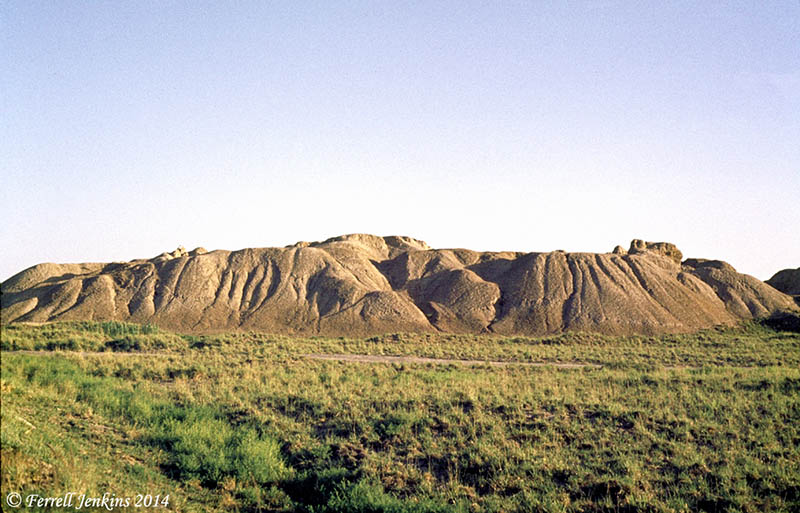
The mound of ancient Babylon in 1970. Photo by Ferrell Jenkins.
As a little flash from the past I thought I would share this 1970 photo made in front of a small Ishtar gate replica that served as the entry to the ruins of Babylon.
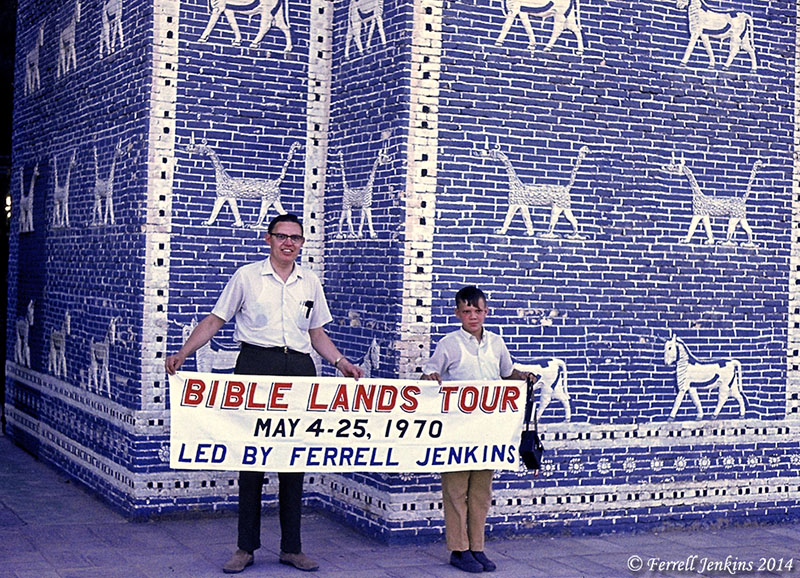
Ferrell Jenkins and Ferrell Jenkins, Jr. at the entry to ancient Babylon.
Notice that the tour was 21 days long. We visited Rome, Greece, Egypt, Lebanon, Iraq, Israel, London, and Lisbon. The cost from New York, including all meals was — drum roll — $1,198!
Posted in Archaeology, Bible Lands, Bible Places, Bible Study, Books, Old Testament, Photography, Travel
Tagged Babylon, Babylon and prophecy., Iraq, Isaiah, Saddam Hussein, tourism
Michael J. Kruger (canon fodder) has written a review of each episode of the History Channel’s Bible Secrets Revealed. He says the series has reminded him of two critical truths:
1. Our popular culture is prone to distort and misrepresent the teachings of the Bible. I was struck again by how sensationalistic and misleading popular-level programming can actually be when it comes to the Bible. Although this series had some good moments, as a whole I was disappointed to see the History Channel offer the standard Da Vinci Code-style approach to the Bible.
2. The church must be equipped to respond to these sorts of critiques. Given the high-profile nature of the History Channel (and similar style programming), the average person we are trying to reach is going to be exposed to this type of material. And we need to be ready to offer some answers if we expect non-Christians to give the biblical message a hearing.
The six reviews cover a wide variety of topics of interest to many people.
Begin here on canon fodder for links to each of the reviews.
Kruger is President and Professor of New Testament at Reformed Theological
Seminary, Charlotte. You will find much useful material on this blog.
HT: Brooks Cochran
Çatalhöyük. Polish archaeologists have discovered containers of barley, said to be 8,200 years old from the Neolithic period, at Çatalhöyük in Turkey.
The largest so far known in the Middle East amount of grain of the Neolithic period in a perfect state of preservation has been discovered by Polish archaeologists in Çatalhöyük, a famous archaeological site in Turkey. Çatalhöyük is one of the largest urban centers of first farmers and one of the most famous archaeological sites in the world.
Read the report, with photo, here.
Preserving Tal Al Umayri in Jordan. Many archaeological sites are in danger of destruction. Tal Al Umayri, south of Amman, Jordan, is going to become an archaeological park. The site is on private property. Now the owners have agreed to give the land for the project. Details here.
New Museum in Petra, Jordan. The report here says,
According to the Petra National Trust, it was visited by around 450,000 people in 2013, though this was a significant drop from 2010’s record number of 975,000 visitors. Officials hope the new museum will encourage tourists to spend more time in the ancient city. It will present the history of Petra and the Nabataeans, as well as house antiquities, but it is unclear what this means for the site’s two existing museums: the Petra Nabataean Museum, opened in 1994, and the Petra Archaeological Museum, opened in 1963.
HT: Steven Braman
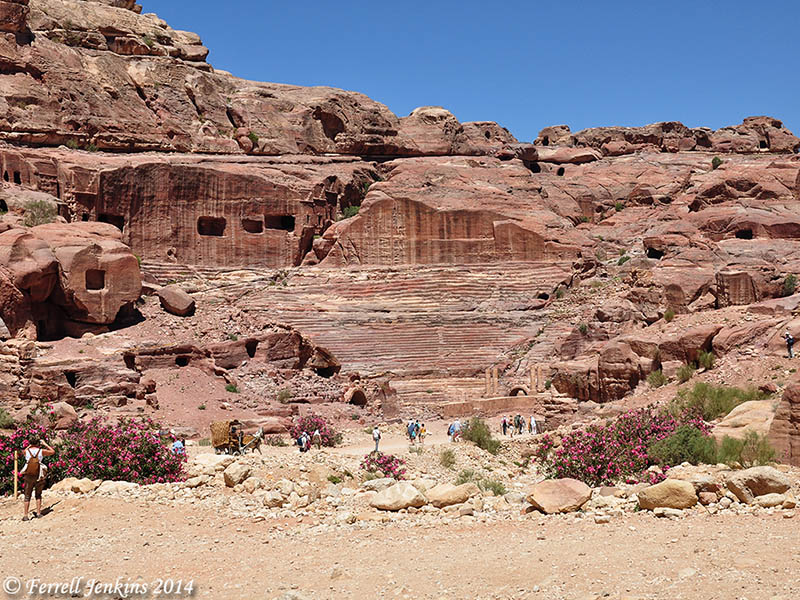
The Roman Theater at Petra. Photo by Ferrell Jenkins.
Old Testament Bibliography by Ray Clendenen. Here is the info from Charles Savelle at Bible X.
You can access Ray Clendenen’s recently revised 385-page Old Testament bibliography here. Note: you have to have an account with academia.edu to access it but if you don’t already have an account,signing up is free.
A Dictionary of the Bible. This five-volume set is now on Community Pricing at Logos. A bid of $15.00 will secure a set in Logos digital format. Information is here.
A Dictionary of the Bible, James Hastings. The work will be in digital format for use with Logos Bible Software.
It is true that this is an old work first published between 1893 and 1905, but it contains some excellent material. The five volumes contain 4,718 page. The projected price of $15 is less than you might pay for a paperback with one good idea in it.
I have owned the hardback set for many years and am anxious to include these volumes in my Logos 5. Logos needs some more orders to produce this set of books. Let’s pull together. Once the work is published in digital format the price will be $99.95.
Posted in Archaeology, Bible Lands, Bible Places, Bible Study, blog, Book Review, Books, Jordan, New Testament, Old Testament, Photography, Travel, Turkey
Tagged History Channel
Do you have a good book on Church History? I have observed that many church members are generally ignorant of church history. A few months ago I learned that two books by Zondervan were to be available in Kindle format for $3.99 each. The second volume in the series was available, but there was some delay in getting the first volume online. Volume two is available today for $3.99. For how long I do not know.
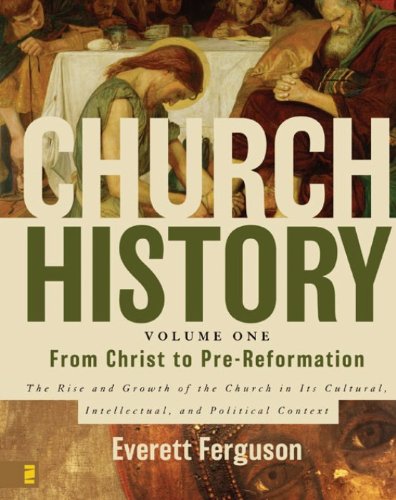
Everett Ferguson’s Church History ,Volume One: From Christ to Pre-Reformation: The Rise and Growth of the Church in Its Cultural, Intellectual, and Political Context: 1
Ferguson is widely respected as a scholar in early church history. With a Ph.D. from Harvard, he is professor emeritus of Bible and distinguished scholar-in-residence at Abilene Christian University. He is author of several books on early Christianity.
An eBook like this could be helpful for travelers visiting the Bible lands. In Turkey, for example, one sees the development of the Church Councils. In Italy there is the rise of the papacy and Catholicism. The Crusades involved numerous countries, including Israel. Sections on monasticism and the rise of Islam can be helpful as well. Ferguson also covers the “Dark Ages” and sets the stage for the earliest Reformation efforts.
Our photo shows ruins of The Church of Mary, also called the Church Council Church, at Ephesus. In A.D. 431 the Council of Ephesus was conducted here.
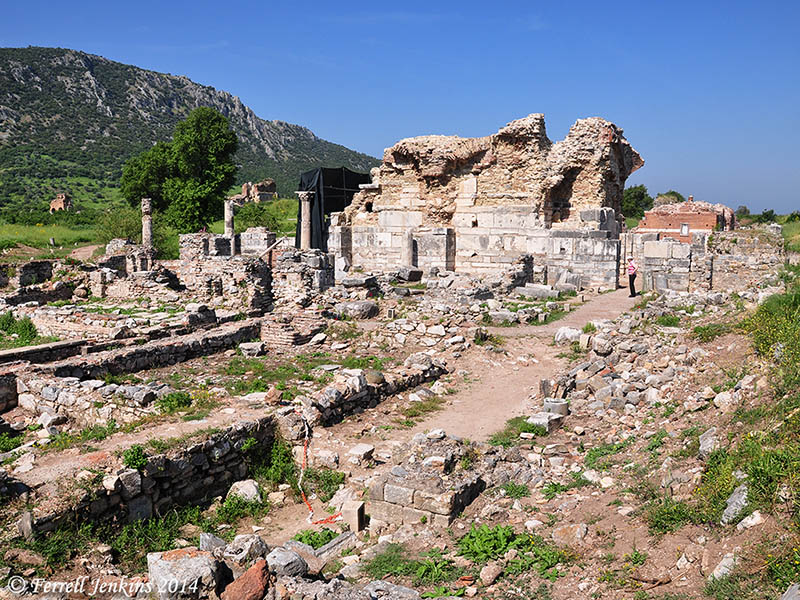
Church of Mary (Church Council Church) at Ephesus. Photo by Ferrell Jenkins.
HT: Brooks Cochran
Posted in Bible Lands, Books, Church History, Israel, New Testament, Photography, Travel, Turkey
Tagged Everett Ferguson, Islam, Italy, Roman Catholicism
The full title of this Haaretz article is “Hiking in Abraham’s footsteps, from Turkey to the Holy Land.” Sounds incredible at the moment. To hike this complete trail from Haran (Genesis 12:4) to Beersheba (Genesis 21:31) (not to mention the trip to Egypt) requires travel in Turkey, Syria, Jordan, Israel, and the Palestinian Authority (West Bank).
Among the leaders back of the concept is David Landis and his wife Anna Dintaman, developers of the Jesus Trail from Nazareth to the Sea of Galilee. Their book, Hiking the Jesus Trail and Other Biblical Walks in the Galilee
Larry Haverstock walked the Jesus Trail in 2011. I see that Larry’s posts about the experience is still available on his blog. See the 3rd Journey. You will find some fascinating stories along with beautiful photos you may never see from a bus or car.
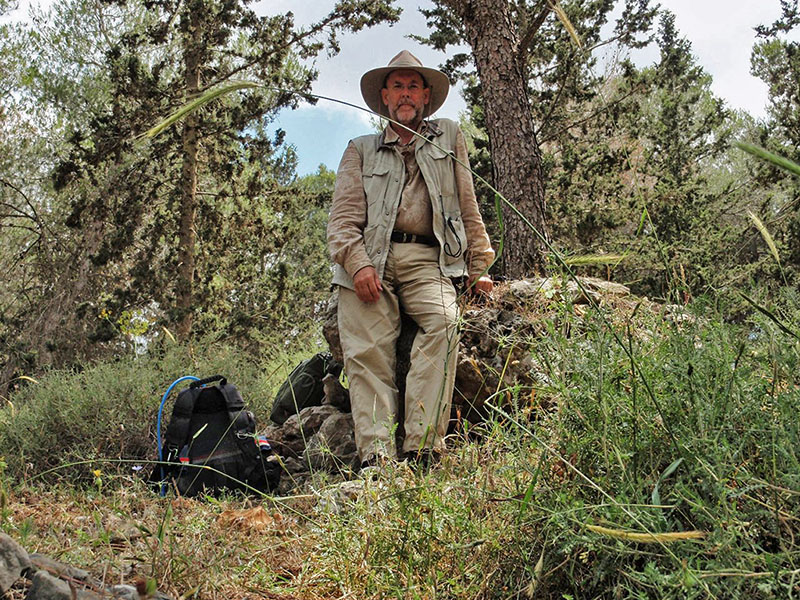
Larry Haverstock in the Zippori Forest north of Nazareth.
The link to the Haaretz article may be accessed here. In order to read the full article you must register for free access to 10 articles a month.
Don’t expect to walk the Abraham Path from Haran (in Turkey) to Beersheva [Beersheba], but you might be able to walk small portions of the trail everywhere except the part going through Syria.
There are many hiking trails in Israel, but most of these avoid contact with the Palestinian Authority. The new plan seeks to involve the local people in the development of facilities useful to hikers.
If you like hiking, or if you appreciate the geography of the Bible lands you will probably enjoy the article. Abraham Path has a nice web site with maps and photos here.
I don’t know what, if any, relationship there is between the Abraham Path and the Patriarchs Way, a trail that is said to run from Beersheba to Nazareth. The defacing of the sign to eradicate the Arabic indicates one of the problems either trail might face. One often sees this sort of thing on signs pointing to Christian sites.
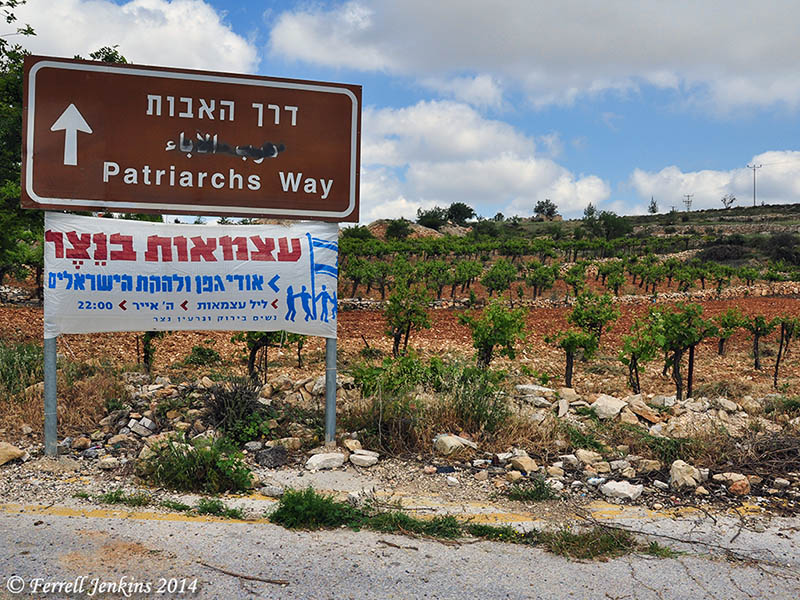
Sign pointing to Patriarchs Way off Hebron Road (Hwy. 60) south of Bethlehem . Photo by Ferrell Jenkins.
Walk the Land : A Journey on Foot through Israel
Posted in Bible Lands, Bible Places, Bible Study, blog, Books, Culture, Egypt, Israel, Jordan, Old Testament, Photography, Travel, Turkey
Tagged Hiking, Palestinian Authority, Syria, West Bank
Since I started with a small single-volume Smith’s Bible Dictionary more than 60 years ago, I have collected dozens of dictionary volumes on my library shelf and on the computer. My favorite single-volume Bible dictionary has been the Zondervan Illustrated Bible Dictionary (Premier Reference Series)
Amazon has this $39.99 volume today (or, at least this hour) for the Kindle priced at $4.99. Dictionaries are more difficult to use on the Kindle than some books, but it is helpful to have some info available when you are away from your home materials.
The hardcover volume of Zondervan Illustrated Bible Dictionary (Premier Reference Series)
Note: Pat, in Kentucky, tells me that this book is available for the Nook also.
HT on the price cut: Brooks Cochran
Posted in Archaeology, Bible Places, Bible Study, Book Review, Books
Recently I have been reading C. S. Lewis – A Life: Eccentric Genius, Reluctant Prophet by Alister McGrath. He says that Warnie found his brother dead at the foot of his bed at 5:30 p.m. [in Oxford], “Friday, 22 November 1963.” Then comes this paragraph:
At that same time, President John F. Kennedy’s motorcade left Dallas’s Love Field Airport, beginning its journey downtown. An hour later, Kennedy was fatally wounded by a sniper. He was pronounced dead at Parkland Memorial Hospital. Media reports of Lewis’s death were completely overshadowed by the substantially more significant tragedy that unfolded that day in Dallas.
C. S. Lewis was buried in the churchyard of Holy Trinity, Headington Quarry, Oxford after a private, and very small service. Warnie chose a phrase from a Shakespearean calendar that was in their home back in Belfast at the time of their mother’s death in August 1908: “Men must endure their going hence.” The quotation is from Shakespeare’s King Lear.
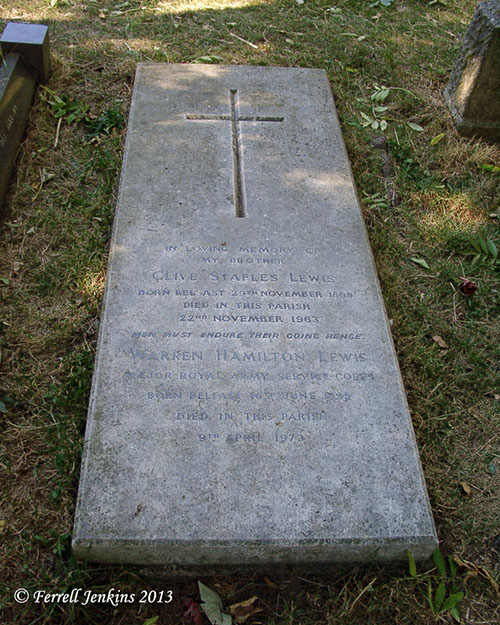
The grave of C. S. Lewis. Photo by Ferrell Jenkins.
McAlister suggests that a better epitaph might be one from Lewis’s own words,
a seed patiently waiting in the earth: waiting to come up a flower in the Gardner’s good time, up into the real world, the real waking. I suppose that our whole present life, looked back on from there, will seem only a drowsy half-waking. We are here in the land of dreams. But cock-crow is coming.
C. S. Lewis is appreciated by many for the Chronicles of Narnia. Others have found his popular apologetic writings helpful. More information, including photos, about sites associated with Lewis is available here.
Posted in Bible Study, Books, Culture, Photography, Travel
Tagged apologetics, C. S. Lewis
The École Biblique et Archéologique in Jerusalem announced Monday the death of Jerome Murphy-O’Connor (1935-2013).
Fr. Jerome Murphy-O’Connor, O.P., passed away peacefully on Monday, November 11, 2013. He was 78 years old.
Fr. Murphy-O’Connor taught for more than four decades at the École Biblique et Archéologique. He was a world-renowned biblical scholar and author of numerous books on St. Paul and the Holy Land. Many throughout the world counted him their friend.
The writings of Murphy-O’Connor have been helpful to me. I have especially enjoyed The Holy Land An Oxford Archaeological Guide which is now in its 5th edition. In my recommendations of books for those traveling to Israel I have annotated this book with the words “Excellent. The Best.” I am pleased to say that I have seen several tour members using their copy of the book. I see the book is now available for the Kindle.
St. Paul’s Corinth: Texts and Archaeology (Good News Studies, Vol. 6) has been helpful in studying about Corinth. His article about traveling conditions in the first century in the second issue of (the now defunct) Bible Review has been extremely helpful in studying Paul’s journeys. (Murphy-O’Connor. “On the Road and on the Sea with St. Paul.” Bible Review 1:2 (1985).
HT: Jack Sasson; Bible Places Blog.
Posted in Archaeology, Bible Lands, Bible Places, Bible Study, Biblical Studies, Book of Acts, Book Review, Books, Israel, New Testament, Photography, Travel
Tagged Apostle Paul
The Center for the Study of New Testament Manuscripts (CSNTM) announces that they have filmed the Chester Beatty papyri. Here is the press release signed by Dr. Daniel B. Wallace, Executive Director of CSNTM:
The Chester Beatty papyri, published in the 1930s and 1950s, are some of the oldest and most important biblical manuscripts known to exist. Housed at the Chester Beatty Library (CBL) in Dublin, they have attracted countless visitors every year. It is safe to say that the only Greek biblical manuscripts that might receive more visitors are Codex Sinaiticus and Codex Alexandrinus, both on display at the British Library.
The Center for the Study of New Testament Manuscripts (CSNTM) is pleased to announce that a six-person team, in a four-week expedition during July–August 2013, digitized all the Greek biblical papyri at the Chester Beatty Library. The CBL has granted permission to CSNTM to post the images on their website (www.csntm.org), which will happen before the end of the year.
The New Testament papyri at the CBL include the oldest manuscript of Paul’s letters (dated c. AD 200), the oldest manuscript of Mark’s Gospel and portions of the other Gospels and Acts (third century), and the oldest manuscript of Revelation (third century). One or two of the Old Testament papyri are as old as the second century AD.
Using state-of-the-art digital equipment, CSNTM photographed each manuscript against white and black backgrounds. The result was stunning. Each image is over 120 megabytes. The photographs reveal some text that has not been seen before.
Besides the papyri, CSNTM also digitized all of the Greek New Testament manuscripts at the CBL as well as several others, including some early apocryphal texts. The total number of images came to more than 5100.
CSNTM is grateful to the CBL for the privilege of digitizing these priceless treasures. The staff were extremely competent and a joy to work with. Kudos to Dr. Fionnuala Croke, Director of CBL, for such a superb staff! This kind of collaboration is needed both for the preservation of biblical manuscripts and their accessibility by scholars.
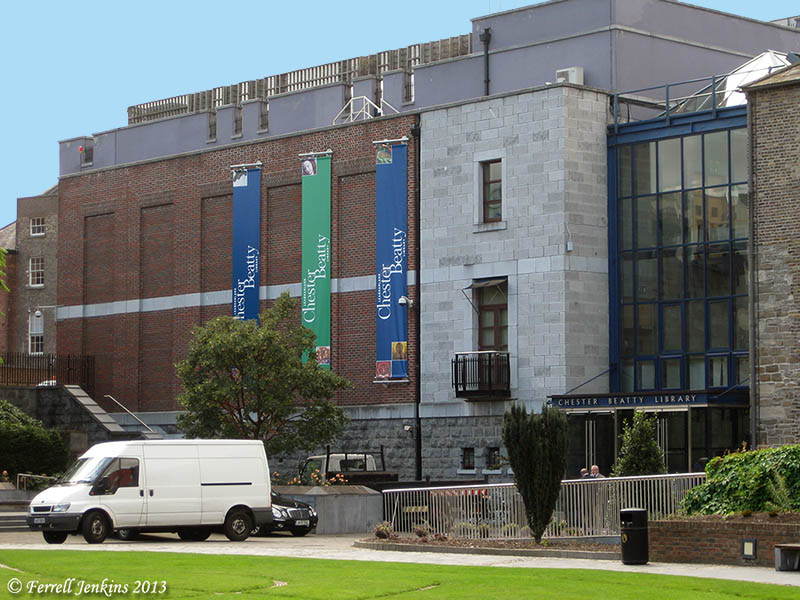
Chester Beatty Library in Dublin, Ireland. Photo by Ferrell Jenkins.
Larry Hurtado tells a little more about the background of this project here. If you wish to see the quality made possible by the CSNTM, see these pages from a 3rd century papyri at the University of Pennsylvania here.
Posted in Bible Study, Biblical Studies, blog, Books, New Testament, Photography, Travel
Tagged Apostle Paul, Biblical Manuscripts, Chester Beatty Papyri, Papyri
How the Bible Came to Be is an Ebook short (about 60 pages) from The Baker Illustrated Bible Handbook. It is available free today only (May 25). The link I am including is only good for the United States.
Here is a list of the subjects covered.
Use this link.
HT: Brooks Cochran
Posted in Bible Study, Biblical Studies, Books, New Testament, Old Testament


 Ferrell's Travel Blog
You must be logged in to post a comment.