Category Archives: Bible Study

David stayed at Mahanaim when he fled from Absalom

The name Mahanaim is found 13 times in the Old Testament. The site is where Jacob and Laban met and made a covenant. Mahanaim seems to mean “two camps” (Genesis 32:2). This is where Jacob’s name was changed to Israel after he wrestled with a man (angel, Hosea 12:4). When morning came, Israel crossed over Penuel (Genesis 32:31).

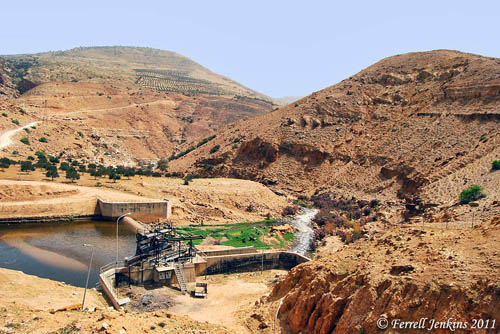
Two large tells face each other and the Jabbok River flows in an S-curve between them. The tells are now named Tall adh-Dhahab East and Tall adh-Dhahab West. These tells are located a few miles east of the Plains of the Jordan and Tell Deir Allah (likely the site of biblical Succoth). Some scholars identify Dhahab West as Mahanaim and Dhahab East as Penuel. Other scholars reverse the identifications.
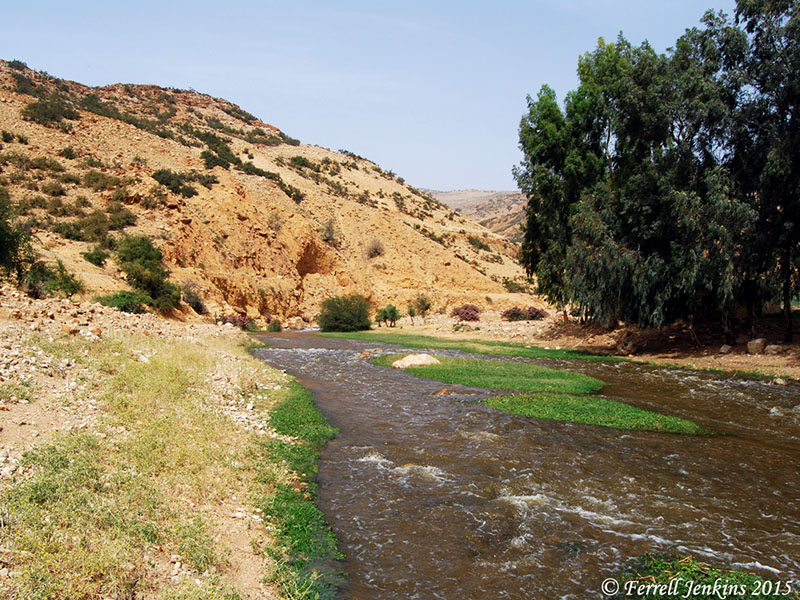
The Jabbok River near Mahanaim. Photo by Ferrell Jenkins.

The Jabbok River near Mahanaim. Photo by Ferrell Jenkins.

When Transjordan was divided among the tribes, Mahanaim was located in the territory of Gad on the boundary with East Manasseh (Joshua 13:26, 30). It was one of the cities allotted to the Levites (Joshua 21:38; 1 Chronicles 6:80).

Ishbosheth made king over Israel from Mahanaim

After the death of Saul, Abner made Ishbosheth, the son of Saul, king over all Israel from Mahanaim (2 Samuel 2:8, 12, 29).

David fled to Mahanaim

When David fled from his rebellious son Absalom he fled across the Jordan to Mahanaim (2 Samuel 17:24, 27; cf. 2 Kings 2:8). Absalom met his death in a nearby forest.

A Gileadite by the name of Barzillai took care of King David while he stayed at Mahanaim (2 Samuel 19:32). The city became one of Solomon’s administrative centers (1 Kings 4:14).

Song 6:13 describes gazing upon the Shulammite girl to be like looking on “the dance of the two camps” or “dance of two companies” (CSB, JPS, NAU, NKJ). Other translations use the expression “the dance of Mahanaim” (ASV, NIV, NJPS, TNIV) or “dance of the Mahanaim” (NET).

Recent excavations at Dhahab West, conducted by a German team, have revealed what they believe to be part of a monumental building of Herod the Great. They think this was the Hellenistic and Roman site described by Josephus as Amathus.
Tall adh-Dhahab East (left) and Tall adh-Dhahab West (right). These are thought to be the sites of Mahanaim and Penuel. Photo by Ferrell Jenkins.

Tall adh-Dhahab East (left) and Tall adh-Dhahab West (right). These are thought to be the sites of Mahanaim and Penuel. Photo by Ferrell Jenkins.

Our photo shows both tells. (Tall adh-Dhahab East is on the left. Tall adh-Dhahab West is on the right.) There is a pumping station on the Jabbok to provide agricultural irrigation. The Jabbok continues in the valley separating the two hills and tells.

Click on the photo for an image suitable for use in teaching presentations.
Ram’s horn announces Rosh Hashanah

Jews will celebrate Rosh Hashanah, the Jewish new year, for two days beginning at sunset September 13. Leading up to the celebration the ram’s horn is blown.

The ram’s horn was important in the history of Israel. One of the words often used for the horn is shofar (or shophar).

  • A long blast on the ram’s horn was used to alert the Israelites when they could approach Mount Sinai (Exodus 19:13).
  • The ram’s horn was sounded at the beginning of important feast days (Leviticus 25:9). On the first day of the seventh month of the Jewish calendar trumpets were to be blown (Numbers 29:1). This festival was known as the Feast of Trumpets.
  • After Israel marched around Jericho they would hear a long blast on the ram’s horn (Joshua 6:5). The word horn in this verse is qeren, but the word shofar is translated trumpet.

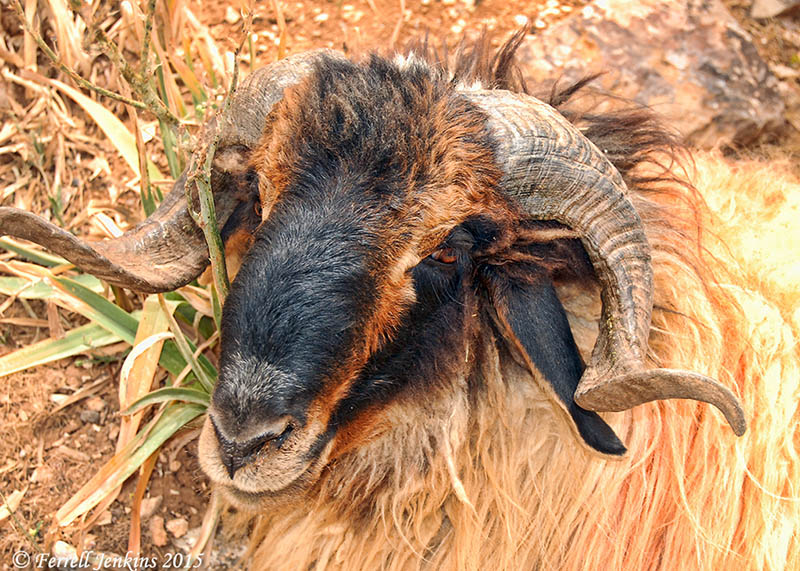
I have observed that shepherds are proud of the ram of the flock. This photo was made in April, 2008, in northern Jordan not very far from Ramoth in Gilead and the border with Syria.

Ram with large horns. Photo taken in northern Jordan near ancient Ramoth Gilead, near the Syrian border in 2008. Photo by Ferrell Jenkins.

Ram with large horns. Photo taken in northern Jordan near ancient Ramoth Gilead, near the Syrian border in 2008. Photo by Ferrell Jenkins.

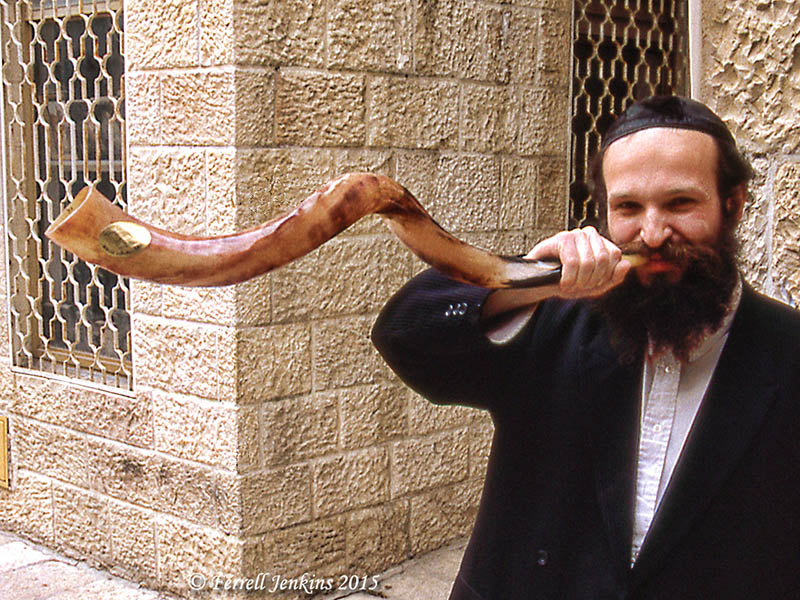
Sometimes in the Jewish Quarter of Jerusalem one of the shopkeepers will demonstrate the sounding of the shofar in hopes of attracting customers. That beautiful horn was a little above my budget. I do not know the animal from which it came. It may be a Yemenite shofar made from the horn of an African kudu. If a reader knows for sure, your comment would be appreciated.

Shofar being sounded in the Jewish Quarter, Jerusalem, in 1993. Photo by Ferrell Jenkins.

Shofar being sounded by a shop owner or clerk in the Jewish Quarter, Jerusalem, in 1993. Photo by Ferrell Jenkins.

Silver trumpets were also to be blown on certain occasions (Numbers 10:1).

For Christians, the sound of a trumpet will signal the coming of the Lord and the resurrection.

For the Lord himself will descend from heaven with a cry of command, with the voice of an archangel, and with the sound of the trumpet of God. And the dead in Christ will rise first.  Then we who are alive, who are left, will be caught up together with them in the clouds to meet the Lord in the air, and so we will always be with the Lord.  Therefore encourage one another with these words. (1 Thessalonians 4:16-18 ESV)

Behold! I tell you a mystery. We shall not all sleep, but we shall all be changed,
52 in a moment, in the twinkling of an eye, at the last trumpet. For the trumpet will sound, and the dead will be raised imperishable, and we shall be changed.
(1 Corinthians 15:51-52 ESV)

Joab and Uriah travel from Jerusalem to Rabbah

Last evening I was looking at the biblical account of David’s battles against the Ammonites (2 Samuel 10-11).

In the spring of the year, at the time when kings normally conduct wars, David sent out Joab with his officers and the entire Israelite army. They defeated the Ammonites and besieged Rabbah. But David stayed behind in Jerusalem. (2 Samuel 11:1 NET)

You probably know the rest of the story. David is attracted to Bathsheba, commits adultery, learns Bathsheba is pregnant, calls Uriah home in hope that he will spend the night with Bathsheba. Uriah acted in the true warrior way by not enjoying the benefits of the marriage bed while his companions were camping in the open field. David sent Uriah back to the battle with a letter to Joab to put Uriah in the forefront of the battle.

Have you thought about the journey made by Uriah and the other Israelite soldiers as they traveled from Jerusalem to Rabbah and back? You know where Jerusalem is located. It is situated on the eastern side of the water parting ridge of Israel at an elevation of about 2400 feet above sea level. Numerous times we have discussed the journey from Jerusalem to the Jordan Valley. See here and here.

The distance from Jerusalem to the Dead Sea is not more than 20 miles. The elevation drops from about 2600 feet at the Mount of Olives to (currently) about 1384 feet below sea level at the surface of the Dead Sea. The point of crossing at the Jordan River would be a little higher. From there one must go up into the Transjordan Tableland to reach Rabbah. The general elevation of the Transjordan Tableland is about 3000 feet above sea level. Amman is about 2500 feet above sea level. That makes this a difficult route of travel.

Rabbah (Rabbath), the capital of ancient Ammon, is the site we now know as Amman, capital of Jordan. During the Hellenistic period the city was renamed Philadelphia.

The total distance from Jerusalem to Rabbah is about 40 miles as the crow flies. Men rarely travel like crows. The distance by road is longer and more difficult.

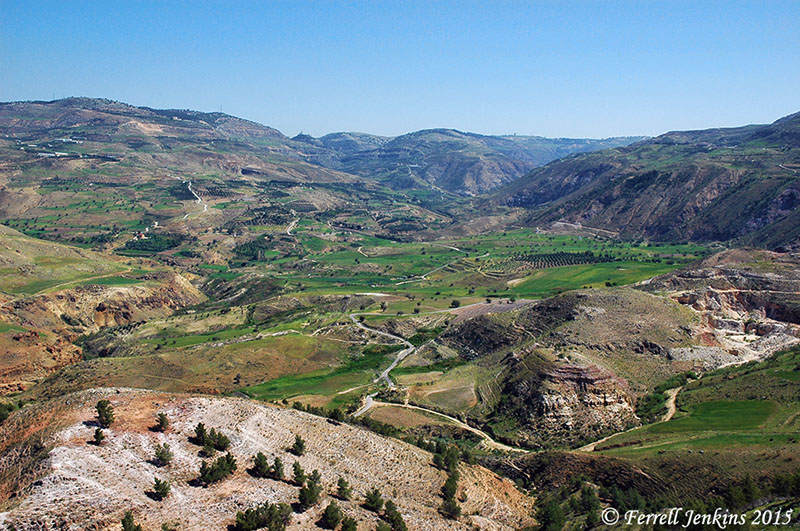
The photo I wish to share today was made in early April. It was made along a road a little east of the Jordan Valley and the Plains of Moab. From here you can see the terrain David’s men, including Joab and Uriah, had to travel on their way from Jerusalem to Rabbah. Modern Amman is located in the mountains we see on the horizon.

View looking east toward Amman. Photo by Ferrell Jenkins.

View looking east toward Amman. Photo by Ferrell Jenkins.

Learning routes of travel is one of the most important values in visiting the Bible lands. I hope this photo will help you with your study of the biblical account.

Reprint from 12/2/10.

“A dry and weary land where there is no water”

The title to Psalm 63 states that it is “a Psalm of David, when he was in the wilderness of Judah.”

David says his soul thirsts for God; his flesh faints for God, “as in a dry and weary land where there is no water.”

O God, you are my God; earnestly I seek you; my soul thirsts for you; my flesh faints for you, as in a dry and weary land where there is no water. (Psalm 63:1 ESV)

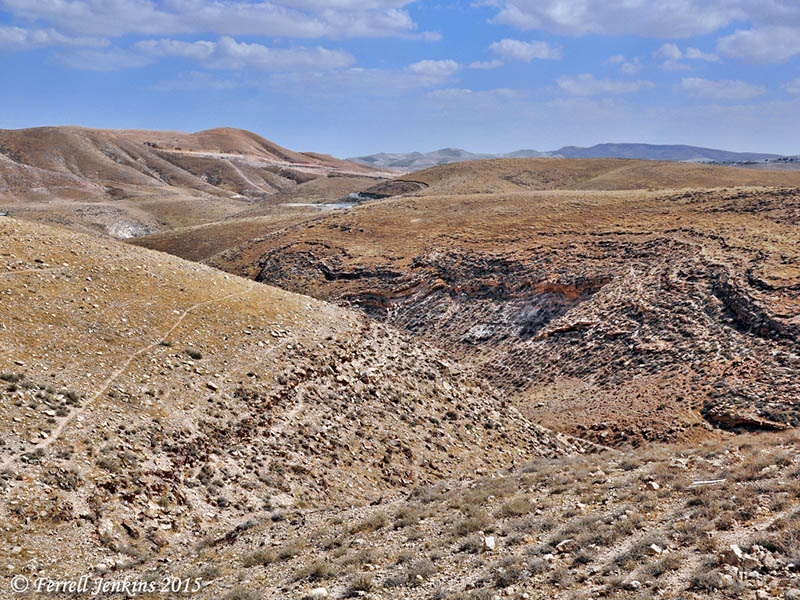
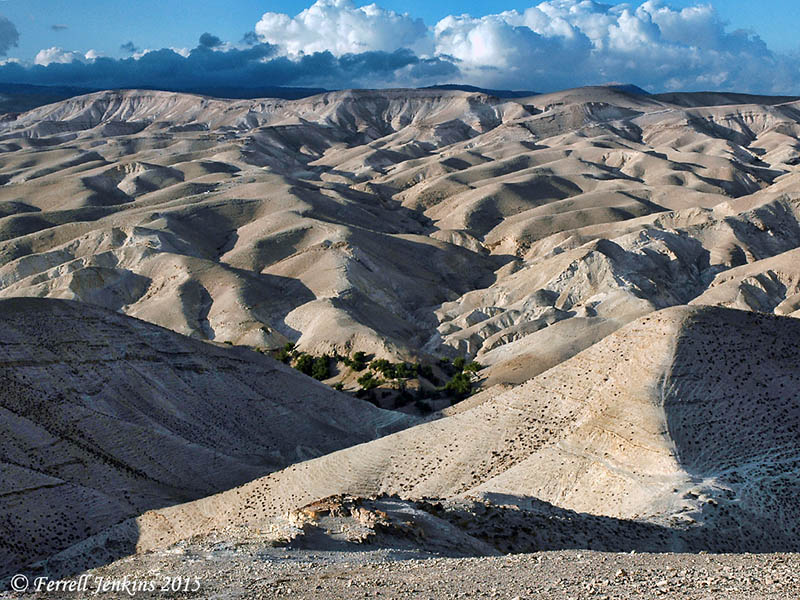
In my experience, most travelers who see the wilderness of Judah for the first time are surprised that it is a dry, barren, rugged wasteland. Perhaps our photos in this post will allow you to see the vividness of David’s illustration.

The first photo was made a few miles east of Jerusalem in the vicinity of Michmash. You can see some dry grass left over from the winter rains. David would have passed through territory like this when he fled from Jerusalem during the rebellion of his son Absalom (2 Samuel 15).

A view of the wilderness of Judah from near Michmash. Photo by Ferrell Jenkins.

A view of the wilderness of Judah from near Michmash. Photo by Ferrell Jenkins.

The next photo was made much further south between Arad and the southern end of the Dead Sea. It was territory more like this where David hid when he was fleeing from Saul (1 Samuel 23, et al.).

A view in the wilderness between Arad and the Dead Sea. Photo by Ferrell Jenkins.

A view in the wilderness between Arad and the Dead Sea. Photo by Ferrell Jenkins.

This is indeed a dry and weary land where there is no water.

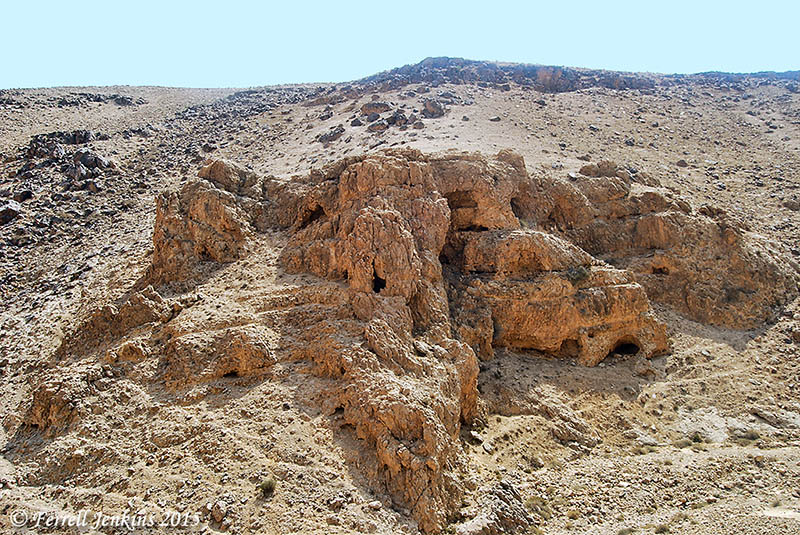
Even where there might be some water, such as Wadi Qelt, the wilderness can be foreboding.

The wilderness of Judah with a view of Wadi Qelt visible. Photo by Ferrell Jenkins.

The wilderness of Judah with a view of Wadi Qelt visible. Photo by Ferrell Jenkins.


Philistines introduced new plants to the coastal plain

One of my neighbors came to the USA from an Asian country spelled with five letters beginning with “I”. After he moved in, some strange plants that I had not seen in our part of the world began to grow. Perhaps he got then at  Exotic Plants R Us, but I doubt it.

Maybe you have had the same experience. Apparently the same thing happened to ancient Israel. Typical plants known to the Biblical Israelites include wheat, barley, grapes, olives, pomegranate, date, and fig.

Sign in the Ashkelon National Park indicating one of the groups that inhabited the city. Photo by Ferrell Jenkins.

Sign in the Ashkelon National Park indicating one of the groups that inhabited the city. Photo by Ferrell Jenkins.

What happened when the Philistines moved in? A recent article by Frumin, Maeir, Horwitz, and Weiss in Scientific Reports provides an answer. The authors describe their approach.

Here we propose a novel research approach aiming to study the different anthropogenic impacts on an ecosystem resulting from the advent of an extinct historical culture, the Philistines–one of the so-called “Sea Peoples”–that appeared in the southern Levantine littoral, after ca. 1,200 BCE. Until quite recently, the accepted view was that the Philistines originated from a single region, most likely somewhere in the Aegean. Recent research has revised this view and shown that in fact, the Philistine culture is comprised of migrants of multiple foreign origins, including the Aegean, who, when arriving in Canaan, intermingled with local Canaanites. The non-Levantine origin of a substantial portion of the Philistine culture is evidenced by their distinctive architecture, ceramic ware, technologies and ritual activities that point to their diverse and multifaceted origins with different components resembling Aegean, Cypriot, Anatolian, Egyptian and even Southeast European cultures.

The article is chocked-full of maps and diagrams which I will leave for you to explore at your leisure. What really caught my attention was the introduction of new species of plants by the Philistines. The three plants were,

  1. Cumin (Cuminum cyminum), found at Aphek in the early Iron Age.
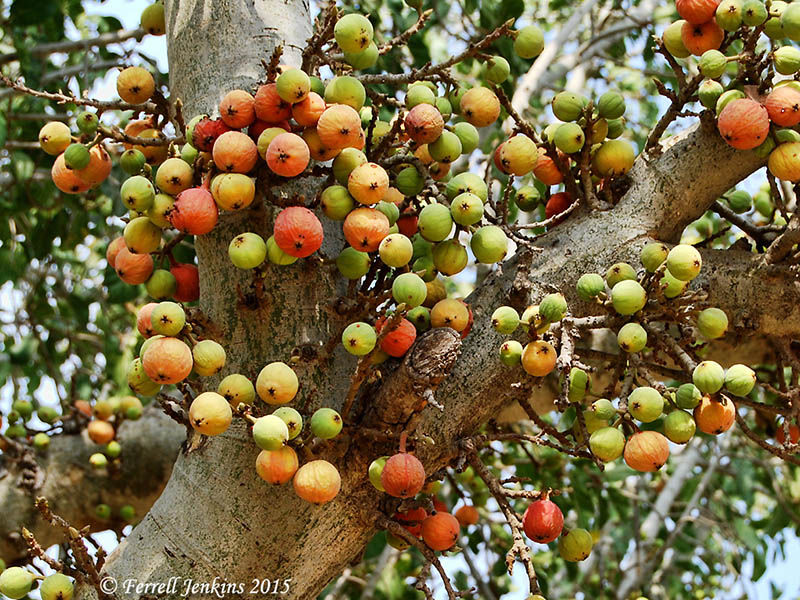
  2. Sycamore (Ficus sycomorus) found at Ashkelon in the late Iron Age.
  3. Opium poppy (Papaver somniferum) found at Ashkelon in the late Iron Age.

Cumin and sycamore came from the Eastern Mediterranean, but opium came from west Europe.

Let’s take a look at a few Biblical references to cumin and sycamore.

Cumin is mentioned by the prophet Isaiah in the 8th century B.C. (28:25, 27), and then by Jesus in the first century A.D.

“Woe to you, scribes and Pharisees, hypocrites! For you tithe mint and dill and cumin, and have neglected the weightier matters of the law: justice and mercy and faithfulness. These you ought to have done, without neglecting the others. (Matthew 23:23 ESV)

Cummin for sale at Aswan, Egypt. Photo by Ferrell Jenkins.

Cummin for sale at Aswan, Egypt. Photo by Ferrell Jenkins.

The sycamore is mentioned in connection with Solomon who wanted to make cedars as plentiful in Jerusalem as the sycamores were in the Shephelah.

And the king made silver as common in Jerusalem as stone, and he made cedar as plentiful as the sycamore of the Shephelah. (1 Kings 10:27 ESV)

Amos of Tekoah claimed to be one who took care of the sycamore fig trees.

Then Amos answered and said to Amaziah, “I was no prophet, nor a prophet’s son, but I was a herdsman and a dresser of sycamore figs. (Amos 7:14 ESV)

And there is the well known story of Zacchaeus who climbed up into a sycamore tree at Jericho in order to see Jesus as He passed by.

So he ran on ahead and climbed up into a sycamore tree to see him, for he was about to pass that way. (Luke 19:4 ESV)

Sycamore figs at Ashkelon. Photo by Ferrell Jenkins.

Sycamore figs at Ashkelon. Photo by Ferrell Jenkins.

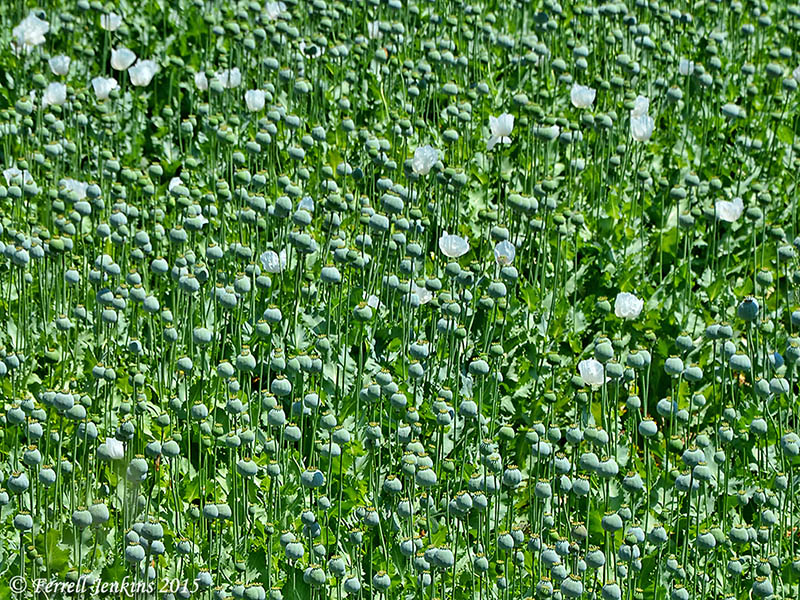
The opium poppy is not mentioned in the Bible and is not currently grown in Israel. Turkey is one of three countries where it is grown for medicinal purposes . I have seen small fields of it in several places in Turkey.

Opium poppies are grown for medicinal purposes in Turkey. Photo by Ferrell Jenkins.

Opium poppies are grown for medicinal purposes in Turkey. Photo by Ferrell Jenkins.

The link to the full article by Frumin, Maeir, et al. is here. Near the top there is a link to the PDF file. An informative article by Nir Hasson appeared in Haaretz here earlier this week.

Archaeology does not consist solely of stone walls and broken pottery. It also includes uncovering and identifying the tiniest of seed.

HT: Thanks to Aren Maeir, director of the excavation at Gath for the original article. Check out his blog.

Possible speaker’s podium found in City of David

The first headline I clicked on this morning when Haaretz arrived was the one reading “Second Temple-era Soapbox Found in City of David?” I located the IAA press release, and then a few hours later my inbox was loaded with links to various coverage of the find.

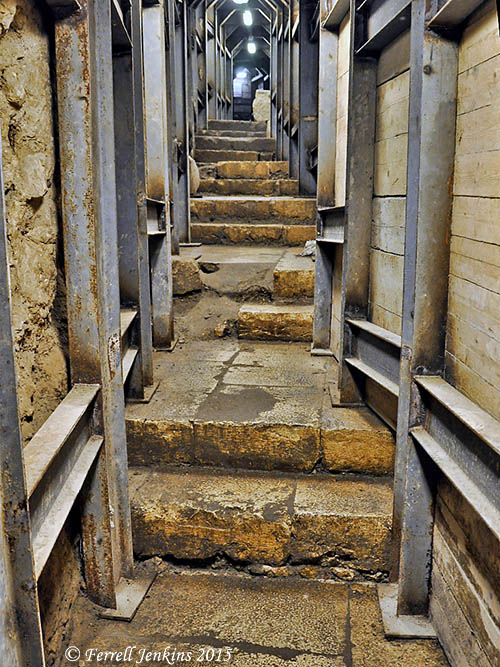
Several years ago the archaeologists working in the City of David uncovered a staircase and a drainage channel leading from the Temple Mount to the Pool of Siloam.

My group was one of the first to walk through the drainage channel in May, 2010. See my report and photos here.

Here is a photo of the steps leading from the Pool to the Temple Mount.

Steps leading from the Pool of Siloam to the Temple Mount. Photo by Ferrell Jenkins.

Steps leading from the Pool of Siloam to the Temple Mount. Photo by Ferrell Jenkins.

The discovery we report today was somewhere along those steps. The press release issued today by the Israel Antiquities Authority says,

This structure, situated alongside the 2,000 year old Second Temple stepped street, which carried pilgrims on their way from the Shiloah (Siloam) Pool to the Temple, which stood atop the Temple Mount. The street, a section of which was excavated in the past, is remarkably well-preserved and is built of enormous stone slabs. The street most likely runs above the 2,000 year old drainage channel, discovered a number of years ago, which carried rain water out of the city. It was constructed sometime in the fourth decade of the first century CE, and was one of the largest construction projects undertaken in Jerusalem during the Second Temple period. Dozens of whole pottery vessels, stone vessels and glassware were found at the foot of the pyramid-shaped staircase.

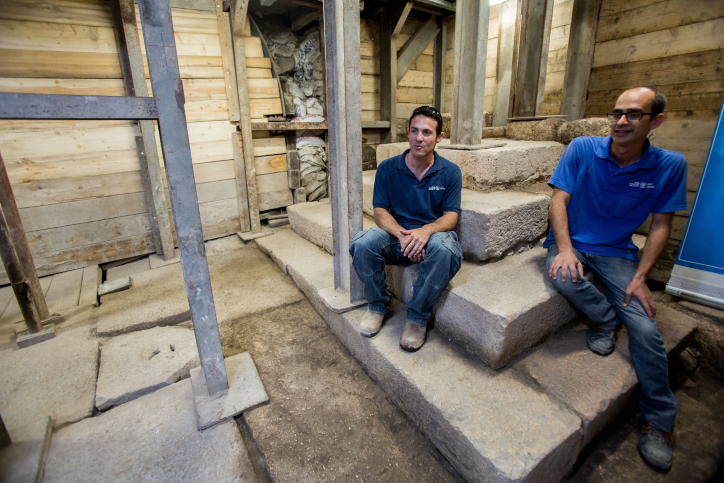
Szanton and Uziel sit on the recently uncovered podium. Photo: IAA

Szanton and Uziel sit on the recently uncovered podium. Photo: IAA

According to archaeologists Nahshon Szanton and Dr. Joe Uziel, who direct[ed] the excavation on behalf of the Israel Antiquities Authority, “The structure exposed is unique. To date such a structure has yet to be found along the street in the numerous excavations that have taken place in Jerusalem and to the best of our knowledge outside of it. For this reason, its exact use remains enigmatic. The structure is built along the street in a place that is clearly visible from afar by passers-by making their way to the Temple. We believe the structure was a kind of monumental podium that attracted the public’s attention when walking on the city’s main street. It would be very interesting to know what was said there 2,000 years ago. Were messages announced here on behalf of the government? Perhaps news or gossip, or admonitions and street preaching – unfortunately we do not know. Bliss and Dickie, two British archaeologists who discovered a small portion of this structure about 100 years ago, mistakenly thought these were steps that led into a house that was destroyed. They would certainly be excited if they could come back today and see it completely revealed.”

Rabbinic sources speak of an “auction block” where slaves could be sold, and of a “Stone of Claims” where one who had found an item might announce it and the owner might claim it. The IAA Press release provides the references here.

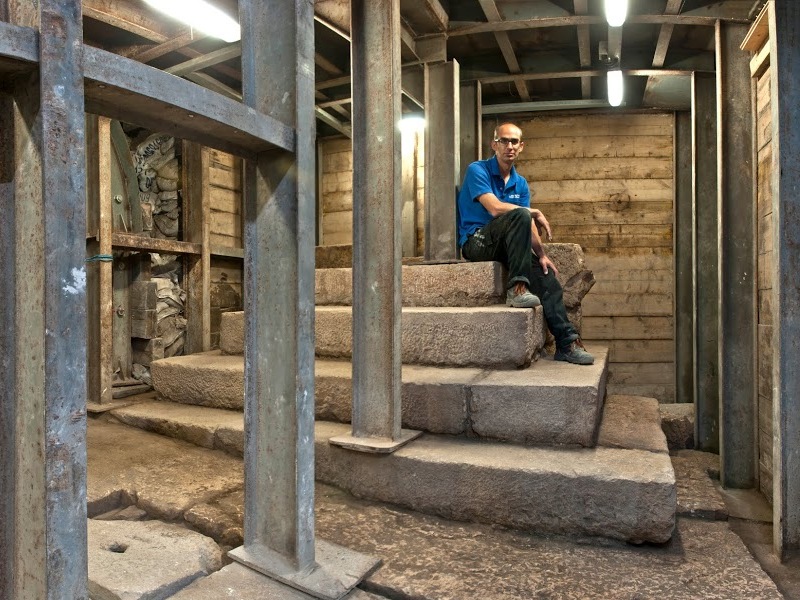
Dr. Joe Uziel seated on the top step of the "podium." Photo: IAA.

Dr. Joe Uziel seated on the top step of the “podium.” Photo: IAA.

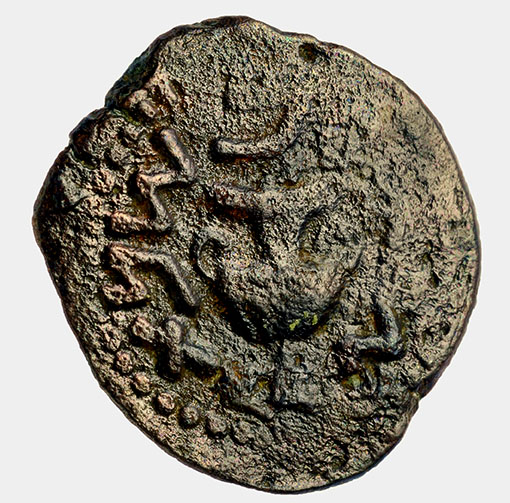
The coin below, from the Second Temple period, was found in the destruction layer atop the street.

Coin from period of the Great Revolt against the Romans. Copyright Clara Amit, IAA.

Coin from period of the Great Revolt against the Romans. Copyright Clara Amit, IAA.

We had already made a possible association of these steps with the blind man who left the Temple precinct to go to the Pool of Siloam at the bidding of Jesus (John 9).

A passage that now comes to my mind is from the Sermon on the Mount when Jesus teaches His disciples how to (and not to) pray.

And when you pray, you must not be like the hypocrites. For they love to stand and pray in the synagogues and at the street corners, that they may be seen by others. Truly, I say to you, they have received their reward. (Matthew 6:5 ESV)

HT: Joseph I Lauer for the additional links.

New “water law” inscription from Laodicea

Hurriyet Daily News reports here the discovery at Laodicea of a marble slab containing a code of laws pertaining to the water supply of the city during the reign of the Roman Emperor Trajan in 114 A.D. The article says,

The rules were prepared by Anatolian State Governor Aulus Vicirius Matrialis.

This marble slab discovered at Laodicea contains a code of laws protecting the water supply of the city of Laodicea in the early second century A.D. (Photo credit: AA photo)

This marble slab discovered at Laodicea contains a code of laws protecting the water supply of the city of Laodicea in the early second century A.D. (Photo credit: AA photo)

Here is some further information about the discovery.

The excavation works, led by Pamukkale University and supported by Denizli Municipality, have continued on Stadium Street in the ancient site. Excavations head Professor Celal Şimşek of Pamukkale University, said, “The Laodicea Assembly made this law in 114 A.D. and presented it to a pro council in Ephesus for approval.

The pro council approved the law on behalf of the empire. Water was vital for the city. This is why there were heavy penalties against those who polluted the water, damaged the water channels or reopening the sealed water pipes. Breaking the law was subject to a penalty of about 12,500 denarius – 125,000 Turkish Liras.”

One hundred twenty-five thousand Turkish Liras amount to approximately $42,700. Fairly stiff fine.

The full article is accompanied by several nice photos and will be well worth your time. Another article about the discovery appears in Ancient Origins here.

Last year my fellow-traveler Leon Mauldin and I made a personal study tour in Turkey. We had the opportunity to make a return visit to Laodicea and see the continuing excavations at the site. I think the city is destined to become one of the most popular sites in the country.

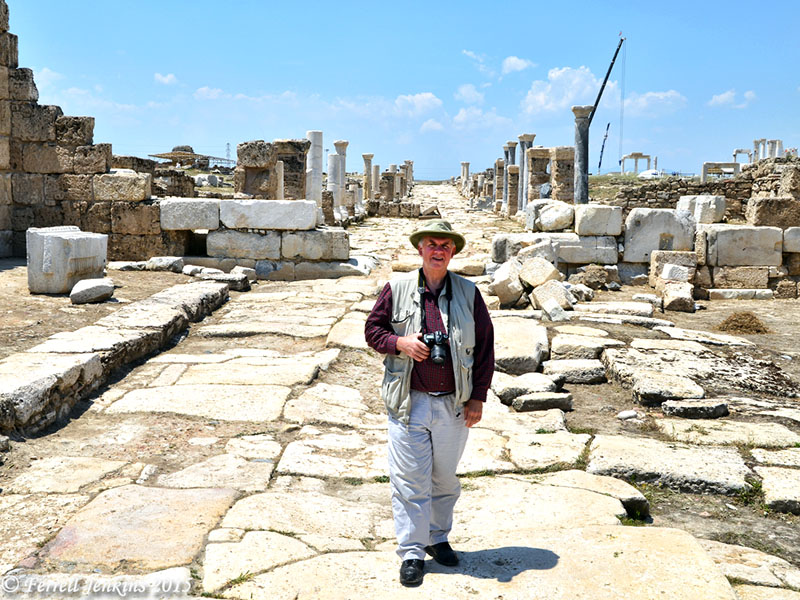
Leon Mauldin on Syria Street in Laodicea. Photo by Ferrell Jenkins.

Leon Mauldin on Syria Street in Laodicea. Photo by Ferrell Jenkins.

Laodicea is known to us from the book of Revelation (1:11; 3:14-22), and from Paul’s epistle to the Colossians.

For I testify for him that he has a deep concern for you and for those who are in Laodicea and Hierapolis. Luke, the beloved physician, sends you his greetings, and also Demas. Greet the brethren who are in Laodicea and also Nympha and the church that is in her house. When this letter is read among you, have it also read in the church of the Laodiceans; and you, for your part read my letter that is coming from Laodicea. (Col 4:13-16 NAU)

One might easily connect this discovery to what we already knew about the water system at Laodicea. I was rather sure that I had written about the source of water and the water distribution tower, but I find only the photo of the tower here. I have written about the subject in material distributed to my tour members. Perhaps I will be able to reprint some of that material in another post. Meanwhile, I call attention to the recent good post by Carl Rasmussen about this same discovery. He includes comments about the “lukewarm” water at the Holy Land Photos’ Blog here.

HT: Joseph I. Lauer

Discovery of first century ritual bath with inscriptions and drawings

The Israel Antiquities Authority announced Wednesday the discovery of a ritual bath (mikveh, miqwe) dating to the second temple period in the Arnona quarter of Jerusalem during the construction of a nursery school. Arnona is east of the Hebron Road and north of Ramat Rahel.

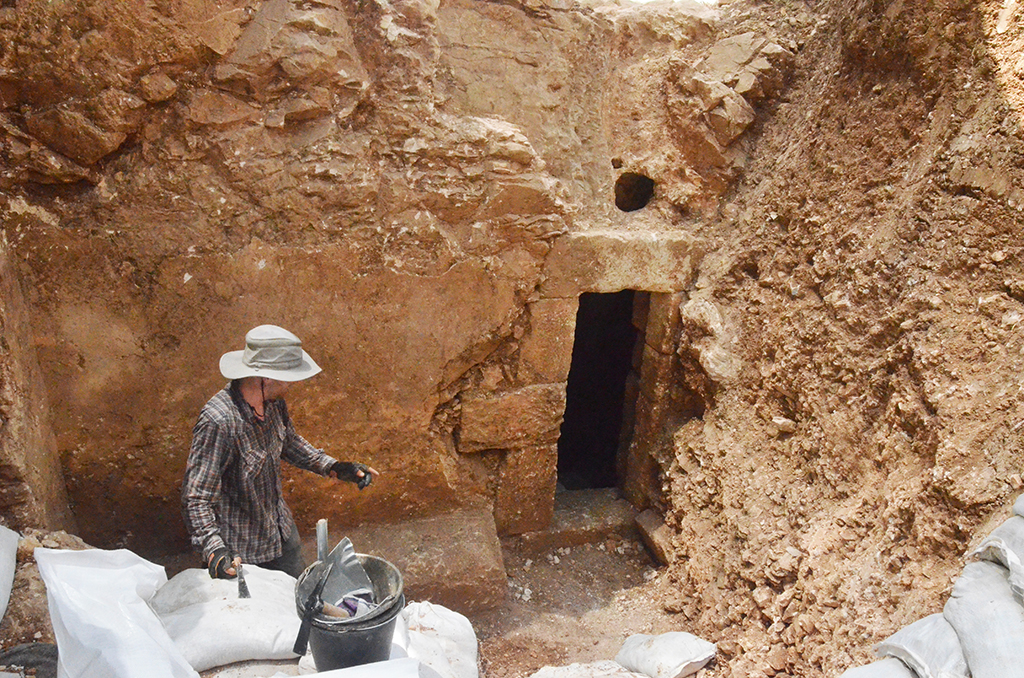
In the excavation an impressive ritual bath (miqwe) dating to the time of the Second Temple (first century CE) was exposed inside an underground cave. An anteroom, flanked by benches, led to the bath. A winepress was excavated alongside the ritual bath.

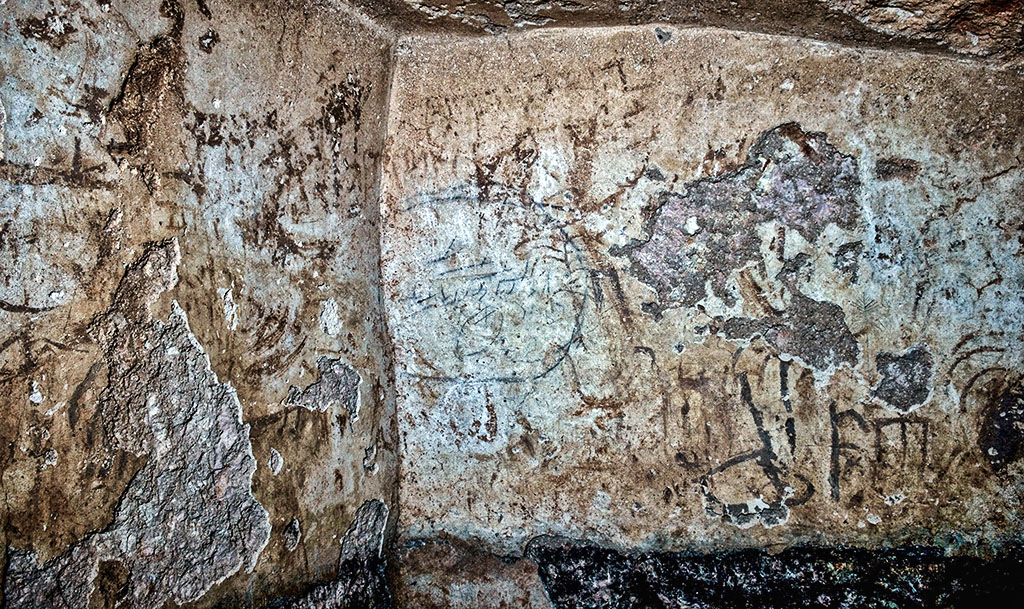
The walls of the miqwe were treated with ancient plaster and were adorned with numerous wall paintings and inscriptions, written in mud, soot and incising. The inscriptions are Aramaic and written in cursive Hebrew script, which was customary at the end of the Second Temple period. Among the symbols that are drawn are a boat, palm trees and various plant species, and possibly even a menorah.

The entrance to the cave when discovered during an inspection by the Israel Antiquities Authority, prior to the construction of a neighborhood nursery school. Photo by Shai Halevy, courtesy of the IAA.

The entrance to the cave when discovered during an inspection by the Israel Antiquities Authority, prior to the construction of a neighborhood nursery school. Photo by Shai Halevy, courtesy of the IAA.

The IAA English press release with a link to 11 photos and a short raw video may be downloaded here. I will post just one more of the photos showing some drawings and inscriptions on the walls of the mikveh. [Added note: I have been informed that the news release I mentioned above does not have the photos and video. Here is a link to that material on Dropbox. I have no control over this material on other sites. If you would like to get 2.25 gig of Dropbox free, click here.]

Inscription on the wall of the ritual bath. Photo Shai Halevy, courtesy IAA.

Inscriptions on the walls of the ritual bath. Photo Shai Halevy, courtesy IAA.

Arutz Sheva includes all of the photos provided by the IAA and their own video of the mikveh. They point out that the claim that this mikveh dates to the end of the second temple period (by A.D. 70?) is indicated by the script, pottery, and coins.

Something I noticed in the IAA video that I did not see mentioned is that there are two characters depicted on the wall. In my knowledge this is not otherwise known as early as the end of the second temple period. In later centuries it became common to have humans depicted. Is it because this is not a synagogue? Comments by knowledgeable persons welcomed.

Two significant New Testament references mention the Jewish rites of purification.

Now there were six stone water jars there for the Jewish rites of purification, each holding twenty or thirty gallons. (John 2:6 ESV)

Now a discussion arose between some of John’s disciples and a Jew over purification. (John 3:25 ESV)

Leen Ritmeyer reports on this discovery here and includes a couple of his drawings to help illustrate the find.

Many fascinating discoveries are made as a result of various types of construction work. Keep up the good work.

HT: Joseph I. Lauer and several Israeli papers.

Iron Age fortification and possible gate discovered at Gath

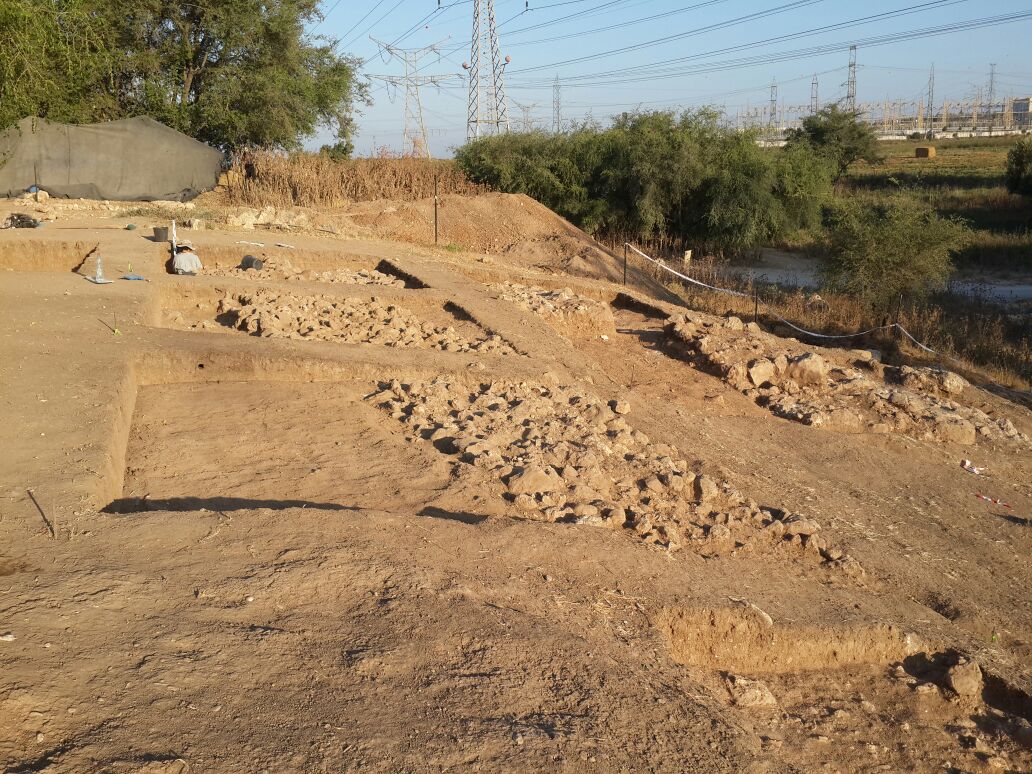
This is a view of the remains of the Iron Age city wall of Philistine Gath. Credit: Prof. Aren Maeir, Director, Ackerman Family Bar-Ilan University Expedition to Gath

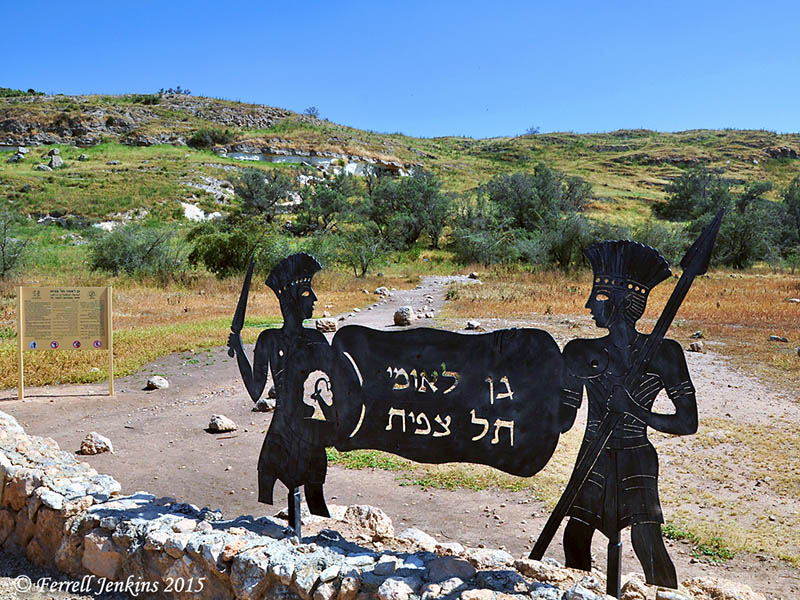
A sign welcoming visitors to Tel Safi, now identified as Gath. Photo by Ferrell Jenkins.

Gath was a significant city during much of Old Testament history. Here are a few of the interesting things we know about Gath from the Bible:

  • Gath was one of the five major cities of the Philistines (1 Samuel 6:17).
  • The ark of the covenant was brought here by the Philistines after being capture in battle with the Israelites (1 Samuel 5:8).
  • Goliath was from Gath (1 Samuel 17).
  • David once sought refuge from Achish king of Gath (1 Samuel 21).
  • When Saul and Jonathan died, David did not want it to be published among the Philistines. He said, “Tell it not in Gath, Proclaim it not in the streets of Ashkelon, Or the daughters of the Philistines will rejoice, The daughters of the uncircumcised will exult” (2 Samuel 1:20).
  • King Uzziah broke down the wall of Gath, and other Philistine cities, and built Judean cities (2 Chronicles 26:6).

Gath is now identified with Tel es-Safi (or Tel Safi). The archaeological excavation known as The Ackerman Family Bar-Ilan University Expedition is under the direction of Prof. Aren Maeir. The recent season has been an exciting one with the announcement Monday of the discovery of  “fortifications and apparent gate of the lower city.” Maeir provides a list here of some of the news sources making the announcement.

The Ackerman Family Bar-Ilan University Expedition to Gath, headed by Prof. Aren Maeir, has discovered the fortifications and entrance gate of the biblical city of Gath of the Philistines, home of Goliath and the largest city in the land during the 10th-9th century BCE, about the time of the “United Kingdom” of Israel and King Ahab of Israel. The excavations are being conducted in the Tel Zafit National Park, located in the Judean Foothills, about halfway between Jerusalem and Ashkelon in central Israel.

Prof. Maeir, of the Martin (Szusz) Department of Land of Israel Studies and Archaeology, said that the city gate is among the largest ever found in Israel and is evidence of the status and influence of the city of Gath during this period. In addition to the monumental gate, an impressive fortification wall was discovered, as well as various building in its vicinity, such as a temple and an iron production facility. These features, and the city itself were destroyed by Hazael King of Aram Damascus, who besieged and destroyed the site at around 830 BCE.

The city gate of Philistine Gath is referred to in the Bible (in I Samuel 21) in the story of David’s escape from King Saul to Achish, King of Gath.

Now in its 20th year, the Ackerman Family Bar-Ilan University Expedition to Gath, is a long-term investigation aimed at studying the archaeology and history of one of the most important sites in Israel. Tell es-Safi/Gath is one of the largest tells (ancient ruin mounds) in Israel and was settled almost continuously from the 5th millennium BCE until modern times.

The archaeological dig is led by Prof. Maeir, along with groups from the University of Melbourne, University of Manitoba, Brigham Young University, Yeshiva University, University of Kansas, Grand Valley State University of Michigan, several Korean universities and additional institutions throughout the world.

Among the most significant findings to date at the site: Philistine Temples dating to the 11th through 9th century BCE, evidence of an earthquake in the 8th century BCE possibly connected to the earthquake mentioned in the Book of Amos 1:1, the earliest decipherable Philistine inscription ever to be discovered, which contains two names similar to the name Goliath; a large assortment of objects of various types linked to Philistine culture; remains relating to the earliest siege system in the world, constructed by Hazael, King of Aram Damascus around 830 BCE, along with extensive evidence of the subsequent capture and destruction of the city by Hazael, as mentioned in Second Kings 12:18; evidence of the first Philistine settlement in Canaan (around 1200 BCE); different levels of the earlier Canaanite city of Gath; and remains of the Crusader castle “Blanche Garde” at which Richard the Lion-Hearted is known to have been.

This photograph of the lower city fortifications is included with the news release.

This is a view of the remains of the Iron Age city wall of Philistine Gath. Credit: Prof. Aren Maeir, Director, Ackerman Family Bar-Ilan University Expedition to Gath

This is a view of the remains of the Iron Age city wall of Philistine Gath. Credit: Prof. Aren Maeir, Director, Ackerman Family Bar-Ilan University Expedition to Gath

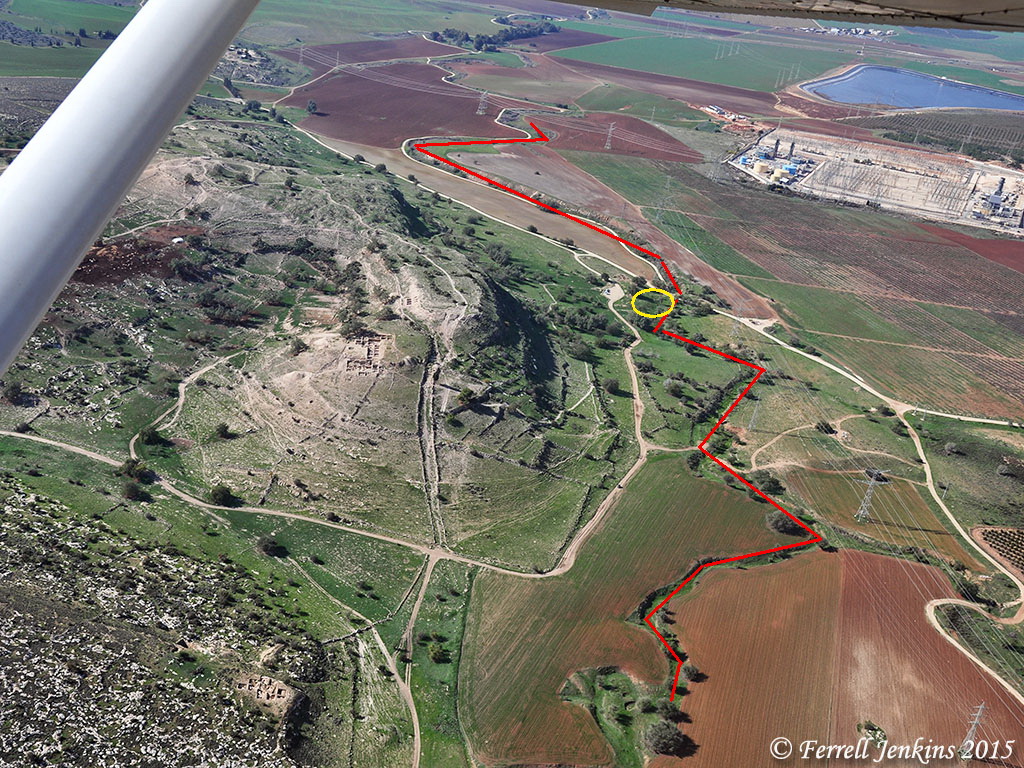
My aerial photos of Tel Safi were made in December, 2009. I want to point out that Gath is on the edge of the Shephelah and the beginning of the southern coastal plain which can be seen in this photo. The brook of Elah runs on the north side of the mound, then curves south and west. I have marked some of it in red.

Aerial view of Tel es-Safi/Gath. Photo by Ferrell Jenkins.

Aerial view of Tel es-Safi/Gath. Photo and markings by Ferrell Jenkins.

The best I can tell from the limited photos provided, the new discovery is in the area marked by the yellow oval.

Maeir has been dropping hints about this discovery on his blog for the past few weeks. On July 28th he provided an aerial photo of the “fortifications and possible city gate.” He says that “more than 30 meters of the city wall” has been traced on the surface.

July 11th Maeir posted in both Hebrew and English “just for fun…what the biblical text has to say about the city gate of Gath (I Sam 21:11/10-15/14).” More about that later.

I follow the Tel es-Safi/Gath expedition and have posted several articles about the site over the past few years. Today, I also give a tip of the hat to Joseph I. Lauer for the links to some of the news releases.

A closer view of the other Aphek – of Asher

Early in the year I posted an article here about “The other Aphek – of Asher” in which I included some aerial views of the site and explained the difference between this site and the better known Aphek in Sharon. Earlier this year I made a visit to the northern site (locally spelled Afek).

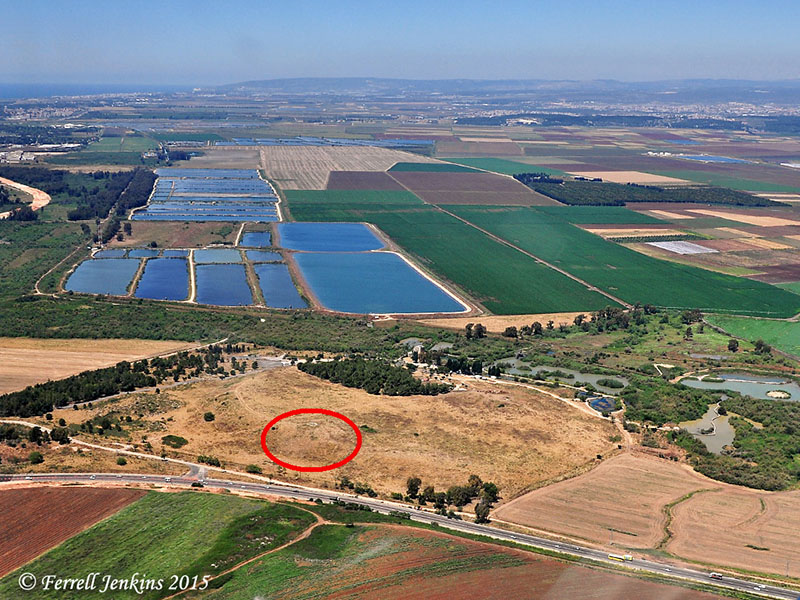
I will repeat one of the photos to provide some perspective.This view shows the tel, the nature reserve and the plain of Acre. The biblical tel is marked by the red oval.

Aphek of Asher. View north-northeast toward the Ladder of Tyre. Photo by Ferrell Jenkins.Photo by Ferrell Jenkins.

Aphek of Asher. View N-NE toward the Ladder of Tyre.  Photo by Ferrell Jenkins.

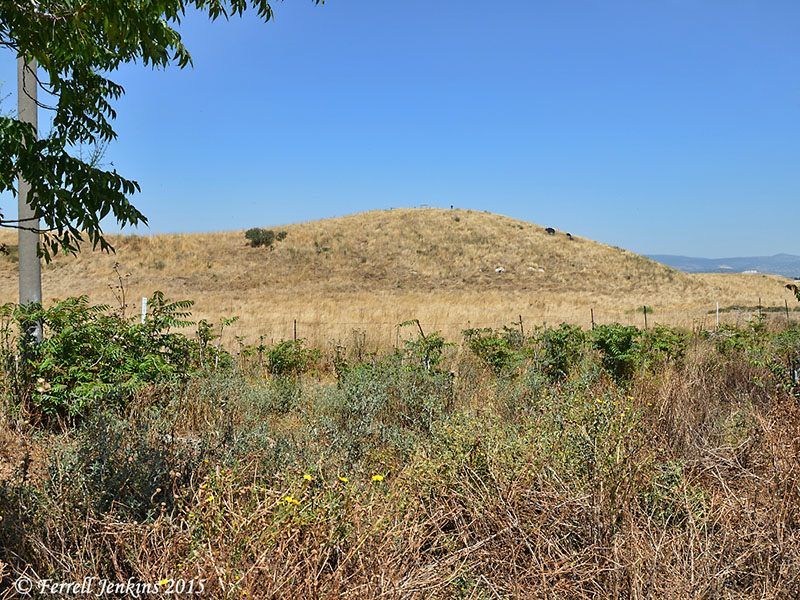
Here is a close view of the tel.

Tel Aphek of Asher. View northeast toward the border with Lebanon. Photo by Ferrell Jenkins.

Tel Aphek of Asher. View NE toward the border with Lebanon. Photo by Ferrell Jenkins.

The Israel Nature and Parks Authority has a nice PDF English brochure about the Afeq Nature Reserve here. The brochure provides a brief history of the tel.

A number of archaeological surveys have been carried out on Tel Afeq. They have revealed finds going back to the Canaanite period, beginning around 5,000 years ago. A row of large field stones discovered here is apparently a remnant of the most ancient city wall, dating from the Middle Bronze age (the tenth to sixth centuries BCE). During the Canaanite period a purple dye industry developed here, based on excretions from snails harvested from the sea. Glass was also produced here using sand from the beach at Acre and the surrounding area. Both these industries made the area very important economically.
In a salvage dig in May 1998 at the northern edge of the tell, human remains were found, along with pottery vessels and tombs from the Middle and Late Bronze ages (19th-13th centuries BCE).

Bible Walks has many photos, historical references, and a Google earth map with identifications here.

If you choose to enjoy the whole area you will need a few hours.