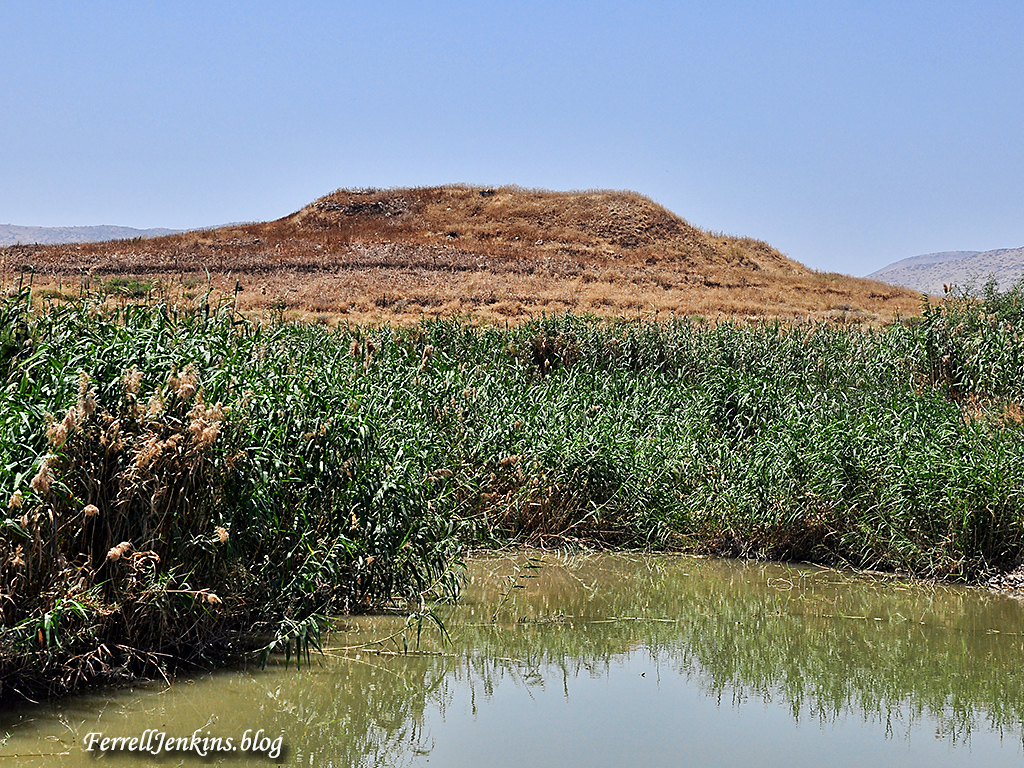
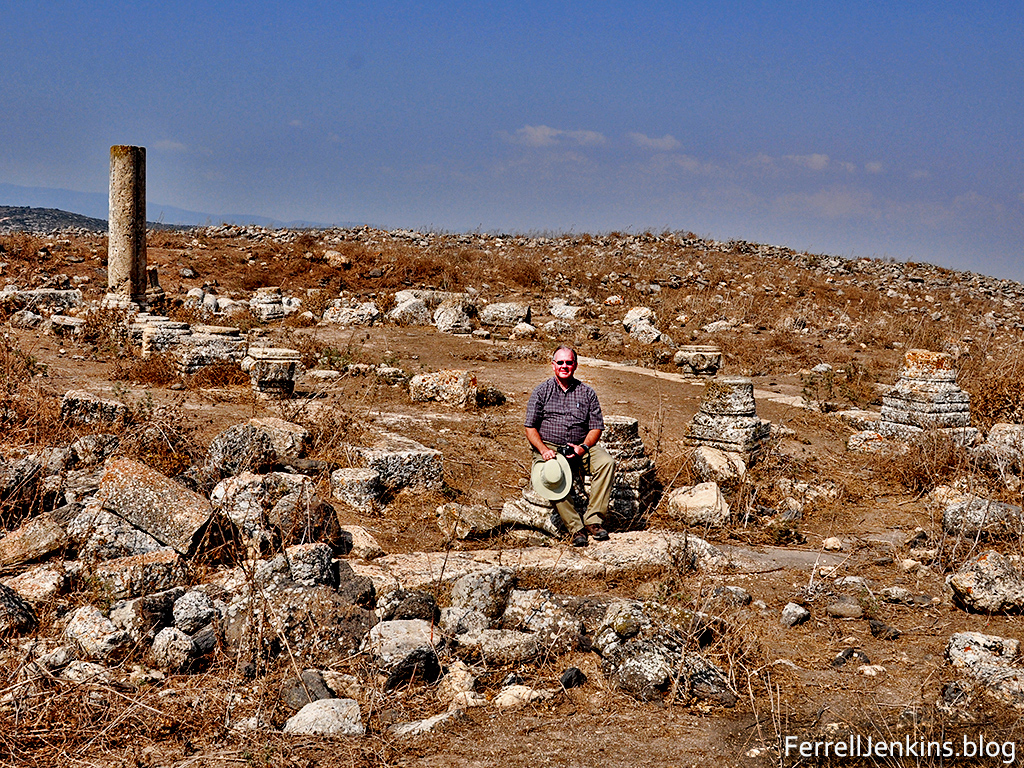
There was a time that John (the baptizer) was baptizing in the vicinity of Aenon near to Salem. I have not had the opportunity to visit the site of Aenon, but I have been to Salem several times. Sergio and Rhoda (locate on YouTube) visited the site with Danny the Digger, a guide who who has lived in the vicinity.
Salem is now identified with Tel Shalim. a site about eight miles south of Beth-shan (Beit She’an) on a dirt road between highway 90 and the Jordan River. In the vicinity there are many pools of water, many now used to raise the fish sold in the restaurants around the Sea of Galilee.
Tel Shalem in the northern Jordan Valley. Photo by Ferrell Jenkins.
Corinth is located about two miles south of the narrow isthmus which forms the land bridge, and controlled access, between the main land mass of Greece and the Peloponnesus. Corinth seemed to have flourished from the 8th to the 5th centuries B.C., and there are signs of habitation much earlier. In 146 B.C. the Greek history of Corinth was terminated when the Roman consul Mummius destroyed it. All that remains today of the old Greek city are the seven columns of the Temple of Apollo. Julius Caesar rebuilt Corinth in about 46 /4 4 B.C. as a Roman colony and settled many Roman soldiers there. Corinth became the capital of the Roman province of Achaia and had direct communications with Rome. There were enough Jews in the city to account for a synagogue (Acts 18). Perhaps the two most noticeable sites at Corinth today are the ruins of the temple of Apollo and the Acrocorinth (the mountain or high point of Corinth). The temple of Apollo was built in the 6th century B.C., but only seven of the original 38 Doric monolith columns are standing. There were numerous other pagan temples in the city including one dedicated to Asklepios, the god of healing.
The ruins of the Temple of Apollo at Corinth with the Acro Corinth in the background.
The judgment-seat (Greek, bema) was a speaker’s platform on which the judge sat or stood for the trial of one against whom an accusation had been made. In the excavations a t Corinth which have been conducted since 1896 the bema has been exposed in the agora. It is likely that Paul stood before Gallio at this place (Acts 1 8:12). The bema is dated to A.D. 44, but could be as early as the time of Augustus. The gospel was successful in this pagan city. Paul preached “Christ and Him crucified” (1 Cor. 2:2; 15:1-4). Paul was fearful but the Lord told him, “Do not be afraid any longer, but go on speaking and do not be silent; for I am with you, and no man will attack you in order to harm you, for I have many people in this ci ty” (Acts 18:9-10 ). Paul remained in Corinth for a year and six months.
A portion of the Erastus inscription at Corinth.
Inscribed in a limestone pavement near the theater at Corinth is a phrase which reads in Latin: ERASTVS PRO AEDILITATE S P STRAVIT. The translation goes something like this: Erastus , in return for the aedileship, laid the pavement at his own expense. It is possible, but not certain, that this Erastus was the friend of Paul (Rom. 16:2-3; 2 Tim 4:20). If so, then Erastus may have been one of the few (contrast, not many) of the socially elite at Corinth who accepted the gospel (1 Cor 1:26).
In the gospels one may find several references or allusions to events of the wilderness wandering. This indicates the significance of the event and suggests that it should be studied carefully by Christians as well as Jews.
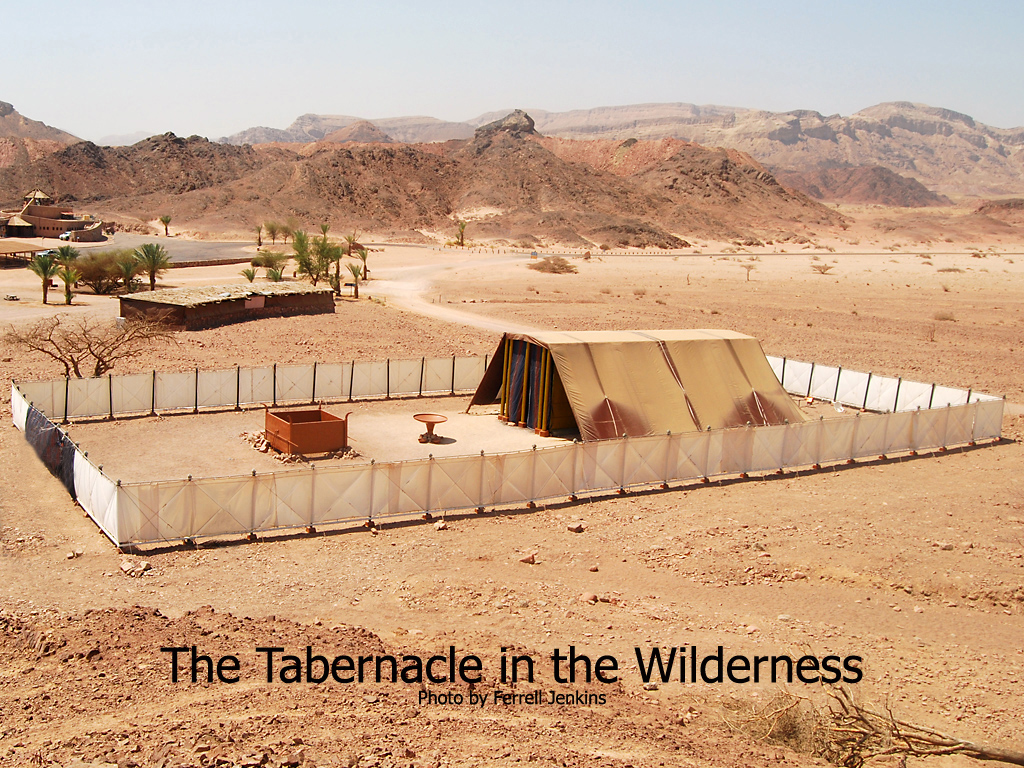
“The Word became flesh and dwelt [tented, tabernacled] among us…” (Jn. 1:14). The Lord made His presence known to the Israelites in the “tent of meeting” (the tabernacle; Ex. 29:45-46).
The Law was given through Moses [in the wilderness] (Jn. 1:17).
The serpent in the wilderness (Jn. 3:14ff.; cf. 8:28; 12:32).
The manna (Jn. 6:31ff.; notice the “grumbling” over the bread, vs. 41).
The water (Jn. 7:37-38).
Jesus was tempted in the wilderness by the devil. (Mt. 4:1-11).
Jesus fasted for 40 days and 40 nights (cf. Israel’s 40 years).
Jesus was tempted but did not succumb.
In response to the temptations of the devil Jesus quoted from the book of Deuteronomy (Mt. 4:4;
Dt. 8:3; Mt. 4:7; Dt. 6:16; Mt. 4:10; Dt. 6:13).
Stephen made several references to the events of the wilderness in his sermon (Acts
7:30-44).
Paul calls attention to the exodus and events of the wilderness wandering (Acts 13:18; Gal. 4:21-31). Notice his use of the phrase, “Remove the wicked man from among yourselves” (1 Cor. 5:13; cf. Dt. 13:5, the false prophet; 17:7, the one who served other gods; 17:12, one who acts presumptuously; 21:21, the rebellious son; 22:21, a girl not found a virgin).
Israel was baptized, ate spiritual food and drank spiritual drink, but practiced idolatry and immorality and fell (1 Cor. 10:1-13). Compare the situation at Corinth: Christians who had been baptized, ate and drank the Lord’s supper, were tempted by the idolatry (meat sacrificed to idols) and immorality of their city.
The Writer of Hebrews speaks of events of the wilderness wandering.
The events at Mount Sinai (Heb. 12:18-29). The word spoken through angels (2:2; cf. Gal. 3:19).
The unfaithfulness of Israel in the wilderness (Heb. 3–4).
In the book of Revelation.
“See…that you make all things according to the pattern which was shown you on the mountain” (Heb. 8:5; Ex. 25:40, the building of the tabernacle).
The woman who gave birth to the man child fled into the wilderness where she was nourished (Rev. 12:6). This symbol makes the wilderness a place of protection and nourishing. The figure seems to be based on the experience of the nation of Israel and of Elijah (1 Kings 19:1-18) as they were cared for by the Lord.
Some of the trumpets of chapters 8-10 are drawn from the plagues of Egypt. The one like a son of man came on a white cloud (cf. Isa. 19:1, judgment of Egypt) and judged the enemy (Rev. 14:14-20). The saints sing the song of Moses and the Lamb beside the sea (Rev. 15; cf. Ex. 14:31; 15:1-19).
My booklet on The Middle East Conflict and the Bible has been available off and on since 1991. I have presented numerous short series of lessons on this topic in past years.
Today Florida College Press has an attractive edition for sale in the bookstore at 119 N. Glen Arven Ave., Temple Terrace, FL 33617. This is just in time for those attending the Florida College lectures next week to pick up a copy. I remind you that the content of this booklet is written from the amillennial perspective. Specifically I have explained it as the Philosophy of History, Preterist, or Historical Background viewpoint.
We had hoped to have The Old Testament in the Book of Revelation available in a new format but still lack a little having that completed. We hope to have it ready soon.
My Studies in the Book of Revelation is available and I suggest it as the book one should choose if he/she wants to gain an understanding of the overall content of the great book of Revelation.
The Middle East Conflict and the Bible discusses the following questions.
Is the return of the Jews to Palestine in the twentieth century a fulfillment of Biblical prophecy?
Why do the Arabs and Israel have so much conflict
Was Saddam Hussein the successor to Nebuchadnezzar, king of Babylon? Will Babylon be rebuilt?
What does Biblical prophecy say about Israel, Babylon and Nineveh?
Does God use Nations to serve His purpose?
When and how will the nations turn their swords into plowshares?
It is difficult to locate these books on the Florida College Bookstore website, but you can ask for them by calling the bookstore at the college switchboard and asking for the Bookstore: 813.988.5131.
Review Comments:
Three persons received a preview copy of the book. Here are their comments.
Don Truex: “As has been the case for decades, Ferrell Jenkins sets the standard for Biblical, practical and applicational knowledge of the events in the Middle East and their relevance to Christians. His firsthand knowledge of the Text, the land and the people combine to bring essential insight into the all-too-common turmoil in this history filled region.”
Leon Mauldin: “Today I read my advance copy of The Middle East Conflict and the Bible. I know of nothing else like it, that packs so much in one small book. This is truly a great resource!”
Brooks Cochran: “The Middle East Conflict and the Bible” is an excellent resource to use in a study of current events in the Middle East as they relate to Bible Prophecy and the Nation of Israel. This updated edition includes a chapter on “Understanding Islam The Moslem Religion”.”
At the top of our home page, we have a link to INDEXES (INDICES). There, occasionally I have included a collection of posts on a specific subject. If you have not used this feature of the blog, I suggest you take a look.
Specifically, I am calling attention to the INDEX: Route of the Exodus and the Location of Mount Sinai. Click on the link below to visit that page which includes many photos pertaining to the exodus and Mount Sinai.
Recently I observed on a social media site a discussion conducted by several young preachers. One was asking others what they thought about the location of Mount Sinai. A few days ago I received a note from an older former student about a column that some are calling Solomon’s Post or Pillar. I have learned enough about archaeology to know that an artifact must have a context. One random stone is not enough to build a legitimate conclusion. What archaeological excavation has determined the origin and provenance of the stone post? What ancient document has mentioned the post? What evidence do we have that it is in any way associated with Israelite King Solomon?
One respondent in the exchange on social media did call attention to the articles on my blog, but mostly they each were giving their opinion. The thing that really got my attention what that not one of them referenced a Bible dictionary or Bible encyclopedia. No one called attention to a Bible Atlas. When I was in college and several students gathered in a room to pool our ignorance we called it Shooting the Bull.
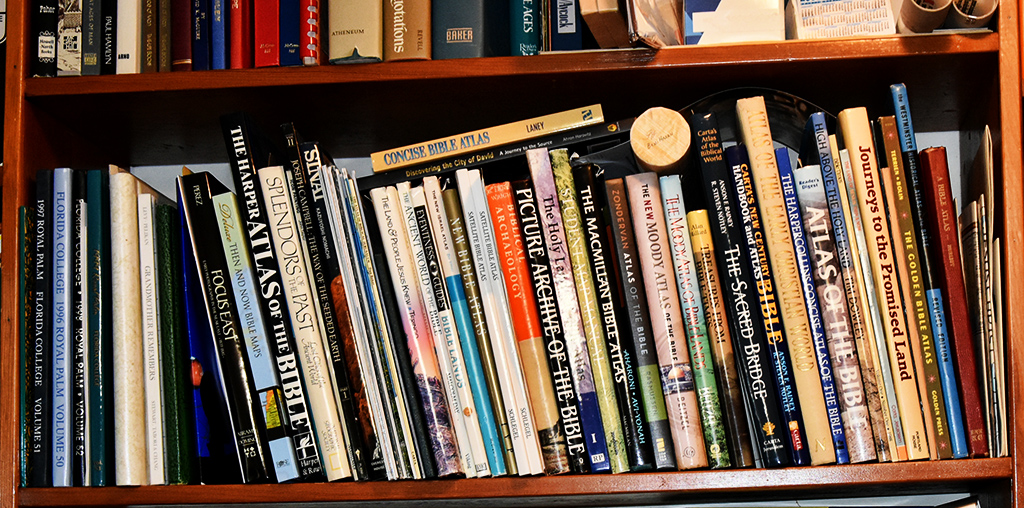
Most of my Bible Atlases.
Most of my Bible Atlases can be seen in this photo, but I have some others in digital format, and I do have several other smaller atlases on different shelves. Over half a century of travel to the Bible lands might explain why I have collected so many atlases as well as numerous road atlases and maps. Every preacher/teacher needs a few good Bible Atlases.
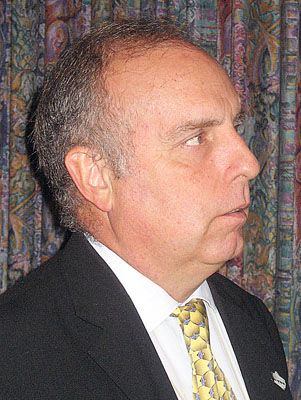
Gordon Franz at ETS annual conference.
Some scholars concentrate on certain areas of study and produce good material. Here I call attention to the work of Gordon Franz. He has written several essays under the category of Cracked Pot Archaeology at https://www.lifeandland.org/category/cracked-pot-archaeology/
His article on “Where is Mount Sinai in Arabia (Galatians 4:25)? Is especially helpful. Franz documents the view that the region commonly called Sinai was known as Arabia in Roman times:
Also check the article, MT. SINAI IS NOT AT JEBEL EL-LAWZ IN SAUDI ARABIA.
When you arrive at the Life and Land page search for Saudi Arabia. The site will return links for several articles.
Many of the articles written by Gordon Franz are available on the ABR (Associates for Biblical Research) web site. Go there and search for Mount Sinai. Use the link below to visit this site.
Franz exposes the claims of the late Ron Wyatt and Robert Cornuke pertaining to several biblical events.
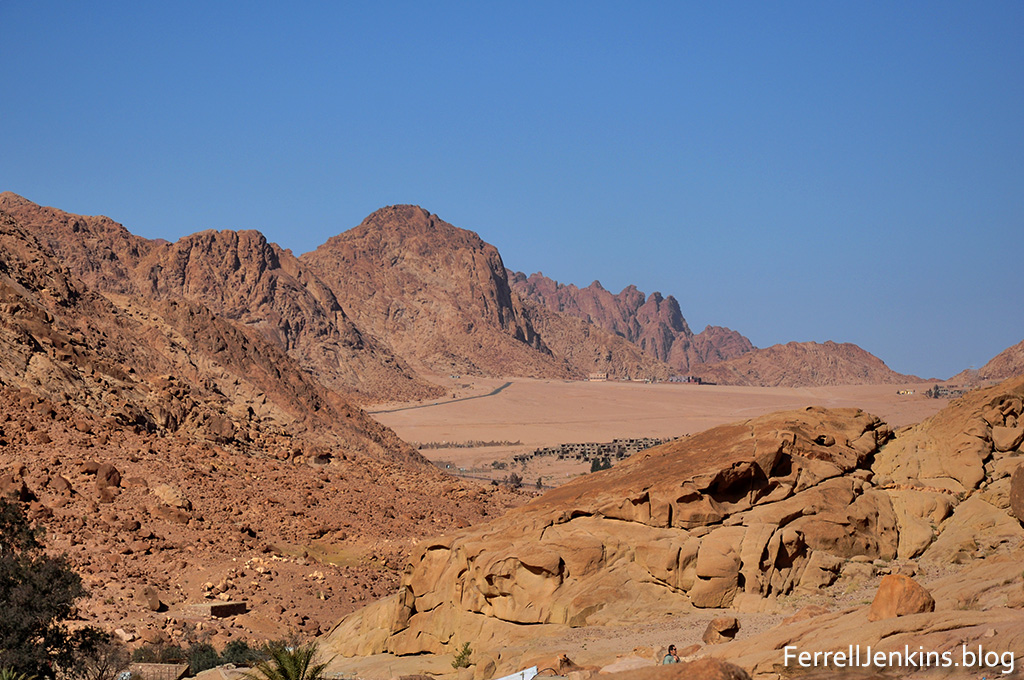
This is on the way to Mount Sinai which is still a distance to the east (left), Photo by Ferrell Jenkins
Carl Rasmussen says there are at “at least ten different proposals for the location of the Red Sea or Reed Sea including three lakes near the Mediterranean Sea, five lakes along the line of the present-day Suez Canal, as well as the Gulf of Suez and the Gulf of Elath. In addition, there are at least twelve different candidates for Mount Sinai: five in the southern part of the peninsula, four in the north, one in the center, one in Midian (Saudi Arabia), and another in Edom (southern Transjordan). (Zondervan Atlas of the Bible Revised Edition. 105).
The following map is part of a collection by David at BibleMapper now numbering 165. You may access this wonderful resource here.
BibleMapper shows no less than 10 candidates for the location of the Biblical Mount Sinai.
Anson F. Rainey was considered one of the top scholars on matters of Old Testament geography. I am pleased to have an autographed copy of The Sacred Bridge which was written by Anson Rainey (OT) and Steven Notley (NT).
Rainey’s comment on this matter is on page 120 of The Sacred Bridge. “Mount Sinai = Horeb = Mount Paran. The wilderness itinerary (Num 33:1–49) seems to point to a location for Mount Sinai in the southern Sinai Peninsula. Mount Sinai (סִינַי) is mentioned fifteen times in the books of Exodus, Leviticus, and Numbers as the place where the people of Israel received the revelation of the Torah. Poetic passages (e.g. Judg 5:5; Ps 68:9 [Eng. 8; note also v. 18 = Eng. 17]) depict it as the dwelling place of YHWH. Two call it Mount Paran (הַר פָּארָן; Deut 33:2; Hab 3:3). The steppe land (wilderness) of Paran (מִדְבַּר פָּארָן; e.g. Num 10:12; 12:16; 13:3) seems to be the generic name for the main Sinai expanses of which there are various subdivisions. Its name may be preserved in that of the oasis of Feirân known as Φαραν in Byzantine sources (Aharoni 1979:199). In Numbers 10:33 Sinai is called “the mountain of YHWH.” Seventeen times in the Hebrew Bible, especially throughout Deuteronomy and three passages in Exodus (3:1; 17:6; 33:6) and elsewhere (1 Kgs 8:9; 19:8; 2 Chr 5:10; Ps 106:9; Mal 3:22), the name Horeb (חֹרֵב) is used, evidently for the same place.” He also reminds us that several passages mention the mountain of God.
The Rest. This is suggested as the large expanse near Sinai where the Israelites camped before receiving the ten commandments.
In conclusion, I am writing this post in an effort to encourage all preachers and teachers to study more widely and deeper. I am aware that books are extremely expensive these days and many churches do not take into account this peculiar expense that ministers have. Perhaps this word to the sufficient is wise.
Cornelius, a Roman centurion, was the first Gentile convert to the faith. He was stationed at Caesarea on the Mediterranean coast at the time when the apostle Peter was actively working in the spread of the Gospel.
A centurion in the Roman army normally had charge of 100 men (= to an Army captain). A regular cohort was one tenth of a legion and had a paper strength of 600 men. An auxiliary cohort was usually comprised of 1,000 men. Cornelius was of the Italian cohort. There is inscriptional evidence for the “Italian cohort” from Syria (See Bruce, 215).
When Paul set sail from Caesarea for Rome he was accompanied by a centurion of the Augustan cohort named Julius (Acts 27:1). All of the centurions mentioned in the New Testament make favorable impressions. This was not true of soldiers generally (Luke 3: 14). Note these examples:
The centurion at Capernaum (Matthew 8:5-13; Luke 7:2-10).
The centurion at the crucifixion of Jesus (Luke 23:47).
F. F. Bruce (The Book of Acts, NICNT) cites Polybius (History vi.24) saying,
“Centurions are required not to be bold and adventurous so much as good leaders, of steady and prudent mind not prone to take the offensive or start fighting wantonly, but able when overwhelmed and hard-pressed to stand fast and die at their post.”
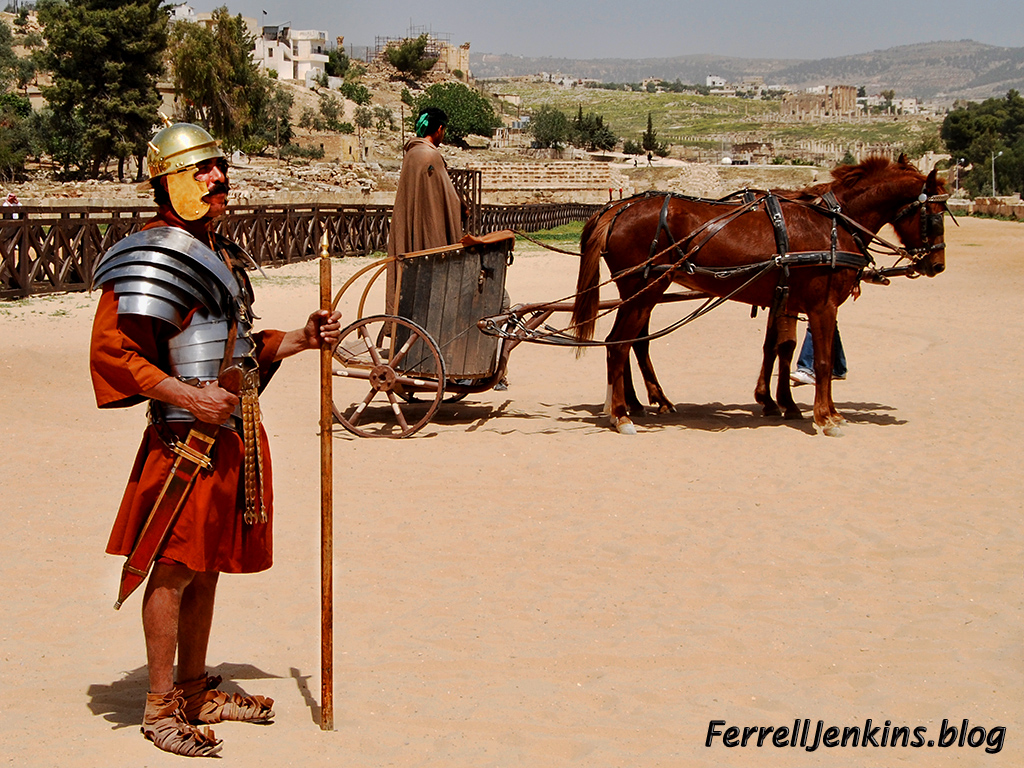
There is a wonderful performance in the early second century A.D. hippodrome at Jerash, Jordan. The RACE show (Roman Army Chariot Experience) shows actors dressed as Roman soldiers performing various activities of the early soldiers. Our photo shows a Roman centurion from that show.
Roman Centurion, with his chariot waiting, in the RACE show at Jerash, Jordan.
The Apostle Simon Peter followed Jesus during His personal ministry. It is not surprising that some of the illustrations he uses come from this experience. In 1 Peter 1:13 the apostle wrote,
Therefore gird up the loins of your mind, be sober, and rest your hope fully upon the grace that is to be brought to you at the revelation of Jesus Christ; (1 Peter 1:13 NKJ).
The Louw-Nida Lexicon says that the Greek phrase used in 1 Peter 1:13 is “(an idiom, literally ‘to bind up the loins of the mind’) to prepare oneself for learning and thinking – ‘to get one’s mind ready for action, to be ready to learn and to think, to be alert.” The Greek phrase is translated this way: ‘so then, have your minds ready for action.1 Peter 1:13.” (27:55)
In The IVP Bible Background Commentary, Craig Keener writes,
Men wore long robes and would tuck them into their belt, “gird up their loins,” so they could move more freely and quickly. Although the image also occurs elsewhere in the Old Testament, here Peter may specifically allude to the Passover (Exodus 12:11): once God’s people had been redeemed by the blood of the lamb (1 Peter 1:19), they were to be ready to follow God forth until he had brought them safely into their inheritance (cf. 1:4), the Promised Land.”
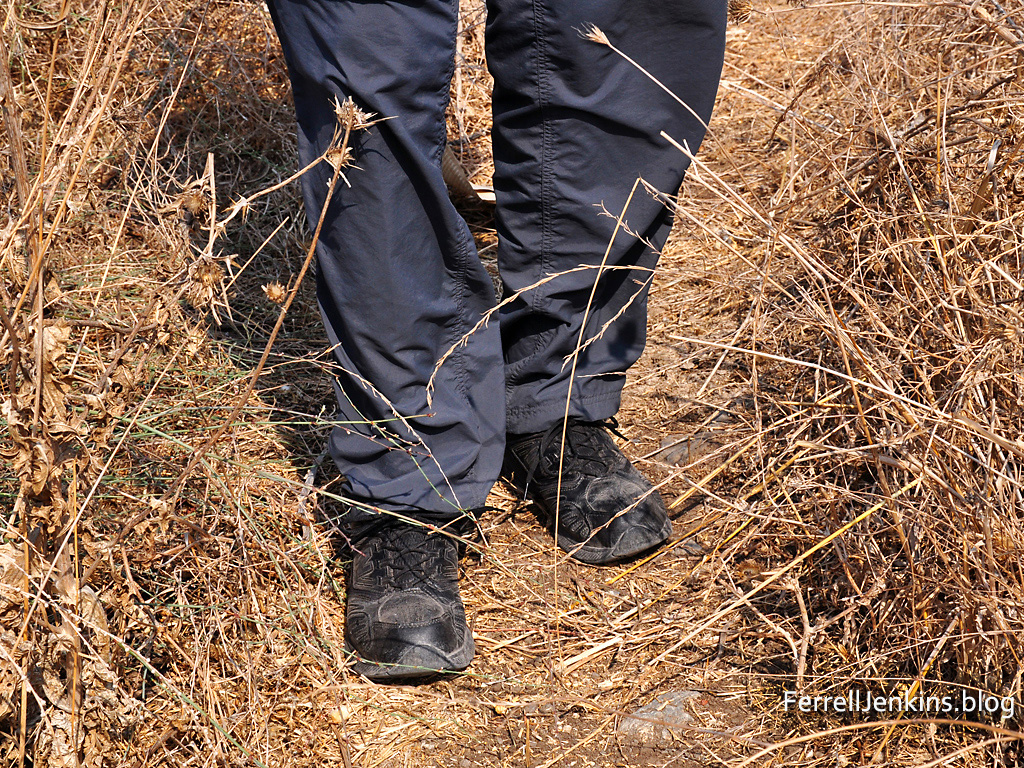
Even though I have never worn a long, flowing robe I could illustrate this over and over from my years of travel in Israel. Take a look at this photo made at Horbat Adumim in upper Galilee.
Walking across fields to get a desired photo often brings one in contact with thistles, as happened at Horbat Adumim.
Horbat Adumim is a national park in Israel, the site of an the ruins of an ancient synagogue. My frequent traveling companion on private study tours is Leon Mauldin. Leon is seen here seated at the entrance to the old synagogue.
I have used this text from 1 Peter various times in discussing the need to avoid those things that hinder us in service to God. Gird up the loins of your mind.
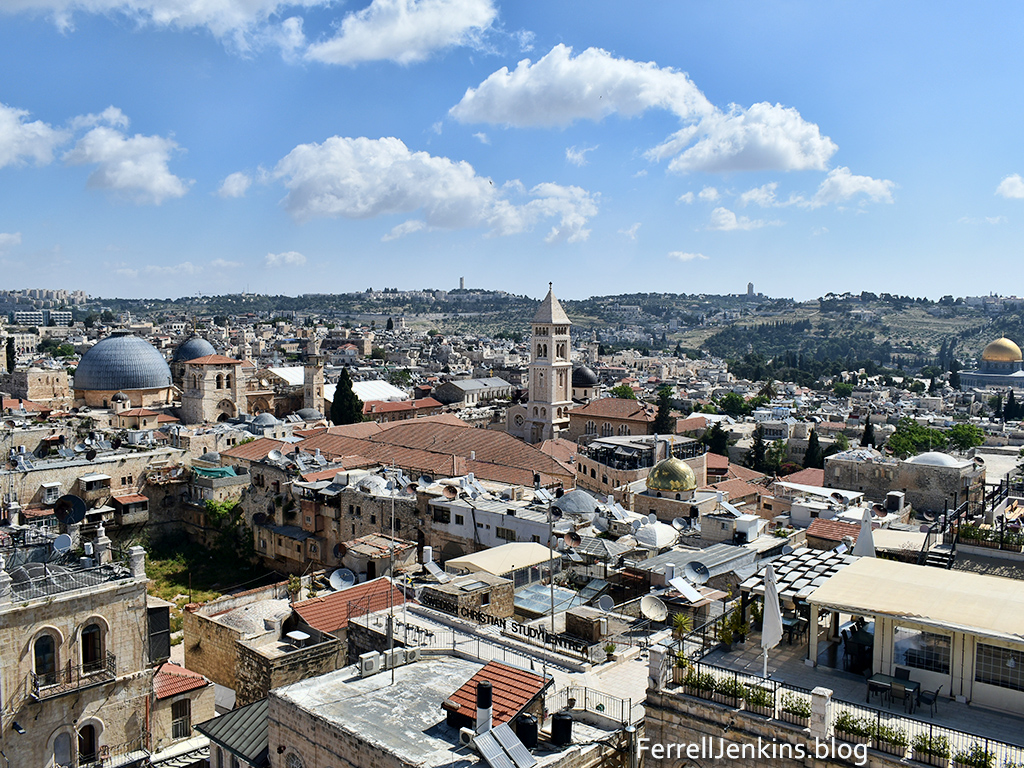
The climb to the roof of the Citadel, also known as the Tower of David, is worth the climb just to see the roof tops of various significance buildings. The Citadel is located at Jaffa [Joppa] Gate which serves as the main entry to the Old City of Jerusalem on the west side of the walled city.
Our photo looks northeast.
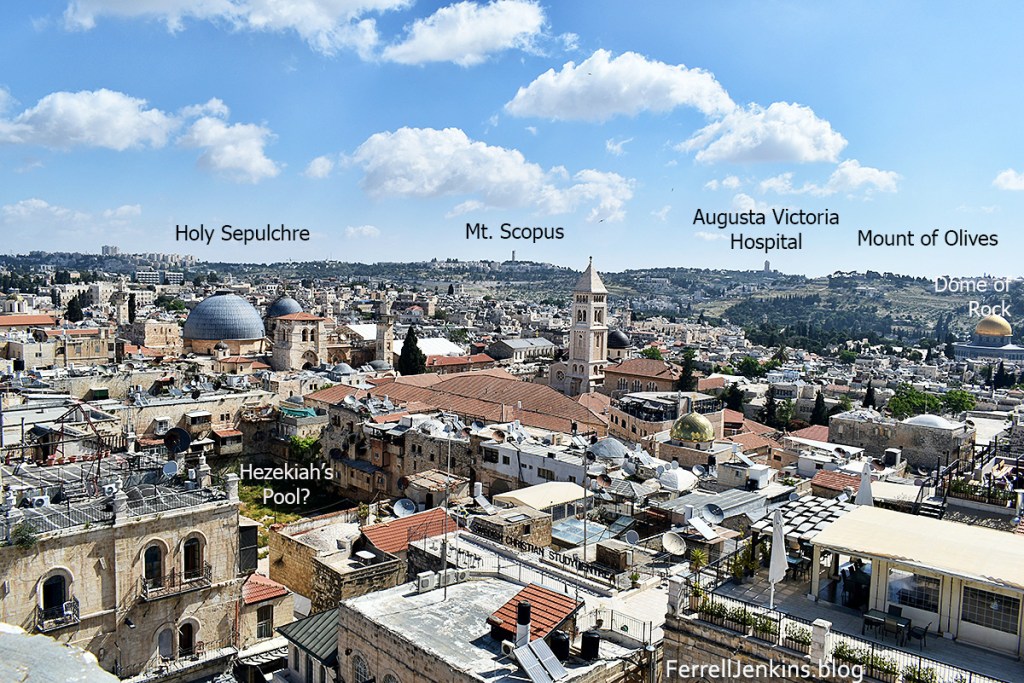
In a second photo I have placed identifying names on many of the highlights. Remember that you may download these photos for use in your Bible teaching. I had trouble uploading the second photo to WordPress, but you can see it in larger format by right clicking on it to open it.
Beginning left to right here is a list of some of the significant places shown on the photo.
Hezekiah’s Pool. Whether this pool had anything to do with King Hezekiah is unknown. Josephus identified it by the name Amygdalon, a place where the 10th Roman Legion was active in A.D. 70 (Wars, 5:468).
The Holy Sepulchre. This site has marked the location of Golgotha (the smaller dome) and of the burial of Jesus (the larger dome) since the early 4th century A.D.
The tower of the Lutheran Church of the Redeemer is the white tower with a pyramidal top. It is also possible to climb to the top of that tower.
At this point look to the North (left) on the horizon where you will see Mount Scopus, the place from which Alexander the Great scoped the city. Today this is the home of the Hebrew University. Continue along the mountain top right to the tower of the Victoria Augusta Hospital. Continue to the south (right) and you will see the Mosque of Omar, more commonly known as the Dome of the Rock. This site sits very near where Solomon’s Temple was built. The hill to the east of the Temple Mount is the Mount of Olives. If I had been using a slightly wider lens we would have a photo of the Tower of Ascension which is near Bethphage and Bethany.
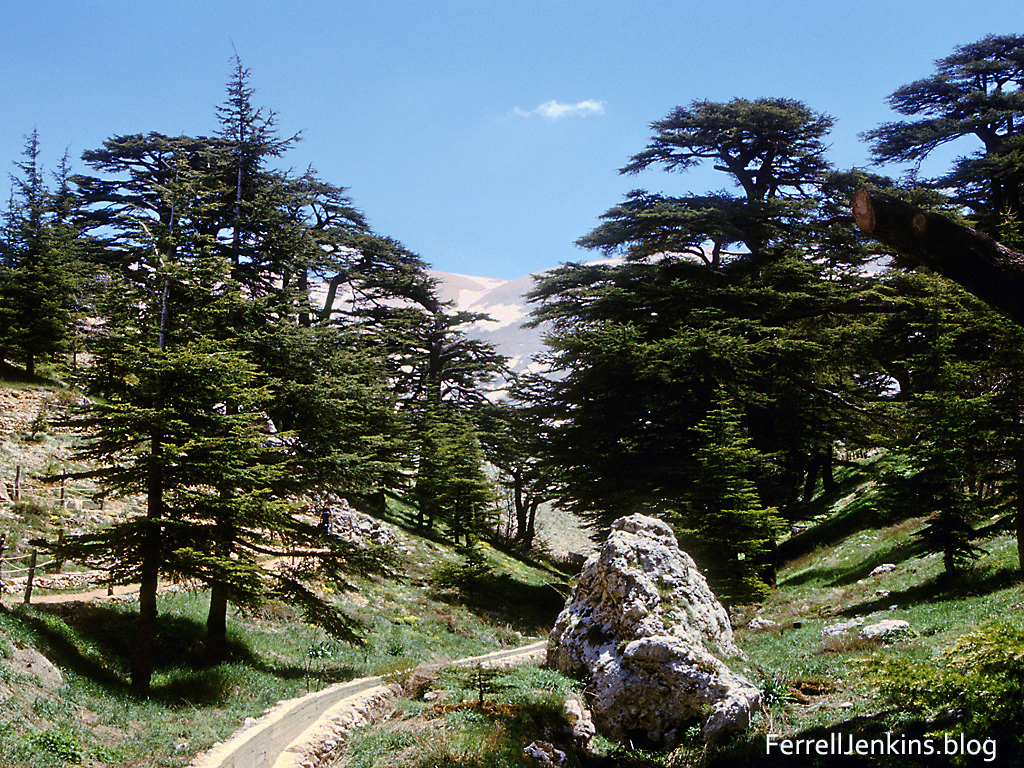
My first trip to Lebanon was in May, 1968. At that time I was able to visit several of the historic places that I had read about in the Bible and other sources. These included Tyre and Sidon, Byblos, and the Cedars of Lebanon.
The Cedars are about 75 miles north of Beirut on a mountainous road and not included on my second Bible Lands Tour. But we had a half day free to visit as we wished. My wife Elizabeth and I were joined by Louis and Margie Garret, co-workers at Florida College, and Joe Corley who had come all the way from Lethbridge, Alberta, Canada to join the tour. We had met Joe and his family earlier when I preached there a year or two earlier. We crowded into a taxi willing to take us to the Cedars.
A couple of days ago I located a slide I made on Agfachrome film during that visit. I hope you will enjoy it about half as much as I enjoyed seeing it again.
There are numerous biblical references to the cedars, but I wanted to mention just one reference today.
About 1040 BC King Solomon, the new king of Israel, requested cedars from King Hiram of Tyre in Lebanon for use in building the temple in Jerusalem. If you have visited Israel or read about the buildings you know that most of them are made of stone. Wood for various purposes had to be brought from other places.
Now therefore command that cedars of Lebanon be cut for me. And my servants will join your servants, and I will pay you for your servants such wages as you set, for you know that there is no one among us who knows how to cut timber like the Sidonians” (1 Kings 5:6 ESV).
Over the years we have posted several articles about the Cedars of Lebanon. To access these just put Cedars of Lebanon in the Search box. Think of the blog as a mini-dictionary where you can find information about various Bible places and customs.
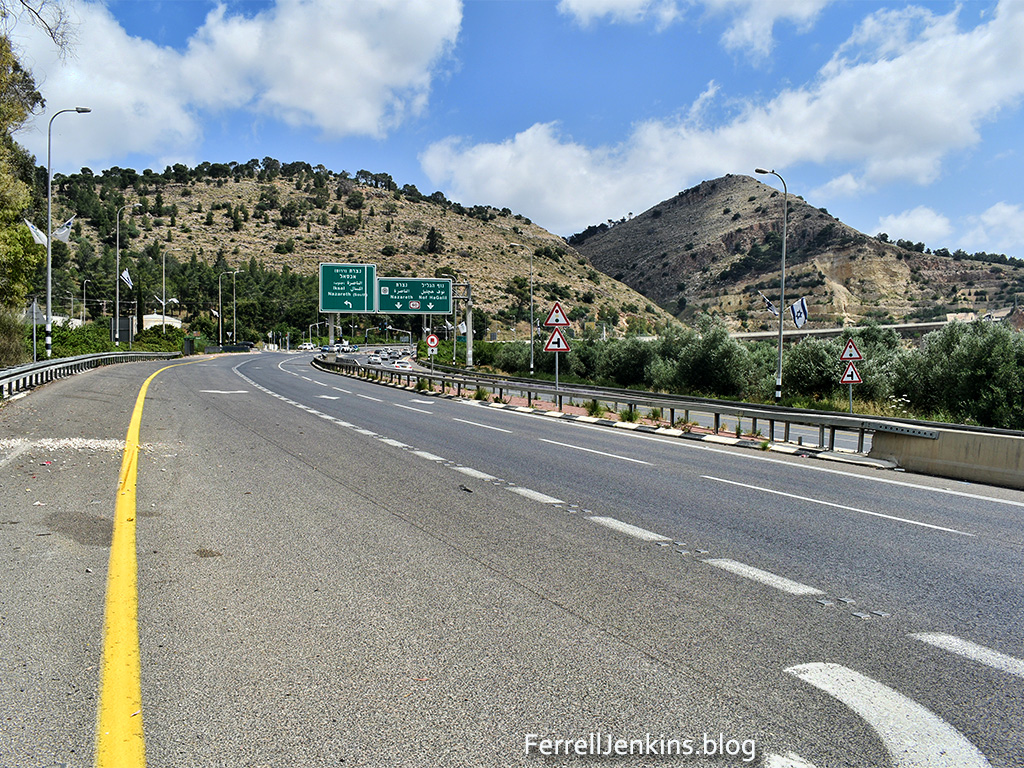
True. It happened more than once. Here I have in mind the event at Nazareth at the beginning of His ministry (Luke 4:16-30). Jesus read a portion of Isaiah 61 in the synagogue and claimed that He fulfilled that scripture. His teaching outraged those present. They took Jesus to the brow of the hill on which their city was built, intending to throw him down the cliff. Jesus passed through the crowd and left Nazareth to go down to Capernaum, a town that would become the headquarters for His earthly ministry.
Nazareth is located in the hills of Lower Galilee, where the elevation is about 2000 feet above sea level. These hills lie on the north side of the Valley of Jezreel (Esdraelon, or Megiddo). The hill of precipitation overlooks the Jezreel valley.





 Ferrell's Travel Blog
You must be logged in to post a comment.