Category Archives: Bible Places

Hierapolis, Philip and Papias

Early tradition associates Philip with the city, but scholars differ over whether it was Philip the apostle (Matthew 10:3) or Philip the evangelist (Acts 21:8).

This was the home of Papias (about A.D. 60 to 130) who was a disciple of the apostle John and a companion of Polycarp. Fragments of his writings about the apostles survive in Irenaeus and Eusebius of Caesarea. Eusebius (about A.D. 265 − about A.D. 339), tells us that Papias wrote as follows:

“Matthew also issued a written Gospel among the Hebrews in their own dialect, while Peter and Paul were preaching at Rome, and laying the foundations of the Church. After their departure, Mark, the disciple and interpreter of Peter, did also hand down to us in writing what had been preached by Peter. Luke also, the companion of Paul, recorded in a book the Gospel preached by him.” He adds that John, the disciple who leaned on Jesus’ breast, published a Gospel from Ephesus (Against Heresies III.1.1).

Some things of interest to see at Hierapolis include the hot springs and limestone formations, the monumental Arch of Domitian and Roman Street. This entire region suffered from the policies of the Emperor Domitian. The photo below shows the theater set against the surrounding hills.
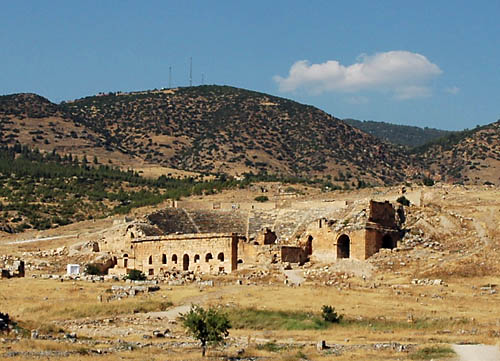
Roman theater at Hierapolis. Photo by Ferrell Jenkins.

Roman theater at Hierapolis. Photo by Ferrell Jenkins.

The theater was built in the 2nd century A.D., renovated in the 3rd century, and again in the 4th century.

During the 4th-century renovations, the orchestra area of the theater was altered to allow it to be filled with water for staging mock naval battles and other water presentations. (Fant and Reddish, A Guide to Biblical Sites in Greece and Turkey, 213)
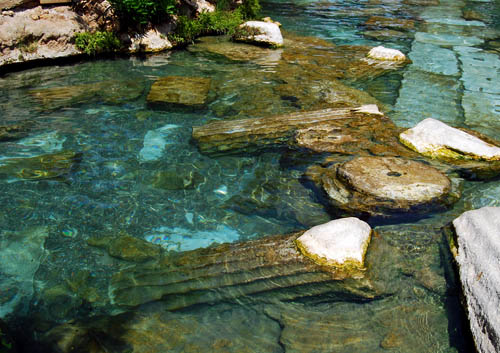
The hot springs at Hierapolis

The hot springs at Hierapolis caused the city to be known for its textile industry. There were guilds of wool workers, carpet weavers, and purple dyers. The hot medicinal springs (95°) attracted visitors. The city prospered under the Romans, but often suffered from earthquakes.

Ruins of the Roman city of Hierapolis in the hot springs. Photo by Ferrell Jenkins.

Ruins of the Roman city of Hierapolis in the hot springs. Photo by Ferrell Jenkins.

Recall that Hierapolis is one of three cities of the Lycus River valley named in the New Testament.

For I can testify that [Epaphras] has worked hard for you and for those in Laodicea and Hierapolis. (Colossians 4:13 NET)

Hierapolis and the Lycus River Valley

Hierapolis is mentioned only once in the New Testament. Paul commends Epaphras, who seems to be from Colossae, for his burdensome labor for the churches of the Lycus River Valley. He says,

For I bear him witness that he has worked hard for you and for those in Laodicea and in Hierapolis. (Col. 4:13 ESV)

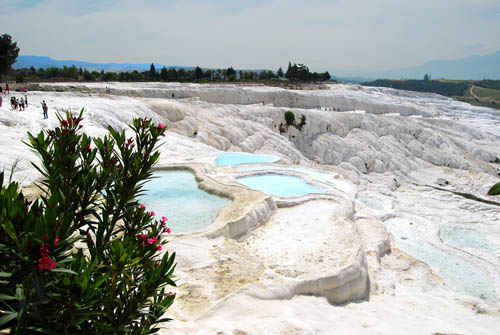
The name Hierapolis means “holy city.” The modern Turkish name is Pamukkale, meaning “cotton castle” or “cotton fortress.” The city is famous for the hot springs and the limestone formations that cascade down the hillside below the city.

Limestone formations at Hierapolis. Photo by Ferrell Jenkins.

Limestone formations at Hierapolis. Photo by Ferrell Jenkins.

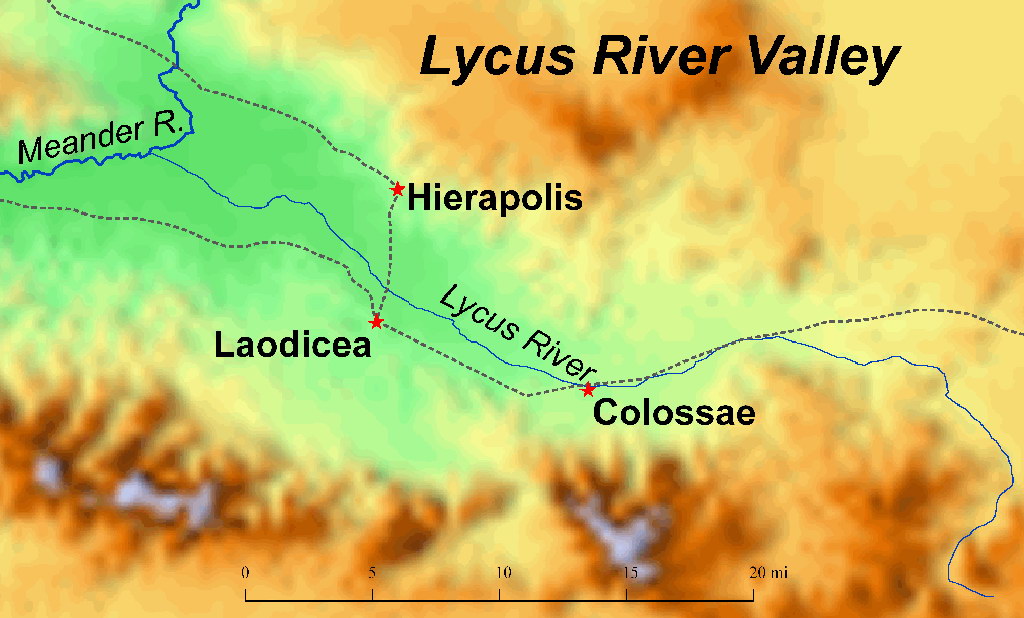
The Lycus valley is in extreme southwestern Phrygia, Asia Minor. Hierapolis is situated on a plateau about 600 feet above the valley floor. Hierapolis, Colossae, and Laodicea form a triangle in the valley. From Hierapolis to Laodicea is about 6 miles south. The sites can be seen across the valley. From Laodicea to Colossae is about 10 miles to the southwest. From Colossae it is about 12 miles to Hierapolis.

The Lycus River Valley.

The Lycus River Valley.

Click on the map for a copy large enough to use in a PowerPoint presentation. Detailed maps of the area around Hierapolis, Laodicea, and Colossae are not usually found in maps found in Bibles, or even atlases. I used Bible Mapper to make this map showing the three cities of the valley. The Lycus river begins south east of Colossae, flows through the valley to join the Meander River. The Meander flows west to the Aegean Sea at Miletus. The dotted lines show the major roads traversing the valley.

Thanks for following our tours

Thanks to your interest we noticed an increase in readers during our trip to Egypt. We appreciate your interest in the subjects we write about.

A blog is different from a web page. On a web page, such as the Biblical Studies Info Page, there are many categories and pages available. When you check the blog you see the last entry at the top of the page. You must click on the Archives listing, or use the Search Box to locate earlier posts.

A list of some other trips we have covered on this blog might be helpful to you (from the most recent to the earliest).

  • Egyptian Adventure (begin January 16, 2009).
  • Israel (personal study) trip (begin August 20, 2008).
  • Steps of Paul and John (Greece and Turkey) (May, 2008).
  • Bible Land Tour of Israel and Jordan (April, 2008).
  • Scotland Highlights (September 2007).
  • Biblical & Historical Sites in Turkey (May and June, 2007).

The purpose of these trips is educational. We seek to relate the history and the land to the biblical account.

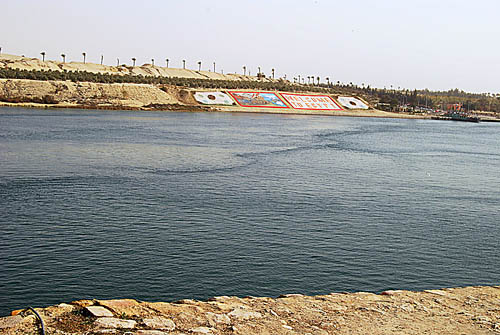
Suez Canal near Ismailia. Photo by Ferrell Jenkins.

Suez Canal near Ismailia. Photo by Ferrell Jenkins.

This view of the Suez Canal at Ismailia looks from the east to the west. The ancient Egyptians dug numerous canals in the general area. This modern canal was officially opened November 17, 1869.

We would like for you to continue to check the blog several times a week as we write about other matters of interest to Bible students.

Group headed for home

Our group, all healthly and happy, left the hotel a short time ago for the Cairo International Airport.  The flight isn’t until 12:30 p.m. (Cairo time), but we have been staying near the Giza Pyramids. With nearly 20 million people in Cairo one never knows how long the normally 1 hour trip to the airport will take.

Elizabeth and I are remaining for a few days to visit some other sites we have not seen or been able to photograph.

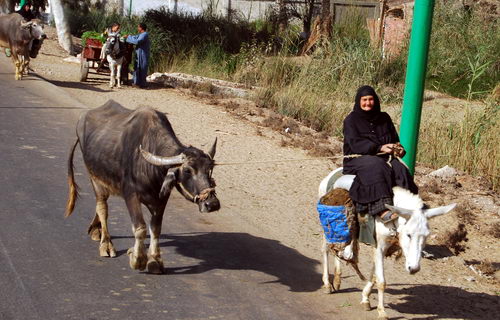
Yesterday I had a photo ready that I wanted to share. It was made at Memphis and is typical of so much of what we see in Egypt. Don’t get the wrong impression. There are many affulent people in this country, but the vast majority seem to eek out a living day by day.

Moving the "herd" near ancient Memphis. Photo by Ferrell Jenkins.

Moving the "herd" near ancient Memphis. Photo by Ferrell Jenkins.

Yesterday our group used a long day to visit the Eastern Delta of
Egypt. Biblically we know that land as Goshen. Few travelers are able to go into this area of Egypt. Over the next few weeks I will try to share a few photos and thoughts about the area.

You might enjoy reading a first person account of the tour written by one of our tour members. This would be especially true if you know some of the folks who have been traveling with us. Click on Picture This.

Comment about Lachish

I note that we have an interesting comment on the post about Lachish on July Fourth. You might enjoy reading it.

Ineffective teaching no longer excusable

Examples of the use of visuals in teaching are abundant in Scripture. Think of these.

God used visuals.

  • The rainbow (Genesis 9:12-18).
  • The stars He showed to Abraham (Genesis 15:5).
  • The burning bush through which he spoke to Moses (Exodus 3:3-4).

Ezekiel has been called the dramatic prophet because of his use of so many object lessons.

  • He made a sketch of Jerusalem on a brick to teach about the siege against Jerusalem by the Babylonians (Ezekiel 4:1-3).

Jesus used visuals in His teaching. There are too many illustrate to cite all of them. Think about these.

  • A little child (Matthew 18:3-6)
  • The birds of the air and the lilies of the field (Matthew 6:26-28).
  • A Roman coin (Matthew 22:15ff.).

Repeatedly on this page, and elsewhere, I have said that every church needs to have good maps and photographs available for use by the teachers. Specifically, I have recommended the Pictorial Library by Todd Bolen. On the Biblical Studies Info site, under Scholarly, I keep a list of excellent sources where one may find photographs suitable for use in teaching the Bible. Many of them are free of charge. Scroll down to Photos.

Today I want to call attention to maps for use in teaching. There are several good sites listed under Maps at the Biblical Studies Info page. David Barrett has made his Bible Mapper available free of charge. This marvelous program allows one to make his own maps. There is a learning curve, but the results are remarkable. The resultant map shows exactly what the teacher wants to emphasize in class.

The folks over at Biblos.com have posted many Bible Study Tools including visuals and a marvelous Bible Atlas. You get to it directly at BibleAtlas.org.  Hundreds of maps have been made using Bible Mapper, but they are specific to certain places. Let me illustrate.

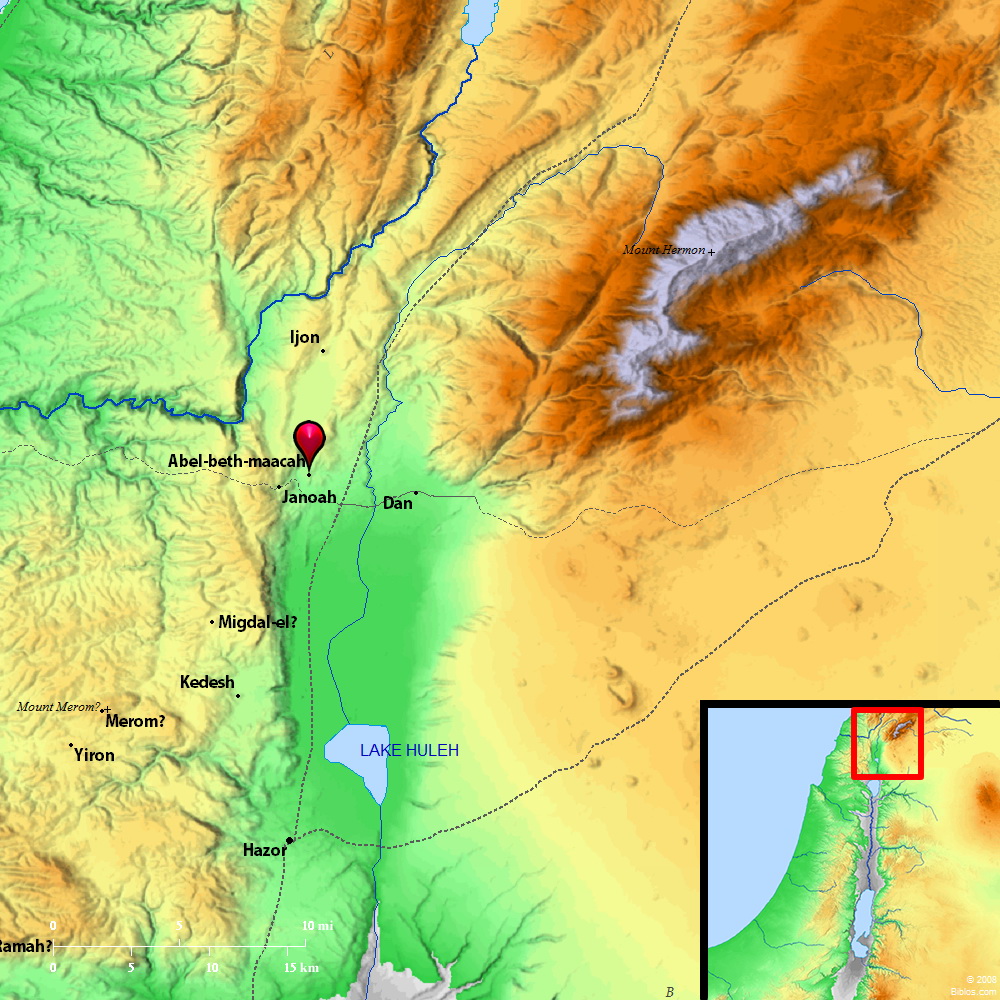
Recently I wrote here about an event at Abel-Beth-Maacah. If I were teaching on this subject I could use this map from BibleAtlas.org.

Map of Abel-beth-maacah. Courtesy of Biblos.com.

Map of Abel-beth-maacah. Courtesy of Biblos.com.

The original map is 1000 x 1000 (click on the map to see the original). It can be inserted into a PowerPoint presentation without any further work. There is plenty of space for the teacher to include some calls outs with additional information.

It is true that once you have inserted a map like this into your presentation it will take some additional study for you to be able to use it effectively. But your lesson will be much more interesting and you will more easily make your point.

Take advantage of these marvelous teaching aids. We extend our hearty thanks to the folks at BibleAtlas.org and all the others who labor and invite us to share in their labors. David Padfield frequently reminds us of the teaching of Jesus.

Freely you received, freely give. (Matthew 10:8 NAS)

Favorite photo of 2008?

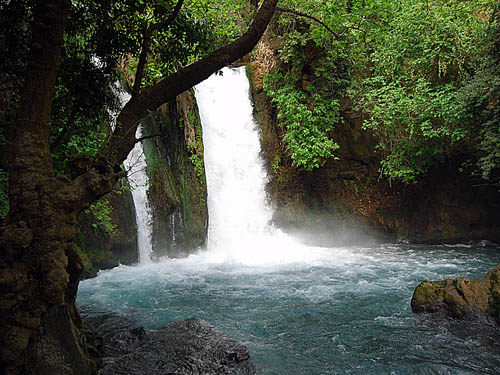
Elizabeth and I were driving from lunch today when I asked her what she thought would be my favorite photo of 2008. That excludes the grandson, of course. After some discussion we both agreed that it was a difficult decision. She suggested the En Gedi waterfall. Good suggestion. We posted one of those photos here. I debated about posting a different view, but then decided to go with another choice.

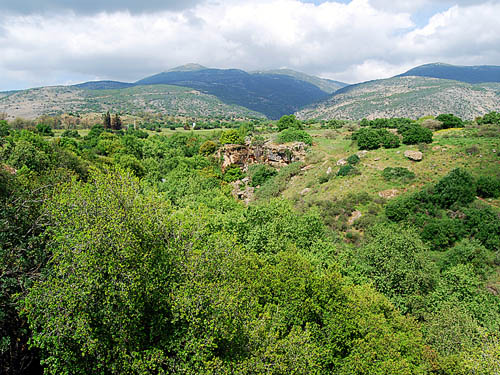
Early in the year I posted a 1984 photo of the Jordan River waterfall here. In April, while my group was eating lunch at Banias, the site of Caesarea Philippi, I broke away with David Padfield to visit the nearby Jordan Waterfall. The fall is also known as the Banias Waterfall. In order for this photo be understood it might be good if I showed you a photo of the surrounding terrain.

The photo below was made from above the waterfall. The waterfall is in the depression to the left of the rocky area; you are seeing the top of large trees. Caesarea Philippi is between the two closest hills. The Banias River begins as a spring there and soon cuts its way into the surrounding earth and rock. It is not really the Jordan until it joins with other sources, including the Dan River.

Vicinity of the Jordan River Waterfall. Photo by Ferrell Jenkins.

Vicinity of the Jordan River Waterfall. Photo by Ferrell Jenkins.

Once we make our way down into the depression among the trees we see the beautiful waterfall.

Jordan River Waterfall. Photo by Ferrell Jenkins.

Jordan River Waterfall. Photo by Ferrell Jenkins.

On my first trip in 1967 it was impossible to visit either the source of the river or the waterfall because it was within Syria. After Israel captured the territory, it became possible to make the visit.

Was this absolutely my favorite photo of 2008? Probably not. I was blessed to visit Israel (twice), Jordan, Turkey, Greece and the Greek islands. There were too many favorites to make a choice.

Matthew uses the term district or region to describe the area Jesus visited with His disciples (Matthew 16:13). The Kings James Version coasts is misleading. Mark’s term is villages (Mark 8:27). It was not far from here that Jesus was confessed as the Christ by Peter.

Jesus went out, along with His disciples, to the villages of Caesarea Philippi; and on the way He questioned His disciples, saying to them, “Who do people say that I am?”  They told Him, saying, “John the Baptist; and others say Elijah; but others, one of the prophets.” And He continued by questioning them, “But who do you say that I am?” Peter answered and said to Him, “You are the Christ.” (Mark 8:27-29 NASB; also read Matthew’s account)

Ashkelon and the Seacoast

This has been a busy month for me. It was the month of two cataract surgeries, but I won’t be able to get the needed glasses for reading until about the second week of January. With each surgery it takes about two days to get over the dilation and do any serious reading and computer work.

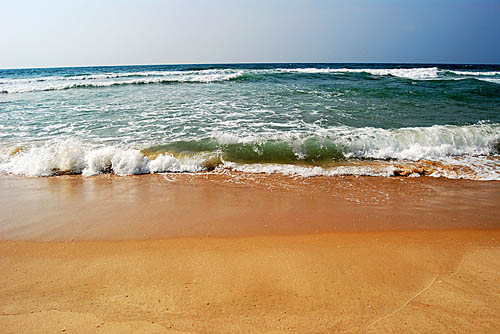
I want to share a photo of the beach and Mediterranean Sea at Ashkelon. The city is in the news this week due to the conflict between Israel and Gaza. Ashkelon is the closest Israeli town to the Gaza Strip.

The Sea at Ashkelon. Photo by Ferrell Jenkins.

The LORD spoke against the Philistine cities through the prophet Jeremiah (ch. 47). These verses caught my attention.

How long will you cry out, ‘Oh, sword of the LORD, how long will it be before you stop killing? Go back into your sheath! Stay there and rest!’ But how can it rest when I, the LORD, have given it orders? I have ordered it to attack the people of Ashkelon and the seacoast. (Jeremiah 47:6-7 NET)

Jesus lived in Nazareth

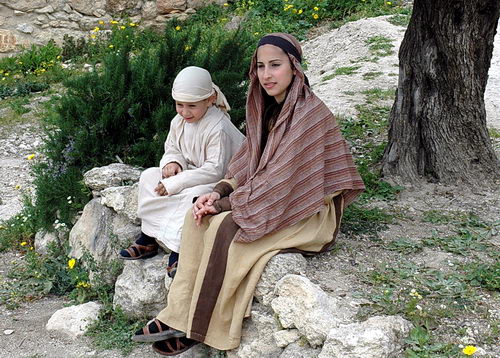
This photo of two children was made at the Nazareth Village (a nice place to visit).

Children at the Nazareth Village. Photo by Ferrell Jenkins.

Children at the Nazareth Village. Photo by Ferrell Jenkins.

All four Gospels and the book of Acts make a reference to Nazareth as the place where Jesus lived in his early years. This one from the Gospel of Luke is set at a time when Jesus was about 12 years of age (Luke 2:42), and before He was 30 (Luke 3:23).

And he went down with them and came to Nazareth and was submissive to them. And his mother treasured up all these things in her heart. And Jesus increased in wisdom and in stature and in favor with God and man. (Luke 2:51-52 ESV)