Category Archives: Bible Lands

The Halys (Kizilirmak) River

The Kizilirmak (Kizil Irmak) River was known as the Halys River in ancient times. The river flows past the Turkish town of Bafra into the Black Sea. Notice the Halys between Sinope and Amisos on the map below. It is about 35 to 40 miles west of Amisos. The river to the east of Amisos is the Iris.
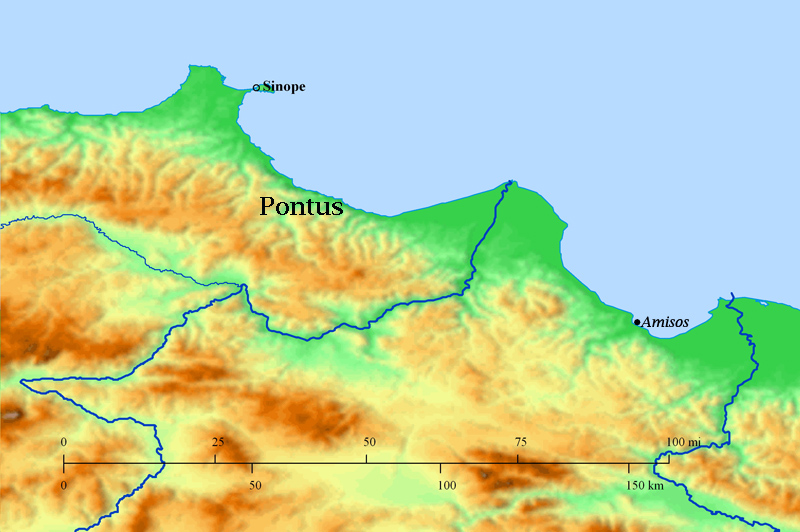
Map of Pontus showing Sinop and Amisos.

Map of Pontus showing Sinope and Amisos. The Kizilirmak (Halys) River is located between the two towns, but closer to Amisos.

Pfeiffer and Vos describe the importance of the Halys.

The most important river of the peninsula [Asia Minor] is the Kizil Irmak (ancient Halys), 600 miles long, which originates in eastern Asia Minor and flows in a great bend to the southwest and finally into the Black Sea through what was Pontus. Unfortunately its gorge is often too narrow to permit it to be an important means of communication into the interior. (The Wycliffe Historical Geography of Bible Lands, 316).

The photos below show the river flowing from the mountains on the south side of Pontus. These photos were made about 10 miles from the Black Sea, which is to the north. This is one of the widest areas of what was once the Roman province of Pontus.
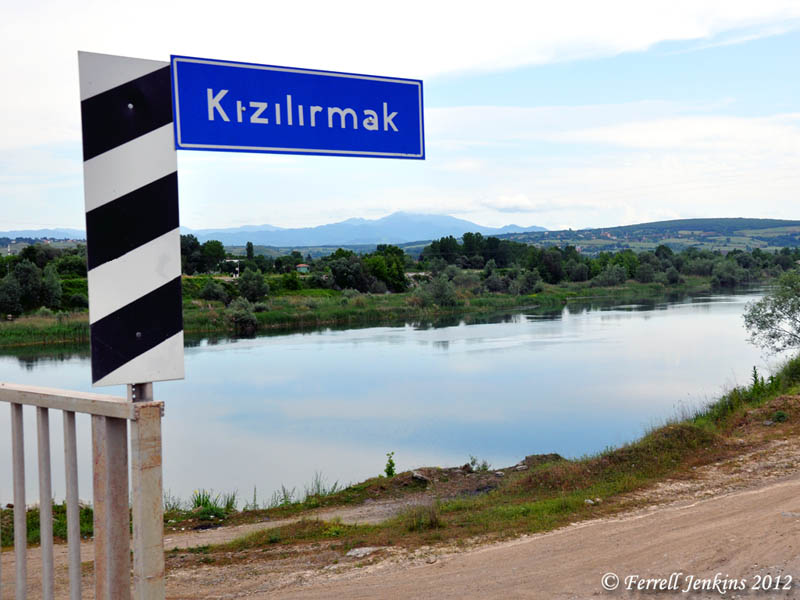
Kizilirmak (Halys) River flowing to the Black Sea. Photo by Ferrell Jenkins.

C. J. Hemer wrote of the importance of the rivers of Pontus. He also calls attention to the fact that the “narrow coastal margin was separated from the interior by mountains.”

The chief rivers besides the Halys were the Iris, Lycus, and Thermodon. The fertile land of their valleys and of the narrow coastal margin was separated from the interior by mountains, once heavily forested, which have always impeded communication with the plateau. Important products included fruit, corn, olives, and timber. (The International Standard Bible Encyclopedia, Revised (3:903).
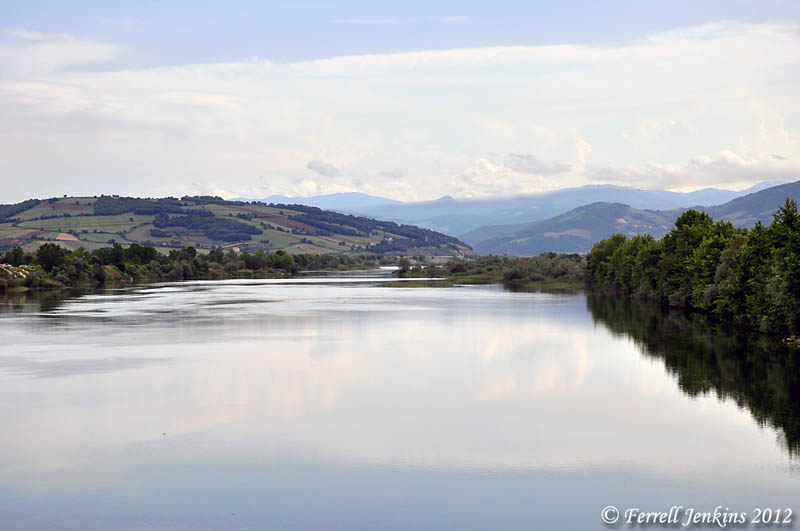
Kizilirmak (Halys) River flowing to the Black Sea. Photo by Ferrell Jenkins.

Kizilirmak (Halys) River flowing to the Black Sea. Photo by Ferrell Jenkins.

The ancient Hittite Empire comes to mind when I think of the Halys River, as Pfeiffer and Vos have pointed out. We say that the Hittites lived within the bend of the Halys River. A portion of Cappadocia (1 Peter 1:1) is also within that same bend.

Seeing the Halys, which I had seen before near the Hittite capital, was a pleasant surprise.
BiblePlaces giveaway of the PLBL Israel Collection

Between now and Friday at 10 am Pacific time you have an opportunity to enter a significant giveaway worth $149. Todd Bolen announces how you can win one of two copies of the 5 volumes of Israel photos in the Pictorial Library of Bible Lands.

For full details click here. If you don’t win one of the sets you can always purchase it.

For my opinion about the full 18 volume Pictorial Library of Bible Lands see the review here.

— • —

Peter’s Epistles and Pontus. I have been busy with other matters and unable to write more about the Black Sea coast. Hopefully tomorrow.

Visiting the Black Sea coast of Turkey

One might ask why a person interested in the Bible world would want to visit the Black Sea coast of Turkey. A few weeks ago, while there, I gave some of the reasons here. A summary before proceeding might be advisable. My visit was limited to a region of about 100+ miles from about 20 miles east of Samsun to Sinop.

Both Samsun and Sinop are located in the the region known as the Roman province of Pontus in Asia Minor. By New Testament times the provinces of Bythinia and Pontus were combined and governed as a single province.

Roman Provinces of Asia Minor in New Testament Times. BibleAtlas.org.

Roman Provinces of Asia Minor in New Testament Times. BibleAtlas.org.

There were 13 cities in the province of Pontus (Wilson, Biblical Turkey, 332).

The New Testament mentions Pontus only three times. The first reference is in Acts 2. Note the association with Peter.

  • Jews from Pontus were visiting Jerusalem during Pentecost when the gospel was first announced by Peter (Acts 2:5,9). It is likely that some of these men became obedient to the gospel before returning home.

Beside Peter’s address to Christians in Pontus in his first epistle, the only person named in association with Pontus is Aquila.

  • A Jew by the name of Aquila was a native of Pontus. He had gone to Rome, but was commanded to leave Rome under the decree of the Emperor Claudius (A.D. 41-54). Reaching Corinth, he and his wife Priscilla, met the apostle Paul (Acts 18:2). We are not told whether Priscilla was from Pontus, Rome, or some other place.
  • When Paul left Corinth, Aquila and Pricilla went with him to Ephesus and remained there. When they heard the eloquent Alexandrian preacher Apollos who knew only John’s baptism, they privately taught him the “the way of God more accurately” (Acts 18:18, 26). I think the inference is that they encouraged Apollos to go to Corinth.
  • Paul mentions Aquila and Priscila (Prisca) in his letter to the Corinthians which was written from Ephesus (1 Corinthians 16:19).
  • During Paul’s third journey, when he wrote to the saints at Rome from Greece (Corinth) during the reign of the Emperor Nero (A.D. 54-68), he sends greetings to Prisca and Aquila (Romans 16:3). This means that by this time they found it safe to reside in Rome.
  • In his final letter from Rome, Paul tells Timothy to “Greet Prisca and Aquila” (2 Timothy 4:19).

We have evidence that the name Aquila was known in Pontus. In the 1909 Dictionary of the Bible (ed. James Hastings), A. Souter says,

an inscription has recently been found referring to one Aquila at Sinope, one of the principal cities of the Roman province Pontus.

Do not make the mistake of thinking this is a reference to the husband of Priscilla. It simply means that the name was known in the region.

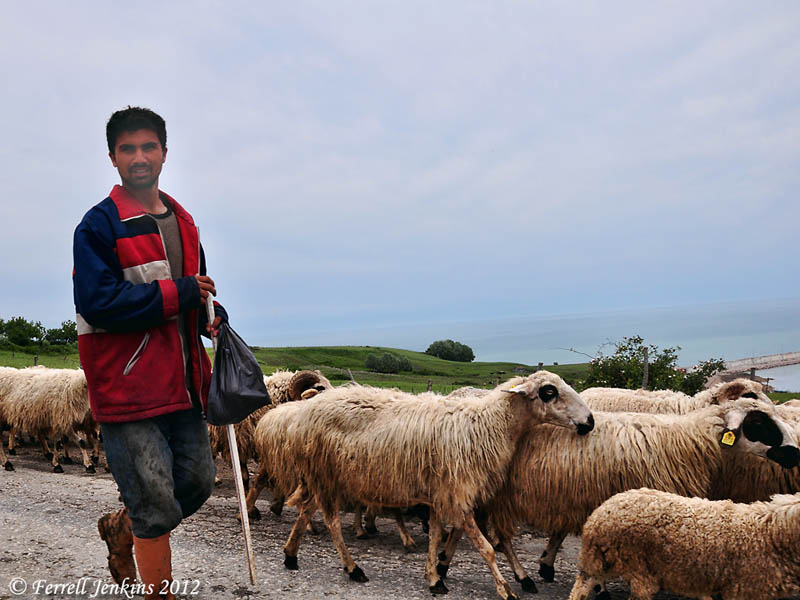
Our photo today was made on a dreary, rainy day near Sinop. Notice that the highway is high in the mountains overlooking the Black Sea. At several points there is no coastal road. This is an important fact that we will speak more about in a future post.

A shepherd overlooking the Black Sea near Sinop, Turkey. Photo by Ferrell Jenkins.

A shepherd overlooking the Black Sea near Sinop, Turkey. Photo by Ferrell Jenkins.

Major revision of the Pictorial Library of the Bible Lands

Todd Bolen announces the release of a total revision of the Pictorial Library of Bible Lands. This revised and expanded edition is the culmination of 9 years of work. The previous version contained 6000 photographs in 10 volumes. According to the announcement,

This new edition consists of 18 volumes with nearly 18,000 photographs, adding hundreds of new sites and re-visiting the old favorites.

Here are just a few features of the new edition of the Pictorial Library of Bible Lands.

  • Eight new volumes: (Lebanon, Eastern and Central Turkey, The Greek Islands, and more. New subjects include Cultural Images, Signs, and Trees, Plants, and Flowers.
  • New Photos: For example, more than 1000 new photos have been added to the Jerusalem volume.
  • New Photographers. In addition to the photos by Todd Bolen, the work of more than 40 photographers are included in this new set.
  • New Maps. New, original maps have been created to identify the sites.
  • New Indexes. Every photograph is indexed in a list of more than 400 pages.
  • You get the hi-res photos and the photos already in PowerPoint. You can use the presentation as it is or include individual slides in your own lesson.
  • And more…
Pictorial Library Complete Collection. BiblePlaces.Com.

Front cover of the new Pictorial Library Complete Collection.

For those who already own the previous collection, Bible Places is offering the new 18-volume set for the upgrade price of $179. The entire set for new purchasers is $389.

Would you prefer to make your own photos? Try buying a good digital SLR camera starting at about $1500, flying to Israel (not to mention Lebanon, Egypt, Turkey, Greece, the Greek Islands, Italy, et al.), renting a car for a few weeks, buying the gas. Oh, and don’t forget to hire a private plane for a few hours so you can get some good aerial photos. That might cost at least $389. 🙂 And what if the lighting conditions were not right for a good photos the day you were at a site? What if you don’t have time to get your photos organized and write a description of each one? Need I go on to make a point? Did I mention that living and teaching in Israel for a decade helps?

Every church should have a set of this material for the teachers to use in their teaching. Over the years I have found that some short-sighted groups (churches) will not make such an expenditure. The other choice is to buy the set for yourself.

I hear several lessons a week, and every one of them could be improved by the use of photos from this wonderful collection.

Learn more about the new Pictorial Library of Bible Lands in the following places:

Charles Savelle has a good interview with Todd Bolen at the BibleX blog here.

I have profited much from the work of Todd Bolen and am delighted to count him as a friend and to recommend this collection of photographs to every teacher of the Bible.

Follow the BiblePlaces.com Blog here.

Black Sea coastal town of Sinop

We drove the 100 miles from Samsun to Sinop today. The distance on the road map is deceptive. about one half of the distance is in serious mountain territory. The drive took three hours each way. We had a 6:15 p.m. flight from Samsun to Istanbul, so our time was limited. The drive was educational and helped us to understand some things we had only read about before.

I don’t have the time to explain the reasons for going to this town, except to say that it is in the region of the ancient Roman province of Pontus (1 Peter 1:1).

Later I hope to show you some photos and explain the importance of the town to the study of Peter’s epistles.

Homeward bound tomorrow after a great (nearly) four weeks in Turkey, Greece, and Cyprus.

1400 year old olive press excavated

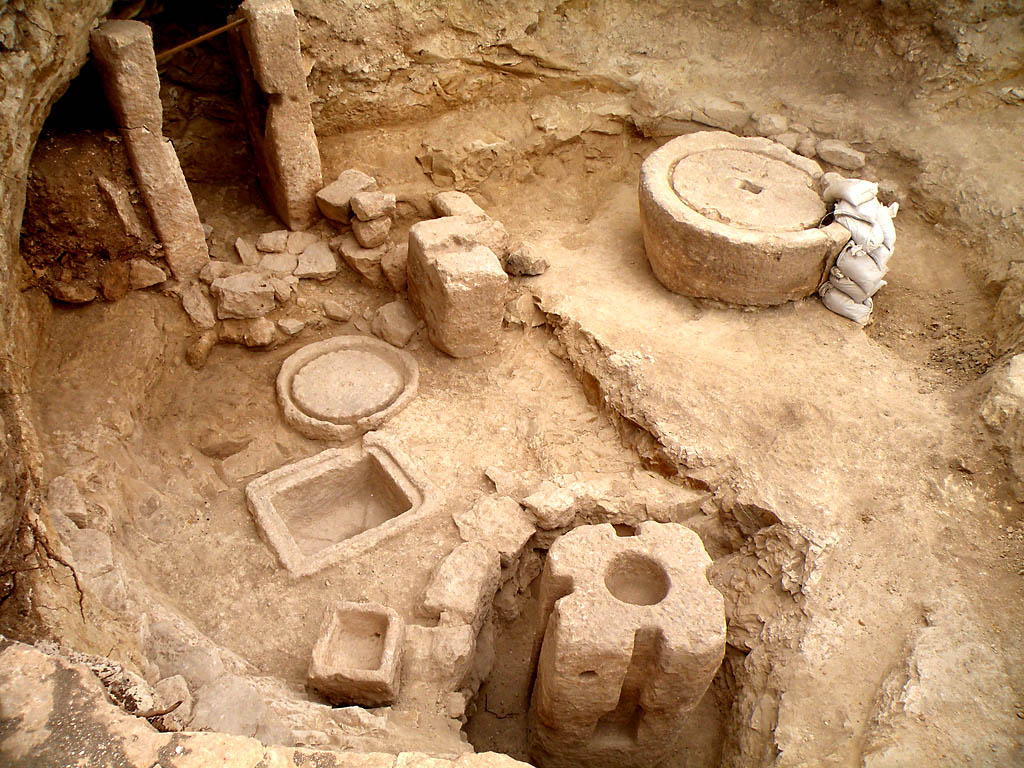
The Israel Antiquities Authority announces the discovery of a 1400 year old olive press at Modi’in. According to a brief article in Arutz Sheva,

A statement by the IAA called the press the grandest and most complete one found so far.

Archaeologist Hagit Torgë, who is directing the dig, said the press, which was used to produce industrial quantities of oil for food and light, about 1,400 years ago, “was preserved surprisingly intact with all its components.”

1400 year old olive press at Modi'in. Credit: Hagit Torgë, Israel Antiquities Authority.

Olive press at Modi’in. Credit: Hagit Torgë, Israel Antiquities Authority.

Click on the photo for a hi-res image.

Olives are mentioned in the Bible from Genesis (8:11) to Revelation (18:13), and are still important in many parts of the world.

HT: Joseph Lauer

Group departs for home after two weeks of study in Turkey and Greece

About noon today our group of travelers departed from the Athens International Airport for the USA and their various residences. One couple from Canada left earlier in the day. Others will be traveling to Alabama, Florida, Indiana, Kentucky, Tennessee, Texas, Oregon, and perhaps a few other states that do not come to mind at the moment.

Yesterday morning Steve Niemeier, a minister from Indiana, spoke during our worship period. He mentioned some of the things he had learned on this tour. It was not his first time to travel to foreign lands, but his first organized tour to some of the Bible lands. He said that previously the places we visited, such as Ephesus, Colossae, Patmos, Corinth, et al. had been places on a map, but that now they were places in our mind. I thought that was a good way to express the value of tours like this for preachers, teachers, and other Bible students.

I have a few more places to visit before returning home. Perhaps we will be sharing some of those in the days to come.

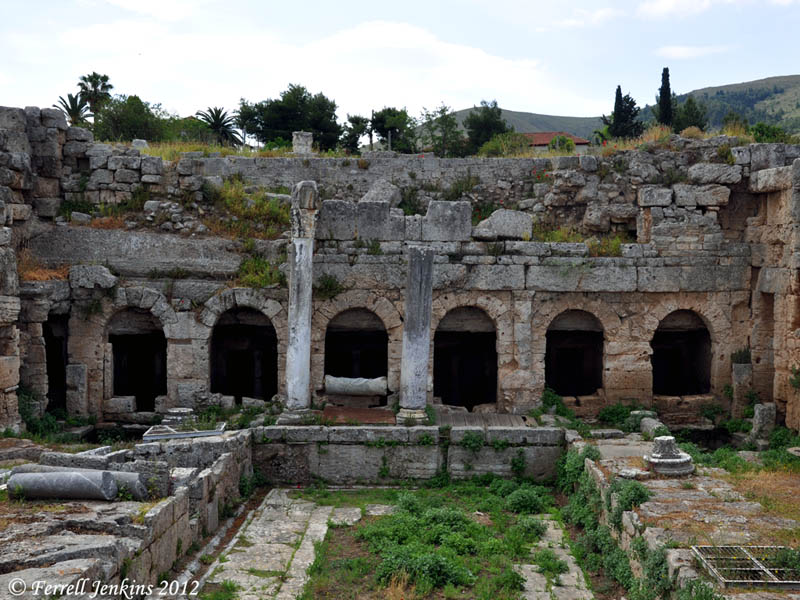
The photo below is one that I took in at Corinth a couple of days ago. It is the Fountain of Peirene, Corinth’s most important reservoir with a capacity of over 81,000 gallons. The fountain was fed from subterranean springs. The fountain is no longer in use, but you can still hear the water flowing.

Fountain of Peirene at Ancient Corinth. Photo by Ferrell Jenkins.

Fountain of Peirene at Ancient Corinth. Photo by Ferrell Jenkins.

Sardis, Philadelphia, Laodicea, Colossae, and Hierapolis

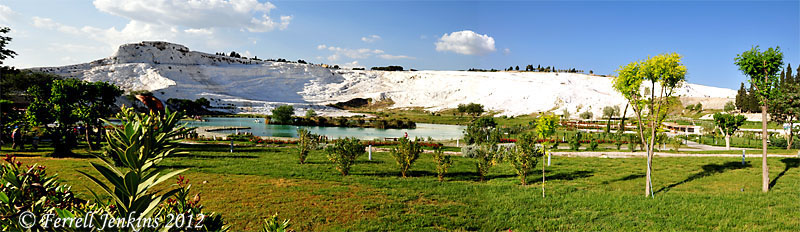
There were many sites to see today. We left Izmir (Smyrna) in the morning and drove east to the site of ancient Sardis (Revelation 3:1-6). From there we continued to in a southeast direction to Philadelphia (Revelation 3:7-13). Then we made our way to the Lycus River valley. The first stop was at Colossae (Paul’s epistle to the Colossians). After viewing the ancient mound which still awaits excavation, we went to Laodicea (Revelation 3:14-22). On the way to the hotel we stopped for a photo of the cliffs at Pamukkale (ancient Hierapolis, Colossians  4:13). The name Pamukkale means  “cotton castle” or “cotton fortress.”

Mellink describes the formation here. He says the city,

… is famous for its continuing geological transformation. Hot mineral springs issue from the rock in the city, and the waters streaming down the cliffs have deposited limestone in large formations, the surface of which is made a gleaming white ‘frozen cascades’ (IDB II:601).

'Pamukkale 'frozen cascades'. Photomerge by Ferrell Jenkins.

‘Pamukkale ‘frozen cascades’. Photomerge by Ferrell Jenkins.

We could see the white hillside clearly from Laodicea about six miles to the south. The photo above was made just below the cliffs. Hierapolis sits on the plateau. Click on the photo for a larger image.

Nothing has changed in the past few years at Sardis, Philadelphia, and Colossae. A tremendous change is taking place at Laodicea. Portions of the city that had remained buried until the past decade are now coming to light. I was surprised at the changes just in the past four years since I was here. Later on we will try to show you some of these new things.

Tomorrow we plan to visit Hierapolis and Aphrodisias before arriving at Kusadasi on the Aegean Sea near Ephesus.

Everyone in our group remains well and seems to be enjoying the visits and the study time together.

Steps of Paul and John in Turkey and Greece

We’re off to visit Turkey and Greece for the next few days. Visiting all of the sites where Paul and John traveled would be impossible in a few weeks. Our tour in Turkey, which we have conducted several times since 1968, is limited to the area of the Seven Churches of Revelation (1:4, 11), and a few cities associated with Paul’s ministry (Ephesus, Acts 19; Colossae and Hierapolis, Colossians 4:13; Miletus, Acts 20). The entry point into the country is Istanbul, the former Constantinople, a city that was significant in the early post-apostolic history of the church.


In the Aegean Sea we visit Patmos (Revelation 1:9), Rhodes (Acts 21:1), and Crete (Acts 27; Titus 1:5).

Our stops in Greece are limited to Athens, Corinth and Cenchreae (Acts 17-18).

We don’t promise to be as thorough as we might while in the comfort of the study at home, but we will try to post a few photos of interest as we move along.

We arrived in Istanbul this morning, collected the luggage, cleared customs and had our luggage loaded on the bus by noon. After a stop for lunch near the Hagai Sophia and the Blue Mosque, we continued with some general sightseeing of the city and a boat ride on the Bosporus. I think everyone is looking forward to a good night of sleep and a full day of sightseeing in the city tomorrow.

Grinding grain in Bible times

The grinding of grain was an important part of the life of people in Bible times. After the grain was gathered from the fields it had to be threshed. This was done by running a threshing sledge over the stalks of grain on the threshing floor (2 Samuel 24:22). The stalks, now cut into small pieces, was then winnowed with “shovel and fork” to separate the chaff from the good grain (Isaiah 41:16; Ruth 3:2; Luke 3:17; Psalm 1:4). Next came the sifting of the grain to further removed small pieces of debris. Jesus makes reference to this practice when he predicts Peter’s denial:

“Simon, Simon, pay attention! Satan has demanded to have you all, to sift you like wheat, (Luke 22:31 NET)

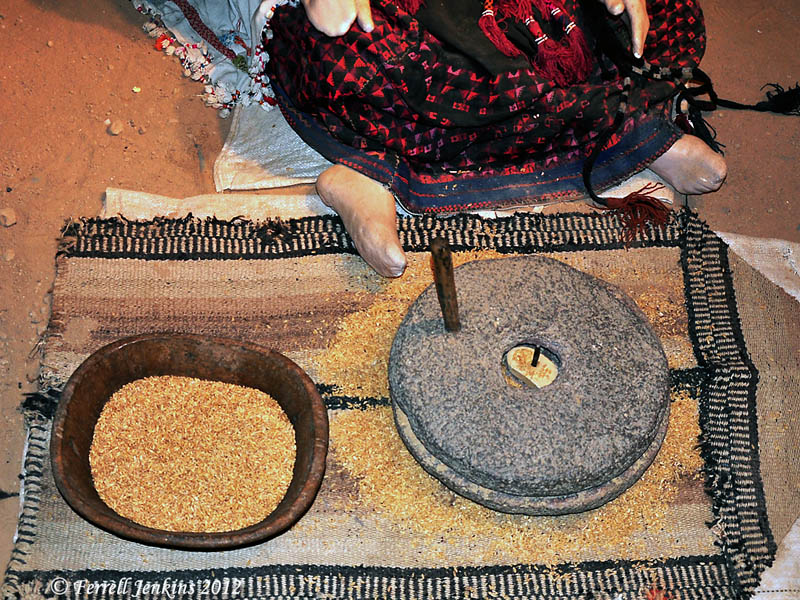
After that, there was still hard work to be done. The grain had to be ground between two millstones. The photo, below taken at The Museum for Bedouin Culture at Kibbutz Lahav in the Negev, shows the process.

Grinding grain. Exhibit at Museum of Bedouin Culture at Kibbutz Lahav. Photo by Ferrell Jenkins.

Grinding grain. Exhibit at The Museum of Bedouin Culture at Kibbutz Lahav in the Negev. Photo by Ferrell Jenkins.

There will be two women grinding grain together; one will be taken and the other left. (Luke 17:35 NET)

There was still the necessary kneading before the bread could be baked and eaten.

I am worn out. I think I will run down to the store and get a loaf of bread.