Category Archives: Bible Lands

Visualizing Isaiah 10: “Assyria, the rod of my anger”

The Assyrians are first introduced in Isaiah 7. In chapter 10 we are informed that they are “the rod of [the LORD’s] anger.” They will serve the purpose of God to punish His people. Isaiah tells us that the Assyrians did not plan to be doing the will of the LORD; they only wanted to destroy many nations.

Ah, Assyria, the rod of my anger; the staff in their hands is my fury! Against a godless nation I send him, and against the people of my wrath I command him, to take spoil and seize plunder, and to tread them down like the mire of the streets. But he does not so intend, and his heart does not so think; but it is in his heart to destroy, and to cut off nations not a few; for he says: “Are not my commanders all kings? (Isaiah 10:5-8 ESV)

In the photos below I hope to illustrate a few ways the Assyrians punished the Judeans. Certainly the same was true of the northern kingdom of Israel (2 Kings 17:5-6).

The Assyrians destroyed northern cities of Israel such as Hazor and the site sometimes identified as Geshur or NT Bethsaida in 732 B.C. By 722/21 Samaria lay in ruins. Assyria continued south into Judah. Sennacherib claims to have destroyed 46 strong cities of Judea in addition to all of the nearby villages (The Taylor Prism).

Assyrian King Sennacherib left reliefs of his war against Lachish on his palace wall at Nineveh. The following photos are portions of that relief now displayed in the British Museum. Many Judeans were taken into captivity. Other begged for mercy in the hilly Shephelah of Judah.

Judeans begging for mercy. Photo by Ferrell Jenkins.

Judeans begging for mercy. Photo by Ferrell Jenkins.

The plea was unsuccessful for some of them. This portion shows an Assyrian commander killing a Judean.
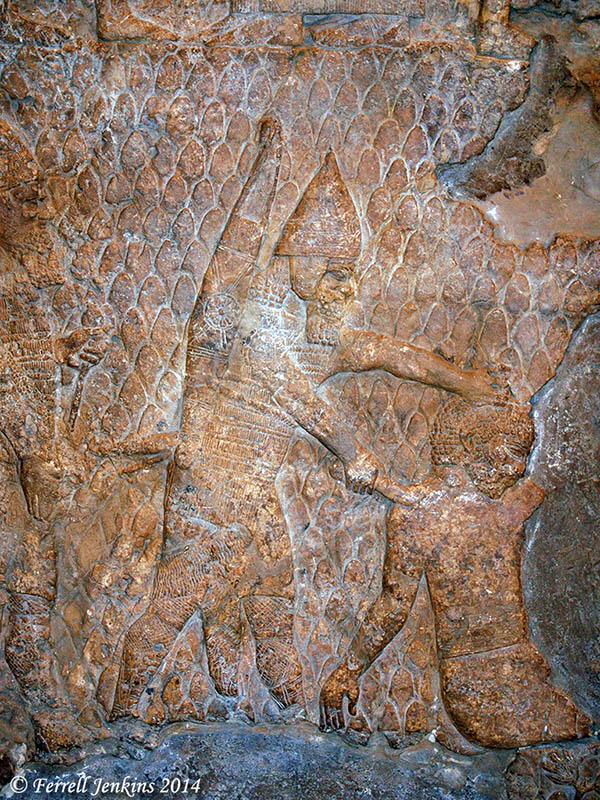
An Assyrian soldier kills a Judean. Photo by Ferrell Jenkins.

An Assyrian soldier kills a Judean. Photo by Ferrell Jenkins.

This portion of the relief shows heads of the slain being brought together for accounting. Some Egyptian reliefs show hands and other body parts being gathered for the same purpose.
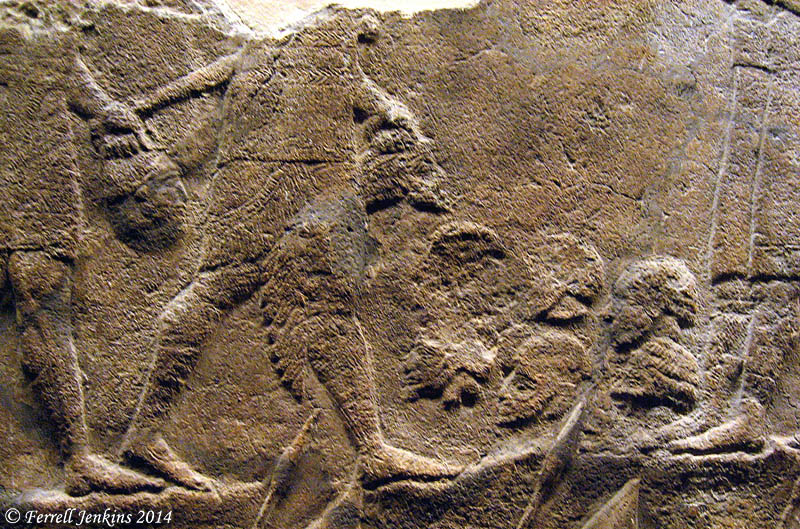
Heads of Judeans being collected to get a count. Photo by Ferrell Jenkins.

Heads of Judeans being collected to get a count. Photo by Ferrell Jenkins.

A 25-minute Discovery Channel video entitled The Assyrians: Masters of War uses Assyrian reliefs to tell the story of their savagery in war. Lachish is emphasized. Click here. (HT: Bible Places Blog).
Visualizing Isaiah 4: the Branch of the LORD

The book of the prophet Isaiah promises the return of a remnant from captivity, but is also filled with Messianic expectation. After describing the terrible consequences of the conquest by foreign powers, Isaiah promises,

In that day the branch of the LORD shall be beautiful and glorious, and the fruit of the land shall be the pride and honor of the survivors of Israel. (Isaiah 4:2 ESV)

It should be pointed out that many of the popular English versions capitalize the word Branch (see NAU, NKJ, CSB, NIV, NRSV). The NET Bible understands the expression to refer to “crops given by the LORD.”

Edward J. Young says,

In the present passage the Sprout is that shoot which comes from the tree of David which has been cut down, and which springs to life from its fallen trunk and brings the tree to more glorious and wondrous heights than before. (The Book of Isaiah)

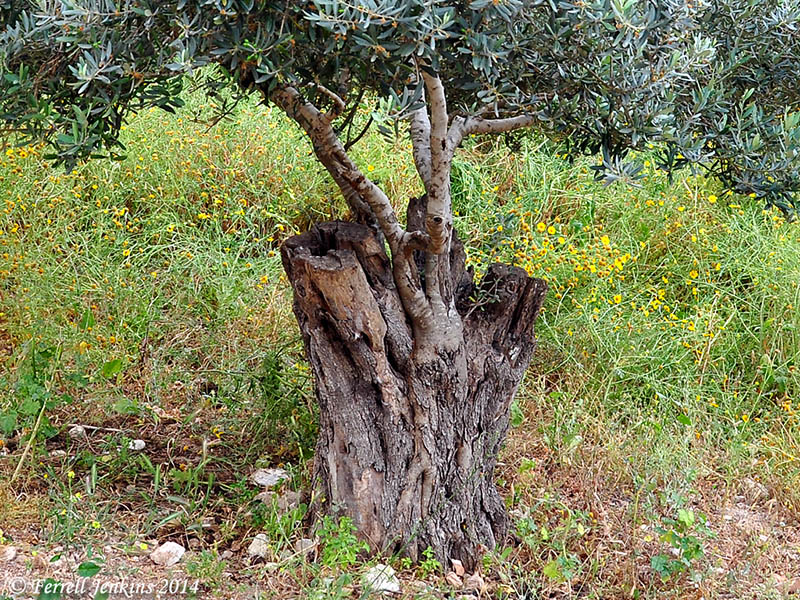
Our photo is intended to illustrate this truth. The tree of David was cut down; only a stump was left. But a shoot, Sprout, or Branch (the Messiah) sprang from it. Certainly a Divine act.

A Sprout comes forth from an olive stump at Nazareth Village. Photo by Ferrell Jenkins.

A Sprout comes forth from an olive stump at Nazareth Village. Photo by Ferrell Jenkins.

I understand this verse to be parallel to the following texts.

In that day the root of Jesse, who shall stand as a signal for the peoples– of him shall the nations inquire, and his resting place shall be glorious. (Isaiah 11:10 ESV; cf. Romans 15:12; Revelation 5:5; 22:16)

“Behold, the days are coming, declares the Lord, when I will raise up for David a righteous Branch, and he shall reign as king and deal wisely, and shall execute justice and righteousness in the land.” (Jeremiah 23:5)

See also Jeremiah 33:15 and Zechariah 3:8.

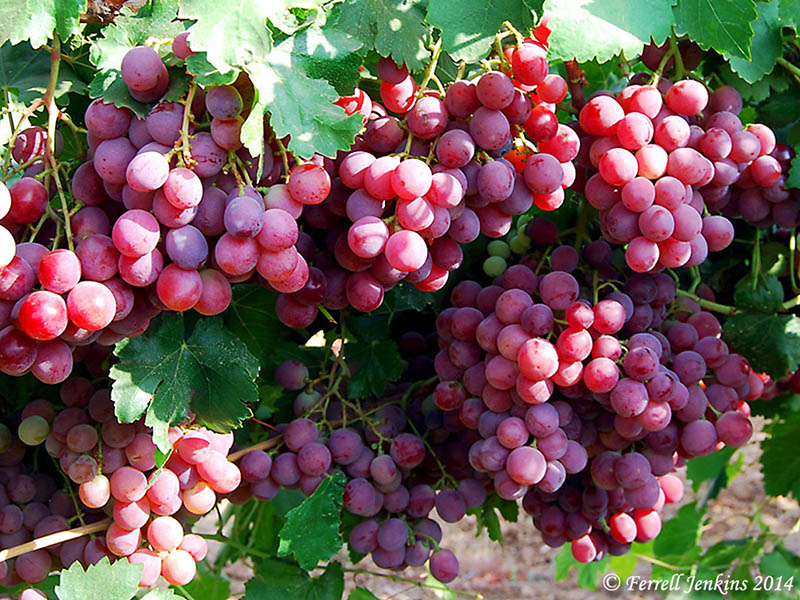
If you would like to think of an abundance of fruit, whether literal or figurative, I think this photo might help.

Abundant fruit in the vineyards of Lachish. Photo by Ferrell Jenkins.

Abundant fruit in the vineyards of Lachish. Photo by Ferrell Jenkins.

The Pools of Solomon

It is a fact that numerous structures in Israel are incorrectly identified. Earlier travelers may have asked where this or that biblical event took place. There was always someone willing to show them what they wanted to see. Some items that come to mind include the Tower of David and Solomon’s Stables in Jerusalem, Ahab’s Palace at Jezreel, and Solomon’s Pools southwest of Bethlehem.

In the earliest days of my tours we were able to visit Solomon’s Pools as we traveled between Bethlehem and Hebron. In more recent years the Pools have been in the Palestinian Authority’s West Bank. This means going to Bethlehem and then making arrangement to visit the pools.

Solomon, who ruled about 970–931 B.C., is said to have developed vineyards, gardens, and pools.

I made great works. I built houses and planted vineyards for myself. I made myself gardens and parks, and planted in them all kinds of fruit trees. I made myself pools from which to water the forest of growing trees. (Ecclesiastes 2:4-6 ESV)

These pools do not belong to the time of Solomon. It may be legendary, but Josephus says that Solomon used to ride upon a chariot to a place called Etham (Etam). This area is described as “very pleasant in its fine gardens, and abounding in rivulets of water; he used to go there in the morning sitting high in his chariot” (Antiquities 8:186).

One of the earliest projects conducted by Amihai Mazar, in 1968, was a survey of the 70 kilometers of aqueducts. He wanted to see how accurate Conrad Schick has been in his 19th century surveys.

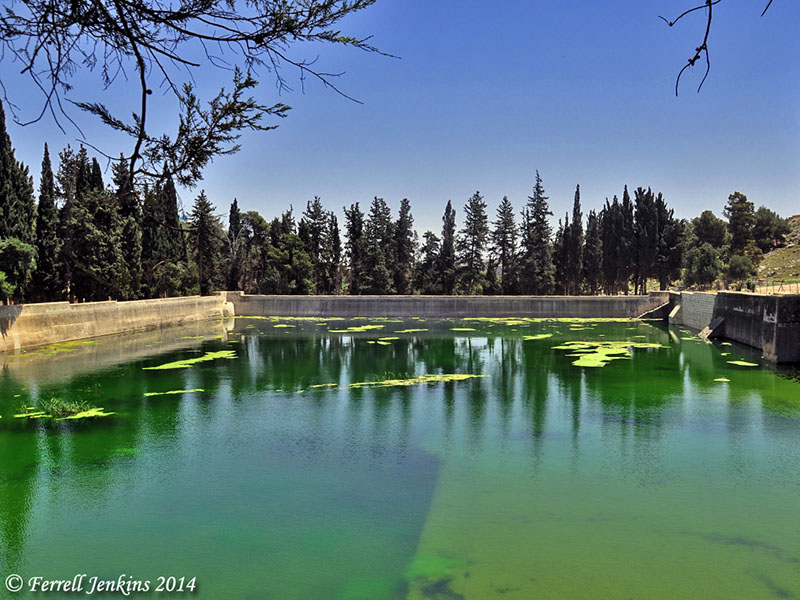
Several springs feed into the “pools of Solomon” from the south through two aqueducts. From the western pool a high level aqueduct carried water to the Upper City of Jerusalem. From the easternmost pool a low level aqueduct carried water to the Temple Mount.

One of the earliest projects conducted by Amihai Mazar, now Professor Emeritus at Hebrew University, in 1968 was a survey of 70 kilometers of aqueducts. He wanted to see how accurate Conrad Schick had been in his surveys in the 19th century. He says the pools,

must date to the Hasmonean period, perhaps to Alexander Jannaeus [126 B.C.–76 B.C.]. We don’t have any written sources, and there is no objective archaeological data for dating them. But we base our assumption on the fact that in the Mishnah the aqueducts are referred to and are very important for ritual purposes on the Temple Mount. (BAR, 10:3, May/June 1984).

Mazar’s study of “The Aqueducts of Jerusalem” is published in Jerusalem Revealed: Archaeology in the Holy City 1968–1974. 79-84.

Our first photo shows the highest of the pools which I am calling the western pool.

The western most pool. View east. Photo by Ferrell Jenkins.

The western pool. View east. Photo by Ferrell Jenkins.

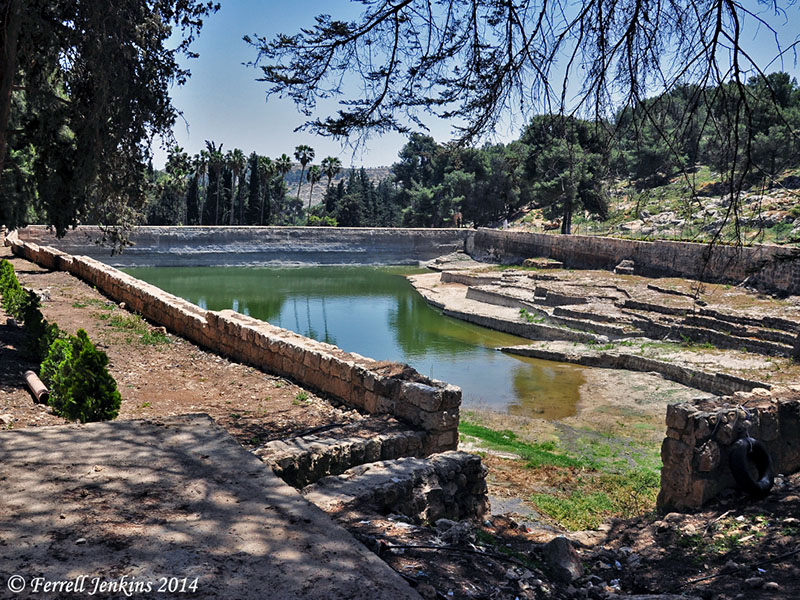
The middle pool is shown here with a view to the northwest. You can see the higher hills in the break between the trees.

The middle pool. View west. Photo by Ferrell Jenkins.

The middle pool. View northwest. Photo by Ferrell Jenkins.

The third pool (eastern) is shown below with a view toward the west.

The eastern pool. View west. Photo by Ferrell Jenkins.

The eastern pool. View west. Photo by Ferrell Jenkins.

A recent study of “Jerusalem’s Ancient Aqueduct System” by Tom Powers is available for download at his website here. This article can be helpful for those who wish to know more about the subject.

Jerome Murphy-O’Connor has a few pages devoted to Solomon’s Pools, including the aqueduct system, in The Holy Land (483-486).

Within the past few weeks there has been some information, and some unfounded speculation, about a water system found at ‘Ain Joweizeh. Todd Bolen describes the location of the site:

The site is located 5.5 miles (9 km) southwest of the Old City of  Jerusalem, 3.5 miles (5.5 km) northwest of Bethlehem, and just down the slope to the west of Har Gilo.

Bolen has a good summary of what we know about this water system (“Royal Water System Excavated in Judean Hills”) in a recent post here.

BAR’s Bible History Daily includes photos of the Proto-Aeolic Capital associated with the recently discovered tunnel here.

Visualizing Isaiah: a booth in a vineyard

Because the events of the Bible took place in the Ancient Near East, we expect it to use illustrations from that world. Many of these cultural practices are different from those we know, but others are similar.

The prophet Isaiah describes what will happen to Jerusalem as a result of their sin.

And the daughter of Zion is left like a booth in a vineyard, like a lodge in a cucumber field, like a besieged city. (Isaiah 1:8 ESV)

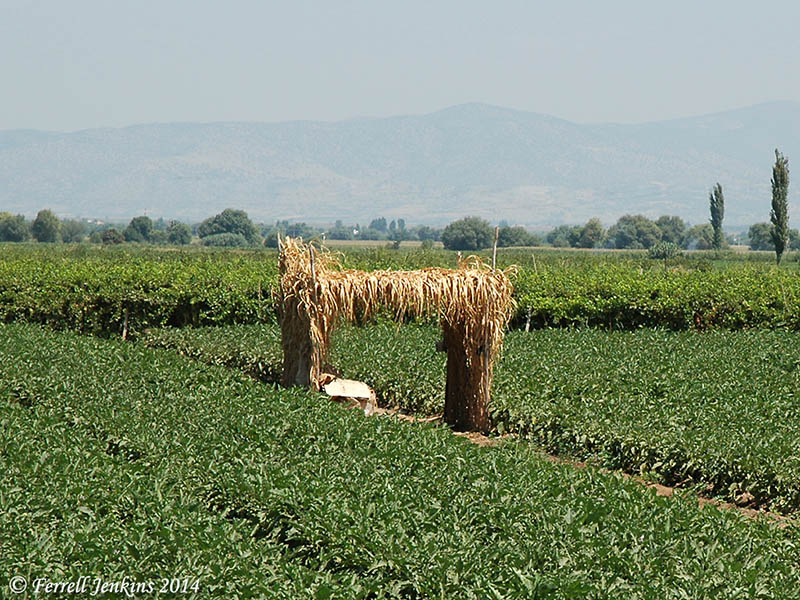
Almost everyone has seen a fruit or vegetable booth along a highway during the picking season. Months later we may see that same booth in disrepair. In Biblical times, watchtowers and temporary booths were set up in fields to provide a moment of shade for the workers.

Our photo today was made a few miles east of Sardis (Revelation 3:1) in modern Turkey. It is near a vineyard and set amidst another crop. One can easily image it still standing in disarray when the winter rains come.

A booth in the field, east of Sardis. Photo by Ferrell Jenkins.

A temporary booth in the field, east of Sardis. Photo by Ferrell Jenkins.

The Judeans of the 8th century B.C. could easily visualize what Isaiah was describing, and those who were living when the city was destroyed by the Babylonians would see it as a fact.

Jeremiah’s lament over the city after 586 B.C. illustrates the point:

How lonely sits the city that was full of people! How like a widow has she become, she who was great among the nations! She who was a princess among the provinces has become a slave. (Lamentations 1:1 ESV)

Church History book available for Kindle

Do you have a good book on Church History? I have observed that many church members are generally ignorant of church history. A few months ago I learned that two books by Zondervan were to be available in Kindle format for $3.99 each. The second volume in the series was available, but there was some delay in getting the first volume online. Volume two is available today for $3.99. For how long I do not know.

51YVjpXge3L

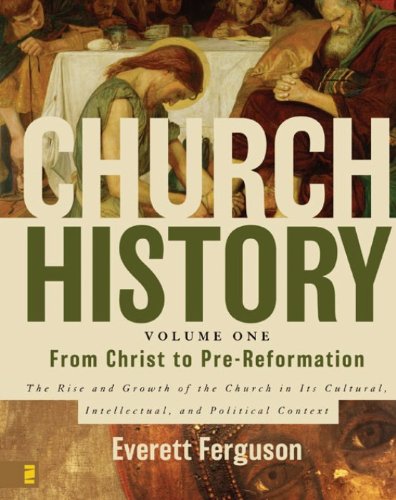
Everett Ferguson’s Church History ,Volume One: From Christ to Pre-Reformation: The Rise and Growth of the Church in Its Cultural, Intellectual, and Political Context: 1, is currently available for the Kindle for $3.99. The regular price for the Kindle edition is $44.99. This book begins with the historical setting for the coming of Christ and the establishment of the church. It ends at about 1300 A.D.
Ferguson is widely respected as a scholar in early church history. With a Ph.D. from Harvard, he is professor emeritus of Bible and distinguished scholar-in-residence at Abilene Christian University. He is author of several books on early Christianity.

An eBook like this could be helpful for travelers visiting the Bible lands. In Turkey, for example, one sees the development of the Church Councils. In Italy there is the rise of the papacy and Catholicism. The Crusades involved numerous countries, including Israel. Sections on monasticism and the rise of Islam can be helpful as well. Ferguson also covers the “Dark Ages” and sets the stage for the earliest Reformation efforts.

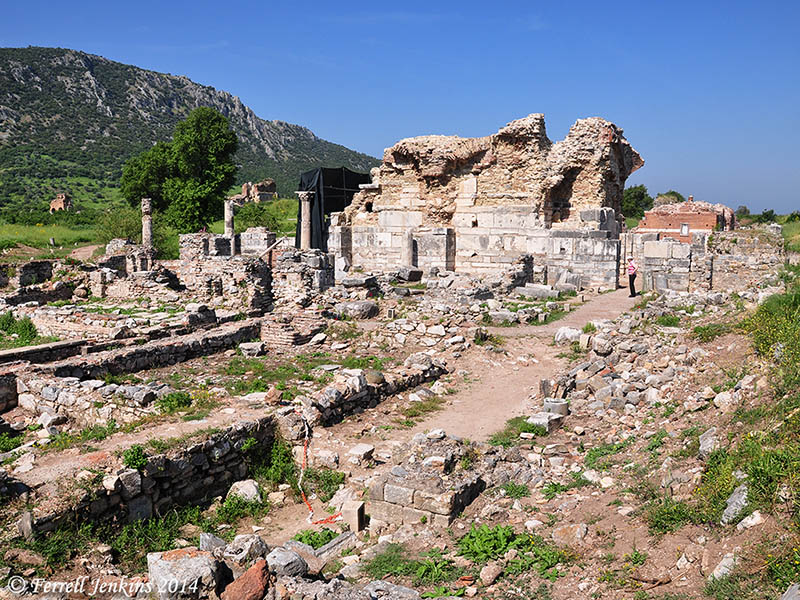
Our photo shows ruins of The Church of Mary, also called the Church Council Church, at Ephesus. In A.D. 431 the Council of Ephesus was conducted here.

Church Council Church at Ephesus. Photo by Ferrell Jenkins.

Church of Mary (Church Council Church) at Ephesus. Photo by Ferrell Jenkins.

HT: Brooks Cochran

Hiking Abraham’s footsteps

The full title of this Haaretz article is “Hiking in Abraham’s footsteps, from Turkey to the Holy Land.” Sounds incredible at the moment. To hike this complete trail from Haran (Genesis 12:4) to Beersheba (Genesis 21:31) (not to mention the trip to Egypt) requires travel in Turkey, Syria, Jordan, Israel, and the Palestinian Authority (West Bank).

Among the leaders back of the concept is David Landis and his wife Anna Dintaman, developers of the Jesus Trail from Nazareth to the Sea of Galilee. Their book, Hiking the Jesus Trail and Other Biblical Walks in the Galilee, is worthwhile even for those who do not plan to walk the trail.
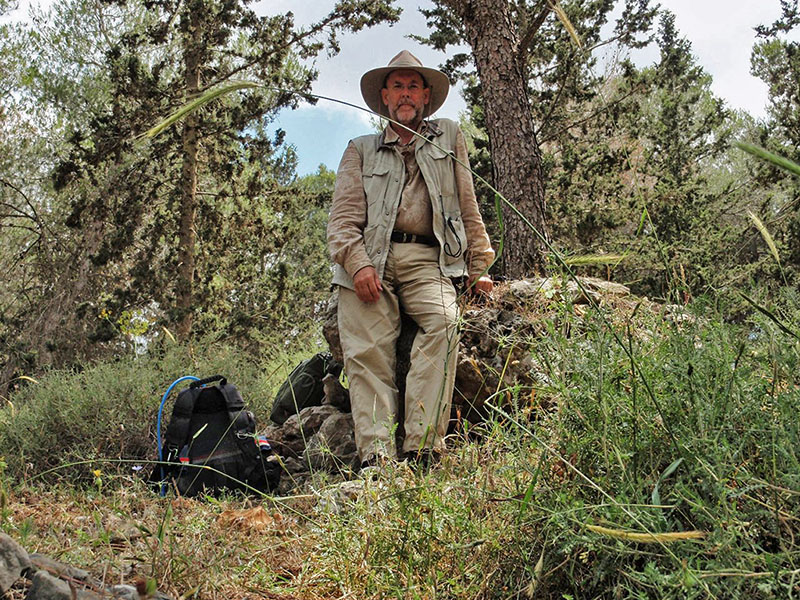
Larry Haverstock walked the Jesus Trail in 2011. I see that Larry’s posts about the experience is still available on his blog. See the 3rd Journey. You will find some fascinating stories along with beautiful photos you may never see from a bus or car.

Larry Haverstock in the Zippori Forest north of Nazareth.

Larry Haverstock in the Zippori Forest north of Nazareth.

The link to the Haaretz article may be accessed here. In order to read the full article you must register for free access to 10 articles a month.

Don’t expect to walk the Abraham Path from Haran (in Turkey) to Beersheva [Beersheba], but you might be able to walk small portions of the trail everywhere except the part going through Syria.

There are many hiking trails in Israel, but most of these avoid contact with the Palestinian Authority. The new plan seeks to involve the local people in the development of facilities useful to hikers.

If you like hiking, or if you appreciate the geography of the Bible lands you will probably enjoy the article. Abraham Path has a nice web site with maps and photos here.

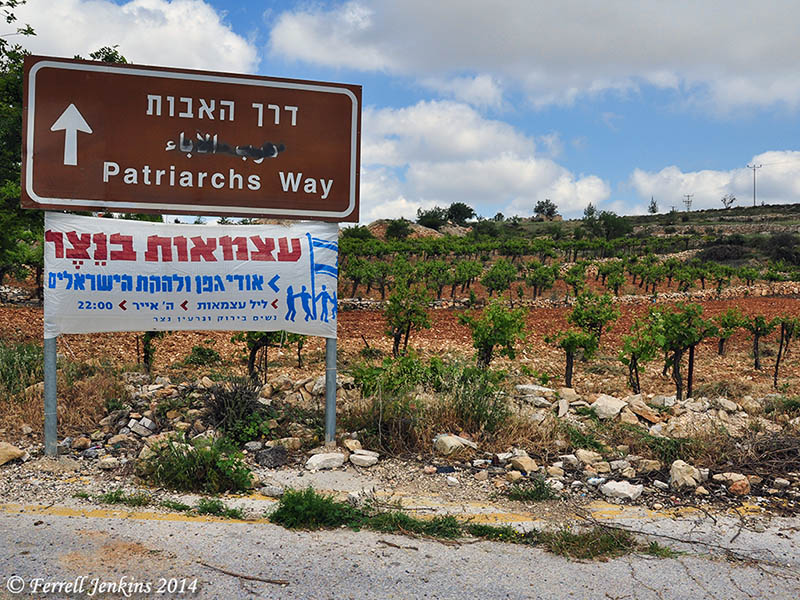
I don’t know what, if any, relationship there is between the Abraham  Path and the Patriarchs Way, a trail that is said to run from Beersheba to Nazareth. The defacing of the sign to eradicate the Arabic indicates one of the problems either trail might face. One often sees this sort of thing on signs pointing to Christian sites.

Sign pointing to Patriarchs Way off Hebron Road (Hwy. 60) south of Bethlehem . Photo by Ferrell Jenkins.

Sign pointing to Patriarchs Way off Hebron Road (Hwy. 60) south of Bethlehem . Photo by Ferrell Jenkins.

Walk the Land : A Journey on Foot through Israel, by Judith Galblum Pex, is a fascinating account of a couple who walked the Israel Trail from Eilat to Dan.
Reading the blogs

The majority of the content of this blog deals with biblical studies, archaeology, travel and photography. Concentration is especially on travel in the Bible World. As a result of this I follow several blogs that are extremely helpful. These include:

Bible Places Blog. Todd Bolen’s Weekend Roundup, and Midweek Roundup are extremely helpful, as are his insightful comments on recent archaeological announcements.

HolyLandPhotos’ Blog by Carl Rasmussen covers numerous lesser known places. Recently he has covered some sites visited, or probably visited, by Paul on his journeys through Asia Minor (modern Turkey).

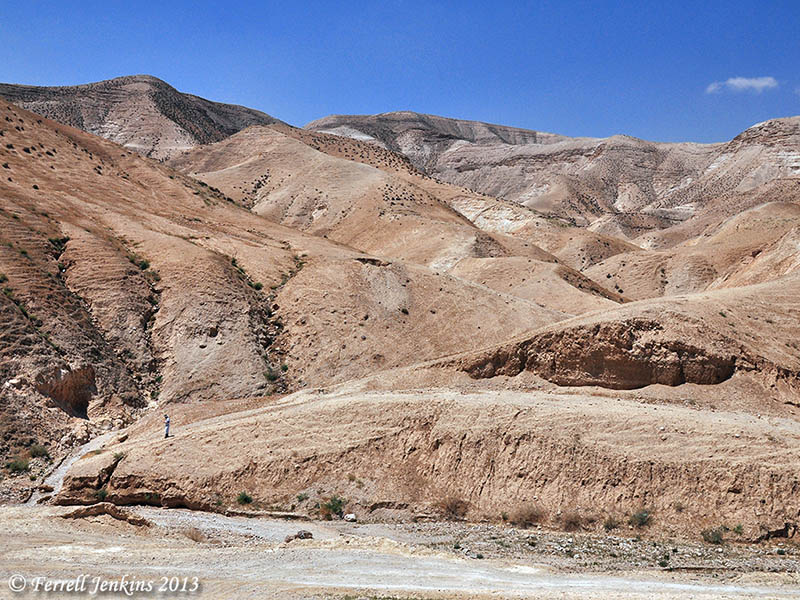
The wilderness of Judea. Photo by Ferrell Jenkins.

The wilderness of Judea. Photo by Ferrell Jenkins.

I have a few former students  who write about these areas. You might enjoy taking a look at Leon’s Message Board (Leon Mauldin), Exploring Bible Lands (Barry Britnell), Luke Chandler’s Blog. Leon recently posted photos of the gathering of olives at Shechem. Trent and Rebekah, former tour members, have posted some helpful articles during their six months in Israel.

Gordon Franz writes less frequently on his Life and Land Seminars, but most of his material reflects a considerable amount of research. As part of his ongoing Cracked Pot Archaeology series he posted a response to the theory that the Arabia of “Mount Sinai in Arabia” (Galatians 4:25) is in modern Saudi Arabia.

Leen Ritmeyer,  Ritmeyer Archaeological Design, writes about the way the buildings looked in Bible times as well as recent discoveries and developments.

Wayne Stiles seeks to connect the Bible and its Lands to Life. In a recent post he discussed the “Top 5 Gifts for Bible Lands Study.”

Shmuel Browns, Israel-tourguide, has an interesting blog with great photos. A recent post features fascinating photos of Nahal Prat or Wadi Qelt. This may be where Jeremiah was told to go and bury his loincloth (shorts) (Jeremiah 13:4-7). Most English versions use the word Euphrates for the Hebrew term Perath. The NET Bible transliterates the term. Nahal Prat is near Jeremiah’s hometown Anatot (Anathoth). We wrote about a morning with Shmuel here.

Recently I learned of two new blogs dealing with the Bible lands and customs. Mark Ziese writes Bible Lands Explorer. Mark’s most recent post is about the Milk Grotto in Bethlehem. Yep, a place dedicated to Mary feeding baby Jesus. Willis Britt writes on Lessons From The Land. A recent series deals with Preaching and the Land.

Believe me, there is quite an education in reading these blogs.

I keep links to these and other blogs on the Scholarly page at the Biblical Studies Info Page.

Elah River flooding at Tell es-Safi/Gath

Several times we have commented on the wonderful photos supplied by Prof. Aren Maeir about the archaeological excavations at Tell es-Safi/Gath, both during the season and throughout the year.

For the past two days Maeir has posted photos of the Elah River flooding at Safi/Gath. English readers will relate to the word brook. The Hebrew is nahal. This is the same brook we read about in the account of David choosing five smooth stones when he went to fight Goliath (1 Samuel 17:40). The term used here is equivalent to the Arabic wadi.

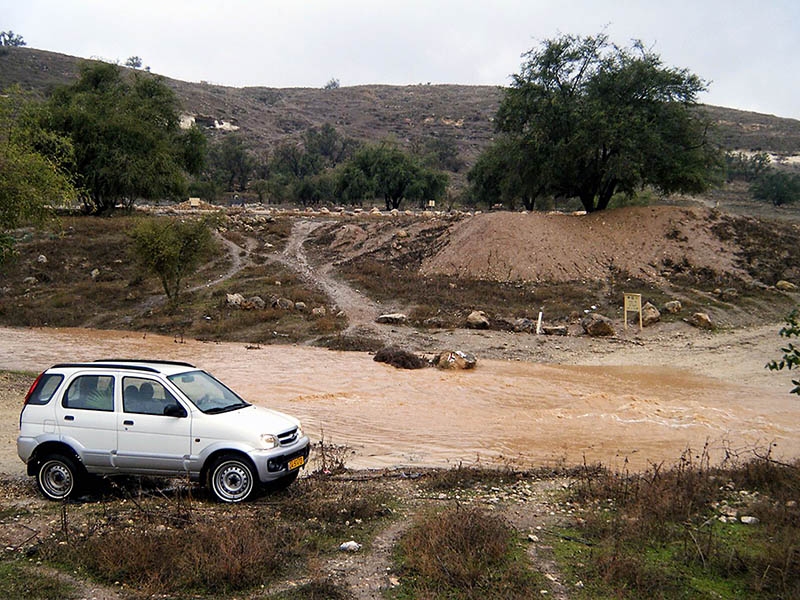
A stream like this is dry most of the year, but flows freely during the rainy, winter season.

The photo below is from the Tell es-Safi/Gath blog here. It was made by Uri Yehuda, a student in Prof. Maeir’s department at Bar Ilan University. Those who have visited Gath during the dry season should find it instructive.

Flooding of the Elah River next to Safi. Photo by Uri Yehuda.

Flooding of the Elah River next to Safi. Photo by Uri Yehuda.

You may locate this photo in hi-resolution, and another made by Aren on the blog. The best picture may be in video format with a young lady telling us it is the “flood of December.” The link to all of this material is here.

The Brook of Elah begins below Adulam, flows through the valley bearing its name, around Azekah, past Gath, and into the Mediterranean Sea.

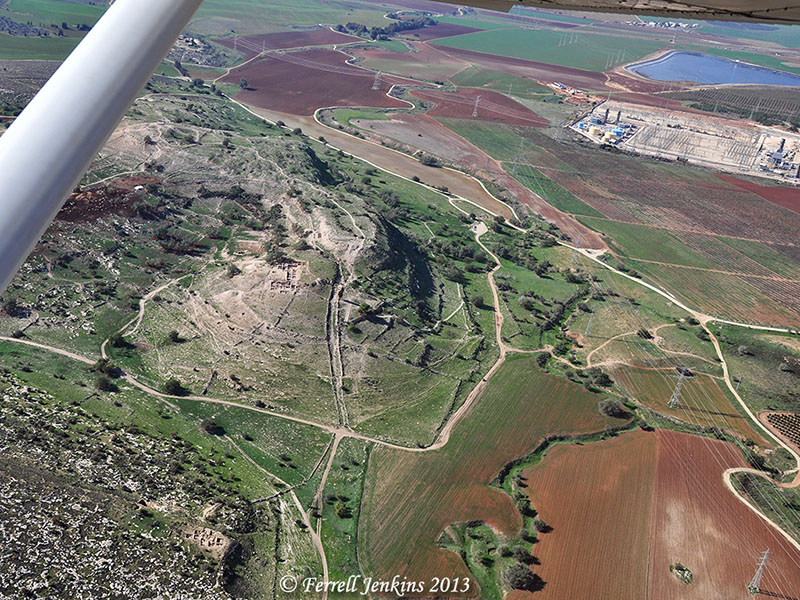
In the aerial photo below you will see Tell es-Safi/Gath just to the left of the center of the photo. The Elah River (Brook) can be seen in the lower right corner of the photo. This photo was made December 15, 2009. The river bed is green because there had been earlier rains, but nothing like the recent storm seen in Israel.

Aerial view of Gath and the Elah Brook. Photo by Ferrell Jenkins.

Aerial view of Gath and the Elah Brook. Photo by Ferrell Jenkins.

Snow in Israel

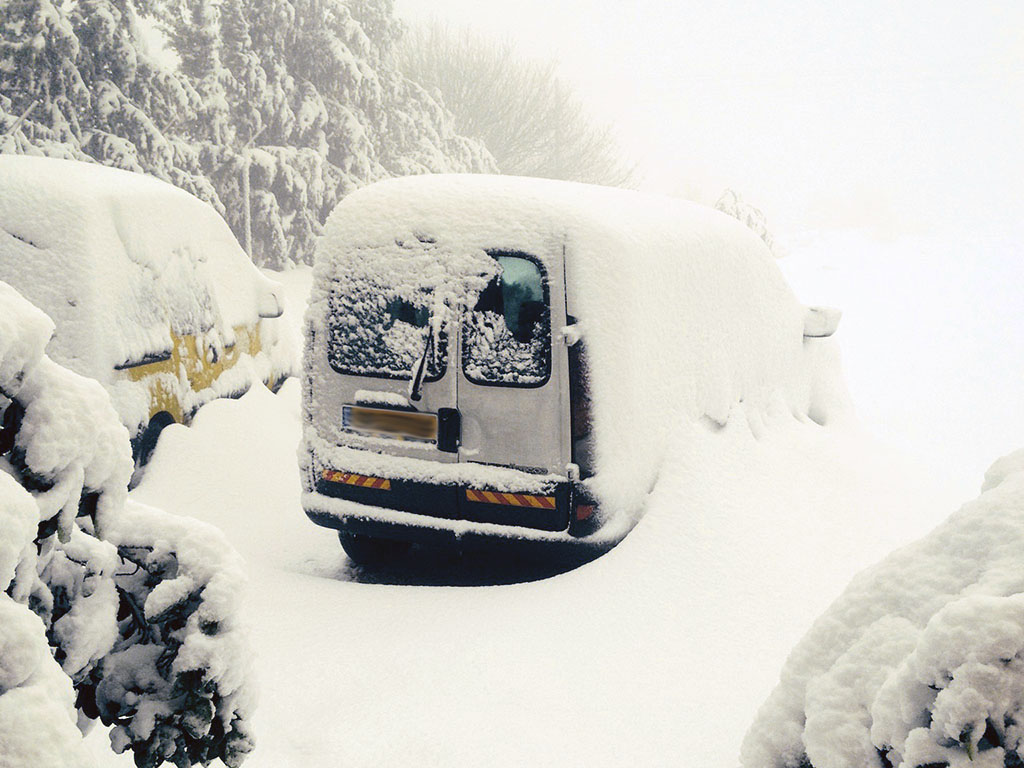
Today I have been reading of snow in Lebanon and Israel. There are reports that a foot of snow has fallen in Jerusalem in the past day. Todd Bolen links to the Jerusalem Post (with photos) and other snow links here.

My friend Elie just sent a photo of his back yard. This is in Bar Giyora, a town on Hwy. 375 between Bethlehem and the Valley of Elah. The town is located in the hill country of Judea.

Snow in the mountains of Judea. Photo by EMB, 12/14/13.

Snow in the mountains of Judea. Photo by EMB, 12/14/13.

“For as the rain and the snow come down from heaven and do not return there but water the earth, making it bring forth and sprout, giving seed to the sower and bread to the eater, so shall my word be that goes out from my mouth; it shall not return to me empty, but it shall accomplish that which I purpose, and shall succeed in the thing for which I sent it.” (Isaiah 55:10-11 ESV)

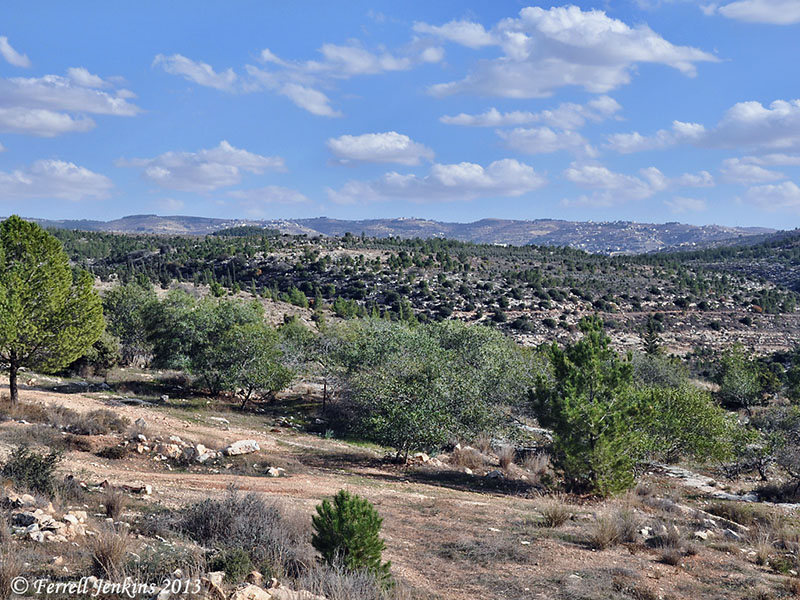
Here is a photo of the general area along Hwy. 375 with a view east toward the central mountain ridge (without snow).

Judean Hills. View east to central mountain range from Hwy. 375. Photo by Ferrell Jenkins.

Judean Hills. View east to central mountain range from Hwy. 375. Photo by Ferrell Jenkins.

On the Facebook page of Jerusalem University College you will find several nice photos of the snow in Jerusalem. Check here.

Zondervan Essential Atlas of the Bible

Frequently we have mentioned and recommended the Zondervan Atlas of the Bible by Carl G. Rasmussen. Every Bible student needs at least one or two good atlases to assist them in their study of the Scriptures.

Last month I attended some annual professional meetings in Baltimore and was pleased to see that Zondervan already had copies of the new Zondervan Essential Atlas of the Bible. One of the sales reps gave me a copy for review here.

At first appearance, the ZEAB has a beautiful cover of stiff, durable paper. It is a convenient 9 1/8″ x 7 3/8″ in size. The content is basically the same as the larger hard back edition. There has been some editing of the text to condense the book from 303 pages to 159 pages.

There are two major sections to the book: Geographical Section and Historical Section. The Geographical Section includes an Introduction to the Middle East as a Whole, and discusses the geography of Israel and Jordan, Egypt, Syria and Lebanon, and Mesopotamia.

The Historical Section covers the entire Bible from the Pre-Patriarchal Period to the Seven Churches of Revelation, with an additional chapter on Jerusalem, in 17 chapters.

The maps are superbly drawn and easy to read. A timeline accompanies each chapter. Rasmussen is noted for his Holy Land Photos web site. The photos are beautiful and helpful in illustrating the content.

This book has been prepared by a teacher, and I consider that a plus. In addition to his work at Bethel University, Carl continues to serve as an adjunct professor at Jerusalem University College. He has spent 16 years of his adult life in the Bible lands. His  Holy Land Photos’ Blog provides helpful, up-to-date, information about both familiar and unfamiliar places mentioned in the Bible. He has also led numerous tours through Bible lands.

This Atlas sells for $16.99. I see that Amazon has the Zondervan Essential Atlas of the Bible for $12.97. A Kindle version is about $3 less.

Either version is ideal for a person to take with them to Bible class, or on a tour of Bible lands.

The larger Zondervan Atlas of the Bible still remains indispensable for the serious student. I am trying to say you should have both books.

Carl has assisted me on several occasions in locating some of those hidden, out-of-the-way, places that most visitors to the Bible lands never see. I am pleased to commend this new edition of his book.