Monthly Archives: December 2008

Jerome in Bethlehem

Recently I was reading a manuscript written by a friend on the general subject of how we got the Bible. Of course, he mentioned Jerome and his work of translating the ancient Hebrew and Greek manuscripts into what would be called the Latin Vulgate.

The earliest English versions of the Bible were translated from the Latin Vulgate. Even though the translations of today rely mostly on the Hebrew and Greek texts, we are still indebted to the work of Jerome.

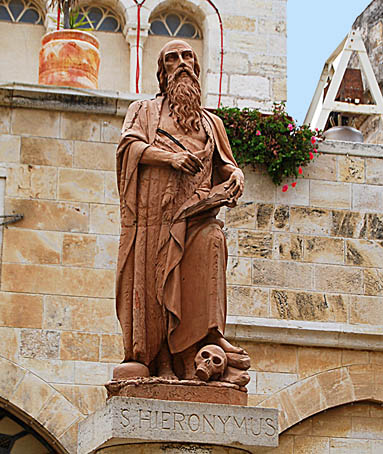
Jerome lived in Bethlehem from about 384 A.D. to 420 A.D. In the front of the Church of St. Catherine in Bethlehem there is a modern statue of Jerome showing him in the act of writing. Everyone always asks about the skull at the foot of the statue. Some have suggested that Jerome kept a skull on his desk to remind him of his mortality. That would do it for me!

Statue of Jerome in front of St. Catherine's Church. Photo by Ferrell Jenkins.

Statue of Jerome in front of the church of St. Catherine in Bethlehem. Photo by Ferrell Jenkins.

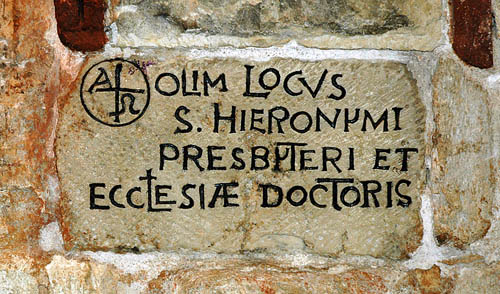
Underneath the Church of the Nativity there are a series of grottoes or caves. One of these is said to have been the place where Jerome did his work of translation and writing. This sign presently marks the place where he once lived.

The place where Jerome once lived. Photo by Ferrell Jenkins.

The place where Jerome once lived. Photo by Ferrell Jenkins.

Reliability of the New Testament Manuscripts

Earlier I mentioned hearing Dr. Daniel Wallace speak on New Testament Textual Criticism at the annual ETS meeting. Dan is NT editor of the NET Bible and a respected textual critic. He has a DVD video of this lecture and of another one (“Is What We Have Now What They Wrote Then?”) available for the small sum of $15.00 plus $3 S&H. This is good, up-to-date, material on this subject. I ordered my copies this morning. Here is the info about the DVDs:

“Is What We Have Now What They Wrote Then?”
A lecture at an apologetics conference in Providence, Rhode Island, 2008, about whether our printed New Testaments today accurately represent the original text.

“Challenges in New Testament Textual Criticism for the 21st Century”
A plenary lecture at the annual Evangelical Theological Society meeting in Providence, Rhode Island, 2008, on current issues in NT textual criticism.

Use this link to get to the order page: Wallace DVDs. To read a bit more about the DVDs and see comments by readers, click here.

Information about The Center for the Study of New Testament Manuscripts, which is headed by Wallace, is available here.

McGarvey’s Land of the Bible

J. W. McGarvey was one of the best scholars of the 19th century Restoration Movement. He was president of the College of the Bible in Lexington, KY. One of my first books was his practical New Commentary on Acts of Apostles (1892). He had earlier (1868) written A Commentary on Acts of Apostles dealing with some of the critical issues of the book. McGarvey addressed some of the critical questions of the day in The Authorship of Deuteronomy, Jesus and Jonah, and Biblical Criticism.

McGarvey visited Palestine in 1879. His former students paid for the trip [I like that!], with the understanding that he would write a book. They would get their money back from the sale of the book. His book, Lands of the Bible, was published by J. B. Lippincott & Co., London and Philadelphia, in 1881. The title page indicates that 15,000 copies were printed. Impressive for a book on that subject.

J. W. McGarvey’s Lands of the Bible is available at the Restoration Movement pages here. For other works by McGarvey and other Restoration leaders begin with the home page here.

When I led my first group to the Bible Lands in 1967, one friend in the group had studied McGarvey’s book carefully. He took a tape measure with him. When we came to certain sites he took out the tape to take measurements. He wanted to be sure he was at the same place McGarvey visited.

Chapter IX in McGarvey’s book is titled “Argument from the Agreement of the Land and Book.” I have an outline of this material in my Introduction to Christian Evidences [OP], and use some of this material in my Daily Life in Bible Times series. One would be mistaken not to move beyond McGarvey, Thompson, Robertson, and the other early explorers. On the other hand, it would be amiss to dismiss what these scholars wrote.

What prompted all of this? Todd Bolen recently wrote a post on The Acoustics of Mounts Gerizim and Ebal in which he quotes from one of McGarvey’s letters here. I urge you read his post now. Also follow the link to the Biblical Studies and Technology Tools post showing the valley between Ebal and Gerizim using digital mapping tools.

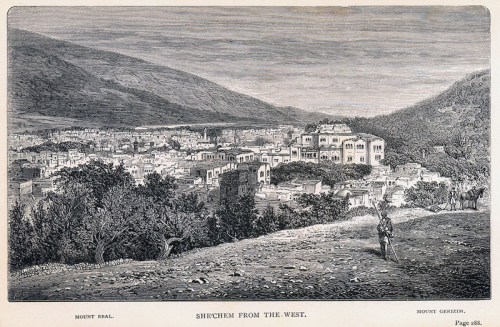
I wanted to contribute something to this study by including here a scan of the plate from my original edition of Lands of the Bible (opposite page 288).

Shechem from the West. McGarvey, Land of the Bible.

Shechem from the West. McGarvey, Land of the Bible.

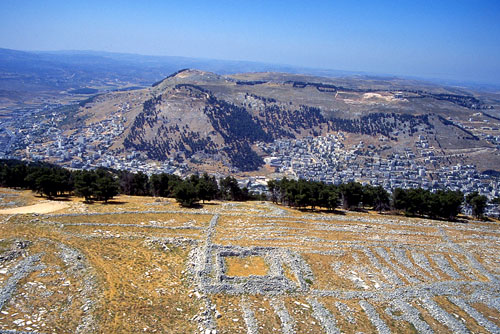
Todd Bolen has a great photo of Mount Ebal from Mount Gerizim. I would like to add the other side of the valley. Here is a photo showing Mount Gerizim from above Mount Ebal. It is an aerial shot made for me by the well known photographer Zev Radovan.

View of Mount Gerizim from above Mount Ebal.

View of Mount Gerizim from above Mount Ebal.

Maybe later we will discuss some of the important biblical events that took place in this area. For not let us note that this is where the blessings and curses of the law were read after the children of Israel entered the promised land (Deuteronomy 11:19). Here is the account of that event:

All Israel with their elders and officers and their judges were standing on both sides of the ark before the Levitical priests who carried the ark of the covenant of the LORD, the stranger as well as the native. Half of them stood in front of Mount Gerizim and half of them in front of Mount Ebal, just as Moses the servant of the LORD had given command at first to bless the people of Israel. Then afterward he read all the words of the law, the blessing and the curse, according to all that is written in the book of the law.  There was not a word of all that Moses had commanded which Joshua did not read before all the assembly of Israel with the women and the little ones and the strangers who were living among them. (Joshua 8:33-35 NASB)

An invitation from Issuu by mistake

A short time ago I received a notice that a newsletter I was interested in was available. When I followed the link I ended up at something called Issuu. When I registered I was able to get the newsletter. In the process of registering I allowed Issuu to begin issuing invitation to my Gmail mailing list. I have no way of knowing how many invitations when out.

Several of you have already joined.

Sorry about that. It may be a wonderful service, but I don’t like to receive unwanted Emails and I normally try to avoid sending them.

Please forgive!

Museum exhibitions

Babylon: Myth and Reality runs until March 15, 2009, at the British Museum in London. Details, along with videos and photos available here. This exhibition brings together artifacts from the British Museum, Berlin, the Louvre, and other museums. If you have an opportunity to go, be sure to download our brief list of Some Biblically Related Artifacts in the British Museum here.

Tutankhamun and the Golden Age of the Pharaohs runs through May 17 at the Dallas [Texas] Museum of Art. Details here.

Tutankhamun: The Golden King and the Great Pharaohs runs through May 22 at the Civic Center in Atlanta, Georgia. Details here.

The Michael C. Carlos Museum at Emory in Atlanta has an exhibition called Wonderful Things: The Harry Burton Photographs and the Discovery of the Tomb of Tutankhamun. It runs through May 25. Details here.

Excavating Egypt is a major exhibition from the Petrie Museum of Egyptian Archaeology. This exhibition runs at the University of Kentucky, Lexington, from March 14 through June 14, 2009. Details here.

We wrote of a King Tut exhibition in Vienna, with a nice photo, here.

Pompeii and the Roman Villa (Art and Culture Around the Bay of Naples) continues at the National Gallery of Art in Washington, D.C. through March 22. Details here. Videos, audios, and other material online.

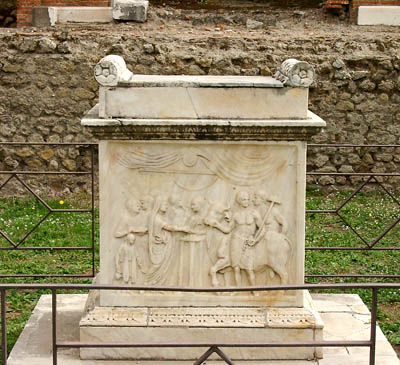
The photo below is one I made in 2001 of the altar at the Temple of Vespasian at Pompeii. Vespasian was the Roman general who led the attack on the Jewish rebels beginning in A.D. 66. Upon learning of the death of Nero he headed back to Rome. Later he became Emperor. Pompeii was covered with volcanic ash in A.D. 79. This altar shows a sacrificial scene.

Sacrificial altar, Temple of Vespasian, Pompeii. Photo by Ferrell Jenkins.

Sacrificial altar, Temple of Vespasian, Pompeii. Photo by Ferrell Jenkins.

Art and Empire: Treasures From Assyria in the British Museum continues through January 4 at the Museum of Fine Art in Boston. Details here. We wrote about visiting this exhibition here.

Most of these exhibition are listed in the Nov./Dec. 2008 issue of Saudi Aramco World.

It’s snowing

I see that WordPress has it snowing across my page this morning. Guess the computer didn’t take into account that I live in Florida. Enjoy the snow.

Healing of the blind man at Bethsaida

There are several accounts in the Gospels (Matthew, Mark, Luke, John) of Jesus giving sight to the blind.

  • Two blind men were healed (Matthew 9:27-31).
  • A blind, mute, demon-possessed man was healed by Jesus (Matthew 12:22).
  • Two blind men near Jericho were given sight (Matthew 20:29-34). It may be that the blind beggar named Bartimaeus was one of these (Mark 10:46-52).
  • A blind man was brought to Jesus at Bethsaida and healed (Mark 8:22-25).
  • The man who was blind from birth, and was told to go wash in the pool of Siloam in Jerusalem (John 9).

My eyes have experienced several problems over the past few years. I am fortunate to have received excellent care from a team of competent professionals. Earlier this week I had my first cataract surgery. I have been surprised that most of my friends who knew about the surgery asked “which eye?” I always said, “right,” but I wonder if their response would have been different if I had said “left.”

When you had your cataract surgery I thought it was minor and routine. When I had mine it was more serious! Actually it was not too difficult. I can tell that I see better in the right eye, but I must wait a couple of weeks to see what will be done about the lens I have been wearing before I will know how effective it has been. And then there is the left eye.

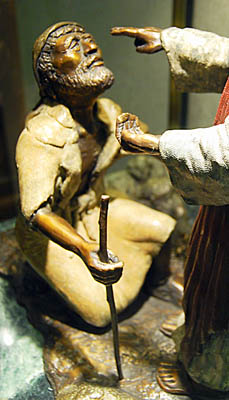
Well, all of this got me to thinking about the miracles of Jesus in the healing of the blind. One of the physicians at the clinic where I go has a nice piece of sculpture in his waiting area.

"Miracle of Sight" at Tampa Eye Clinic. Photo by Ferrell Jenkins.
Miracle of Sight.

I suspect that this sculpture is based on the account of the blind man in John 9. It could possibly be the account of the man at Bethsaida (Mark 8).

Bethsaida is now identified with et-Tell. In with Jesus through Galilee according to the fifth Gospel, the late Bargil Pixner points out that the man was healed in stages. He then says,

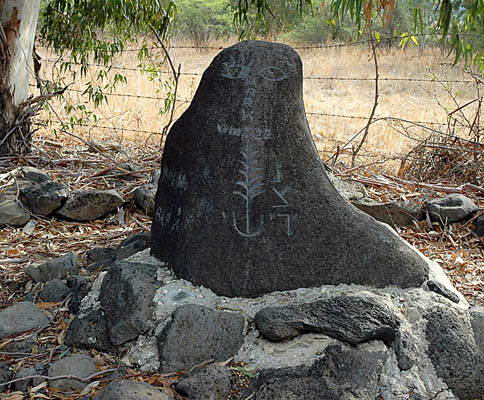
The place of the healing near Bethsaida is marked today by a memorial stone on which two eyes have been chiselled, one half-closed and the other open brightly. (page 95)

I had the opportunity to meet Pixner once at Tabgha and have him autograph a copy of his book. I asked him if he knew how long the marker had been at the site. He told me exactly and then added, “I put it there.” You might like to see that memorial stone.

Memorial stone placed at Bethsaida by Bargil Pixner. Photo by Ferrell Jenkins.

Travel is fun

One of the perils of travel is dealing with the hawkers. There is the guy who approaches a person with a Nikon Digital SLR trying to sell him postcards of the monument he just photographed. I remember a boy in Damascus in 1967 hawking those little inlaid boxes for “Just one lousy American dollar.” We were on a boat taking the canal tour in Bangkok when suddenly a boy comes up out of the dirty water into the moving boat.

Egypt is probably the worst place for hawkers. One thing is for sure. If you ever take an item in your hand it will be difficult to get rid of it. You may say, “I don’t need that.” He say, “Why you no need this?”

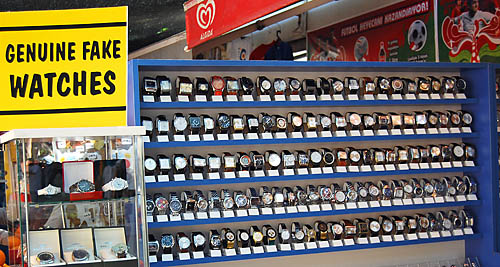
I like this refreshing sign in a shop at Ephesus. No doubt here!

Genuine fake watches in a shot at Ephesus. Photo by Ferrell Jenkins.

Genuine fake watches in a shop at Ephesus. Photo by Ferrell Jenkins.

Celebrating 100,000 visitors; a gift for you

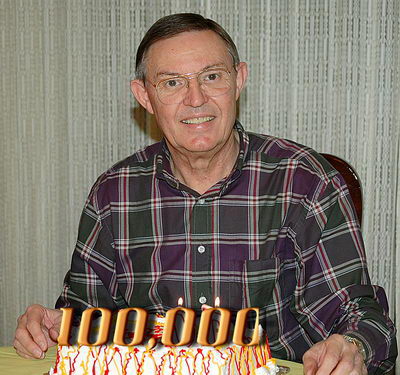
Thanks for visiting Ferrell’s Travel Blog. This afternoon our Blog Stats moved above 100,000. I think when we began the blog we only had in mind that families of some of our tour members could follow our route of travel. Then I began to write about other places I had visited. Well, here we are today.

As my wife and I looked at the stats I said, “Well, we have reached a millstone, if not a milestone.” She said, “Yes, it is a millstone.” I must admit it has become addictive. But when I realize that I am reaching a large number of people each day/week/month with something that may be beneficial in Bible study and teaching, I am delighted.

Ferrell Jenkins celebrating 100,000 visitors.

Ferrell Jenkins celebrating 100,000 visitors.

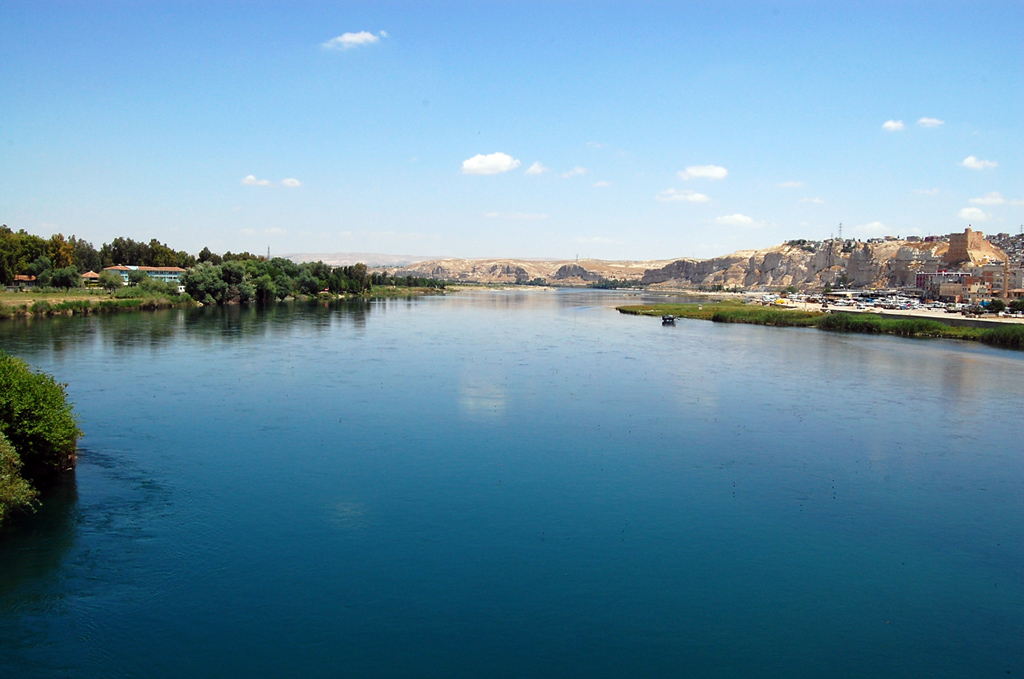
I want to share a gift that may be of benefit to those who use PowerPoint presentations in teaching. During the life of the blog, more people have visited our pages on the Euphrates River than any other. Here is a photo of the Euphrates at Birecik, Turkey. Click on the small photo below and it will take you to a high resolution photo that you may download and use. We request that you not publish the photo without permission. A digital copyright notice is embedded in the image.

The Euphrates River at Birecik, Turkey. Photo by Ferrell Jenkins.

The Euphrates River at Birecik, Turkey. Photo by Ferrell Jenkins.

The Euphrates is the largest, longest and most important river of Western Asia. It is nearly 1800 miles long and was the northeastern boundary of the land promised to Abraham (Gen. 15:18). The empires of Assyria and Babylon, the greatest enemies of Israel, were east of the Euphrates. The Old Testament prophets often put the Euphrates by metonomy for these countries to designate the place from which the punishment of God would come (Isa. 7:20; 8:7; Jer. 46:10). For more information on the Euphrates River read the article here.

Traveling without a bag

Read the previous post, Treasures old and new, for an introduction to this one.

Recently I was reading a section in Light From the Ancient East by Adolf Deissman about the value of understanding the meaning of New Testament words through words in common use in New Testament times.

Deissman takes up the account of Jesus sending out the twelve and shows how one simple word is understood better through the use of documents from the same time period.

Jesus said to the disciples,

“Heal the sick, raise the dead, cleanse the lepers, cast out demons. Freely you received, freely give. “Do not acquire gold, or silver, or copper for your money belts, or a bag for your journey, or even two coats, or sandals, or a staff; for the worker is worthy of his support. (Matthew 10:8-10 NASB)

See also Mark 6:8 (the KJV uses scrip for the Greek pera) and Luke 9:3; 22:35-36.
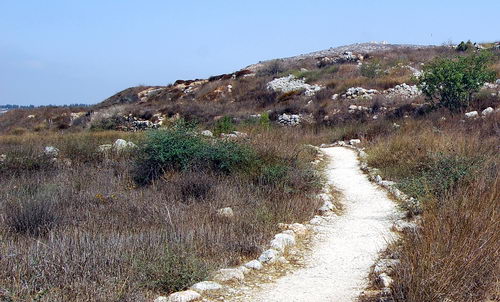
A path at Shiloh. Photo by Ferrell Jenkins.

A path at Shiloh. Photo by Ferrell Jenkins.

Below is the rather lengthy quotation from Deissman which I have in the Libronix format now. Because of the length of this paragraph I will not indent it as we normally do, and will divide it into three paragraphs for ease of reading.

——

One of the characteristic utterances of Jesus has here been handed down, not without variations, but still in such form that the original can be discerned beneath them: the apostles were told to take with them for their journey only the barest necessaries, among which was to be reckoned neither money nor bread. According to St. Matthew’s report they were further forbidden even to earn money on their way, as they might have done by working miracles of healing, etc. The meaning of the “wallet” (A.V. “scrip”) has seldom been questioned, because it seems so obvious: most commentators probably think of it as a travelling-bag, or, more precisely defined, as a bread-bag.

The word in the original Greek, πήρα, is capable of either meaning, according to circumstances. In the context “travelling-bag” would do very well; “bread-bag” not so well, being superfluous after the mention of “bread,” and tautology seems out of place in these brief, pointed commands given by Jesus. But there is a special meaning, suggested by one of the monuments, which suits the context at least as well as the more general sense of “bag” or “travelling-bag.” The monument in question was erected in the Roman Imperial period at Kefr-Hauar in Syria by a person who calls himself, in the Greek inscription, a “slave” of the Syrian goddess. “Sent by the lady,” as he says himself, this heathen apostle tells of the journeys on which he went begging for the “lady” and boasts triumphantly that “each journey brought in seventy bags.”

The word here employed is πήρα. Of course it has nothing to do with well-filled provision-bags for the journey: it clearly means the beggar’s collecting-bag. The same special meaning would make excellent sense in our text, particularly in St. Matthew’s version: there is to be no earning, and also no begging of money. With this possible explanation of the word πήρα the divine simplicity of Jesus stands out afresh against the background suggested by the heathen inscription. While Christianity was still young the beggar-priest was making his rounds in the land of Syria on behalf of the national goddess. The caravan conveying the pious robber’s booty to the shrine lengthens as he passes from village to village, and assuredly the lady will not forget her slave. In the same age and country One who had not where to lay His head sent forth His apostles, saying:—

“Freely ye received, freely give. Get you no gold, nor silver, nor brass in your purses: no wallet for your journey.”

——

I was looking at some material on the financial support of preachers. John encouraged his readers to receive those who come preaching the gospel. He says,

You will do well to send them on their journey in a manner worthy of God. For they have gone out for the sake of the name, accepting nothing from the Gentiles. (3 John 1:6-7)

The Linguistic and Exegetical Key to the Greek New Testament points out the difference between those who went out preaching the message of Christ and those who were out for the money. The preachers of Christ were to be supported by fellow Christians. This was “in marked contrast both to the wandering philosophers of the day and to the beggar priests of the Syrian goddess” [mentioned by Deissmann].