Monthly Archives: May 2008

Ferrell’s Travel Blog banned in Turkey

Since sometime after our Ancient Crossroads Tour of Historical and Biblical Turkey (May and June, 2007), WordPress has been banned in Turkey.

Recently I checked with some friends in Istanbul. They tell me that this is the message they get when they try to access this page:

Access to this site has been suspended in accordance with decision no: 2007/195 of T.C. Fatih 2. Civil Court of First Instance.

A friend in Izmir (biblical Smyrna) says he is able to access this page. Izmir is our second stop. Perhaps we will be able to post here from some Turkish locations.

I have neither time nor interest to try to explain why this has happened. (It has nothing to do with this blog.)I can say that I don’t like censorship.

Because of this, I have setup a blog on Blogger. We will be posting there regarding the Steps of Paul and John Tour, at least while we are in Turkey. Please go to this URL:

fjtours.blogspot.com

If you have not read our posts from last May and June, please check the archives for those months to do so.

On the road in the Steps of Paul and John

Tuesday afternoon, May 6, our group should land in Istanbul, Turkey, to begin a tour that I have called Steps of Paul and John. This area of travel has been one of my favorites for many years. My first visit here was in 1968. We will visit Istanbul, a city rich in church history. It has been called Constantinople and Byzantium.

From Istanbul we plan to fly to Izmir, the site of biblical Smyrna. There we begin a visit to the sites of the seven churches of the book of Revelation (chapters 2-3), and a few other sites (Hierapolis, Colossae, Miletus, and Aphrodisias). We will be discussing important themes from the book of Revelation during this portion of the tour.

Our group will then spend 3 days cruising the Aegean Sea in order to visit some of the islands associated with the travels of Paul and John. Our first stop will be at Patmos (Revelation 1:9). Then Rhodes (Acts 21:1) and Crete (Acts 27; Titus 1:5). There is also a stop at Santorini.

Upon arrival in Athens, Greece, we will visit the city of Athens (Acts 17). We have planned a visit to ancient Corinth also (Acts 18).

We hope you will join us for these visits. I will do my best to write a post each day of the tour.

Tampa to New York (JFK)

Our Delta flight from Tampa to JFK in New York was on time departing and arriving this evening. But, it was a full hour before we had all of our luggage. This airport really needs some renovations. I think it is the worst airport that I have used in many years.

We are thankful for the safety of our flight. We look forward to meeting our group tomorrow.

Pictures of Adam?

The title could be misleading. It could be like all of those drawings showing John the Baptist pouring water over the head of Jesus. The Adam we speak of is a place mentioned in the account of the Israelite crossing of the Jordan River.

the waters which were flowing down from above stood and rose up in one heap, a great distance away at Adam, the city that is beside Zarethan; and those which were flowing down toward the sea of the Arabah, the Salt Sea, were completely cut off. So the people crossed opposite Jericho. (Joshua 3:16)

Our fellow-blogger over at Aantekeningen bij de Bijbel in the Netherlands asks,

Do you have also pictures from the Jordan in the neighbourhood of Adam? The place where the Jordan was halted for some time?

To my knowledge It is not possible to approach the Jordan except an area between the Sea of Galilee and Beth-shan, and at Bethany Beyond the Jordan. Photos are not allowed at the various military check points.

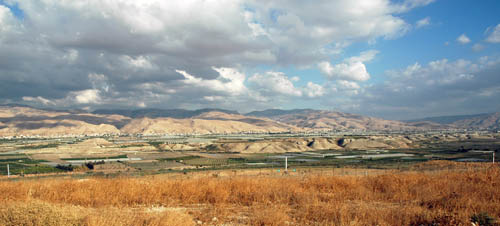
The best I can do is to show you a photo I made in November of 2005. This photo is looking east toward the mountains of Gilead. I think the rift to the right of the middle of the photo is the Jabbok Valley. Adam would be located somewhere to the right in this photo. If some other reader can be more specific I would be happy to know.

The fence in the foreground of the photo is the boundary between Israel (West Bank area) and Jordan. I often describe the Jordan River as being shy. All along the Jordan Rift, one only sees the River at a place or two. The Jordan flows in the green area in the bottom of the rift. All of the white horizontal lines in the photo are hot houses use for growing agricultural produce.

The Jordan River

The distance from the principal source of the Jordan at the foot of Mt. Hermon to the northern end of the Dead Sea is about 135 miles, but the serpent-like Jordan flows over 200 miles. At the source, the elevation is about 1150 feet above sea level. By the time the river reaches the Sea of Galilee it is about 700 feet below sea level, and when it reaches the Dead Sea it is more than 1300 feet below sea level. These and other unusual physical characteristics make the Jordan a significant river. To the Bible student the importance of the river is found in the events which transpired in it.

Israel crosses the Jordan. The children of Israel crossed the Jordan when the water was out of all its banks during the time of harvest (Josh. 3:15). An American reader might think of this as the fall of the year, but actually it was in the spring, at the time of the latter rain (Joel 2:23). As spring approached in Bible times the Jordan would overflow its banks due to the heavy latter rains (about early April) and the melting snows of Mount Hermon. Conditions are different in modern times. Water that once flowed south from the Sea of Galilee and from tributaries such as the Yarmuk River is now used for irrigation. This makes the Jordan much smaller than in earlier times. The crossing of the Jordan by the Israelites provided the imagery for our hymn, “On Jordan’s Stormy Banks I Stand.”

Elijah and Elisha. Both of these oral prophets crossed the Jordan on dry ground prior to Elijah=s being taken up by a whirlwind into heaven. Elisha later used the mantle of Elijah which had fallen upon him to smite the Jordan so that he was able to return (2 Kings 2:8-14).

Naaman the leper. Naaman, captain of the army of the king of Aram, was told by the prophet Elisha to wash seven times in the Jordan to be cleansed of his leprosy. For a reason not explicitly given, Naaman complained that the Abanah and Pharpar, the rivers of Damascus, were better than all the waters of Israel. When he eventually obeyed the Lord, he was made clean (2 Kings 5:1-14). We understand that it was not in the properties of the water but by the power of the Lord that Naaman was made clean through his obedience.

John and Jesus. John immersed in the Jordan River (Mt. 3:1-6). The last important biblical event and the crowning glory of the Jordan was the baptism of Jesus (Mt. 3:13-17).

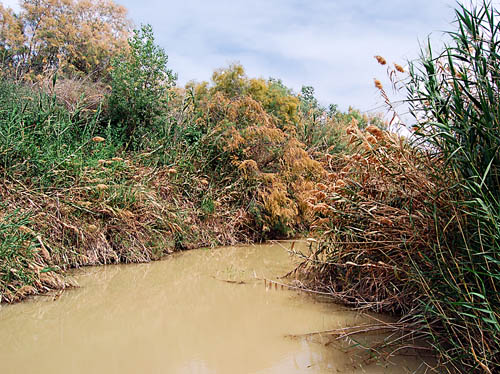
Photographs of the Jordan south of the Sea of Galilee have been difficult to make since 1967 because the river has served, more or less, as the boundary between Israel (or the occupied West Bank) and Jordan. This photograph was made at the site across from Jericho that may be identified as “Bethany beyond the Jordan” (John 1:28), where John the Baptist baptized at first (John 10:40).

Where in the world?

Many of you probably saw the Today Show this morning. This is the week for Matt Lauer’s “Where in the world…” series. We have always enjoyed these programs because they remind us of so many places we have visited on our tours.

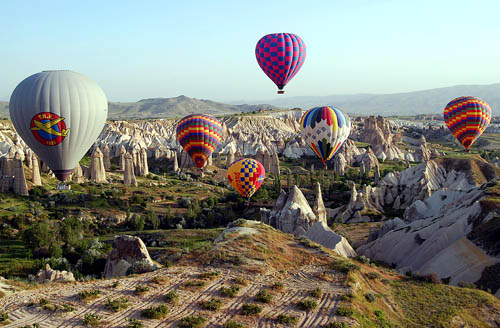
This morning Matt was in Istanbul, Turkey. We will be heading there in a few days to begin our Steps of Paul and John tour. There were a few scenes from other places in Turkey, including Ephesus and Cappadocia. We visited Cappadocia last summer on our Ancient Crossroads tour of historical and biblical Turkey. Here is a photo I made during a hot air balloon over the mysterious landscape of Cappadocia. Note the cultivated vineyards in the foreground below our balloon.

Two of the New Testament epistles were addressed to saints living in Cappadocia.

Peter, an apostle of Jesus Christ, To those who reside as aliens, scattered throughout Pontus, Galatia, Cappadocia, Asia, and Bithynia, who are chosen. (1 Peter 1:1).

All of the places mentioned in 1 Peter 1:1 are located in modern Turkey. It is a fascinating place to visit.

The first attempt on the life of Jesus

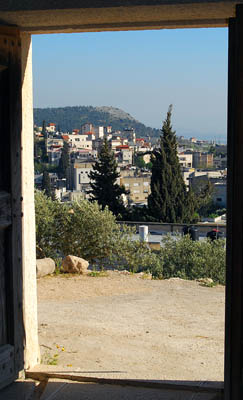
Nazareth is located in the hills of Lower Galilee, where the elevation is about 2000 feet above sea level. These hills lie on the north side of the Valley of Jezreel (Esraelon, or Megiddo).

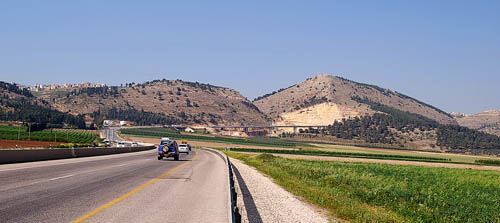
In this photo some of the buildings of upper Nazareth can be seen to the left. The hill on the right, with the scaring from quarrying, is popularly called the hill of precipitation. If this is correct, and we have no certain evidence, then this would be the the hill spoken of in Luke’s account of Jesus speaking in the synagogue at Nazareth.

And they rose up and drove him out of the town and brought him to the brow of the hill on which their town was built, so that they could throw him down the cliff. (Luke 4:29, ESV)

A synagogue, similar to the one that might have existed in Nazareth during the time of Jesus, has been built at the Nazareth Village. The photo shows the view from the door of the synagogue. The hill of precipitation can be seen. Jesus was brought up in a small town that was located near the heart of all important travel through the land of Israel (Canaan, Palestine).