Tag Archives: Syria

Aleppo National Museum – #2

See our previous post on Aleppo here. Our #1 on the Aleppo National Museum is here.

In the first post on Aleppo I posted a photo of the Hittite Storm god Teshub standing on the back of a bull. I should have mentioned at the time that a large temple of the storm god from the Late Bronze and Early Iron ages has been excavated underneath Islamic buildings at the Aleppo Citadel. A well illustrated article by Kay Kohlmeyer states,

The storm god, first venerated as Hadda, then as Addu, Teshub, Tarhunta, and Hadad, played a supra-regional role in the ancient Near East, which explains the enormous size of his temple at Aleppo and the brilliance of its relief decoration. (Near Eastern Archaeology 72;4 (2009).

A statue of Hadad of poor quality is also displayed in the museum.
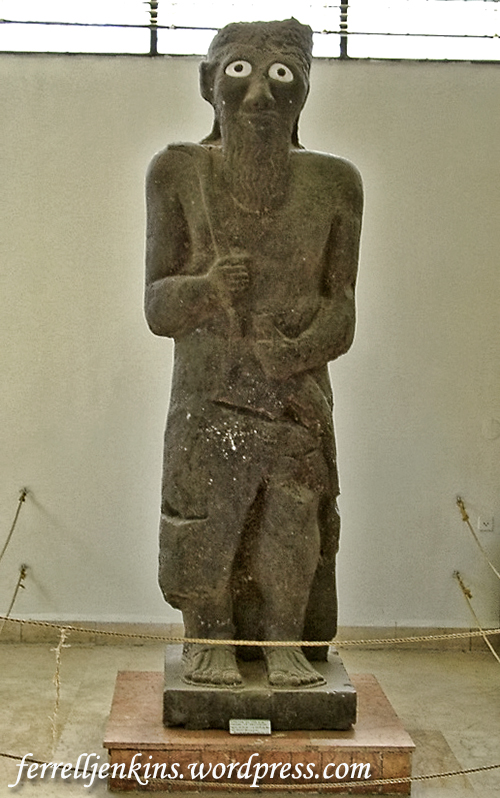
Statue of Hadad displayed in the Aleppo National Museum. Photo by Ferrell Jenkins.

Statue of Hadad displayed in the Aleppo National Museum. Photo by Ferrell Jenkins.

There are several other Neo-Hittite artifacts in the Aleppo National Museum. This first I am showing is a basalt lion with a slight wing relief. This is likely part of a pair that stood along an entrance to some building. Here you will notice that the lion is represented as having five legs. This allows the passerby to see at least four legs from almost any direction. We have become familiar with the huge winged bulls from Assyria that are made in the same fashion. I do not have the original source of the lion, but there are numerous Neo-Hittite sites  to the north of Aleppo in Syria and Turkey.
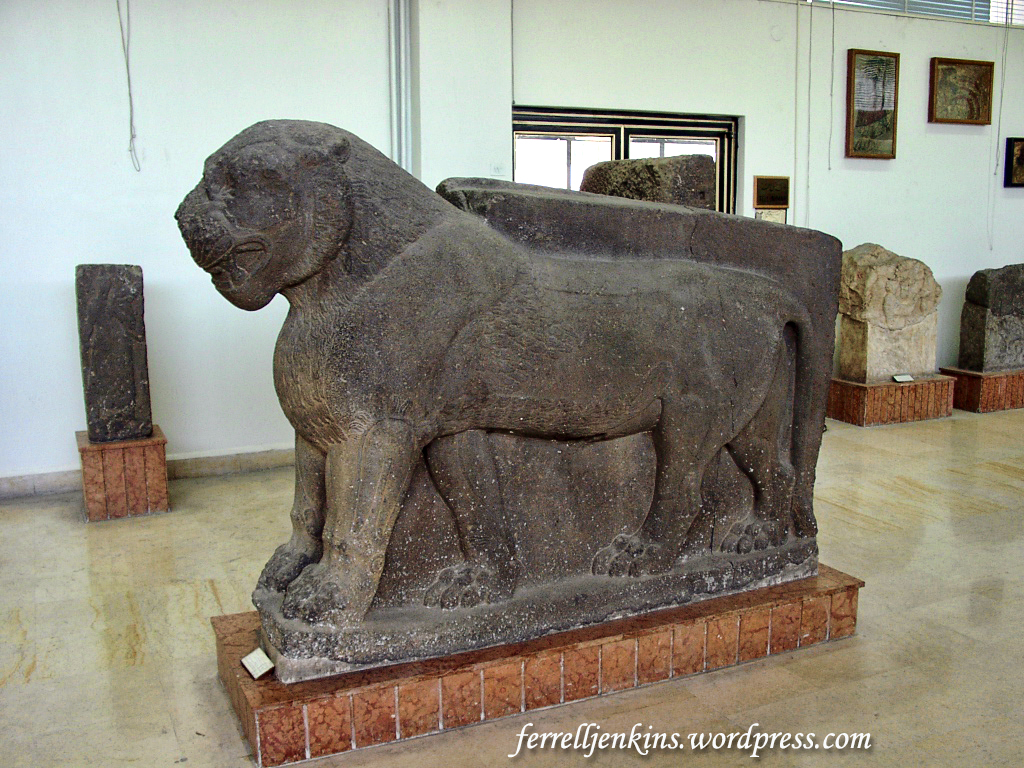
Lion from the Neo-Hittite Period in the Aleppo National Museum. Photo by Ferrell Jenkins.

Lion from the Neo-Hittite Period in the Aleppo National Museum. Photo by Ferrell Jenkins.

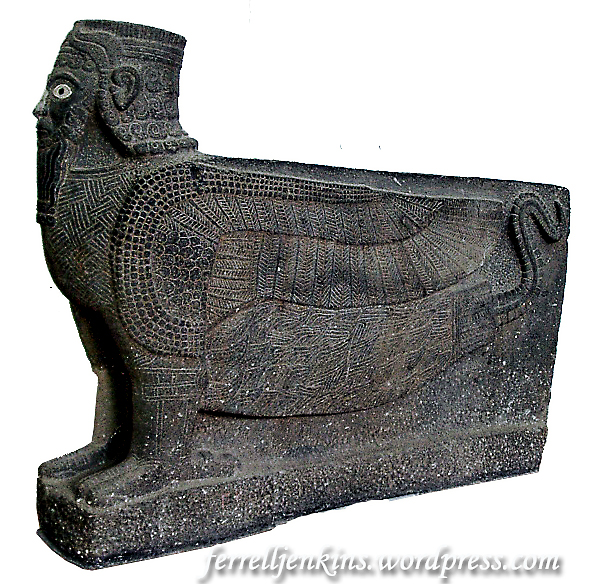
The next image is a fascinating one from the palace of Karara at Tell Halaf. It shows a composite creature of basalt consisting of the head of a man with the feet and wings of a bird, and the tail of a scorpion.

Composite creatures were common during the Hittite, Assyrian, and Babylonian periods of Old Testament history, and many of them have been found in the extended region. They provide us some insight into the background of apocalyptic literature. We find these creatures especially in the Old Testament books of Daniel, Ezekiel, and Zechariah, and in the New Testament book of Revelation (the Apocalypse). See a previous post, “Apocalyptic imagery is not strange,” here.

The composite creature here brought to my mind the events of the sounding of the fifth trumpet in Revelation 9:1-11.
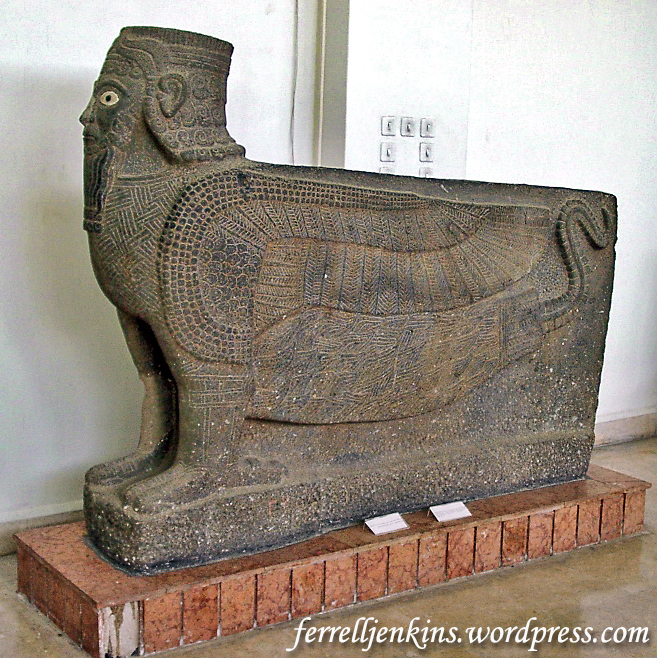
Composite creature showing the head of a man, body and feet of a bird, and the tail of a scorpion. Photo by Ferrell Jenkins.

Composite creature showing the head of a man, body and feet of a bird, and the tail of a scorpion. Photo by Ferrell Jenkins.

I am adding an additional image that I was able to enhance to show a little better sharpness.
aleppo-museum-composite-creature-fjenkins051302_09en

 1 And the fifth angel blew his trumpet, and I saw a star fallen from heaven to earth, and he was given the key to the shaft of the bottomless pit.
2 He opened the shaft of the bottomless pit, and from the shaft rose smoke like the smoke of a great furnace, and the sun and the air were darkened with the smoke from the shaft.
3 Then from the smoke came locusts on the earth, and they were given power like the power of scorpions of the earth.
4 They were told not to harm the grass of the earth or any green plant or any tree, but only those people who do not have the seal of God on their foreheads.
5 They were allowed to torment them for five months, but not to kill them, and their torment was like the torment of a scorpion when it stings someone.
6 And in those days people will seek death and will not find it. They will long to die, but death will flee from them.
7 In appearance the locusts were like horses prepared for battle: on their heads were what looked like crowns of gold; their faces were like human faces,
8 their hair like women’s hair, and their teeth like lions’ teeth;
9 they had breastplates like breastplates of iron, and the noise of their wings was like the noise of many chariots with horses rushing into battle.
10 They have tails and stings like scorpions, and their power to hurt people for five months is in their tails.
11 They have as king over them the angel of the bottomless pit. His name in Hebrew is Abaddon, and in Greek he is called Apollyon. (Revelation 9:1-11 ESV)

Knowing that such imagery was common in the ancient Near East should assist us in our understanding of the nature of apocalyptic literature of the Bible.
Aleppo National Museum – #1

See our previous post on Aleppo here.

In this post we will continue to look at some of the interesting artifacts displayed in the Aleppo National Museum at the time of our visit in 2002.

The Amorites. The Amorites are described as “the inhabitants of the land west of the Euphrates River, which included Canaan, Phoènicia, and Syria” (Youngblood, Bruce, and Harrison, Nelson’s new illustrated Bible dictionary 1995).

Here is a summary of information about the Amorites from the same article.

  • Amorites were one of the major tribes, or national groups, living in Canaan. The Old Testament frequently uses “Amorites” as a synonym for Canaanites in general. The Book of Genesis cites Canaan as the ancestor of the Amorites (Gen. 10:16).
  • Before 2000 B.C. the Amorites lived in the wilderness regions of what today is western Saudi Arabia and southern Syria.… Beginning about 2000 B.C., they migrated eastward to Babylonia in large numbers. There they captured major cities and regions from the native Mesopotamians. “Abram” is an Amorite name, and Abraham himself may have been an Amorite.
  • Throughout Old Testament times, other Amorites remained in Syria, Phoenicia, and the desert regions to the south (Joshua 13:4). A significant number, however, settled in the land of Canaan itself, eventually occupying large areas both east and west of the Jordan River (Judges 11:19–22). These Amorites spoke a dialect that was closely related to Canaanite and Hebrew. Occasionally, the Amorites were identified as a Canaanite tribe (Genesis 10:16). At other times they were called the people of Canaan (Deuteronomy 1:27).
  • During the invasion of Canaan, Joshua and the Israelites defeated Amorite kings Sihon and Og, rulers east of the Jordan River (Joshua 12:1-6).
  • Various cities west of the Jordan—Jerusalem, Hebron, Jarmuth, Lachish, and Eglon—also were called “Amorite” cities (Joshua 10:5), even though Jerusalem was also known as a Jebusite city.
  • While conquering Canaan, the Israelites frequently fought with the Amorites. After the Israelites prevailed, the Amorites who had not been killed remained in Canaan and became servants to the Israelites (1 Kings 9:20–21).
  • Much of our knowledge about the Amorites and their culture comes from clay tablets discovered at Mari, a major Amorite city situated on the Euphrates River in western Mesopotamia. [Numerous artifacts from Mari are displayed in the Damascus National Museum.]

A significant text in Ezekiel 16:3 says to the Israelites of Judea,

… Thus says the Lord GOD to Jerusalem: Your origin and your birth are of the land of the Canaanites; your father was an Amorite and your mother a Hittite. (ESV)

The IVP Bible Background Commentary Old Testament suggests that when the land was conquered, the Israelites were supposed to have purified the land “of its idolatrous traditions (Deut. 7:1-5), but instead the people became just like the nations  they were supposed to displace.”

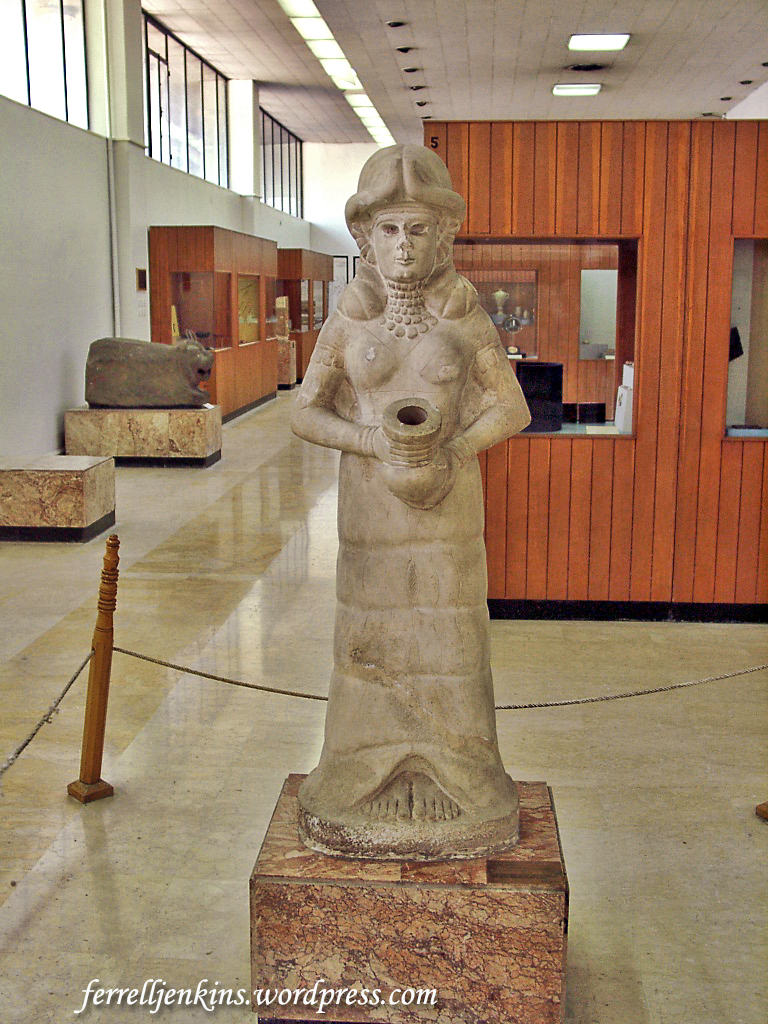
The Amorite Spring Goddess from the 18th century B.C. When I walked in the door of the Museum and saw the impressive statue of an Amorite Spring Goddess I recalled the work of French Archaeologist André Parrot and his comments about the Gushing Vases of Mesopotamia that are displayed in the Louvre.

Amorite Spring Goddess displayed near the main entry of the Aleppo Museum. Photo by Ferrell Jenkins.

Amorite Spring Goddess from the 18th century B.C. displayed near the main entry of the Aleppo National Museum. Photo by Ferrell Jenkins.

In his book Land of Christ, Parrot calls attention to the statement of Jesus in John 7:37-38.

On the last day of the feast, the great day, Jesus stood up and cried out, “If anyone thirsts, let him come to me and drink. Whoever believes in me, as the Scripture has said, ‘Out of his heart will flow rivers of living water.'”  (John 7:37-38 ESV)

Parrot says this passage,

“is an extraordinary and impressive reminiscence of Mesopotamian iconography: monuments from the 3rd, 2nd, and 1st millennia often have representation of male or female deities holding waist-high, in both hands, a vase from which water flows. Rivers literally flow from the heart of the personage represented. Two scholars, Rudolph Bultmann and Millar Burrows, have made the same comparison. They do not explain it, nor do we, but it is nonetheless striking” (page 102).

In our next post on this subject we will show some of the Hittite artifacts.

Aleppo

Aleppo (pronounced ə-leʹpō in the revised ISBE).

A single word. What does it mean to you? An ancient city of Syria. The largest city of Syria prior to the recent war. A place of warfare. A place of untold suffering and killing. A humanitarian crisis. A symbol of failure for numerous governments and world bodies.

Or, a place you are pleased to have visited in better days?

In 2002, a year after I retired from teaching, I asked one of my former colleagues at Florida College to join me for three weeks traveling in Lebanon, Syria, and Jordan, a trip I labeled LeSyJo for my files. David McClister agreed to do that. I had been to most of the sites that we wished to visit several times before beginning in 1967, and I had crossed the Anti-Lebanon mountains to visit Damascus a few times. But this time we wanted to see several major historical sites in Syria.

Our itinerary in Syria included Damascus, Hama (Hamath), Homs, Riblah, Latakia, Ras Shamra (Ugarit), Qarqar, Ebla, Aleppo, and an excursion to the Euphrates River NE of Aleppo. South of Damascus we traveled the road “from Damascus” past Mount Hermon as close to the border with Israel as possible. On the way to Jordan we stopped by Bosra for a visit. We wanted to visit Palmyra, Mari, and a few other places, but our schedule did not permit it.

David and I both had reasonably nice 35mm cameras, but I was carrying a Casio QV3000EX 4 million megapixel camera. What else could anyone want? Unfortunately these original images are only 1024 x 768 pixels. They do fairly well for a visual presentation, but very disappointing if one wants to use them in a publication. As technology has improved cameras we could wish to return and make new, more, and better photos. I think that not many readers will have had the opportunity to travel to Aleppo, so I will share a few photos from the Aleppo National Museum.

Aleppo is not mentioned by name in the Bible, but it was likely visited by Abraham (Genesis 12:4), Jacob (Genesis 25:20ff.; 35:22-27), and other Old Testament characters who traveled from Paddan-aram to the land of Canaan.

Aleppo, once named Halab, was famous as “a sacred city of the weather/storm god—Teshub or Tarhuns to Hurrians or Hittites, Hadad or Baal to the Aramaens” (K. A. Kitchen, New International Dictionary of Biblical Archaeology). Alalakh was a major satellite-city of Aleppo in the second millennium, according to Kitchen.

Rasmussen places Aleppo on a major international highway.

One of the major international routes ran approximately 1,770 miles from Ur in southern Mesopotamia to Thebes in southern Egypt. Along the way it passed through great urban centers such as Babylon, Mari, Tadmor, Aleppo, Ebla, Damascus, Hazor, and Gaza. It does not appear that this route as a whole had a name, but it was made up of shorter segments that ran from city to city, and in all probability these shorter stretches had special names (Zondervan Atlas of the Bible. Revised Edition. Grand Rapids, MI: Zondervan, 2010.)

In 2002 the use of the Internet was still outlawed in Syria. We had learned that there were a few Internet cafes that we might use. One in Damascus was operated by a Syrian man who lived in the USA, but was back visiting family. In many places we had to log in long distance through Beirut in order to send and receive Email. Some hotels would allow Internet access via AOL, and others via a service called Excite. When we arrived in Aleppo I wrote this note to my wife:

Also visited Ebla and came to Aleppo. Hotel is a 4-star, not 5-star as last night. [These would not be by American standards.] Last night [in Latakia] we were in a new floor of the hotel overlooking [the Mediterranean]. This hotel is in center of city. Aleppo reminds me more of Turkey than Damascus does. Hotel personnel are helpful and friendly. I am not able to go to AOL, or Excite to get mail. A backroom manager type allowed me to use the hotel email to write.

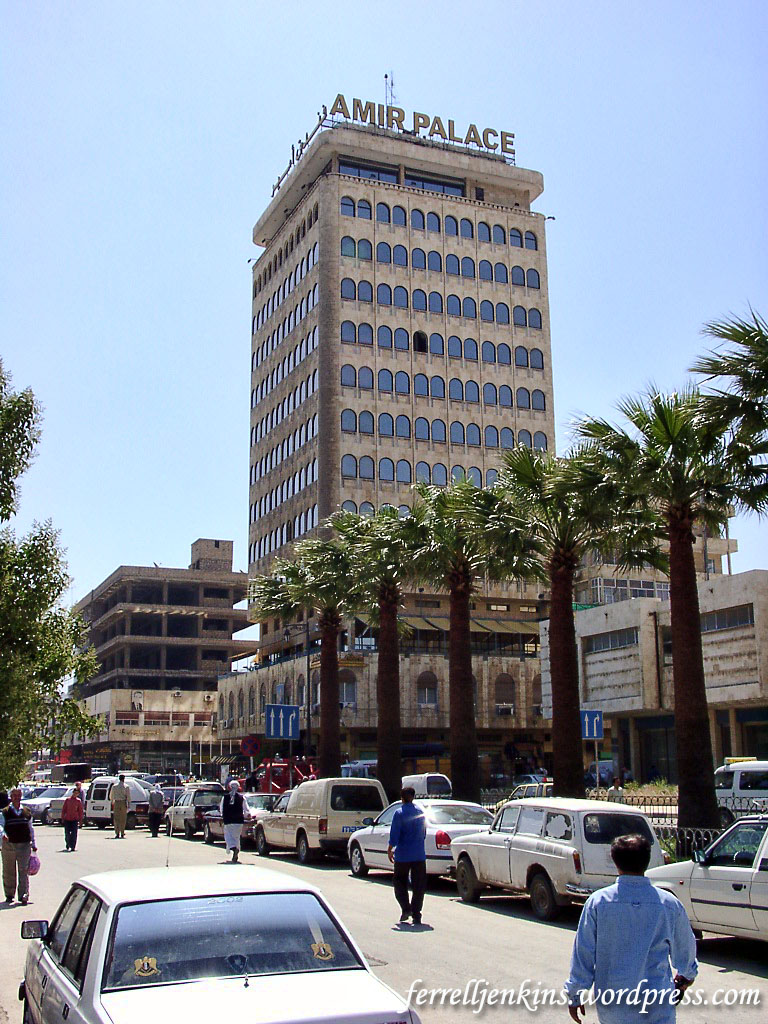
Our hotel was the Amir Palace. Two men went with us to our room. I recall it as being rather small — not a place one would wish to spend a lot of time. The men showed us how to turn on the TV. There was not much in English, but one of the men pointed out, with a smile, that we could watch news on Al Jazeera.

Amir Palace Hotel in Aleppo, Syria, May, 2002. Photo by Ferrell Jenkins.

Amir Palace Hotel in Aleppo, Syria, May, 2002. Photo by Ferrell Jenkins.

After dinner, David offered to buy me a candy bar at a little kiosk across from the hotel. We walked over in great anticipation, but soon learned that none of the candy bars were sweet. Spoiled Americans!

The next day I included this note in my brief email back home:

This morning we went to the Aleppo National Museum which was directly across the street from the hotel. Spent about 1 ½ hours there. Even though photos are not permitted I was able to get several good ones.

There are numerous items in the museum and adjoining yard from Tell Halaf, the ancient site of Gozan located northeast of Aleppo near the Turkish border. (Do not confuse Tell Halaf with Tel Halif in southern Israel.) Tell Halaf is identified with the city of Gozan to which Israelites were deported by the Assyrians (1 Chronicles 5:26).

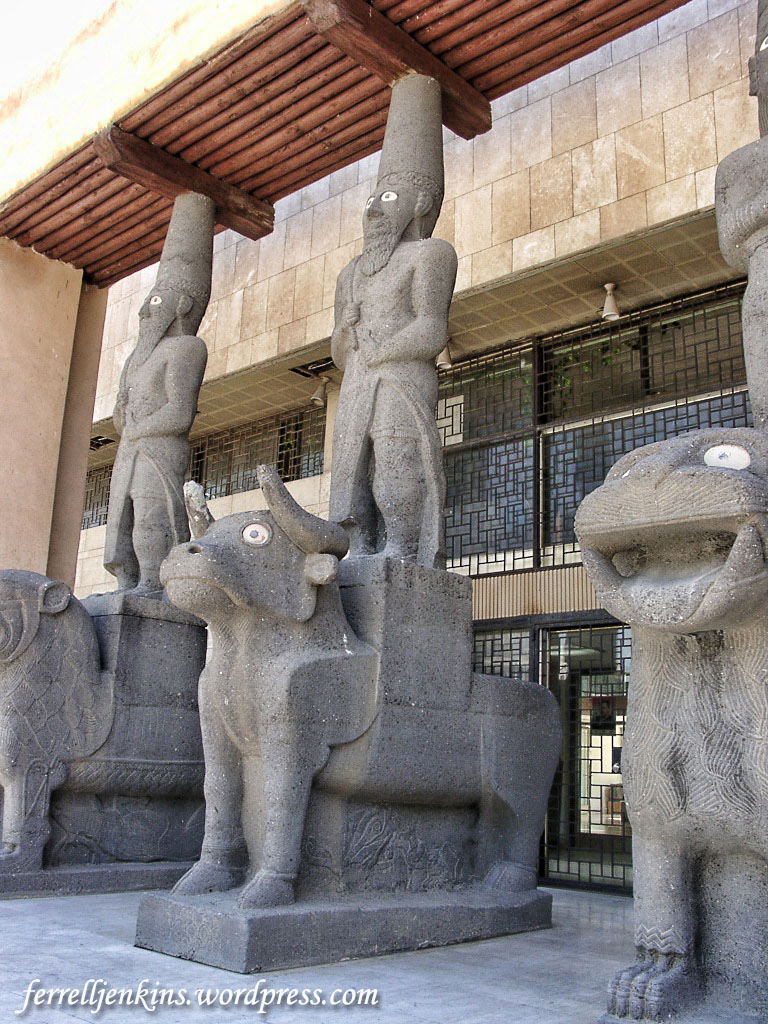
To enter the Aleppo National Museum one must walk past three basalt caryatids in the likeness of Hadad from Tell Halaf. The central one is standing on the back of a bull and the others are standing on the back of lions.

Entrance to Aleppo National Museum in 2002. Photo by Ferrell Jenkins.

Entrance to Aleppo National Museum in 2002. Photo by Ferrell Jenkins.

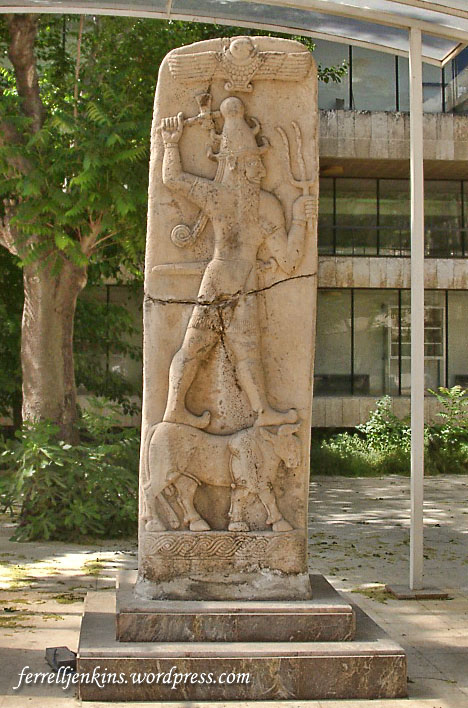
In the courtyard there were at least two images of Teshub, the neo-Hittite storm god from Tell Ahmar.

Teshub, the neo-Hittite storm god, standing on a bull. Photo by Ferrell Jenkins.

Teshub, the neo-Hittite storm god, standing on a bull. Photo by Ferrell Jenkins.

The Aleppo National Museum, established in 1931, suffered severe damage to the building in 2016, but SANA (Syrian Arab News Agency) reports in July “that the archaeological collections in the museum suffered little damages.”

I have several photos prepared for another post (or two?) to help you get some idea about the treasures in this museum.

The greatest tragedy in the recent crisis in Aleppo is the inhumanity of man and the loss of life. But the destruction of many historical treasures in Syria is a loss for all of us.

The great lesson of the book of Daniel is that the LORD rules in the kingdoms of men, even when evil men think they are in charge. Nebuchadnezzar, the Babylonian king, was driven from the great city he had built and made to live like an ox until he learned  “that the Most High rules the kingdom of men and gives it to whom he will” (Daniel 4:32 ESV)

Recall the admonition of Peter when he cut off the ear of one of those who came to arrest Jesus in the Garden.

Then Jesus said to him, “Put your sword back into its place. For all who take the sword will perish by the sword. (Matthew 26:52 ESV)

Birket Ram on the road to Trachonitis

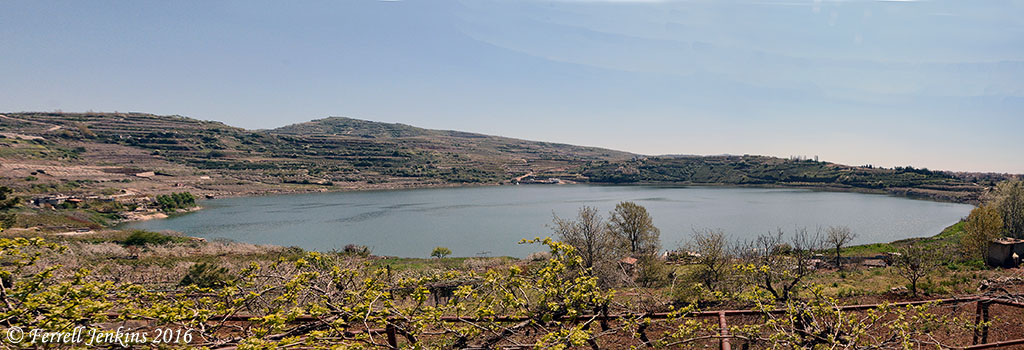
Birket Ram is located north of Mas’ada in the Golan Heights (now Northeastern Israel; formerly Syria). Using two 18mm images I was able to make this panorama. Click on the photo for a larger image.

Panorama of Birket Ram. Photo by Ferrell Jenkins.

Panorama (view south) of Birket Ram. Photo by Ferrell Jenkins.

Birket Ram is not mentioned in the Bible, but there is some related historical information.

Azaria Alon devotes only a single paragraph to Birket Ram, or Ram Pool.

Birket Ram is a natural water formation which measures 600 x 900 meters [1,968 x 2,952 ft.], reaches a depth of 6 to 10 meters [20 to 30 ft.], and holds about 3 million cubic meters of water. The pool has the appearance of a crater and is at an elevation of 940 meters [3,083 ft.]. It contains sweet water fed by underground springs and rain. Geologists believe that the pool was formed by volcanic activity in which the peak of the mountain blew off leaving a crater. (Israel National Parks & Nature Reserves, 2008. p. 39).

Josephus states that Panium [Paneas or Banias = Caesarea Philippi] is thought to be the source of the Jordan River. He claims, however, the source is Phiale (Birket Ram).

509 Now Panium is thought to be the source of the Jordan, but in reality it is carried there after a hidden manner from the place called Phiale:
510 this place lies as you go up to Trachonitis, and is fifteen miles from Caesarea, and is not far out of the road on the right hand;
511 and indeed it has its name of Phiale [vial or bowl] very justly, from the roundness of its circumference, as being round like a wheel: its water continues always up to its edges, without either sinking or running over;
512 and as this origin of Jordan was formerly not known, it was discovered when Philip was tetrarch of Trachonitis [Luke 3:1];
513 for he had chaff thrown into Phiale, and it was found at Panium, where the ancients thought the source of the river was, where it had been therefore carried [by the waters]. (Jewish Wars 3:509-513)

In 1865 Edward Robinson questioned the claim of Josephus saying,

This story helps to confirm the identity of Phiala with Birket er-Râm; but the supply of such a fountain as that of Bâniâs would exhaust this lake in a single day. (Physical Geography of the Holy Land)

Contrary to Alon’s claim that the water of Birket Ram is sweet, Robinson and other older sources say that the water is stagnant and slimy. I got no closer than the photo shows and can not testify about the quality of the water.

The French and archaeology

Media commentators have spoken of the long relationship between France and the United States of America. We may disagree vigorously with various French policies, but in times like this we join in deep concern for the attack on freedom and human life that Paris has recently experienced.

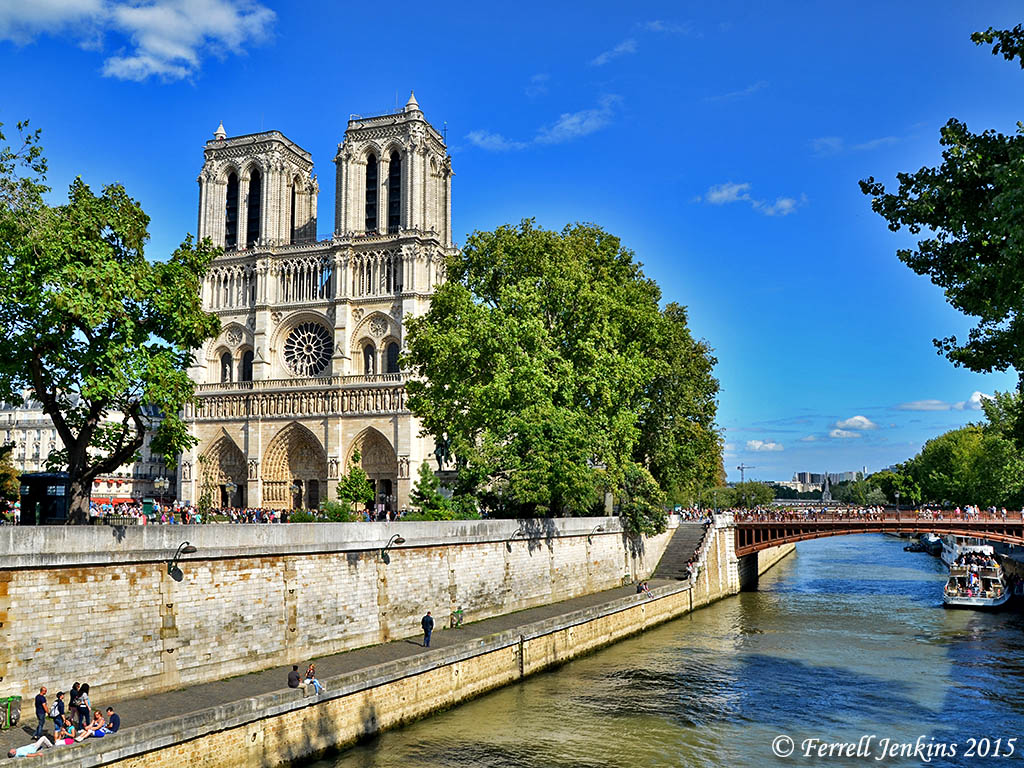
Notre Dame and the River Seine. Photo by Ferrell Jenkins.

Notre Dame and the River Seine. Photo by Ferrell Jenkins.

I have visited France on several occasions. When I have that opportunity I always try to visit the Louvre Museum at least twice during my stay. French archaeologists have worked throughout the Middle East and brought many of the artifacts to Paris for display.

When I first became aware of those little books on Biblical archaeology by Prof. André Parrot, I purchased used copies of everyone I could locate. Parrot was for a time Curator-in-Chief of the French National Museums, Professor at the Ecole du Louvre, and director of the Mari Archaeology Expedition. Mari is in Syria.

The Louvre displays numerous items from Syria. How many of you have traveled in Syria and visited the archaeological sites and the wonderful museums? Not so many, I suppose. But many have visited the Louvre in Paris and seen some of the greatest discoveries of the ancient world.

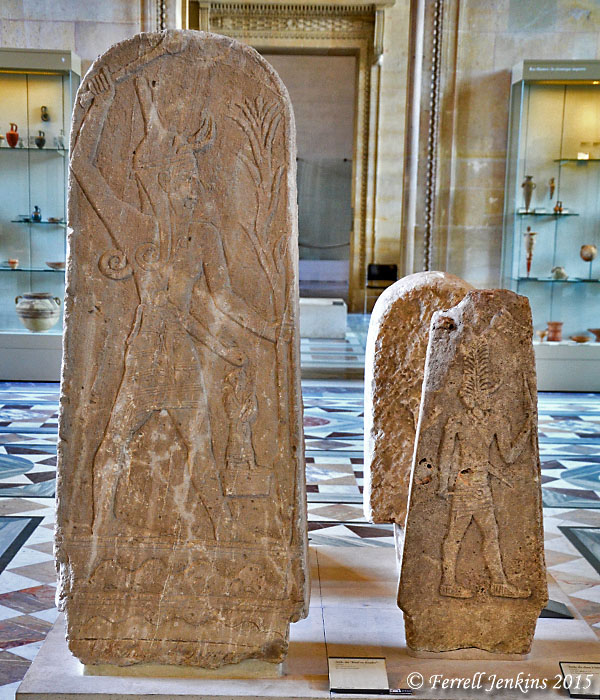
The photo below shows the display from Ugarit (Ras Shamra), a city on the Mediterranean coast of Syria a few miles north of Latakia. The excavations were conducted by French archaeologists Claude F. A. Schaeffer. Baal is portrayed as the Canaanite god of grain, weather, and war. This, and the Ugaritic documents displayed in the Louvre, provided much background information for those who study the Bible.

Stele of Baal from Ugarit (Ras Shamra). Displayed in Louvre. Photo by Ferrell Jenkins.

Stele of Baal from Ugarit (Ras Shamra). Displayed in Louvre. Photo by Ferrell Jenkins.

The great archaeological work by the French is much appreciated. Time would fail me to tell of all of the French archaeologists who have contributed to our knowledge.

Joseph was sold at Dothan

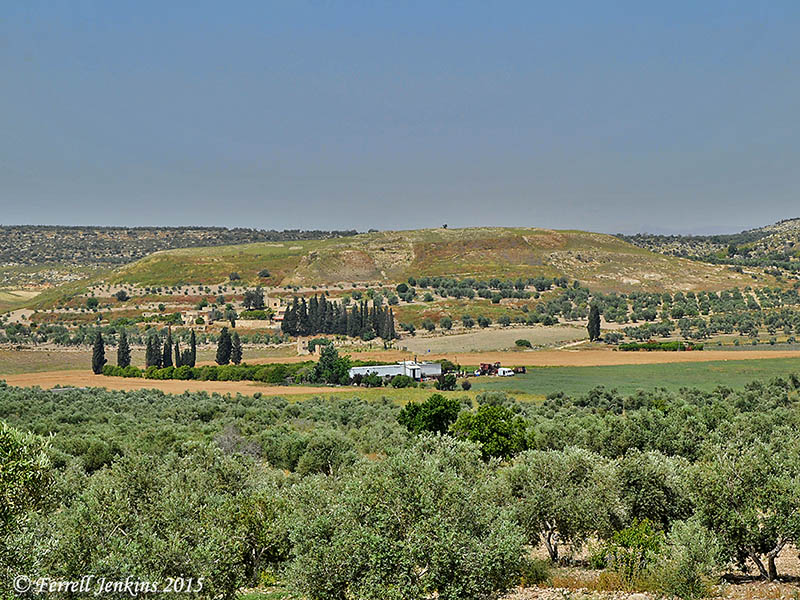
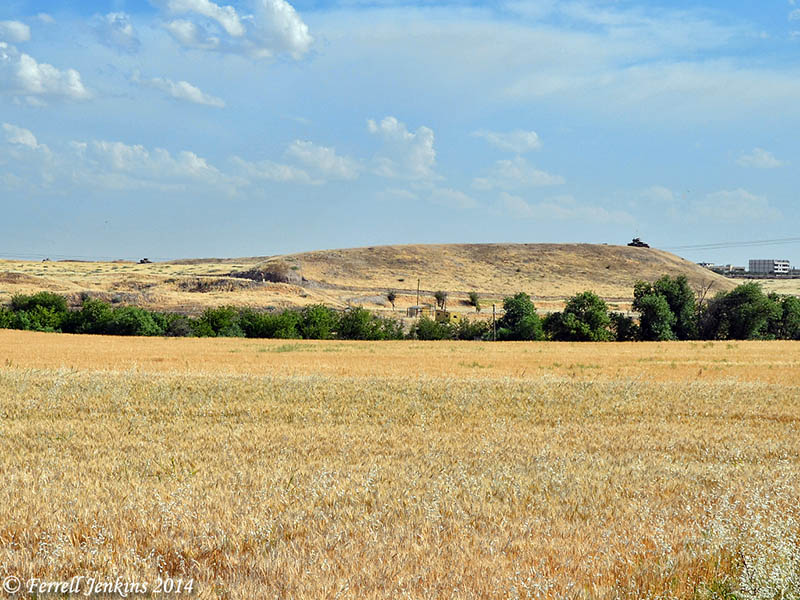
Dothan (Tell Dothan) is located about 11 miles north of Samaria on the east side of the modern highway. The impressive mound rises nearly 200 feet above the plain. The top of the Tell covers about 10 acres and the slopes cover almost 15 more.

Our first photo shows the view of Dothan to the east of the main highway. The mound is located in the region of Samaria in the fertile Dothan Valley.

A view of the west side of Tel Dotan. Photo by Ferrell Jenkins.

A view of the west side of Tell Dothan. Photo by Ferrell Jenkins.

Biblical Events at Dothan

The best known Biblical event at Dothan is the selling of Joseph. The seventeen-year-old went from the Valley of Hebron where he lived with his father Jacob to Dothan searching for his brothers. Motivated by envy they put him into one of the pits, later sold him to a caravan of Ishmaelites, from Gilead, on their way to Egypt (Gen. 37:16-28). Joseph P. Free said in 1975:

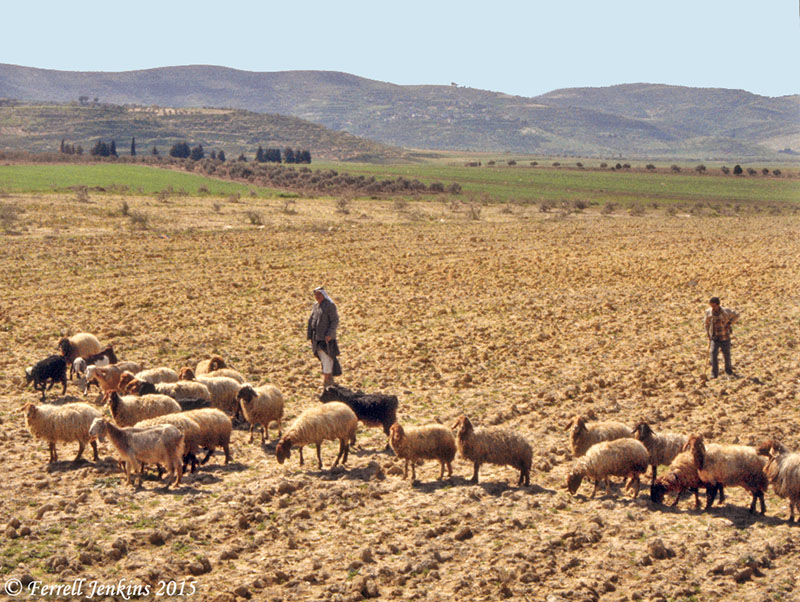
“Shepherds still come from southern Palestine to the region of Dothan to water and pasture their flocks, as they did 4000 years ago in the days of Jospeh’s brother. Some doubt has been expressed (Kraeling) on the Biblical record of shepherds traveling out of ‘the vale of Hebron’ eighty miles or more to the Dothan area. One spring week-end we counted ninety flocks on the road from Jerusalem to the Dothan area; many came from the region between Hebron and Jerusalem” (ZPEB  2:160).

Dothan was in Jordan at the time of Free’s work; it is now in the Palestinian West Bank. This is one factor that has complicated any continued excavations.

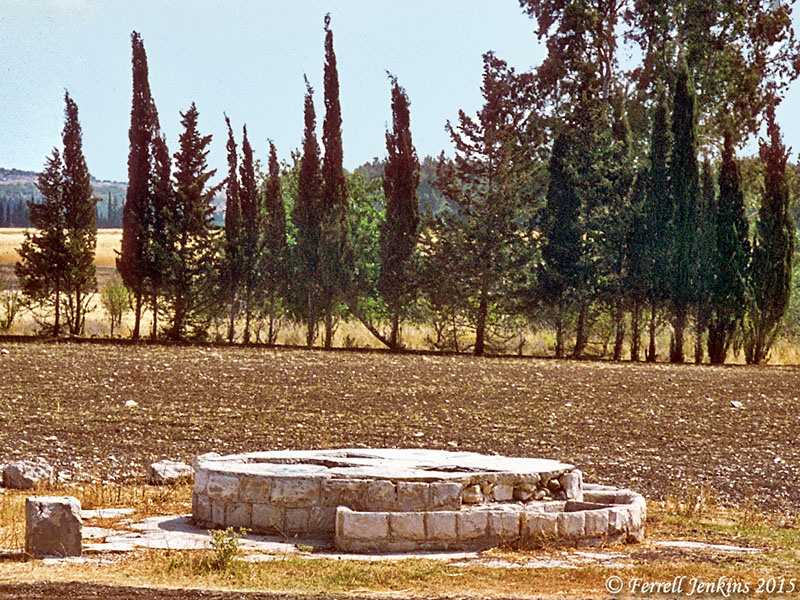
The next photo is one I made in 1979. On the west side of the main highway, across from Tell Dothan there was a cistern that was used by the shepherds to water their flocks. I was looking carefully to locate the cistern again, but discovered that a strip of small stores had been built in the area.

Joseph’s brothers put him in a dry pit. The term pit may be used of a cistern, or a pit of some other sort. From the first time I saw this cistern I was reminded of the episode of Joseph.

A cistern in the Dothan Valley in 1979. Photo by Ferrell Jenkins.

A cistern in the Dothan Valley in 1979. Photo by Ferrell Jenkins.

Next is a photo that I made of shepherds tending their flocks in the Valley of Dothan in 1979.

Shepherds watching their flock in the Valley of Dothan. Photo by Ferrell Jenkins.

Shepherds tending their flock in the Valley of Dothan. Photo by Ferrell Jenkins.

The Pictorial Library of the Bible Lands includes some nice photos of Dothan, including an aerial shot and a different picture of a well near the Tell.

Ben-hadad and Elisha. A lesser known event at Dothan is that of Syrian king Ben-hadad who surrounded the city seeking to capture the prophet Elisha. Instead, the Syrians were struck blind by the Lord and led to Samaria by Elisha (2 Kings 6:11-23).

Archaeological Excavations
Excavations were conducted from 1953 to 1962 by Joseph and Ruby Free (Wheaton Archaeological Expedition). You may read Free’s own brief account of the excavations in the Zondervan Pictorial Encyclopedia of the Bible 2:157-60.

The excavations revealed that Tell Dothan was occupied as early as 3000 B.C. Bowls and juglets were discovered from the Middle Bronze Age (2000 – 1500 B.C.), showing that the city was occupied during the patriarchal period. Upper levels of the excavation provided evidence of the city from the 9th century B.C., the time of Ben-Hadad and Elisha.

I decided to follow the example of Master in Dothan: Remains from the Tell (1953-1964) in using the term Tell rather than Tel as shown on Israeli maps.

NASA photos of Israel and Middle East

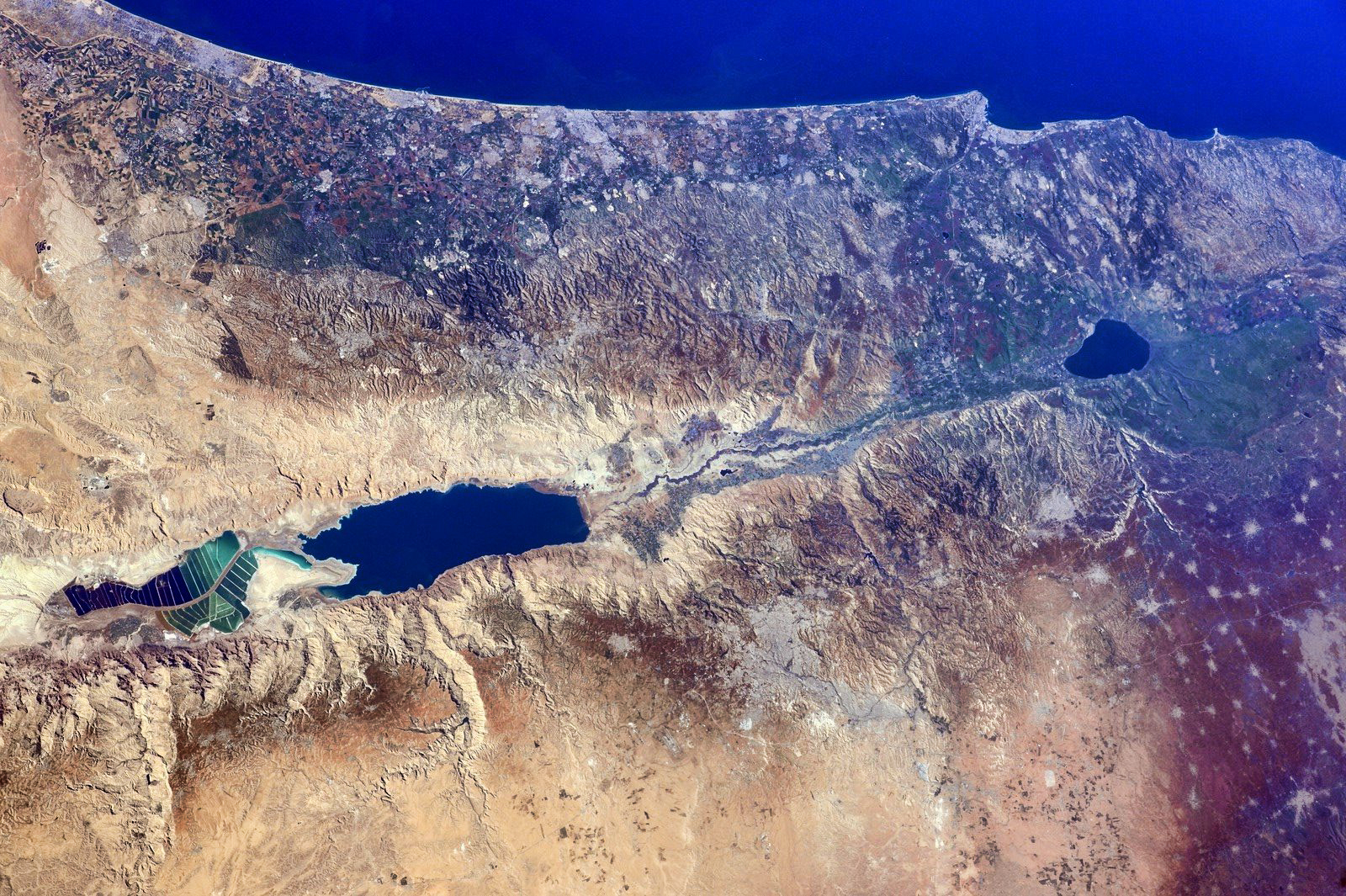
NASA has posted several excellent photos made by Barry Wilmore from the International Space Station on Facebook. The photos were made on Christmas day, 2014. See how many landmarks you can identify. Click on the photo for a larger image. Do you see Tyre?

Israel, the West Bank, and part of Jordan from the ISS. Photo: NASA/Barry Wilmore.

Israel, the West Bank, and part of Jordan from the ISS. Photo: NASA/Barry Wilmore.

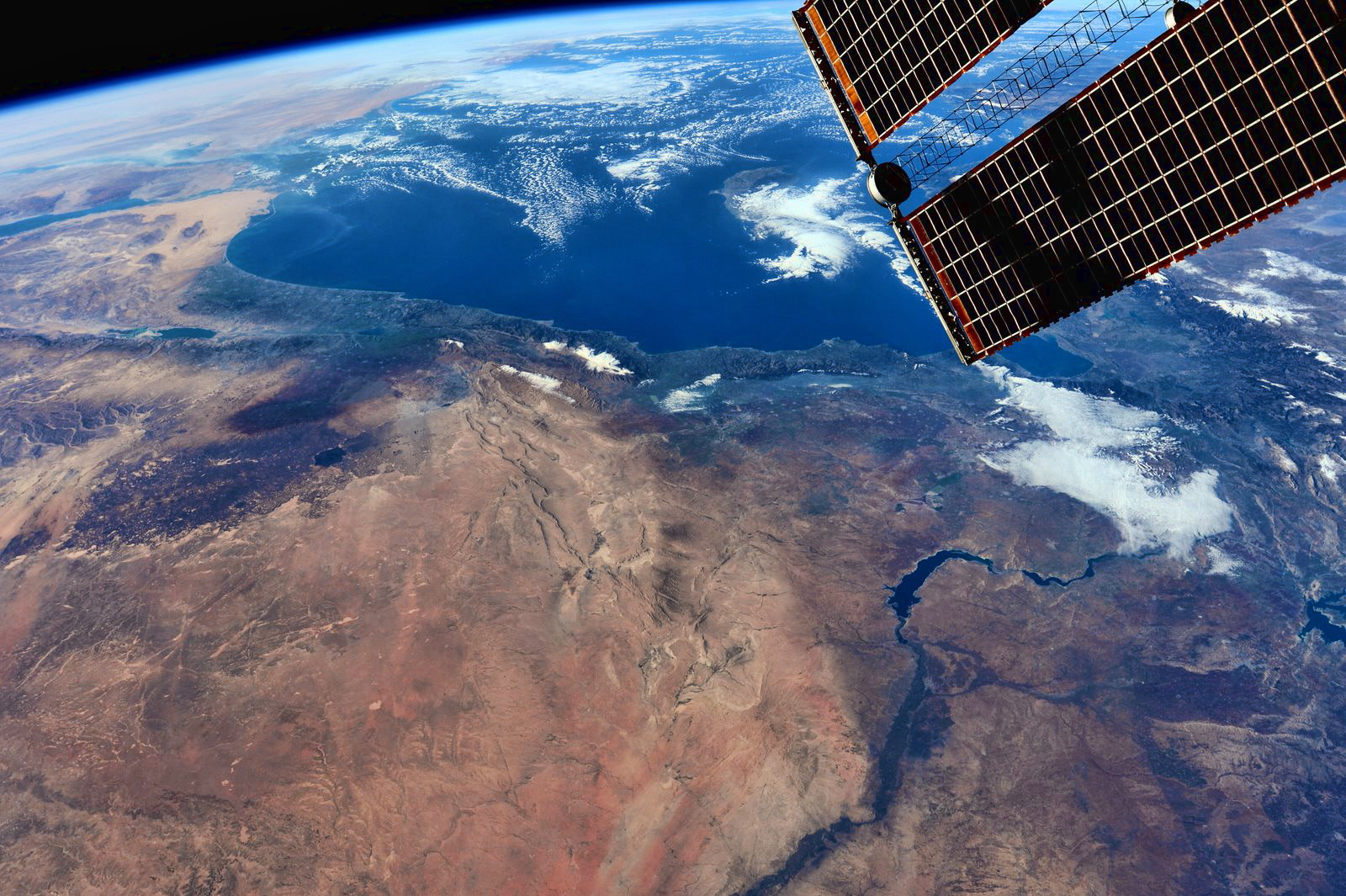
The photo below shows portions (or all) of (L to R) Egypt, Sinai Peninsula, Israel, Jordan, Lebanon, Syria, Turkey (including Euphrates River), and Iraq. Great photo.

The Middle East from the ISS. Photo: NASA/Barry Wilmore.

The Middle East from the ISS. Photo: NASA/Barry Wilmore.

Get out your Bible atlases and study these photos.

Our tax dollars put to good use, I would say.

Book on the origin of Israel available

Daniel I. Block’s book, Israel: Ancient Kingdom or Late Invention?, is available in Kindle format today for $2.99. The retail price of the hardback is $28.
The publisher (B&H) of the 2008 book describes it as

a collection of essays responding to the radical claims that Israel and its history actually began following the Babylonian exile, and that the history of Israel we read about in the Bible is a fictionalized account.

Contributors are leading Bible and archaeology scholars who bring extra-biblical evidence to bear for the historicity of the Old Testament and provide case studies of new work being done in the field of archaeology.

The book includes the following essays dealing with some of the current discussions in Biblical studies.

  • Israel – Ancient Kingdom or Late Invention? – Daniel I. Block
  • The Value and Limitations of the Bible and Archaeology – Alan R. Millard
  • Contextual Criticism as a Framework for Biblical Interpretation – John M. Monson
  • North-West Semitic Inscriptions and Biblical Interpretation – Joel Drinkard
  • From Joseph to David: Mari and Israelite Pastoral Traditions – Daniel E. Fleming
  • Major Geographical Issues in the Accounts of the Exodus – James K. Hoffmeier
  • Slavery and Slave Laws in Ancient Hatti and Israel – Harry A. Hoffner Jr.
  • Were the Israelites Really Canaanites? – Alan R. Millard
  • Syria and the Bible: The Luwian Connection – Richard S. Hess
  • David and Solomon’s Jemsalem: Do the Bible and Archaeology Disagree? – Alan R. Millard
  • Who Were Israel’s Transjordanian Neighbors and How Did They Differ? – Gerald L. Mattingly
  • Shalmaneser III and Israel – K. Lawson Younger Jr.
  • Did the Israelites Really Learn Their Monotheism in Babylon? Simon J. Shenvin
  • Did Persian Zoroastrianism Influence Judaism? – Edwin M. Yamauchi
  • Interpreting the Bible as an Ancient Near Eastern Document – John H. Walton

Archaeologist pushes for a park at Carchemish

The ancient site of Carchemish (modern Karkamiş in Turkey) was identified by George Smith in 1876, and later excavated by the British Museum beginning in 1911. The various directors included Hogarth, Thompson, Wooley, and Lawrence. Many remains of Assyrian and Neo-Hittite periods were uncovered.

Carchemish is mentioned only a few times in the Bible, but it was one of the most significant cities in the ancient Bible world.

  • Isaiah made a reference to Carchemish (Isaiah 10:9). The city had been sacked by Sargon II in 717 B.C.
  • Pharaoh Necho of Egypt went up to Carchemish on the Euphrates to assist the Assyrians against the Babylonians in 609 B.C. (2 Chronicles 35:20; Jeremiah 46:2). King Josiah of Judah tried to stop him, but was killed.

One of the Babylonian Chronicles says that Nebuchadnezzar “crossed the river to go against the Egyptian army which lay in Carchemish.”

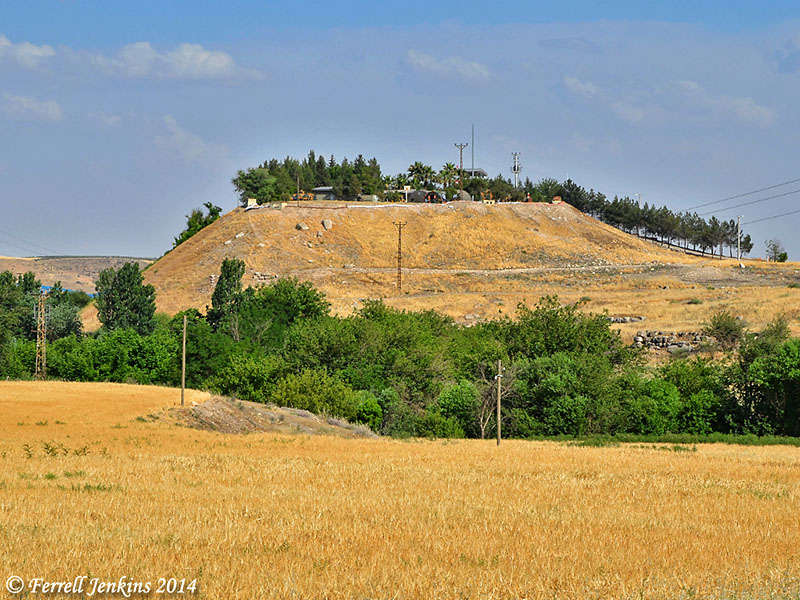
The tell (mound) at Carchemish consists of a smaller high mound and a larger lower mound. Hazor, in Israel, would be a similar site. The first photo shows the higher mound which is immediately north of the Turkish border with Syria. The Turkish military is making use of the tell. On the left side of the tell, above the trees you will see a blue metal structure. That is the bridge crossing the Euphrates River. Part of the ancient city is now within Syria. On the right side of the photo above the lower trees you will see portions of ancient walls.

Carchemish is now used by the Turkish military. Photo by Ferrell Jenkins.

Carchemish is now used by the Turkish military. Photo by Ferrell Jenkins.

Professor Nicola Marchetti of Bologna University in Italy has been heading a new excavation on the lower tell. Last year Marchetti announced plans to build a new archaeological park at Karkamiş. Monday he made a new call for the opening of the park and a museum to display artifacts from the site.

He said establishing an archaeology park in the ancient city would draw many tourists to the region.

The most important areas in the excavations are a lower palace and a lower city, which they had unearthed two years ago, and there were two temples in this area, said Marchetti, adding the most important stage of the excavations would be finished this year.

See the article in Hurriyet Daily News here. (HT: Bible Places Blog).

A few weeks ago we were able to get close to the ancient site, but was not able to visit the excavation. In the photo below you will see a military tank on top of the lower tell near the recent excavations. The high tell is immediately to the left.

Lower tell of Carchemish. Photo by Ferrell Jenkins.

Lower tell of Carchemish. Photo by Ferrell Jenkins.


Visualizing Isaiah 17: olives and altars

In the oracle concerning Damascus (Syria), Isaiah uses illustrations of the gleaning of grain and olives –plants common in that time.

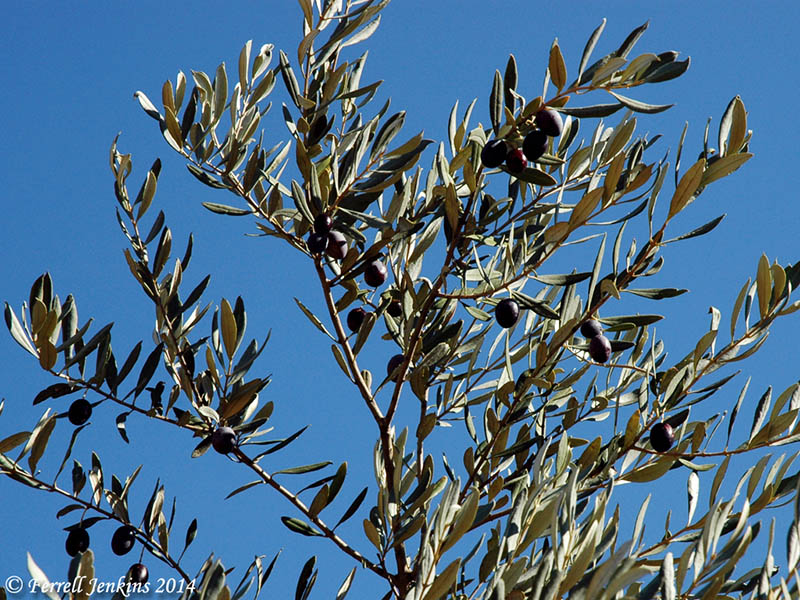
Gleanings will be left in it, as when an olive tree is beaten– two or three berries in the top of the highest bough, four or five on the branches of a fruit tree, declares the LORD God of Israel. (Isaiah 17:6 ESV)

We could probably shake off several more of the olives from the limbs below and have a better illustration of what Isaiah says, but hopefully this will serve to illustrate the point.

Olives on a branch at Neot Kedumim. Photo by Ferrell Jenkins.

Olives on a branch at Neot Kedumim. Photo by Ferrell Jenkins.

Another thing Isaiah says is that Damascus would no longer look to the altars they had made with their own hands. These images, and the gods they represented, would fail.

He will not look to the altars, the work of his hands, and he will not look on what his own fingers have made, either the Asherim or the altars of incense. (Isaiah 17:8 ESV)

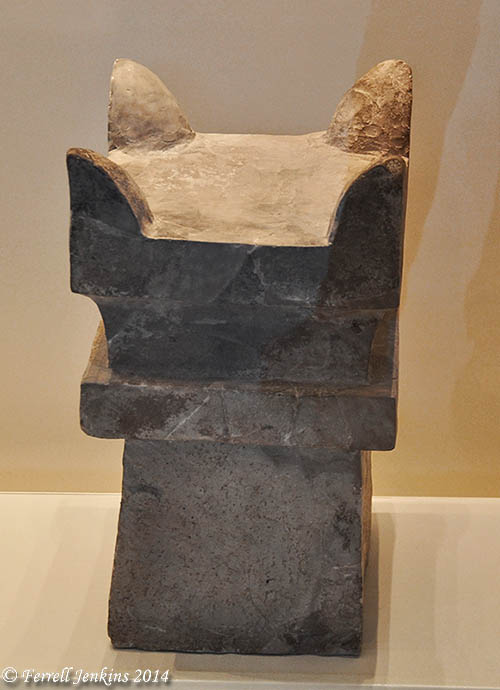
Altars of incense came in all sizes in those days, and many have been uncovered by archaeologists working at various sites. The altar below, now displayed in the Israel Museum, is from Megiddo.

Altar of Incense from Megiddo. Israel Museum. Photo by Ferrell Jenkins.

Horned altar of Incense from Megiddo. Israel Museum. Photo by Ferrell Jenkins.