The photo below was made from the roof of the Tower of David at Jaffa (Joppa) Gate. It gives one a nice view of some of the highlights of the Old City of Jerusalem and, left to right, Mount Scopus, and the northern portion of the Mount of Olivet.
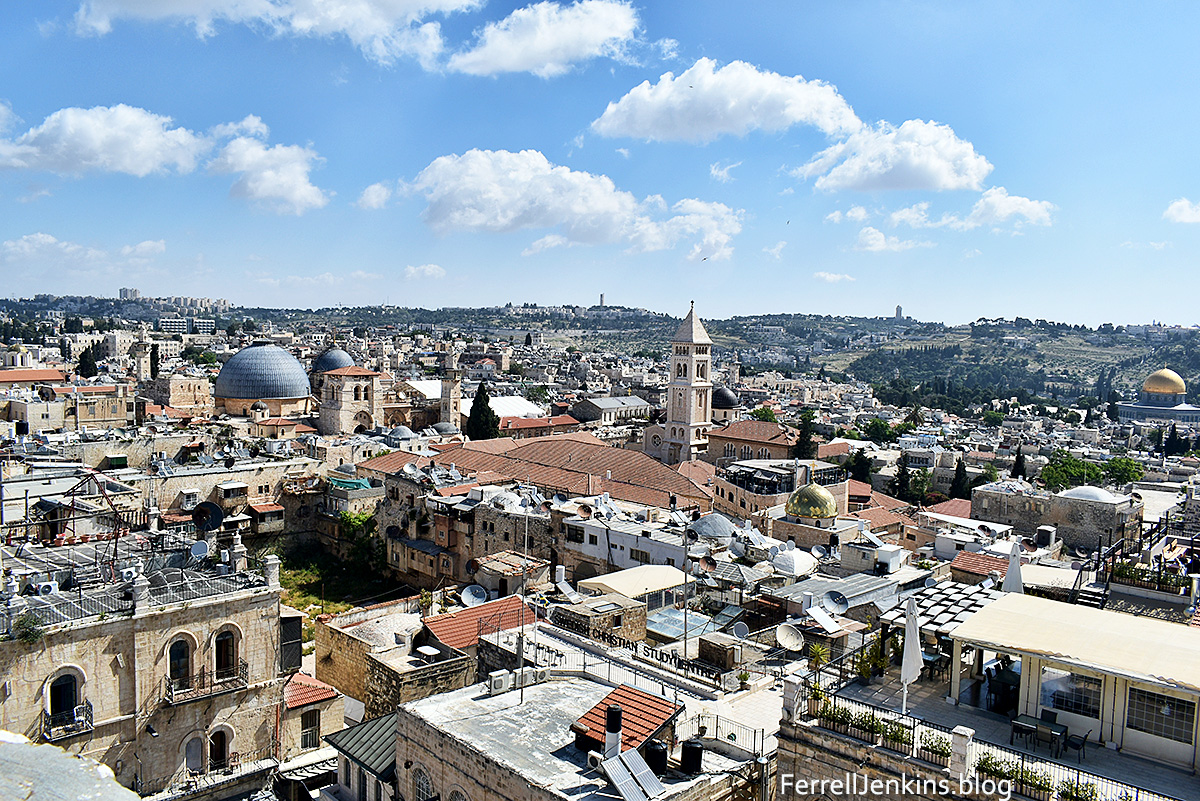

The photo below was made from the roof of the Tower of David at Jaffa (Joppa) Gate. It gives one a nice view of some of the highlights of the Old City of Jerusalem and, left to right, Mount Scopus, and the northern portion of the Mount of Olivet.
24 When they came to Capernaum, the collectors of the two-drachma tax went up to Peter and said, “Does your teacher not pay the tax?” 25 He said, “Yes.” And when he came into the house, Jesus spoke to him first, saying, “What do you think, Simon? From whom do kings of the earth take toll or tax? From their sons or from others?” 26 And when he said, “From others,” Jesus said to him, “Then the sons are free. 27 However, not to give offense to them, go to the sea and cast a hook and take the first fish that comes up, and when you open its mouth you will find a shekel. Take that and give it to them for me and for yourself.” (Matthew 17:24-27 ESV).
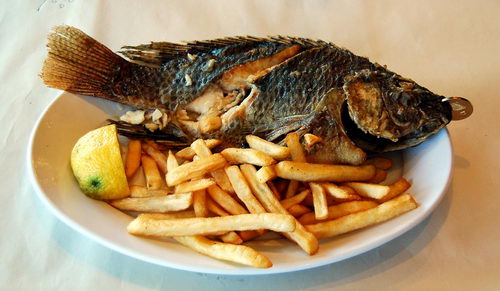
Fishing is still important on the Sea of Galilee. Tour groups to Israel usually have at at least one meal of the famous St. Peter’s Fish when we are in the Galilee.
Mendel Nun spent more than 50 years fishing the Sea of Galilee. He became an expert in the history of fishing on the Sea. His article, “Cast Your Net Upon the Waters: Fish and fishermen in Jesus’ Time” (Biblical Archaeology Review, 19:06), includes information on this episode. Because this is a lengthy quotation I will leave it full width for easier reading.
— • —
The musht is the only large fish in the lake that moves in shoals, which of course is a key to the identification of the fish in the story in Luke, although not the only one.
The flat shape of the musht makes it especially suitable for frying. The skeleton consists of an easily detachable backbone and relatively few small bones, and thus it is easy to eat. It has long been known as St. Peter’s fish. Recently, it has even been exported under this name. But, alas, the name is a misnomer.
Presumably the fish got its name because of an incident recorded in the Gospel of Matthew (Matthew 17:24–27). In this episode, the tax collectors come to Capernaum to collect the half-shekel Temple tax that each Jew was required to pay annually. Jesus tells Peter, “Go to the sea and cast a hook, and take the first fish that comes up, and when you open its mouth you will find a shekel; take that and give it to them for me and yourself.”
The musht was probably given the name St. Peter’s fish because of this miracle. However, this cannot have been the fish Peter caught with a hook and line. The reason is simple: Musht feeds on plankton and is not attracted by other food. It is therefore caught with nets, and not with hook and line. The fishermen on the lake have, since time immemorial, used a hook baited with sardine to fish for barbels, which are predators and bottom feeders. Peter almost surely caught a barbel. There can be only one explanation for the confusing change of name. It was good for tourism! The Sea of Galilee has always attracted pilgrims; musht (today raised mostly in ponds) is part of the unique local cuisine. It is delicious, especially when freshly fried. In ancient times, just as today, the fishing boats delivered their catch to the eating places on shore. Indeed, the proverbial metaphor for speed in the Talmud is “as from the sea into the frying pan.” This expression was part of daily speech in Tiberias and clearly refers to musht and not barbels; the latter are best when boiled.
The first Christians were local people and were therefore familiar with the various fish. They of course knew that the fish Peter caught could only have been a barbel and not a musht. However, as pilgrims began to come from distant regions, it no doubt seemed good for business to give the name “St. Peter’s fish” to the musht being served by the early lakeside eating houses. The most popular and easily prepared fish acquired the most marketable name! But even if Peter did not catch a musht, he deserves to have his name associated with the best fish in the lake.
Returning to the miracle of the fish caught in Luke (5:1–7), additional clues that the fish were musht are the kind of net referred to and the place and the time of the event. Several kinds of nets were used in the Sea of Galilee. The most important were the seine, the cast net and the trammel net.
— • —
For some time the most searched for article on this blog has been Fish of the Sea of Galilee. If you have not read the article and enjoy the photos I urge you to do so now.
Here is one of the photos from that post.

A fisherman unloading his catch early in the morning at a dock at Tiberias, Israel.
Use this shortlink to go to the article with more information about the fish of the Sea of Galilee: https://wp.me/p1zOp-42k
If you use our SEARCH box and insert the word fish you will locate many articles about fish and fishing on the Sea. If you search for Mendel Nun you will find several more helpful articles about fishing and the harbors of the Sea of Galilee.
Posted in Bible Lands, Bible Places, Bible Study, Israel, New Testament, Photography, Travel
Tagged Bible, Christianity, faith, fishing, Israel, Jesus, john, Mendel Nun, Ministry of Jesus, New Testament, Sea of Galilee
John, the son of Zachariah and Elizabeth, was born in a village west of Jerusalem. The Lord gave him a special responsibility as the one preparing the way for Jesus the Messiah. The Gospels record some of his early work. John appeared, baptizing in the wilderness and proclaiming a baptism of repentance for the forgiveness of sins. And all the country of Judea and all Jerusalem were going out to him and were being baptized by him in the river Jordan, confessing their sins.
(Mark 1:4-5 ESV)
John began to preach a baptism of repentance and many from Jerusalem and Judah came to him to be baptized.
Jesus came from Galilee to the Jordan River to be baptized by John (Matthew 3:13-17). His baptism was an exception to all the others John baptized. Jesus had no sin, but this was the occasion of the Father’s acknowledging him as his son.
A specific location is mentioned as “Bethany across the Jordan” (John 1:28). This location very near the traditional site that many have visited at Qasr el-Yahud near Jericho. Jordanian scholars claim that the baptism of Jesus took place on the eastern side of the Jordan River, a place they call Bethany beyond the Jordan. The photo below shows my long-time traveling friend, Leon Mauldin, very near this site.

When I was leading tours I often said to my group about some proposed site of a Biblical event, “If it was not here (pointing directly in front of me), it was here (spreading my arms wide). In Israel one is never far from a significant Biblical event.
Posted in Bible Study
Tagged baptism, Israel, Jordan, Ministry of Jesus, Photography, Travel

The following text is taken from the Gospel of John, chapter 20.
Now on the first day of the week Mary Magdalene came to the tomb early, while it was still dark, and saw that the stone had been taken away from the tomb. So she ran and went to Simon Peter and the other disciple, the one whom Jesus loved, and said to them, “They have taken the Lord out of the tomb, and we do not know where they have laid him.” So Peter went out with the other disciple, and they were going toward the tomb. Both of them were running together, but the other disciple outran Peter and reached the tomb first. And stooping to look in, he saw the linen cloths lying there, but he did not go in. Then Simon Peter came, following him, and went into the tomb. He saw the linen cloths lying there and the face cloth, which had been on Jesus’ head, not lying with the linen cloths but folded up in a place by itself. Then the other disciple, who had reached the tomb first, also went in, and he saw and believed; for as ye they did not understand the Scripture, that he must rise from the dead. Then the disciples went back to their homes. (Jn. 20:1-10 ESV)
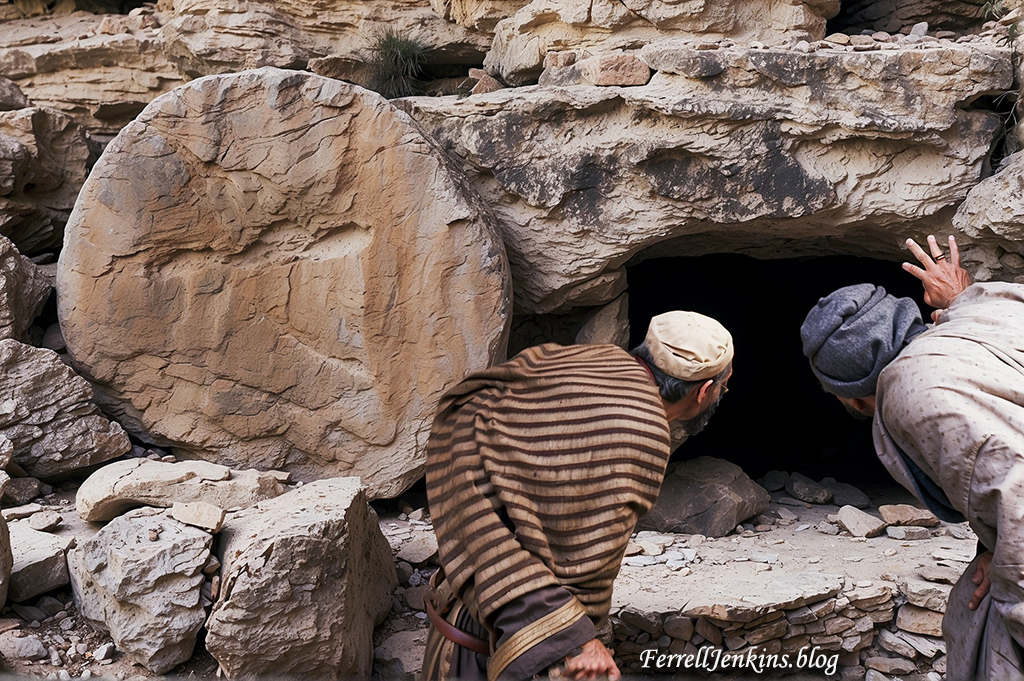
Imagine the emotions of the disciples of Jesus, both women and men, when they were told that the tomb that had been so carefully secured on Friday was found empty on the first day of the week, with only the grave clothes and the cloth that covered the head still in the tomb.
[The second photo showing the disciples of Jesus at the open tomb was made in Leonardo AI. David Padfield assisted me in this project.
Subscribe
Posted in Bible Lands, Bible Study, Culture, Israel, New Testament, Photography, Travel
Tagged Israel, Jerusalem, Jesus, Ministry of Jesus, Photographs, Tombs, Travel
Cornelius, a Roman centurion, was the first Gentile convert to the faith. He was stationed at Caesarea on the Mediterranean coast at the time when the apostle Peter was actively working in the spread of the Gospel.
A centurion in the Roman army normally had charge of 100 men (= to an Army captain). A regular cohort was one tenth of a legion and had a paper strength of 600 men. An auxiliary cohort was usually comprised of 1,000 men. Cornelius was of the Italian cohort. There is inscriptional evidence for the “Italian cohort” from Syria (See Bruce, 215).
When Paul set sail from Caesarea for Rome he was accompanied by a centurion of the Augustan cohort named Julius (Acts 27:1). All of the centurions mentioned in the New Testament make favorable impressions. This was not true of soldiers generally (Luke 3: 14). Note these examples:
The centurion at the crucifixion of Jesus (Luke 23:47).
F. F. Bruce (The Book of Acts, NICNT) cites Polybius (History vi.24) saying,
“Centurions are required not to be bold and adventurous so much as good leaders, of steady and prudent mind not prone to take the offensive or start fighting wantonly, but able when overwhelmed and hard-pressed to stand fast and die at their post.”
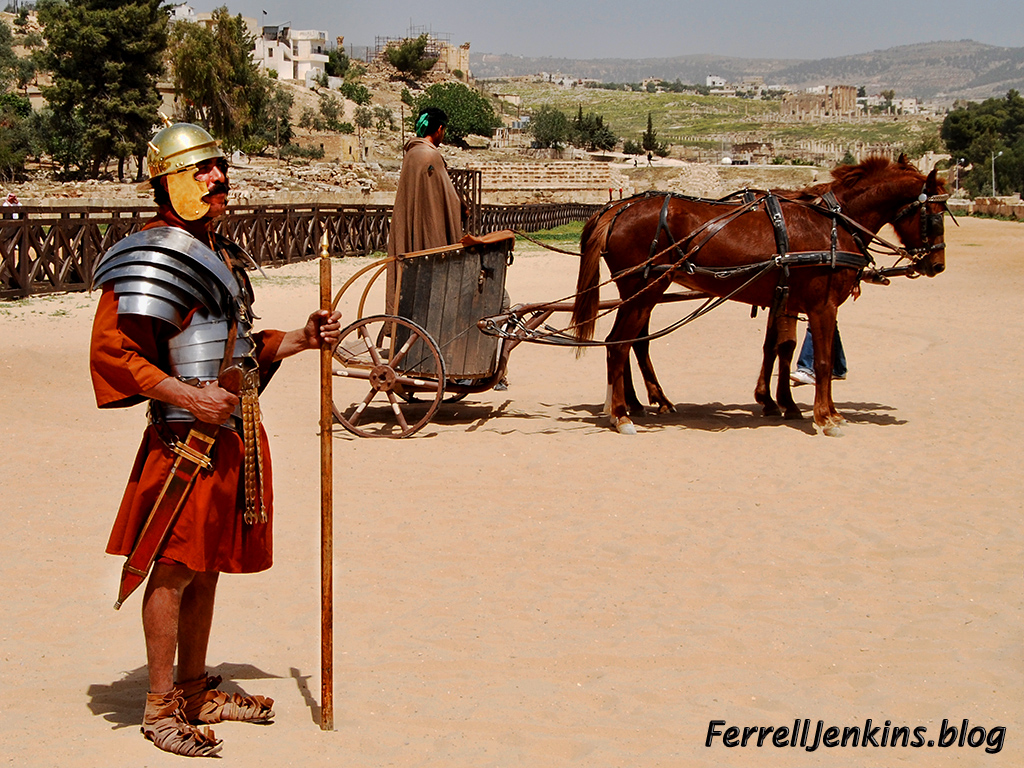
There is a wonderful performance in the early second century A.D. hippodrome at Jerash, Jordan. The RACE show (Roman Army Chariot Experience) shows actors dressed as Roman soldiers performing various activities of the early soldiers. Our photo shows a Roman centurion from that show.
Posted in Apostle Paul, Bible Places, Bible Study, Book of Acts, Israel, New Testament, Photography, Travel
Tagged Apostle Paul, Apostle Peter, Ministry of Jesus, Photography, Roman Empire, Travel
In the parable of the young prodigal and his older brother, Luke says that when the younger brother ran out of money he would gladly have eaten the pods the pigs were eating.
He was longing to eat the carob pods the pigs were eating, but no one gave him anything. (Luke 15:16 NET)
BDAG says that the word keration (translated pod) is used in the plural “of the fruits of the carob tree, carob pods.” Louw-Nida states that the word is “a diminutive derivative of keras which means horn.” They add,
“the pod of the carob tree (which closely resembles a small horn.…Carob pods were commonly used for fattening swine and were employed as an article of food by poor people.”
The first photo shows a carob tree loaded with green pods in the Spring of the year in the Jezreel Valley at Gan-Hashlosha.

Some nutritionists suggest that carob is high in protein content and is a good substitute for chocolate.
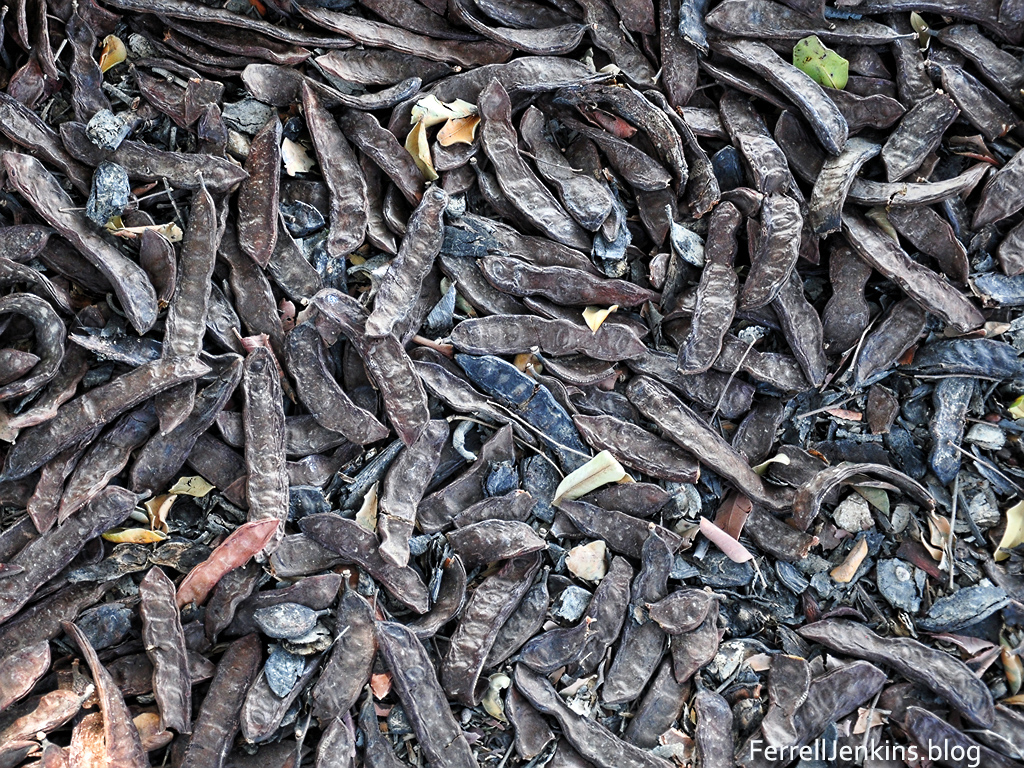
The next photo shows dried pods underneath a Carob tree at Hazor. Having been brought up on a farm, I can easily image the pigs rooting in these pods for the best one.
When the young prodigal son came to himself he headed for home. There is a good lesson in this for each of us when we become too attached to the things of this world (1 John 2:15).
Posted in Bible Lands, Bible Study, Israel, New Testament, Photography, Travel
Tagged Flora and Fauna, Ministry of Jesus
Even though I have made and posted several photos of the so-called “Jesus Boat” each time the photos look different. This can be due to using a different camera or of the lighting at the display.

After two years of drought a boat that belonged to the Roman period (dated from the first century B.C. to the first century A.D.) was discovered buried in the mud on the shore of the Sea of Galilee in January, 1986, by two members of the Kibbutz Ginosar. The boat measures 26.90 x 7.55 feet. Shelly Wachsmann, nautical archaeologist for the Israel Antiquities Authority and Museums, says,
“The boat was most likely used for fishing and transport of people and cargo. It could have been sailed, or rowed by a crew consisting of four oarsmen and a helmsman.” – (An Ancient Boat Discovered in the Sea of Galilee, a brochure once sold at the Museum.)
The boat is now displayed in the Yigal Allon Centre at Kibbutz Ginosar.
A more detailed article posted here provides more information and photos.
Only one of the Gospel accounts of the ministry of Jesus records a visit by Jesus to the town of Nain. Strangely it is Luke who wrote two volumes (Luke and Acts of the Apostles) to a man known as Theophilus (Luke 1:3; Acts 1:1).
John, who was a personal eyewitness to the ministry of Jesus, included only seven miraculous signs of Jesus in his gospel. He exaggerated for the sake of emphasis, “Now there are also many other things that Jesus did. Were every one of them to be written, I suppose that the world itself could not contain the books that would be written” (John 21:25 ESV). In addition to the resurrection of Jesus, John included the account of the resurrection of Lazarus in John 11.
I find it intriguing that Luke mentions this account of the resurrection of a young man as his mother was on the way to bury him. Luke was a physician who became what we might call the primary physician of the apostle Paul (Colossians 4:14; 2 Timothy 4:11; see also the “We” sections of Acts where Luke is traveling with Paul.
Scholars have written about the medical language of Luke used in his two volumes.
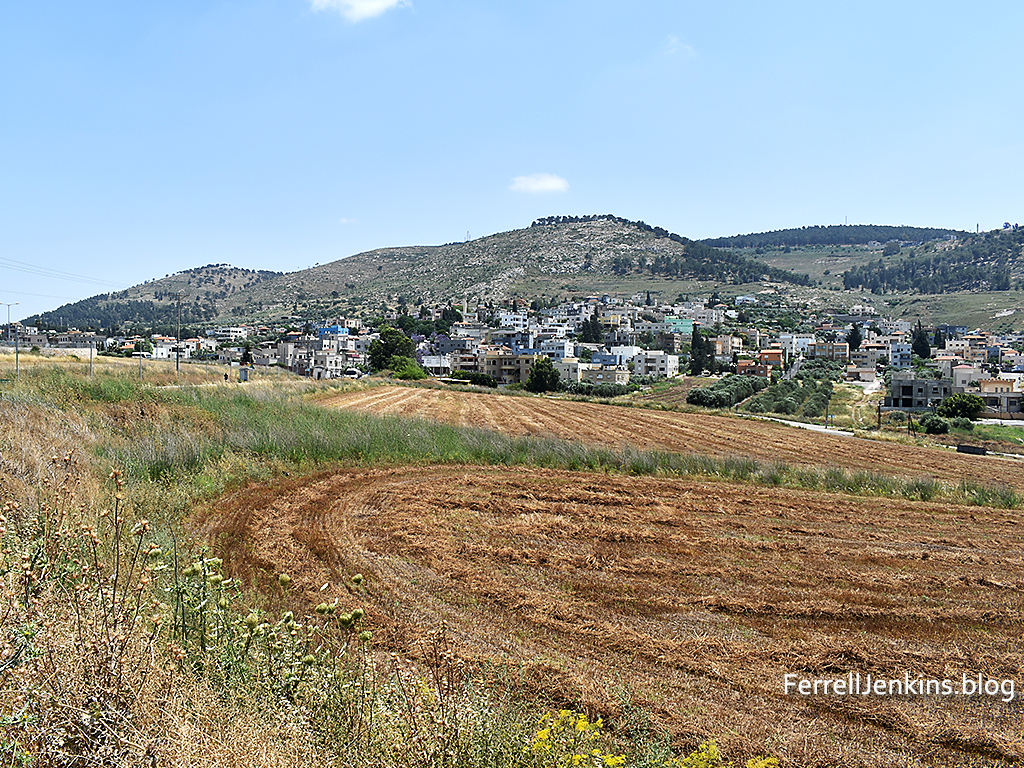
On our visit to Israel earlier this year I stopped to make a new photo of the town of Nain on the north side of the the Hill of Moreh.
Posted in Apostle Paul, Bible Places, Bible Study, Book of Acts, New Testament, Old Testament, Travel
Tagged Apostle Paul, Ministry of Jesus
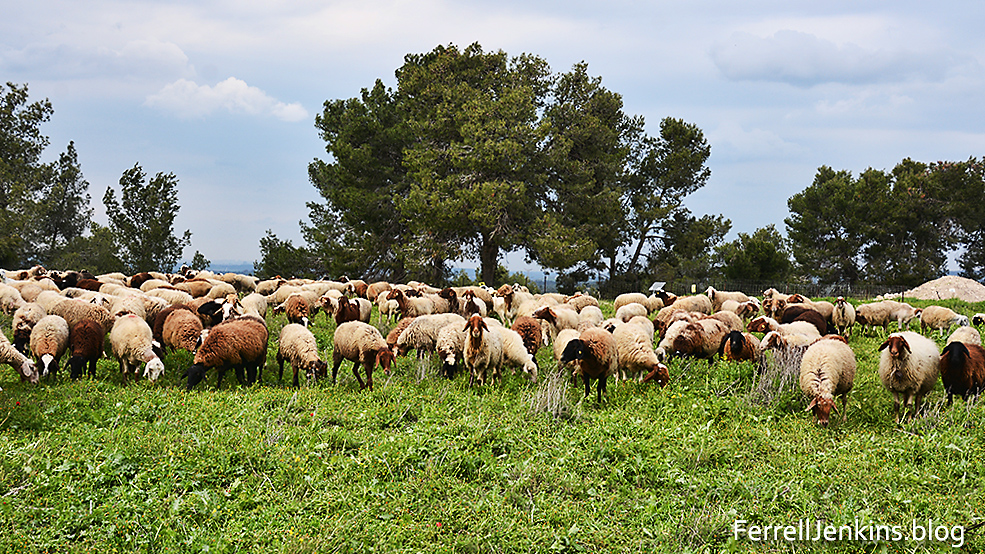
“He makes me lie down in green pastures. He leads me beside still waters” (Psalm 23:1-2 ESV). Shepherds bring their sheep to green pastures at Azekah. Photo made March 10, 2022.
The Pool of Bethesda is mentioned only once in the New Testament. At this pool Jesus healed a man who had been an invalid for 38 years.
Now there is in Jerusalem by the Sheep Gate a pool, in Aramaic called Bethesda, which has five roofed colonnades. (John 5:2 ESV)
The pool consisted of two pool near what we know today as the Lion’s Gate or Saint Stephen’s Gate to the Old City of Jerusalem. The church of Saint Anne faces the east side of the southern pool. The two pools were divided by a barrier wall between them. Citing the 1938 French publication by N. Van Der Vliet , Shimon Gibson says,
The Bethesda Pool was divided into two parts: the “Northern Pool” (53 x 40 m) which served as a reservoir for collected rainwater (with a capacity of some 21,200 cubic metres of water), and the “Southern Pool” (47 x 52 m) which was used for bathing (see below). The two pools would have been surrounded by porticoes (stoai) on four of its sides (with flat, not tiled, roofs), and with an additional portico (open on both sides) ex- tending across the barrier wall separating the two pools. The pools were not symmetrically rectangular, but were trapezoidal in form, (“The Excavations at the Bethesda Pool in Jerusalem: Preliminary Report on a Project of Stratigraphic and Structural Analysis”, pp. 17-44 in F. Bouwen (ed.), Sainte-Anne de Jérusalem. La Piscine Probatiquen de Jésus À Saladin. Proche-Orient Chrétien Numéro Spécial. 2011, Saint Anne: Jerusalem, p. 23).

Photo of the Pool of Bethesda from the Second Temple Model, Israel Museum, Jerusalem. In this model you see the two pools with the five colonnades or porticoes, the Herodian temple, and the Antonia (the building with the four towers build to protect the temple precinct. Notice that the model shows tiled roofs which Gibson says was not the case. Photo by Ferrell Jenkins
Gibson says that the archaeological excavations have revealed that Early Roman, Late Roman, two phases of Byzantine, and the Crusader period are known here. That area now looks like this.

The excavated area of the Pool of Bethesda showing the Crusader and Byzantine ruins. Photo by Ferrell Jenkins.
This nice map from the Bible Mapper Blog shows the relationship of the Pools of Bethesda to the Temple Mount. Those who have visited the Temple Mount in recent years may have exited on the northern side and visited the Pool (or Pools) of Bethesda. As you exit there is a noticeable depression. This is where the Pool of Israel or the Sheep Pool was located.

This map shows the Pools of Bethesda near the top. It comes from the Bible Mapper Blog.
The foreground of the next photo shows ruins of various pools from the Roman period that are known to have been considered a place of healing. Votive offering to Serapis and Asklepius, pagan healing gods, were found in the excavations.

In the foreground, to the east of the church ruins, we have ruins from the Roman period showing a sacred area known to have been considered a place of healing. Photo by Ferrell Jenkins.
Even though the invalid of John 5 had been brought there by friends or neighbors (he could not have come by himself) he remained an invalid. André Parrot says Jesus,
… achieved a victory over the gods of classical paganism which had been introduced into the very heart of Jerusalem, the city of Yahweh (Land of Christ, p. 100).
Posted in Archaeology, Bible Places, Bible Study, Church History, Israel, New Testament, Photography, Travel
Tagged Ministry of Jesus


 Ferrell's Travel Blog
You must be logged in to post a comment.