If we consider the Gospel of John a sort of “Day Planner” for Jesus, we have nearly complete activity recorded for two weeks of the earthly ministry of Jesus. The first is in John 1:19—2:11 where activity for six of the seven days is recorded. I think the omitted day is the sabbath.
The next nearly complete week is the last week, leading up to the resurrection. John gives more attention to the last week than any other Gospel. Even here we have activities for only six of eight days. This section begins in John 12:1 and continues into John 20. Here is the way I have reconstructed it. Where John does not record the activity I have omitted the scripture reference.
Sunday — The King enters Jerusalem — 12:12-19
Monday — Cleansing the Temple —
Tuesday — Visit of the Greeks — 12:20-36
Tuesday — Jewish rejection — 12:37-50
Wednesday — No events recorded in the Gospels
Thursday Evening — Passover Meal, including Washing Disciples Feet (only in John) — 13:1-38
Thur. Eve — Farewell discourses — 14—16
Thur. Eve — Prayer — 17
Thur. Eve — Annas (only in John) — 18:12-14
Thur. Eve — Caiaphas — 18:24-28
Friday — Pilate — 18:28—19:16
Friday — Crucifixion — 19:16-42
Sabbath —
First Day — Resurrection — 20
It should be noted that the appearance before Annas and Caiaphas were the Jewish (Religious) trials. The appearance before Pilate [and Herod Antipas] were the Roman (Civil) trials.
John does not record the pronouncement of woes on the religious leaders, the institution of the Lord’s Supper, and the account of the agony in the Garden of Gethsemane.
With this sparse attention given to two weeks, no wonder John says,
Now there are also many other things that Jesus did. Were every one of them to be written, I suppose that the world itself could not contain the books that would be written. (John 21:25 ESV)
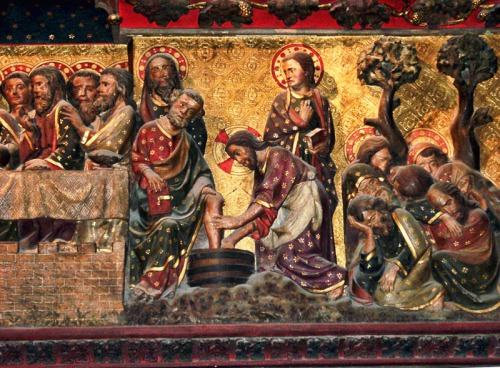
There is a medieval wood carving of the last week of Jesus in Notre Dame (Paris). In this photo you see the representation of the last supper, the washing of the disciples’ feet, and the agony in Gethsemane. (Sorry, this was made more than a decade ago and I don’t have a hi-res photo.) I do not know if this was destroyed in the fire.
Wood carving of Last Week of Jesus in Notre Dame. I do not know if this was destroyed in the fire. Photo by Ferrell Jenkins.
A reader of the previous post (Click to read: https://wp.me/p1zOp-5FC ) wonders how we know Jerusalem was not destroyed later than A.D. 70.
It is a good question. The New Testament, including the records of the life and ministry of Christ, is rooted in history. Notice how Luke, a gentile physician, emphasizes the historicity of the work of John the Baptist and the beginning of the baptism and ministry of Jesus.
Luke 3:1 In the fifteenth year of the reign of Tiberius Caesar, Pontius Pilate being governor of Judea, and Herod being tetrarch of Galilee, and his brother Philip tetrarch of the region of Ituraea and Trachonitis, and Lysanias tetrarch of Abilene, 2 during the high priesthood of Annas and Caiaphas, the word of God came to John the son of Zechariah in the wilderness. 3 And he went into all the region around the Jordan, proclaiming a baptism of repentance for the forgiveness of sins. (Lk. 3:1-3 ESV)
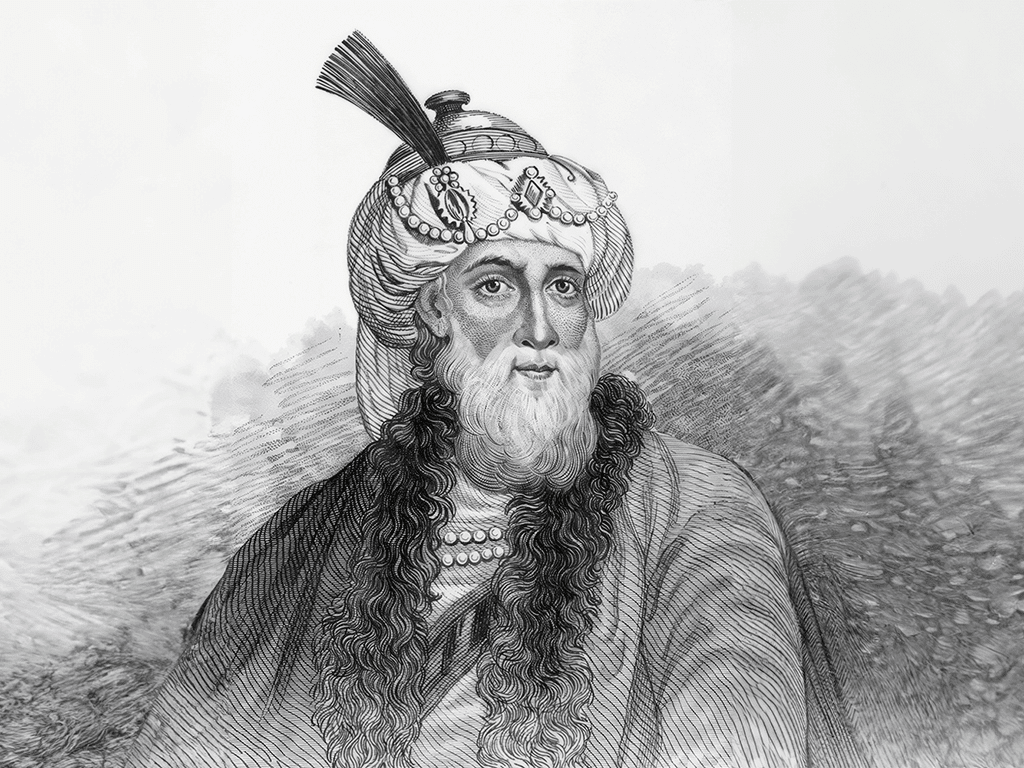
We don’t know what Josephus looked like, but older English versions of his works sometimes included a line drawing. David Padfield, at Padfield.com, had one of those old drawings enhanced by AI and shared the drawing with me. I suggest you visit Padfield.com for more good material.
Josephus, the Jewish historian, who was contemporaneous with these events, and an eye witness of many of them, tells us much about the movement of the Romans as they came near the city of Jerusalem. Vespasian had been leading the plans to attack Jerusalem. When he learned of the death of Emperor Nero (A.D. 68) he returned to Rome to become emperor. His son Titus became the leader of the effort. Josephus, a native of Yodfat, now in north western Israel, was an eye witness to many of the events of the Roman invasion of the country. Not only did he write the History of the Jews, but also the Wars of the Jews. He provides specific information about the movement of the Romans as they approached the city of Jerusalem. As the army began to be seen in plain view, Josephus records the events.
JOE Wars of the Jews 2:528: He then pitched his camp upon the elevation called Scopus [or watch tower], which was about a mile from the city; yet did not he assault them in three days’ time, out of expectation that those within might perhaps yield a little; and in the meantime he sent out a great many of his soldiers into neighboring villages, to seize their grain; and on the fourth day, which was the thirtieth of the month Hyperbereteus, [Tisri], when he had put his army in array, he brought it into the city. (Wars 2:528) This might be a reference to the temple which was in the city.
Accordingly, this place, on the north quarter of the city, and joining thereto, was a plain, and very properly named Scopus [the prospect]; 68 and was no more than a mile from the city And here it was that Titus ordered a camp to be fortified for two legions that were to be together; but ordered another camp to be fortified, six hundred yards behind them, for the fifth legion; for he thought that, by marching in the night, they might be tired, and might deserve to be covered from the enemy, and with less fear might fortify themselves; (Wars 5:67-68)
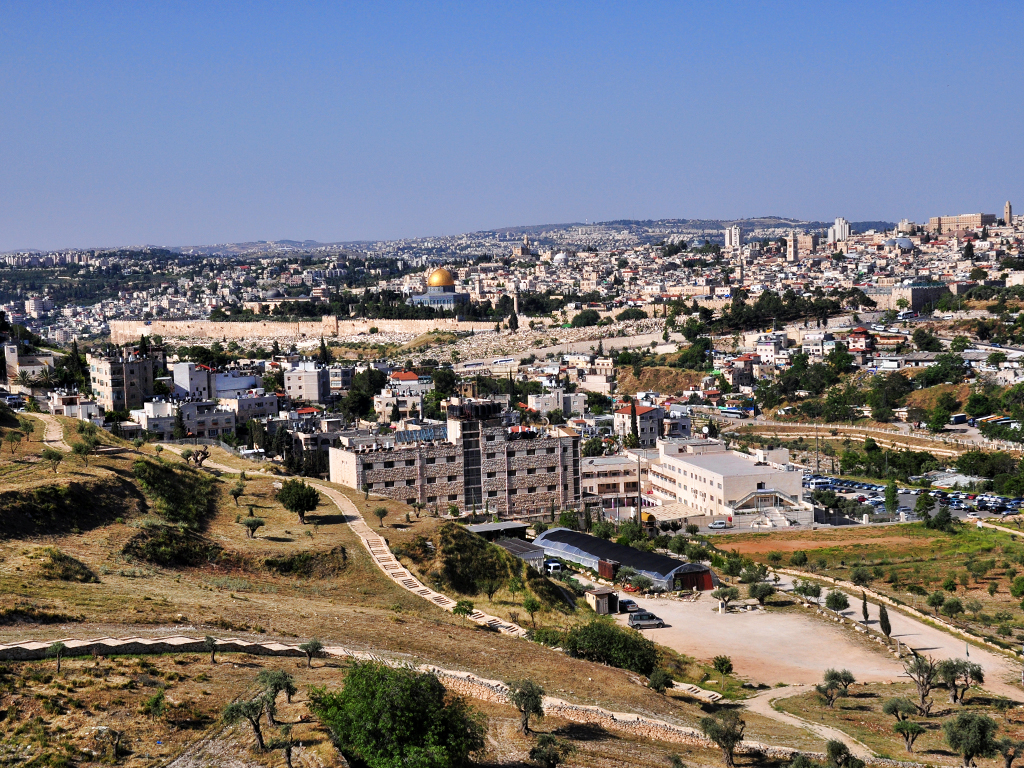
The photo below shows a view of the Old City of Jerusalem made from the slope of Mount Scopus. Notice the Dome of the Rock, the gold domed building with the sun shining on it. It is located approximately where Herod’s temple was stood from its completion until the destruction in A.D. 70. If you click on the image it should enlarge to allow you to see everything better.
(c)FerrelllJenkins2013______________
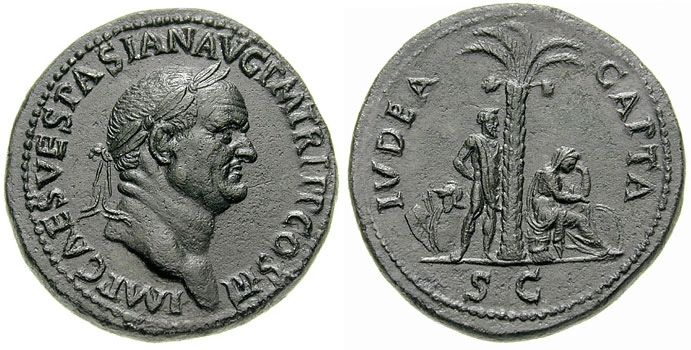
The images below show an example of the coins minted by Vespasian and Titus to commemorate the capture of Judea. The obverse [heads] shows a laureate head of image of Caesar Vespasian. The reverse[tails ] had the wording Judea Capta and shows a mourning Jewess under a palm tree. David Hendin, Guide to Biblical Coins, Fifth Edition, shows a variety of this coin minted by different emperors at various places.
Merrill C. Tenney, New Testament Times, includes a chart of the various Roman and Herodian rulers in connection with the events in Judea. Good Bible dictionaries and Encyclopedias will also provide this type of information.
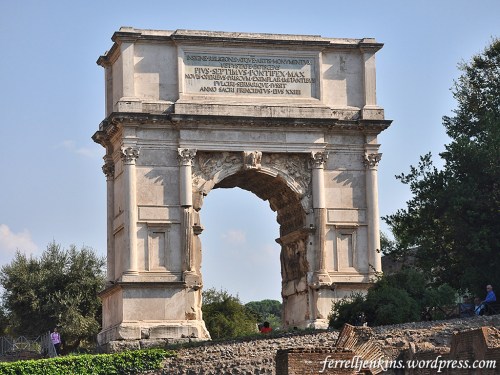
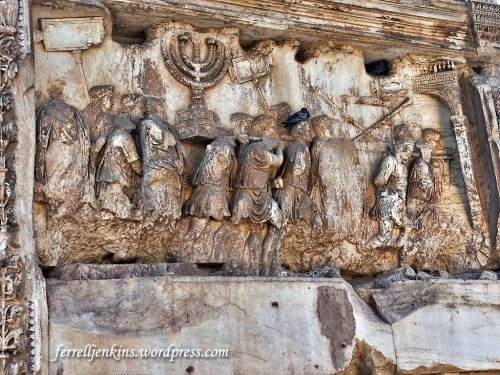
During A.D. 68 and 69 three men, Galba, Otho, and Vitellius, ruled. Vespasian was Emperor of Rome A.D. 69-79. Titus was emperor 79-81. The Arch of Titus on one end of the Roman forum commemorates this event. Carvings on the inside of the arch show the Roman soldiers taking away the ark of the covenant and the table of showbread from the Jerusalem temple.
The Arch of Titus in the Roman Forum commemorates the Roman victory of the Jews in A.D. 70. Photo by Ferrell Jenkins.Arch of Titus relief showing Roman soldiers carrying the items taken from the Temple in Jerusalem in A.D. 70. Photo by Ferrell Jenkins.
Jews now celebrate a holiday called Tisha B’Av [The 9th of the Jewish month of Av] (roughly our August). Tjhis day commemorates the destruction of the first temple which was built by Solomon was destroyed by the Babylonians in 586 B.C., and the destruction of the temple built by Herod the Great was destroyed by the Romans on Tisha B’av in A.D. 70.
Jerusalem was destroyed in A.D. 70, or as the Jews would say 70 C.E..
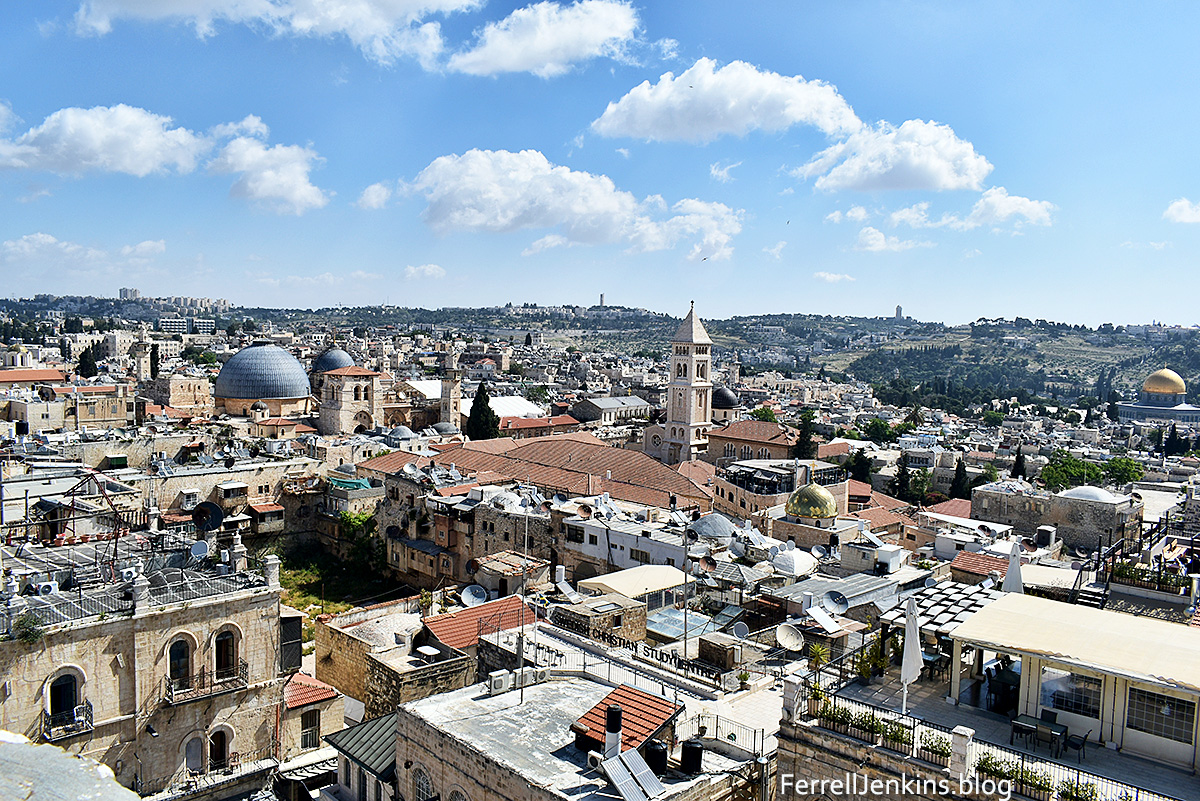
The photo below was made from the roof of the Tower of David at Jaffa (Joppa) Gate. It gives one a nice view of some of the highlights of the Old City of Jerusalem and, left to right, Mount Scopus, and the northern portion of the Mount of Olivet.
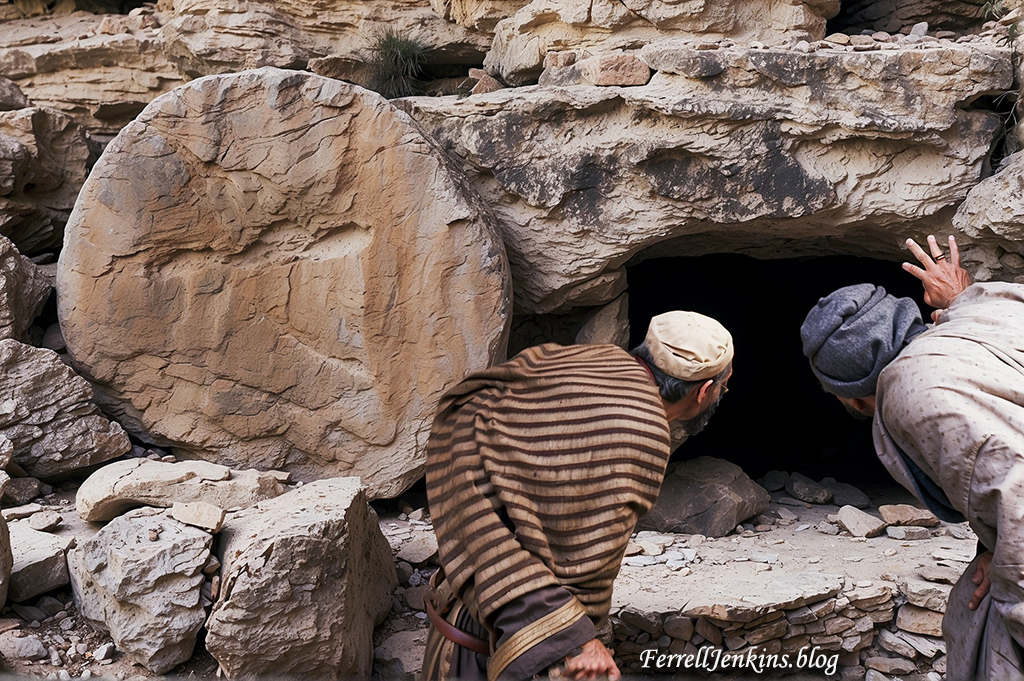
A Roman period tomb cut from stone, using a rolling stone to cover the opening.
The following text is taken from the Gospel of John, chapter 20.
Now on the first day of the week Mary Magdalene came to the tomb early, while it was still dark, and saw that the stone had been taken away from the tomb. So she ran and went to Simon Peter and the other disciple, the one whom Jesus loved, and said to them, “They have taken the Lord out of the tomb, and we do not know where they have laid him.” So Peter went out with the other disciple, and they were going toward the tomb. Both of them were running together, but the other disciple outran Peter and reached the tomb first. And stooping to look in, he saw the linen cloths lying there, but he did not go in. Then Simon Peter came, following him, and went into the tomb. He saw the linen cloths lying there and the face cloth, which had been on Jesus’ head, not lying with the linen cloths but folded up in a place by itself. Then the other disciple, who had reached the tomb first, also went in, and he saw and believed; for as ye they did not understand the Scripture, that he must rise from the dead. Then the disciples went back to their homes. (Jn. 20:1-10 ESV)
Imagine the emotions of the disciples of Jesus, both women and men, when they were told that the tomb that had been so carefully secured on Friday was found empty on the first day of the week, with only the grave clothes and the cloth that covered the head still in the tomb.
[The second photo showing the disciples of Jesus at the open tomb was made in Leonardo AI. David Padfield assisted me in this project.
My booklet on The Middle East Conflict and the Bible has been available off and on since 1991. I have presented numerous short series of lessons on this topic in past years.
Today Florida College Press has an attractive edition for sale in the bookstore at 119 N. Glen Arven Ave., Temple Terrace, FL 33617. This is just in time for those attending the Florida College lectures next week to pick up a copy. I remind you that the content of this booklet is written from the amillennial perspective. Specifically I have explained it as the Philosophy of History, Preterist, or Historical Background viewpoint.
We had hoped to have The Old Testament in the Book of Revelation available in a new format but still lack a little having that completed. We hope to have it ready soon.
My Studies in the Book of Revelation is available and I suggest it as the book one should choose if he/she wants to gain an understanding of the overall content of the great book of Revelation.
The Middle East Conflict and the Bible discusses the following questions.
Is the return of the Jews to Palestine in the twentieth century a fulfillment of Biblical prophecy?
Why do the Arabs and Israel have so much conflict
Was Saddam Hussein the successor to Nebuchadnezzar, king of Babylon? Will Babylon be rebuilt?
What does Biblical prophecy say about Israel, Babylon and Nineveh?
Does God use Nations to serve His purpose?
When and how will the nations turn their swords into plowshares?
It is difficult to locate these books on the Florida College Bookstore website, but you can ask for them by calling the bookstore at the college switchboard and asking for the Bookstore: 813.988.5131.
Review Comments:
Three persons received a preview copy of the book. Here are their comments.
Don Truex: “As has been the case for decades, Ferrell Jenkins sets the standard for Biblical, practical and applicational knowledge of the events in the Middle East and their relevance to Christians. His firsthand knowledge of the Text, the land and the people combine to bring essential insight into the all-too-common turmoil in this history filled region.”
Leon Mauldin: “Today I read my advance copy of The Middle East Conflict and the Bible. I know of nothing else like it, that packs so much in one small book. This is truly a great resource!”
Brooks Cochran: “The Middle East Conflict and the Bible” is an excellent resource to use in a study of current events in the Middle East as they relate to Bible Prophecy and the Nation of Israel. This updated edition includes a chapter on “Understanding Islam The Moslem Religion”.”
Paulette and I enjoyed two weeks of travel in Israel the first part of May. It was her first opportunity to see and learn the land. I led tours to the Bible world almost annually from 1967 to 2016 and have made personal study trips to Israel or some other part of the Bible world with a friend every year except the first year of the recent pandemic. I wanted to show Paulette places that she had read about many times in her Bible study. Though she believes the Biblical accounts about the activities of Jesus and his disciples, as well as the judges, prophets and other writers of the Bible, I watched as the Biblical text came alive to her in a new way. We did not see as much as I had hoped but we were able to work out from Jerusalem and Tiberias on the Sea of Galilee and also enjoy a day along the Dead Sea.
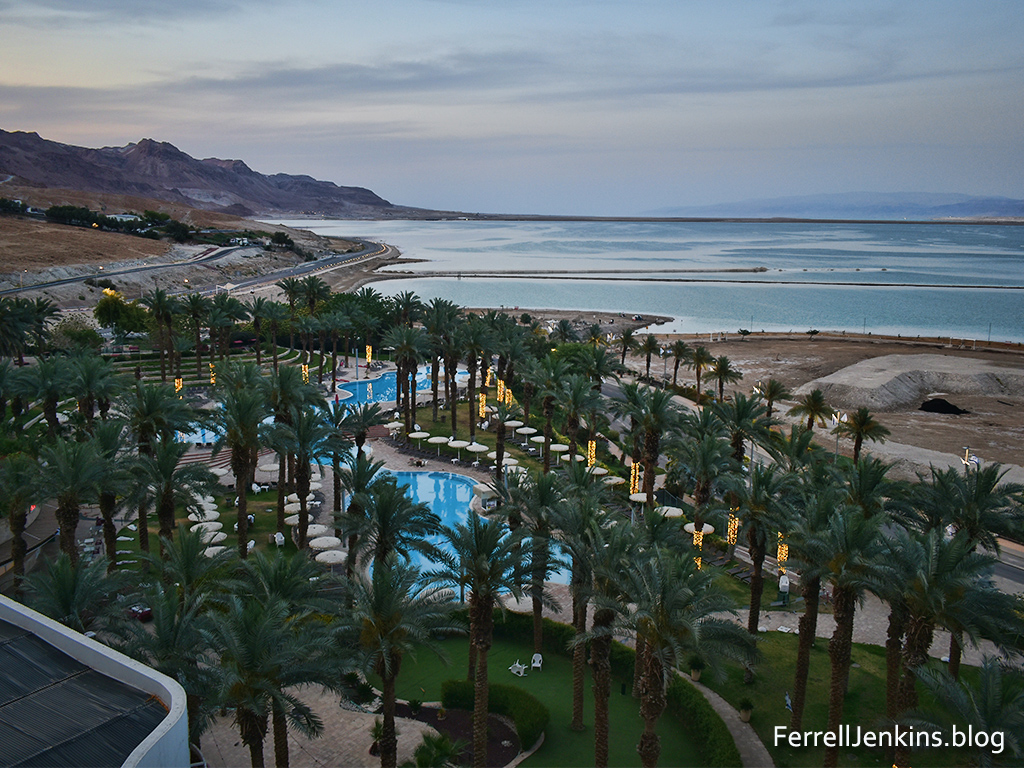
We drove the full length of the Dead Sea, south and north. Here are photos of some scenes that impressed us. The first one is a late afternoon view of the recreation area of the Dead Sea Resort and Spa at Ein Bokek at the southern end of the Dead Sea. The view is to the northeast. The water in this area is pumped from the deeper north. Otherwise it would be dry.
Biblical references refer to the Dead Sea as the Sea of the Arabah and the Salt Sea (Deuteronomy 3:17; Joshua 3:16). The Greeks called it Lake Asphaltitis (Josephus, Jewish War IV.476-450).
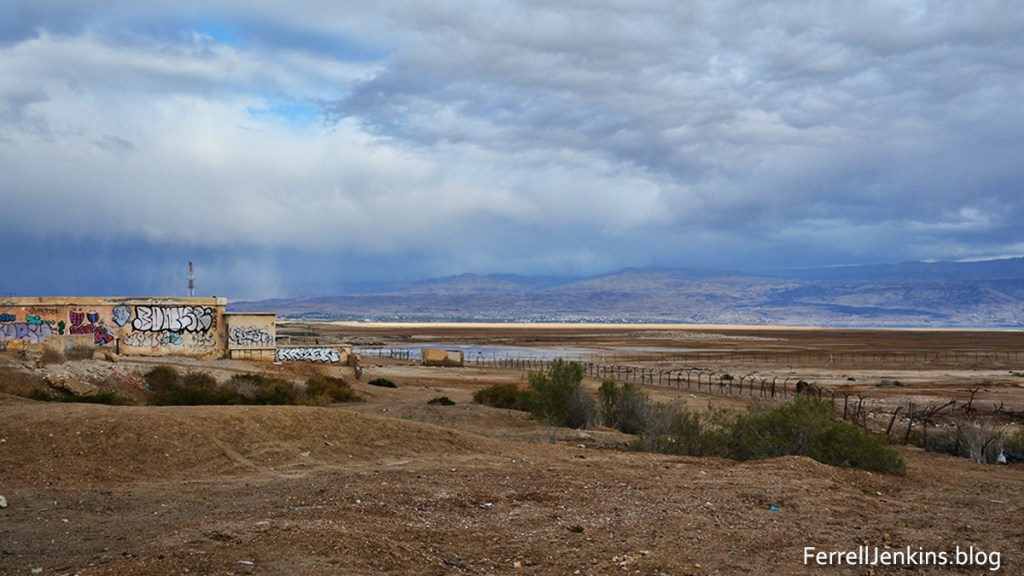
The next photo shows ruins of an old hotel or a building used by the military in the 1967 war. A hotel was there in 1967, my first trip. It was only a short walk to the water at that time, but today one can hardly see the water. We are aware that the level of the Dead Sea has continued to recede at about a meter (three feet) each year as less water flows into the Dead Sea from the north. Most of the water is pumped into reservoirs to provide water for the residents of Israel.
When I took my first class dealing with Bible geography in 1953 I learned that the Dead Sea was 1290 feet below sea level. Fairly recent reports give the surface level of the water as 1410 ft.
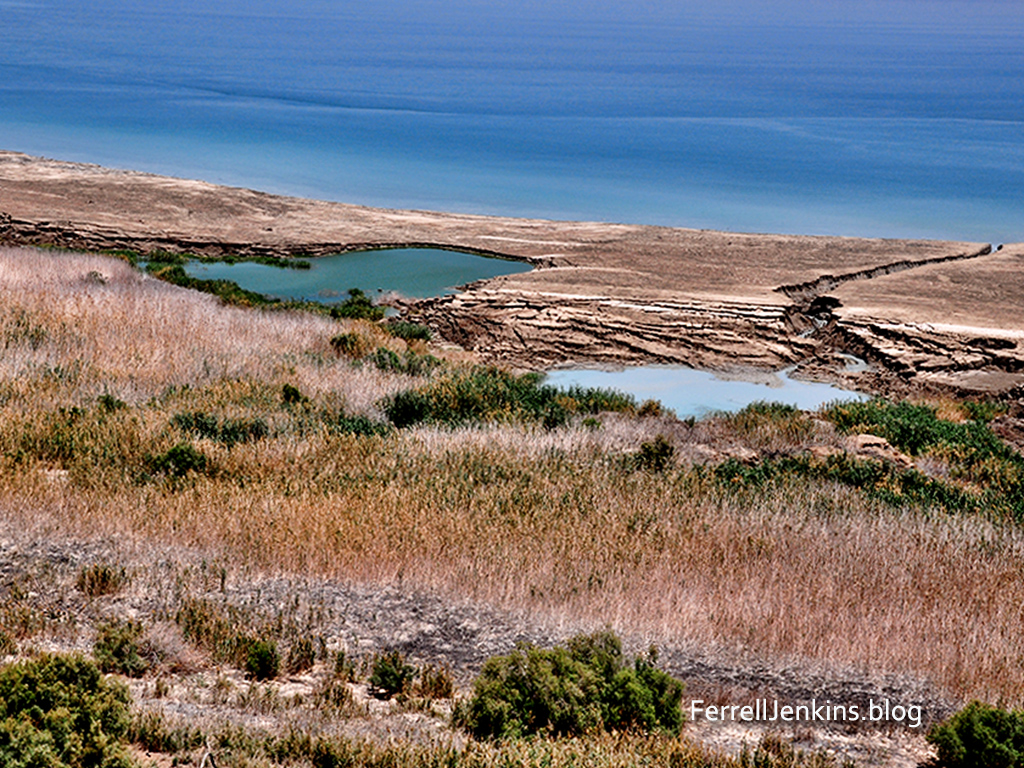
This photo below shows some of the sink holes that have recently developed on the west side of the Dead Sea near the northern end. A few years ago the water came almost to the highway.
We have written about the Dead Sea on several occasions. As always, we suggest that you use the Search box to seek information and photos for this and other Biblical places and topics.
The New Testament site of Antipatris was known as Aphek in Old Testament times. It is the place where the Philistines were encamped when they took the ark of the covenant from the Israelites who had camped at nearby Ebenezer (1 Samuel 4:1).
Antipatris was built by Herod the Great and named in honor of his father Antipater.
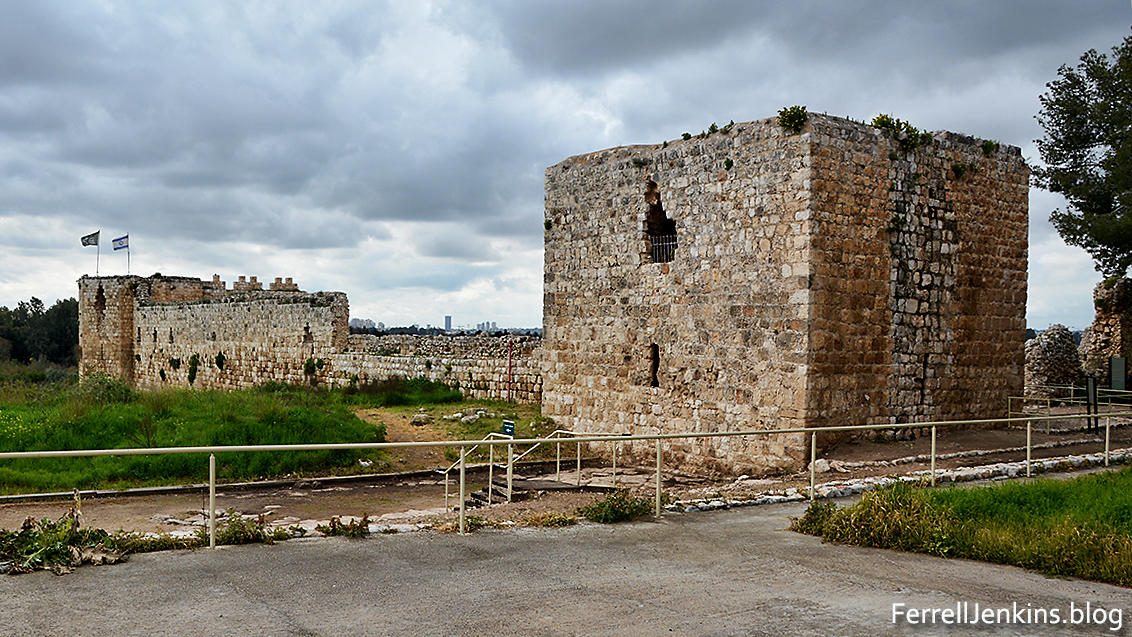
Because Aphek/Antipatris sat on a major south-north and west-east routes, it was dominated by many nations. The dominant feature of the site today is the Turkish fort. Inside are the excavated ruins of buildings from Canaanite to Herodian/Roman times.
The 16th century Turkish fortress at Aphek-Antipatris, now an Israeli National Park.
Aphek/Antipatris is known by the modern name Ras el-Ain because it is located at the source of the Yarkon River which flows a few miles into the Mediterranean.
Ras al ein, the source of the Yarkon River at Aphek-Antipatris.
When a plot was raised against Paul while he was in the Fortress of Antonia in Jerusalem, he was sent by night to Antipatris. The next day he was escorted to Caesarea Maritima. Luke records the event,
So the soldiers, according to their instructions, took Paul and brought him by night to Antipatris. And on the next day they returned to the barracks, letting the horsemen go on with him. When they had come to Caesarea and delivered the letter to the governor, they presented Paul also before him. (Acts 23:31-33 ESV)
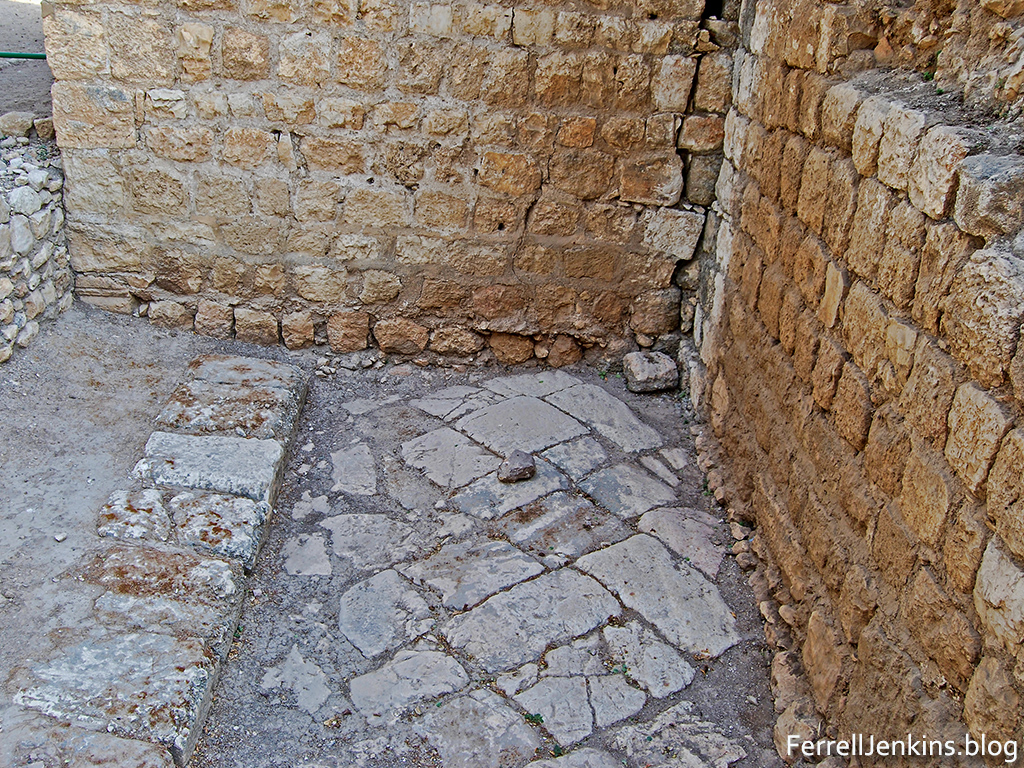
A small portion of the Roman cardo, the main East-West road has been uncovered.
From Jerusalem to Antipatris is about 30 miles. From there to Caesarea Maritima is an additional 27 miles.
Paul would remain in custody at Caesarea Maritima for two years. We probably realize that the wheels of power often turn slowly.
From the time I was a child I recall the song “Bringing in the Sheaves” by Knowles Shaw. I see it was written in 1874, already an old song when I first sang it. I really miss the old songs. Some song leaders seem to forget that it is the repetition of songs that allows the children to learn them – just like they recall all of the TV jingles. Here are the words, now in public domain.
Sowing in the morning, sowing seeds of kindness,
Sowing in the noontide and the dewy eve;
Waiting for the harvest, and the time of reaping,
We shall come rejoicing, bringing in the sheaves.
Refrain:
Bringing in the sheaves, bringing in the sheaves,
We shall come rejoicing, bringing in the sheaves;
Bringing in the sheaves, bringing in the sheaves,
We shall come rejoicing, bringing in the sheaves.
Sowing in the sunshine, sowing in the shadows,
Fearing neither clouds nor winter’s chilling breeze;
By and by the harvest, and the labor ended,
We shall come rejoicing, bringing in the sheaves.
Going forth with weeping, sowing for the Master,
Though the loss sustained our spirit often grieves;
When our weeping’s over, He will bid us welcome,
We shall come rejoicing, bringing in the sheaves.
The meaning is clear. We continue to do kind deeds when times are good and when they are bad. Eventually “we shall come rejoicing, bringing in the sheaves.”
What are sheaves, and what is the basis of this encouraging song?
Perhaps the author recalled young Joseph’s dream of binding sheaves in the field when his sheaf stood upright and the sheaves of the brothers gathered around it and bowed down (Genesis 37:7).
Or, maybe it was the experience of Ruth gathering the left over grain among the sheaves in the field of Boaz at Bethlehem (Ruth 2:7, 15).
It seems that Shaw knew the words of Psalm 126:6.
He who goes out weeping, bearing the seed for sowing, shall come home with shouts of joy, bringing his sheaves with him. (Psalm 126:6 ESV)
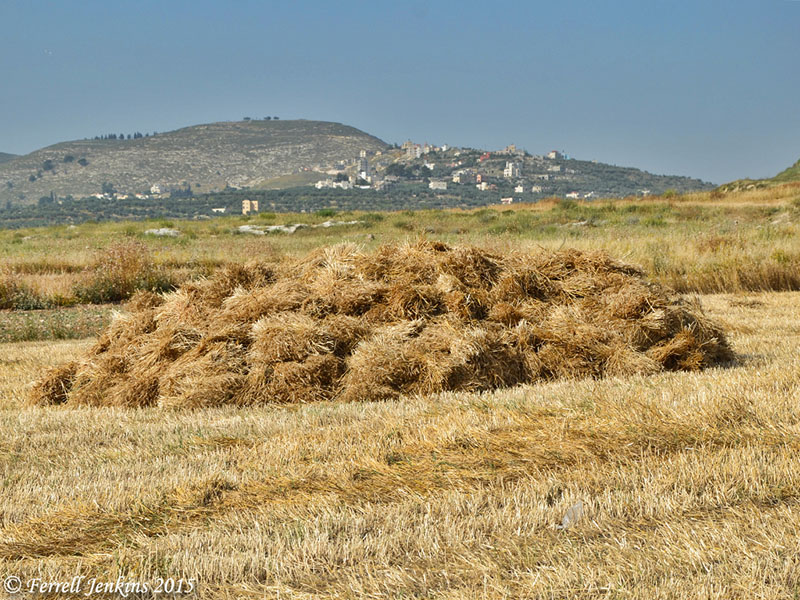
Toward the end of May last year, in the vicinity of Samaria, we saw sheaves in the field ready to be brought in for storage and use for the remainder of the year.
Sheaves in the field near ancient Samaria. Photo by Ferrell Jenkins.
If you click on this photo and look carefully at the larger image you will see that the sheaves have been bound to hold them together.
Sheaves bound in the field, ready to be taken from the fields. Photo by Ferrell Jenkins.
I fear that many of our folks today just dismiss the older songs that have themes they don’t readily understand. If we use this as an excuse, it is a reflection on our knowledge of the Bible. Perhaps its time to learn.
Bertha Spafford Vester explains how the early American Colony residents of Jerusalem made a living by engaging in various projects from weaving cloth to growing wheat. She recounts an interesting story about cutting grain and binding sheaves.
Our Swedish and American farmers had tilled these bits of ground so well that there was evidence of excellent crops. Some Orthodox Jews came to inspect the wheat and offered us a higher than usual price for it to make matzoth (unleavened bread) for their Feast of the Passover on condition that we harvested it under their supervision. We agreed.
We had no machinery; it was harvested by hand. One stipulation they made was that we should not begin work until the sun had risen and dried any moisture from dew fallen during the night. After breakfast we all went out to work in the field, our Jewish overseers keeping watch. As our custom was when working, washing dishes, or over the washtub, or at any other task, we sang hymns. So now we started in the harvest field. Singing helped the work, which went with a swing. But we were not allowed to sing by these Orthodox Jews. Peradventure a bit of moisture might fall from our mouths and cause fermentation. It would no longer be unleavened. So we gathered the sheaves silently. (Our Jerusalem, 190-191)
Last evening at sundown the Jews began to celebrate their modern interpretation of Pentecost (Shavu’ot). Christians know this from the Old Testament scriptures as the feast of weeks (Leviticus 23:15; Deuteronomy 16:9). Last evening we saw many Jews heading for the Western Wall through the Damascus Gate when we were there. The Orthodox Jews were the easiest to detect because of their distinctive dress.
Pentecost comes 50 days after Passover. It follows a sabbath and amounts to a two-day holiday here in Jerusalem. Those who are not religious may be seen at recreational places enjoying the time off as many persons in America do on any holiday. Some of the religious take the family to a hotel and allow non-Jews to serve them the food they wish. The hotel has a Shabbat elevator. You only make the mistake of getting on it once. It requires no work (= pushing the button for your floor), but it takes a long time to get where you are going. The elevator is programmed to stop at each floor. I don’t recall seeing anyone using the one in our hotel.
Back to more important issues. The church had its beginning with the preaching of the gospel in its fullness on the first Pentecost after the resurrection of Christ (Acts 2).
Model of Herod’s Temple now displayed on the grounds of the Israel Museum. It was in this large area where the gospel of Christ was first preached in its fullness by Peter and the other Apostles on the first Pentecost after the resurrection of Christ. Photo by Ferrell Jenkins.
The Apostle Paul, through his teaching and example, taught the early Christians to take their collection and to observe the Lord’s Supper on the first day of the week (1 Corinthians 16:1-2; Acts 20:7). On the return from his third preaching journey he hurried to be at Jerusalem for Pentecost.
For Paul had decided to sail past Ephesus, so that he might not have to spend time in Asia, for he was hastening to be at Jerusalem, if possible, on the day of Pentecost. (Acts 20:16 ESV)
I did not specifically pick the time of Pentecost to be in Jerusalem; it just happened to coincide with my travel schedule. It would be wonderful to see the gospel freely preached again in this city as it was on that first Pentecost after the death and resurrection of Jesus nearly two thousand years ago.
After dinner this evening we went to Damascus Gate to try our hand at some night shots of the Gate. Here is one of my resultant photos.
Damascus Gate at Night. Photo by Ferrell Jenkins.
Damascus Gate is the main one of three gates on the north side of the Old City wall in Jerusalem. The gate we see was built over a gate from the early second century when the city was rebuilt by the Romans, and likely over the earlier gate from New Testament times.
The gate is called Damascus because this formerly was the way one would depart Jerusalem to head for the city of Damascus. Paul may have used an earlier gate when he made his way to Damascus to locate and bind followers of Christ and bring them to Jerusalem for trial (Acts 9, 22, 26).
The weather was pleasantly cool this evening. Earlier in the week in Tiberias we found the 104° to be uncomfortable.







 Ferrell's Travel Blog

You must be logged in to post a comment.