Tag Archives: Bible Study

Books Available at FC Bookstore

With former students and other acquaintances attending the Florida College Homecoming and Bible lectureship this week, I thought it would be wise to make a list of my available books that you will be able to purchase from the Florida College Bookstore. while you are on campus.

Ask one of the workers where the books are located when you visit the store.

  • Better Things (Workbook on Hebrews)
  • Studies in the Book of Revelation
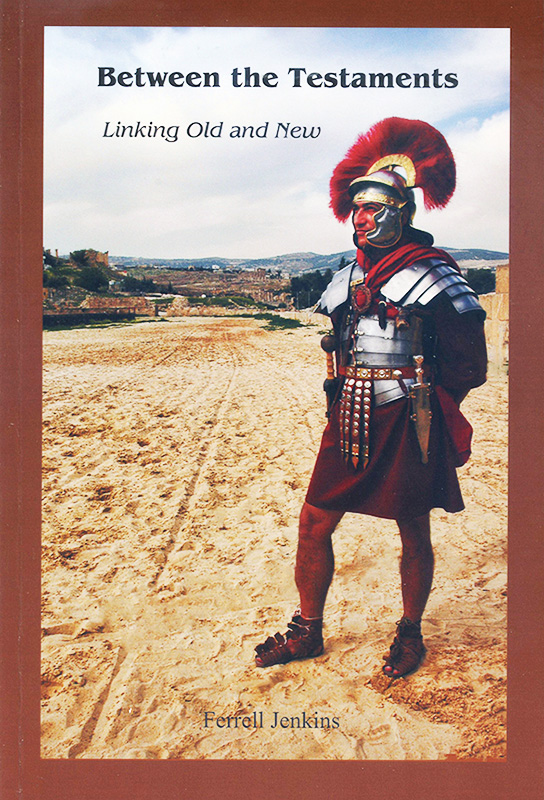
  • Between the Testaments (Linking Old and New)
  • The Early Church
  • The Finger of God (A Study of the Holy Spirit)
  • The Middle East Conflict and the Bible
  • Biblical Authority
  • God’s Eternal Purpose (Workbook on Ephesians)
  • The Old Testament in the Book of Revelation (new edition in preparation. Follow FerrellJenkins.blog for the announcement and for photographs you may use in your preaching and teaching.

Many of these books make excellent class studies.

The LORD Rules in the Kingdoms of Men

Several years ago we posted an index of articles on ancient Babylon here: https://ferrelljenkins.blog/2014/11/04/babylon-index-of-articles/

Recently we posted an article showing that the arrogance of rulers is often responsible for bringing about the fall of the nation they should serve.

The Old Testament Scriptures (the Hebrew Bible) is filled with illustrations of the rule of the LORD over the kingdoms of men. The Babylonian king Nebuchadnezzar is a prime example of the arrogant ruler. He is sometimes referred to as a megalomaniac. He ordered that all the Babylonian citizens worship him at his golden image on command. (Daniel 3:7).

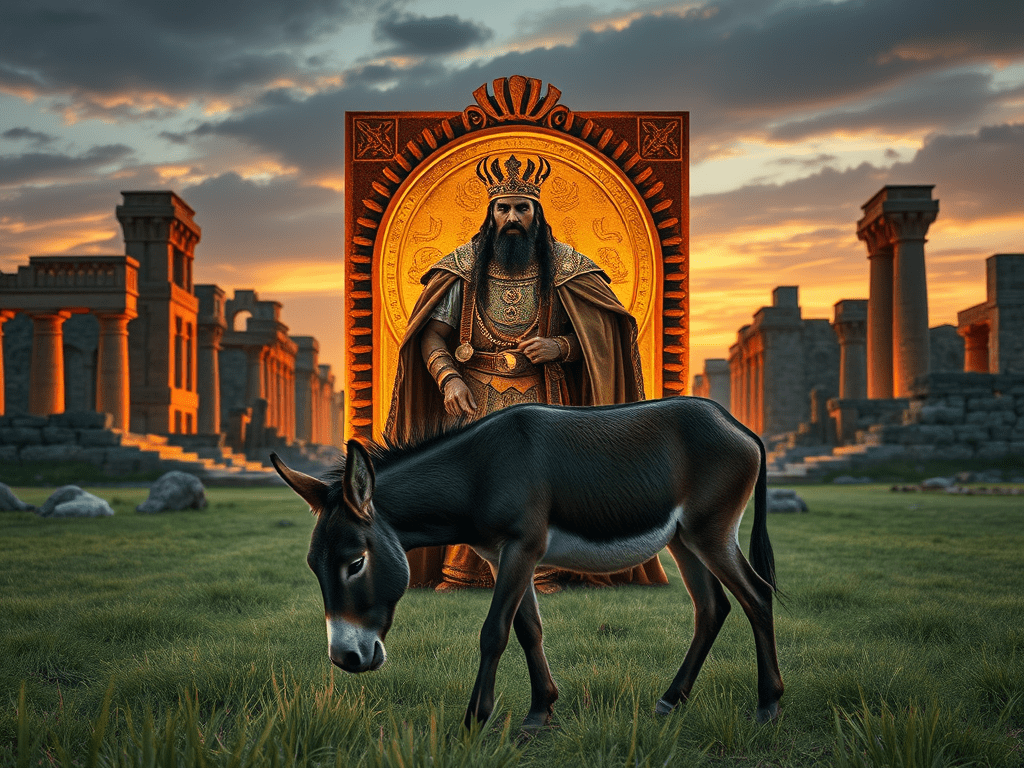
This AI generated art imagines how the image of Nebuchadnezzar might have looked, and how God punished the ruler.

The Golden Image of Nebuchadnezzar

The golden image erected by King Nebuchadnezzar is a significant event recorded in the Book of Daniel in the Old Testament. This image symbolizes the king’s arrogance and the expectation of absolute loyalty from his subjects.

Historical Context

After Nebuchadnezzar’s dream of a great statue representing different kingdoms (Daniel 2), he became consumed with pride, leading him to construct a colossal golden statue, likely representing himself. This act demonstrated not just his authority but also his desire for worship.

The Decree

In Daniel 3:1-6, Nebuchadnezzar issued a decree that all peoples of the empire must bow down and worship the golden image whenever they heard the sound of musical instruments. Those who refused would face severe punishment, including being thrown into a fiery furnace.

The Consequences of Defiance

Three young men—Shadrach, Meshach, and Abednego—refused to comply with the king’s order, boldly declaring that they would not worship the image or any other god but the LORD. Their defiance led to their arrest and punishment.

Divine Intervention

When thrown into the fiery furnace, they were miraculously unharmed, and a fourth figure, described as looking like “a son of the gods,” was seen walking with them in the flames (Daniel 3:25). This divine intervention led Nebuchadnezzar to acknowledge the power of their God, which reinforces the theme of God’s sovereignty over earthly kingdoms.

Conclusion

The story of the golden image of Nebuchadnezzar serves as a powerful reminder of the consequences of pride.

God punished Nebuchadnezzar by causing him to have the mind of a beast and eat of the grass of the field.

In this post I wish to show a series of Scriptures from the prophet Daniel who, as a young man, spent years in Babylon being trained to become one of those who could be a ruler in the Neo-Babylonian Empire. In each of these five Scriptures we are informed that the LORD rules in the kingdoms of men and sets up and takes down rulers as He wishes.

He changes times and seasons; he removes kings and sets up kings; he gives wisdom to the wise and knowledge to those who have understanding” (Dan. 2:21 ESV)

Nebuchadnezzar was driven from among the children of mankind, and his mind was made like that of a beast, and his dwelling was with the wild donkeys. He was fed grass like an ox, and his body was wet with the dew of heaven, until he knew that the Most High God rules the kingdom of mankind and sets over it whom he will. (Daniel 5:21 ESV)

The sentence is by the decree of the watchers, the decision by the word of the holy ones, to the end that the living may know that the Most High rules the kingdom of men and gives it to whom he will and sets over it the lowliest of men.’ (Daniel 4:17 ESV)

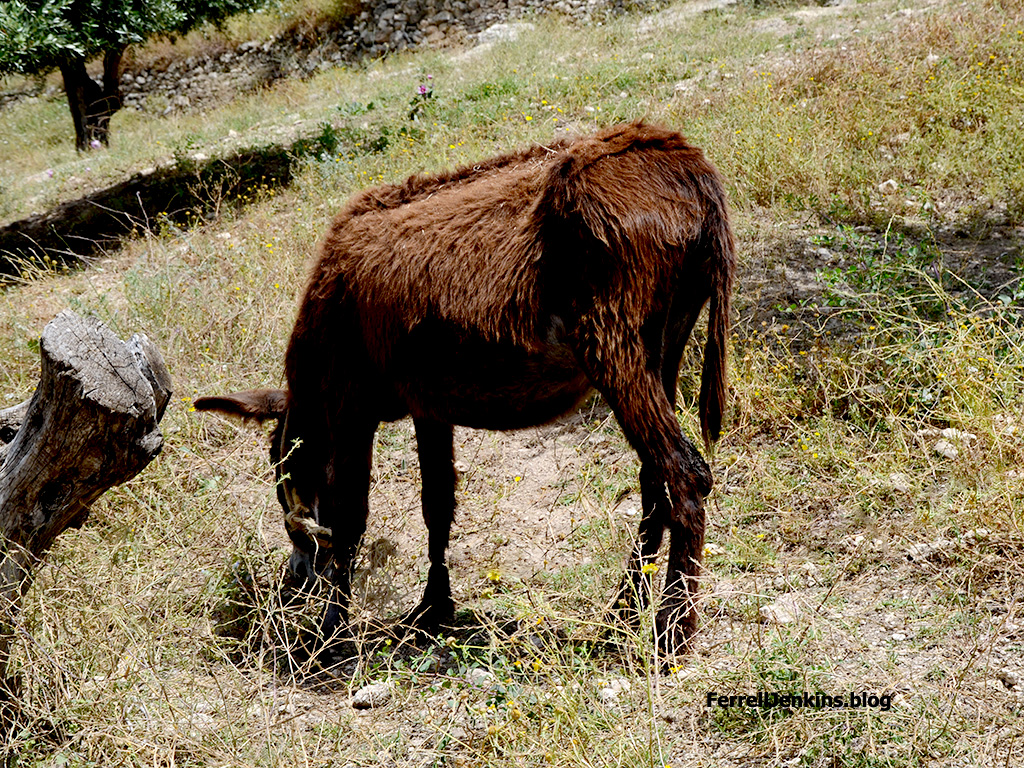
A donkey eating grass at the Nazareth, Israel, Village.
Photo by Ferrell Jenkins.

“…that you shall be driven from among men, and your dwelling shall be with the beasts of the field. You shall be made to eat grass like an ox, and you shall be wet with the dew of heaven, and seven periods of time shall pass over you, till you know that the Most High rules the kingdom of men and gives it to whom he will.” (Daniel 4:25 ESV)

In the New Testament the apostle Paul has these words for Christians.

“Let every person be subject to the governing authorities. For there is no authority except from God, and those that exist have been instituted by God.
“Therefore whoever resists the authorities resists what God has appointed, and those who resist will incur judgment.
“For rulers are not a terror to good conduct, but to bad. Would you have no fear of the one who is in authority? Then do what is good, and you will receive his approval,
4 for he is God’s servant for your good. But if you do wrong, be afraid, for he does not bear the sword in vain. For he is the servant of God, an avenger who carries out God’s wrath on the wrongdoer.
“Therefore one must be in subjection, not only to avoid God’s wrath but also for the sake of conscience.
“For because of this you also pay taxes, for the authorities are ministers of God, attending to this very thing.
“Pay to all what is owed to them: taxes to whom taxes are owed, revenue to whom revenue is owed, respect to whom respect is owed, honor to whom honor is owed.”(Romans13:1-7 ESV)

Bringing in the Sheaves

The two main grain crops in Bible times were wheat and barley. Barley tended to be used mostly by the poor and for the feeding of the animals. It was planted and ripened about a month earlier than wheat.

Here is a list of the Biblical references to cutting the grain, binding it into sheaves so they could be brought into the barns.

The Psalmist said ” He who goes out weeping, bearing the seed for sowing, shall come home with shouts of joy, bringing his sheaves with him.” (Psalm126:6 ESV). And again, the Psalmist says, with which the reaper does not fill his hand nor the binder of sheaves his arms (Psalm 129:7 ESV)

Sheeves of grain bound to be gathered into the barn near ancient Samaria. The tell can be seen on top of the hill to the left of the photo. Photo by Ferrell Jenkins.
Grain that has been cut and bound so that it can be brought into the barn. The ancient hill of Samaria can be seen in the distance.

The Lord had many people at Corinth

Corinth is located about two miles south of the narrow isthmus which forms the land bridge, and controlled access, between the main land mass of Greece and the Peloponnesus. Corinth seemed to have flourished from the 8th to the 5th centuries B.C., and there are signs of habitation much earlier. In 146 B.C. the Greek history of Corinth was terminated when the Roman consul Mummius destroyed it. All that remains today of the old Greek city are the seven columns of the Temple of Apollo. Julius Caesar rebuilt Corinth in about 46 /4 4 B.C. as a Roman colony and settled many Roman soldiers there. Corinth became the capital of the Roman province of Achaia and had direct communications with Rome. There were enough Jews in the city to account for a synagogue (Acts 18). Perhaps the two most noticeable sites at Corinth today are the ruins of the temple of Apollo and the Acrocorinth (the mountain or high point of Corinth). The temple of Apollo was built in the 6th century B.C., but only seven of the original 38 Doric monolith columns are standing. There were numerous other pagan temples in the city including one dedicated to Asklepios, the god of healing.

Ruins of the Temple of Apollo at Corinth, a city where Apostle Paul preached (Acts 18).
The ruins of the Temple of Apollo at Corinth with the Acro Corinth in the background.

The judgment-seat (Greek, bema) was a speaker’s platform on which the judge sat or stood for the trial of one against whom an accusation had been made. In the excavations a t Corinth which have been conducted since 1896 the bema has been exposed in the agora. It is likely that Paul stood before Gallio at this place (Acts 1 8:12). The bema is dated to A.D. 44, but could be as early as the time of Augustus. The gospel was successful in this pagan city. Paul preached “Christ and Him crucified” (1 Cor. 2:2; 15:1-4). Paul was fearful but the Lord told him, “Do not be afraid any longer, but go on speaking and do not be silent; for I am with you, and no man will attack you in order to harm you, for I have many people in this ci ty” (Acts 18:9-10 ). Paul remained in Corinth for a year and six months.

Erastus inscription at Corinth. Photo by Ferrell Jenkins.
A portion of the Erastus inscription at Corinth.

Inscribed in a limestone pavement near the theater at Corinth is a phrase which reads in Latin: ERASTVS PRO AEDILITATE S P STRAVIT. The translation goes something like this: Erastus , in return for the aedileship, laid the pavement at his own expense. It is possible, but not certain, that this Erastus was the friend of Paul (Rom. 16:2-3; 2 Tim 4:20). If so, then Erastus may have been one of the few (contrast, not many) of the socially elite at Corinth who accepted the gospel (1 Cor 1:26).

The Lord had many people at Corinth

Israel’s Wilderness Wandering in the Gospels

In the gospels one may find several references or allusions to events of the wilderness wandering. This indicates the significance of the event and suggests that it should be studied carefully by Christians as well as Jews.

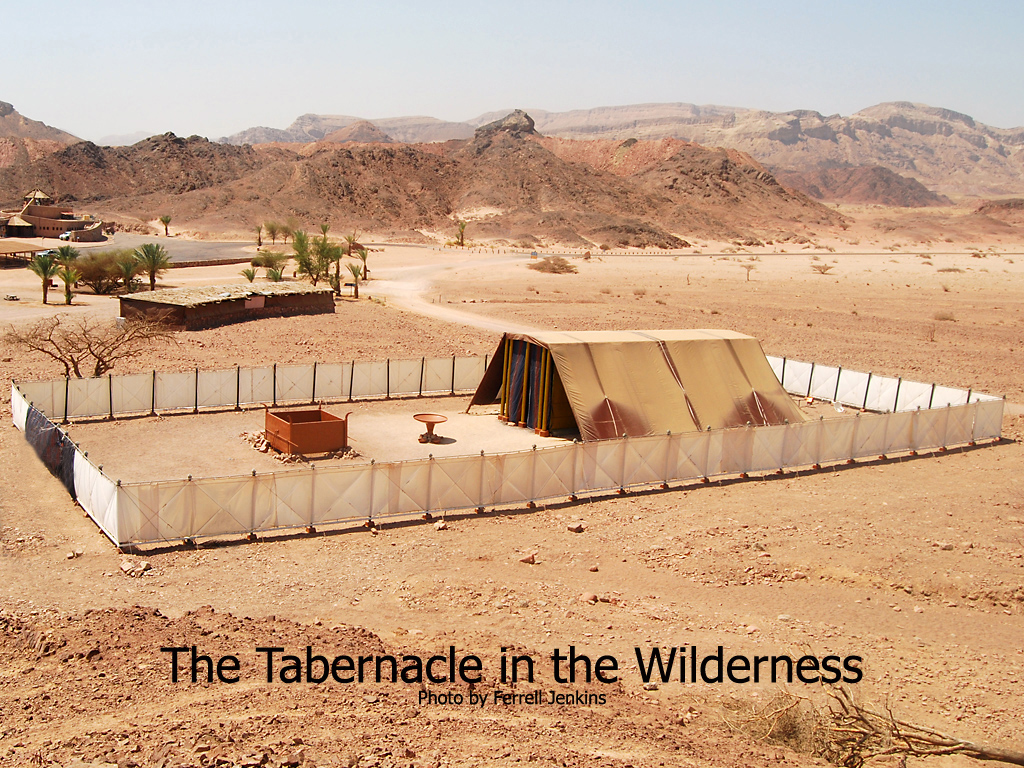
  • “The Word became flesh and dwelt [tented, tabernacled] among us…” (Jn. 1:14). The Lord made
    His presence known to the Israelites in the “tent of meeting” (the tabernacle; Ex. 29:45-46).
  • The Law was given through Moses [in the wilderness] (Jn. 1:17).
  • The serpent in the wilderness (Jn. 3:14ff.; cf. 8:28; 12:32).
  • The manna (Jn. 6:31ff.; notice the “grumbling” over the bread, vs. 41).
  • The water (Jn. 7:37-38).
  • Jesus was tempted in the wilderness by the devil. (Mt. 4:1-11).
  • Jesus fasted for 40 days and 40 nights (cf. Israel’s 40 years).
  • Jesus was tempted but did not succumb.
  • In response to the temptations of the devil Jesus quoted from the book of Deuteronomy (Mt. 4:4;
  • Dt. 8:3; Mt. 4:7; Dt. 6:16; Mt. 4:10; Dt. 6:13).
  • Stephen made several references to the events of the wilderness in his sermon (Acts
  • 7:30-44).
  • Paul calls attention to the exodus and events of the wilderness wandering (Acts 13:18; Gal.
    4:21-31).
    Notice his use of the phrase, “Remove the wicked man from among yourselves” (1 Cor. 5:13; cf.
    Dt. 13:5, the false prophet; 17:7, the one who served other gods; 17:12, one who acts presumptuously; 21:21, the rebellious son; 22:21, a girl not found a virgin).
  • Israel was baptized, ate spiritual food and drank spiritual drink, but practiced idolatry and immorality and fell (1 Cor. 10:1-13). Compare the situation at Corinth: Christians who had been baptized, ate and drank the Lord’s supper, were tempted by the idolatry (meat sacrificed to idols) and immorality of their city.


    The Writer of Hebrews speaks of events of the wilderness wandering.
  • The events at Mount Sinai (Heb. 12:18-29). The word spoken through angels (2:2; cf. Gal. 3:19).
  • The unfaithfulness of Israel in the wilderness (Heb. 3–4).

    In the book of Revelation.
  • “See…that you make all things according to the pattern which was shown you on the mountain”
    (Heb. 8:5; Ex. 25:40, the building of the tabernacle).
  • The woman who gave birth to the man child fled into the wilderness where she was nourished (Rev.
    12:6). This symbol makes the wilderness a place of protection and nourishing. The figure seems to
    be based on the experience of the nation of Israel and of Elijah (1 Kings 19:1-18) as they were cared
    for by the Lord.
  • Some of the trumpets of chapters 8-10 are drawn from the plagues of Egypt. The one like a son of
    man came on a white cloud (cf. Isa. 19:1, judgment of Egypt) and judged the enemy (Rev.
    14:14-20). The saints sing the song of Moses and the Lamb beside the sea (Rev. 15; cf. Ex. 14:31;
    15:1-19).

Back in Print: Middle East Conflict…

My booklet on The Middle East Conflict and the Bible has been available off and on since 1991. I have presented numerous short series of lessons on this topic in past years.

Today Florida College Press has an attractive edition for sale in the bookstore at 119 N. Glen Arven Ave., Temple Terrace, FL 33617. This is just in time for those attending the Florida College lectures next week to pick up a copy. I remind you that the content of this booklet is written from the amillennial perspective. Specifically I have explained it as the Philosophy of History, Preterist, or Historical Background viewpoint.

We had hoped to have The Old Testament in the Book of Revelation available in a new format but still lack a little having that completed. We hope to have it ready soon.

My Studies in the Book of Revelation is available and I suggest it as the book one should choose if he/she wants to gain an understanding of the overall content of the great book of Revelation.

The Middle East Conflict and the Bible discusses the following questions.

Is the return of the Jews to Palestine in the twentieth century a fulfillment of Biblical prophecy?

Why do the Arabs and Israel have so much conflict

Was Saddam Hussein the successor to Nebuchadnezzar, king of Babylon? Will Babylon be rebuilt?

What does Biblical prophecy say about Israel, Babylon and Nineveh?

Does God use Nations to serve His purpose?

When and how will the nations turn their swords into plowshares?

It is difficult to locate these books on the Florida College Bookstore website, but you can ask for them by calling the bookstore at the college switchboard and asking for the Bookstore: 813.988.5131.

Review Comments:

Three persons received a preview copy of the book. Here are their comments.

Don Truex: “As has been the case for decades, Ferrell Jenkins sets the standard for Biblical, practical and applicational knowledge of the events in the Middle East and their relevance to Christians. His firsthand knowledge of the Text, the land and the people combine to bring essential insight into the all-too-common turmoil in this history filled region.”

Leon Mauldin: “Today I read my advance copy of The Middle East Conflict and the Bible. I know of nothing else like it, that packs so much in one small book. This is truly a great resource!”

Brooks Cochran: “The Middle East Conflict and the Bible” is an excellent resource to use in a study of current events in the Middle East as they relate to Bible Prophecy and the Nation of Israel. This updated edition includes a chapter on “Understanding Islam The Moslem Religion”.”

Problems faced by the Seven Churches – # 5

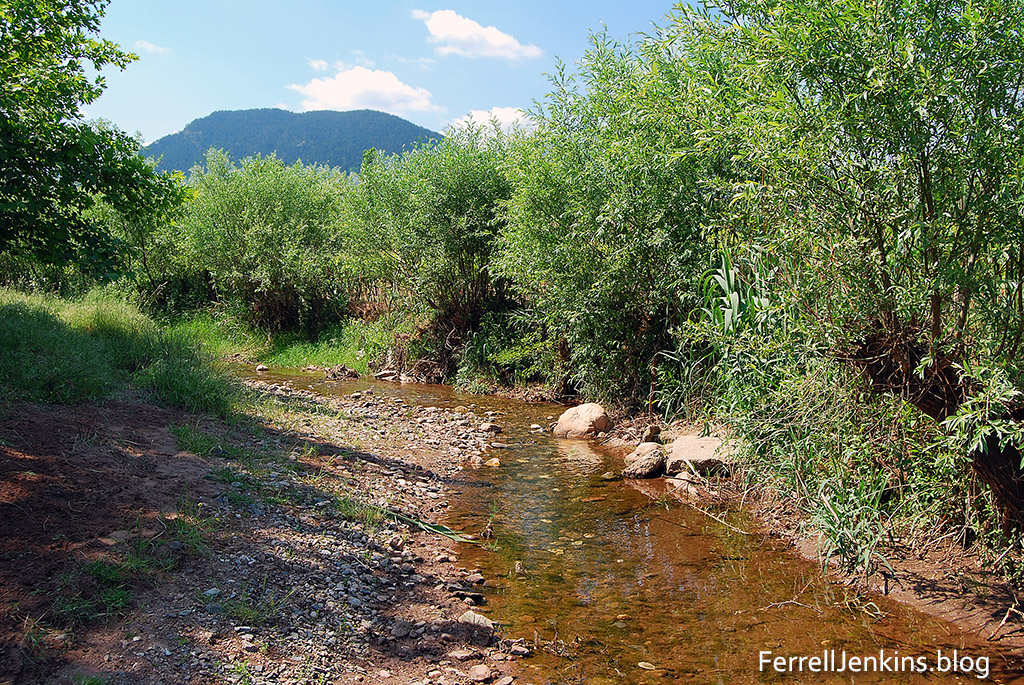
The city of Sardis is located on the banks of the Pactolus river in the Hermus Valley remained important for many centuries. The river may not look very impressive when compared to the Euphrates, the Thames or the Mississippi but its importance lies in the fact that it was panned for gold. The Lydians lived here as early as the 13th century B.C. and were the first to mint coins of gold in the 7th century B.C. The last and most famous king of the Lydians was Croesus (560-546 B.C.). King Croesus gave his name to the Greek language to the precious metal refined at the site (chrusos).

sardis_pactolus-river_fjenkins051008_107sm-1
The Pactolus River at Sardis. The Lydians panned gold from the river.

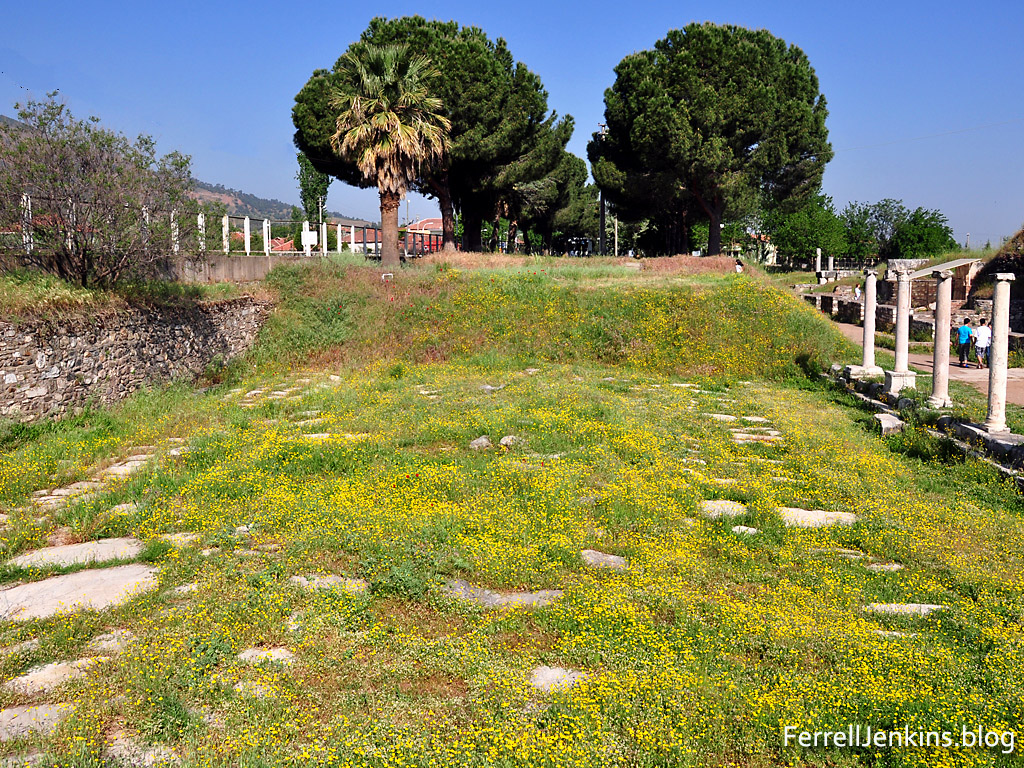
Later the Persians traveled through Sardis. In fact, the Royal Road that ran through the city was used by the famous Persian post. It is no wonder that Alexander the Great came to Sardis.

Ruins of the famous Persian Royal Road that ran through Sardis.

In The Campaigns of Alexander, Arrian records the visit of the Macedonian warrior to Sardis. He says that when Alexander came to Sardis he agreed to exact the same tribute which they had paid to the Persian king Darius. He determined to build a temple to Zeus at the same place where the palaces of the Lydian kings had stood.

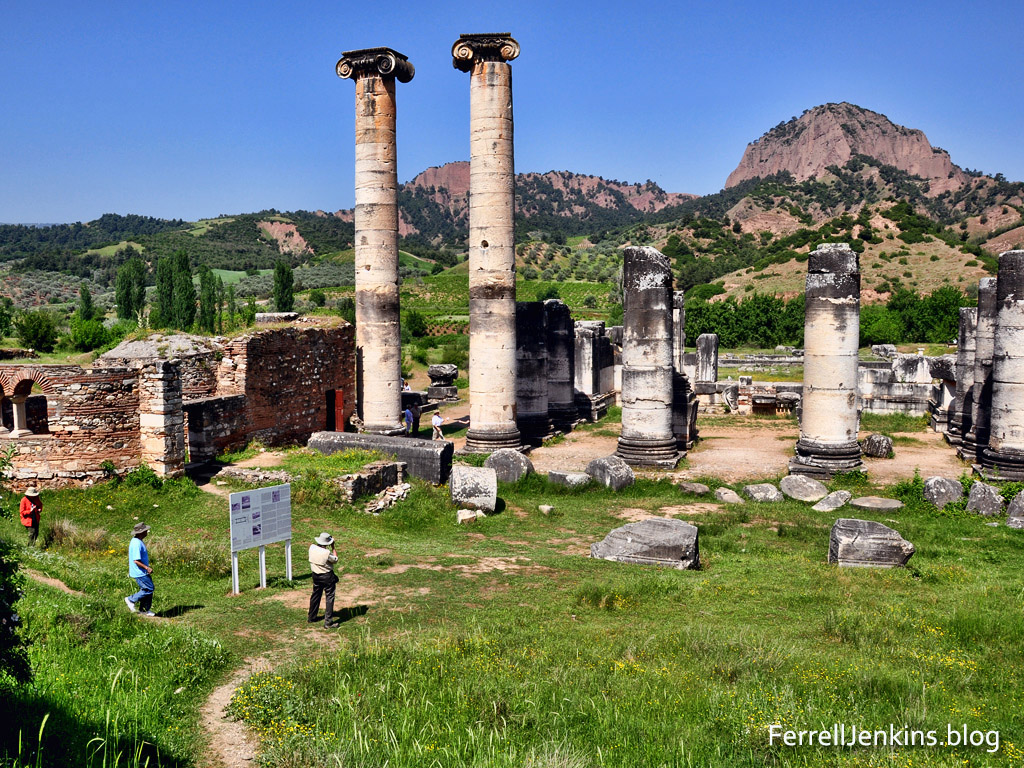
Sardis
The Temple of Artemis at Sardis. In the distance may be seen the citadel of the city.

Leaving Sardis under the control of his officers Alexander continued to Ephesus, arriving there on the fourth day.

The Problems in the Church at Sardis

There seem to be two problems mentioned in the letter to the church at Sardis. The edict to the church begins,

“And to the angel of the church in Sardis write: ‘The words of him who has the seven spirits of God and the seven stars. “‘I know your works. You have the reputation of being alive, but you are dead. Wake up, and strengthen what remains and is about to die, for I have not found your works complete in the sight of my God.” (Rev. 3:1-2 ESV)

The church had a reputation for being alive but they were dead and none of their works has been completed.

The saints at Sardis needed constantly to be watching. Wake up or else! The Lord will come like a thief and catch them unprepared. This warning would have special meaning to a city which had been caught off guard on at least two important occasions. The city was located in the Hermas Valley on the banks of the Pactolus River (a tributary to the Hermas). The acropolis of the city was built on a spur of Mount Tmolus about 1500 feet above the plain. Mount Tmolus is  5,800 feet high. The acropolis was difficult to reach and was considered unassailable by an enemy. The city spread until it soon had an upper city and a lower city.

In 546 BC the Lydian king Croesus and city of Sardis fell to Cyrus and the Persians. Remember the attitude of the Sardians that the fortress city was unassailable. Herodotus (Book I) tells the story of the fall. The Persians were in the valley below the citadel. A Lydian soldier dropped his helmet over the city wall and scurried down the rock to get it. A Persian carefully marked this in his memory and afterward scaled the city wall, with other soldiers, to capture the city for Cyrus. Croesus was taken prisoner. The confident city had fallen.

In 334 BC Sardis surrendered willingly to Alexander the Great. The city became the administrative center for the Seleucid Dynasty. In 214 BC the city fell to Antiochus Epiphanes through the use of tactics almost identical to those which caused its fall to the Persians more than three centuries earlier. The admonition to watch finds parallel in the teaching of Jesus (Matthew 24:42-43; 25: 13; Luke 12:39; cf. 1 Thessalonians 5:2). We must be on watch at our weak point, and at our strongest point. We need to be especially careful if we say, “that’s the one thing I would never do.”

The citadel of Sardis was built on Mount Tmolus, but the rock naturally flaked off and did not provide a firm foundation for the walls. Our photo was made in the late afternoon before sunset by Dr. Mark Wilson, author of Biblical Turkey, in October, 2020. Photo used by permission.

The city that thought it was secure was actually vulnerable to the attacking enemies. The letters to the seven churches are replete with allusions to local customs and history. We see this in the letter to Sardis. Too many churches of our own time rely on their past achievements of famous meetings, well known preachers, big crowds, or numerous conversions. They started great projects, first ever, annual this or that, but they never finished them. Think about this on a personal basis also.

The problems faced by the Seven Churches of the Book of Revelation are the same or similar to those faced by churches today. Let us listen and learn.


A personal note to our readers: This short series of lessons was begun last November. A brief word of explanation about the delay in completing them might seem appropriate. My wife of 66 years has been dealing with dementia, medically diagnosed by her neurologist as Alzheimer’s Disease, since 2013. This has not been an easy road for her or the man who promised to love her in sickness and in health. Our doctors told me long ago that I would not be able to care for her on my on, but I did so as long as possible. In mid-April we moved her to a nearby assisted living memory care center. She has adapted well but my work is not complete. This task as caregiver still requires a considerable amount of time and your interest in our well being is appreciated.

Problems faced by the Seven Churches # 2

In the first of this series we discussed the worship of Artemis and other gods that were prevalent at Ephesus. None of these problems are limited to a single group of Christians but I will often use one of the churches as an illustration.

The second problem faced by the Christians of Asia Minor was Emperor worship. It is common to hear a lot of talk about the persecution of the early Christians, but the term is not used in the Apocalypse. Instead we find the terms trial (Rev. 3:16) and suffer (Rev. 2:10) and tribulation (Rev. 1:9; 2:9,10,22; 7:14). The term tribulation implies pressure brought upon the Christians. We may think of this as persecution but let us not get hung up on that particular term. In my tour notebooks for this area I have included a chart showing the Ten Major Persecutions under the Roman Empire typically listed in works on church history. Here below is that simple list. Nero’s persecution seems to have been limited to Rome. By the time we reach Diocletian we see a more widespread situation. In A.D. 305 Diocletian ordered that all church buildings be burned along with all books and Bibles of the church.

1. Nero (A.D. 64–67).
2. Domitian (A.D. 81–96).
3. Trajan (A.D. 98–117).
4. Hadrian (A.D. 117–138).
5. Marcus Aurelius (A.D. 161–180).
6. Septimus Severus (A.D. 193–211).
7. Maximinus the Thracian (A.D. 235–236).
8. Decius (A.D. 249–251).
9. Valerian (A.D. 257–260).
10. Diocletian (A.D. 303–311).

Major persecutions against Christians by the Roman Empire. ferrelljenkins.blog

Ten major persecutions against Christians by Roman emperors. Photo: Ferrelljenkins.blog.

If one understands the Babylon of the book of Revelation (14:8; 16:19; 17-18) to be the Roman Empire then we see the “soon” of passages like 1:1, 3:11, et al. to include this entire period. Certainly the same or similar situations face Christians of all ages.

A bit of background of the situation in Asia Minor might be helpful to some readers. The next section comes from my Studies in the Book of Revelation which includes a chapter on Emperor Worship.

The Roman Empire was made up of many smaller nations. Rome accepted all of the “gods” and the Pantheon in Rome was erected so that all these “gods” could be worshiped. Later, the rulers were often worshiped by all citizens. The worship of kings was common in the eastern portion of the Roman empire. About three hundred years before Christ the Attalid Kingdom was set up in Asia Minor. These Attalid kings, many of them bearing the name Attalus, were worshiped as gods. At Pergamum one may see the ruins of the heroon, outside the citadel gate, which served as a sanctuary of the heroized kings.

Attalus III, who died in 133 BC, bequeathed all the movable assets of his empire to the Romans. “This was misinterpreted as meaning all his possessions, including his whole kingdom. Thus, the Romans inherited a country of 66,750 square miles with the most beautiful cities of Asia Minor” (Cosmades, Nothing Beside Remains, 36). This territory served as an excellent buffer between Rome and the Seleucid empire of Syria and later the Parthians. This explains how Rome came to have power in Asia Minor. Emperor worship was easily adopted by the people of this region.

Christians could not worship the emperor and were considered atheists by Empire standards. The Christians were not persecuted for serving Christ, but for not worshiping the emperor. The cities of Asia Minor vied for the honor of erecting a temple to the emperor. Pergamum won this honor as early as 29 B.C. (cf. Rev. 2:13). When the Christians were persecuted some of them were willing to serve the Emperor but others were willing to die. It cost something to be a Christian then. (Studies in the Book of Revelation, p. 5.)

⇒ This book is available from the Florida College Bookstore here. Search for the title of the book or the author’s name.)

One of the significant things to see during a visit to the ruins of ancient Ephesus is called Domitian Square. There we see the platform with steps leading to the top where the Temple of Domitian, or Temple of the Flavian Emperors once stood.
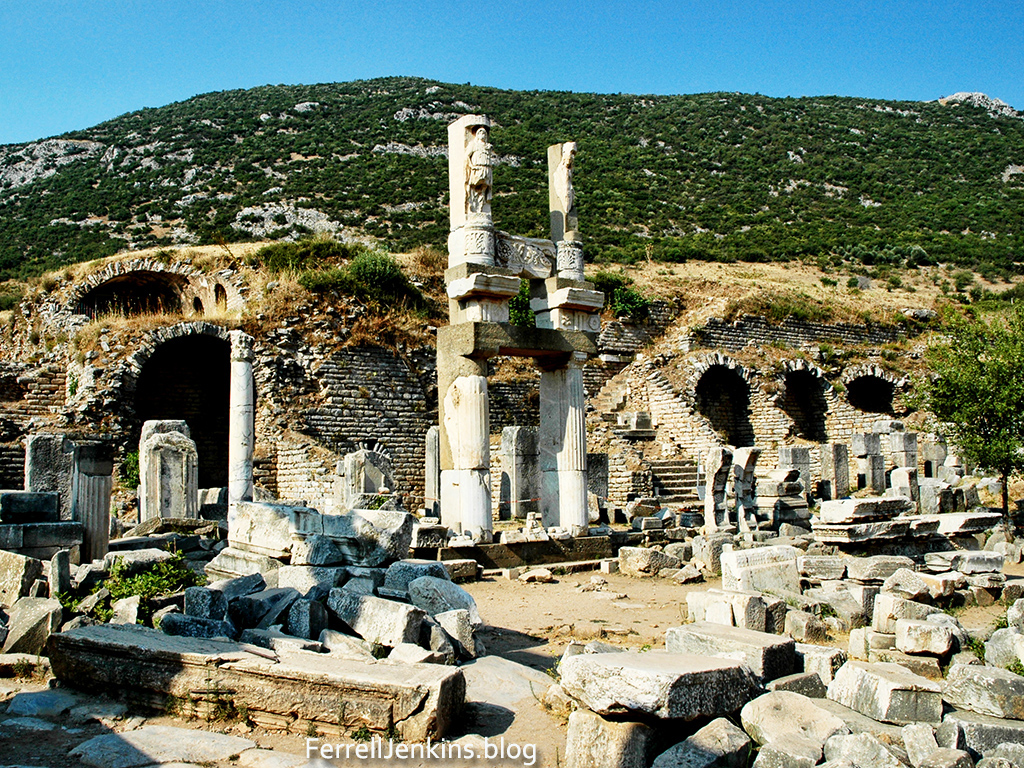
Domitian Square, Ephesus. Ferrelljenkins.blog.

Domitian Square at Ephesus. Some writers refer to this area where the temple stood as the temple of the Flavian Emperors. This would include Vespasian, Titus, and Domitian. The temple stood on the platform above the arches. The steps to the right of center led to the temple. Photo by Ferrell Jenkins.

A large statue of the emperor stood on the platform. Several scholars hold the more recent view that the head discovered here is that of Titus.
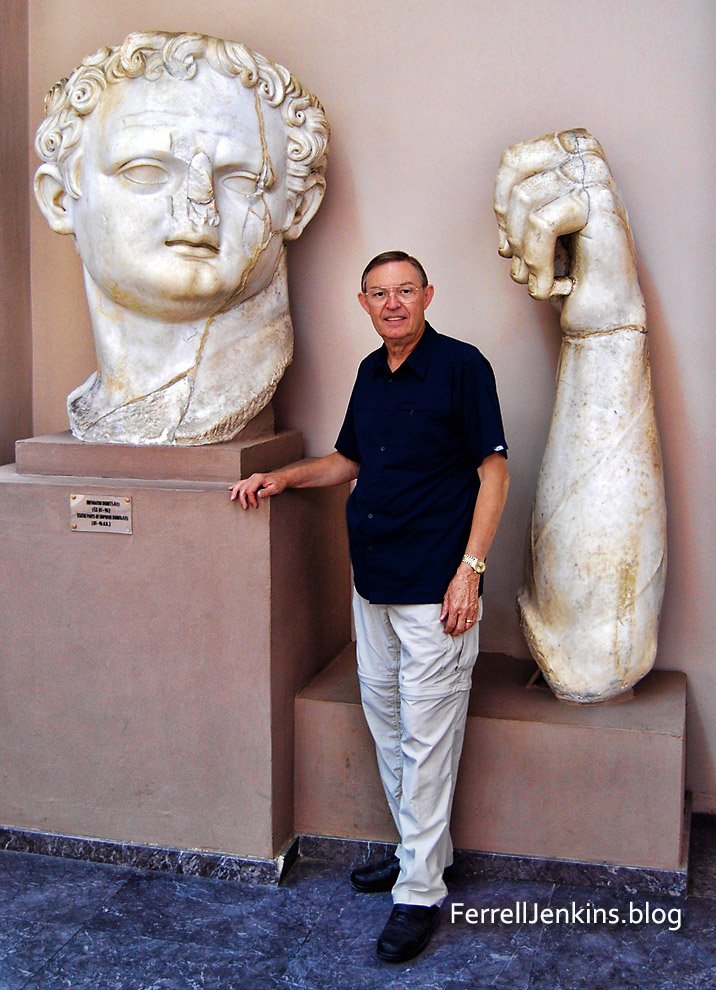
Portions of the larger-than-life statue of Domitian (or Titus) from the temple in Ephesus. Ephesus Museum. Photo:  ferrelljenkins.blog.

Smyrna (modern Izmir, Turkey) became a great center for Emperor worship. Out of the Pax Romana (the Roman peace) grew the worship of Dea Roma (the goddess Rome). Smyrna was the first city of Asia to erect a temple to the cult of the city of Rome in 195 B.C. In 26 B.C., during the early imperial period, eleven cities of Asia were competing for the right to build a temple of Tiberias and thus become the neokoros (temple warden) for the Roman Imperial cult. Rome decided in favor of Smyrna in recognition of her long loyalty (Tacitus Annals Iv. 55.56). Smyrna won the title of “First of Asia” (found on coins) and was thrice named “Temple Warden” (Cosmades, Thomas. Nothing Beside Remains, 1964. 26).

During the reign of the emperor Trajan (A.D. 98-117), Ignatius of Antioch passed through Smyrna on his way to execution in Rome. While at Troas he wrote letters to several churches including The Epistle of Ignatius to the Smymaeans, and an epistle to Polycarp (The Ante-Nicene Fathers).

Polycarp, a leader in the church at Smyrna, was martyred by the Romans in about A.D. 156. He was arrested and ordered to say Lord Caesar” and to offer incense to the image of the Emperor Antonius Pius (A.D. 138–161). Upon refusing to do so, Polycarp was then asked to swear by the fortune of the emperor, to
deny Christ and to denounce the atheists (Christians). He was sentenced to death by burning because he would not comply with the wishes of the authorities. He is remembered for his offer to teach the
Roman soldiers, and for saying “Eighty and six years have I served Him, and He never did me any injury; how then can I blaspheme my King and my Saviour?” Yamauchi says about 10 other Christians were martyred in the city’s stadium at the same time (The Archaeology of New Testament Cities in Western Asia Minor, p. 61).
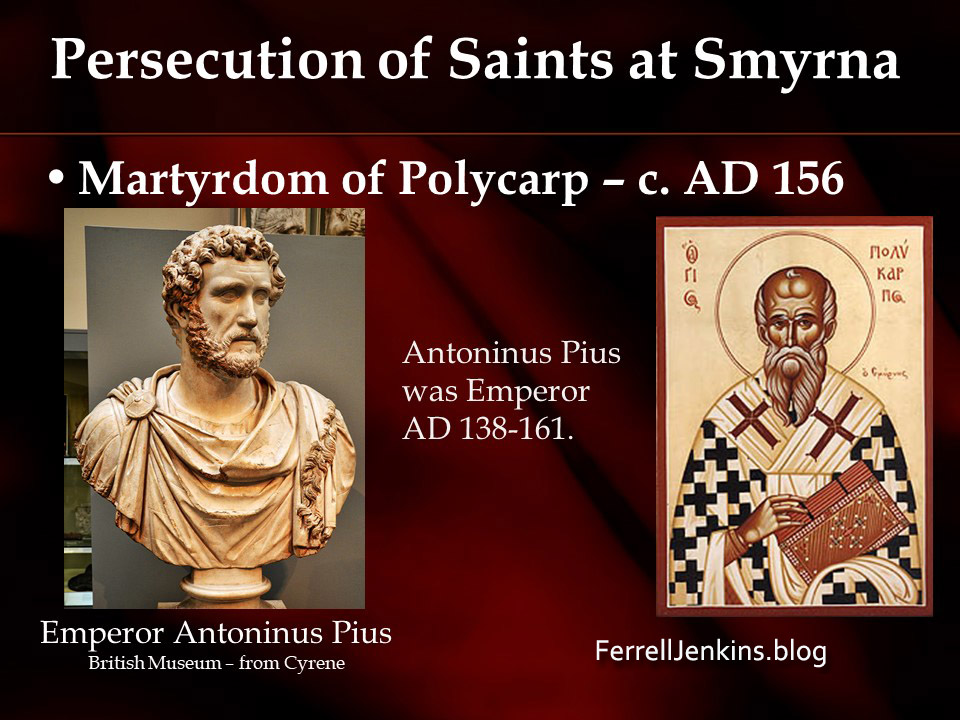
Persecution of Christians at Smyrna. Photo: ferrelljenkins.blog.

Polycarp of Smyrna was put to death during the reign of Antonius Pius in about A.D. 156. Powerpoint slide: ferrelljenkins.blog.

In Izmir, Turkey, the modern counterpart of ancient Smyrna, we find the Polycarp church. There a large piece of art illustrates what we know about his death.
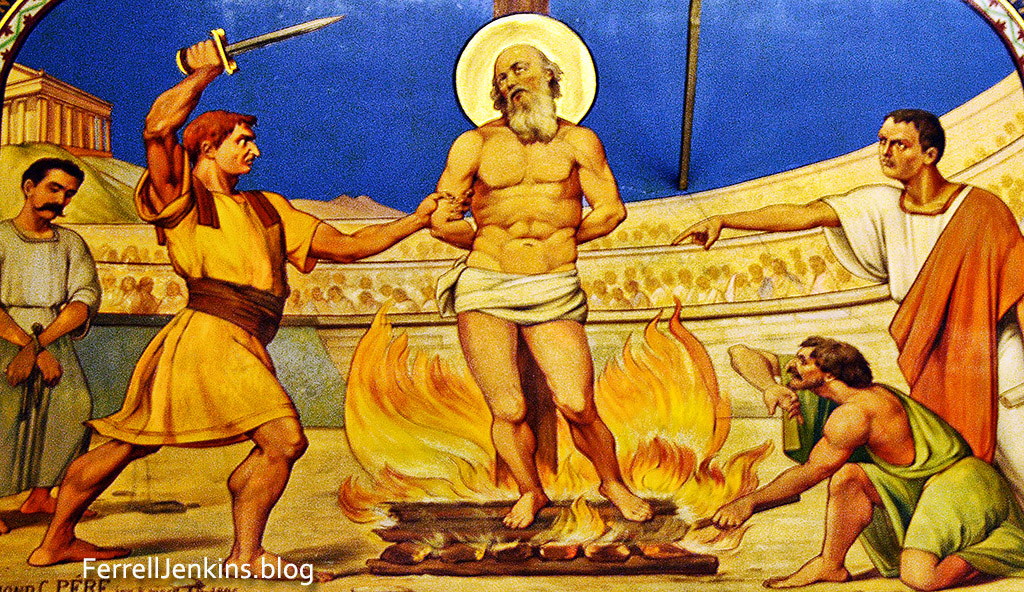
Artist rendition of the martyrdom of Polycarp displayed in the Polycarp church in Izmir. Photo by Ferrell Jenkins.

Artist rendition of the martyrdom of Polycarp in the city stadium displayed in the Polycarp church in Izmir. Photo by Ferrell Jenkins.

The letter to the church at Pergamum names a Christian by the name of Antipas who was killed (Rev. 2:13). After the close of the New Testament we find other references to followers of Christ who were martyred at the hands of the Romans.

From the writings of Pliny, governor of Pontus, to the emperor Trajan we learn that the same procedure was practiced by the authorities before they killed Christians. See our article with more photos here.

Numerous illustrations could be used from other cities, but I will leave the subject here. The situation described in the book of Revelation fits perfectly with what we learn when we read the history of the area and visit the ruins of the ancient cities named in the book.

The term autokrator (= English, autokrat) is used of the Roman emperors on coins and inscriptions. Domitian styled himself Master and God. Two inscriptions found at Jerash, Jordan, in 1974 describe Domitian as son of the divine (theou) Vespasian. Domitian’s name is erased from both inscriptions as it is on many other inscriptions indicating that he  is of damnable memory. After the death of Domitian the Roman Senate issued a damnatio memoriae (of damnable memory) and his name was erased from many monuments throughout the Empire. I have examples of this from Ephesus, Smynra, Thyatira, and other places. (See Franz, Gordon. “The King and I: The Apostle John and Emperor Domitian.” Bible and Spade 12.2 (1999): 44. Print.

Above I mentions my Studies in the Book of Revelation. There I list several believers who were martyred during the reign of various Roman emperors (pp. 79-81).

Our lesson from all of this is to be loyal to Christ no matter what the threat may be.